70 | P a g e
IMPLEMENTATION OF SPATIAL MODULATION
FOR MASSIVE MIMO
L.K.Chithra
1, S.Nahanandhini
2, M.Ranjitha
3, Prof.Dr.P.Rameshkumar.
1,2,3,4
ECE, Sengunthar Engineering College (India)
ABSTRACT
A key challenge of future mobile communications research is to strike an attractive comprise between wireless
networks area spectral efficiency and energy efficiency .This necessitates a clean state approach to wireless systems
design, embracing the rich body of existing knowledge. Spatial modulation with massive MIMO is an entirely new
concept that exploits the uniqueness and randomness properties of the wireless channel communications.
Multiple-input multiple-output (MIMO) systems can increase wireless link capacity without requiring additional bandwidth
and power. In this study, an emerging wireless communication concept which is termed as spatial modulation (SM)
is considered for large scale MIMO. This is achieved by adopting a simple but effective coding mechanism that
establishes a one to one mapping between blocks of information bits to be transmitted and the spatial position of the
transmit antenna in the antenna array. The research of SM has reached sufficient maturity to motivate its
comparison to state of art MIMO communication, as well as to inspire its application to other emerging wireless
systems such as relay-aided, corporative, smell-cell, optical wireless and power efficient communications. In this
article, we summarize the latest achievements and outline some relevant open research issues of this recently
proposed transmission technique.
INTRODUCTION
The use of multiple-antenna for wireless communication systems has received an upsurge of research interest during
the last decade, both in academia and industry. The multiple-antenna in Multiple-Input-Multiple-Output (MIMO)
systems can be exploited in different ways to achieve multiplexing, diversity, or antenna gains. However, regardless
of the use as spatial multiplexing, diversity, or smart antenna system, the main drawback of any MIMO scheme is an
increase in complexity and cost. This is primarily due to three main reasons The MIMO has the following
disadvantages .it will increase the complexity and cost due to three reasons.
Inter-channel Interference (ICI) , which is introduced by superimposing independent information
sequences to be transmitted by multiple transmit antenna.
Inter -antenna synchronization (IAS), which represents the baseline assumption for space time and
delay diversity encoded methods.
Multiple radio frequency chains are needed to transmit all signals simultaneously and are, in general
71 | P a g e
Following the ambitious research objectives, spatial modulation has been recently proposed a new modulationconcept for MIMO systems, which aims at reducing the complexity and cost of multiple antenna for schemes
without deteriorating the end to end systems performance and still guaranteeing good data rates more specifically
the low complexity trans-receiver design and high spectral efficiency are simultaneously achieved by adopting the
simple modulation and coding mechanisms in what follows:
Just one transmit antenna is activated for data transmission at any signaling instance.
The spatial position of each team transmit antenna array is used as source of information. This is obtained
by one to one mapping between each antenna index and blocks of information bits to be transmitted which
results in a coding mechanism that can be called transmitted which results in a coding mechanism that can
be called transmit antenna index coded modulation.
A key enabler for MIMO operation is the rich scattering environment between transmit and receive antennas, and
that receivers can successfully separate the multiple data streams transmitted with the assistance of channel state
information (CSI) at the receiver .There are existing transmission schemes for MIMO links in the absence of CSIT.
Among them standalone space-time (ST) code and spatial multiplexing (SMX) are prominent. In SMX, as many
independent data streams as the number of transmit antennas are transmitted in a single use of the channel, and it has
been shown to have reasonable decoding complexity. In ST coding, redundancy is added to the transmit symbol to
provide multiple independent replicas of the transmit data symbols to the receiver.
In this work, a simple information based antenna switching technique called Spatial Modulation (SM) is considered
as a possible transceiver solution for MIMO links with no CSIT. SM modulates information in both the signal
constellation and antenna index. In addition to its simplicity, the ability to control the number of transmit RF chains
in SM is very important in terms of the transmit power efficiency. In contrast to the spatial multiplexing and ST
coding, SM uses a subset of transmit antennas for transmission .The main objective of this work is to investigate the
potential gain of SM in a massive MIMO system with no CSIT. In particular, a MIMO scenario with a large number
of transmit antennas with relatively fewer number of receive antennas is considered. This scenario typically occurs
in cellular downlink communication from a base station (BS) to a user terminal. On the one hand, transmission
schemes such as vertical Bell Laboratories layered space-time (V-BLAST) could be employed with random beam
forming .On the other hand, standalone ST code could also be used for such MIMO systems, but ST codes may
experience rate loss for a higher number of transmit antennas . Since both V-BLAST and ST code transmit using all
transmit antennas, their energy efficiency may not scale well with the number of transmit antennas due to the large
number of power amplifiers.
SPATIAL MODULATION FOR MASSIVE MIMO:
SPATIAL MODULATION:
The mobile communication faces two main challenges. One is in the demand of success of mobile phones there is an
72 | P a g e
So we are allocate more radio frequency spectrum to the network to step down of the spectrum available .Theanother one effect is more spectrum efficient. In worldwide 1.45 million base station consumes more energy .To
overcome these challenges we are going to the new technology which is called “spatial modulation”.
The basic idea of SM is to map a block of information bits into two information carrying units:
• A symbol that is chosen from a complex signal-constellation diagram.
• A unique transmit-antenna index that is chosen from the set of transmit-antenna in the antenna-array (i.e., the
so-called spatial-constellation diagram) The net result of embedding part of the information to be transmitted into the
position of the transmit-antenna is a hybrid modulation and MIMO technique in which the modulated signals belong
to a tridimensional constellation diagram, which jointly combines signal and spatial information. A simple example
is shown in Fig. 1 for a linear antenna-array with Nt = 4 and a QPSK (Quadrature Phase Shift Keying) modulation.
When the information carrying unit is only the transmit-antenna index, SM reduces to the so called Space Shift
Keying (SSK) modulation, which avoids any form of conventional modulation and trades-off receiver complexity
for achievable data rates. Simple example of the encoding and decoding processes are shown in Fig. 2 when Nt = 4,
Nr = 1, and M =2. If multiple-antenna are available at the receiver, they are exploited, under the assumption of
ML-optimum detection, to achieve receiver diversity gains via Maximal Ratio Combining (MRC).
Figure 1. Tri-dimensional constellation diagram of SM
THE TRANSMITTER:
At the transmitter, the bitstream emitted by a binary source is divided into blocks containing log2 (Nt) +log2 (M)
bits each, with log2 (Nt) and log2 (M) being the number of bits needed to identify a transmit-antenna in the
antenna-array and a symbol in the signal-constellation diagram, respectively. Each block is then processed by a SM mapper,
which splits each of them into two sub-blocks of log2 (Nt) and log2 (M) bits each. The bits in the first sub-block are
73 | P a g e
the current signaling time interval. The bits in the second sub-block are used to choose a symbol in thesignal-constellation diagram. In the example shown in Fig. 2, Tx2 will be activated for data transmission by the first two
bits (“10”) and a –1 binary signal will be sent out from it corresponding to the third bit (“1”)
Figure 2. Transmitter of SM
A WIRELESS CHANNEL AS A MODULATION UNIT:
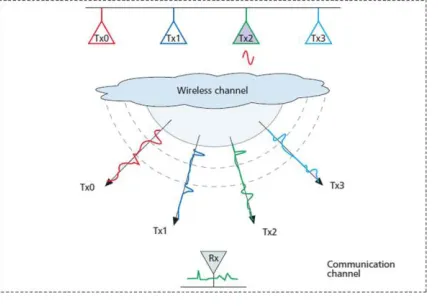
The signal emitted by the active TA then traverses through a generic wireless channel, whose channel impulse
responses are illustrated in Fig. 5. Owing to the different spatial locations occupied by the TAs in the antenna array,
the signal transmitted by the active TA experiences different propagation conditions due to the different interacting
environmental objects along any transmitter-to receiver wireless links. As such, the same „„1‟‟ PSK symbol emitted
by the TA element TX2 travels through a communication channel, which introduces a specific „channel signature or
fingerprint,‟‟ i.e., the channel impulse response, that makes it unique compared to the same symbol emitted by any
other Task This constitutes the fundamental essence of SM–MIMO: the more different the channel
signatures/fingerprints are from each other, the simpler it becomes to distinguish the signals at the receiver.
Figure 3. Modulation unit
THE RECEIVER:
At the receiver, the demodulation unit exploits the unique fingerprint introduced by the wireless channel for
74 | P a g e
the actual channel impulse response that is received in each channel use depends on the index of the active TA. Thedemodulator performs an exhaustive search among all the possible combinations of channel impulse responses and
modulation symbols, and makes a decision in favor of the hypothesis associated with the lowest Euclidean distance.
In a nutshell, due to the information-driven antenna-switching mechanism of SM– MIMO transmission, the Nt
channel impulse responses become part of the search space of the hypothesis-testing problem solved by the receiver.
Based on the estimated channel impulse response, the demodulator is capable of retrieving the information bits
associated with it. In summary, the essence of SM–MIMO transmission is all about exploiting the TA-specific
property of the wireless channel, i.e., the uniqueness of each transmit-to-receive wireless link, for data
communication.
Figure 4. Receiver of SM
MASSIVE MIMO:
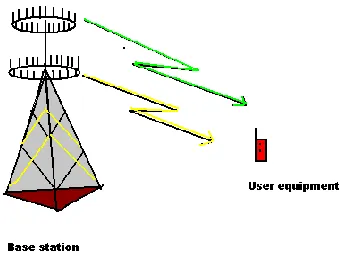
MIMO systems are not sufficiently capable to cater the need of growing data rate necessities of next generation
wireless communications. Also due to technical and design constraints user equipments cannot have much more
antenna elements. To overcome this problem Massive-MIMO can be used as leading technique in which huge
antenna arrays are used at base station with maximum possible separation among antenna elements .It consists of all
the advantages of MIMO systems with many fold increased data throughput. It is a low cost and low power
communication system.
75 | P a g e
MIMO TO SM-MASSIVE MIMO:
Conventional MIMO communications take advantage of all the antennas available at the transmitter by
simultaneously transmitting multiple data streams from all of them. Thus, all TAs are active at any time instance.
For example, in above paragraph shown that, under realistic BS power consumption models, MIMO systems
equipped with more than two active TAs unlikely provide any total EE gains at the current state of the art.
Compared to baseline single-antenna transmissions, MIMO communications obtain higher data rates and improved
error performance at the cost of:
increasing the signal processing complexity at the receiver, which is caused by the need for counteracting
the interference imposed by simultaneously transmitting many data streams;
More stringent synchronization requirements among the TAs to exploit the benefits of space-time-Coded
and multiuser MIMO transmissions;
Multiple RF chains at the transmitter to be able to simultaneously transmit many data streams, which
Do not scale with Moore‟s law and make the transmitter bulky.
Independent power amplifiers for each RF chain, which dissipate the majority of the power consumed
At the transmitter, since they are power inefficient due to the stringent linearity requirements of
state-of-the-art phase/amplitude modulations.
These considerations imply that a major challenge of next-generation MIMO-aided cellular networks is the design
of multi antenna transmission schemes with a limited number of active RF chains aiming for reducing the
complexity, to relax the inter antenna synchronization requirements, and ICI, as well as the signal processing
complexity at the receiver, while aiming for improving the EE. In this context, single-RF MIMO design is currently
Emerging as a promising research field in wireless communications. The fundamental idea behind single-RF MIMO
is to realize the gains of MIMO communications, i.e., spatial multiplexing and transmit diversity, with the aid of
many antenna elements, of which only a few, possibly a single, activated antenna elements (single-RF front–end) at
the transmitter at any modulation instant. Fueled by these considerations, SM has recently established itself as a
promising transmission concept, which belongs to the single-RF large-scale MIMO wireless systems family, while
exploiting the multiple antennas in a novel fashion compared to state-of-the-art high complexity and power-hungry
classic MIMOs [48]. In simple terms, SM can be regarded as a MIMO concept that possesses a larger set of
radiating elements than the number of transmits electronics. SM–MIMO takes advantage of the whole antenna array
at the transmitter, while using a limited number of RF chains. The main distinguishing feature of SM–MIMOs is that
they map additional information bits onto an „„SM constellation diagram,‟‟ where each constellation element is
constituted by either one or a subset of antenna elements. These unique characteristics facilitate high-rate MIMO
implementations to have reduced signal processing and circuitry complexity, as well as an improved EE. Recent
analytical and simulation studies have shown that SM–MIMOs have the inherent potential of outperforming many
state-of-the-art MIMO schemes, provided that a sufficiently large number of antenna elements is available at the
76 | P a g e
ADVANTAGES:
SM-MIMO Provides the following potential advantages compared to multiple input and multiple output
communications.
SM avoids ICI and IAS, and only requires a single RF chain at the transmitter while compared to the
conventional MIMO solutions such as V-BLAST and alamouti space time schemes. This is due to working
mechanism of spatial modulation, a single transmit- antenna is switched on for data transmission while all
the other antennas are kept silent.
The wireless channel acts not just as a modulation unit, but also channel source of purely random
signatures for multiple access.
Simpler transmitter and receiver design.SM-MIMO can be implemented by using a single active RF chain
and many inactivated Transmitters, which is inexpensive. Thus, the employment of multiple expensive and
bulky power amplifiers, RF filters, ADC converters are avoided.
The multiple gains is achieved by a single RFsource, SM-MIMO reduces the total consumed power
required for the same RF power. Particularly the power dissipation is independent of the number of the
transmitters. Thus the SM-MIMO produces the lower transmit power supply.
The achievable throughput of SM-MIMO systems with single RF chain increases logarithmically with the
number of TAs.
SM can efficiently works if Nr< N(t), since the receive antenna are used to achieve only a diversity gain.
a single receive antenna is needed to exploit the SM paradigm, this makes SMsuitable for downlink settings
with low complexity principles.
CONCLUSION:
The need for power-efficient MIMO-aided cellular networks requires a paradigm shift in the wireless system design.
This trend is irreversible and will have a profound impact on both the theory and practice of future heterogeneous
cellular networks, which will no longer be purely optimized for approaching the attainable capacity, but will
explicitly include the energy efficiency during the design and optimization of the entire protocol stack. We have
conjectured that the SM concept can be further leveraged, by exploiting the beneficial features of large scale antenna
arrays for low-complexity transceiver designs and for energy-efficient front–end concepts at the transmitter, while
relying on a limited number of RF chains. Although an enormous amount of papers on multiple-antenna systems has
already been published, there are still interesting open problems that deserve further investigation, especially in the
area of cooperative diversity schemes, closed-loop MIMO techniques, and multiuser scenarios.
REFERENCES:
Younis, N. Serafimovski, R. Mesleh, and H. Haas, “Generalized spatial modulation,” Proc. Asilomar Conf. on
77 | P a g e
E. Biglieri, R. Calder bank, A. Constantinides, A. Goldsmith, A. Paul raj, and H. V. Poor , MIMO Wireless
Communications, Cambridge University Press, 2007.
J. Mietzner, R. Schober, L. Lampe. H. Gerstacker, and P. A. Hoeher, „„Multiple-antenna techniques for wireless
communications comprehensive literature survey,‟‟ IEEE Commun. Surv. Tut., vol. 11, no. 2, pp. 87–105, 2nd
Quart. 2009.
J. Xu, L. Qiu, and C. Yu, „„Improving energy efficiency through multimode transmission in the downlink MIMO systems,‟‟ EURASIP J. Wireless Commun. Netw., vol. 2011, Dec. 2011, DOI:
10.1186/1687-1499-2011-200.
J. Mietzner, R. Schober, L. Lampe, W. Gerstacker, and P. Hoeher, “Multiple-antenna techniques for wireless
communications-a comprehensive literature survey,” IEEE Communications Surveys and Tutorials, vol. 11, no.
2, pp. 87–105, 2009.
J. Hoydis, S. Ten Brink, and M. Debbah, “Massive MIMO in the UL/DL of cellular networks: how many antennas do we need?” IEEE Journal on Selected Areas in Communications, vol. 31,no. 2, pp. 160–171, 2013.
F. Rusek, D. Persson, B. K. Lau, E. G. Larsson,T. L. Marzetta, O. Edfors, and F. Tufvesson, „„Scaling up MIMO: Opportunities and challenges with very large arrays,‟‟ IEEE Signal Process. Mag., vol. 30, no. 1, pp.
40–46,Jan. 2013.
R. Y. Chang, S.-J. Lin, and W.-H. Chung,„„Energy efficient transmission over spaceshift keying modulated MIMO channels,‟‟ IEEE Trans. Commun., vol. 60, no. 10, pp. 2950–2959, Oct. 2012.
S. Dimitrov and H. Haas, „„Information rate of OFDM-based optical wireless communication systems with nonlinear distortion,‟‟ J. Lightw. Technol., vol. 31, no. 6,pp. 918–929, Jun. 2013.
R. Schober, W. H. Gerstacker, and L. H.-J. Lampe, “Performance analysis and design of STBCs for