SUPPLEMENT ARTICLE
Transitions Into Underage and Problem Drinking:
Developmental Processes and Mechanisms
Between 10 and 15 Years of Age
Michael Windle, PhDa, Linda P. Spear, PhDb, Andrew J. Fuligni, PhDc, Adrian Angold, MRCPsychd, Jane D. Brown, PhDe, Daniel Pine, MDf, Greg T. Smith, PhDg, Jay Giedd, MDh, Ronald E. Dahl, MDi,j
aDepartment of Behavioral Sciences and Health Education, Emory University, Atlanta, Georgia;bDepartment of Psychology, Binghamton University, State University of
New York, Binghamton, New York;cDepartment of Psychology, University of California, Los Angeles, California;dDepartment of Psychiatry and Behavioral Science, Duke
University, Durham, North Carolina;eSchool of Journalism and Mass Communication, University of North Carolina at Chapel Hill, Chapel Hill, North Carolina;fSection on
Development and Affective Neuroscience andhUnit on Brain Imaging in the Child Psychiatry Branch, National Institute of Mental Health, Bethesda, Maryland; gDepartment of Psychology, University of Kentucky, Lexington, Kentucky; Departments ofiPsychiatry andjPediatrics, University of Pittsburgh, Pittsburgh, Pennsylvania
The authors have indicated they have no financial relationships relevant to this article to disclose.
ABSTRACT
Numerous developmental changes occur across levels of personal organization (eg, changes related to puberty, brain and cognitive-affective structures and functions, and family and peer relationships) in the age period of 10 to 15 years. Furthermore, the onset and escalation of alcohol use commonly occur during this period. This article uses both animal and human studies to characterize these multilevel devel-opmental changes. The timing of and variations in develdevel-opmental changes are related to individual differences in alcohol use. It is proposed that this integrated developmental perspective serve as the foundation for subsequent efforts to prevent and to treat the causes, problems, and consequences of alcohol consumption.
D
URING THE DEVELOPMENTALperiod spanning 10 to 15 years of age, considerablechanges occur in biological, cognitive, emotional, and social processes, as well as physical and social contexts. These changes occur across different levels of per-sonal organization, including overt physical appearance (eg, increases in physical size), refinements in the structure and function of the central nervous system (CNS), and maturational changes in the internal hormonal and neurophysiological milieus. By age 10, most adolescents have begun the rapid changes of puberty, as defined by
changes in secretory patterns of the gonadal steroids. These hormonal changes are accompanied by dramatic changes in height as well as readily visible changes in body composition and secondary sexual characteristics, with overt physical differences between the genders becoming increasingly apparent.
Whereas some personal changes are closely aligned with chronological age, such as attendance at elementary, middle, or high school, others are more closely tied to variations in the timing of events (pubertal onset) and/or developmental stages, such as interest in the opposite gender and relative peer influences. As a result, different aspects of personal development take place at different times, and different individuals mature in different dimen-sions at different times. For example, pubertal development may occur at a different time than does the social-cognitive development necessary for intimate relationships. The physical and emotional changes associated with pubertal development occur over a considerable age range. Adolescents who begin puberty relatively early may experience processes postulated to be associated with puberty, such as heightened emotional states and greater influences of external stimuli, sooner than they have the cognitive and emotional abilities to control consistently behaviors that develop as a function of the maturation of brain regions and collaborative brain networks.
The average age of puberty has decreased over the past century, whereas the average age of assumption of adult roles has increased because of prolonged education by more youths and later age of initial marriage. These changes have heightened the significance of understanding adolescence along the multiple continua of physical, cognitive, social, and environmental changes.
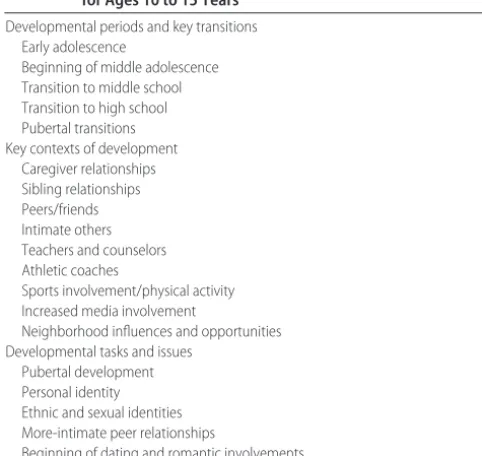
Table 1 summarizes a number of the developmental periods, transitions, contexts, and tasks confronted during the period of 10 to 15 years of age. This period is commonly referred to as early adolescence and the beginning of middle adolescence (beginning at⬃15 years of age) and includes key transitions in physical environments (from elementary school to middle school and from middle school to high school) and important biological processes (such as pubertal changes). These transitions are best viewed as processes with multiple (often new) demand characteristics (eg, multiple teachers and classrooms in middle school, rather than a single teacher and classroom in elementary school) that require adaptation and control in cognitive, emotional, and social spheres. Some of the key contexts of development during this period carry forward from the past (such as caregiver relationships), although the nature of
www.pediatrics.org/cgi/doi/10.1542/ peds.2007-2243C
doi:10.1542/peds.2007-2243C
Key Words
alcohol, development, adolescence
Abbreviation
CNS— central nervous system
these relationships may be modified substantially (eg, amount of time spent together and topics of conversa-tion). Other contexts of development are relatively new and/or assume greater significance. For instance, peers, friends, and cultural influences such as the mass media may contribute much more to the development of be-liefs, personal preferences (eg, in clothes and music), behaviors, and leisure activities than they did before age 10. There is also greater involvement during this period in elective activities such as sports teams and special-interest clubs, which provide important social contexts both with adults (eg, athletic coaches and adults who lead school-related or church-related activity groups) and with peers, to foster development in cognitive, emo-tional, and social realms. Vital developmental tasks and issues during this period are manifold and include changes related to biological features (such as pubertal development), cognition (such as personal, ethnic, and sexual identities), and social relations (such as more-intimate, self-disclosing, peer relationships, the launch-ing of datlaunch-ing and romantic relationships, and, in some instances, the early onset of sexual behavior). These developmental tasks are of great importance because they help provide the foundation for middle and later adolescence, as well as early adulthood.
In this article, we link the ways in which alcohol use may affect, and be affected by, the transitions, changes, and activities in the developmental period of 10 to 15 years of age. It is the interplay of context, relationships, and biological development that sets each individual on a unique pathway to adulthood. It is theorized that adolescents increasingly actively recruit or select their physical environments and social relationships, thereby increasing risk and/or protective factors through evolv-ing person-environment transactional processes. Under-standing what facilitates positive trajectories and
out-comes and what actions (eg, interventions) can redirect negative trajectories is integral to our success in fostering healthy adolescent development.
Here we describe in more detail the developmental periods, contexts, and tasks associated with the period of ages 10 to 15, across biological, cognitive, social, and emotional levels of analyses. Levels of alcohol use during this period and the relationships between use and changes in developmental domains are discussed. We then turn to a discussion of risk and protective factors associated with alcohol use, focusing on nonspecific fac-tors before turning to alcohol-specific risk and protective factors and concluding with the important issue of indi-vidual differences in the timing and tempo of develop-mental processes. Given the robust bodies of information about adolescent development and alcohol use, we con-clude that it is time to think across disciplinary bound-aries to identify the mechanisms and processes underly-ing the causes and consequences of underage drinkunderly-ing and to develop optimal targeted interventions.
NORMATIVE DEVELOPMENT BETWEEN 10 AND 15 YEARS OF AGE
Changes in Brain and Cognitive-Affective Structures and Functions
Changes in brain structure and function at the neural level are readily apparent in early adolescence. The pe-riod is characterized by particularly robust alterations in secondary and tertiary expanses of the cerebral cortex, encompassing components of the temporal, parietal, and prefrontal cortices, as well as alterations in key subcor-tical structures within the medial temporal lobe.1–5 No-tably, this area includes the amygdala and hippocampus, brain structures with high densities of sex steroid recep-tors. As with changes in the structure of the primary cortex that occur during an earlier age period, these changes in the association cortex involve gradual de-creases in gray matter volume, which presumably arise from a series of developmental processes such as reduc-tions in synaptic connecreduc-tions among neurons (a process known as dendritic “pruning”). Moreover, functional connectivity seems to change during this period, consis-tent with the gradual increases in the white matter/gray matter ratio. These changes are likely to reflect increases in myelin (ie, the white insulating sheath that surrounds some axonal processes of neurons connecting spatially disparate brain regions), coupled with the pruning of dendritic processes in cell body (gray matter) regions.6 Such changes in connectivity are likely to contribute to maturation of neurocognitive processes that depend on functioning within distributed neural circuits. At a neu-ral systems level, changes in structuneu-ral connectivity are likely to be reflected in changes in the degree to which specific brain regions become engaged during specific cognitive tasks. It is now possible to observe such changes by using modern functional neuroimaging tech-niques. For example, the association cortex in the pre-frontal and posterior regions has been shown to become differentially active in functional MRI studies as adoles-cents mature from ages 10 to 15, and key limbic regions TABLE 1 Developmental Periods, Transitions, Contexts, and Tasks
for Ages 10 to 15 Years
Developmental periods and key transitions Early adolescence
Beginning of middle adolescence Transition to middle school Transition to high school Pubertal transitions Key contexts of development
Caregiver relationships Sibling relationships Peers/friends Intimate others Teachers and counselors Athletic coaches
Sports involvement/physical activity Increased media involvement
Neighborhood influences and opportunities Developmental tasks and issues
Pubertal development Personal identity Ethnic and sexual identities More-intimate peer relationships
have been shown to exhibit parallel developmental changes.7–11At a physiological level, changes in the phys-ical properties of the brain and other soma reflect the influences of both hormonally related and experience-dependent processes. These physiological changes also manifest in functional aspects of the organism that are observable at the gross behavioral level. Some of the most dramatic changes are reflected in patterns of sleep and arousal regulation. The 10- to 15-year-old period involves particularly profound changes in sleep, includ-ing maturational changes in aspects of circadian regula-tion that contribute to adolescents’ natural tendencies toward later bedtimes and later awakening times.12 Other signs of arousal regulation also show robust changes, in terms of both patterns of autonomic reg-ulation and patterns of subjective state regreg-ulation.13 Adolescents report particularly marked extremes of emotional state fluctuation when monitored by using event-sampling methods.14
Such changes in physiological features and associated arousal patterns are associated with broader changes in behavioral regulation that may underlie risks for various psychopathological conditions. The 10- to 15-year-old period is characterized by marked increases in rates of many psychopathological conditions, including major depression, social anxiety disorder, various behavior dis-orders, and substance use disorders.15,16 Even among adolescents who do not meet the criteria for a specific psychopathological condition, this developmental period involves dramatic increases in high-valence emotional events and episodes of rule-violating behavior.17
Finally, the 10- to 15-year-old period involves marked alterations in cognitive processes. The salience of social stimuli typically increases, as can be seen in studies of the viewing of evocative facial photographs and the hearing of evocative vocal utterances.12The abilities to plan, to main-tain information “online,” to solve complex cognitive tasks, and to exhibit self-regulation and inhibitory control typi-cally increase in this developmental period10and well past age 15, into the twenties. These changes in emotional and cognitive processes are highly likely to parallel changes in underlying brain physiological features and structure.
Changes in Family, Peer, and Romantic Partner Relationships Consistent with an ecological approach to human devel-opment, it is critical to remember that the myriad of biological, psychological, and physical changes that take place during the early adolescent period are mediated largely by the proximal social relationships in children’s lives. The most significant social relationships for all children and adolescents are those with their families and their peers, and 10 to 15 years of age is a time when these relationships undergo significant changes. Al-though the myth of inevitable estrangement between children and their parents during the adolescent years has been proven to be unfounded, important adjust-ments do occur. For instance, children spend consider-ably less time with their parents as the children make the transition into early adolescence. The overall frequency of parent-child conflicts does not increase during these years, perhaps because parents and children spend less
time together, but the intensity of such arguments, when they do occur, seems to be greater during early adolescence.18 In addition, emotional distancing be-tween children and their parents increases during the teenage years, particularly within the relationships between children and their fathers.19,20
Parents remain significant influences in early adoles-cents’ lives, but there are changes that do reflect a sig-nificant adjustment in family relationships. These adjust-ments are assumed to reflect the need to accommodate rapidly changing children who are no longer dependent solely on their parents and who are increasingly capable and competent. Such changes in family relationships are thought to be driven by several factors. Cognitively, early adolescents increasingly are able to think ab-stractly, which enables them to become better arguers and to idealize how their parents “could” be.21 Physi-cally, the attainment of reproductive maturity has been suggested by some observers to trigger an evolutionarily adaptive mechanism to begin the process of separating from the natal family.22 Socially and emotionally, early adolescents increasingly desire autonomy and the op-portunity to participate in decision-making that affects their daily lives.23
An additional factor thought to stimulate changes in family relationships is the increased exposure to and importance of peer relationships during the early ado-lescent period. Children spend increased time with peers during the early adolescent period. In the United States, this time with peers is largely unsupervised by adults. The transition to middle school, with the frequent changing of classes and increased time spent out of classes, results in a dramatic increase in exposure to age mates even during school hours. Peer influence in-creases during the years of early adolescence and is thought to peak around the ages of 11 to 13 years, precisely the time of middle school for most US adoles-cents.24,25Although parents retain their significant influ-ence on fundamental issues such as religion, morality, and education, peers are thought to have the most sig-nificant influence on issues of personal style, popular culture, and antisocial behavior. In fact, studies of de-velopmental changes in peer influence during childhood and adolescence have observed the most consistent peaks in peer influence during early adolescence to be in the areas of risky and antisocial behaviors.24
friend-ship cliques and peer crowds, in terms of their endorse-ment of alcohol use.28A key developmental issue for both research and intervention is to identify the individuals who show the greatest risk for becoming involved in peer groups that encourage such risky behaviors.
The increased involvement with peers during early ad-olescence occurs at the same time as sexual maturation. The height of pubertal maturation occurs between the ages of 10 and 15, with girls beginning puberty⬃1 to⬃2 years before boys.29With the attainment of reproductive matu-rity comes the emergence of secondary sex characteristics, which can be both a sign of status and a source of worry and concern as children attempt to become comfortable with their changing bodies. Adolescents vary greatly in terms of the timing of puberty, with early maturation bringing some positive effects in terms of popularity but also some negative implications, particularly among girls. Early-maturing girls have shown some signs of risk for internalization problems, perhaps because of concerns about their weight, given that a certain amount of body fat is necessary to achieve menarche.30,31 Early maturation among girls also can bring unwanted attention from older boys who engage in behaviors that are more risky for younger children, thereby exposing the girls to peer con-texts in which behaviors such as drinking may be more common.32Romantic and intimate relationships also begin to emerge at 10 to 15 years of age. Many adolescents in the United States begin dating around the age of 13 or 14 years, but there is variation according to gender, ethnicity, and religiosity.33Dating activities during early adolescence are presumed to be more socially oriented and a way to spend time with friends. More-serious and more-enduring ro-mantic relationships generally develop later in the adoles-cent years. Overall, adolesadoles-cents are engaging in sexual activity more often and at an earlier age than in the past, again with important variations according to gender, eth-nicity, and religiosity. Only a minority of adolescents⬍15 years of age have engaged in sexual intercourse. However, this minority might represent a particularly at-risk group, given that earlier sexual activity is associated with other risky behaviors, such as early drug and alcohol use.34The causal direction between early sexual activity and sub-stance use is not particularly clear, but it is an important issue to clarify when considering initiation into drinking among early adolescents and intervention targets.
Changes in Physical and Family Contexts and Societal and Cultural Influences
The period of 10 to 15 years of age is also a time of changes in the existing physical and social contexts of children’s daily lives, as well as increased exposure to newer settings. As in earlier stages of childhood, family and school are the dominant physical contexts in the lives of early adolescents. However, there are changes in the nature of these 2 contexts from earlier periods of childhood. In terms of the family, early adolescents be-gin a trend of gradually spending less time with their parents, which continues through the later years of high school. Time-use studies have shown that this time with parents and families is replaced by time with peers and time alone, particularly among boys.35 Although the
home remains a dominant physical context in the lives of early adolescents, the time spent in this context grad-ually decreases during this period and is replaced by increased time spent outside the home in other contexts, such with peers in the neighborhood.
The shift to secondary school results in a dramatic change in the everyday school environment for early adolescents.36,37 Middle and junior high schools are much larger, more-impersonal settings than elementary schools, sometimes including as many as several hun-dred students per grade level. Instruction becomes de-partmentalized according to subject matter. Children no longer spend most of the day with 1 or 2 teachers and instead change classes frequently and have several dif-ferent teachers for a variety of subjects. In addition, grading becomes more stringent and based on compar-ative performance among different students. The in-creased sizes of the student body and of classes make it more difficult for teachers to engage in individual-based, creative instruction that involves high levels of student-teacher interaction. As a result of all of these changes in the learning environment, many early adolescents ex-perience a loss of intrinsic motivation for school during the middle school years. Their grades tend to decline and their enthusiasm for and attachment to the school and academic endeavors decrease.
At the same time that early adolescents begin to spend less time at home and become less invested in school, they spend more time outside the home and in the neighborhood. Children between the ages of 10 and 15 years desire and are provided with increased behav-ioral autonomy by their families,38which enables them to spend more time outside the home, in the neighbor-hood, at malls and movie theaters, and in parks and other public areas. Studies of the effects of neighbor-hoods on children have noted that troublesome features of some neighborhoods, including high levels of poverty, crime, and antisocial activity, can have a negative impact on children’s development, particularly during the teen-age years, when children increasingly become exposed to such factors without being monitored by parents and families.39 The impact of deleterious neighborhood fac-tors may be especially great in neighborhoods in which there is a dearth of high-quality after-school activities and programs that are attractive to young adolescents.40 In the absence of such developmentally positive, neigh-borhood settings, children may be increasingly exposed to older adolescents and young adults who are engaging in activities (such as alcohol and substance use) that are particularly risky for early adolescents.
society and by their peers. Social categories and identi-ties such as ethnicity, gender, and religion become more salient to children during this age period.42Early adoles-cents find themselves increasingly placed in these social categories and experience differential treatment and ex-pectations on the basis of factors such as ethnicity and gender. Experiences with prejudice and discrimination begin to increase during this period, and early adoles-cents find themselves pushed toward some activities and away from others on the basis of their social category membership.43 Early adolescents’ attempts to settle on where they belong within social groups and social cate-gories (such as ethnicity, gender, and religion) likely include decisions about whether to begin experimenting with drinking. A key point is that children’s decision to begin using alcohol during this age period may be just as much a decision about who they are and who they want to become as it is a decision to use alcohol for its psy-chological and behavioral effects.
Another significant social and cultural influence on early adolescents is the media. Early adolescents spend a great deal of time with various forms of media, often out of view of their parents and thus with less opportunity for adult monitoring, communication, and/or interpre-tation of messages. A majority of children in this age group have television sets in their own bedrooms, and virtually all have some kind of sound system. They tend to choose more adult-oriented fare than younger chil-dren. The media industry has capitalized on the potential of this age group as a market and has developed televi-sion channels (eg, UPN and BET), radio formats, maga-zines (eg,Teen PeopleandCosmo Girl), and Web sites (eg, www.Gurl.com) aimed at attracting youths’ attention and disposable income. On average, 11- to 15-year-old youths spend 6 to 7 hours/day with some form of mass media, often using⬎1 form simultaneously (eg, listen-ing to music through headphones while surflisten-ing the In-ternet). The Internet is an important mode of interper-sonal communication for this age group; youths may spend hours each day using instant messaging to keep in touch with their friends and to meet others.44
These teens see and hear alcohol-related messages in much of the media to which they attend. Alcohol is the most frequently portrayed food or drink on network television, with approximately two thirds of primetime fictional television programs depicting alcohol in ⬃8 drinking acts per hour.45 Alcohol use is portrayed in more than one fourth of videos on MTV and VH-1, both favorite television channels of this age group.46 Teenag-ers frequently are depicted drinking in teen-oriented movies and rarely are shown suffering any negative consequences.47
This early adolescent developmental stage is increas-ingly sensitive to the values and behaviors of peers, and the mass media may serve as a kind of “super peer” for alcohol use. One study showed that earlier-sexually ma-turing girls were more interested in sexual content in the media than were their less-mature age mates.48 We should expect that teens similarly turn to media to learn about alcohol and may adopt the values and normative behaviors they see. Many studies of the effects of
view-ing violence on television have shown that imitative aggressive behavior is more likely if the violent acts are committed by attractive characters who do not suffer negative consequences. The same pattern holds for por-trayals of alcohol in the media. Increased exposure to television, music videos, and alcohol advertising in early adolescence is associated with earlier onset of alcohol use and heavier beer drinking in later adolescence.49
Because early adolescents tend to overestimate the prevalence of drug use and rarely discuss it with each other, interventions might focus effectively on shifting perceptions that “everyone is doing it.” Early adolescents also need to know the facts about negative conse-quences. In 1 intervention, early teens’ intentions to drink were reduced significantly after exposure to only 1 educational video about the dangers of drinking. Al-though this age group is increasingly skeptical of adult authority, interventions are most effective when parents are involved as sources of information and rule set-ters.50–52
Older early adolescents would appreciate and respond to being asked to be part of intervention development. This is especially important in message design and chan-nel selection if media are used, because teens’ media choices rarely appear in the commercial rating services, which tend to include all teens in a 12- to 17-year-old category. Media preferences differ dramatically accord-ing to age, gender, race, and other individual character-istics, such as need for stimulation and risk-taking. To reach this age group effectively, it is important to choose the channels used most frequently by the subgroup of most interest. Music, movies, and teen-oriented televi-sion channels are most important. The Internet may be an important channel, especially if the peer network can be exploited in some way. Adolescents in this stage of cognitive development also can be taught media literacy skills, to increase the likelihood of their perceiving the current inaccurate and incomplete portrayals of alcohol use.53
Changes Associated With Puberty and Implications for Research on Alcohol Use and Abuse
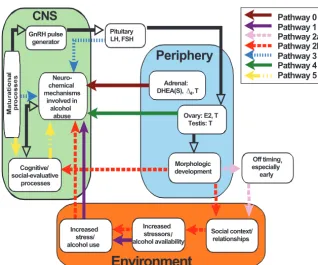
It is also worth cautioning that something that occurs during adolescence is not necessarily related to puberty per se. For instance, attending high school may serve as a particular risk factor for escalating alcohol use, regard-less of pubertal status. The presence of pathway 1 in Fig 1 accommodates this possibility.
In later childhood, before gonadal puberty, the output of androgens (such as dehydroepiandrosterone and an-drostenedione) from the adrenal glands begins to in-crease in both boys and girls (a process known as adre-narche; pathway 0 in Fig 1). These levels continue to increase until they peak near age 20 in women and in the early 20s in men. Although this period covers the age range for the onset of alcohol use in the vast majority of people and alcohol abuse in many, the possibility that adrenarche might be physiologically relevant to alcohol use and abuse has been understudied.
The onset of gonadal puberty is triggered by un-known brain mechanisms that seem to be under a high degree of genetic control but were shown recently to require normal leptin and kisspeptin function. The initial manifestation of puberty involves reactivation of the hypothalamic gonadotropin-releasing hormone pulse generator. Gonadotropin-releasing hormone, in turn, stimulates the release of follicle-stimulating hormone and luteinizing hormone from the pituitary gland. Pres-ently, we do not know whether these central processes also have direct physiological implications for alcohol-related physiological processes and behavior (pathway 3). During these stages, puberty is “invisible,” because it is not until follicle-stimulating hormone and luteinizing hormone have stimulated the gonads (ovaries and tes-tes) sufficiently to produce estrogens (principally estra-diol) and testosterone that the familiar external changes of puberty (development of the breasts and external
genitalia, growth spurt, and redistribution of body fat and muscle mass) occur. In other words, the onset of puberty actually occurs well before the time at which it is typically observed in the well-known Tanner stages, which are based on external observation.
There is also a great deal of variation in “end-organ sensitivity” to hormonal actions, and there are many opportunities for hormonal effects on behavior that are not well indexed with observational approaches to the measurement of pubertal status. Similar problems arise regarding menarche (the onset of menses) as a marker for the onset of puberty, because menarche is typically 1 of the later physiological occurrences of puberty. It is important to recognize that currently the average age of onset of breast and pubic hair development is typically in late childhood (⬃10.5 years of age for non-Hispanic white girls and 1 year earlier for non-Hispanic black girls, with intermediate ages for Hispanic girls), rather than early adolescence. The average age at menarche, however, is⬃12.5 years for non-Hispanic white girls and only a few months earlier for non-Hispanic black girls.
It is commonly observed that puberty occurs⬃1 to 2 years later for boys, compared with girls, and the growth spurt typically occurs relatively later within the pubertal process for boys. Generic statements about the onset of puberty in boys and girls are misleading, however, be-cause such statements depend on what is used to indi-cate puberty. For instance, in a study by Sun et al,54the median onset of pubic hair development was later for boys than for girls (12.0 vs 10.6 years for white chil-dren), but the median age of onset of genital develop-ment in boys was 10.0 years, compared with 10.4 years for the onset of breast development in girls (for non-Hispanic white children). This feature is important in the present context because, if it is true that the whole GnRH pulse
generator
Cognitive/ social-evaluative
processes
Pituitary LH, FSH
CNS
Ovary: E2, T Testis: T
Morphologic development
Pathway 0 Pathway 1 Pathway 2a Pathway 2b Pathway 3 Pathway 4 Pathway 5
Neuro-chemical mechanisms
involved in alcohol
abuse
Social context/ relationships Increased
stressors alcohol availability
Adrenal: DHEA(S), 4, T
Periphery
Increased stress/ alcohol use
Off timing especially early
Environment
p
∆
,
/
FIGURE 1
Schematic overview of the potential pathways and mech-anisms through which puberty may affect risks for alcohol use and abuse. The relationships among elements of the CNS and peripheral hormone-producing functions, as well as features of the environment, may influence risk through the different pathways specified in the model. GnRH indi-cates gonadotropin-releasing hormone; LH, luteinizing hormone; FSH, follicle-stimulating hormone; DHEA(S), de-hydroepiandrosterone (sulfate);⌬4,⌬4-androstenedione;
process of puberty begins in girls a few years before it begins in boys, then we would expect any pubertal contribution to the development of alcohol use and abuse to result in the earlier onset of alcohol use and abuse among girls than among boys; however, this is contrary to the existing data. The lack of major gender differences in age at onset of adolescent alcohol use or abuse does not preclude the possibility that puberty is etiologically important for alcohol-related behavior. We also need to remember that a number of neuromatura-tional changes occur in the brain across adolescence, leading to substantial alterations in neurocognitive func-tions, some of which (such as decision-making and in-creased risk-taking) are associated with alcohol use. Many of these changes may be quite independent of puberty, despite occurring with it (pathway 5).
A major target organ for the sex steroids is the brain, which contains estrogen and androgen receptors in various locations. Estrogen, progesterone, and testosterone all have modulatory effects on dopaminergic pathways, as well as affecting serotonergic function.55–59It is also important to note that some findings6 have suggested that hormonal influences, such as estrogen-mediated delays in dendritic pruning among girls, may affect age-related gender differ-ences in brain maturation. Therefore, there is no shortage of possible routes by which direct physiological effects re-lated to substance use and abuse might be instigated by gonadal maturation (pathway 4).
This is not intended to suggest that all effects of pu-berty must be caused by hormone actions on the brain. Two pathways in Fig 1 (pathways 2a and 2b) relate to the psychosocial effects of physical maturity. Pathway 2a indicates that physical maturity has implications for so-cial functioning that may lead to increased risk for alco-hol use and abuse. It seems likely that physically mature early adolescents are more likely to be invited to parties by older boys and thus find themselves faced with op-portunities to drink. They also may find themselves in more-stressful situations, and alcohol consumption has been linked repeatedly to higher levels of environmental stress. Pathway 2b adds the additional possibility that the timing of physical maturity may have implications for the effects of maturity on behavior. This area has re-ceived the most research attention. As far as behavioral deviance (including alcohol abuse) is concerned, there is now strong evidence that girls who become physically mature earlier than their peers are at particular risk,60,61 because they may be less well endowed in terms of their cognitive development than their physical appearance would indicate (ie, there are dyssynchronies in develop-ment). Therefore, they may be less able to deal appro-priately with the challenges posed by the social situa-tions in which they find themselves. The situation for boys is much less clear, but there is some evidence that early development may be linked to increased levels of alcohol consumption.60,61
A major problem with many studies of this issue is that they have typically used relatively crude markers of puber-tal status (such as menarche) and not controlled for current developmental level, that is, those who began puberty earlier would be more advanced in their development at
some fixed age than those who began later. A conceptual approach that acknowledges that there are several aspects of puberty and a methodologic approach that measures multiple aspects of these pubertal processes, so that effects can be attributed to particular hormonal, neurocognitive, or social aspects, are needed. Only in this way can the mechanisms responsible for associations with alcohol-re-lated behavior be clarified. To provide maximal scientific significance, such studies would need to monitor children and adolescents across puberty, which would involve be-ginning longitudinal studies by age 7 or 8, to identify the key group of early maturers, and monitoring the sample for ⱖ10 years. Only then would it be possible to clarify the effect of timing, as opposed to the level of development. Such studies would need to use endocrinological, neuro-cognitive, psychological, family, social, and environmental measures with samples large enough to make it possible to distinguish the effects of necessarily correlated predictors.
LEVELS OF ALCOHOL USE AND CONSEQUENCES
Prevalence of Alcohol Use
National survey data on alcohol use are not currently collected for individuals ⬍12 years of age. However, alcohol consumption by early adolescents is a relatively common experience. In the 2005 Monitoring the Future study,62the proportion of eighth-graders who had used alcohol in their lifetimes was 41.0% and that of 10th-graders was 63.2%. With different time windows for use (past 12 months and past 30 days), the prevalence rates remained high. The prevalence rates for the past 12 months and past 30 days were 33.9% and 17.1% for eighth-graders and 56.7% and 33.2% for 10th-graders, respectively. Also of note for these early adolescents was the relatively high level of use of flavored alcoholic beverages (eg, alcopops). Among eighth-graders, 35.5% reported using flavored alcoholic beverages in their life-times; the prevalence was 57.0% among 10th-graders. Although these data do not provide information regard-ing how frequently flavored alcoholic beverages are con-sumed, relative to how frequently nonflavored alcoholic beverages are consumed, they do indicate that flavored alcoholic beverages are used by a large number of early adolescents.
In addition to the prevalence of alcohol use, the Mon-itoring the Future data indicated that 19.5% of eighth-graders and 42.1% of 10th-eighth-graders reported having been drunk in their lifetimes and 10.5% of eighth-graders and 21.0% of 10th-graders reported having consumed ⱖ5 drinks on a single occasion in the past 2 weeks. These data, considered in conjunction with the data on the prevalence of use, suggest an episodic or opportunistic pattern of drinking among early adolescents. That is, a large majority of early adolescents who drink do not drink daily but, when they do drink, they often drink to excess. As is evident elsewhere in this article, such high levels of drinking on single occasions or drinking until drunk may have multiple adverse effects on optimal health and development, by negatively influencing bio-logical, cognitive, and social systems and functions.
ado-lescents are also of importance in identifying potential targets for intervention studies. Data from the 2005 Monitoring the Future study62 indicated that 64.2% of eighth-graders and 83.7% of 10th-graders rated the ac-cessibility of alcohol as fairly easy or very easy. With regard to perceived harm resulting from alcohol use, 57.2% of eighth-graders and 53.3% of 10th-graders ratedⱖ5 drinks of alcohol once or twice each weekend as a “great risk.” However, less than one third (31.4% of eighth-graders and 312.6% of 10th-graders) rated 1 or 2 drinks nearly every day as a “great risk” for harm. Strong disapproval of alcohol use was relatively high, with 51.2% of eighth-graders and 38.5% of 10th-graders in-dicating disapproval or strong disapproval of people who try 1 or 2 drinks. However, the large grade-level differ-ences between eighth- and 10th-graders regarding strong disapproval suggest that attitudes and perceptions change across this early adolescent period, toward less disapproval of using alcohol.
Biological, Cognitive, Affective, and Social Processes That Influence Interactions Between Development and Underage Drinking
Studies examining the biological sensitivity of adoles-cents to alcohol are limited because of ethical issues regarding administration of alcohol to human youths for research purposes. However, research using animal models of adolescence has revealed that adolescents are considerably less sensitive than adults to most conse-quences of ethanol. These effects are seen even when controlling for blood alcohol levels and the slightly faster rate of ethanol metabolism that is sometimes seen dur-ing adolescence. Alcohol effects to which adolescents are relatively insensitive include many that serve as cues to limit intake, including ethanol-induced motor impair-ment, dysphoria, social impairimpair-ment, and sedation,63 as well as certain postintoxication, “hangover” effects.64 Al-though studies distinguishing age effects within adoles-cence are limited, the available data suggest that these adolescent-related insensitivities to ethanol may be par-ticularly pronounced during early adolescence.65
A similar adolescent insensitivity to ethanol may be seen in human adolescents. Although comparable hu-man data are almost nonexistent, a study conducted several decades ago challenged 8- to 15-year-old boys with 0.5 mL/kg pure ethanol, a dose inducing peak blood alcohol levels of⬃34 to 35 mg per 100 mg,66blood alcohol levels well within the intoxicating range in adults.67 However, Behar et al66 found no behavioral signs of intoxication in those youths and noted that they “were impressed by how little gross behavioral change occurred in the children after a dose of alcohol which had been intoxicating in an adult population.” Attenu-ated sensitivity during adolescence to negative conse-quences of ethanol that normally serve as cues to limit intake may permit relatively high levels of drinking, contributing to the greater per-occasion consumption levels seen in human adolescents, relative to adults (eg, 4.9 drinks per consumption day among 12-20-year-old youths, compared with 4.2 drinks per consumption day among 21-25-year-old adults and 2.6 drinks per
con-sumption day among ⱖ26-year-old adults68), and the two- to threefold higher ethanol intakes (in grams per kilogram) seen under some circumstances in adolescent rats, relative to adults.69A similar insensitivity to alcohol is evident in individuals with a family history of alcohol-ism70and may combine with the ontogenetic insensitiv-ity to ethanol normally seen during adolescence to precipitate unusually high intakes of ethanol when ge-netically at-risk adolescents begin to drink.
In contrast to the relative insensitivity of adolescents to most effects of ethanol, they are more sensitive than adults to a few effects of ethanol, including the social facilitation seen at low doses of ethanol71; this ethanol-induced social facilitation may serve to encourage ethanol consumption, given the unusual sensitivity of adolescents to stimulation of ethanol intake by social experiences in humans72 and laboratory animals.73Animal studies have also shown ad-olescents to be more sensitive than adults to ethanol-re-lated impairments in brain plasticity (ie, long-term poten-tiation) and memory,74with the latter effect being reported for human adolescents as well.75This combination of eth-anol sensitivities seems inopportune for adolescents, with attenuated sensitivities to cues that normally serve to mod-erate drinking likely encouraging relatively large ethanol intakes but those elevated intakes exacerbating the already increased sensitivity of adolescents to ethanol-induced dis-ruptions of hippocampal function and spatial memory.
Consequences of Normative Drinking
Adverse social and health consequences occurring in conjunction with alcohol use, and especially heavy use, are quite prevalent among adolescents, although many studies include a broader age range than 10 to 15 years of age when considering such consequences. Windle and Windle76 reported on adverse alcohol-related conse-quences for a community sample of adolescents (mean age: 16.96 years). Among those who had consumed alcohol in the past 6 months, almost 75% reportedⱖ1 alcohol-related problem. The prevalence rates for a few specific problems were as follows: passed out from drink-ing, 29.6%; did things while I was drinking that I regret-ted the next day, 47.7%; had a fight with members of my family about my drinking, 16.2%; got into a fight or heated discussion with someone I didn’t know when I was drinking, 16.6%. Across 15 possible alcohol-related problems, 44.1% of respondents reported ⱖ3 problems in the past 6 months.
thought about committing suicide and 12.3% had at-tempted suicide. Among light drinkers, 52.0% had thought about committing suicide and 21.4% had made an attempt. Finally, 63.1% of heavy drinkers had thought about committing suicide and 38.8% had at-tempted suicide.
Findings have indicated that alcohol consumption among early adolescents increases the probabilities that they will engage in sexual intercourse and also that they will engage in risky sex (eg, having multiple sexual partners). Data from the Youth Risk Behavior Surveil-lance study indicated that, among sexually active teens, 26.2% of ninth-graders and 21.1% of 10th-graders re-ported alcohol or drug use at most-recent sexual inter-course.78 Using data collected from the 1999 Harvard College Alcohol Study, Hingson et al79 evaluated the associations between an earlier age of onset of first in-toxication and college students’ reports that drinking caused unplanned sex and unprotected sex. The findings indicated that students who reported a younger age of intoxication, relative to those who reported a later age of intoxication or never having been intoxicated, were more likely to report that drinking caused unplanned sex and unprotected sex. For example, 31.2% of stu-dents who were ⱕ12 years of age at first intoxication reported that alcohol “caused” them to engage in un-planned sex; in contrast, ⬍5% of those who reported never having been intoxicated thought that alcohol caused them to engage in unplanned sex.
Developmentally Related Effects of Alcohol Use and Exposure When potential long-term consequences of adolescent alcohol use are being considered, an important consid-eration is whether this exposure increases the probabil-ity of later ethanol use and development of alcohol use disorders. In both prospective and retrospective human studies, early onset of alcohol use typically emerges as a reliable predictor of later problematic use of and depen-dence on alcohol and other drugs.80,81For instance, in survey data, the rate of lifetime alcohol dependence was found to be 40% when individuals started drinking at ⱕ14 years of age but was only 10% when drinking was not initiated untilⱖ21 years of age.80It remains unclear, however, whether early use of alcohol is causal or merely serves as a marker of later problematic ethanol use. For instance, evidence is accumulating that exter-nalizing problems seen early in childhood serve as de-velopmental precursors of alcohol use disorders and also increase the probability of early drinking onset, with this early onset thus serving as an intermediate marker for later alcohol use disorders.82It is also possible that early exposure to alcohol alters developmental processes dur-ing adolescence, with long-term effects on neurobehav-ioral functions that increase the propensity for later abuse. Indeed, there is evidence that chronic heavy al-cohol use during adolescence is associated with cognitive deficits and alterations in brain activity83 and morpho-logic features.84 Some of these neurocognitive deficits may predate use and serve as risk factors for early and substantial adolescent alcohol use, whereas others may
be a result of this consumption; these possibilities re-quire additional investigation in longitudinal studies.85
Studies using animal models have begun to explore whether there is a causal relationship between early exposure and later alcohol consumption and whether exposure to alcohol during adolescence has lasting neurobehavioral consequences. Although findings are mixed,86 voluntary drinking of alcohol during adoles-cence has been reported to facilitate acquisition of alcohol self-administration in adulthood, to increase “craving” behavior and probability of relapse,87 and to exacerbate stressor-specific increases in alcohol intake.88 Chronic exposure to alcohol during adolescence also has been reported to induce long-lasting tolerance that serves to “stamp in” the adolescent-associated insensi-tivity to the sedative89 and motor-impairing90 effects of ethanol, so that these insensitivities persist into adult-hood, perhaps contributing to greater propensities for high levels of alcohol use in adulthood. Such chronic exposure in adolescence also might stamp in vulnerabil-ity to ethanol-induced memory impairments, resulting in maintenance of these adolescent-typical vulnerabili-ties in adulthood.90,91Adolescents seemed to be notably more vulnerable than adults to brain damage induced by using a binge model of alcohol exposure in rats, with greater adolescent damage seen in a variety of regions, including the frontal cortex.92 Although these studies have revealed that adolescent alcohol exposure can have lasting effects on neural and behavioral function, the comparability of these exposures to those seen in human adolescents remains to be determined.
Animal research has shown additional effects of ado-lescent alcohol consumption. Ethanol-related alterations in hormone levels differ during adolescence, compared with adulthood. For example, acute exposure to ethanol increases testosterone levels in male rats early in adoles-cence,93while having no effect on testosterone levels in rats in mid-adolescence94 and suppressing testosterone levels in postadolescent and adult rats.93,94Chronic ex-posure to ethanol during early adolescence has been shown to alter puberty-associated hormone levels and pubertal timing. In female rats, chronic exposure to eth-anol early in adolescence alters serum concentrations of hormones associated with puberty, such as luteinizing hormone,95and delays puberty.96,97In contrast, chronic exposure to alcohol beginning before and continuing through adolescence has been reported to increase ag-gressive behavior and testosterone levels in male ham-sters98 and to advance the onset of sexual behavior in male rats,99although delays in puberty-related increases in testosterone levels and sex organ size after adolescent alcohol exposure in male rats have also been reported.100
NONSPECIFIC RISK AND PROTECTIVE FACTORS
Identification of Factors
drinking, emergence of alcohol-associated problems (eg, poor school performance, conflicts with parents, vio-lence, and driving under the influence), and manifesta-tions of alcohol dependency symptoms. A broad range of risk factors that do increase the risk for alcohol use behaviors among children and adolescents have been identified.101,102No single factor has emerged as omnip-otent in the prediction of adolescent alcohol-related be-haviors. Rather, constellations of factors tend to cooccur in the prediction of problematic outcomes. Research has also focused on the identification of factors that mitigate or eliminate risk for the expression of problematic alco-hol use behaviors; such factors are referred to as protec-tive factors.103It should be noted that there are a number of risk and protective factors (ie, protective factors re-duce probable adverse outcomes) that have been iden-tified for older adolescents and adults (eg, a polymor-phism at theALDH2locus); however, this section focuses on findings for early adolescents.
Risk factors for alcohol use, abuse, and use disorders across the course of adolescence have been reviewed elsewhere,101,102and 2 general conclusions can be drawn. First, risk factors occur at multiple levels of influence, ranging from biogenetic factors to individual (psycholog-ical), family, and peer factors and to neighborhood, com-munity, and cultural factors. Second, alcohol use and alcohol problems during childhood and adolescence are typically predicted by multiple risk factors, although dif-ferent risk factors may emerge as predictive of adverse outcomes at different ages during adolescence. Some risk factors seem to operate in a dynamic way across time. For example, person-environment and gene-environ-ment models of the causes of adolescent alcohol use and problems describe characteristics of individuals that shape subsequent development and subsequent expo-sure to risk. Provided below are some of the major nonspecific risk factors and a brief characterization of how they may pose risks. By nonspecific, we refer to findings that suggest that these factors may influence other psychopathological conditions (eg, affective and anxiety disorders) in addition to alcohol use, problem drinking, and alcohol disorders. More alcohol-specific risk factors are considered in a later section.
Risk Factors
Temperament and Personality
Temperamental attributes have been defined in numerous ways, but there is a general consensus that such attributes are of early onset (eg, at birth or during infancy), are genetically influenced, and are relatively stable aspects of behavior that are involved in emotional reactivity and the regulation of behavior. Numerous studies have indicated significant associations between temperament and alcohol use among early and middle adolescents. For example, Tubman and Windle104 reported that, both concurrently and prospectively (over a 1-year period), a more difficult temperament (defined as higher activity level, lower task orientation, inflexibility, withdrawal orientation, biological arrhythmicity, and low positive mood) predicted higher levels of alcohol problems among middle adolescents. In
addition to research demonstrating significant associations between temperamental dimensions and adolescent alco-hol use, several studies of personality dispositions and ad-olescent alcohol use have supported significant associa-tions. For example, there have been consistently positive associations between sensation-seeking and higher levels of adolescent alcohol use. Cloninger et al105 reported that childhood (11 years of age) personality characteristics of high novelty-seeking, high reward dependence, and low harm avoidance predicted subsequent alcohol abuse. Other studies reported statistically significant correlations be-tween aggression and features of behavioral undercontrol (eg, delinquent activity, impulsivity, and difficulty inhibit-ing responses) and more serious levels of adolescent alco-hol use. The available evidence on temperament and per-sonality associations with adolescent alcohol use suggests strongly that some of these attributes are influential in the expression of adolescent alcohol-related behaviors. Fur-thermore, many of the attributes seem to share a core commonality associated with low inhibitory control and behavioral dysregulation.
Researchers have begun to explore distinctions among different personality bases for impulsive be-haviors such as alcohol use. There is evidence in young adult samples that negative urgency (the ten-dency to act rashly in response to subjective distress) and positive urgency (the tendency to act rashly when experiencing unusually positive moods) tend to ex-plain problem levels of alcohol involvement.106–110 In contrast, sensation-seeking may tend to explain drink-ing quantity and frequency but not drinkdrink-ing problems, once mood-based impulsivity is taken into account.109 Given that other aspects of biopsychosocial develop-ment occur in early adolescence, the possibility of mood-based impulsivity being important during this age period merits additional investigation.
Childhood Behavior Problems
and Statistical Manual of Mental Disorders, Revised Third Edition, criteria for conduct disorder. The occurrence of conduct disorder among this sample of treated adoles-cents was related to a poorer clinical course in a 2-year, posttreatment, follow-up study. Treated adolescents with a clinical diagnosis of conduct disorder, compared with treated adolescents without conduct disorder, were involved in higher levels of alcohol use (eg, more drink-ing days per month), had more alcohol problems, and had more alcohol withdrawal symptoms during the 2-year follow-up period.
Among children 10 to 15 years of age, the literature suggests strongly that the expression of multiple prob-lem behaviors predicts subsequent substance abuse dis-orders and comorbid psychiatric disdis-orders.82In addition, there are high rates of comorbid mental health disorders among adolescents in treatment for substance abuse dis-orders.113To date, childhood disorders other than disrup-tive behavior disorders, such as anxiety and depressive disorders, have not been studied as extensively in rela-tion to early adolescent alcohol-related behaviors, al-though the adult literature clearly indicates substantial rates of comorbidity involving anxiety and depressive disorders among adults with alcoholism.
Family Factors
Family influences have been associated with levels of adolescent alcohol use and other problem behaviors.101 For example, higher levels of marital conflict and marital dissatisfaction have been associated with more adoles-cent alcohol use.102 Similarly, higher levels of family stressful events and violence within the family have been associated with earlier onset and more-involved pattern of alcohol use by adolescents.103
Protective Factors
Temperament
Although some studies have supported difficult temper-ament as a risk factor for the development of adverse, alcohol-related behaviors, Werner and Smith103reported prospective data regarding how temperament may function as a protective factor for high-risk groups. In their influential, longitudinal, Kauai study of low-socio-economic status children of alcohol-abusing parents, Werner and Smith103 reported that a cuddly, affection-ate, temperamental style in infancy and early childhood was associated with decreased risk for alcohol-related and other adverse outcomes for offspring in adolescence and adulthood. The explanation offered for these find-ings was that such children elicited more-frequent, stronger, social and emotional support from their envi-ronmental contexts. This support, in turn, contributed to the development of age-appropriate social and cognitive skills, which facilitated normative development and were perpetuated across the life course. The concept of goodness of fit accommodates these seemingly contra-dictory findings regarding temperament as a risk or pro-tective factor by viewing temperamental attributes as relational (ie, influenced by and influencing their phys-ical and social contexts). Individual variations in
tem-perament may contribute to negative or positive behav-ior interaction cycles that are perpetuated across time and settings, contingent on the individual characteristics and contextual demands and opportunities involved.
Religiosity
Level of religiosity has often been identified as a protec-tive factor for the early onset of and progression toward serious involvement with alcohol among adolescents. A weak negative correlation between level of religious commitment and alcohol use was the prototypical em-pirical finding, although there was some variability in the strength of the association depending on the manner in which religiosity was measured (eg, affiliation or fre-quency of attendance) and what other variables were included in prediction equations. For example, after in-cluding the variables of parental monitoring and family drug use, Bahr et al114reported that religious importance was not significantly associated with peer drug use or current adolescent substance use. Therefore, level of religiosity, by itself, may not be a consistent potent pre-dictor of adolescent alcohol use. However, level of reli-giosity may be better conceptualized as a marker or an indirect factor (influenced by and influencing family relationships and community ties), rather than a direct factor.
Parenting Factors
Parenting factors have been prominent correlates and predictors of adolescent alcohol use. The source of these family influences (ie, genetic and/or environmental) is still subject to debate, but the emerging consensus is that both genetic and environmental sources are important and the relative influences may vary, depending on the phenotype studied (eg, severe alcohol dependence ver-sus ever tried alcohol) and the age period under inves-tigation. The following discussion focuses on presumed socialization influences, rather than direct genetic con-tributions.
method-ologically, at a higher level they all may reflect common processes related to the level of parental involvement or parents’ investment in their adolescent offspring, with greater parental involvement being associated with greater internalization by the adolescents of parental norms for drinking and other behaviors.
ALCOHOL-SPECIFIC RISK AND PROTECTIVE FACTORS
In addition to the nonspecific risk and protective factors discussed above, a number of alcohol-specific risk and protective factors have been identified. A positive family history of alcoholism has been associated with four- to ninefold increased risk of alcoholism for male offspring and two- to threefold increased risk for female off-spring.115That is, sons of alcoholic men are 4 to 9 times and daughters are 2 to 3 times as likely to express an alcohol disorder as are the sons and daughters of men who are not alcoholic. These general findings have been supported through adoptee and twin research designs and are consistent with family resemblance studies in supporting a genetic intergenerational association for the inheritance of alcohol disorders. With specific refer-ence to early adolescrefer-ence, a family history of alcoholism has been associated with higher levels of alcohol use and deviant behaviors and with an earlier age of initiation of alcohol use.
Peer factors are perhaps the most frequently cited proximal influence on adolescent alcohol use. In many prediction studies of peer influences on adolescent alco-hol use, the number of alcoalco-hol-using friends (or the proportion of alcohol-using friends) was the most potent predictor of adolescent alcohol use, sometimes account-ing for as much as 50% of the variance. The empirical literature has consistently supported the importance of peers in accounting for adolescent alcohol use, and such peer influences seem to operate through both initial selection processes and subsequent reciprocal socializa-tion processes. Therefore, peer selecsocializa-tion is not a random process but involves sophisticated social interaction pat-terns of selection, deselection, and dropout of 1 peer group and affiliation with new peer groups on the basis of common interests and activities, whether such inter-ests are in the direction of musical interinter-ests or scholastic events or deviant activities, including alcohol use. As escalatory cycles into heavier alcohol use or drug use are initiated, some members drop out of peer groups, whereas others increase the peer bond and group affili-ation associated with given activities.
Among the family factors associated with levels of adolescent alcohol use is the use of alcohol within the family. In families with an alcoholic parent, there are a range of familial and parenting processes that contribute to heightened inconsistency in parenting practices, greater spousal and child abuse, greater spousal conflict, and more stressful events (eg, financial strain associated with sporadic employment for the alcoholic parent), which may undermine a relatively stable, emotionally supportive context for child and adolescent develop-ment. This instability may contribute to earlier and more-severe patterns of alcohol involvement for adoles-cents who seek to escape the unpleasantness of the
home environment as they move toward a more-deviant peer context for social and emotional support.
In addition to parental influences on adolescent drinking, older siblings have been identified as role mod-els and influential agents who contribute to higher rates of adolescent alcohol use. With an adolescent sample ranging in age from 11 to 17 years, Ary et al116reported a concurrent (ie, cross-sectional) regression coefficient of 0.44 (P ⬍.001) between older sibling alcohol use and younger adolescent alcohol use. On the basis of a sample of 508 families with a focal adolescent 11 to 13 years of age and an older sibling 14 to 18 years of age, the findings of Needle et al117indicated statistically signifi-cant associations between older sibling and younger sib-ling alcohol use. Specifically, if the older sibsib-lings were nonusers of alcohol in the past year, then⬎90% of the focal adolescents reported nonuse in the past year. If the older siblings reported using alcohol ⱖ20 times in the past year, then ⬎25% of the focal adolescents re-ported usage.
Alcohol expectancies have been associated consis-tently with earlier onset of alcohol use, higher levels of alcohol use (eg, frequency and quantity), and prospec-tive transitions to increased levels of alcohol use. Alcohol expectancies have emerged from social learning theory formulations and are important to understand because they may reflect subjective utilities (eg, costs and bene-fits) associated with alcohol use (a more-thorough de-scription of expectancies is provided below). Much of the initial research on alcohol expectancies was conducted with adults, but there have been increasing numbers of studies with children and adolescents. In a prospective study, Christiansen et al118reported that alcohol expect-ancies held by nondrinking seventh- and eighth-graders (ie, those who had consumed ⱕ4 drinks in their life-times) predicted⬎25% of the variance in levels of alco-hol use 12 months later. In addition, 5 of the 7 alcoalco-hol expectancy scale scores assessed at the first occasion of measurement differed significantly between adolescents who became problem drinkers at the second occasion of measurement (1-year interval) and adolescents who were not problem drinkers at the second occasion. Sev-eral other prospective studies supported the utility of adolescent alcohol expectancies as short- and long-term predictors of alcohol-related behaviors, and some indi-cated bidirectional relationships between alcohol use and alcohol expectancies (ie, across-time alcohol expec-tancies predicted increases in alcohol use, and alcohol use predicted increases in alcohol expectancies). The findings of Stacy et al119indicated that adolescent expec-tancies predicted substance use 9 years later, controlling statistically for initial level of adolescent substance use.
together in the environment; doing so helps humans perceive order and predictability in their worlds. Hu-mans also routinely form response-outcome expectan-cies, which are expectations concerning the likely con-sequences of behavioral options.121–123Stimulus-stimulus and response-outcome expectancies are influenced by experience123 and by individual differences in respon-siveness.124 Alcohol use behavior and its range from nonproblem use to problem use can (like any behavior) be explored profitably with these tools.125
Alcohol expectancies seemed to form first as stimulus-stimulus expectancies. Children 3 to 5 years of age tended to guess that adults consuming a beverage in a picture were consuming alcohol, and individual differences in that ten-dency predicted drinking levels 9 years later.126Therefore, the association of adults (who are generally important, powerful, role models) with alcohol consumption proved important in understanding future behavior. By 9 or 10 years of age, children seemed to form response-outcome expectancies for drinking.127–131 Their response-outcome expectancies at that age tended to be negative; third-grad-ers tended to associate drinking with acting wild, danger-ous, rude, or goofy.128Even at those young ages, however, children who endorsed more-positive expectancies tended to drink more.128
Studies of slightly older children indicated that such children tended to endorse more-positive expectancies and their endorsement of positive expectancies mirrored greater alcohol consumption.127,128,130,131 Unfortunately, we do not yet have longitudinal data mapping the pro-gression of expectancy endorsement and its prediction of subsequent drinking among children 10 to 12 years of age. This gap in the literature is an important one that needs to be rectified. The period from age 10 to age 12 involves, for most children, the transition to middle school and, in many ways, adolescence. Because of in-dividual differences and contextual factors, this transi-tion may become a turning point for some children, and their developmental trajectories may become character-ized by maladaptive features.132
Several findings suggest the likelihood that individual differences in childhood expectancies would predict dif-ferences in drinking behavior during these early adoles-cent years. First, Goldberg et al133found that perceived benefits of drinking (ie, positive response-outcome ex-pectancies) predicted drinking behavior over 6 months among fifth-graders. Second, there is a high degree of convergence in endorsement of child-based and adoles-cent-based expectancy measures by children on the cusp of adolescence.131 This finding is important because adolescent measures of alcohol expectancies assessed during the first year of middle school predict future drinking behavior.118,134
Among nondrinking youths in seventh grade (the first year of middle school), the expectancy that alcohol facili-tates social experience predicted both drinking behavior and problem drinking behavior 1 year later.118,135Individual differences in the expectancy for social facilitation from drinking predicted different drinking trajectories over 2 years.134Grube and Agostinelli136also found that expectan-cies predicted subsequent drinking, whereas Colder et al137
found that expectancies predicted drinking onset but not growth in heavy drinking. However, the studies by Grube and Agostinelli136and Colder et al137both used samples that combined younger and older adolescents, who are at dif-ferent developmental stages and face difdif-ferent develop-mental transitions.
Given that alcohol expectancies successfully predict later alcohol drinking during this age period, it is impor-tant to understand the multiple interactive factors that influence their formation. As anticipated, learning expe-riences influence expectancy formation. Family history of alcoholism, parents’ drinking levels, perceptions of peer drinking, and prototypes of typical adolescent drinkers all seem to help shape expectancies.135,138 In addition, previous drinking experience influences sub-sequent expectancies.138Adolescents who begin drinking early tend to increase their subsequent endorsement of positive alcohol expectancies, in a positive feedback loop.134Expectancies in late childhood may be pliable; 2 studies modified alcohol expectancies in preadolescent children through focused interventions.130,139 It also seems that individuals may be differentially prepared to form high-risk expectancies, as a function of personality factors.140 Smith et al124 demonstrated that individuals with different personalities formed different expectan-cies from the exact same experience, and late adolescent cross-sectional data on alcohol expectancies are consis-tent with this possibility.141–143
Learning and personality factors likely interact with as-pects of the developmental transition to adolescence and middle school to influence expectancy formation. The de-velopmental literature is rich with models for understand-ing the risk process durunderstand-ing developmental transition-linked turning points,132such as the joint occurrence of puberty and school transitions, exposure to multiple stressors si-multaneously, heightened biological or psychological sen-sitivity to transitions, and other factors that influence risk. Whether these factors influence expectancy formation, and how they do so, still needs to be studied and should be addressed with longitudinal research designs.
INDIVIDUAL DIFFERENCES IN TIMING AND TEMPO OF ADOLESCENT DEVELOPMENT