EMBEDDED WEB SERVER
SARIKA CHHATWANI
Department of E &TC, Amravati University, SSGMCE, Shegaon, Maharashtra, India
Dr. K.B. KHANCHANDANI
HOD, Department of E & TC, SSGMCE, Shegaon, Maharashtra, India
Abstract :
The embedded web server technology is the combination of embedded device and Internet technology, which provides a flexible remote device monitoring and management function based on Internet browser and it has become an advanced development trend of embedded technology. Through this embedded web server user can access their equipments remotely. The equipment mentioned here could be home appliances and factory devices. This paper is focused on realization of TCP/IP suite and user development platform for this embedded web server. The embedded web server design includes a complete web server with TCP/IP support and Ethernet interface. It also includes support for sending mail, and software for automatic configuration of the web server in the network. The web server reference design includes complete source code written in C-language.
Keywords: TCP/IP protocol suite; LPC2124 Kit.
1. Introduction
Of all the semiconductor industries, the Embedded systems marketplace is the most conservative. Engineering decisions in this market are usually conservative, leaning towards established, low-risk solutions. Because of this, the basic infrastructure of embedded systems has only evolved slowly over the past ten years.
Intelligent homes will be connected to the Internet and requires a microcontroller to communicate with the other network devices. Recently, ubiquitous computing technology and home network technology have developed rapidly and are in practical use. Therefore, more and more connectibility to the Internet will be required for home appliance such as lighting fixtures, refrigerators and audio-visual equipment. When these appliances are fitted with servers which are connectable to the WWW, interactive communication will become possible and new functions and services will become available. The embedded web server can simplify the design process for embedded web server applications. There has been exponential growth of Internet use in recent years. This has generated a strong trend toward using Internet protocols.
2. System Description
The embedded web server reference design is designed for integration in digital equipment. The embedded web server can be plugged into any Ethernet interface and communicate with a standard web browser. Figure 1 illustrates some situations where the web server can be used.
Fig.1 Monitoring Home Equipment from Office
3. Hardware Structure
High performance chip was produced abundantly every year. The price is acceptable. The prime consideration is the size and system cost. Many embedded computers are physically located within some large artifact .The embedded web server reference design is designed to be flexible for future development. The web server primarily communicates through an Ethernet connection. But it is also able to communicate with SLIP and modem connection using the built–in UART. A CPLD is included in the reference design to allow memory mapping of other devices to the system. With only SRAM and the Ethernet controller connected to the data bus the CPLD can be omitted. The hardware design is flexible, making it usable for many applications. It is designed to be used with Ethernet, SLIP or PPP connections, either through a LAN, another computer or through a dial-up connection. It is also possible to connect other external peripherals to the system. The on-board Flash memory can be expanded without hardware changes.
Fig.2 System Architecture
3.1 Memory
The web server includes enough memory to develop large applications on top of the web server protocols. 32K bytes of external SRAM is used for buffering data. A 2-Mbit External Data Flash is used for storing web pages to allow a large amount of pages to be stored. The SRAM is connected to the address bus and data bus. The Serial Peripheral Interface (SPI) is used for communication with the Data Flash.
3.2 Ethernet-Controller
The Ethernet controller was originally a 16-bit ISA device, but can also be controlled in 8-bit mode. The Ethernet controller is configured as an 8-bit device. The Ethernet controller features 4K bytes of internal memory which is accessed through the I/O registers or directly through memory mapping of the entire memory. Default operation on the Ethernet controller is I/O mode and address 0300h. Since only address lines A0 - A12 are connected (need only 4 K bytes of address space), the I/O registers are mapped to address 8300h - 830Fh (I/O mode when the address lines into the PLD have the following configuration: bit 15 is high and bit 14 is low). By configuring the Ethernet controller through the I/O registers, the address can be changed and memory mode can be enabled. Memory mode operations can be mapped into address locations C000h - D000h.
.
4. Software
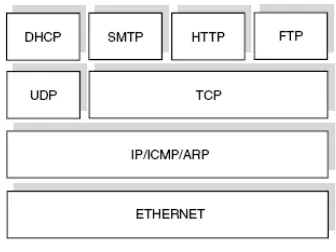
The software running on the embedded web server follows the same layered structure as used in the TCP/IP protocol suite. The TCP/IP protocol suite allows computers of all sizes, running different operating systems, to communicate with each other. It forms the basis for what is called the worldwide Internet; a Wide Area Network (WAN) of several million computers .The TCP/IP protocol suite is a combination of different protocols at various layers .Every layer acts independently from each other. An Ethernet controller driver controls the Ethernet interface. The Address Resolution Protocol (ARP) translates IP addresses to Ethernet MAC addresses (and vice versa) The Internet Protocol (IP) delivers packets to Transmission Control Protocol (TCP), UDP, and Internet Control Message Protocol (ICMP), the ICMP answers to PING requests and TCP/UDP delivers data to the applications. The applications can communicate with the transport layer through buffers with data and variables with control information. This section explains how the TCP/IP protocol suite is built up in our approach.
Fig. 3 Protocol Stack
4.1 Link Layer
Data-link or Network Interface Layer is another common name of this layer. The Link Layer normally includes the device driver in the operating system and the corresponding Network interface (card) in the computer. Together they handle all the hardware details of physically interfacing with the cable. The Ethernet controller is configured to generate an interrupt every time a packet addressed directly to the Ethernet address arrives or when a broadcast arrives. When an interrupt occurs, the microcontroller reads the whole Ethernet frame into memory. A buffer of 1514 bytes, which is the maximum frame size on Ethernet, is reserved for this frame. Once the frame is transferred to the microcontroller, the Ethernet header is checked in order to ensure not receiving a misplaced frame. If the Ethernet address seen by the receiver is either a broadcast (all binary 1’s) or addressed directly to specific Ethernet device, the frame is sent to the next layer or protocol according to the field, protocol type, in the Ethernet header.
4.2 Network Layer
easy to make. The ICMP sends messages between hosts and is only used to answer PING requests from a host. The IP handles communication for the overlaying Transport Layer.
4.3 Transport Layer
On the transport layer there are two major protocols which offer two different kinds of service; TCP which is a reliable delivery service and UDP which offers an unreliable service. TCP also offers flow control for retransmission of segments and acknowledgement of received segments.
4.4 Application Layer
The Application layer handles the details of a particular application. Several applications may be implemented in the embedded web server. The main limitation is memory usage and performance. Running several applications at once means lower performance.
5. Protocol Dependencies
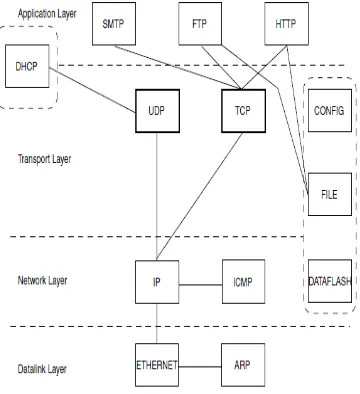
Figure shows the protocol dependencies for the modules in the Embedded Web server. The protocols are described below:
HTTPD needs TCP and a file-system/Data Flash to operate. FTPD needs TCP and a file-system/Data Flash to operate. SMTP needs a running TCP implementation to operate.
DHCP needs IP and UDP to operate. In the initialization phase DHCP requires that the IP and UDP protocol forward any IP packets delivered before the IP address is configured.
Fig.3 Protocol Dependencies
TCP needs IP to operate. UDP needs IP to operate. ICMP needs IP to operate. IP needs ETHERNET to operate. ARP needs ETHERNET to operate
ETHERNET depends only on the hardware Ethernet controller.
CONFIG needs file-system/Data Flash to read the configuration file. If the configuration file is unavailable it can return standard values.
FILE needs DATAFLASH to work.
DATAFLASH is only dependent on the hardware Data Flash.
MAIN must initialize Ethernet, Data Flash, and file-system, TCP, DHCP and HTTPD if these protocols are to be used.
6. User Developing Platform
When an application sends data using TCP, the data is sent down the protocol stack, through each layer, until it is sent as a stream of bits across the network. Each layer adds information to the data by prepending headers and adding trailers to the data it receives.
Some abbreviations:
• TCP segment: The unit of data that TCP sends to IP.
• IP datagram: The unit of data that IP sends to the network interface. • Frame: The stream of bits that flows across the Ethernet.
IP (Internet Protocol) adds an identifier to the IP header it generates to indicate which layer the data belongs to. IP handles this by storing an 8-bit value in its header called the protocol field. Similarly, many different applications can be using TCP or UDP at any time. The Transport Layer protocol stores an identifier in the header they generate to identify the application. Both TCP and UDP use 16-bit port numbers to identify applications. The TCP and UDP store the source port number and the destination port number in their respective headers. The network interface sends and receives frames on behalf of IP, ARP, and RARP. There must be some form of identification in the Ethernet header indicating which network layer protocol generates the data. To handle this, there is a 16-bit frame type field in the Ethernet header.
Fig.4 Encapsulation of Data as It Goes Down the Protocol Stack
7. Case Study-The web server apply to a Air Condition
The goal of this embedded web server is link to device and home appliances, the small size of allow that it can embedded into any little appliances. We have built several applications using this web server here we present an example of application that allow users to control and monitor the state of air-condition.
Fig.5 Controlling an air condition through Web server
8. Conclusion
We have introduced the general design concept of the embedded web server and the policy of TCP/IP reduction, especial the reduction of TCP, whose goal is to allow easy access to and exploitation of remote equipment. This web server gives the common devices an Internet interface and gains a good performance. It can be used broadly in industry, medical, and other fields, more important it can bring us a new home life. With the web server embedded, we will begin to see the application of computing technologies in settings where they are unusual today device and appliance networking in the home; faithful capture of scientific experiments in the laboratory; and automated full-time monitoring of patient.
9. References
[1] Lixia Liu, Research on Technology of Embedded Web Server Application, IEEE, 2005.
[2] Chong FU, Zhi-liang ZHU, The Design & Implementation of General Reduced TCP/IP Protocol for EWS, IEEE, 2005. [3] Janne Riihijarvi, Petri Mahonen, Provding Network connectivity for small appliances, IEEE, 2001.
[4] Masato Shimano, Futoshi Okazaki, Small Embedded web server for home appliances with embedded MPU & RTOS, IEEE, 2004. [5] Tao Lin , Hai Zhao, An Embedded Web Server for Equipments, IEEE, 2004.
[6] [EME99] Gary Desrosiers, 99. Embedded Ethernet. http://www.embeddedethernet.com/ [Accessed Feb 2000].
[7] [TCP86] Geoffrey H. Cooper. IMAGEN Corporation. http://www.csonline.net/bpaddock/tinytcp/default.htm [Accessed Feb 2000] [8] Behrouz A. Forouzan (2006):, Data Communication & networking, 4th Edition.
[9] Raj Kamal (2004): Embedded System architecture, programming and design, 1st Edition . [10] Andrew S. Tanenbaum (2008): Computer Networks, 4th
Edition. [11] Cirrus Logic Product Data Sheet, Crystal LANTM