Care Coordination Services in Pediatric Practices
Vidya Bhushan Gupta, MD, MPH*; Karen G. O’Connor‡; and Carlos Quezada-Gomez, PsyD, MBA§
ABSTRACT. Objective. To examine the frequency
with which pediatricians provide care coordination ser-vices to children, particularly those with special health care needs, in their practices and the barriers to providing these services.
Methods. An 8-page questionnaire was mailed to 1632 randomly selected US members of the American Academy of Pediatrics.
Results. The response rate was 56.7%. Most pediatri-cians (71.2%) reported that they or someone in their prac-tice serves as the primary care coordinator for their chil-dren with special needs, but fewer than one fourth (23.3%) always contact the school about the child’s health and educational needs as part of care coordination, only 18.7% always schedule time with the child’s family to discuss the findings of a specialist, and only 23.2% meet with the discharge planning team to facilitate transition from hospital to home. The respondents identified the 2 top barriers that impede this activity: limited time and lack of medical staff in their offices.
Conclusions. Although most pediatricians believe that they are providing care coordination services, when asked about specific care coordination activities, such as contacting the school or scheduling time with the family to discuss the findings of a specialist, many do not pro-vide these services. Pediatrics 2004;113:1517–1521; care coordination, children with special health care needs.
ABBREVIATIONS. CSHCN, children with special heath care needs; AAP, American Academy of Pediatrics; HMO, health main-tenance organization.
C
are coordination is emerging as one of the most important aspects of the care of children with special heath care needs (CSHCN). CSHCN are those who have or are at increased risk for a chronic physical, developmental, behavioral, or emotional condition and who also require health care and related services of a type or an amount beyond that required by children generally.1This definitionis very broad and includes many children— up to 18% of all children in the United States.2As early as
the 1960s, the American Academy of Pediatrics (AAP) recognized that CSHCN receive care from many different health and nonhealth professionals
who work independent of each other in various lo-cations, without adequate communication and coor-dination of all of the care provided.3 Because the
needs of these children cross multiple disciplines and involve many subsystems of the broad human and health services system, the families of CSHCN need assistance in accessing and negotiating these sys-tems. Care coordination is a process that links CSHCN and their families to services and resources. The goal of care coordination is to maximize the potential of the children and optimize their health care, which is achieved in part through the develop-ment and impledevelop-mentation of a specified care plan by a variety of service providers and programs in an organized manner.4
The AAP has designated care coordination as one of the most important services needed by children and adolescents with genetic and other chronic health care conditions.4,5 Furthermore, care
coordi-nation has been identified as one of the most impor-tant emerging subjects to teach future pediatricians6
and a central tenet of the medical home.7The role of
the primary care pediatrician as a coordinator of care within the medical home is not fixed but is a dy-namic process driven by the health and developmen-tal status of the child, the specific needs of the child and the family, the primary care pediatrician’s ex-pertise with CSHCN, and the availability of other professionals to provide care.4 The Maternal and
Child Health Bureau’s Division of Children With Special Health Care Needs and the AAP National Center for Medical Home Initiatives for Children With Special Needs consider the medical home con-cept of accessible, family-centered, continuous, com-prehensive, coordinated, compassionate, and cultur-ally competent health care to be the ideal method of health care delivery to CSHCN.7 The pediatricians’
current care coordination practices are largely un-known. This study focused on the care coordination aspect of the pediatric practice to identify determi-nants of and barriers to providing care coordination services to all children, but particularly CSHCN. The data for this study were obtained from a survey initiated by the AAP National Center for Medical Home Initiatives for Children With Special Needs and Committee on Children With Disabilities to ex-plore pediatricians’ provision of the elements of a medical home to all children, with and without spe-cial needs.
METHODS
An 8-page, self-administered, forced-choice survey was mailed to 1632 members of the AAP from January to May 2000. This survey was the 44th in the series of Periodic Surveys of Fellows
From the *New York Medical College, New York, New York; ‡Division of Health Policy Research, American Academy of Pediatrics, Elk Grove Vil-lage, Illinois; and §Wellness Center, San Carlos Apache Tribe, San Carlos, Arizona.
The views expressed in this article are those of the authors and do not represent policies of the American Academy of Pediatrics.
Reprint requests to (V.B.G.) Department of Pediatrics, New York Medical College, Metropolitan Hospital Center, 1901 First Ave, Rm 523 New York, NY 10029. E-mail: [email protected]
conducted by the AAP 4 times annually on topics of importance to pediatrics, each using a unique random sample of active US members of the AAP. The survey was approved by the AAP Institutional Review Board and pilot tested before the beginning of the study. Each questionnaire was accompanied by an intro-ductory letter from the executive director of the AAP and a postage-paid return envelope. After 6 mailings, a total of 925 completed questionnaires were received, resulting in a response rate of 56.7%. The analyses in this study are based on responses provided by the 803 pediatricians who reported that they provide patient care.
The questions included in the survey were adapted from the 1998 Medical Home Best Practices Survey developed by the Insti-tute for Child Health Policy for the AAP Medical Home Program for Children With Special Needs. The survey contained questions on the availability of and frequency with which services that characterize a medical home—such as accessibility, family cen-teredness, continuity, comprehensiveness, coordinated care, com-passionate care, and cultural competence—are provided to chil-dren with and without special health care needs and on medication compliance, a subject not reported here. Some of the specific care coordination services about which pediatricians were asked and that are reported on in this article included 1) integrat-ing a child’s medical care plans with the care plans developed by other providers or organizations, 2) discussing a family’s potential needs for nonmedical services, 3) scheduling extra time for an office visit when seeing a child with special needs, 4) contacting the school about a child’s health and education needs as part of care coordination, 5) meeting with the hospital discharge planning team to assist in a child’s transition to the community, and 6) scheduling time with the family to discuss the results of a visit to a specialist. The survey explored the effect of various practice elements, including practice location, setting, and participation in managed care on the provision of these services.2tests were performed to compare responses by practice characteristics.
RESULTS
The mean age of the respondents was 43 years, and almost half (48%) of the respondents were female. Twelve percent practiced in solo- or 2-physician practices, 41% were in a pediatric or multispecialty
group practice or group model health maintenance organization (HMO), 35% were in a hospital or clinic practice, and the remainder practiced or worked in other settings. Thirty-five percent described their practice location as suburban, 31% as urban (but not inner city), 24% as inner city, and 10% as a rural area. Overall, 90% of respondents (n ⫽ 803), spent an average of 39 hours per week in direct patient care. Approximately 69% spent more than half of their time in general pediatrics. Nearly all respondents (96.4%) have patients covered by managed care health plans; these pediatricians reported that an average of 61% of their insured patients belong to managed care plans. The characteristics of respon-dents are representative of the known characteristics of current AAP membership and are consistent with the findings of previous Periodic Surveys.
The pediatricians in direct patient care estimated that 26.9% of their patients in their primary practice setting have special needs. Among these CSHCN, 70.9% have high-prevalence, low-severity condi-tions; and 20% have low-prevalence, high-severity conditions; and 9.5% are categorized as technology dependent (eg, ventilator, feeding tube).
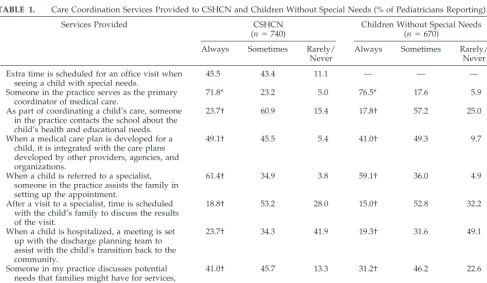
Care coordination services provided to CSHCN are presented in Table 1. Although someone in the office of most pediatricians always serves as the pri-mary coordinator of medical care for children with and without special needs, there are several services for which responses vary significantly between these 2 groups. When a child has special needs, signifi-cantly more pediatricians say they always contact the school about the child’s health and educational needs (23.7% vs 17.8%;P⬍.001), integrate the
med-TABLE 1. Care Coordination Services Provided to CSHCN and Children Without Special Needs (% of Pediatricians Reporting)
Services Provided CSHCN
(n⫽740)
Children Without Special Needs (n⫽670)
Always Sometimes Rarely/ Never
Always Sometimes Rarely/ Never
Extra time is scheduled for an office visit when seeing a child with special needs.
45.5 43.4 11.1 — — —
Someone in the practice serves as the primary coordinator of medical care.
71.8* 23.2 5.0 76.5* 17.6 5.9
As part of coordinating a child’s care, someone in the practice contacts the school about the child’s health and educational needs.
23.7† 60.9 15.4 17.8† 57.2 25.0
When a medical care plan is developed for a child, it is integrated with the care plans developed by other providers, agencies, and organizations.
49.1† 45.5 5.4 41.0† 49.3 9.7
When a child is referred to a specialist, someone in the practice assists the family in setting up the appointment.
61.4† 34.9 3.8 59.1† 36.0 4.9
After a visit to a specialist, time is scheduled with the child’s family to discuss the results of the visit.
18.8† 53.2 28.0 15.0† 52.8 32.2
When a child is hospitalized, a meeting is set up with the discharge planning team to assist with the child’s transition back to the community.
23.7† 34.3 41.9 19.3† 31.6 49.1
Someone in my practice discusses potential needs that families might have for services, such as financial services, respite care, equipment, transportation, etc.
41.0† 45.7 13.3 31.2† 46.2 22.6
ical care plan with the care plans developed by other providers (49.1% vs 41.0%;P⬍.001), assist the fam-ily in setting up an appointment with a specialist (61.4% vs 59.1%; P ⬍ .001), schedule time with the child’s family to discuss the results of visits to a specialist (18.8% vs 15.0%; P⬍ .001), meet with the discharge planning team if a child is hospitalized (23.7% vs 19.3%;P⬍ .001), and discuss the family’s nonmedical needs (40.5% vs 31.2%;P⬍.001).
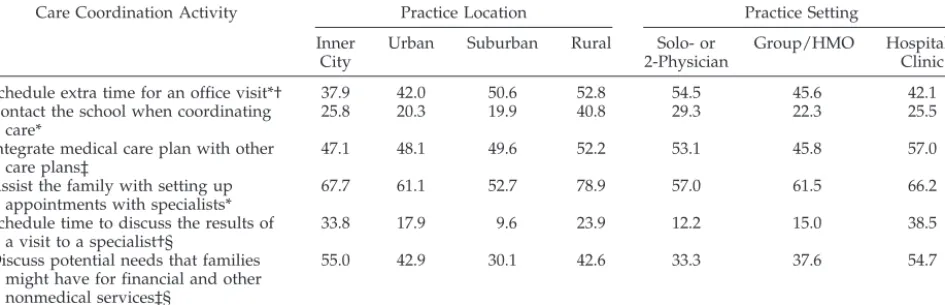
The frequency with which various care coordina-tion services are provided to CSHCN varied by pe-diatricians’ practice location and setting (Table 2). Pediatricians in suburban and rural areas and those in solo- or 2-physician practices are more likely than those in other practice areas or settings to schedule extra time for an office visit when seeing a child with special needs (37.9% inner city vs 42.0% urban vs 50.6% suburban vs 52.8% rural [P⬍.01]; 54.5% solo-or 2- physician practice vs 45.6% group/HMO vs 42.1% hospital/clinic [P⬍.05]). Pediatricians in rural practices are more likely to say that they contact the school when coordinating care for a child with spe-cial needs (25.8% inner city vs 20.3% urban vs 19.9% suburban vs 40.8% rural; P ⬍ .01). There is no sig-nificant difference in the frequency with which pe-diatricians provide this service when results are ex-amined by practice setting.
Pediatricians in hospital/clinic practices (57.0%) and solo practices (53.1%) are more likely than pedi-atricians in group or HMO settings (45.8%) to say that they integrate their patients’ medical care plan with care plans developed by other providers, agen-cies, and organizations. Pediatricians in all practice areas are equally likely to provide this aspect of care coordination. Rural pediatricians, compared with their counterparts, are more likely to say that they always assist the family of a child with special needs with setting up appointments with specialists (67.7% inner city vs 61.1% urban vs 52.7% suburban vs 78.9% rural; P ⬍ .01). There is no difference in the provision of this service between pediatricians in solo, group, or hospital practices. However, pediatri-cians in inner-city practice and hospital/clinic set-tings are more likely than their counterparts to say
that they schedule time with families of CSHCN to discuss the results of a visit to a specialist and to discuss potential needs that families might have for nonmedical services.
When responses are examined by practice area and setting, there is no significant difference in the proportion of pediatricians who report that they serve as the primary coordinator of medical care for the CSHCN in their practice or who meet with the hospital discharge planning team to assist with the transition back to the community of the child with special needs. When care coordination services are examined by proportion of patients covered by man-aged care health insurance plans, with one exception there is no variation in services provided: 15.7% of pediatricians with a majority of patients in managed care schedule time with the family to discuss the results of a visit to a specialist compared with 24.2% of pediatricians with a minority of patients in man-aged care (P⬍ .05).
Barriers to providing care coordination services to either children with or without special needs are presented in Table 3. For each care coordination ser-vice, pediatricians who said that they “sometimes” or “rarely/never” provided that service were asked to identify the main barrier (from a list of 14 potential barriers provided on the survey) for not providing that service or not providing the service to as many patients as they would like. The number of pediatri-cians who indicated a barrier to a specific service varies; among those who indicated a barrier, only those selected by 8% or more of the respondents are shown in Table 3. Although barriers to providing these services vary somewhat by type of service, overall the most frequently cited barriers to provid-ing care coordination services to all children are the lack of time and the lack of medical staff to provide such services. Lack of time was named most fre-quently as the barrier to all but one service: sched-uling extra time for an office visit when seeing a child with special needs. Lack of medical staff to provide services was identified as a barrier for all but 2 services: scheduling extra time for an office visit when seeing a child with special needs and
schedul-TABLE 2. Differences in Care Coordination Activities for CSHCN by Practice Location and Setting (% of Pediatricians Reporting)
Care Coordination Activity Practice Location Practice Setting
Inner City
Urban Suburban Rural Solo- or 2-Physician
Group/HMO Hospital/ Clinic
Schedule extra time for an office visit*† 37.9 42.0 50.6 52.8 54.5 45.6 42.1 Contact the school when coordinating
care*
25.8 20.3 19.9 40.8 29.3 22.3 25.5
Integrate medical care plan with other care plans‡
47.1 48.1 49.6 52.2 53.1 45.8 57.0
Assist the family with setting up appointments with specialists*
67.7 61.1 52.7 78.9 57.0 61.5 66.2
Schedule time to discuss the results of a visit to a specialist†§
33.8 17.9 9.6 23.9 12.2 15.0 38.5
Discuss potential needs that families might have for financial and other nonmedical services‡§
55.0 42.9 30.1 42.6 33.3 37.6 54.7
ing time with the child’s family to discuss the results of a visit to a specialist.
DISCUSSION
Although most pediatricians reported that they provide care coordination services, when asked spe-cifically about care coordination activities, such as integrating a child’s medical care plans with the care plans developed by other providers or organizations or discussing a family’s potential needs for nonmed-ical services, more than half did not always provide these services. This discrepancy underscores the need for additional definition and education con-cerning care coordination and other activities. Com-pared with CSHCN, significantly more children without special needs receive care coordination from someone in the office of their pediatrician (Table 1). Care coordination needs of CSHCN are more com-plex and, therefore, more likely to be delegated to someone outside the pediatrician’s office.
Pediatricians in suburban and rural areas and those in solo- or 2-physician practices were more likely than those in other practice areas or settings to schedule extra time for an office visit when seeing CSHCN (Table 2), but pediatricians in inner-city practices and hospital/clinic settings were more likely than their counterparts to schedule time with families of CSHCN to discuss the results of consul-tations and the potential needs that families might have for nonmedical services. It is likely that pedia-tricians in solo, suburban, and rural practices can bill for extra time that they spend face to face with CSHCN in an office visit but cannot bill for non–face-to-face meetings with the parents to explain the find-ings of the consultation or to discuss the need for
nonmedical services. Pediatricians in the hospital/ clinic settings are usually reimbursed at a flat rate per patient visit regardless of the time they spend with the child. Thus, under pressure to see more patients in a limited time, an extra visit may be scheduled to discuss with the parents the results of consultations and the need for nonmedical services. In addition, pediatricians in the hospital/clinic set-tings may have more medical and nonmedical staff available to provide these non–face-to-face services. The differences in care coordination services in var-ious practice locations and settings should be studied further.
Rural pediatricians assist the families in making specialty appointments and contact schools more than pediatricians in other practice locations. Al-though this survey did not study this, the paucity of specialty services in rural areas necessitates pediatri-cians’ direct involvement in finding the appropriate specialist and helping the family to make the ap-pointment. Rural pediatricians are also more likely to have a closer relationship with the local school dis-trict.
Pediatricians with more than half of their patients in managed care health plans were less likely to say that they schedule time with the families of CSHCN to discuss the results of consultations (15.7% vs 24.1%;P⬍ .05). It is likely that managed care orga-nizations make more demands to increase physician productivity, thus allowing less time for this care coordination activity. This is consistent with previ-ously reported concerns about the care of children with chronic conditions in managed care systems.8,9
Lack of time (31.5%–50% of the pediatricians who reported a barrier) was the most commonly
identi-TABLE 3. Barriers to Providing Care Coordination Services to All Children (% of Pediatricians Reporting)*
Services Barriers to Providing Services
Schedule extra time for an office visit when seeing a child with special needs (n⫽95).
1. Lack of community/government agency services in this area (34.8%)
2. Lack of time (32.6%) I (or someone in my practice) serve as the primary coordinator
of medical care for the children in my practice (n⫽54).
1. Lack of time (31.5%)
2. Lack of medical staff to provide this service (9.3%) As part of coordinating a child’s care, someone in my office
contacts the school about the child’s health and educational needs (n⫽128).
1. Lack of time (49.2%)
2. Lack of medical staff to provide this service (7.8%)
When a medical care plan is developed for a child, it is integrated with the care plans developed by other providers, agencies, and organizations (n⫽88).
1. Lack of time (43.2%)
2. Difficulty communicating effectively (20.5%) 3. Lack of medical staff to provide this service (13.6%) When a child is referred to a specialist, someone in my
practice assists the family in setting up the appointment (n
⫽56).
1. Lack of time (39.3%)
2. Lack of administrative support (14.3%)
3. Lack of medical staff to provide this service (12.5%) After a visit to a specialist, I schedule time with the child’s
family to discuss the results of the visit (n⫽156).
1. Lack of time (50%)
2. Inadequate reimbursement for this service by insurance plans (9%)
When a child is hospitalized, I meet with the discharge planning team to assist with the child’s transition back to the community (n⫽195).
1. Lack of time (48.2%)
2. Lack of medical staff to provide this service (10.8%) 3. Lack of community/government agency services in this
area (8.7%) Someone in my office discusses potential needs that families
might have for services such as financial services, respite care, equipment, transportation, etc (n⫽104).
1. Lack of time (33.7%)
2. Lack of medical staff to provide this service (16.3%) 3. Lack of training in this area (10.6%)
fied barrier to providing care coordination services. According to the National Ambulatory Care Surveys, mean duration of a primary care child visit was 14.2 minutes in 199410 and 14.9 minutes in 1999 (AAP
Division of Health Policy Research, unpublished data, 1999). Although this represents a significant increase from the mean length of a visit in the pre-vious years, it is difficult for a pediatrician to call the school or other nonmedical service providers to co-ordinate the services of the child in 14.9 minutes in addition to providing primary medical care. Increas-ing productivity demands in managed care systems limits the time available for nonclinical care coordi-nation activities by primary care physicians.11
Lack of medical staff and community/government agency services (7.8%–34.8% of the pediatricians who reported a barrier) was the second most com-mon reason for not providing care coordination ser-vices. This study did not specifically address the issue about who should provide care coordination services—a member of the medical and office staff or a designated care coordinator provided by a com-munity/government agency. Inadequate reimburse-ment was cited as a barrier by only 9% of the 156 pediatricians who reported a barrier, and was re-ported as a barrier for only one of the care coordina-tion services: scheduling time with the child’s family to discuss the results of a visit to the specialist. A similar result was obtained in a survey of pediatri-cians about preventive counseling that found that concerns about time and reimbursement were sec-ondary to the physician’s perceived self-efficacy and effectiveness.12 It seems that pediatricians would
provide care coordination if they had enough time and medical or other staff to provide these services. This issue may require additional study.
Lack of training regarding potential needs such as financial services, respite care, equipment, and trans-portation was reported as a barrier by 10% of pedi-atricians. A recent survey of pediatric residents na-tionwide and practicing pediatricians from 2 states, 1 urban and 1 rural, indicated a lack of specific training and physician confidence in prescribing therapies and devices to CSHCN— establishing the necessity of expanding training programs to better ensure quality health care for CSHCN.13 Training
pediatri-cians about these issues has been identified as an important priority in pediatric education.6,14 The
AAP, through its National Center of Medical Home Initiatives for Children With Special Needs, offers a training program for primary care physicians, pedi-atric office staff, and others. This program teaches practical strategies to ensure that CSHCN have a medical home (ie, they receive care that is accessible, family centered, continuous, comprehensive, coordi-nated, compassionate, and culturally competent).15
This study highlights the need to incorporate these aspects in medical education at the undergraduate and graduate levels.
In conclusion, this survey finds that although most pediatricians say that they provide care coordination services, when asked directly about specific activi-ties, many do not provide these services. This
sug-gests a lack of consensus among pediatricians about which activities constitute care coordination. Time and lack of medical and other staff are the most important barriers to providing care coordination services. There is a need to educate pediatricians further about what constitutes care coordination16
and their role in this process.17–20
ACKNOWLEDGMENTS
This study was supported by the American Academy of Pedi-atrics, Elk Grove Village, Illinois.
We thank Sanford Sharp for assistance with data collection and data analysis.
REFERENCES
1. McPherson M, Arango P, Fox H, et al. Commentaries. A new definition of children with special health care needs.Pediatrics.1998;102:137–140 2. Newacheck PW, McManus M, Fox HB, Hung YY, Halfon N. Access to health care for children with special health care needs.Pediatrics.2000; 105:760 –766
3. American Academy of Pediatrics, Council on Pediatric Practice. Chronic illness. In:Standards of Child Health Care.Evanston, IL: American Acad-emy of Pediatrics; 1967:36 – 40
4. American Academy of Pediatrics, Committee on Children With Disabil-ities. Care coordination: integrating health and related systems of care for children with special health care needs.Pediatrics.1999;104:978 –981 5. American Academy of Pediatrics Committee on Children With Disabil-ities. General principles in the care of children and adolescents with genetic disorders and other chronic health conditions.Pediatrics.1997; 99:643– 644
6. Behrman RE. Postgraduate education for pediatricians.Pediatrics.2001; 107:553–557
7. American Academy of Pediatrics Medical Home Initiatives for Children With Special Needs Project Advisory Committee. The medical home.
Pediatrics.2002;110:184 –186
8. Neff JN, Anderson G. Protecting children with chronic illness in a competitive market.JAMA.1995;274:1866 –1869
9. Newachek PW, Stein RE, Walker DK, Gortmaker SL, Kuhlthau K, Perrin JM. Monitoring and evaluating managed care for children with chronic illnesses and disabilities.Pediatrics.1996;98:952–958
10. Ferris TG, Saglam D, Stafford RS, et al. Changes in the daily practice of primary care for children.Arch Pediatr Adolesc Med.1998;152:227–233 11. Grumback K, Osmond D, Vranizan K, Jaffe D, Bindman AB. Primary
care physicians’ experience of financial incentives.N Engl J Med.1998; 339:1516 –1521
12. Cheng TL, DeWitt TG, Savageau JA, O’Connor KG. Determinants of counseling in primary care pediatric practice: physician attitudes about time, money, and health issues.Arch Pediatr Adolesc Med. 1999;153: 629 – 635
13. Hsiao WC, Braun P, Becker ER, et al. Results and impacts of the Resource-Based Relative Value Scale.Med Care.1992;30:NS61–NS79 14. Sneed RC, May WL, Stencel CS. Training of pediatricians in care of
physical disabilities in children with special health needs: results of a two-state survey of practicing pediatricians and national resident train-ing programs.Pediatrics.2000;105:554 –561
15. National Center of Medical Home Initiatives for Children With Special Needs. Every child deserves a medical home training program. Avail-able at: www.medicalhomeinfo.org/training/index.html. Accessed May 19, 2003
16. The Association of Maternal and Child Health Programs. Principles, goals and recommendations developed by the AMCHP Working Group on Care Coordination. In:Care Coordination for Children With Special Health Care Needs and Their Families in the New Millennium.Washington, DC: Association of Maternal and Child Health Programs; 2000:2–14 17. American Academy of Pediatrics Task Force on the Future of Pediatric
Education. The Future of Pediatric Education II: organizing pediatric education to meet the needs of infants, children, adolescents, and young adults in the 21st century.Pediatrics.2000;105:161–212
18. Liptak GS, Revell GM. Community physician’s role in case management of children with chronic illnesses.Pediatrics.1989;84:465– 471 19. Presler E. Care coordination for children with special health care needs.
Orthop Nurs.1998;17:45–51
2004;113;1517
Pediatrics
Vidya Bhushan Gupta, Karen G. O'Connor and Carlos Quezada-Gomez
Care Coordination Services in Pediatric Practices
Services
Updated Information &
http://pediatrics.aappublications.org/content/113/Supplement_4/1517
including high resolution figures, can be found at:
References
#BIBL
http://pediatrics.aappublications.org/content/113/Supplement_4/1517
This article cites 17 articles, 9 of which you can access for free at:
Subspecialty Collections
sub
http://www.aappublications.org/cgi/collection/quality_improvement_
Quality Improvement
_management_sub
http://www.aappublications.org/cgi/collection/administration:practice
Administration/Practice Management
following collection(s):
This article, along with others on similar topics, appears in the
Permissions & Licensing
http://www.aappublications.org/site/misc/Permissions.xhtml
in its entirety can be found online at:
Information about reproducing this article in parts (figures, tables) or
Reprints
http://www.aappublications.org/site/misc/reprints.xhtml
2004;113;1517
Pediatrics
Vidya Bhushan Gupta, Karen G. O'Connor and Carlos Quezada-Gomez
Care Coordination Services in Pediatric Practices
http://pediatrics.aappublications.org/content/113/Supplement_4/1517
located on the World Wide Web at:
The online version of this article, along with updated information and services, is
by the American Academy of Pediatrics. All rights reserved. Print ISSN: 1073-0397.