IJIRT 101469
INTERNATIONAL JOURNAL OF INNOVATIVE RESEARCH IN TECHNOLOGY106
Model Based Controller of pH Neutralization in Waste
Water Treatment Process
Sam Justus A
1, Mr. Kingston Stanley
21
PG Scholar, Department of Electronics and Instrumentation, Karunya University,
2
Assistant Professor, Department of Electronics and Instrumentation, Karunya University,
Coimbatore India
Abstract- Control of pH (hydrogen potential) neutralization process has always been one of the challenging problem in process control particularly in wastewater treatment. However, it is difficult to control a pH process with adequate performance point due to its nonlinearities, time-varying properties and sensitivity to small disturbances when working near the equivalence point. The pH level is controlled by adding NaOH or HNO3 solution directly into the CSTR. A control mechanism must be applied in order to determine the amount of solution added to properly compensate for deviations in pH. By manipulating control parameters, the pH level within the system can be kept within a certain range. The PI and PID controllers are widely used in many industrial control systems because of its simple structure and robustness. MPC generates control actions by optimizing an objective function repeatedly over a finite moving prediction horizon, within system constraints, and MPC is implemented in simulation and compared with Ziegler and Nichols tuned PID.
Index Terms- Proportional Intergral Derivative(PID),Model Predictive Control (MPC)
I.INTRODUCTION
In recent years the industrial application of advanced control techniques for the process industries has become more demanding, mainly due to the increasing complexity of the processes themselves as well as to enhanced requirements in terms of product quality and environmental factors. Therefore the process industries require more reliable, accurate, robust, efficient and flexible control systems for the operation of process plant. In order to fulfill the above requirements there is a continuing need for research on improved forms of control. Control of industrial processes is a challenging task for several reasons due to their nonlinear dynamic behavior, uncertain and time varying parameters, constraints on manipulated variable, interaction between manipulated and
controlled variables, unmeasured and frequent disturbances, dead time on input and measurements.
Control of the pH process plays an important role in different chemical plants, such as chemical and biological reaction, waste water treatment, electrochemistry and precipitation plants, production of pharmaceuticals, fermentation, and food production such as in vegetable oil refining. However, it is difficult to control a pH process with adequate performance point due to its nonlinearities, time-varying properties and sensitivity to small disturbances when working near the equivalence point. More specifically, the pH was controlled in a continuously stirred tank reactor (CSTR) in this experiment. The reaction being controlled was the acid-base reaction of sodium hydroxide, NaOH, and Nitric acid , HNO3. The pH level is controlled by adding NaOH or HCl solution directly into the CSTR. A control mechanism must be applied in order to determine the amount of solution added to properly compensate for deviations in pH. By manipulating control parameters, the pH level within the system can be kept within a certain range.
IJIRT 101469
INTERNATIONAL JOURNAL OF INNOVATIVE RESEARCH IN TECHNOLOGY107
performance for different operating conditions is essential. There is also increasing interest in the potential of “intelligent” control methods for process applications.
Model Predictive Control also known as receding horizon control, is an advanced strategy for optimizing the performance of multivariable control systems. MPC generates control actions by optimizing an objective function repeatedly over a finite moving prediction horizon, within system constraints, and based on a model of the dynamic system to be controlled.
II.HARDWARE DESCRIPTION
A.EXPERIMENTAL SETUP
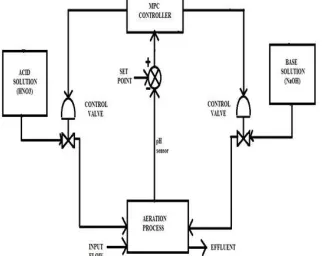
Fig.1 pH control system
Here pH of the process tank is the controlled variable, Inflow rate of the acid and base solution is the controlling variable.The controlled variable is the pH of the solution and the manipulated variable is the inflow of acid and base to the tank. The schematic diagram of the system is shown in the Fig.1
B.BLOCK DIAGRAM
The pH value of the process tank should be maintained at a desired value. So, the controller is designed for the non-linear system and implemented using MATLAB software. The automatic process control block diagram is shown in the Fig. 2
Fig.2Block diagram of pH control system
III.MATHEMATICAL MODELING:
There are two streams of input and one stream of output.
a: acid stream with concentration Ca and flow rate Fa
b: base stream with concentration Cb and flow rate Fb
bf: buffer stream with concentration C(bf) and flow rate F(bf)
e: effluent stream with concentration Ce and flow rate Fe
Temperature maintains 25 degree Celsius Density, Total mass balance:
Accumulation of total mass in the tank/time = [total input to the tank/time] – [total output from the tank/time]
Based on assumption
Balance on component:
Accumulation of particular component in the tank/time = [total input of the component to the tank/time] – [total output from the tank]
According to the assumption that the stirrer in the CSTR well stirring takes place.
Hence say concentration of solution inside the tank and in the effluent stream will be same
Hence Ce = Co
Taking Laplace transform of above equation
TABLE 1 : Parameters of neutralization process
IJIRT 101469
INTERNATIONAL JOURNAL OF INNOVATIVE RESEARCH IN TECHNOLOGY108
Substituting these parameters in equation then the transfer function will be
In this case concentration is taking as the output and flow rate of base is taking as input
PARAMETER SELECTION
Sodium bicarbonate (buffer solution)
Nitric acid (acid solution)
sodium hydroxide (base solution)
’s aqueous solution is mainly alkaline due to the transformation of carbonic acid and hydroxide ion.
The pH number is a measure of concentration or more precisely the activity of hydrogen ion in a solution
Water molecules are dissociated into hydrogen ion and hydroxyl ion according to the formula
In chemical equilibrium
Only a small fraction of water molecules are split into ions. The water activity is practically unity and we get
Where kw is the equilibrium constant, has the value
of at 25
Concentration of ion is considering
Concentration of ion is considering
In this process, because of the acid and bases are completely ionized, Since the number of positive ions equal the number of negative ions. It follows that,
The concentration of hydroxyl ion can be related to the hydrogen ion concentration. Hence
Solving for gives
IV.CONTROLLERS
Controllers are basically employed in a closed loop control system. Closed loop control system is one that automatically changes the output based on the difference between the feedback signal to the input signal. Controller is an element used to produce manipulated variable from error variable, for control action.
Fig.3 Controller in closed loop system R(t) – set point
M(t) - feedback variable E(t) - error variable X(t) - manipulated variable Y(t) - controlled output variable
Basically, the electronic controllers are categorized into ON-OFF Control, Proportional(P) Controller, Proportional-Integral(PI) Controller,Proportional-Integral-Derivative(PID) Controller.
Among these controllers, PID is named as the best controller for its fast response, fast settling time and powerful control.
A.PID CONTROLLER:
IJIRT 101469
INTERNATIONAL JOURNAL OF INNOVATIVE RESEARCH IN TECHNOLOGY109
industrial control systems – a PID is the most commonly used feedback controller. A PID controller calculates an "error" value as the difference between a measured process variable and a desired setpoint. The controller attempts to minimize the error by adjusting the process control inputs.
The PID controller calculation (algorithm) involves three separate constant parameters, and is accordingly sometimes called three-term control: the proportional, the integral and derivative values, denoted P, I, and D. Heuristically, these values can be interpreted in terms of time: P depends on the present error, I on the accumulation of past errors, and D is a prediction of future errors, based on current rate of change. The weighted sum of these three actions is used to adjust the process via a control element such as the position of a control valve, or the power supplied to a heating element.
ZEIGLER NICHOLS OPEN LOOP TUNING The Zeigler Nichols Open-Loop Tuning Method is a way of relating the process parameters - delay time, process gain and time constant - to the controller parameters - controller gain and reset time. It has been developed for use on delay-followed-by-first-order-lag processes but can also be adapted to real processes.
Open loop response, Kp= 3.14
Steady state value = 3.14
28.3% of the steady state value t1=5.464 sec
63.2% of the steady state value t2 = 16.05 sec Time
(T) = (t2 – t1)1.5 = (16.05 – 5.464)*1.5 = 7.057 sec.
Time delay (td) = (t2 – T) = (16.05 – 7.057) = 8.993
sec
Transfer function of the given process,
CLOSED LOOP RESPONSE
PROPORTIONAL CONTROLLER
Kp = T / td Kp = .25
PROPORTIONAL INTEGRAL
CONTROLLER
Kc = (.9T) / td Kp =.225
Ti = 3.33 td = 29.95 sec
Ki = Kc/Ti =.0075 sec -1
PROPORTIONAL INTEGRAL DERIVATIVE
CONTROLLER
Kc = (1.2T) / td Kp = .27
Ti = 2td = (2*8.993) = 17.986 sec
Ki = Kc/Ti = 0.015 sec -1
Td = 0.5 td = 4.5sec
Kd = Kc Td =(.27*4.5) = 1.215 B.MODEL PREDICTIVE CONTROL
Model predictive control (MPC), also known as receding horizon control or moving horizon control, uses the range of control methods, making the use of an explicit dynamic plant model to predict the effect of future reactions of the manipulated variables on the output and the control signal obtained by minimizing the cost function. The performance of the controller depends on how well the dynamics of the system being captured by the input–output model that is used for the design of the controller. Model predictive control is the family of controllers, makes the explicit use of model to obtain control signal. The reason for its popularity in industry and academia is its capability of operating without expert intervention for long periods.
Model Predictive Control, MPC, usually contains the following three ideas,
1. Explicit use of a model to predict the process output along a future time horizon.
2. Calculation of a control sequence to optimize a performance index.
3. A receding horizon strategy, so that at each instant the horizon is moved towards the Future, which involves the application of the first control signal of the sequence Calculated at each step.
IJIRT 101469
INTERNATIONAL JOURNAL OF INNOVATIVE RESEARCH IN TECHNOLOGY110
Fig.4 Block diagram of MPCA block diagram of a model predictive control system is shown in Fig.6.3. A process model is used to predict the current values of the output variables. The residuals, the differences between the actual and predicted outputs, serve as the feedback signal to a Prediction block. The predictions are used in two types of MPC calculations that are performed at each sampling instant: set-point calculations and control calculations.
Inequality constraints on the input and output variables, such as upper and lower limits, can be included in either type of calculation. Note that the MPC configuration is similar to both the internal model control configuration and the Smith predictor configuration, because the model acts in parallel with the process and the residual serves as a feedback signal.
V.RESULTS AND DISCUSSIONS
Many real processes become unstable or out of specifications without controller. Because these reasons, a lot of processes can’t be analyzed in open loop.
Now a frequency domain approach will be followed for the closed loop system. In each subsection a method will be discussed which can directly be implemented for the measurement of a closed loop system
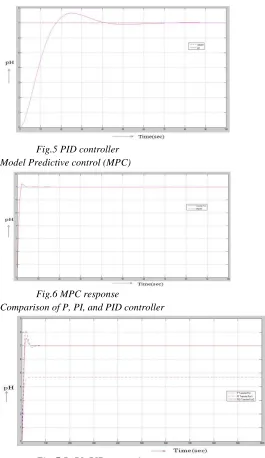
PID Controller:
Fig.5 PID controller Model Predictive control (MPC)
Fig.6 MPC response
Comparison of P, PI, and PID controller
Fig .7 P, PI, PID comparison response
COMPARISON OF RESULTS IN SIMUATION To Compare the Controller action various parameters such as settling time, Integral Absolute Error (IAE) and Integral Square Error (ISE) are taken.
Table 2 Comparison of results for PID and MPC
Parameters PID
controller MPC
Settling
IJIRT 101469
INTERNATIONAL JOURNAL OF INNOVATIVE RESEARCH IN TECHNOLOGY111
Integral Absolute Error (IAE)
69.21 4.851
VI.CONCLUSION
pH control system is highly nonlinear parameter. In this project, the model of the pH control system is obtained using mathematical modeling and the transfer functions are obtained.. The conventional PID controller and MPC controller is designed and implemented in simulation. The predictive controller techniques provide better performance. The settling time, integral absolute error and integral square error was studied for the two controllers were studied. It is clear that MPC is faster when compared to PID.
REFERENCES
[1]. André Felipe Oliveira de Azevedo Dantas, Fábio Araújo de Lima, André Laurindo Maitelli, Gaspar Fontineli Dantas Junior. “Comparative Study of Strategies for Fuzzy Control P and PD applied to a pH plant” IEEE ,Pages 516 –521, 2011
[2]. A.W. Herman son, S. Syafiiey and S.B. Mohd Noor “Multiple Model Predictive Control of Nonlinear pH Neutralization System” IEEE ,pages 301 -304, ,2010
[3]. Davood Shaghaghi , Hossein MonirVaghefi , Alireza Fatehi“Generalized Predictive Control of pH neutralization Process Based on Fuzzy Inverse Model” IEEE ,2013
[4]. N. H. S. Abdullah,M. N. Karsiti and Rosdiazli Ibrahim “A Review of pH Neutralization Process Control” IEEE ,pages 594-598, ,2011
[5]. Z. Shahraeini, N. Daneshpour, M.R. Jahed Motlagh, J. Poshtan. “A Nonlinear Model Predictive Control System Based on Wiener Model”, IEEE , 2006.
[6]. Shahin Salehi a, MohammadShahrokhi b, , AliNejati , “Adaptive nonlinear control of pH neutralization processes using fuzzy approximators ”,science direct,2009.
[7] K. S. Holkar, K. K. Wagh, Nashik, M. S,India and L. M. Waghmare S. “An Overview of Model Predictive Control” International Journal of Control and Automation Vol. 3 No. 4, December, 2010 [8] Liuping Wang “Model Predictive Control System Design and Implementation Using MATLAB” 2009 Springer.
[9] H.Kala, P.Aravind, M.Valluvan “Comparative Analysis of Different Controller for a Nonlinear Level Control Process” Proceedings of 2013 IEEE Conference on Information and Communication Technologies (ICT 2013)
[10] Abhishek Sharma1 and Nithya Venkatesan “Comparing PI controller Performance for Non Linear Process Model” International Journal of Engineering Trends and Technology- Volume4 Issue3- 2013
[11] A. Srividya1, M. Ayeesha Siddiqa, T.K.S. Ravi Kiran, M. Viswanath “Design and implementation of Intelligent Controller for Non-linear system” International Conference on Recent Advancements in Electrical, Electronics and Control Engineering
2012.