1
International journal of Management, IT and Engineeringhttp://www.ijmra.us, Email: [email protected] IMPACT OF TOURISM IN HARYANA ECONOMY
Padam Singh
(Assistant Professor in commerce KLP College Rewari)
Abstract
This paper coins how tourism sector is significant for Haryana economy. Developing state like Haryana tourism has become one of the major sectors of the economy, contributing to a large proportion to GDP and employment opportunities. Tourism is one of the fastest growing service industries in the state with great potentials for its further expansion and diversification. Tourism industry plays a major role in any state‘s economic development. It helps significantly to the state for creating the employment opportunities to the large number of people. Moreover, it is also one of the important engines to attract more foreign exchanges with its potential. We need to concentrate to have liberal policies, relaxation in taxes, comprehensive package and so on to influence tourist and foreign investment. There is also a need to increase the government‘s role to make Haryana flourishing in tourism and established in the global market. Haryana has rich source in tourism for the establishment of the brand. Of course Haryana has been launched the Incredible Haryana to make tourism better.
INTRODUCTION
Tourism has become the Haryana's largest industry, generating wealth and employment, opening the minds of both visitors and the visited to different ways of life. Haryana has strong signs of becoming one of the emerging giants in Haryana tourism. The most imperative factors for successful tourism development include product enhancement, marketing, regulations and human resource development. Haryana‘s tourism is one of the flourishing sectors in terms of its scope. Tourism in Haryana is growing continuously to generate employment and earn large amount of foreign exchange in order to stabilize the state‘s economic and social development. It also helps in preserving and sustaining the diversity of the Haryana's natural and cultural environments. We should develop tourism industry with government supports, new initiations, actions and plans to influence foreigners to sustain our position strongly. This paper explains the impact of tourism in Haryana economy. Tourism in Haryana is a key growth driver and a significant source of foreign exchange earnings. The tourism sector in Haryana is flourishing due to an increase in foreign tourist arrivals (FTA) and a larger number of Haryana travelling to domestic destinations. Haryana has a dramatic growth of tourism and it is one of the most remarkable economic changes. Tourism activity has long lasting socio-economic impacts on the host economy and community. Though the industry has great opportunities, but the there is a need to make it positive in terms of its future.
The tourism industry is one of the largest segments under the services sector of the Haryana economy.
Objectives of the Study
To understand the opportunities in tourism industry
To identify the challenges involved in this sector
To aware different forms of tourism industry
To know the Positive impacts of Tourism in Haryana Research Methodology
This paper is prepared with the support of secondary sources like magazines, newspapers, reports, dissertations, thesis and the like.
Opportunities in Tourism industry
Haryana‘s size and massive natural, geographic, cultural and artistic diversity offers enormous opportunities for the travel and tourism industry. The promotion and aggressive marketing measures undertaken by the government is expected to aid influx of tourists. The industry would also benefit from introduction of new forms of tourism and development. Medical tourism in Haryana has gained considerable popularity in recent years. Haryana has a major cost advantage in this field compared with other countries. In addition to cost advantages, Haryana healthcare industry offers state-of-the art equipment, technological advancement, qualified and experienced medical personnel and a blend of modern and traditional medicines.
Thus, medical tourism has immense potential in Haryana. Opportunities also exist in ecotourism, adventure tourism, and cruise tourism. Eco-tourism is increasing in popularity, evident in the development of eco-friendly hotels and tour packages. With increasing environment awareness and consciousness among tourists and given efforts undertaken by the government and private players, the ecotourism segment is expected to record handsome growth in the coming years. Haryana holds immense potential in adventure and cruise tourism. Haryana‘s greatest adventure tourism assets are Himalayas and its mighty rivers. The peak period for adventure tourism is the ―lean period‖ of cultural tourism. Development of adventure tourism can make Haryana a round-the-year tourist destination.
The cruise industry is one of the most promising industries in Haryana. However, strong efforts need to be made to develop this industry. Other forms of tourism such as agri tourism, pilgrimage tourism, heritage tourism, and MICE tourism also hold enormous potential.
Prospects in Tourism Industry
Healthy economic growth recorded in past few years, especially in the services industry, has led to increase in business travel. Higher disposable income and affordability have increased domestic leisure travel in Haryana. Foreign tourist arrivals in Haryana have also grown. However, the industry has shown signs of recovery in the first half of 2010. This is a clear indicator that the long-term prospects for the Haryana travel and tourism industry are bright. Haryana is expected to witness increased tourist activity both in the business and leisure segments in the coming years. Haryana has been identified as one of the fastest-growing countries in terms of tourism demand. The tourism and hospitality industry is one of the largest segments under the services sector of the Haryana economy. Tourism in Haryana is a key growth driver and a significant source of foreign exchange earnings.
3
International journal of Management, IT and Engineeringhttp://www.ijmra.us, Email: [email protected] Haryana travelling to domestic destinations. The role of the Haryana government, which has provided policy and infrastructural support, has been instrumental in the growth and development of the industry. The tourism policy of the government aims at speedy implementation of tourism projects, development of integrated tourism circuits, special capacity building in the hospitality sector and new marketing strategies. Haryana‘s tourism industry is experiencing a strong period of growth, driven by the burgeoning Haryana middle class, growth in high spending foreign tourists, and coordinated government campaigns to promote ‗Incredible Haryana‘. In fact Haryana has a rich source in tourism sector to influence GDP, employment, image, foreign investments, new projects and the like to make our position comfortable in globally.
Challenges in Tourism industry
Tourism industry in Haryana is growing and it has vast potential for generating employment and earning large amount of foreign exchange besides giving a fillip to the state‘s overall economic and social development. But much more remains to be done. There are challenges involved in tourism industry.
Lack of Proper Infrastructure
Infrastructure needs for the travel and tourism industry range from physical infrastructure such as ports of entry to modes of transport to urban infrastructure such as access roads, electricity, water supply, sewerage and telecommunication. The sectors related to the travel and tourism industry include Airlines, surface transport, accommodation (hotels), and infrastructure and facilitation systems, among others.
Access and Connectivity
The infrastructure facilities like air, rail, road connectivity, and hospitality services are still needs to be improved to connect various cities across the state. This remains a major issue for the development of tourism. Tourists largely depends on road network rather other mode. Despite numerous efforts will be taken to modernize the road facilities connectivity remains a major challenge. There is a greater need to improve road and rail network to connect various locations across different regions in the state.
Amenities:-
Amenities available at various tourist locations and en route need to be improved. These include basic amenities such as drinking water, well maintained and clean waiting rooms and toilets, first aid and wayside such as lounge, cafeteria, and parking facilities, among others. Haryana scores poorly in terms of availability of these infrastructure facilities. Inadequate infrastructure facilities affect inbound tourism and also could lead to an increase in the outflow of domestic tourists from Haryana to other competitive neighboring states.
Human Resource
strategies and policies for human resource development also affect the industry. The industry needs to address these problems at the earliest.
Different forms of Tourism
Tourism industry has contributed enormously in the flourishing graph of Haryana's economy. Tourism industry is the backbone of any state's economic position. It raises the living conditions of the citizens of the state. It will be helpful in raising the GDP of the state. Self employment gives a new boost to the state. Infrastructure development is another advantage of tourism industry. Cultural exchange is also possible only through tourism. There are different types of tourism. The recent trend is moving toward niche segments of tourism: Medical tourism
Medical tourism also known as health tourism has emerged as one of the important segments of the tourism industry. The term has been coined by travel agencies and the mass media to describe the rapidly-growing practice of travelling across international borders to for healthcare. Travelers typically seek services such as elective procedures as well as complex specialized surgeries such as joint replacement (knee/hip), cardiac, dental, and cosmetic surgeries. Psychiatry, alternative treatments, and convalescent care are also available.
Wellness tourism
Wellness tourism is regarded as a sub-segment of medical tourism. Here, the primary purpose is achieving, promoting or maintaining good health and a sense of well-being. Haryana with widespread presence of Ayurveda, Yoga, Siddha, and Naturopathy, complemented by its spiritual philosophy, is a well-known wellness destination. Wellness tourism includes Ayurveda therapies, spa visits, and yoga meditation. The government is promoting this form of tourism with publicity and promotional activities.
Heritage tourism
Heritage tourism is defined as ―travel undertaken to explore and experience places, activities, and artifacts that authentically represent the stories and people of the past and present‖. It is oriented toward cultural heritage of the tourist location. It involves visiting historical or industrial sites, religious travel or pilgrimages. Haryana is well known for its rich heritage and ancient culture. The state‘s rich heritage is amply reflected in the various temples, majestic forts, pleasure gardens, religious monuments, museums, art galleries and urban and rural sites which are citadels of civilization. All these structures form the products of heritage tourism.
Eco tourism
5
International journal of Management, IT and Engineeringhttp://www.ijmra.us, Email: [email protected] Rural tourism
Rural tourism encourages rural life, art, culture and heritage of rural locations, benefitting the local community economically and socially as well as enabling interaction between the tourists and locals for a more enriching tourism experience. Haryana‘s rural, geographical and cultural diversity enables to offer a wide range of tourism products and experiences. Increasing levels of awareness, growing interest in heritage and culture, improved accessibility to rural areas, and
environmental consciousness are playing an important role in promoting rural tourism. Positive impacts of Tourism in Haryana
Generating Income and Employment:
Tourism in Haryana has emerged as an instrument of income, employment generation, poverty alleviation and sustainable human development. It contributes 6.23% to the national GDP and 8.78% of the total employment in Haryana. Almost 20 million people are now working in the Haryana‘s tourism industry.
Preservation of National Heritage and Environment:
Tourism helps preserve several places which are of historical importance by declaring them as heritage sites. For instance, the Taj Mahal, the Qutab Minar, Ajanta and Ellora temples, etc, would have been decayed and destroyed had it not been for the efforts taken by Tourism Department to preserve them. Likewise, tourism also helps in conserving the natural habitats of many endangered species.
Developing Infrastructure:
Tourism tends to encourage the development of multiple-use infrastructure that benefits the host community, including various means of transports, health care facilities, and sports centers, in addition to the hotels and high-end restaurants that cater to foreign visitors. The development of infrastructure has in turn induced the development of other directly productive activities.
Promoting Peace and Stability:
Honey and Gilpin (2009) suggests that the tourism industry can also help promote peace and stability in developing state like Haryana by providing jobs, generating income, diversifying the economy, protecting the environment, and promoting cross-cultural awareness. However, key challenges like adoption of regulatory frameworks, mechanisms to reduce crime and corruption, etc, must be addressed if peace-enhancing benefits from this industry are to be realized.
Conclusion
Foreign exchange earning industries has manifested great potential of growth under liberalized Haryana economy. To attract the foreign tourists in Haryana, liberal policies and reduction in taxes along with a comprehensive package for hour. There is also a need to increase the government‘s role to make Haryana flourishing in tourism and established in the global market. Haryana has rich source for tourism for the establishment of brand. Of course Haryana has been launched the Incredible Haryana to make tourism better. Haryana‘s tourism industry is experiencing a strong period of growth, driven by the burgeoning Haryana middle class, growth in high spending foreign tourists, and coordinated government campaigns to promote ‗Incredible Haryana‘. Nevertheless this campaign truly helped our stand to become colorful in the minds of the people all over the Haryana, and has directly led to increase in the interest among tourists. The tourism industry in Haryana is substantial and vibrant and the state is fast becoming a major global destination. Moreover tourism industry is significantly supported to grow horticultures, handicrafts, agriculture, construction, poultry and the like. Today, tourism has become more inclusive of new concepts which require the support of the government to develop and flourish. There is a need to propagate these concepts with dedicated policies formed for the development of tourism. Effective
Implementation of the policies will help in the growth of the industry overall. REFERENCES
Auroubindo Ganesh and Dr. Madhavi, C. 2007. Jan-June, ―Impact of Tourism on Haryana Economy - A Snapshot‖ Journal of Contemporary Research in Management, Volume-1, No.1, 2 PP. 235-240.
Lugosi, P. 2007. Consumer participation in commercial hospitality, International Journal of Culture, Tourism and Hospitality Research, Vol. 1, No. 3, pp.227-236
Tourism Industry- A Special Focus on Haryana, ―Economy Watch‖ dated 29 June 2010.
Walker, J. 2010. Introduction to Hospitality Management, Pearson Education, London.
7
International journal of Management, IT and Engineeringhttp://www.ijmra.us, Email: [email protected] A STUDY OF AWARENESS LEVEL AMONG THE EMPLOYEES REGARDING HR POLICIES & PRACTICES WITH SPECIAL REFERENCE TO PARLE FACTORY
Arju, Research Scholar,
Department of Commerce, Chaudhary Devi Lal University, Sirsa
Abstract
Every organization is conjured of people and function through people called the human resource who come from different walks of life & who are different from one another in their psychological makeup. With the help of acquired information and talents, a human being is capable of producing new ideas, developing and improving capital goods and amending the available physical and financial resources in order to satisfy his needs and the objectives set by an organization. Environmental factors like education, training and development are also amended by quality & quantity of Human resources.
Keywords: Human resources, Capital, Training Introduction
Human resource policies are way of codified decisions, founded by an organization, to carry administrative personnel functions, employee relations, performance management and resource planning. Each organization has a different set of situations, and so develops an individual set of human resource policies. The competitive advantage that any organization enjoys is headed for its human capital. Policies are common statements that direct an action in decision making process. HR policies are general policies that guide the managers on a number of issues like recruitment, selection, training, motivation promotion and compensation.
Features of HR Policies are:
derived from the personnel objectives of an organization provide useful guidelines to the managers
Personnel policies and procedures. clear and easily understood
comprehensive Flexible Stable
Periodic review
must be reasonable and capable of being accomplished Manpower planning
Vision
Vision and mission statements are often developed and used together for the same purpose. This confuses many people into thinking that vision and mission could be used interchangeably, when actually they can‘t.
Mission
A Mission Statement defines the company‘s business, its goals and its approach to reach those goals.
Objectives
Objectives are more specific and easier to measure than goals. Objectives are basic tools that underlie all planning and strategicactivities.
Review of Literature
Singh (2010) assessed the impact of the HRM practices represented by planning, recruitment, selection, training and development, career management, performance evaluation, and rewards on managerial effectiveness in public sector organisations. Four organisations were studied for this research. This study revealed that the HRM practices along with organisation culture play a significant role and influence the managerial effectiveness of the organisation. Training and development was found to be a significant predictor of managerial effectiveness in public sector organisations.
Pule et al. (2014) in their study titled ―Human Resource Policy and Job Satisfaction of Employees in Knowledge-Based Enterprises: A Comparative Study of the Indigenous and Expatriate Teaching Staffs of Kampala International University, Uganda‖ The study revealed a low variation in human resource policies of between the indigenous and expatriate academic staffs of KIU. However, a significant difference in job satisfaction was reported among the two groups which in favour of the expatriate teaching staff.
A strong civilization is a common denominator among the most flourishing organizations. All have harmony at the top regarding cultural priorities, and those values have center of attention not on individuals but on the organization and its goals. Leaders in flourishing organizations live their cultures every day and go out of their way to communicate their cultural identities to employees. They are comprehensible about their values and how those values define their organizations and determine how the organizations run.
(Xanthopoulou et al., 2007) highlighted thatconsistentency with job recourses, personal resources are functional in achieving work goals and they reduce job demands and the associated physiological and psychological costs, and helps in stimulating personal growth, learning, and development.
Shoaib et al., (2013) in their research article extensively studied organizational culture and had identified individuals and groups within an organization.Organizations are as dynamic as systems and would have the best performance when their components act coordinately and efficiently.
Objectives of the Study
9
International journal of Management, IT and Engineeringhttp://www.ijmra.us, Email: [email protected] 1. To study the awareness level among the employees about the vision statement of the
organization.
2. To study the awareness level among the employees about the mission statement of the organization.
3. To study the awareness level among the employees about the objective statement of the organization.
Research Methodology
For the present study data are collected from the primary sources. A well structured questionnaire is prepared to the check awareness of the employees in the Parle Factory in the Bahadurgarh area of the Jhajjar district in the Haryana state.
A questionnaire is prepared to check the awareness of employee on mission and vision, objectives and goals and working procedure of the organization. A total of 100 employees will be taken in the study and 64% of them said that they are aware about the vision of the organization, whereas 6% of them did not reply well and 30% of them said that they are not aware about the vision of the organization.
Figure 1 shows the Awareness level of the employees with regard to the vision statement
A total of 100 employees will be taken in the study and 70% of them said that they are aware about the vision of the organization, whereas 5% of them did not reply well and 25% of them said that they are not aware about the mission of the organization.
0 10 20 30 40 50 60 70
Aware Did not respond Not aware
Aware
Did not respond
Figure 2 shows the Awareness level of the employees with regard to the mission statement
A total of 100 employees will be taken in the study and 80% of them said that they are aware about the vision of the organization, whereas 5% of them did not reply well and 15% of them said that they are not aware about the mission of the organization.
Figure 3 shows the Awareness level of the employess with regard to objectives
From the above study it is clear that employees of the Parle factory which is located in the Bahadurgarh area of the Jhajjar district of Haryana state were more aware about the objectives of their organization whereas they were less aware about the vision statement of the organization.
Conclusion
From the above study it is concluded that employees of the Parle factory which is located in the Bahadurgarh area of the Jhajjar district of Haryana state were more aware about the objectives of their organization whereas they were less aware about the vision statement of
0 10 20 30 40 50 60 70 80
Aware Did not respond Not Aware
Aware
Did not respond
Not aware
0 10 20 30 40 50 60 70 80 90
Aware Did not respond Not aware
Aware
Did not repond
11
International journal of Management, IT and Engineeringhttp://www.ijmra.us, Email: [email protected] the organization. Vision and mission statements are often developed and used together for the same purpose.
References
Pule. (2014). Human Resource Policy and Job Satisfaction of Employees in Knowledge-based Enterprises: A Comparative Study of the Indigenous and Expatriate Teaching Staffs of Kampala International University, UGANDA. European Centre for Research Training and Development UK, 2 (3), 13-27.
Shoaib, A., Zainab, N., Maqsood, H., Sana, R., (2013) Impact of Organizational Culture on Organizational Commitment: A Comparative Study of Public and Private Organizations, Research Journal of Recent Sciences, 2(5), 15-20.
Xanthopoulou, D., Bakker, A.B., Demerouti, E., & Schaufeli, W.B. (2007). The role of personal resources in the job demands-resources model. International Journal of Stress Management, 14, 121-141
https:en.wikipedia.org
IMPACT OF E- MARKETING ON CONSUMER BEHAVIOR
Ms. Taranjeet Kaur
Assistant Professor, Maharaja Agrasen College, Jagadhri
Abstract
Today is the era of digitalization, in this modern era everyone wants to save his/ her time so that they move towards traditional shopping to online shopping. E-Marketing means company efforts to inform buyer, communicate, promote and sell its product and services over the internet. E-marketing means marketing through electronic devices.E-marketing not only include sale of goods over the internet but also include provide better services to customer. Online market open for 24 hours and 7 days. Now Customer purchase anything through online marketing by just clicking on electronic devices. The paper deal with impact of e marketing on consumer behavior. Data for this investigation were collected from primary as well as secondary sources. Primary data have been collected through online questionnaire and response are presented through graph and charts. Secondary data have been collected from books, journal and internet.
Keywords: online marketing, electronic marketing, internet. Introduction:
E-marketing also known as online marketing, virtual marketing or internet marketing is a system which enables marketing activities with the help of electronic devices like smart phone personal computers. Any firm which wants to survive successfully in the market, has to identify the opportunities and treats thrown by ever changing environment and has to use its internal strength to have smooth sailing of all the forces. All the technological forces are fast changing especially information technology. As a result certain changes have to take place in the field of marketing. Thus the concept of e marketing introduced. E marketing means conduct of marketing activities on internet or extranet, not only buying and selling but also serving to customers. The main aim of e marketing is establish and maintain long term relationship with customers (CRM). E-marketing provide facilities for 24*7*365. It is a part of direct marketing. Direct marketing means selling directly to the customers without any intermediary. Online marketing compete among themselves in term of three key aspects of a transaction:
1. Customer interaction with website 2. Delivery of product
3. Ability to address problems when they arise. Objective of study
To understand the concept of E-marketing
13
International journal of Management, IT and Engineeringhttp://www.ijmra.us, Email: [email protected] Advantages of E-marketing
1. Continuous sales 24 hours* 365 days
There is no fixed schedule or time for work, as marketing of products and services is at any hour throughout the day the week and even the year. This means that we reach our customers in their spare time and in the middle of their work.
2. Reach customers in distance geographical areas
E-marketing is not based on geographic location and this means that we can complete a purchase transaction with the customer who lives in one country and a seller in another country. So, we have overcome one of the most important difficulties in e-marketing which is the long distance difficulty.
3. E marketing means less cost
When anyone wants to present a product and services, then they are worry about the cost of building and expenses of employee. So these problems can be eliminate by e marketing.in e marketing no need to establish building. Through this customer find the product at low cost 4. Save the time
In modern time, no one has more time to go to store and purchase product and consuming more time on this activity. E marketing provide variety of product, persons choice the product and save their precious time.
5. Offer the right product to the right customer
E-marketing will help us know the behavior patterns of the customers through data mining and therefore we can offer a particular products and services for each group of customers. This means the increase the purchase by offering the right products to the right buyer.
Disadvantages of e marketing
1. Depend on technology
E marketing is totally depend on technology. Some time network problem arise while using website. Electronic marketing is limited by the ability of the consumer to access and use Internet services. Although there is an increased popularity of Internet services in the modern world, a large number of consumers are unable to use or have no access to Internet services. 2. Security and privacy issues
Various types of security issue arise while using websites like unauthorized access, theft and fraud and leak of personal details.
3. Lack of personal approach
From the buyer‘s perspective, no one totouch, to smell, to taste tangible goods before making an online purchase.
4. More competition
Method of E-Marketing
1. E-Mail Marketing
Marketing through the email is the best method of e-marketing due to its low cost and simplicity of use.Email marketing is the act of sending a message, typically to a group of people, using email. It refers to sending email messages with the purpose of encouraging customer for purchase, acquiring new customers and convincing current customers to purchase something.
2. Search Engine Marketing
Search Engine Marketing (SEM) is a method of electronic marketing that involves the promotion of websites by increasing their visibility in search engine results pages (SERPs). SEM may incorporate search engine optimization (SEO), which adjusts or rewrites website content and site architecture to achieve a higher ranking in search engine results pages to enhance pay per click (PPC).
3. Social Media Marketing
In present time, social media is the best method of e marketing. It is a type of communication with your customer in order to highlight the value of company‘s product and services and increase the name and fame of company. Social media marketing (SMM) is a form of Internet marketing that utilizes social networking websites as a marketing tool. The goal of SMM is to produce content that users will share with their social network to help a company with broaden customer reach.
4. Content Marketing
Content marketing is a method of E-Marketing focused on creating, publishing, and distributing content for a targeted audience online. A type of marketing that involves the creation and sharing of online material (such as videos, blogs, and social media posts) that does not explicitly promote a brand but is intended to stimulate interest in its products or services.
Differencebetween Traditional Marketing and E-Marketing
E-Marketing Traditional Marketing
It save the time of consumer It consume more time It is economical method of marketing the
product
It is very expensive process of marketing
In e marketing market open for 24*7*365 This is not possiblein traditional marketing It wholly depend on technology This is not depend of technology
Various security and privacy issues arise in E marketing
15
International journal of Management, IT and Engineeringhttp://www.ijmra.us, Email: [email protected] 4 S‘s of E-Marketing
1. Sell- increase sale and attract business using modern technology 2. Serve- Add value through the benefits of the internet such as speed
3. Speak-get closer to customers by making the business available tothem at home, work place with the help of mobile technology
4. Save- reduce cost by using information technologies to make business more efficient Research Methodology and Data Collection
The paper mainly concern with evaluating the customer behavior and finding the scope of e marketing services. The data used was collected from both primary and secondary sources. Primary data: The primary data collected was done through questionnaire
Secondary data: secondary data was collected from books, journals and internet. Sample Size
The study consist of a total of 53 respondent which consist male and female both. Finding and Conclusion
The primary data was collected the online questionnaire method from different age group of people from different educational background. Questionnaire was sent to 80 persons while we receive 53 responses.
Gender of respondent:From the pie chart, it can be seen that out of 52 responses, 38.5% were males whereas 61.5% were femalesthis show that majority of respondents were females.
Education level of respondents: this study investigate the education level of the respondent and education level distribution as follow:
E-Marketing usage: From the following data find that 73.6% persons purchase product through internet and only 26.4% persons not purchase online products
17
International journal of Management, IT and Engineeringhttp://www.ijmra.us, Email: [email protected] Best method of marketing: From pie chart, most of respondents‘ select online marketing is the best method of marketing.
Conclusion:
It can therefore be conclude that E-Marketing is integral part of modern marketing. The study reveal that customer are aware about E-Marketing. More than 50% of customers prefer online marketing. E-marketing services available any time at any place. Online market open for 24*7*365. The only challenges to e- marketing is privacy issue.
References:
Parminder Kaur et al. Int. Journal of Engineering Research and Applications, Vol. 5, Issue 2, ( Part -5) February 2015, pp.116-124
Chaffey et al, e Marketing Xcellence: planning and optimizing your digital marketing. 3. ed. Butterworth-Heinemann. Oxford.2006
Philip Kotler, Kevin Lane Keller, Abraham Koshy, Mithieshwar Jha “Marketing Management, A South Asian perspective” 2012
C.N.Sontakki, Neeti Gupta, Anuj Gupta “ Marketing Management Kalyani publication”2016
https://en.wikipedia.org/wiki/Email_marketing
Bhasker Bharat (2003) “electronic commerce” Tata Mcgraw Hill India.
https://code95.com/blog/advantages-of-e-marketing-for-your-company/
International Journal of Business and Management; Vol. 7, No. 19; 2012, Published by Canadian Center of Science and Education
Varnali, K., & A. Toker (2010). Mobile marketing research: The-state-of-the-art. International Journal ofInformation Management, 30(2), 144-151. http://dx.doi.org/10.1016/j.ijinfomgt.2009.08.009
19
International journal of Management, IT and Engineeringhttp://www.ijmra.us, Email: [email protected]
AGRICULTURAL CREDIT AS A TOOL OF FINANCIAL INCLUSION:
A CONCEPTUAL VIEWPOINT
Meenakshi1 Research Scholar Department of Commerce Chaudhary Devi Lal University, Sirsa
Dr. Surinder Singh2 Assistant Professor Department of Commerce Chaudhary Devi Lal University, Sirsa
Abstract
Agricultural credit is a way to finance agricultural transactions through notes, loans, bill of exchange and bankers‘ acceptances, etc. This method of financing is used to meet the specific financial needs of farmers, which are emerged with planting, harvesting and marketing cycles.This studyis an attempt to describe the trends of agricultural credit flow in India and issues faced while disbursement of credit for agriculture activities. To achieve the said objectives, secondary data were collected from annual reports of the Ministry of Finance, Web sources of NABARD, RBI, World Bank, etc.The data was analysed through a set of simple techniques of statistics. The results were interpreted in a fruitful and simplest manner. Consequently, it is found that the credit flow for agriculture sector is increasing, but a lot of efforts are required to be taken by GoI, RBI and NABARD.
Keywords- Banks, Farmers, Schemes, Financial inclusion, Initiatives. 1. Backdrop
Agriculture is known as the backbone of an Indian economy. As per Census 2011, about 68.8 per cent people belong to rural areas and they depend upon agriculture directly or indirectly for their livelihood. The performance in agriculture depends upon various production factors and agricultural credit is one of them. Agricultural credit is one of the critical input for agricultural development. It enables farmers to make use of new technologies in farming. Since independence, multi agency approach has been adopted to provide adequate and cheaper credit to the farmers. Various formal institutional agencies such as Regional Rural Banks (RRBs), Non-Banking Financial Institutionals (NBFIs), Agricultural Cooperatives Societies, Self-help Groups (SHGs), etc. provide the short-term and long-term credit to the farmers. The Government also framed policies to strengthen the farm credit delivery system with an emphasis on small and marginal farmers and weaker sections of the society to increase agricultural productivity.
2. Review of literature
there is an urgent need of green revolution, strong agricultural financial institutions to build marketing infrastructure, designing of regionally disaggregated nation wide major mission programs for different agricultural activities to ensure smooth credit flow among farmers. Golait(2007) studied the trends in agricultural credit in India through secondary data. The scholar found that there is inadequacy among the credit delivery to the agriculture sector as well as high transaction costs, low volume of loans with high risks, requirement of more manpower, issues related to credit worthiness and disparity among marginal, small, large farmers, etc. The scholar suggested that there is a need to promote micro finance, innovation in product design and delivery methods, etc.
Rahman(2011)found the challenges and proposed remedial measures of agricultural financing in Bangladesh. The scholar evaluated the relationship of agricultural credit and farm production. Also, the impact of policy shift on performance of lenders‘ agricultural credit programs was examined. Under this study, time series data was used and analyzed by using linear and exponential equation. Hence, it was found that there is a strong positive correlation between the credit disbursement and agricultural production. However, it was also noticed that there are various challenges like biasness inselection of borrowers, increasing rate of defaulting farmers and political interference. Therefore, the researcher suggested that a close supervision on credit delivery system and incentives for financial intermediaries be done so that sustainability in financing to agriculture sector be ensured.
Abdullah, et al. (2015) described the trends of agricultural credit flow in Pakistan and problem in disbursement of agricultural credit. They found an upward trend in agricultural credit disbursement and reduction in credit disbursement to agriculture sectors, whereas it was increased to non-agriculture sectors. They also found an increasing trend in institutional credit. They also noticed various problems like lack of efficiency in disbursement of agricultural credit, excessive documentation and political pressure arise in agricultural financing. Lastly, they suggested to focus on group financing system, easy recovery process, low rate of interest and simple procedure for obtaining loans to ensure proper utilization of agricultural credit.
Dev (2006) examined the issues and challenges in reducing financial exclusion. The scholar examined different issues like farmers‘ indebtedness, dependence of marginal farmers on informal sources, inadequate awareness, low financial literacy and concluded banking institutions, self-help group movement, microfinance institutions must have play their significant role to boost financial inclusion.
3. Research Objectives
a). To know the recent trends of agricultural credit flow in India.
b). To identify the initiatives taken by the Government for increasing agricultural credit flow. 4. Research Methodology
21
International journal of Management, IT and Engineeringhttp://www.ijmra.us, Email: [email protected] 5. Trends of Agricultural Credit in India
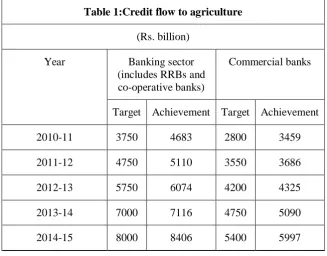
In June, 2004 the Government decided to double the flow of agricultural credit in three years with reference to base year 2003-04. An annual target for ground level agriculture credit by Scheduled Commercial Banks, Cooperative Banks and Regional Rural Banks (RRBs) has been decided by the Government to promote the agriculture sector through effective agriculture credit.
The flow of agriculture credit has consistently exceeded the target since the year 2003-04. This is evident from the fact that agriculture credit flow, which was at Rs.86,981 crore in the year 2003-04 reached to Rs.4,68,291 crore in 2010-11. As against the annual target of Rs.4,75,000 crore was fixed for the year 2011-12, ground level credit disbursement of Rs. 5,11,029 crore was achieved (registering 107 per cent of the target). During the year 2012-13, as against the annual target of Rs.5,75,000 crore, achievement/credit disbursement was Rs.6,07,376 crore (exceeding 105 per cent of the annual target). The target for the year 2013-14 was decided at Rs. 7,00,000 crore and achievement was Rs. 7,11,621.47 crore. During the year 2014-2015, agricultural credit of 8,45,328.23 crore was disbursed against the target of Rs. 8,00,000 crore. The annual target during the year 2015-16 was fixed Rs.8,50,000 crore and achievement was Rs.8,77,527 crore. The target of Rs. 9,00,000 crorehas been set for the year 2016-17 and a sum of Rs. 10,65,755.67 crore has been disbursed (118.42 per cent of the target). The target for the year 2017-18 was decided Rs. 10,00,000 crore and achievement was 11,685 billion. During the year 2018-19, the Government decided an annual target of Rs. 11,000 billion as an agricultural credit flow.
Table 1:Credit flow to agriculture
(Rs. billion)
Year Banking sector
(includes RRBs and co-operative banks)
Commercial banks
Target Achievement Target Achievement
2010-11 3750 4683 2800 3459
2011-12 4750 5110 3550 3686
2012-13 5750 6074 4200 4325
2013-14 7000 7116 4750 5090
2014-15 8000 8406 5400 5997
Table 2:Targets and Achievements for Agricultural Credit
(Rs. billion)
Year Commercial Banks Co-operative Banks RRBs Total
Target Achievement Target Achievement Target Achievement Target Achievement
1 2 3 4 5 6 7 8 9
2016-17
6,250 7,998 1,500 1,428 1,250 1,232 9,000 10,658
2017-18 *
7,040 8,772 1,560 1,504 1,400 1,410 10,000 11,685
*:Provisional.
Note: Figures might not add up to the total due to rounding off of numbers. Source: https://rbi.org.in/ 6. Issues in Agricultural credit flow
6.1 Farmers‘ suicide
As per the Agriculture Census (2010-11), 117 million (85 per cent) farming holdings out of the 138 million are small and marginal holdings in the country. During the year 1970-71, the number of farmers holding marginal sized land were 36 million, which rose to 93 million in the year 2010-11, which highlights that due to hereditary practices, lands are continuously fragmented. Small farm holdings result in low labour productivity and more cost due to lack of mechanization. Small and fragmented holding farmers face agrarian stress as their income get reduced due to heavily dependence on middlemen to sell their agriculture produce. As per National Crime Records Bureau, from the year 2000 to 2012, more than 2,14,000 farmers of the country committed suicide.
6.2 Dependence on non-institutional credit
The major proportion of small and marginal farmers is dependent on non-institutional sources of credit. The banking sector is still averse to small borrowers who are seen as higher risk. One of the main reasons of the agrarian distress among the farmers istheir excessive dependence on noninstitutional sources that charges high interest rates.
6.3 Excessive cost
The cost in terms of various schemes and relief packages announced by the Government, loss of human life due to suicides is very high. For example, during theyear 2006, Prime Minister‘s agricultural relief package amounting to Rs. 17,000 crore and in 2007, under the agricultural loan waiver scheme with an estimated cost of more than Rs. 60,000 was given to provide relief to farmers.
6.4 Indebtedness of farmers
23
International journal of Management, IT and Engineeringhttp://www.ijmra.us, Email: [email protected] indebtedness is inverse proportionate to their land holdings. According to survey findings, in case the land holding is less than 0.01 hectares, then credit from formal banking institutions is accessed by only 13 per cent farmers, while 64 per cent access credit from private moneylenders and in case, the landholding is more than 10 hectares, over 60 per cent of rural households borrow credit from formal banking institutions, and only 16 per cent access credit from private moneylenders.
6.5 Other reasons
Disparity in credit flows among the villages, districts and states, the problem of non repayment of the loan by the marginal farmers also create hindrance in the agricultural credit flows.
7. Initiatives taken by the Government to increase agricultural credit flows
7.1 Kisan Credit Card Scheme (KCC)
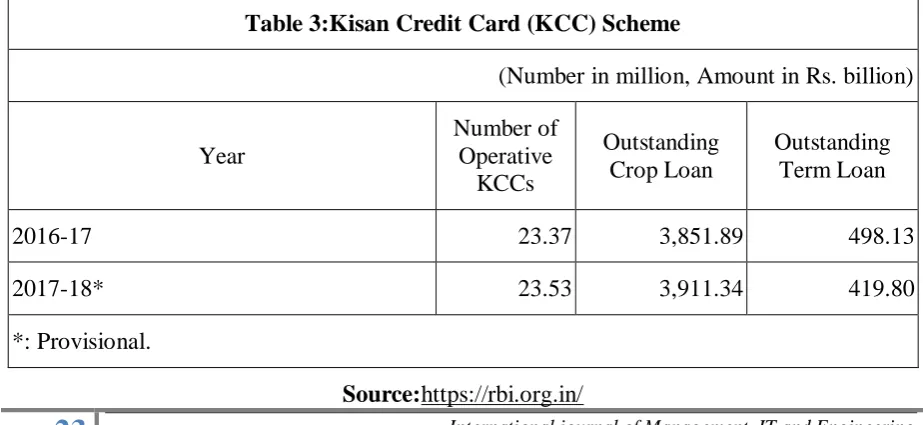
During the year 1998-1999, to ensure timely and adequate credit support fromthe banking system to the farmers for their agricultural operations, an innovative credit delivery system known as Kisan Credit Card (KCC) scheme was introduced. The scheme is being implemented by all Regional Rural Banks (RRBs), Cooperative Banks and Public Sector Commercial Banks. Under this scheme, oral lessee, sharecroppers, tenant farmers and marginal farmers are eligible to be covered. Monitoring of the scheme in respect of Commercial Banks is done by RBI, whereas scheme in respect of Cooperative Banks and RRBs is monitored by NABARD. To provide short term credit for post harvest expenses,cultivation of crops, farmer households‘ consumption requirement, working capital for agriculture allied activities such as inland fishery and dairy animal, sprayersare the aim of this scheme. In 2012, RBI and NABARD circulated the revised scheme for Kisan Credit Card. On 31st March, 2016 the cumulative number of live KCCs issued by Cooperative banks, Commercial banks and Regional Rural Banks were 752.72 lakh. On 31st December, 2016 the Prime Minister makes an announcement that under Rupay Kisan Credit Cards, 3 crore Kisan Credit Cards would be covered within next three months. The total number of 3.71 crore Kisan Credit Cards were converted to Rupay Kisan Credit Cards (RKCCs) on 31st March, 2017 and 4.70 crore KCCs were converted on 3rd January, 2018. The progress of the Kisan Credit Scheme for the last two years is presented in the table.
Table 3:Kisan Credit Card (KCC) Scheme
(Number in million, Amount in Rs. billion)
Year
Number of Operative
KCCs
Outstanding Crop Loan
Outstanding Term Loan
2016-17 23.37 3,851.89 498.13
2017-18* 23.53 3,911.34 419.80
*: Provisional.
7.2 Financing of Joint Liability Group (JLG)
During the year 2005-06, NABARD started the scheme of financing of Joint Liability Groups of tenant farmers.From the year 2009 onwards, JLGs extended to non-farm sectors. A Joint Liability Group (JLG) is an informal group of 4 to 10 people belongs to similar locality and socioeconomic background, and coming together for the purpose of availing loan from a bank against the mutual guarantee on an individual basis or through group mechanism. It serves as collateral substitute for providing credit to small and marginal farmers, tenant farmers, oral lessee, landless labourers and artisans. It also builds confidence between groups and banks and mitigate the credit risk in the loan portfolio for the banks by way of group dynamics, peer education, cluster approach and credit discipline. JLGs facilitate technology dissemination in activities such as testing of soil, providing common access to market information. During the Union Budget announcements in 2014-15, Bhoomi Heen Kisan Scheme was launched by the Indian Government with the aim of financing 5 lakh Joint Farming Groups (JFGs) through NABARD. On 30th September, 2016 total number of JLGs financed were 18.21 lakh and Rs. 18005.79 crore as total loan amount was provided.
7.3 Relief Measures for Natural Calamities
Widespread damage to standing crops is caused by the periodical occurrences of natural calamities. It also takes a heavy toll of human lives in some parts of the country. Such devastation due to natural calamities calls for massive rehabilitation efforts by all agencies (including banks). During the year 2017-18, natural calamities were declared by five states, viz., Andhra Pradesh, Rajasthan, Madhya Pradesh, Odisha and Gujarat. In order to capture the data on relief measures extended by banks, a dedicated portal was developed. During this tenure, as per RBI reports, a total of Rs. 13.68 billion finance was provided against 10,000 account holders as relief measure for natural calamities.
Table 4:Relief Measures for Natural Calamities
(Number in million; Amount in Rs. billion)
Year Loans restructured/
rescheduled
Fresh finance/
Relending provided No. of
accounts
Amount No. of
accounts
Amount
2017-18* 0.10 11.88 0.48 13.68
*: Provisional.
Source:https://rbi.org.in/ 7.4 Digitization of land records
25
International journal of Management, IT and Engineeringhttp://www.ijmra.us, Email: [email protected] been created.
7.5 Interest subvention to farmers
An interest subvention scheme of 2 per cent per annum for providing short term crop credit to farmers upto Rs. 3 lakh at 7 per cent rate of interest, introduced by the Government of India to make the availability of agricultural credit at reasonable cost. Under this scheme, the calculation of 2 per cent interest subvention will be made on the amount of crop loan commencing from its disbursement/ withdrawal up date to the actual repayment date of the crop loan by the farmer or up to the due date of the loan decided by the banks, whichever is earlier, subject to a maximum period of one year. For making prompt repayment of loans, an additional interest subvention of 1 per cent was announced in the budget of 2009-10 by the Government of India. During the year 2010-11, this rate was raised to 2 per cent. Since 2011-12, interest subvention rate of 3 per cent was continued.Now, this scheme has been transferred to Department of Agriculture, Cooperation and Farmers Welfare.
8. Conclusion
After going through the data available in different reports, the flow of agricultural credit is increasing consistently over the years. But, till now, inadequacy of credit, persistence of money lenders are major concerns in rural credit market. However, many initiatives like set up of the Rural Infrastructure Development Fund(RIDF), Short Term Cooperative Rural Credit (Refinance) Fund, Producers Organization Development and Upliftment Corpus (PRODUCE) Fundare being taken by the Government of India. Consequently, positive impacts of all these initiatives are found on agricultural credit flow. Furthermore, the Government of India has to put forward various schemes for farmers as well as the stakeholders who are directly and indirectly linked with agriculture so that all of them can take the benefit of different schemes launched through financial inclusion.
References-
Abdullah, Zhou, D., Jebran, K., Ali, A., & Khan, S. A.. (2015). Agricultural Credit in Pakistan: Past Trends and Future Prospects. Journal of Applied Environmental, 5(12), 178-188.
Golait, R. (2007). Current Issues in Agriculture Credit in India: An Assessment. Reserve Bank of India Occasional Papers, 28(1), 79-99.
Mahendra, D. S. (2006). Financial Inclusion: Issues and Challenges. Economic and Political Weekly, 41(41), 4310-4313.
Mohan, R. (2004). Agricultural Credit in India: Status, Issues and Future Agenda. Reserve Bank of India Bulletin, November, 993-1007.
Rahman, M. W., Luo, J., & Cheng, E. (2011). Policies and Performances of Agricultural/Rural Credit in Bangladesh: What is the Influence on Agricultural Production? African Journal of Agricultural Research, 6(31), 6440-6452.
https://en.wikipedia.org/wiki/Joint_Liability_Groups
PLASTIC MONEY: A WAY OF CASH LESS ECONOMY
ANUJ BHARDWAJ1
ASTT.PROF. IN COMMERCE
MAHARAJA AGRASEN COLLEGE, JAGADHRI
KAMAL KISHORE2
ASTT.PROF. IN COMMERCE
MAHARAJA AGRASEN COLLEGE, JAGADHRI
ABSTRACT
Money is the medium of exchange. Initially barter system was used as important method of payment. Over a year, money has changed from coins to paper cash and today it is available in plastic cards (debit and credit card) due to technological advancement. Plastic money is referring to credit or debit card that we use to make the payment. In present era, it is impossible to imagine modern bank transaction and other payment without using plastic cards. Plastic money is an important way of cash less economy. The study revealed that in modern word, plastic money is important for customers. Majority of people use plastic cards due to convenience and easy portability. They feel safe by using plastic cards.Plastic money is now becoming a necessity across the globe. It is very useful at distant places due to its accessibility at each and every place. It is a part of E- Banking. The present papers make an attempt to understand the consumer preference and attitude towards the use of plastic money. In this paper, data was collected through the primary as well as secondary sources. Primary data are collected through a structured questionnaire with a sample size of 50 respondents. Keywords: Plastic money, Credit card, Debit card, E- Banking
Introduction
27
International journal of Management, IT and Engineeringhttp://www.ijmra.us, Email: [email protected] OBJECTIVE OF STUDY
To study the awareness regarding use of plastic money among the consumers To study the reasons for preference of plastic money
To study the benefit of debit and credit cards Data Collection
Primary and secondary sources are used for data collection. Primary data has been collected from survey questionnaire. Secondary data will be collected from different website, books, internet and past research paper.
Sample
The target population of my study is individual customers of bank. Data is collected from 50 respondents with the help of structured questionnaire. While selecting a respondent, due importance was given to various factors such as age, sex and education etc.
Types of Plastic Cards
1. ATM cum Debit Card:
Debit cards are designed for customers who like paying by card but do not want credit. A debit card is a plastic card for payment of purchases. Functionally, it is similar to writing a cheque as the funds are withdrawn directly from either the bank account or from the remaining balance on the card. The debit card is thus ideal for those who have a tight budget and want to keep within it. There are two types of debit cards systems namely:
• On-line debit cards • Off-line debit cards
On-line Debit Cards: Making a purchase with an online debit card is similar to withdrawing cash from an Automated Teller Machine (ATM). The card has a magnetic reader, which is connected by a phone to a computer. PIN is used for verification and computer verifies the PIN and checks to see if one has enough money in the bank to cover the transaction, all of which will not take more than a few seconds.
Off-line Debit Cards: Off-line debit cards work more like cheques, because there is no direct connection between store and bank.
2. Credit Card
A credit card is again a plastic card to purchase goods, travel and dine in a hotel or other services without making immediate payments. The holders can use the cards to credit from banks up to 45 days. The credit card relieves the consumer from botheration cash and ensures safety. It is a convenience without formality. Different types of Credit Cards:
• Master Card & Visa:
• Smart Card:
A smart card is a chip card, or ICC (Integrated circuit card), which is any pocket-sized card that has included integrated circuits. These are made of plastic, generally polyvinyl chloride. Smart cards can have contact, contactless, or both. It does maintain records, statements and acts as an electronic purse, storing e-money. It is useable for drawing cash and makes payments with automatic facility of keeping accounts of balances of the party. During a loading operation, the deposit account of card holders is debited and credit is given to a centralized card account.
• Dinner Club Card:
The Dinners club card was invented by Dinner‘s club founder Frank McNamara and it was intended to pay restaurant that would accept Dinner‘s club card. Dinner club would pay the restaurant and the card holder would repay Dinners club.
• Global Cards:
This card allows the customer to access their accounts from anywhere and at any time conveniently. They need not carry cash; instead they can use the Bank‘s global Debit card that combines the benefit of traditional ATM card and a credit card.
• Agricultural Card:
Agricultural card is otherwise known as Kissan Credit Card. These are made to provide the financial assistance to farmers. The coverage of the help extended to all farmers and to improve the credit flow under agriculture, the scheme has extended to farmers for term credit as also working capital for agriculture and allied activities and a reasonable component for consumption needs, thus, paving the way for acceptance of Kissan Credit card as a single window for comprehensive credit. The banking system has been routing crop loans through Kissan Credit Cards having recognized it is as a accepted mechanism delivery of credit to farmers.
Advantages of Plastic Money
There are various advantages of plastic money. The advantages include:-
1. Abolish the need for carrying huge cash: This remove the need for carrying huge load of cash which is risky and inconvenient too.
2. Minimizing the risk of loss or theft: In case of cash there is a high risk of losing cash and a chance of cash getting stolen. On the other hand in case of debit-credit card you can report the matter to the bank and block the card to avoid misuse.
3. Mobile Access:- Using cards you have the unique advantage and convenience of using it anywhere and anytime in the country or even abroad.
4. Lent Facility: In case of credit card you have the option of buying on credit and paying later for it. The charges are high but it helps in case of emergencies and contingencies.
29
International journal of Management, IT and Engineeringhttp://www.ijmra.us, Email: [email protected] Disadvantagesof Plastic Money
I. Non-Acceptance at Small Retail Outlets
If you are not a person who shops only in supermarkets, hypermarkets and departmental stores you will be forced to use cash
II. Cannot be used for all daily needs
You cannot pay your milkman, servant, newspaper guy, etc by card. III. Loss & Misuse
If your card is lost you have to immediately report about it and get the card blocked to avoid misuse. Sometimes when you have no knowledge that you lost the card the chances of misuse is higher.
IV. Low Value Transactions
There are some cases where small sized retailers don‘t accept cards for low value transactions (say less than Rs.200). You may have noticed this even in case of petrol pumps and
restaurants. V. Service Charges
In some cases the service provider charges additional service charges for cards. So this can be another pressure on your pocket.
VI. Damage to Card
Sometimes the card‘s gets damaged, scratches or cuts which can render the card unusable. So keeping it safe and secure is very important and necessary.
Plastic Money – Present Scenario
E-Finance:
With the introduction of internet and opportunities it has provided, new product and services are emerging that set to change the way we look at money and monetary systems. Smart Card which can store account balances and update the same periodically can be useful to customer for payment of various types of utility bills and can function like electronic purses.
Banking:
There has been talk for some time that physical cash, notes and coins will become a thing of past and digital cash, electronically held value will become the norms. Telephone banking and bill payment are just couples of examples. The emergence of plastic money can throw.
Issues and Challenges faced by Banks
Business Issues:
Privacy Issues:
What are the laws, Rules and Regulations governing Privacy issues? Are the data collection and data maintenance agreements?
Security Issues
What security measures are being employed?
What Electronic authentication, Signature and Certification Systems will be used?
Regulatory issues: What should be
Capital Requirements? Liquidity Requirements? Reporting Requirements? Privacy Policies?
Taxation?
Control over Supply of E-Cash?
DATA INTERPRETATION AND FINDINGS
1.
Gender of respondents.
options
No of respondents
percentage
Male
37
52.9%
Female
33
47.1%
31
International journal of Management, IT and Engineeringhttp://www.ijmra.us, Email: [email protected] 2. Age of respondents
options
No of respondents
percentage
Below 18 11 15.5%
18-36 57 80.3%
Above 36 3 4.2%
total 71 100
3. Education qualification
options
No of respondents
percentage
Secondary 26.8%
Under graduate 31%
Post graduate 42.3%
4. Do you have debit and credit cards?
options
No of respondents
percentage
Yes 64.8%
No 35.2%
total 71 100
5. How frequently do you swipe your cards?
options
No of respondents
percentage
Daily 7 10.8%
Weekly 18 27.7%
Monthly 14 21.5%
Rarely 26 40%
33
International journal of Management, IT and Engineeringhttp://www.ijmra.us, Email: [email protected] 6. According to you which method is easy to pay?
options
No of respondents
percentage
Cash 15 21.1%
Card 23 32.4%
Both 33 46.5%
7. For which purpose you use cards?
options
No of respondents
percentage
Electricity 2 3.2%
Phone bill 1 1.6%
Banking 5 8.1%
Railway booking 1 1.6%
Only withdraw 10 16.1%
Any other purpose 6 9.7%
All of the above 37 59.7%
Total 62 100
8. Benefits of plastic money?
options
No of respondents
percentage
Easily carry 2 3.1%
Easy to pay 4 6.3%
Security 4 6.3%
Less time consuming 8 12.5%
Added benefit 00 00
All of the above 46 71.9%
35
International journal of Management, IT and Engineeringhttp://www.ijmra.us, Email: [email protected] 9. Are you satisfied with use of cards?
options
No of respondents
percentage
Yes 63 91.3%
No 6 8.7%
total 69 100
10.Satisfaction level
options
No of respondents
percentage
Highlysatisfied 39 59.1%
Quite satisfied 27 40.9%
11.Problems you faced while using cards?
options
No of respondents
percentage
Insecurity 10 21.3%
Fear of loosing 8 17%
Unnecessary formalities 4 8.5%
Other reason 16 34%
Non availability of cash at ATMs
9 19.1%
Total 47 100
Conclusion
37
International journal of Management, IT and Engineeringhttp://www.ijmra.us, Email: [email protected] cut their usage cost. There are some challenges for issuers. Most of challenges faced by bank is non availability of ATMs. The growth of banking industry depends upon appropriate use of plastic cards and banks should meet challenges and make use opportunities profitably. There should be E-finance system used effectively so that issuers can able to meet challenges faced for issuing Plastic Cards and to meet Competitive edge for success in plastic card business. Above all, interest of customer is of foremost importance.
References
Dr Gurpreet kaur and Mrs. Rashmi Sharma (2017) plastic money- A way forward for cashless transactions, IOSR journal of business and management, pp 15-18
K. Neelavathi, Ramya Chavali, Uttej Rao; A atudy on impact of usage of plastic money in India, IOSR journal of business and Management pp 64-69
https://www.wisdomtimes.com/blog/plastic-money-pros-and-cons/
H.R. Suneja 1994, Innovation in Banking Services, Himalaya Publishing House, pp.1-20. [ Hajela Tanu, Dubey Rakshita, Nair Praveen, Bisht Anisha, march 2015, ―Analysis of the use
of Plasitc Money. A boon or a bane. ― SiMS Journal of management Research Volume No.1. Jarunee Wonglipiyarat 2007, ―E-Payment Strategies of Banks Card Innovations‖. Journal of