Abstract—Human performance model (HPM) is an attempt
to integrate and study the factors, and aspects influence the performance of a human during performing a job. Unfortunately, human factors and performance were left behind and be considered as independent factors with very fewer contributions to the system performance. The understanding of human performance will enable the analysis of potentially conflicting task demands in organized and structured ways as the earliest stages in a design. This paper is to address the importance of human performance to be considered in the transportation industry. Three keys human performance models were reviewed and presented for better understanding and to compare various factors influences the performance of a human.
Index Terms—Human performance, human performance
model, transportation, driver safety.
I. INTRODUCTION
Performance of the job and system are very valuable elements for achieving higher quality output and services. However, factors affecting performance of a human were not well understood either by researchers or engineers [1]. Human factors and performance were left behind and leaved as independent factors with very fewer contributions to the overall system performance [2]. In transportation industry, they're more studies on how the accident happened, new design of cockpit, fatigue, sleep behavior, etc.; but yet leaved as an individual study without integrating it by understanding other influential factors. As a result, performance modeling software which typically used in manufacturing sectors has a limitation on the ability to adequate model the people’s behavior (human factors)[3].
Recently, more investigations were conducted on human performance factors; it includes from the air traffic control system, design process at the factories, train driving activities and ship navigation [1, 3-5]. Awareness and better understanding on the importance of human performance are increasing and consideration on the influential factors came earlier. It will enable the analysis of potentially conflicting task demands in organized and structured ways as the earliest stages in a design [6]. However, past practices showed the study was conducted when the system was implemented and
Manuscript received February 20, 2012; revised March 29, 2012. This work is supported by the UM Research University Special Grant.
Mohd Azlis Sani and Siti Zawiah Md Dawal are with the Department of Engineering Design and Manufacturing, University of Malaya (e-mail: [email protected], [email protected]).
Norhayati Mohd Zakwan is with the Department of Management, Faculty of Management and Human Resource Development, Universiti Teknologi Malaysia, Johor Malaysia (e-mail: [email protected]).
factor ignorance such as workload, fatigue established. This previous approach may lead to cost increase due to design amendment, human and sleep problem, and risk level increment [7-11].
This paper is to address the importance of human performance to be considered in the transportation industry. Three keys human performance models are reviewed and to compare various factors influences the performance. With this review, commonality and differences can be listed with most consideration on transportation industry and environment.
II. HUMAN PERFORMANCE MODELS
Human performance model is an attempt to integrate as much as the researcher could consider and study the factors, and aspects influencing the performance of a human. The model also becomes the easier and simpler representation of every item involved in the consideration. Very fewer numbers of researchers included factors affecting performance in a whole package, mostly choose to study in separate issues or factors; which will be more focus and details. Therefore, this research ultimate aim is to integrate every single factor affecting performance of a human (employees) in transportation industry. While as the beginning, this paper intends to discuss some existing performance models, which referred as basic models of human performance. We will discuss the performance model by Bailey (19), Baines et al. (2005) and Chang and Yeh (2010).
A. Bailey’s Model [12]
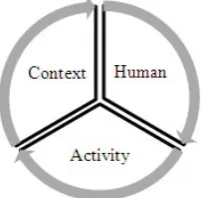
Bailey [12] proposed three elements required to predict human performance. The elements are a) understanding of the human, b) the activity being performed and c) the context in which it is performed as depict in Figure 1. In this generic model, human become major element, which influences the overall performance either positively or negatively.
Human includes complex system of sensors, brain
processing and responders, which affect the wide range of capability. In this very generic model, sensors include vision and hearing; the ability to think, reasoning and decision making for brain processing and arms, fingers and a mouth that functioned as responders.
System designer may propose the best design but do not have much control on user (human). Alternatively, they could control certain conditions on their designated activities. Factors affecting activity, which has potentiality to degrade performance, should be recognized by the designers. Bailey’s model final consideration is context; which the particular activity is performed by a human. There will be a very
Human Performance in Transportation A Comparative
Study of Human Performance Models
significant different when the same activity performed in dissimilar place and weather, which refer as context. In conclusion, Bailey through his fundamental model correlates every aspect for better understanding of human performance; with try to avoid considering only certain part of human.
Fig. 1. Bailey’s basic model of human performance
B. Chang’s Extended SHEL Model [2]
Chang et al. [2] examines interactions of interfaces in air traffic control (ATC) by using extended SHEL model to describe ATC practice systematically. Original SHEL model was introduced by Edwards (1972) had been used by the International Civil Aviation Organization (ICAO) to understand human performance factors in aviation safety. A complete system operates when each of components interacted with each other. The effect of these interactions is provided by the SHEL model, includes L (liveware – human), S (software – rules, procedures, computer programs, symbiology, etc.), H (hardware – machine) and E (environment – the situation in which other components must function). Chang et al. described the components (S,H,E and L) as the human performance factors while the interactions between human performance factors as the human performance interfaces of the SHEL model.
In this extended model, Chang et al. include the organisational aspects as an effort to understand the nature of human error without any aspects left behind. They tested the liveware (human) component interactions with other components; and highlighted, interactions between controllers and the organisation in managing human performance play a significant role. In conclusion, individual differences or peer influences have fewer relevant roles compared to organisation influences when interact with the software (S), hardware (H) and environment (E) of the ATC system as shows in Figure 2.
Fig. 2. The structural model for extended SHEL research model
C. Baines Et Al. Theoretical Framework [1]
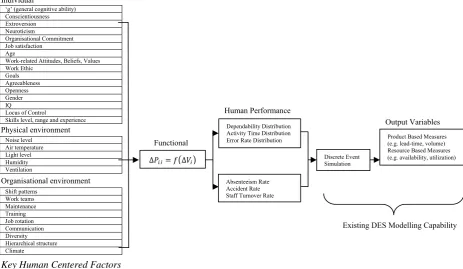
The human performance modeling framework as depict in Figure 3 developed theoretically for manufacturing system designs by Baines et al.(2005)[1]. During the process of manufacturing system design, this framework will enable human performance modeling. It is important to identify influential factors during the design process as many factors can be easily and inexpensively modified. However, awareness on the impact of human factors needs to be improved, which previously the engineer frequently overestimating how efficiently or effectively their employees will work. As the result, this framework provides the basis for a modeling tool that facilitates the assessment of key human factors early in the process of manufacturing system design. An extensive review had been conducted on a variety of existing theoretical frameworks and obviously simpler framework is needed with consideration on human factors. As work performance relates to a wide range of physical and psychosocial factors, they screened and identified 65 potential factors, which later refer as key human centered factors through over 800 references. The factors were classified into three categories; a) individual factors, b) physical environment and c) organizational environment. This is a qualitative representation of manufacturing worker performance where a functional relationship is at the final element of the framework. It will describe the effects on the performance measures of changes in the key variables.
III. COMPARISON OF MODELS
Three basic models on human performance discussed previously; seem at first sight to be quite similar, but the similarities not clearly shown when the comparison is just based on the ‘component title’ and not the contents of the components. ‘Influential factors’ of Baines et al. [1] framework and interfaces in extended SHEL model by Chang and Yeh [2] were compared and matched side by side with existing major components of Bailey’s [12] basic model. However, by understanding the terms used to describe the components actually reveal substantial direct similarities. Such comparison has enabled the authors to compare and identify similarities the models as in Table 1.
Bailey introduced three main components. His model tries to represent overall factors, which affect the performance of a human as general. Human performance generic model as proposed by him focus on three major components; human, tasks or activities performed by a human and the context. It is straightforward with consideration on three different components with strong interactions that results from the performance of a human. Later, the needs, understanding and awareness on importance of human performance criteria enhanced the study on this topic [13-15]. From the basic and generic model, the advancement proposed more precise and details' criteria to be discussed.
Chang and Yeh [2] using a conceptual model of ergonomics (SHEL model) proposed by Edward (1972); continuity from an effort by ICAO to understand human performance factors in aviation safety. Chang extended SHEL model with an additional ‘liveware-organisation’ interface in regard to address importance of organisational factors to the human performance.
Main factor of human performance studies is the human itself. Bailey named it as ‘human’, Baines et al. termed it as ‘individual factors’ while Chang and Yeh (Edward, 1972) referred it as ‘liveware’. Bailey pointed that human includes a complex system of sensors (vision and hearing), brain processing (the ability to think, reasoning and decision making) and responders (arms, fingers and a mouth). These
are the basic and fundamental components of a human that performs the job and reacts with the environment. Whilst, ‘invidual factors’ by Baines et al. contains six major categories - personality, demographics, physiology, cognition, motivation and skills; which has a detail list of factors affecting human performance in the human component. Though ‘human’ component in extended SHEL model comprises ‘liveware’ and interface of ‘liveware – liveware’. Liveware considered personal attributes of the individual; similar to ‘individual factors’. ‘Liveware – liveware’ interface refers on the relationships between workers (controllers) that are characterised by social psychological aspects of the team, including cooperation, teamwork, leadership, and personality interactions.
Fig. 3. The human performance modeling theoretical framework
TABLE I: TABLE OF MODELS’ COMPARISON
Bailey et. al [12] Baines et. al [1] Chang and Yeh [2]
Human
• includes complex system of sensors, brain processing and responders
• sensors - vision and hearing;
• brain processing - the ability to think, reasoning and decision making
• responders - arms, fingers and a mouth
Individual
• ‘g’ (General cognitive ability)
• Conscientiousness
• Extroversion
• Neuroticism
• Organizational commitment
• Job satisfaction
• Age
• Work-related attitudes, beliefs, values
• Work ethic
• Goals
• Agreeableness
• Openness
• Gender
• IQ
• Locus of control
• Skills, level, range and experience
• Lifestyle
• Sleep patterns
• Health
• Biorhythms
• Circadian rhythms
• Family status
• Education
• Strength/stamina
• Attention
• Concentration
• Ethnicity
• Religion
• Adaptability
• Schemas
• Diet
• Agility/dexterity
• Analytic/creative
• Form
Liveware
• personal attributes of the individual controller, including knowledge and experience, attitude and behaviour, situation awareness, decision making skills, and health.
Liveware – liveware
• the relationships between workers (controllers) that are characterised by social psychological aspects of the team,
• including cooperation, teamwork, leadership, and personality interactions.
Activity
• Activity being performed by a human
Specific job/task which determined earlier Tasks’ performed by workers
∆ = ∆
Dependability Distribution Activity Time Distribution Error Rate Distribution
Absenteeism Rate Accident Rate Staff Turnover Rate
Discrete Event Simulation
Product Based Measures (e.g. lead-time, volume) Resource Based Measures (e.g. availability, utilization) Individual
Physical environment
Organisational environment
Functional
Human Performance
Output Variables
Existing DES Modelling Capability
Key Human Centered Factors
‘g’ (general cognitive ability) Conscientiousness Extroversion Neuroticism
Organisational Commitment Job satisfaction Age
Work-related Attitudes, Beliefs, Values Work Ethic
Goals Agreeableness Openness Gender IQ
Locus of Control
Skills level, range and experience
Noise level Air temperature Light level Humidity Ventilation
Context
• place, time and environment of the particular activity is performed by a human
• e.g. : there is a very significant different when the same activity performed in different place and weather
Physical environment
• Noise level
• Air temperature
• Light level
• Humidity
• Ventilation
• Carbon monoxide
• Ozone
• Vibration frequency
• and intensity
• Daylight/(full spectrum light
• Carbon dioxide
• Noise frequency
• Oxygen
• Light frequency/colour
• Noise duration
• Lighting/glare
• Lighting/reflections
• Noise predictability/constancy
Liveware – environment
• the interaction between the controller and the operating environment in which the tasks are performed
• including workplace design, noise, temperature, lighting, air quality, and relaxation settings.
Liveware – hardware
• referred to as the human–machine interface/ interaction
• interaction between the workers and the physical aspects of the system that are provided to perform tasks,
• including monitor and control equipment, automation facilities, maintenance and recovery facilities, and visual facilities.
Organisational environment
• Shift patterns
• Work teams
• Maintenance
• Training
• Job rotation
• Communication
• Diversity
• Hierarchical structure
• Climate
• Leadership
• Payment systems
• Recruitment/orientation
• Employment security
Liveware – organisation
• the interaction between the controller and the
organisational aspects of the system
• including workload allocation, organisational structure, policies and rules,
communication, safety culture, and training.
Liveware – software
• the interaction between the controller and the non-physical aspects of the system that are required to perform tasks,
• including procedures, rules, checklists, documentation, maps and charts, and computer software.
IV. CONCLUSION
It is important for us to understand factors affecting performance of a human before proceed to the detail's investigation on each of the factors. There is a possibility of focusing on fewer relevant and significant factors. Less consideration to address potential and influential factors affecting performance of a driver may lead the researcher only focus on a particular factor and disregard possibilities of other factors. Our hope that, this study gives some information and ideas to other researchers regarding factors and aspects to be focus and integrate when considering ‘human’ component. It also becomes a starter for a better understanding of human performance in transportation in a year to come especially in Malaysia.
ACKNOWLEDGMENT
The main author is currently on study leave at University of Malaya and supported by the Universiti Tun Hussein Onn Malaysia and Ministry of Higher Education, Malaysia. We also would like to thank Department of Safety, Health and Environment (OSHEN), Keretapi Tanah Melayu Berhad (KTMB) on their contribution and participation in this study.
REFERENCES
[1] T. S. Baines, et al., Towards a theoretical framework for human performance modelling within manufacturing systems design. Simulation Modelling Practice and Theory, 2005. vol. 13, no. 6, pp. 486-504.
[2] Y. H. Chang and C. H. Yeh, Human performance interfaces in air traffic control. Applied Ergonomics, 2010. vol. 41, no. 1, pp. 123-129. [3] S. Mason, et al., Improving the Design Process for Factories:
Modeling Human Performance Variation. Journal of Manufacturing Systems, vol. 24, no. 1, pp. 47 - 54. 2005.
[4] B. F. Gore, and J. D. Smith, Risk assessment and human performance modelling: the need for an integrated systems approach. International Journal of Human Factors Modelling and Simulation, vol. 1, no. 1, pp. 119-139. 2006.
[5] K. S. Gould, et al., Effects of navigation method on workload and performance in simulated high-speed ship navigation. Applied Ergonomics, 2009. vol. 40, no. 1, pp. 103-114.
[6] T. Clarke, , The Ergonomics Programme at Network Rail, in Rail Human Factors: Supporting the Integrated Railway, J.R. Wilson, et al., Editors. 2005, Ashgate. pp. 19 - 21.
[7] J. Dorrian, et al., The effects of fatigue on train handling during speed restrictions. Transportation Research Part F: Traffic Psychology and Behaviour, 2006. vol. 9, no. 4, pp. 243-257.
[8] J. Dorrian, et al., Simulated train driving: Fatigue, self-awareness and cognitive disengagement. Applied Ergonomics, 2007. vol. 38, no. 2, pp. 155-166.
[9] S. M. Jay, et al., Driver fatigue during extended rail operations. Applied Ergonomics, 2008. vol. 39, no. 5, pp. 623-629.
Driving. Global Journal of Health Science, vol. 2, no.1. 2010. [11] D. Darwent, N. Lamond, and D. Dawson, The sleep and performance
of train drivers during an extended freight-haul operation. Applied Ergonomics, 2008. vol. 39, no. 5, pp. 614-622.
[12] R. W. Bailey, Human performance engineering : designing high quality, professional user interfaces for computer products, applications, and systems. 3rd ed. 1996, New Jersey: Prentice Hall. [13] J. R. Wilson and B. J. Norris, Rail human factors: Past, present and
future. Applied Ergonomics, 2005. vol. 36, no. 6, pp. 649-660. [14] David j. Oborne, R. B., Fernando Leal, Pat Shipley, and Tom Stewart,
Person - Centred Ergonomics : A Brantonian View of Human Factors. 1993: Taylor and Francis.
[15] M. Shahrokhi and A. Bernard, A framework to develop an analysis agent for evaluating human performance in manufacturing systems. CIRP Journal of Manufacturing Science and Technology, vol. 2, no. 1, pp. 55-60. 2009.
Azlis Sani Jalil is an academic staff at Universiti Tun Hussein Onn Malaysia (UTHM) Johor. He received his B.Eng. (Hons.) Mechanical Engineering from Universiti Sains Malaysia and M.Eng (Manufacturing) from University
of Malaya. Currently doing his Ph.D in Ergonomics at Department of Engineering Design and Manufacturing, Faculty of Engineering, University of Malaya.
Dr. Siti Zawiah Md Dawal is an Associate Professor at Department of Engineering Design and Manufacturing, Faculty of Engineering, University of Malaya. She also a Director of Center for Product Design and Manufacturing. Graduated her degree in BEng(Hons) Comm Eng. from Leeds Metropolitan University, MSc (Manufacturing System Engineering) from Warwick University, UK and Ph.D. in Industrial Ergonomics from University of Malaya, Malaysia.