
e-ISSN: 2278-7461, p-ISSN: 2319-6491
Volume 5, Issue 5 [May 2016] PP: 29-38
Control Systems in Robotics: A Review
Anood Ibrahim
1, Reba Rachel Alexander
1,
Mohammed Shahid Umar Sanghar
1, Royson Donate D‟Souza
21 Student, Department of Mechatronics Engineering, Manipal University, Dubai, UAE.
2Assistant Professor, Department of Mechatronics Engineering, Dubai, UAE.
Abstract : Every robot system is created and modified so as to be able to perform the required function. Control systems allow for the movement and function of various parts of the robot, as well as execute a specific set of motions and forces in the presence of unforeseen errors. Teamwork is also essential in Robotics. The level of interaction between human and machine decides how versatile and adaptable the robot is.
This Paper discusses existing and upcoming types of Control Systems and its implementation in Robotics, and also discusses the role of Artificial Intelligence in Robotics. It also aims to highlight the various issues revolving around Control Systems and the various ways of fixing it.
Keywords: control, systems, robotics, mechatronics, AI, RFID, GA, fuzzy logic, Neural network
I.
INTRODUCTION
A control regulates the behavior of other sub-systems. It needs to have all the knowledge about the current and subsequent stages of all systems that it controls. A Control System has two loops – open and closed. Robotic systems are now widely implemented in “Smart Manufacturing”.
Robotics found one of its first applications in the machine tool industry. Back then, the robots were designed to have a stiff-hand mechanism with each joint controlled separately as a SISO linear system. Besides that, there was a Point-to-Point Control system in place for tasks such as material transferring, and Continuous-path tracking system to carry out tasks such as welding and spray-painting. [1]
In today‟s world, robot control systems have greatly advanced in terms of technique, and vision systems have increased the purpose of robots. Layering the Control System helps increase the ability and flexibility of the robot.
Human-robot teamwork have a crucial part in enhancing the efficiency of the mechanism in robots. Many complex tasks are achieved in real time by autonomous mobile robots. Modern-day robotic control systems have revolutionized the production industry, making it super versatile and user-friendly.
PID controllers are used in more than ninety percent of the industrial controllers. This is mainly because it allows for a variety of tuning rules that have been proposed in relevant literature, and most of these controllers can be adjusted on-site by using these rules. Some controllers may also feature on-line automatic tuning capabilities and automatic tuning methods. Improvised form of PID control, like multi-degrees of freedom PID control and I-PD control, are used in the industry.
There have been massive advancements in the region of Artificial Neural Network (ANN), Fuzzy Logic theory (FL), Artificial Intelligence (AI), and evolutionary computational methods like Genetic Algorithm (GA), Particle Swarm Optimization (PSO), etc. are all intelligent computational techniques that have provided us a new array of solutions to problems in different control system.
Linear Quadratic Regulator (LQR) is a modern feedback control method, which uses the state space approach to analyze systems. At the present, the LQR has been used with a combination of PID and FLC to help control a two-wheeled, self-balancing robot.
II.
CONTROL
SYSTEM
FUNDAMENTALS
1. Open Loop
[control system]. The operation of dousing, washing, and flushing in the washer happens on a period premise. The yield, that is, the cleanliness of the garments is not measured by the machine. [2] [ 3]
2. Closed Loop
Control systems with feedback are most commonly known as to as closed-loop control systems. The terms closed-loop control and feedback control are synonymous in nature. In a closed-loop control system the actuating error signal, which is the calculated difference between the input signal and the feedback signal, is fed to the controller in order to reduce the error and stabilize the output of the system by bringing it to a desired value. Closed-loop control reduces system error by always using the feedback control action.
Fig. 1. The closed loop system
Above is a block diagram representing a closed loop system explaining the use of at least one sensor and controller on the basis of the output of a plant. The plant and controller are on the forward direction and the sensor transmits it to the feedback line. The output obtained by the plant is compared with the desired value at the summing point. The difference is sent to the controller which give out a control signal to drive the plant until desired value and the output value are equal. [2][3]
3. Linear Systems
Linear systems are those which follow the basic laws of superposition [2]. This law states that when two distinct functions are applied at the same time, the response given is the consequence of the two individual control system responses. This makes it easy to calculate the response to several input of the linear systems by considering a single input at a given time and adding their outputs. It is this law that builds up complicated solutions to the linear differential equation from simple solutions possible. [2]
III.
TYPES
OF
CONTROL
SYSTEMS
The following methods of control are presented here to control robots.
1. CONTROL USING PID
The relative basic subordinate (PID) control handles distinctive genuine control issues at all intricate however the best way. The three-label (i.e., P, I and D) convenience manages the issues with relentless state and transient responses. The development in automated advancement have made the control system modified conceivable offers an arrangement of choices for control plot, the same controllers can facilitate the PID Controller's straightforwardness, accommodation, pertinence, and clear value.
The two wheeled robot is an open-circle shaky, non-straight and multi yield framework making the fluffy versatile PID controller most appropriate for the application. The fundamental point of this versatile robot was to adjust the robot while it advances to its destination. It takes a shot at the guideline of an altered pendulum. The versatile robot is intrinsically precarious can tend to tumble from its top vertical position with no assistance. It has numerous preferences and requires less space and can without much of a stretch explore around the landscapes. These controllers are not vigorous, so it has inner and outside unsettling influences. The consequences of the exploration demonstrate that the technique has enhanced the strength. This innovation is promising in wide application Prospect. [4]
2. CONTROL USING LQR
linear quadratic controller (LQR) is a procedure in present day control in which utilizes state space way to deal with examine such a system [5]. MIMO outline methodology is the ideal control strategy LQR. The thought is to exchange the architect's cycle on post areas as utilized as a part of full state input to emphases on the components in an expense function [5]. Straight quadratic controller (LQR) is one of the ideal control strategies, which considers the conditions of the dynamical framework and control information to settle on the ideal control choices. [6] An ideal state criticism controller in view of linear quadratic controller (LQR) strategy has been intended for twin rotor multi info multi yield framework. TRMS is a nonlinear framework with two degrees of opportunity furthermore, cross couplings. The purpose of twin rotor multi input multi output system (TRMS)is to control the flight of helicopter. [7]
3. CONTROL USING RFID
Radio-frequency Identification (RFID) enables access to control system wirelessly. The RFID sub-system is made of three components, a RFID tag, a Reader for the tag and a computing device for managing the information database. The reader picks up the RFID tag signals and this information is processed and authenticated by the computing device. With the help of RFID, a wide range of applications of automated tracking and wireless communication were achieved. RFID not being a recent discovery, Military and Security applications have implemented complex integrations of the active RFID system. Passive RFID systems being fairly cheaper compared to the Active has shown much promise in the marketplace.
Fig.3. The reader and tag are the main components of an RFID system. [8]
The parts enter the processing subsystems via the RFID gates. The RFID station not only scans for parts but also keep updating the tag information as well as the station‟s loading and unloading parameters. [8] The path the part will take depends on its RFID tag and the station ID‟s, this results in a controlled and monitored flow of parts across the conveyer system. The substation processes are operated using high performance Industrial PC‟s (IPC) and once the part is ready it makes its way back onto the conveyers. Changes in orders are first processed and then secondary instructions are transmitted to the respective station‟s IPC from the HML. The IPC‟s compare tag data with the order changes received through the HMI and decisions are made to determine the part flow then-after, i.e. is the part required to be processed at the current or another station. Adjustments are made in the RFID data which helps the RFID gate to create common routes for the conveyer systems, so that the part logistics is handled efficiently.
The flexible nature of RFID makes it capable of long range contact applications, still maintaining the ease in programmability, storage management and even non line of sight scanning [9] [10]. IPC‟s help in scheduling RFID tasks.
IV.
CONTROL
OF
ROBOT
MANIPULATOR
Actuator dynamics, various system uncertainties and joint flexibility are taken into consideration when spoken about control problem of robot manipulators. Now, these uncertainties are said to be time varying but their time varying limits are unavailable which makes adaptive control is practicable due to its varying nature. [12]
The dynamics of the robot are said to highly non-linear and design is difficult. Based on variation bounds the control parameters are determined which confirms the strong stability of a closed loop system. [12]
In case of a flexible joint robot the controller design increases the control performance and it is very complex compared to rigid robot. Joint flexibility has proved play a very important component of robot dynamics and control but previously it was known as a limiting factor for manipulator performance.
The most recent trend in manipulators being the teleoperation of robots. In this the robotic manipulators are operated by a remotely located human operator. Delay problems were identified between the sensory feedback and the command given to the manipulator by the operator. To overcome the dependency on delay, the passivity-based control was used and the master- slave teleoperator system was introduced which acted as an interconnection of two-port networks.
V.
STATE
OF
ART
REVIEW
OF
STRUCTURAL
CONTROL
SYSTEMS
Basic control systems can be utilized to lessen the diverse reaction sorts dynamic loads, for example, winds, activity, tremors etc. Systems can be portrayed as movement control systems. These gadgets are further delegated passive, semi-active, active and cross breed(hybrid). [13]
State of art plays a huge importance of modern building. These systems can also be used to control vibrations in structures.
VI.
ARTIFICIAL
INTELLIGENCE
Artificial Intelligence (AI) is a wide area of interest. It covers issues like:
Deliberate activity, arranging, acting, observing and objective thinking.
Perceiving, displaying, understanding open situations.
Interacting with human and different robots.
Learning models required by capacities
Integrating these capacities in the versatile and flexible engineering. [14]
Although robotics and AI have expanded wide apart there are certain machine intelligence that bring revival to the combination. AI and robotics have been use in Robot Path Planning. The combination has been proved of great importance as it makes possible the independent movements from start to end point while satisfying certain constrains within the work environment [14]. Robot Path Planning is about finding a collision free environment to move from one point to another. Traditional techniques such as PID have been used in the past in robot control. The problem faced by PID if the process they perform is efficient over very limited range of environment. This is where soft computing steps in, fuzzy logic, neural network, evolutionary algorithms etc. are some of the techniques that help achieve precision and certainty. [15].
1. Fuzzy Logic
In various consumer products like washing machine, camera etc. fuzzy controllers are used to make available such gadgets with some level of intellect making them more easy to understand [9].
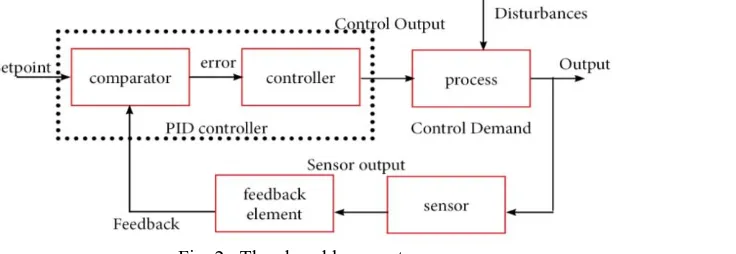
Fig 5. The fuzzy control system. [16]
The simple idea of fuzzy logic is the way to deal with computing in view of degrees of truth as opposed to just a Boolean logic. Among the numerous applications of fuzzy logic, fuzzy control has proved to be the most used. From a theoretical perspective, a nonlinear controller and a model, regarded as a „universal approximation‟ can be recognized using a fuzzy logic rule-base, [9]. A numerical model, human expert facts and tangible input/output information; are the sources which help provide the most appropriate information about any system. [16]
They have proved to be and low-cost development, easy to comprehend and simple to implement by industry and in consumer products.
Figure 5 shows the use of human professionals to extend the knowledge base which comes in linguistic fuzzy IF-THEN rule. By using every bit of information during the design process the fuzzy control designer gets complete advantage. So ultimately the fuzzy logic controller (FLC) that depends on fuzzy logic gives a method for adjusting a linguistic control methodology in view of expert information into the programmed control strategy [17]
2. Genetic Algorithm(GA)
A genetic algorithm(GA) is search of investigation that impersonates the procedure of normal evolution [15]. They have a place with the bigger class of evolutionary algorithms (EA), which create answers for full development issues utilizing methods enthused by essential evolution, similar to crossover, choice, mutation and inheritance [15]. It has been appeared to be a sturdy technique for creating answers for a wide assortment of complex development and machine learning issues. [18] [19]
At present, a third era of ECs has risen with the expansion of particle- swarm development, cultural algorithms, ant-colony development and DNA-based calculation [16].
GAs [16] work with many types of candidate solutions rather than just one candidate solution – or partial solution - in particular and hence, in this case, differ from more traditional search algorithm, just as any other EC technique would do. Each candidate solution of a problem is presented as a data structure referred to as an individual. Individuals are primarily comprised of two parts, one is a chromosome and the other a fitness value. Genes build up the composition of a chromosome, while the assigned values that make up a gene are known as alleles of that particular gene. The chromosome encodes the respective individuals that they are a part of, and a group of strings of these chromosomes, to a problem of optimization, evolves toward better solutions [15]. A group of individuals collectively comprises a population [16]. The population size remains the identical for the length of the search, for most GAs.
As of the existing population single people are carefully chosen, known as parents, the selection depends on their fitness level and are then allowed to make offspring. After the children have been created every offspring gets a fitness value. Prior to the children being added to the population, a few people in the present population need to die and be eliminated to make space for the offspring. [16]
3. Neural Networks (NNs)
In the 1940s, scientists pursuing the task of imitating functions of the human brain developed fundamental software and hardware prototypes of biological neurons and their behaviors. During the 1950s to 1960s, a bunch of analysts integrated biological and surgical perceptions put forth by McCulloch Pitts and other researchers in their study, to fabricate the first artificial neural network(ANN). [9].
Element of NNs
Fig.6 Basic elements of an artificial neuron. [16]
As shown in figure 6, An artificial neuron which is the basic element of an NN contains three main components: (i) Weighting factors
(ii) Threshold
(iii) Activation function
In the recent years, NNs have applied to several field of engineering for example, electronics, robotic, speech, digital signal processing, transportation, aerospace and medical engineering.
Biological neurons are primarily the individual of millions of interconnected units in the human brain. Every neuron comprises of a cell to which a solitary axon (output) and many dendrites(inputs) are connected [3]. The axon is independently associated with other neuron through nodes called synapses. A chemical reaction is created by a synapse in acknowledgement to an input [3]. The brain is a complex network of neurons and motor that make it possible to provide the capacity to remember, think and learn for a human being. ANNs attempt to emulate their biological counterparts. [3].
Fig. 7 Training the neural network. [3]
Neural network in control
Controller imitation [3]: A straightforward application in control is the utilization of NN to imitate the operation of currently existing controllers. It may be the case that a nonlinear plant requires many tuned PID controllers to work over a full scope of control activities. Then again, a LQ ideal controller experiences issues in running in actual-time.
VII.
HUMAN-
ROBOT
COLLABORATION
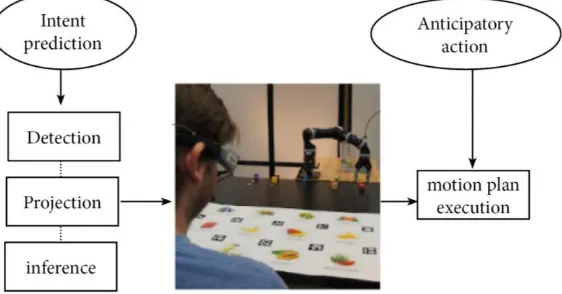
To work effectively and efficiently with human beings, they rely on the users so they can observe their actions. The anticipatory control enables all the robots to anticipate actions of their human counterparts.
Fig 8. It proposes an “anticipatory control” method that enables robots to proactively plan and execute actions based on an anticipation of a human partners task intent inferred from their gaze patterns. [20]
Anticipatory robot is quicker than reactive control by 2.5 seconds up to 3.4 seconds. The focal point of an enabled anticipatory control robot attains an efficient human-robot alliance.
Anticipatory actions are accomplished by observing the actions of their users and then anticipating future actions [21]. Research has proven that monitoring actions of users has helped enhance the collaboration and improve their efficiency of tasks. [22] [23]
There are also many tests done to avoid the collision between the robot and the human being. This so to ensure the safety to the human during the human and robot interaction. The proposed detection methods help reduce the physical contact forces which can be dangerous to human beings.
Robot manipulators performs tasks that are executed by human beings. Human beings are not limited by their intelligence, but are limited by their physical strength. This can be overcome by robots.
In previous years, the psychological feature structure of joint action has been obtaining a lot of thinking [24]. Among different factors, complete coordinated action has been coupled to the formation of expectations of 1 partner‟s actions to the other and also the consecutive performing on these expectations [25, 26]. we tend to argue that an equivalent hold for cooperative robots: if they're to advance higher than stop-and-go interaction, agents should take notes of not solely past events and current perceived state, however additionally the prospects of their human collaborators. Robot manipulators became a “standard” management application, and also the harmony was well known and exploited in research [27]. varied sensible issues inside and out of doors of AI were custom-made by computed force and inverse dynamics management. [20]
1. Gesture recognition using Kinect
Kinect camera is utilized to catch human movement and self-perceptions for computer game playing, by more research on signal recognition. Hand signals are perceived with Kinect framework with high exactness and small figuring. The motions are sent to a hand motion acknowledgment framework to a hexagon robot controller remotely. [28] Hand signals are perceived with Kinect framework with high exactness and small figuring. The motions are sent to a hand motion acknowledgment framework to a hexagon robot controller remotely.
Fig.9. The system structure of the robot control system based on gesture recognition. [19]
The robot control system includes four parts as shown in Fig. 9: (1) a gesture recognition system running on a laptop computer; (2) a Kinect camera connected with the laptop computer; (3) a hexagon robot and the robot controller;
(4) a pair of wireless communication modules connected with the gesture recognition system and the robot controller respectively. [16]
Microsoft visual studio 2010 and Kinect windows SDK developed the gesture recognition system. Utilizing an ongoing acknowledgment, a hexagon robot is created can get data remote by changing its shape agreeing so there is a connection amongst robot and individuals.
The Kinect camera captures the range of human palm and fingers. Furthermore, it processes to recognition which fingers are extended and straight. Each gesture corresponds to a different robot command.
Fig. 10 Kinect sensor
In a related piece submitted in the year 2010[29], they utilized The Kinect Sensor which was created by Microsoft and Prime Sense, appeared in Fig. 10, It is an equipment gadget used to control the Microsoft XBOX-360 diversion console with no sort of controller that the client needs to hold or wear. [29]
2. Adaptive upper Arm based Robot Control System
Various elderly, handicapped individuals are expanding. An advancement of the human-helping robot is vital for them to enhance their standard of life. Euphoria stick, console and other customary gadgets utilized for robot control.
A diagnostic procedure signal could be a physiological signal that generates a shortening, it's adopted for the manipulation of rehabilitation device. [30]
A human-helping robot is helpful for enhancing the life nature of the impairs and aged.
EMG ensnares the human aim of development and is appropriate as a control sign to help robot. Because of fluffiness in EMG flags, they are time changing and extremely non-direct, the framework parameters are not straight forward [31]. The sign estimation and preparing measures the unfiltered EMG signals which sift through clamors.
The separated EMG signs are sent for highlight extraction module. At that point the elements with the movement order and adjustment module decides the arm development and creates orders to run the human-helping robot.
At last, the administrator assesses the execution and figures out what development ought to come next.
The future work of the paper (2010) [31] alluded was, to use the projected framework to regulate arm movements with numerous degrees of chance, within which shut coupling between joints ought to be handled.
VIII.
TECHNOLOGY
BASED
ROBOT
CONTROLS
1. PC Based Open Robot Control System: PC-ORC
A PC based open robot control (PC-ORC) framework, will redesign it in several creation fields. It involves programming, application objects furthermore an extra equipment device [28]. While applying PC-ORC to a SCARA robot, the PC-ORC's execution is examined. A PC based control framework is currently exceptionally prevalent in the self-governing modern. [32]
The explanation behind across the board of PC-ORC is the rise of control system guidelines of movement and for the integration of various equipment gadgets. An open control environment, it coordinates diverse control elements of a modern robot control frameworks into an individual bound together environment alongside its examination. The PC-ORC depends on PC thus it executes programming modules and items utilizing object-arranged worldview. PC-ORC additionally builds up a situation for quick paced working of new robot control framework. PC-ORC additionally permits simple mix and reuses equipment and programming. The open control situations control framework indicates constrained dependability and strength contrasted with a shut control design framework. [32]
IX.
CONCLUSION
This paper proposes the fundamentals of control systems in robotics and various types of control systems in robotics. Each type of control system has its pros and cons which have been discussed in this paper.
The process of some of the control systems like PID & LQR are explained using an example of a 2 wheeled self-balancing robot. Also, RFID based control system has been explained.
Another type of robot control system which has been boosting & is challenging to the research platform is Artificial Intelligence. Some of the theories which are used in AI like fuzzy logic, genetic algorithm and neural network have been elaborated in this paper.
Finally, some of the collaborations of robots with human & technology are mentioned. Human collaboration like Kinect gesture recognition used in gaming and Adaptive upper arm based robots which are used in medical field for people with disability. Also, PC-Open based robot control system which are used in technology is discussed in general.
REFERENCES
[1] Brooks, R. A. (1986). A robust layered control system for a mobile robot. Robotics and Automation, IEEE Journal of, 2(1), 14-23. -29
[2] K. Ogata. Modern Control Engineering, 4th ed., New Delhi: Pearson Education (Singapore) Pvt. Ltd., 2005. -1
[3] Ronald S. Burns. 2001. Advanced Control Engineering. Oxford: Elsevier-Butterworth Heinemann. Pp. 272-379 -2
[4] Qiu, C., & Huang, Y. (2015). The Design of Fuzzy Adaptive PID Controller of Two-Wheeled Self-Balancing Robot. International Journal of Information and Electronics Engineering, 5(3), 193. -3
[5] Khairudin, M., Mohamed, Z., & Husain, A. R. (2013). Dynamic model and robust control of flexible link robot manipulator. TELKOMNIKA (Telecommunication Computing Electronics and Control), 9(2), 279-286. -4
[6] Prasad, L. B., Tyagi, B., & Gupta, H. O. (2012, May). Modelling and simulation for optimal control of nonlinear inverted pendulum dynamical system using PID controller and LQR. In Modelling Symposium (AMS), 2012 Sixth Asia (pp. 138-143). IEEE. -5
[9] A. V. Barenji, R. V. Barenji, and M. Hashemipour, "A framework for structural modelling of an RFID enabled intelligent distributed manufacturing control system," South African Journal of Industrial Engineering, vol. 25, pp. 48-66, 2014. -8
[10] Barenji, A. V., &Değirmenci, C. (2015). Robot Control System based on Web Application and RFID Technology. In MATEC Web of Conferences (Vol. 28, p. 04001). EDP Sciences. -9
[11] R. VatankhahBarenji, M. Hashemipour, and D. A. Guerra-Zubiaga, "A framework for modelling enterprise competencies: from theory to practice in enterprise architecture," International Journal of Computer Integrated Manufacturing, pp. 1-20, 2014. -10
[12] Huang, An-Chyau, Chin, Ming-Chih. 2010. Adaptive Control of Robot Manipulator. -11
[13] TarekEdreesSaaed1, George Nikolakopoulos2, Jan-Erik Jonasson1 and Hans Hedlund3. “A state-of-the-art review of structural control systems”. -33
[14] Felix Ingrand, Malik Ghallab. Robotics and Artificial Intelligence: A Perspective on Deliberation Functions. AI Communications, IOS Press, 2014, 27 (1), pp.63-80. -12
[15] Gigras, Y., & Gupta, K. (2012). Artificial intelligence in robot path planning. International Journal of Soft Computing and Engineering (IJSCE), 2012, 2231-2307. -13
[16] Jamshidi, M. (2003). Tools for intelligent control: fuzzy controllers, neural networks and genetic algorithms. Philosophical Transactions of the Royal Society of London A: Mathematical, Physical and Engineering Sciences,361(1809), 1781-1808. -14
[17] Lee, C. C. (1990). Fuzzy logic in control systems: fuzzy logic controller. II. Systems, Man and Cybernetics, IEEE Transactions on, 20(2), 419-435. -15
[18] Davis, L. 1991 Handbook of genetic algorithms. New York: Van Nostrand Reinhold. -16
[19] Holland, J. H. 1975 Adaptation in natural and artificial systems. Ann Arbor, MI: University of Michigan Press. -17
[20] Huang, C. M., &Mutlu, B. Anticipatory Robot Control for Efficient Human-Robot Collaboration. -18 [21] H. Koppula and A. Saxena, “Anticipating human activities using object affordances for reactive robotic
response,” in in RSS, 2013. -19
[22] Hoffman, G., &Breazeal, C. (2007, March). Effects of anticipatory action on human-robot teamwork efficiency, fluency, and perception of team. In Proceedings of the ACM/IEEE international conference on Human-robot interaction (pp. 1-8). ACM. -20
[23] K. P. Hawkins, S. Bansal, N. N. Vo, and A. F. Bobick, “Anticipating human actions for collaboration in the presence of task and sensor uncertainty,” in Proceedings of ICRA, 2014, pp. 2215–2222. 21
[24] N. Sebanz, H. Bekkering, and G. Knoblich. Joint action: bodies and minds moving together. Trends in Cognitive Sciences, 10(2):70–76, 2006. -22
[25] G. Knoblich and J. S. Jordan. Action coordination in groups and individuals: learning anticipatory control. Journal of Experimental Psychology: Learning, Memory, and Cognition, 29(5):1006–1016, September 2003. -23
[26] M. Wilson and G. Knoblich. The case for motor involvement in perceiving conspecifics. Psychological Bulletin, 131:460–473, 2005. -24
[27] H. J. Levesque, P. R. Cohen, and J. H. T. Nunes. On acting together. In Proceedings of AAAI-90, pages 94–99, Boston, MA, 1990. -25
[28] M. Biao, X. Wensheng, and W. Songlin, “A robot control system based on gesture recognition using Kinect,” TELKOMNIKA Indonesian Journal of Electrical Engineering, vol. 11, no. 5, pp. 2605–2611, 2013. -26
[29] Mohammed A. Hussein, Ahmed S. Ali, F.A. Elmisery and R. Mostafa. 2014. “Motion Control of Robot by using Kinect Sensor” pp. (1-5) -27
[30] Sasaki, M., Suhaimi, M. S. A. B., Matsushita, K., Ito, S., &Rusydi, M. I. (2015). Robot Control System Based on Electrooculography and Electromyogram. Journal of Computer and Communications, 3(11), 113. -28
[31] Liu HJ, Young KY: An adaptive upper-arm EMG-based robot control system. Int J Fuzzy Syst 2010, 12:181–189. -29
[32] Hong, K. S., Choi, K. H., Kim, J. G., & Lee, S. (2001). A based open robot control system: PC-ORC. Robotics and Computer-Integrated Manufacturing,17(4), 355-365. -34
[33] Umar Farooq, Mahmoud ul Hassan. (2015). “IACSIT International Journal of Engineering and
Technology” Vol.6, No.4. -31
[34] F. L. Lewis. Optimal Control, New York: John Wiley &Sons Inc., 1986. -36
![Fig 5. The fuzzy control system. [16]](https://thumb-us.123doks.com/thumbv2/123dok_us/1364045.1645798/5.595.146.456.140.280/fig-the-fuzzy-control-system.webp)
![Fig.6 Basic elements of an artificial neuron. [16]](https://thumb-us.123doks.com/thumbv2/123dok_us/1364045.1645798/6.595.140.458.487.636/fig-basic-elements-artificial-neuron.webp)
![Fig.9. The system structure of the robot control system based on gesture recognition. [19]](https://thumb-us.123doks.com/thumbv2/123dok_us/1364045.1645798/8.595.147.445.613.723/fig-structure-robot-control-based-gesture-recognition.webp)
