Kirk Anderson
University of New Brunswick
Keith Walker
andEdwin Ralph
University of Saskatchewan
Practicum Teachers’ Perceptions of Success in
Relation to Self-Efficacy (Perceived Competence)
How do student teachers gain confidence in their teaching abilities as part of their school-based practicum experience while increasing their self-efficacy from the successes of their practicum? To understand this question better, we explored preservice teachers’ post-practicum accounts of experiences of success in relation to efficacy (Bandura, 1977, 1982) with some reflection on motivational perspectives as found in self-determination theory (Ryan & Deci, 2000). Of particular interest are the findings that illuminate the views of post-practicum students toward the formative importance of school cooperating teachers, principals, and vice-principals and their lack of reference to university-based supervisors. Of more general interest are possible connections that support the need for a better understanding of intrinsic and extrinsic motivation in relation to perceived competence (self-efficacy) for novice teachers.
Comment les stagiaires acquièrent-ils confiance en leurs habiletés pédagogiques et augmentent-ils leur auto-efficacité. dans le cadre des réussites découlant de leurs stages? Pour mieux comprendre cette dynamique, nous avons étudié les récits qu’ont fait des stagiaires de leurs réussites en matière d’auto-efficacité (Bandura, 1977, 1983) tout en puisant dans les perspectives sur les motivations présentées dans la théorie sur
Kirk Anderson joined the Faculty of Education in July 2007 after three years in the University of Calgary. He is an experienced school-based practitioner, in which capacity he has worked for 20 years as a teacher and administrator. He is currently involved in three major areas: the
International Beginning Principal Study (IBPS), Writing Our Way Home (a series of reflections and writings based on the University of Calgary’s international work in retraining teachers and school leaders in post-conflict settings), and the Leadership Compendium Project (a compendium of the current and future major leadership issues facing Canadian schools). His teaching areas include courses in educational administration, leadership, and theory; leading change; and teacher evaluation and supervision. He was the recipient of the 2006-2007 Graduate Student Association Award for Excellence in Teaching (University of Calgary).
Keith Walker is a professor of educational administration. His recognized areas of work include educational governance and policymaking; leadership philosophies and practices; community and interpersonal relations; organizational improvement and capacity-building; and applied and professional ethics. He brings over 30 years of experience as a manager, teacher, minister, leader, scholar, and educational administrator in public and social sectors. His formal education is in physical education, sports administration, theology, education, educational administration, and philosophy.
l’autodétermination (Ryan & Deci, 2000). D’intérêt particulier sont les résultats révélant l’opinion des stagiaires ayant terminé leurs stages face à l’importance formative des enseignants coopérants, des directeurs d’écoles et des directeurs adjoints, et la lacune de références relatives aux superviseurs universitaires. De façon plus générale, nous présentons des liens possibles appuyant le besoin pour une meilleure connaissance de la motivation intrinsèque et extrinsèque par rapport à la perception de la compétence (auto-efficacité) chez les enseignants novices.
Introduction
The body of research literature related to preservice teacher education and change is substantial. However, there is little available documentation on the effect of self-efficacy in the context of success experiences in the professional growth of teacher interns as part of the practicum process; hence it is worthy of investigation and report. Our study speaks to this conclusion in that it shares the experiences of four cohort groups of interns over a three-year period. The 193 respondents are post-practicum preservice teachers who related to us the most notable success experience of their 16-week extended practicum (intern-ship). We use these success incidents to build an understanding of how such experiences relate to the socially constructed and cognitive sense of self-ef-ficacy (perceived competence) of these emerging teachers.
The Self-Efficacy Building Process
Preservice student teachers enter their school-based practicum (internship) and begin to acclimatize to their host school surroundings as they learn to teach in the practicum setting. They engage in a type of situated cognition (Coffin, 1997) or “cognitive apprenticeship” (Brown, Collins, & Duguid, 1989; McCown et al., 1999) in which they apply the instructional skills and situated knowledge that they are acquiring in real-world school situations (Driscoll, 1994). This growth occurs under the mentorship of classroom cooperating teacher(s) and college supervisory personnel (Ralph, 1998). The practicum experience, including the self-judgments of these neophyte teachers, is intended to help influence the ongoing beliefs of student teachers in their instructional and professional capabilities, that is, their sense of self-efficacy. The practicum teachers’ judg-ments, and thus their self-efficacy are also affected by other factors such as the interns’ previous success experiences, their existing skills and knowledge levels in performing particular teaching tasks, and the quality of their key mentors’ teaching and supervisory style (Ralph, 2002, 2003).
[therefore] knowing how to promote more active and volitional (vs. passive and controlling) forms of extrinsic motivation becomes an essential strategy for successful teaching” (p. 55).
Further to this, Sheldon, Ryan, and Reis (1996) argue that “psychological health depends on ongoing feelings of effectance or competence.… the need to feel competence is a basic organismic propensity that underlies self-esteem and self confidence” (p. 1271). Indeed this element may be an often missed reality of teacher development programs, as the importance of building self-efficacy for novice teachers should be more clearly articulated as a key aim of teacher training.
Increasing self-efficacy has ramifications for the long-term welfare of teach-ers as noted by Sheldon et al. (1996), who refer to Bandura (1977) suggesting that he “showed that self-efficacy, the feeling that one can bring about desired outcomes, is an important determinant of psychological health” (p. 1271). As part of the efficacy building process, Bandura (1997, 1982, 1986) has shown that learners engage in observing and modeling the behavior of others in mutually interactive relationships, which contributes to the learners’ judgments of their self-efficacy. The elements of these relationships are: personal (one’s beliefs, values, expectations, physical traits, and social skills); behavioral (one’s out-ward actions); and environmental (one’s physical and social surroundings). All these elements may influence and be influenced by one another as the learner engages in the learning process.
Research Design
Our focus in this research was to shift the attention from a teacher training program deficit concern orientation to the efficacy-building of preservice teachers and the use of successful motivation and efficacy-enhancing experi-ences. We wondered what preservice teachers in practicum programs actually believed had constituted success experiences for them; specifically, what events, interventions, challenges, or persons had contributed to such experi-ences. This led to the research question: How do student teachers gain con-fidence in their teaching abilities as part of their practicum experience while developing the self-efficacy that will enhance their training as teaching profes-sionals?
anticipate beliefs formed from ideations and experiences (Maddux, 2005). Of course, this research points to sources of performance experience, vicarious experiences, imaginal experiences, verbal persuasion, and physiological and emotional states as the key sources of agentic development (Bandura, 1977, 1986; Eagly & Chaiken, 1993; Williams, 1995). We were particularly mindful of imaginal (Emmelkamp, 1994; Kazdin, 1979) and vicarious experience (Ban-dura, 1986; Williams).
We developed an informative research strategy that focused on the success experiences of post-practicum teachers (or interns) during their practicum (Walker & Carr-Stewart, 2006). We had no previous relationship with these students, and their participation in this study was sought by canvassing volun-teers through post-internship courses. No demographic data were collected from these teacher candidates from which to characterize the various cohorts who provided the narratives. One hundred, ninety-three respondents par-ticipated over a three-year period. On returning from their practicum, each of the post-practicum preservice teachers was asked to write about a success experience related to that practicum. Specifically, they were asked to think back over their experiences of the previous several weeks and “recall an … activity, situation, circumstance, or event that depicts a real success narrative for you. Relate this success by telling a narrative that energizes and encourages you when you recall it.” The results reflect the personal success reflections of recent post-practicum teachers who were asked to write about their single most successful experience during their teaching practicum.
Of interest to us were the various interpretations that students seemed to make of this invitation. Some students related incidents and stories; others reflected on conditions and situations whereas still others used the notion of success to explain overcoming adversity or “meeting challenges.” Using the single most successful narrative in reporting these experiences purposefully focused on a narrow but informative band of experiences as it omitted other successful but less noteworthy success narratives. The data were analyzed using the constant comparative method (Miles & Huberman, 1994), and 266 ideas were identified. As we reviewed and classified these ideas (or incidents of experience), we compared them across categories to discover relationships. Continual refinement occurred as ideas were continually compared for new relationships and categories were conceived and reconceived. Although the primary approach to reporting the data employs the percentage of respondents as the independent variable, the frequency of responses is used throughout the article to present the findings.
The Findings
experiences among all post-interns; second, the pronounced depth of the emo-tional connections for each respondent; and finally (we suspect that teacher development programs may not be sufficiently aware of this connection), the heliotropic potential for success to produce growth in efficacy and healthy response to motivational (intrinsic and extrinsic) imperatives.
What Preservice Teachers Saw As Success
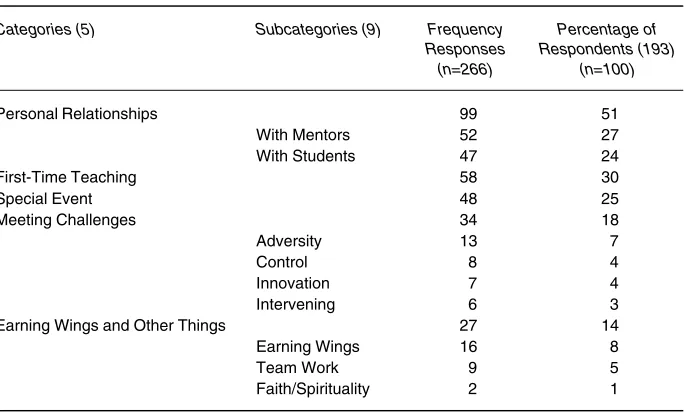
As shown in Table 1, the ideas that generated responses were organized ac-cording to five key themes with nine related subcategories. The experiences reported by preservice teacher interns related to their self-efficacy and success were as follows: personal relationships (51% of respondents, 99 responses), my first time teaching (30% of respondents, 58 responses), special events (25% of respondents, 48 responses), meeting challenges (18% of respondents, 34 re-sponses), and earning my wings and other things (14% of respondents, 27 responses).
Personal Relationships
The most frequently mentioned dimension of success during the practicum was personal relationships (51%). This category falls neatly and almost evenly into two natural subcategories as areas of focus for respondents; notably, personal relationships with mentors-exemplars (27%), and personal relation-ships with students (24%).
Personal relationship with mentor-exemplars. Twenty-seven percent of respon-dents saw mentoring-exemplar relationships with other educators as sig-nificantly related to a successful aspect of their school-based experiences. The mentors identified by respondents were not always the formal mentors as-signed by the practicum protocols (the university supervisor and cooperating teacher for example) as they instead saw other educators as mentors. These informal mentors could be more accurately called exemplars for the teacher
Table 1
Success Factors Categories and Response Rates
Categories (5) Subcategories (9) Frequency Percentage of Responses Respondents (193)
(n=266) (n=100)
Personal Relationships 99 51
With Mentors 52 27
With Students 47 24
First-Time Teaching 58 30
Special Event 48 25
Meeting Challenges 34 18
Adversity 13 7
Control 8 4
Innovation 7 4
Intervening 6 3
Earning Wings and Other Things 27 14
Earning Wings 16 8
Team Work 9 5
intern. Given the emphasis that the literature places on mentor relationships in the practicum for interns, this finding is noteworthy.
Reflecting the heliotropic search for light and efficacy, our respondents (interns) looked to sources other than formal supervisors and cooperating teachers as mentor-exemplars who served as role models and guides during their practicum experiences. Notably, and in order of frequency cited, they listed principals, vice-principals, teachers and cooperating teachers, district superintendents, and university supervisors. Most responses (98%) were re-lated to the following school-based personnel: principals, vice-principals, teachers, and cooperating teachers. The non-school-based references were at-tributed to seemingly few but important other sources of mentorship, as 1% of respondents mentioned the superintendent and, somewhat surprisingly to the researchers as teachers of practicum students only 1% of respondents men-tioned their university supervisors.
Respondents saw school administrators, principals, and vice-principals as role models whom they wished to emulate; they spoke of the stability and collegial nature of the working relationships they provided. One respondent offered the view that principals were “in control” of the schools and had the respect of students. Principals were able to “work with others in an efficient and respectful manner where everyone felt valued.” Another respondent spoke of developing a sense of trust in the principal, “who was able to turn bad situations into purposeful ones.” Similarly, a respondent spoke of the vice-principal’s positive attitude, which was believed to influence the entire staff. The respondent said, “I hope I can adopt some of her qualities as my own and act as a role model for someone, as she did for me.”
Regular staff teachers (those with no directly formal responsibility for the practicum) and cooperating teachers are discussed together, as respondents did not always distinguish between the two. For the most part, the mentor-ex-emplar relationships with teachers were related to teaching and classroom situations. Respondents’ comments supported the view that they were im-pressed with the teachers’ ability to teach exciting lessons and deliver cur-riculum in what seemed to be chaotic situations. Such exposure accordingly enhanced the respondents’ relatively small repertoire of teaching strategies. One respondent explained her observation of great teaching: “I witnessed a very successful teacher in action … she respected the ideas of her students, included them in developing the unit.… She expressed real enthusiasm and interest, which fostered the same feelings in her students.” Another referred to a teacher’s ability to bring order to a chaotic situation: “She handled chaotic situations and made everyone believe that there was no problem to begin with. I hope that one day I too will be an able teacher.” Yet another respondent commented on a pair of teachers involved in team teaching: “I will never forget this experience because of the organized chaos that these two teachers were able to create in their classroom.” Least mentioned by respondents, but still notable were an equal number of references to district superintendents and university supervisors (only 2 each).
school. Sometimes this was a routine matter of developing techniques to better manage the learning experiences of children. Some situations were more chal-lenging, yet respondents were able to meet these challenges and produce success narratives. One case in particular merits discussion, as it is illustrative of the challenges of teaching. One respondent described the complex and somewhat difficult context of dealing with a student who struggled to manage his anger and had several outbursts that were quite disruptive. The respondent investigated the boy’s family situation and found that there was considerable anger in his home. On reflection, the respondent came to the conclusion that “understanding the issues that the student was dealing with at home did not make his actions excusable. It did, however, make his behavior easier to under-stand.” With this more in-depth perspective, the respondent found ways to engage the boy in conversation and to spend time with him, consequently establishing a trusting relationship. Reportedly, the boy’s behavior improved. The respondent stated, “although this worked, it took a great deal of time and patience. In the end the student and I were able to celebrate our success together.”
First-Time Teaching Experience
The category first-time teaching experience indicates the first time that the respondent took primary responsibility for a class lesson or related event. As interns, respondents encountered a variety of activities related to successful experiences that fall loosely into the following themes: teaching the first class or taking responsibility for part of a class, references to events or situations that involved respondents such that it made them realize that they were responsible for an outcome related to their actions, receiving positive feedback from parents and students (direct experiences of efficacy), and meeting challenges.
The first lesson. Three respondents gave accounts that reflected this first step. One spoke of her unease when assigned teaching duties sooner than others in her cohort saying that she
began to feel overwhelmed. My [cooperating] teacher noticed my stress and reassured me that everything would be fine. She told me she knew I could do it and all I needed was a push. I believe her persistence and the pressure I felt is what made me have a successful internship, even though she put a lot of pressure on me she was always there to help when I needed it.
Receiving positive feedback. Sometimes coupled closely with the intrinsic reward of surviving the first-time teaching experience is the more extrinsic recognition that comes from positive parents’ comments, and perhaps even more efficacious is the interns’ realization that students were learning as a direct result of the intern’s teaching. One intern referred to her sense of satisfac-tion arising from the comments of a parent who stated to the intern that “at dinner my son told his older brother that he has the best drama teacher in the world.” Another intern spoke of her excitement on realizing that the students were learning from her and were actually able to put this knowledge into their own words: “That particular student understood what I was teaching and could also express the concept in his own words—how exciting!” Yet another intern described a sense of success: “I felt good, as I know I got all the major points across and the cooperating teacher commended me on a job well done.” Continuing this positive commentary, another intern noted that her students, “remembered every tiny detail about the narrative and knew the significance of what I was trying to get across. My objectives were met and I felt like an effective teacher—an amazing teacher—a valued teacher—a ‘real’ teacher!” Special Events
Respondents sometimes discussed success in the context of special or large-scale events related to school functions. They discussed sports tournaments, drama, concerts, and community events. These events provided an opportuni-ty for interns to become involved in the opportuni-typical extended school-related ac-tivities. Such events provided avenues of opportunity for interns to practice their skills in forums that involved students and sometimes the larger com-munity. One respondent described stepping into the coach’s role with a sense of both pressure and success as,
for the entire game I put aside my fears and did what I needed to do. I knew the girls were counting on me; if I lost it and got all worked up due to frustrating circumstances then the girls would do the same thing. It was successful.
The fear faced by interns and the joy of overcoming these fears was evident in one intern’s view of staging a drama production:
I felt a poor show would reflect poorly on my internship and I couldn’t back out on my commitment. My integrity and that of my students were being challenged, so ready or not, we were going on stage. We did it. We pulled it off! And the students had something of which to be proud.
There were also reports of positive feedback and surprises. One intern related,
A lady walked in and said, “Sorry to interrupt, but my son James loves your drama club. I would just like to thank you for offering it.” That really made my day; it was a good experience and I am sure I can use it to help me in the future.
Meeting Challenges
Adversity. Respondents noted meeting challenges related to success in deal-ing with adverse teachdeal-ing assignments. The teachdeal-ing assignments were not always consistent with their training and expectations. Interns were sometimes assigned courses for which felt they had little or no preparation. In one of the two cases of misassignment, the cooperating teaching was a source of help and enabled the transition whereas in the other, the cooperating teacher was less than helpful, and the intern was left to deal with the challenge alone. Com-menting on the first instance, one respondent said,
Like many interns and new teachers I was obligated to teach a course that was completely foreign to my experience. Fear, rather than interest, initiated my study of the guitar: my new role as “expert” compelled me to learn. Learning how to corral a group of potentially disinterested students and teach a subject that is new to me, demonstrated what tools are necessary to succeed as a novice teacher.
Other interns found themselves in situations that they perceived as putting them in conflict with a member of the regular teaching staff. One respondent discussed attempts to improve a particular child’s involvement in the class. The respondent referred to this as two battles: one to have the student accepted and the other to deal with the child’s rejection by the cooperating teacher. The intern wrote, “I could see that she [the cooperating teacher] and I were going to have problems as I was going to do everything in my power to have this child fit in, and feel success.” As an intern, this respondent seemed determined to include the child in the teaching and learning environment so that “she could feel a sense of belonging. My cooperating teacher really did not like the atten-tion I was giving [the student].” Another respondent referred to a clash of personalities between the intern and the cooperating teacher. In this case the intern drew on students’ and parents’ support as sources of affirmation recall-ing,
My co-op teacher and I didn’t get along from the start. And it didn’t get any better until the last couple of weeks. I muddled my way through. If it wasn’t for the students and their parents I wouldn’t feel successful as a teacher at all. The kids were the major contributing factors to my feelings of success.
Exerting control. This dimension is much like other categories related to first-time teaching, but is unique in that respondents identified strategies or instan-ces when they sucinstan-cessfully exerted control when control seemed to be lacking. In one instance the intern used a “clicking noise to control an unruly class.” This unusual sound brought the students’ attention back to the teacher and the lesson went on relatively smoothly. Another intern felt success as a result of overcoming control problems with three boys, and the college supervisor had noticed this improvement on his second trip to the school.
administered his Ritalin consistently. In this case the solution was in “having the grandmother administer the Ritalin instead of Mom.”
Intervening (stepping in on short notice). There were times when interns met unexpected challenges as they were drafted into action. This often occurred in situations where the interns had to step in when the teachers [whom the interns were assisting] were unexpectedly ill or otherwise unavailable. One respon-dent described a football game and how he had to step in because the head coach could not be there that day. He felt that, “while the day was very hectic it was a great learning experience.” Another intern referred to a similar in-stance where “the official coach—my co-operating teacher was ill that day. I led the [volleyball] team and guided the team in decision-making and goal setting.”
Earning Wings and Other Things
Earning wings and other things is a collection of dimensions that relate to recognition of interns by others (8%), a sense of being part of a team as a member of the staff (5%), and the interns’ spirituality (1%).
Earning wings. Arguably, this category could also be cited as a first-time teaching experience, but respondents used a unique emphasis in expressing their sense of awareness in becoming teachers, which we felt merited making this a distinctive voice. These were times when the interns felt like real teachers,
and the source of this recognition was the interns’ self-awareness. Earning wings expressed the interns’ sense of rite of passage in gaining recognition as a teacher as acknowledged by others in the school context. Eight percent of the respondents referred to times when they felt the success of being recognized as what they called “a real teacher” by others. Three instances help illuminate this aspect of intern success. One described being treated as a teacher during parent-teacher interviews. Although nervous and apprehensive, the intern-teacher felt satisfaction on completion of the interviews saying, “Even though my cooperating teacher was not there I gained the courage to conduct the interviews on my own. I displayed my ability as a teacher and was able to show courage.” Another referred to the treatment by others after a successful project in which the intern was a leader. The intern felt the experience “helped break the ice and helped me ease into the school and form relationships. This success paved the way for the rest of my internship. I was really a colleague and not just an intern.” Last, an intern referred to the exhilaration of having completed an internship, exclaiming, “my teacher didn’t take me on a walk; she took me for a run. A run that started off fast and ended with a feeling of success that could be tagged with a ribbon.”
the teaching staff. Although this was undoubtedly truer for some interns than for others, it is part of a transformation that all interns should be expected to experience as part of their practicum. One respondent described an early successful experience in a school related to this transition. The we group in-volved members of the cohort group who were interns in the same school. They were assigned the task of organizing a drama evening and relating the experience, “we [the intern colleagues] started to get to work right away.” As their experiential narrative unfolds the we group expands as the interns extend the group to get others involved in the project. Indeed throughout the time of the experience, several key people helped organize the event. As one respon-dent reflected, “I find the team work required for a major production like ours [school-based colleagues as we] to work out well.” Last, there is a developing shift in the context from I to we when joining the school team. A respondent described being supported as a member of a school committee although feeling “a little nervous at our first meeting. I was not quite comfortable voicing my opinions, but staff members on this committee were great and encouraged me to share my ideas and supported what I thought.”
Faith/spirituality. Two respondents referred to success aspects in their school-based experiences as being related to spirituality. One respondent felt that her sense of faith and values helped her to make the correct decisions during her practicum. The other felt that the practicum was successful because of her experience teaching in her church. This category constitutes only 1% of responses, and we wonder if the infrequency of such comments and other such religious ideations says anything about the depth and temporal nature of what might constitute success, the tacit nature of narrative experiences, or perhaps the lenses of these particular preservice teachers.
Discussion and Conclusions
The literature and our research suggest that teacher educators involved in practicum programs should refine or develop interventions that will alleviate the student teachers’ teaching concerns. It is our view that a concern displace-ment approach might be considered as a way of preparation to help practicum preservice teachers realistically imagine themselves as successful in a manner that will increase their sense of teaching-related self-efficacy. The efforts being made to sensitize and heighten practicum preservice teachers’ attention to the identification of successes and their ability to determine the root causes of these successes suggest that such novice teachers will grow in their efficacy and that the concerns and challenges they face will be placed in perspective and perhaps be better addressed.
various supervisors, student groups, or individual students. In this context one can see that the induction of interns into the school setting results in their seeking how to assert their influence (self-efficacy) while seeking deeper con-textual meaning (social cognition and construction). In some cases they were also getting to the root of problems and helping students move forward (build-ing self-efficacy) while increas(build-ing levels of intrinsic motivation and positive reactions to extrinsic motivation.
We have determined from the literature and our findings that at least four principles may be offered to guide teacher educators and administrators in their functions with practicum training of preservice and possibly even new-to-service novice teachers:
1. The social relationships that interns construct during their practicums are critical for their personal, cognitive, and professional growth. The
influence of these relationships has two primary sources: mentors and students. Mentors are the key agents in assisting interns to increase their teaching efficacy. Students are the objects of the efficacious practice. 2. Although is it not news that interns face a variety of experiences related to
teaching for the first time or that they develop at varying rates, mentors should not only focus on helping teacher-interns develop generic teaching competences, but should also place an intentional focus on the building of self-efficacy of interns.
3. Interns encounter challenges related to their practicum experiences, many of which are outside the normal classroom context. The social context nature and influence on the growth of self-efficacy should not be underestimated.
4. As reflected in points 1-3, efficacy-building will be promoted more comprehensively if practicum supervisors and others adapt their
mentorship styles to the developmental needs of their protégés in the light of the opportunities that arise. In particular, mentors should ensure that the level of support provided to interns is in harmony with intern teachers’ emerging confidence and competence to meet specific challenges, as interns appear to be heliotropically seeking success and need to be nurtured by mentors. As this process is largely a matter of social cognition and construction, mentors should help interns navigate through this process. The ultimate goal is to help practicum preservice teachers to become more self-efficacious practitioners who will continue to engage in professional development throughout their careers in the school setting.
It can be argued that success is a subjective notion mediated by each ob-server and performer. Similarly, Maddux (2005) has indicated that competence is incremental and, “we need to be continually vigilant for success experiences and actively retrieve past successes in times of challenge and doubt” (p. 284). More specifically however, Ryan and Deci (2000) delineate self-efficacy in SDT as “perceived competence” in relation to increasing intrinsic motivation. They argue that “people must not only experience perceived competence (or self-ef-ficacy), they must also experience their behavior to be self-determined if intrin-sic motivation is to be maintained or enhanced” (p. 58). Our discussion of self-efficacy suggests that the heliotropic principle is a means toward that end for novice teachers using success events. It seems that our respondents al-though initially stimulated by a mixture of extrinsic and intrinsic motivation, increased their levels of intrinsic motivation and positive reactions to extrinsic motivation as a result of success, thereby building self-efficacy as actual com-petence.
It is our view that positive motivational images generated by preservice teachers as they reflect on the successes associated with their school experi-ences have the potential to increase self-efficacy (perceived competence) and alleviate the doubts and fears that often accompany teachers in the early period of their professional formation, a process that will have long-term benefits for teachers throughout their careers.
References
Bandura, A. (1977). Self-efficacy: Toward a unifying theory of behavioral change. Psychological Review, 84, 191-215.
Bandura, A. (1982). Self-efficacy mechanism in human agency. American Psychologist, 37, 122-147. Bandura, A. (1986). Social foundations of thought and action. Englewood Cliffs, NJ: Prentice Hall. Brown, J., Collins, A., & Duguid, P. (1989). Situated cognition and the culture of learning.
Educational Researcher, 18, 32-42.
Coffin, G. (1997). The impact of district conditions on principals’ experientially-acquired professional learning. Unpublished doctoral dissertaton, OISE/University of Toronto.
Cooperidder, D., & Sorensen, P.F. (2001). Appreciative inquiry: An emerging direction for organization development. Champaign, IL: Stipes.
Driscoll, M. (1994). Psychology of learning for instruction. Needham Heights, MA: Allyn & Bacon. Eagly, A., & Chaiken, S. (1993). The psychology of attitudes. New York: Harcourt, Brace, Jovanovich. Elliot, C. (1999). Locating the energy for change: An introduction to appreciative inquiry. Winnipeg,
MB: International Institute for Sustainable Development.
Emmelkamp, P. (1994). Behavior therapy with adults. In A. Bergin & S. Garfield (Eds.), Handbook of psychotherapy and behavior change (4th ed., pp. 379-427). New York: Wiley.
Guay, F., Ratelle, C., Sencecal, C., Larose, S., & Dechenes, A. (2006). Distinguishing development from chronic career indecision: Self efficacy, autonomy, and social support. Journal of Career Assessment, 14(2), 235-251.
Kazdin, A. (1979). Imagery elaboration and self-efficacy in the covert modeling treatment of unassertive behavior. Journal of Consulting and Clinical Psychology, 47, 725-733.
Maddux, J. (2005). Self-efficacy: The power of believing you can. In C. Snyder & S. Lopez (Eds.), Handbook of positive psychology (pp. 277-287). New York: Oxford University Press.
McCown, R., Driscoll, M., Roop, P., Saklofske, D., Schwean, V., Kelly, I., & Haines, L. (1999). Educational psychology: A learning-centred approach to classroom practice (2nd ed.). Scarborough, ON: Allyn & Bacon.
Miles, M., & Huberman, M. (1994). Qualitative data analysis. Thousand Oaks, CA: Sage.
Ralph, E. (1998). Developing practitioners: A handbook of contextual supervision. Stillwater, OK: New Forums Press.
Ralph, E. (2002). Mentoring beginning teachers: Findings from contextual supervision. Journal of Personnel Evaluation, 16(3), 191-210.
Ryan, R., & Deci, E. (2000). Intrinsic and extrinsic motivations: Classic definitions and new directions. Contemporary Educational Psychology, 25, 54-67.
Sheldon, K., Ryan, R., & Reis, H. (1996). What makes for a good day? Competence and autonomy in the day and in the person. Society for Personality and Social Psychology, 22(12), 1270-1279. Walker, K., & Carr-Stewart, S. (2006). Beginning principals: Experiences and images of success.
International Studies in Educational Administration, 34(3), 17-36.
Watkins, J.M., & Mohr, B.J. (2001). Appreciative inquiry. Change at the speed of imagination. San Francisco, CA: Jossey-Bass/Pfeiffer.