468 Abstract—The use of low cost, recycled waste and
eco-friendly absorbent has been investigated as an alternative process for replacement of currently expensive process for removing dyes from wastewater. In this study, Acid activated saw dust was used to remove dyes from aqueous solution in a column filtration reactor. Saw dust is an excellent low cost adsorbent of colored organic anions and may have significant potential as a color removal from tannery wastewater. The effectiveness of acid activated sawdust in absorbing Lurazol Brown pH (LBP) dye from aqueous solutions was studied as a function of agitation time, adsorbent dosage and initial dye concentration. The experimental data were fitted to Langmuir and Freundlich isotherm and found that adsorption process follows both the isotherm. The values of Langmuir and Freundlich constants indicate favorable and beneficial adsorption. A two-stage treatment system was developed and its performance assessed in relation to a variety of initial dye concentrations. This was backed by a series of laboratory experiments, the results of which provide a better scientific understanding of the biodegradable material like acid activated sawdust and help realize their potential as commercial products.
Index Terms—Dye Removal, Column Filtration Reactor,
Biodegradable, Adsorption.
I. INTRODUCTION
Color organic effluent produced in the textile, paper, plastic, leather, food and mineral processing industries are high volume, hazardous and toxic waste. Among various industries, textile industry ranks first in usage of dyes for coloration of fibre. Today more than 9000 types of dyes have been incorporated in the color index [1]. Due to low biodegradability of dyes, a conventional biological treatment process is not very effective in treating a dye wastewater [2]. The conventional methods of removal of dye using alum, ferric chloride, activated carbon, lime etc. are not economical. Morris and Weber suggested that adsorption is a physiochemical treatment process, which has gained lot of attraction for the removal of dyes from wastewater since it produces a high quality treated effluent [3] and [4]. The most widely used adsorbent for industrial application is activated carbon [5], [6] and [7]. But the cost of the activated carbon is high and it increases with its quality. Ample research and
Department of Mechanical Systems Engineering, University of the Ryukyus, Nishihara, Okinawa 903-0213, JAPAN, E-mail: [email protected]
investigations have been carried out in different part of the world for the search of low cost adsorbents suitable to remove dyes from wastewater. V.K. Gupta and Suhas examined Application of low-cost adsorbents for dye removal– A review and demonstrated that among various methods adsorption occupies a prominent place in dye removal [8]. The growing demand for efficient and low-cost treatment methods and the importance of adsorption has given rise to low-cost alternative adsorbents.
Agricultural solid waste such as coir pitch, banana pitch, coconut husk, rice husks, fly ash, Bagasse pith and sawdust etc have been investigated for the removal of dyes from wastewater[9], [10], [11], [12], [13] and [14]. Hardwood sawdust is a very cheap and easily available material in developing countries like India; Bangladesh has not been investigated with much attention for its possibility as an adsorbent. Though Asfour et al. has reported that the application of hardwood sawdust for the removal of some basic dyes from wastewater and their results give positive indication of use of sawdust as an effective and economical adsorbents [15] but so far our knowledge goes no works are available for the removal of acid dyes and reactive dyes from wastewater stream using sawdust. It seems that the extensive work is still required especially for acid dyes and reactive dyes before using it as a practical adsorbent. Thus the objective of this study is to explore the feasibility of using acid activated sawdust, as an adsorbent for the removal of Lurazol Brown PH (LBP), acid dye from aqueous solutions, which is widely used in leather processing industries. In order to demonstrate solvents performance, and to determine optimal design and operating conditions for a two-stage wastewater treatment system, the investigations were divided into two consecutive phases; i) laboratory tests and ii) two-stage treatment unit design and construction and operation of the two-stageunit.
Saw dust is a waste by-product of the timber industry that is either used as cooking fuel or a packing material. In this work, we investigated the adsorption of malachite green by saw dust pretreated with formaldehyde and sulphuric acid. The influences of dye concentration, adsorbent dose, pH and contact time were investigated.
II. EXPERIMENTAL METHODS
Hardwood sawdust was collected from a local sawmill and dried in air at room temperature for some day and larger particles were removed with a sieve of size 200μm. Small
Low Cost Biodegradable Adsorbent Material for
the Removal of Dissolved Dyes from Aqueous
Solutions: An Economical Process
469 size of saw dust was selected in order to design consistent properties of material. 20 gm sawdust was mixed in 400 ml water and 10 ml of HCL was added to the mixer. Then the mixer was stirred one hour at 800C ± 2oC in a magnetic stirrer with hot plate (Stuart Scientific, SM-6, UK). The temperature rises up to that level within 30 min. The sawdust was then filtered and dried in air at room temperature and termed as acid activated sawdust (ACSD). During the activation it imparted an orange color to the water. The dye Lurazol Brown PH (LBP) was obtained from BASF, Bangladesh.
Batch sorption studies were carried out by 40 ml of dye solution with desired concentration (100 mg/l, 300 mg/l and 500 mg/l) with mixing of 1 gm of acid activated sawdust. The mixer was agitated in a 250 ml. beaker at room temperature (250C) in a magnetic stirrer (Stuart Scientific, SM-6, UK) at the time intervals of 1, 2, 4, 8, 10, 20, 30, 40, 50, 60, 80, 100 and 120 min. The pH of the solution was 2.65 ± 0.05 levels, which is, determined by the pH meter (Denver Instrument, USA). After desired time the solution was filtered and then centrifuged at 2000 rpm for 10 min in a centrifuged machine (SIGMA 2-5, Germany). All the absorbance measurements were carried out in a Perkin Elmer Lamda-35 UV-visible Spectrophotometer (Lamda-35, USA).
With the assistance of information collected during laboratory, a two-stage effluent treatment system was designed and constructed as shown in fig. 1. The final design consisted of two stirred tanks in series; each tank possessing an internal volume of approximately 10 liters(20 liters total). It was intended that acid activated sawdust and effluent be added to the first tank and then subsequently allowed to 'weir' downstream from tank to tank in series. The use of multiple tanks (rather than a single larger tank) was intended to allow ease of both process control and rig transportability.
III. RESULTS AND DISCUSSIONS
A. Maximum wavelength and molar extinction co-efficient
The maximum wavelength (λmax) and molar extinction co-efficient (ε) of a particular dye are constant parameters. It was investigated that the λmax and ε of Lurazol Brown pH
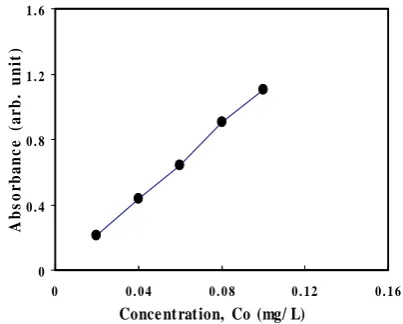
were measured by preparing 0.02, 0.04, 0.06, 0.08, 0.10 and 0.12 mg/L concentrated solution. The dye removal was determined spectrophotometrically by monitoring absorbance changes at wavelength of maximum adsorption20 (λmax= 443) by using Perkin Elmer Lamda-35 UV-visible Spectrophotometer as shown in Fig.2. The absorbance of the Lurazol Brown pH solution obtained from UV-visible Spectrophotometer varies linearly with concentration. Fig.3 shows the linear Relationship between Variation absorbance and different concentrations. The value of molar extinction co-efficient was determined using Lambert-Beer’s law from Fig.3, which is 0.011053.
Fig. 2. UV-VIS Spectrum of Lurazol Brown pH at different concentrations (λmax = 443 nm).
0 0 . 4 0 . 8 1 . 2 1 . 6
0 0 . 0 4 0 . 0 8 0 . 1 2 0 . 1 6
Conce nt rat ion, Co (mg/ L)
A
b
s
o
rb
a
n
c
e
(
a
rb
. u
n
it
)
Fig. 3. Relationship between Variation absorbance and different concentrations
B. Effect of agitation time and initial dye concentration
Fig.4. shows the relationship between amounts of (Lurazol Brown pH) dye sorption by acid activated sawdust of varying concentration and agitation time at equilibrium. It is observed that the removal of dye is rapid in the initial stages of agitation time and gradually decreases and finally reaches at equilibrium. The equilibrium time is the time taken for the maximum adsorption of the dye on to the adsorption surface, above which adsorption remains constant. The equilibrium time is observed to be 20 min for 100 mg/L, 60 min for 300 mg/L and 80 min for 500 mg/L dye concentrations. It is also observed that the sorption of LBP depends on the initial concentration of LBP aqueous solution and the rate of LBP uptake by activated sawdust decrease with the increases in
380.0 400 420 440 460 480 500 520 540 560 580 600 620 640 660 680.0 0.000
0.05 0.10 0.15 0.20 0.25 0.30 0.35 0.40 0.45 0.50 0.55 0.60 0.65 0.70 0.75 0.80 0.85 0.90 0.95 1.00 1.05 1.10 1.15 1.200
nm A
443.58,0.21022 443.58,0.43635 443.58,0.64276 443.58,0.90638 443.58,1.1019 0.1
0.08
0.06gm/ 0.04
0.02
pH meter
Stage-I
Stage-II
Treated water
470 initial concentration. The similar relationship also observed by McKay21 in case of sorption Cl Direct Orange 39 and Victoria Blue by activated carbon. According to McKay21 some sorbents may be more efficacious for waste streams that contain smaller concentrations of dyes because of the more rapid kinetics.
0 20 40 60 80 100 120
0 100 200 300 400 500 600
C
o100 mg/l
300 mg/l
500 mg/l
C
onc
en
tra
tio
n, C
o
(m
g/l)
Agitation time (min)
Fig. 4. Relationship between amounts of dye Sorption by acid activated sawdust of varying concentration and agitation time at equilibrium
IV. ADSORPTION DYNAMICS
In order to design an effective sorbet having the knowledge on the rate at which the adsorption takes place by the adsorbent is an important factor. However, adsorption kinetics largely depends on the physical and chemical characteristics of the adsorbent material, which influences the adsorption mechanism. Thus the rate constant of adsorption of dye is determined from the following equation (1) first order rate expression given by Lagergren22.
(
q
eq
t)
( )
q
ek
t
303
.
2
log
log
110
10
−
=
−
... (1)Where qe is the amounts of dye adsorbed at equilibrium (mg/g) and qt is the amounts of dye adsorbed at time t, (mg/g) and k1 is the rate constant of pseudo-first order adsorption.
Fig. 5 shows the Relationship between Lagergren rate constant for the adsorption of Lurazol Brown PH and agitation time by acid activated sawdust. The values of the k1
and the correlations coefficient were calculated from the slope of the linear plots as shown in fig.5 and were presented
in Table-I.
0 10 20 30 40 50
-3.0 -2.5 -2.0 -1.5 -1.0 -0.5 0.0 0.5 1.0 1.5
Co r 2 100 mg/l 0.930 300 mg/l 0.920 500 mg/l 0.933
log (q
e
-q
t)
Agitatioin time (min)
Fig. 5. Relationship between Lagergren rates constant for the adsorption of Lurazol Brown pH and agitation time by acid activated sawdust
TABLE-I:VARIATION OF RATE CONSTANT AND CORRELATION COEFFICIENT
Initial concentration (C0), mg/L
Rate constant (k1)
Correlation coefficient (r2) 100
300 500
0.05286 0.03109 0.02150
0.930 0.920 0.932
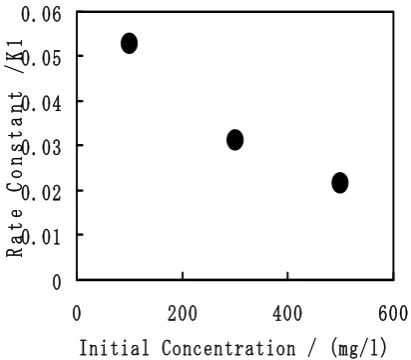
It is observed that the value of rate constants decreases with the increase of the initial concentration as shown in fig. 6. It is very interesting to mention here that in the present investigation the variation of rate constants with initial concentrations follows a linear relation having the equation, K1=0.05867-7.84 X 10⁻⁵ Co with the regression co-efficient, r2 = 0.9521.
0 0.01 0.02 0.03 0.04 0.05 0.06
0 200 400 600
Initial Concentration / (mg/l)
Rate
Con
sta
nt /
K1
471 V. EFFECT OF ADSORBENT DOSAGE
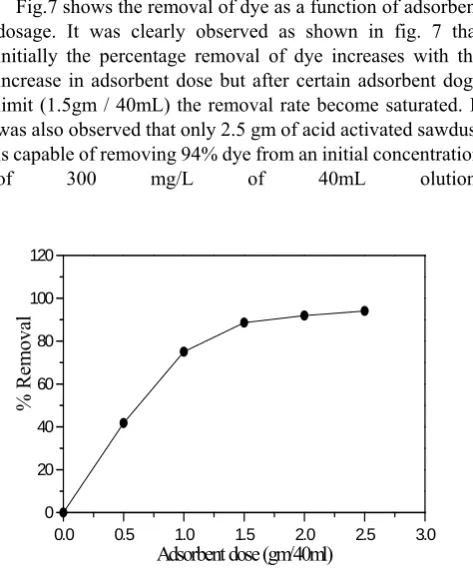
Fig.7 shows the removal of dye as a function of adsorbent dosage. It was clearly observed as shown in fig. 7 that initially the percentage removal of dye increases with the increase in adsorbent dose but after certain adsorbent doge limit (1.5gm / 40mL) the removal rate become saturated. It was also observed that only 2.5 gm of acid activated sawdust is capable of removing 94% dye from an initial concentration of 300 mg/L of 40mL olution.
0.0 0.5 1.0 1.5 2.0 2.5 3.0 0
20 40 60 80 100 120
% R
em
oval
Adsorbent dose (gm/40ml)
VI. ADSORPTION ISOTHERM
The Langmuir [16] adsorption isotherm was applied for adsorption equilibrium as the following equation (2).
o e o
e e
Q
C
b
Q
q
C
+
=
1
………..…. (2)Where Ce is the equilibrium concentration (mg/L), qe is the amount of dye adsorbed at equilibrium (mg/g), and Q0 and b is Langmuir constants related to adsorption capacity and energy of adsorption respectively.
The linear plot of Ce/qe vs. Ce shows that the adsorption obeys Langmuir isotherm model as shown in fig.8. The values of Q0 and b were determined from the slope and intercept of the plot and are presented in the Table-II.
TABLE-II DATA FOR LANGMUIR ISOTHERM
Langmuir Constant Initial Concentration (C0),
mg/L
RL
Q0 =16.37
b =0.0334
100 300 500
0.2304 0.0907 0.0565
0 20 40 60 80 100 120 140 160 0
3 6 9 12 15
Ce /qe
(mg/l)
Ce(mg/l)
The essential characteristics of Langmuir isotherm [16] can be expressed in terms of dimensionless constant separation factor for equilibrium parameter, RL which is defined by equation (3)
(
o)
L
bC
R
+
=
1
1
……….. (3)
Where C0 is the initial dye concentration (mg/L) and b is the Langmuir constant (l/mg). According to Hall et al. [17] it has been seen, using mathematical calculation that the parameter RL indicates shape of the isotherm as indicated in the Table-III. The RL value obtained in the present studies for different initial concentration indicates favorable adsorption of Lurazol Brown PH onto acid activated sawdust.
TABLE-III VARIATION OF SHAPE OF THE ISOTHERM WITH RESPECT TO RL
RL value Type of isotherm
RL>1
RL=1
O<RL<1
RL =0
Unfavorable Linear Favorable Irreversible
Freundlich isotherm model was also used to explain the observed phenomenon. The Freundlich isotherm [18] is represented by the following equation (4).
)
(
log
1
)
(
log
)
(
log
10 10 f 10C
en
k
m
x
+
=
…………..(4)where, Ce is the equilibrium concentration (mg/l), x is the amount of dye removal (mg), m is the weight of the adsorbent used (g) and Kf and n are constant incorporating all factors affecting the adsorption process such as adsorption capacity and intensity respectively. Fig. 9 represent the variation of log10 (x/m) with respect to log10 (Ce). The linear nature of the graph indicates that the present observations follow the Freundlich isotherm as well. The values of Freundlich constants (Kf and n) were calculated from the intercept and slope of the plot and found to be Kf = 0.134 and n = 2.12. Fig. 7.Effect of adsorbent dosage on Lurazol Brown pH
removal by acid activated sawdust
472 According to Treybal [19] it has been shown that the value of n was between 1 and 10 representing beneficial adsorption.
0.8 1.2 1.6 2.0 2.4 2.8 0.4
0.6 0.8 1.0 1.2 1.4 1.6
log
(x/m)
log C
eFig. 9.Freundlich plot for the adsorption of Lurazol Brown PH by acid activated sawdust
As observed in the Fig. 9 that the amount of dye adsorbs at equilibrium and the time required for it depend on the initial concentration. Thus in the present study a two-stage filtration were carried out. Initially, 5 liter of solution having 500-mg/L dye concentrations was taken and 125gm of sawdust was used. The mixer was agitated and concentrations were measured in different time intervals. At next step the sawdust was divided in equally two portions and the process was repeated with the one portion (62.5 gm) of sawdust. After completion the process the filtered solution was taken to the second column and another portion of sawdust was added and agitated the mixer accordingly and concentration was measured at certain time intervals.
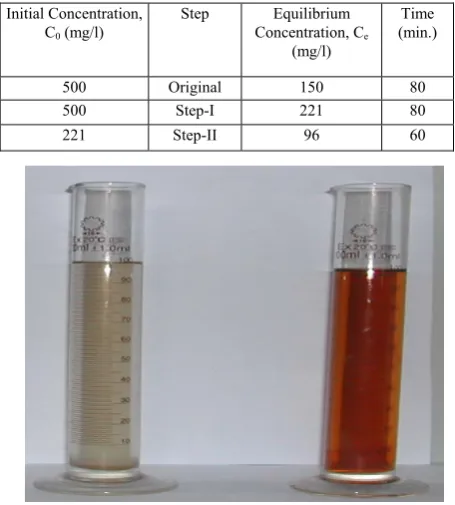
Fig. 10. shows the comparative studies of removal of dyes between one- stage and two-stage filtration system. Table-4 represents the equilibrium concentration and time in two systems. It is observed that one stage filtration system can lower the concentration from 500 mg/l to 150 mg/l at equilibrium, which is equivalent to 70% removal. But the same concentration of dye were used and the same amount of adsorbent applied in two step the final equilibrium concentration become 96 mg/l, which is equivalent to 81% removal. It indicates that two-stage filtration system can enhance the dye adsorption in 11% when the initial concentration is 500 mg/l. It is also observed from Fig.10 and Table-4 that the time required to reach the equilibrium for two-stage system is 60 min. but that of one-stage is 80 min, which indicates that the two-stage system improves the rate of uptakes of dye, by the adsorbent. In conclusion it can be mentioned that two-stage system can provide two-way benefits by removing more amount of dyes in lesser time with compare to one-stage system. Fig. 11 shows both untreated and treated wastewater.
0 20 40 60 80 100 120
0 100 200 300 400 500 600
Step-I
Step-II
Original for 500 mg/l
Concentration, C
o
(m
g/l)
Agitation time (min)
Fig. 10. Enhancement of dye removal by two-step column filtration system
TABLE-IVEQUILIBRIUM CONCENTRATION IN STAGE FILTRATION SYSTEM
Initial Concentration, C0 (mg/l)
Step Equilibrium Concentration, Ce
(mg/l)
Time (min.)
500 Original 150 80 500 Step-I 221 80 221 Step-II 96 60
Fig. 11. Left: treated raw water; Right: untreated raw water
VII. CONCLUSIONS
473 Freundlich isotherms. The values of rate constants found in the present investigation is encouraging for using acid activated sawdust as an adsorbent for treating dye wastewater.
A two-stage filtration system has been designed, constructed and demonstrated with regards of variety initial solution concentrations. The technology has yield very promising results (reducing waste stream contaminants to low levels) and has been showed to provide two-way benefits by removing more amounts of dyes in lesser time with compare to one-stage system. Result suggests significant improvements in performance to be achievable and hence, continued study is recommended in order to refine operating conditions and design.
REFERENCES
[1] K. Garg, Renuka Gupta, Anu Bala Yadav and Rakesh Kumar, Dye removal from aqueous solution by adsorption on treated sawdust, Bio-resource Technology, Volume 89, 2003, pp. 121-124
[2] S. Saiful Azhar, Ghaniey Liew, D. Suhardy, K. Farizul Hafiz and M.D Irfan Hatim, Dye Removal from Aqueous Solution by using Adsorption on Treated Sugarcane Bagasse, Applied Sciences, Volume 2 (11), 2005, pp. 1499-1503
[3] J.C. Morris and W.J.Jr. Weber, Public Health Service Publication, 1962, pp. 62-24.
[4] J.C. Morris and W.J.Jr. Weber, Public Health Service Publication 999, 1964, WP-11.
[5] G.M. Walker and L.R. Weatherly, Biochemistry, Volume 32, 1997, pp. 327-335.
[6] L.B. Khalil and B.S. Girgis, Column removal of some dyestuffs by activated carbons derived from apricot stone shells, Adsorption science & Technology, Volume 16, 1998, pp. 405-414.
[7] Benoit Boulinguiez, Pierre Le Cloirec and Dominique Wolbert, Revisiting the Determination of Langmuir Parameters Application to Tetrahydrothiophene Adsorption onto Activated Carbon, American Chemical Society, Volume 24 (13), 2008, pp. 6420–6424.
[8] V.K. Gupta, and Suhas, Application of low-cost adsorbents for dye removal – A review, Environmental Management, Volume 90, 2009, pp. 2313-2342.
[9] Namasivayam, C. and Kadirvelu, K, Coir pith, an agricultural waste by-product, for the treatment of dyeing wastewater, Bioresource Technology, Volume 48, 1994, pp. 79–81
[10] Namasivayam, C., Prabha, D. and Kumutha, M., Removal of direct red and acid brilliant blue by adsorption on to banana pith, Bioresource Technology, Volume 64, 1998, pp. 77–79
[11] K.S. LOW and C.K. LEE, the Removal of Cationic Dyes Using Coconut Husk as an Adsorbent, Pertanika, Volume 13(2), 1990, pp. 221-228
[12] V. Ponnusami, V. Krithika, R. Madhuram and S.N. Srivastava, Biosorption of reactive dye using, acid-treated rice husk: Factorial design analysis,Hazardous Materials (Bioresource Technology), Volume 142, 2007, pp. 397-403
[13] I.D. and Upadhyay, S.N, Studies on treatment of basic dyes bearing wastewater by adsorptive treatment using flyash, Environmental Health, Volume 40 1998, pp. 177-188
[14] Gordon McKay1 Application of Surface Diffusion Model to the Adsorption of Dyes on Bagasse Pith. Journal of Adsorption 4(1998) 361-372
[15] H.M. Asfour, M.M. Nassar, O.A. Fadala, and El-Geundi, J. Chem. Tech. Bio. Tech., Volume 35, 1985, pp. 28-34.
[16] Langmuir, J. Amer. Soc., Volume 40, 1918, pp. 1361.
[17] R.K.Hall, L.C.Eagleton, A.Acrivos and A.Vermevlem, Ind. Engg. Chem., Volume 5, 1966, pp. 212.
[18] Freundlich, Uber die adsorption in lusungen, J. Phys. Chem., Volume 57, 1906, pp. 385.
[19] R.E. Treybal, “Mass Transfer Operations”, 3rd ed., New York: McGraw Hill, 1980