Framework for Introducing and Implementing
Value Methods: A Novel Toolkit for Small and
Medium Scale Industries in Developing Nations
Babatunde O. Odedairo
1,
David Bell
21Department of Management Technology, The Bells University of Technology, Ota, Ogun State. Nigeria
2School of Computing, Engineering and Information Sciences (CEIS), University of Northumbria at Newcastle upon Tyne,
United Kingdom [email protected]
Abstract-- The role of small and medium scale enterprises as agents for building a resilient economic system have long been identified. This is shown in their flexibility, innovative and good relationship with other sectors of the economy especially large scale industries. In recent years, large scale industries have undergone many changes in their production environment by implementing various manufacturing techniques such as JIT, TQM, S ix S igma, Value methods and Lean manufacturing. These techniques are generally acceptable process improvement approaches for achieving exceptional results in areas like quality, cost, reliability and good value.
A critical review of S MEs in both developed and developing countries indicates little application of these techniques. However, to sustain the link between S MEs and large scale industries, the need for appropriate manufacturing concepts in the S ME sector was identified. Also, an increase in the demand for high quality products and exceptional business processes by large organization from S MEs has left no choice for smaller companies.
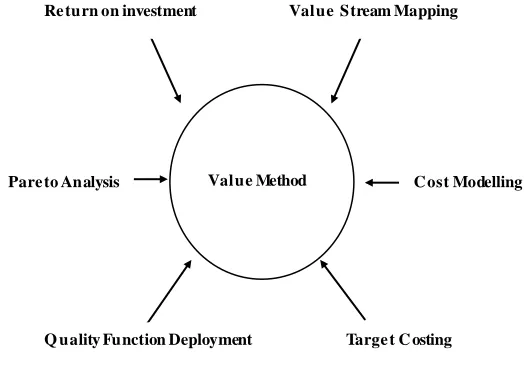
This paper focuses on developing a function-oriented value method strategy required to implement the value methodology for S MEs in developing nations. The Value methodology has function and cost as the foundation upon which the technique operates. Therefore a toolkit with value methods as the central management tool was developed. The toolkit integrates few supporting techniques (return on investment, cost modeling, pareto analysis, value stream mapping, quality function deployment and target costing) within value methods. The aim of integrating these management techniques into a dynamic and competent hybrid is to increase the scope and applicability of the parent tool (Value methods). In addition, requirements for implementing value methodology i n S MEs were highlighted.
Index Term-- S MEs, Developing nations, Manufacturing tools/technique, Value methods, Toolkit, S upporting techniques.
1. INTRODUCTION
The dynamic roles of small and medium enterprises (SMEs) as engines through which the growth ob jectives of developing countries can be achieved have long been recognized. Also, its recognition as a prerequisite for the development of a modern and progressive economy cannot be over emphasised. Therefore, any country that is desirous of rapid industrialisation and economic prosperity cannot afford to relegate the development of its small and medium scale enterprises to the background because SMEs form the vanguard of the modern enterprise sector. This sector also presents the propelling force for econo mic modernisation and growth in developing economies.
McAdams et al. (2000) [1] summarised the impact of SMEs as “the life blood of modern economies”. Beyene (2002) [2] argued that SMEs are universally acknowledged as effective instruments for employment generation and economic growth. Beaver & Prince (2004) [3] reaffirmed smaller companies as the focus of political, business and management research as well as a vehicle for generating an enterprise economy. Kharbanda (2001) [4] believed that in developing countries, small and medium enterprises (SMEs) form the bulk of the industrial base and contribute significantly to the gross domestic profits (GDP) of these nations. Dangayach & Deshmukh (2001) [5] also identified SMEs as an excellent ancillary unit for large companies; supporting them in serving niche markets in this era of globalisation. Gunasekaran et al. (2000) [6] argued that not only does SMEs play a greater role in national economy; their competitiveness is also of prime concern to producers of both goods and services.
Furthermore, the realization of the sector‟s potentialities specifically in developing economy has also aroused the interest of major international aid agencies including the World Bank. This is practically proved with targeted assistance to the sector. From 1998-2002, the World Bank Group approved more than $10 billion in SMEs support programs and $1.3 billion in 2003 in an effort to achieve meaningful and rapid industrial progress [7]. In the developed world where big industries flourish, SMEs are still a major force. Hence, the drive towards a dynamic, focused, consistent, and productive SME base in developing nations is healthy when their capability for building sustainable and resilient economic system are considered. In the overall economic development, the impact of the micro, small and medium enterprises is enormous to the extent that over 90% of enterprises in the world and 50-60 % of employment belong to this sector [8].
encompasses both technical and human issues. Also, the type of technique to be utilised, organisational structure and possible interaction between different departments are some of the factors needed for a successful productivity initiative. In addition, while some of these tools focus more on achieving a particular purpose, others have grown to become multi-dimensional business improvement roadmaps. Therefore, it is imperative for smaller companies to strategically consider the possibilities of integrating and implementing these manufacturing approaches within their own operations. This is necessary as most large scale industries expect from their major suppliers which are mostly SMEs, a reasonable level of reliable and dependable services.
1.1 Review of manufacturing techniques usage in SMEs In the light of these developments, it is necessary to gain more insights into a number of manufacturing approaches and ascertain the current level of use in SMEs. Review of the current level of applicability of some techniques in SMEs is presented below:
1.1.1 Just-in-Time
The desire to maximize the velocity of material flow through the plant and hence minimize inventory) by arranging materials to arrive at each stage of manufacture just in time to be processed is the objective of the just –in –time production. With the analysis of just-in-time and the capabilities of SMEs, most literature on JIT implementation focus more on large manufacturing firms, the environment in which the concepts arose, with less emphasis on SMEs. Most small enterprise fear new investments of capital in labour, materials, and equipments to implement JIT. While top management commitment, training of workers on JIT concepts, development of a long-term supplier and customer relationship are some of the issues to consider for successful implementation of JIT in SMEs .Hence the need to identify these critical variables associated with each basic JIT philosophy in SMEs is necessary before considering any implementation plan.
1.1.2 Six Sigma
Six Sigma is the current stage of evolution in the field of Quality management with a core focus on profitability improvement and strategic value levelling. The technique is based on the fundamentals of traditional TQM with the aim of achieving no more than 3.4 defects per million units of output or opportunities. This means organisations that embrace the technique are striving to meet or exceed their customer's expectations 999,996.6 times out of every million encounters. Wessel & Burcher (2004) [9] summarised the discussion of Ghobadian & Gallear (1997) that “the published work of the gurus of quality, such as Crosby, Juran, Deming and Feigenbaum, reflect their experiences at large multinationals” and further stated that there are little research on Six Sigma specifically focusing on SMEs. Therefore, small enterprises must consider the structure of their processes and compare if any opportunities exist for implementing Six Sigma before refining the model to their needs. Above all, the technique can work in any organisation irrespective of the size.
1.1.3 Lean Manufacturing
A review of Lean manufacturing indicate that it encompasses a wide range of management practices, including just-in-time, quality systems, work teams, supplier management, value stream mapping, 5s, SMED, etc in an integrated system. In general, Lean manufacturing is an approach which allows businesses to improve their profitability and competitiveness through the identification and elimination of wasteful practices and behaviour. Benefits such as reduction in lead time, increase in sale, productivity improvement can be achieved by applying this technique. Ettkin et al. (1990) [10] found that most small enterprises who claimed to be using lean manufacturing actually did not adopt some of the major components of lean management system while Brown & Inman (1993) [11] identified lack of top management commitment, investment in specialized equipment, education, training and limited financial resources as reasons for SMEs not adopting the lean system. Furthermore, the need for continual improvement and methods involved in implementing Lean manufacturing require that the area needing improvement be selected followed by developing a theoretical framework which creates an understan ding of the lean philosophy.
It is obvious that these techniques have contributed immensely to productivity improvement, quality of products and services in large industries; but of little application in SMEs. Gunasegaram (2000) [12] supported the claim that the implementation of these manufacturing approaches has not received due attention from SMEs.
However, Gunasekaran et al. (2000) [6] explained that the manufacturing practices used to achieve excellence in large-scale industries can be successfully implemented in SMEs for quality and productivity improvement. However, despite all the known contradiction and limitation faced by SMEs, Yeb-Yun Lin (1999) cited by Wessel & Burcher (2004) [9] believed that a team oriented tool and method can be successful in a small company. Nelder & Willcock (2000) [13] further stressed that most SMEs usually consider opportunity that offer instant remedy to a wide range of problems. This means that small enterprises are known to prefer short-term goals, benefits and strategy.These features of SMEs make the sector an ideal target for improvement opportunities in business, production, and cooperation with large and other smaller enterprises.
Therefore, the aim of the study is to develop a function-oriented value method strategy required to implement value methodologies for SMEs in
collection. While the result will be presented in section four. In concluding we present issues for future work
2.
TRENDS IN VALUE METHOD
Value method is a systematic and valuable decision -making approach in problem-solving. A critical review of the definition exposed the following characteristics of value methods:
• It is a value –based decision process.
• It employs a cross functional approach in defining purpose and generating concept understanding.
• A “job plan” is organized that incorporates all the phases of decision-making.
From the definition, it is obvious that regardless of the nomenclature used, value methods works by examining the sources of information, defining the function(s) of the product and the necessary cost required to provide such function(s). Lawrence Miles (1961) [14] define value analysis “as a philosophy implemented by the use of techniques, a body of knowledge, and a group of learned skills. This means, the technique is a creative approach which has for its purpose the efficient identification of unnecessary cost, i.e. cost which provides neither quality nor use nor life nor appearance nor customer features”. However, Shillito & De Marle (1992) [15] argued that Miles earlier definition of value methods do not have a customer approach and looking at the developments in the business world today, the voice of the customer matters. Therefore, defining the value of a product or service should be on what the customer says it is worth. They further argued that incorporating the voice of the customer in a value improvement plan targeted at a new product design will preserve what the customer deem important.
The customer oriented value engineering (COVE) allows customers desire for a function and definition of value to prevail. Kermode et al. (2000) [16] also argued that value study can be targeted at a product in which an improvement is desired. This is achieved by analysing the product through a creative effort with the aim of increasing functionality and reduction in cost. This is illustrated in fig. 1. The functional domain can be seen as a further step which clarifies functions and the cost required to produce the product.
Fig. 1. Product improvement s using functional analysis.
The job plan in a VM study has been identified as a crucial part of the value method study. It is the job plan that implements the theory. Therefore, to develop a toolkit with value methods as the central tool, the job plan must be used as a template. Kermode et al. (2000) [16] proposed an iterative job plan shown in fig 2
Fig. 2. Iterative Value Methods job plan.
From the figure above, each stage require some basic tools in order to accomplish the purpose of that stage and the goal of the study. In addition, researchers believe that the technique can be integrated with other tools in a function oriented methodology; the purpose is to identify the role of the tools being added.
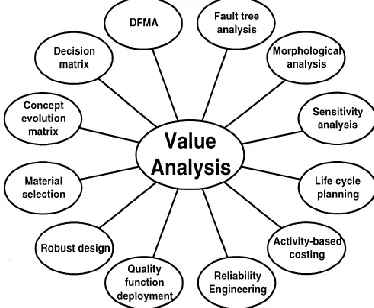
The technique has also been demonstrated in a way to address other categories of problems in various industries. Such industries include petroleum refining, chemicals, health care, process control, transportation and construction to mention a few. However, based on the versatility of the technique, Kermode et al. (2000) [16] proposed a system such that value methods can be used as a general design – enhancing tool within concurrent engineering1. The emphasis is on the belief that the relevance of value analysis can further be realized in a toolkit comprising of other techniques. This will enable value methods to become an integrated tool for use in a systematic product development initiative as shown in fig. 3.
Fig. 3. Integrating Value Analysis and other techniques
Furthermore, while concurrent engineering is a new product development technique with the aim of getting it right first time by combining all integrated efforts from different departments; value methods is a problem solving technique. This means value methods identify problems and possible ways of correcting the problems.
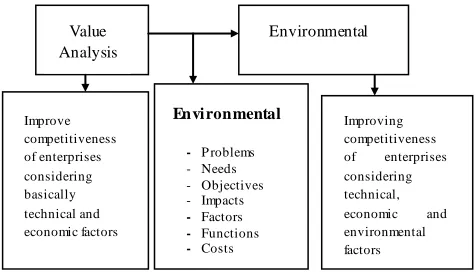
Agbejule et al. (2004) [17] demonstrated how the concept of value analysis can be extended to incorporate the costs of the impacts made by environmental burdens, this extension
1 This is a recent term applied to the engineering design
opens new avenues for an eco-friendly green product development that is essentially a cost-effective one. They presented a model for the environmental value analysis (EVA) and its usefulness as a tool towards environmental improvement analysis. The concept was called Environmental Value Analysis (EVA) which focuses on integrating environmental issues within value analysis. The mathematical model of environmental value index (EVI) derived from EVA analysis, aims to define the relationship between the importance of the environmental functions and the cost of the functions as illustrated in fig. 4.
Fig. 4. T ransfer of Value Analysis into Environmental ap plications
Previous studies have also shown that value methodology can evolve from a single purpose tool to a better and multi-dimensional problem solving tool. Ball (2003) [18] believe that it is possible to integrate other technique with value methods in a function-structured VM study. The point is to identify where the tool or method will be relevant in the job plan. Kermode et al. (2000) [16] further argue that the versatility of value methods will be fully utilized when linked with relevant tools in a toolkit for better analysis and decision- making. Since value methods is not a cure for all technique and to keep pace with the changing business climate, integrating other supporting techniques with the method in a function structured study is relevant.
Hence, research shows that value method is a proactive, creative, cross-functional, systematic and team-oriented methodology. The technique maximises the functional value of a product, project and service. It is a reliable technique for productivity improvement. However, value methods study thrives on good and accurate information such that any misinformation will definitely affect the integrity and accuracy of the study. Therefore, the need for other supporting techniques linked together in a „toolkit‟ is to ensure better analysis and decision-making while utilising value methods. A critical consideration of the characteristics of SMEs vis-à-vis their opportunities and limitations reveals that opportunities exist for implementing value methods when characteristics such as:
• Flexibility,
• Absence of bureaucracy in management team, • Rapid execution and implementation of decision, •Quick deployment of improvements are considered.
3. METHODOLOGY
A critical evaluation of the purpose of this research indicates it is an exploratory research with the aim of gaining insights and better understanding of the subject area for further
investigation. Therefore, a qualitative methodology is chosen which usually use data in the form of words from documents and collection of various observations. The purpose of these data sets is to create a path towards a better understanding on how value methods are generally applied in both large companies and SMEs. However, the name “Toolkit” was chosen being that it is a common term denoting a container housing a collection of many tools needed to accomplish a predefined task, function or purpose. Also, the toolkit will be in form of worksheets and workbooks covering all the process of a value study. This will be made simpler for better understanding and easier usage in small and medium scale industries (SMEs).
For the purpose of gaining better understanding on how the goals of value methods study can be achieved and the tools required during the process of implementing the techniqu e; key steps taken by organisation already running the study was observed. The aim is to assist the author in developing a roadmap on how the toolkit should be structured for use by SMEs in developing nations. Kermode et al. (2000) [16] reinforced the successful application of the technique in a wide range of fields evident by its adoption in the British and European standard as well as the United States government. Large scale companies such as Betchel, BP, Boeing, Cannon, Eastman Kodak, General Motors, Honeywell, Kellogg Brown & Root, Lockheed Martin, Pratt & Whitney, Shell, Tata Steel, Technip, Nortel, Xerox etc., are known to have internal value management/value engineering capabilities with a mandatory requirement for all capital projects to be exposed to a VM or VE study as part of the decision-making processes.
Also, identified companies in the process sector of the UK economy implementing value methods includes: BP Amoco, BNFL (British Nuclear Fuels Ltd), ICI and Unilever. For the above mentioned companies, the job plan is a crucial step while implementing the technique. Therefore, for Small and Medium Scale industries (SMEs), successful application of the technique was traced to strict adherence to the job plan. In the context of the above value programmes, a case study investigation on the application of value method in large and medium scale industries reveals some vital tools necessary for a successful value programme. Such tools include Quality function deployment, Target costing, lean manufacturing, Six sigma, Theory of constraint, Total quality management and Design for manufacturing/ assembly, process mapping, Cost/ benefit, Value target just to mention a few.
In addition, Ball (2003) [18] stressed that by incorporating tools and techniques such as quality function deployment, Target costing , Lean manufacturing, Six sigma, Theory of constraint, Total quality management and Design for manufacturing/ assembly in a function-structured value method study. An organisation can gain an edge on creating true value for the consumer as well as obtaining a good market margin. However, considering the characteristics and limitations of SMEs in developing nations, the author believes that any tool chosen to form part of the supporting tool in the toolkit must meet the following criteria:
Simple,
Quick to learn and
Value Analysis
Analy
sis
Environmental- P roblems
- - Needs
- - Objectives
- - Impacts
- Factors
- Functions
- Costs
Environmental
Environme
ntal
Value
Analysis
Improve competitiveness of enterprises considering basically technical and
economicfactors
Improving competitiveness
of enterprises
considering technical,
economic and
Easier to understand. This criteria form the basis for selecting the supporting techniques for the toolkit.
3.1 Developing the Toolk it
The toolkit will be made up of workbooks and worksheets with instructions on how to use it. The reason for the worksheets is that it is the basis of value methods and it provides means of recording the information developed during the value study for better decision making and problem solving. Therefore, each of the value job plan phases will have a worksheet for easier understanding. Also, the toolkit will be developed in such a way that it can be fashioned to solve problems on issues surrounding product development, capital investment and management issues. Lastly, the purpose of the toolkit is for use in SMEs and simplicity is very important. A diagrammatic representation of the toolkit is presented in fig. 5.
Fig. 5. T he Toolkit: Integrating various tools within a Value Methods study
Since each value method phase require a particular tool, table I highlight the probable techniques needed.
C ost Modelling Value Method
Re turn on investment Value Stream Mapping
Targe t C osting Q uality Function Deployment
TABLE I
T ools corresponding to each phase of a Value Methods study
The Value Method Job Plan Phase Activity
Tools used
Pre –study/Information 1. Select project/product/Service 2. Define scope
3. Identify goals 4. Identify constraints 5. Identify all data needed 6. Form Team
7. Select areas with savings potential
1. Pareto analysis 2. Cost modelling 3. Cost data 4. Quality function deployment
5. Value stream mapping
Analysis 1. Analyse functions
2. Determine function costs 3. Identify function/ costs difference
4. Develop cost model 5. Assign worth and cost to functions
6. Validate all cost element used 7. Set target costs
1. FAST diagram
2. Verb/Noun description 3. Function cost matrix 4. Target costing
Creative 1. Generate better ideas 1.Team oriented
brainstorming
Evaluation 1. Screen alternatives
2. Prioritize alternatives 3. Determine feasibility 4. Select better ideas
1. Pareto analysis 2. Return on investment
Presentation/ Implementation
1. Justify the chosen alternative 2. Identify advantages/disadvantages 3. Specify benefits
4. Requirement for implementation
1.Training
4. RESULTS
The research proved so far that value method is a proactive, creative, cross-functional, systematic and team-oriented methodology. The technique maximises the functional value of a product, project and service. Therefore, it is a reliable technique for productivity improvement. However, value methods study thrives on good and accurate information such that any misinformation will definitely affect the integrity and accuracy of the study. Hence, the need for
supporting techniques linked together in a „toolkit‟ is to ensure better analysis and decision-making while utilising value methods. Furthermore, a critical consideration of the characteristics of SMEs reveals that opportunities exist for implementing value methods when characteristics such as:
Flexibility,
Absence of bureaucracy in management team, Rapid execution and implementation of decision
Quick deployment of improvements is considered.
Since most of the manufacturing approaches were developed with large organisations in mind, therefore “the one size fits all” attitude of attempting to adopt these techniques to SMEs is not practical. Hence, SMEs must not only adopt these manufacturing concepts, they must adapt the concept to their business while cons idering any
inherent limitation. With these manufacturing approaches, a deployment model specifically built for use in SMEs is the best option if the benefits of such approaches are to be achieved.
Value methods have been successfully applied to address value problems in the area of new product development, capital investment and management of plant operation. Hence, the author can establish the fact that integrating value method with other associated technique in a toolkit is relevant if the right techniques are chosen and the rationale for choosing such tools justified. The emerging toolkit will definitely enhance the usefulness of the parent tool (value methods) in SMEs. Apart from the individual strength from each of the technique in the toolkit, it is important to note that the inherent limitation of each participating technique will also come into play in the emerging toolkit.
The techniques chosen to form part of the toolkit were selected such that the emerging toolkit will be a multi-facet problem solving tool for any value programme. Also, simplicity and ease of understanding was part of the underlying thought of the author while considering the choice of the supporting tools. Another reason for choosing the contributing techniques is that owners of small businesses wish to be convinced of the benefits of embracing any new technique. Hence, such supporting techniques in the context of SMEs must meet the following criteria:
Be easier to understand,
Enhance the applicability of the toolkit, Quick to learn and
Allow SMEs to digest the methodology of such technique at their pace.
Therefore, the supporting techniques in the toolkit were Quality function deployment, Pareto analysis, Target costing, Return on investment, Cost modelling and Value stream mapping. The basis of their inclusion in the toolkit is discussed below.
4.1 Quality Function Deployment
QFD inclusion in the toolkit is to achieve the following: capture the voice of the customer,
translate soft customer requirements into measurable goals and
used in new product development.
These criteria form the basis of selecting QFD as a supporting technique for the toolkit. However, a customer oriented value method also emerged through the inclusion of QFD. QFD translate customer requirement which is also customer voice into measurable goals. Therefore, the value team can fully understand what the customer wants and translate these requirements into the functions of a product . This ensures that the right services or products are introduced into the market the first time. This is also in line with the observation of Ball (2003) [17] that QFD can be
beneficial in the information phase of the value method job plan.
However, previous research indicated that QFD is a lengthy process, which usually takes 4-8 months. Also, relevant and up-to-date customer information may be too expensive to collate by SMEs. In the context of value methodologies and depending on the value programme in operation, QFD is only relevant in product development. And all the processes of QFD do not necessarily have to be applied in the value methodologies, what is important is to capture the voice of the customer and translate this into measurable goals.
4.2Pareto Analysis
In the toolkit, Pareto analysis reveals items that demands attention. This is because in most cases the law of disproportion holds, which means 80% of the cost (action/effort), is proportional to 20% (result) of the component. However, the technique has limits which can be divided into 2 categories:
Focus only on the past: While analysing the past problems, the historical data can be misleading by any recent change. Some small activities may raise their amount suddenly after collecting data.
Dependent on availability and applicability of data: The quality of the analysis relies on the availability of the relevant and reliable data for the s ituation that is being studied. Therefore, collecting the significant data is a condition to a successful analysis.
4.3 Return on investment
Since there are start up cost required in the implementation of value study, the earlier the benefit of embracing value methods is communicated to the management of a smaller company the better. Therefore, the toolkit should provide an ample benefit/cost ratio quickly. The return on investment (ROI) calculation reveals such ratio. A typical example is the case of Pizza Hut UK with a return of investment of 35.1 [19]. However, inadequate cost data can be a barrier. Sources of materials useful in getting such data can be reference manuals, price catalogue, etc.
4.4 Target costing
This is used in product development; cost targeting is based on what the customer is willing to pay. It is necessary that cost targets be formally established in product development. Therefore, the accuracy of the targets is developed based on available information on pricing formulas and strategies.
4.5 Cost modelling
Most companies try to restrict access to cost data to prevent their competitors from having access to such information. This restriction can have both good and bad influence on the product development teams. It is important that cost data be readily accessible. However, adequate data is needed to support modelling. Typical data required will be labour rates, overhead rates and projected parts costs.
4.6 Value mapping stream
Identify the value adding and non- value adding operations.
Identify the correct areas for improvement.
The author believes that a good value methods study is built on availability of cost data. Also, the cost of a product, service and project is a critical input that cannot be relegated. Therefore, to achieve the aim of any value study, reliable sources of information should be available. Usually there are plenty of data available on material performance but little information on cost data. Hence, it is not surprising that excess cost arises at the planning and design stage of product development. Usually the designer‟s need is more of simple data that relates the cost of different materials and processes.
Therefore, the strength of the toolkit can be weakened when the value programme lacks good cost data for product development. Inadequate cost data are as a result of the following factors:
Lack of reliable information: insufficient data on the functions the user wants and further information on new materials, products and processes.
Lack of communication and coordination Outdated standards and specifications.
Furthermore, the value of a product from the manufacturer point of view is only attained when the cost of all the features in the product is brought into balance with the cost of attaining the essential function of the product. This means before a value study can be carried out, there must be a product or service. Therefore, it is advisable that any value programme in a small company begins with a pilot project or a less complicated projects before any company wide project is carried out. Furthermore, a small company implementing the toolkit will need the assistance of a value specialist. In addition, an evaluation of the performance of the value methods implementation over time would certainly help to identify the benefits and any bottleneck in the implementation.
Looking at the estimated period required for executing a value programme. On the average, it is usually between six months to three years [20]. This raises a question on the patience level of the management of a small company because smaller companies prefer short-term solution rather than wait on the long run. The author believe that the company awareness seminar developed be used to convince the management on the benefits of embracing the method. Capital savings from previous successful value programme and the period required to achieve such ben efits can be used as examples.
One of the limitations while carrying out this research is inadequate research specifically focusing on the use of value methods in a small company, though many researchers argue that deploying the method in a small company is practicable . However, previous research on building hybrid of tools proved successful. A case study of Lean Sigma framework in an Indian SME [21] validate the claim that building a hybrid of tools should be to address the weaknesses of the individual tools while retaining the strengths of the emerging tool. The case study also raises the opinion about validating the Lean Sigma implementation. The case study identifies difficulties in convincing the management on the benefit of
embracing Lean Sigma. With proven results from other companies, the management has to change the attitude of employees towards the introduction of a new technique by assuring them of their job and rewards for better performance.
However, this is not saying that other tools such as Six Sigma, JIT and Lean manufacturing are not potent and reliable techniques to consider for use by SME, the author discovered that a number of these tools have been considered for use by SMEs with different results . A critical look at the characteristics of SMEs and pas t works on applicability of these tools indicate little application of value methods in SMEs.
Finally, though there is a general framework for implementing the elements of value methods, its application would be defined by the industry in question. Therefore once the goals have been established and targets for change determined, the support structure is then put in place to implement value method using the toolkit developed.
5. CONCLUSION AND FUTURE WORK
The findings from the emerging toolkit led the author to conclude that the toolkit is relevant for any value programme. However, the toolkit and the proposed implementation requirements need industrial application in different scenarios to further establish its validity and reliability. The effect of individual techniques on the emerging toolkit should also form part of the future research. A critical look at each of the techniques in the toolkit indicates that though each of the techniques has limitations, which are capable of affecting the effectiveness of the emerging toolkit. This is a limitation for the study at this stage, but further work can be on how to reduce or totally eliminate the limitations of each supporting technique on the overall performance of the toolkit. Previous research has proven that computerisation of manufacturing techniques can enhance the utility of various productivity improvement tools. Hence, more effort should be focused on transforming this toolkit into a user spreadsheet in order to tap into the versatility of the computer.
Due to few numbers of case studies considered in this study, further work will be on a large-scale survey of SMEs in developing nations for greater validity of the findings from this research. The author will take the strengths and weaknesses of SMEs into account, because most developed nations and developing countries are not compatible in many respects. Therefore, what is applicable in one country might not apply in another. While the developed nations and equally some developing nations like China are trying to discover and invent new technologies that speed up production, their foremost problem will be perhaps the acquisition of finance to facilitate these developments. But in developing countries like Nigeria which is still struggling with the provision of basic necessities of production such as water, power and transportation; then finance might not be the spear-heading barrier to SMEs.
strategy for dealing with barriers faced by SMEs. Unless the business community and government harness their efforts in tranquilising a developing nation environment such as Nigeria, no matter the amount of financial and technological assistance SMEs receive, there is little or nothing to be achieved in an environment of nepotism, cultu ral disintegration, ethnicity, religious intolerance and lack of accountability which undoubtedly inhibits not only businesses, but every sector of a nation that seeks to attain economic, social and political prosperity.
Hence, there is a need to explore these barriers and prioritise them, so that the necessary attention and efforts could be directed to developing strategies that would suit the heterogeneous business environment of most developing countries. Above all, this further research would enhance a clearer understanding of the usage of the techniques within the toolkit.
REFERENCE
[1] McAdam, R., Stevenson,P. and Armstrong, G; 2000, Innovative
change management in SMEs: beyond continuous improvement ,
Journal of Logistics Information management,13(3), pp. 138-149
[2] Beyene, A; 2002 „Enhancing the competitiveness and
productivity of small and medium scale enterprises (SMEs) in Africa: An analysis of differential roles of National
[3] Governments through improved support services, Journal of
African Development, 27(3), pp. 130-156
Beaver, G & Prince, C 2004, Management, strategy and policy in the UK small business sector: a critical review, Journal of Small
Business and Enterprises Development, 11(1), pp. 34-49
[4] Kharbanda V; 2001, Facilitating innovation in Indian small and
medium enterprises – The role of Clusters, Current Science, 80
(3), pp.343-348
[5] Dangayach, G. & Deshmukh, S.„ Manufacturing strategy; 2001,
Literature review and some issues, International Journal of Operations & Productions Management , 21(7), pp.884 - 932
[6] Gunasekaran, A., Forker, L. & Kobu , B; 2000, Improving
operations performance in a small company: a case study‟,
International journal of operations & Productions Management, 20(3), , pp. 316-335.
[7] Beck, T . Demirguc-Kunt, A. and Levine, A. SME, Growth and
Poverty: Cross- country Evidence. Available online: http//www.worldbank.org/research\/bios/beck/sme.pdf. Date accessed:08/07/2009
[8] Wilfred, L: Private Sector Development: The support programme
of the Small and Medium Enterprises branch, 2005. Available online:http://www.unido.org/
filestorage/download/?file%5fid=48575 Date accessed: 08/07/2009
[9] Wessel, G. and Burcher, P; 2004, Six Sigma for Small and
Medium –sized enterprises, T he TQM Magazine, 16(4), pp.
264-272
[10] Ettikin, L. P; Raiszadehn F. M.E & Hunt H.R; 1990, Just – in –
T ime: A timely opportunity for small manufacturers‟, Journal of Industrial Management, 32(1), pp.16-18.
[11] Brown, K & Inman, A.R, 1993, Small business and JIT : A
managerial Overview, International Journal of Operations and Production Management , 13(3), pp. 57-66
[12] Gunasegaram, A, 2000 , World class manufacturing in small and
medium enterprises, International Journal of Manufacturing T echnology and Management, Vol. No. 1/2/3/4/5/6/7, pg 777-789
[13] Nelder, G. & Willcock, J., 2000, SME Research: Impact
assessment and reality check‟, Proceedings of the T hird International Conference on Stimulating Manufacturing Excellence in Small and Medium, Enterprises ( SMESME) , pp. 14-22 , Coventry, UK.
[14] Miles L. D. 1972, T echnique of ValueAnalysis and
Engineering, 2nd Edition. USA : McGraw- Hill Inc .45-46
[15] [15] Shillito L.M & DeMarle D.J , 1992, Value –Its
Measurement, Design & Management. USA: John Wiley &
Sons,
[16] [16] Kermode,G. R., Sivaloganathan, S. and Shahin, 2000, T. M.
, Value Analysis –T he T echnique: State of the art and future directions‟, Journal of Engineering Manufacture, Part B 234 (Part 4), pp.301-312
[17] Agbejule, A., Fernandez, M. and D‟Espiney. S, 2004,
Approaches to Environmental value analysis of products, processes, and services‟, International Journal of Management of Environmental Quality, 15(2), pp. 111-130.
[18] Ball H:Value methodology– the link for modern management
improvement tools, 2003 Available online: http://www.value-eng.org/knowledge_bank/attachments/.
Date accessed:08/06/2009
[19] Value Management. Available online:
http://www.constructingexcellence.org.uk (Date accessed: 09/08/2009).
[20] Value Management. Available online:
http://www.constructingexcellence.org.uk (Date accessed: 09/08/2009).
[21] Kumar, M., Antony, J., Singh, R., T iwari, M. & Perry, D. 2006,