Trident Form using Pentagonal Fuzzy
Numbers
M.Geethalakshmi
11
Assistant Professor Department of Mathematics KCG College of Technology, Karapakkam, Chennai
Abstract- This paper deals with the solution to find the Shortest Path using Trident Form through Aggregation Operations such as Arithmetic Mean and Geometric Mean with the help of pentagonal fuzzy numbers which are considered as edge weights. In this paper, the optimal path is decided by obtaining the minimum value of the Trident form which in turn obtained from fuzzy triangular form from which the Pascal’s Triangle graded mean taken along the three sides of Pascal’s Triangle. Here the pentagonal fuzzy numbers are taken to calculate the Pascal’s Triangle Graded Mean. The optimal path has been obtained using Arithmetic Mean and also by using Geometric Mean and the best optimal solution is identified among aggregation operators in order to determine the suitable optimal path through suitable numerical example with the help of the connection network taken from source node to the destination node. Keywords – Fuzzy Numbers, Graded Mean, Optimal Path, Optimal Solution, Pascal’s Triangle.
I. INTRODUCTION
The most common optimization problem is to find the shortest path among networks. Dubois and Prade introduced the shortest path problem in 1980 [2].Then the same problem is worked using fuzzy numbers by Okada and Soper [5]. The Graded Mean Integration Representation for generalized fuzzy numbers by Chen and Hsieh in the year 1998. Later Kadhar Babu and Rajesh Anand [11] introduced Pascal’s Triangle Graded Mean in Statistical Optimization. Fuzzy Set Theory was introduced by Lotfi.A.Zadeh in the year1965 [1]. Aggregation Operation on fuzzy numbers by which several fuzzy numbers are combined to produce a single fuzzy number was introduced by George.J.Klir and Tina.A.Folger [4].
In this paper the Shortest Path using Trident Form for Pentagonal fuzzy numbers through Aggregation operations such as Arithmetic Mean and Geometric Mean are calculated by giving suitable numerical example through networking. Four section of this paper are as follows: the methodologies used in this paper in first section, working rule or the algorithm in the second section, explanation of the study by giving suitable illustration through networking in the third section and finally the conclusion based on our study.
II.METHODOLOGIES
In this paper, we use the following methodologies to find the optimum shortest path.
2.1 Basic Definitions –
Definition 2.1 Fuzzy Set A fuzzy set
~
S
in X is characterized by a membership function ~(
x
)
S
represents grade of membershipof
x
~(
x
)
S
More general representation for a fuzzy set is given by
x
x
x
X
S
S
)
(
,
~~
.Definition 2.2 Alpha-cut The
cut
of a fuzzy set~
S
of the Universe of discourse X is defined as
~(
)
~
x
X
x
S
S
where
0
,
1
.
Definition 2.3 Fuzzy NumberA fuzzy set
~
S
defined on the set of real numbers
is said to be a fuzzy number if its membership function:
0
,
1
~
~
S
is convex if
~(
x
1
(
1
)
x
2)
min
~(
x
1),
~(
x
2)
x
1,
x
2
X
,
0
,
1
.
S S
S
~
S
is normal if there exists anx
such that ifmax
~(
x
)
1
.
S
~
(
x
)
S
is piece wise continuous. [10]Definition 2.4 Pentagonal Fuzzy Number
A Pentagonal fuzzy number is defined as
(
1,
2,
3,
4,
5)
~p
p
p
p
p
A
where allp
1,
p
2,
p
3,
p
4,
p
5 are real numbers and its membership function is given below:
\
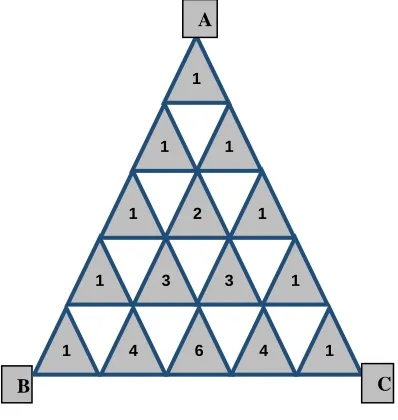
2.2 Pascal’s Triangle Graded Mean Approach–
The Graded Mean Integration Representation for generalized fuzzy number by Chen and Hsieh [6] and [7]. Later Kadhar Babu and Rajesh Anand introduces Pascal’s triangle graded mean in statistical optimization [11]. But the present approach is a very simple for analyzing fuzzy variables to get the shortest path. This procedure is taken from the following Pascal’s triangle. We take the coefficients of fuzzy variables as Pascal’s triangle numbers. Then we just add and divide by the total of Pascal’s number and we call it as Pascal’s Triangle Graded Mean Approach.
Figure 1. Pascal’s Triangle
1
1 1
1 2 1
1 3 3 1
A
B
1 4 6 4 1
5 5 4
4 5
5
4 3
3 4
4
3 3 2
2 3
2
2 1
1 2
1
1
0
1
0
)
(
~p
x
if
p
x
p
if
p
p
x
p
p
x
p
if
p
p
x
p
p
x
if
p
x
p
if
p
p
p
x
p
x
p
if
p
p
p
x
p
x
if
x
A
The following are the Pascal’s triangular approach: Let
(
1,
2,
3,
4,
5),
~
p
p
p
p
p
B
be pentagonal fuzzy numbers then we can take the coefficient of fuzzy numbers from Pascal’s triangles and apply the approach we get the following formula:The coefficients of
p
1,
p
2,
p
3,
p
4,
p
5 are 1, 4, 6, 4, 1.This approach can be extended for n-dimensional Pascal’s Triangular fuzzy order also.2.3 Fuzzy Triangular Form of Pascal’s Triangle–
Let
(
1,
2,
3,
4,
5),
~
p
p
p
p
p
A
be Pentagonal Fuzzy Numbers. The Fuzzy Triangular form (FyTri) of Pascal’sTriangle is given by FyTri = (Pg(A), Pg(B), Pg(C)) = (p, q, r) where Pg(A) =
p
p is the Graded Mean taken alongthe side AB, Pg(B) =
q
q is the Graded Mean taken along the side BC, Pg(C) =r
r is the Graded Mean taken along the side CA as follows:5
(A)
P
1 2 3 4 5g
a
a
a
a
a
p
p
,16
4
6
4
)
(
a
1a
2a
3a
4a
5q
B
P
g q
,5
(C)
P
1 2 3 4 5g
a
a
a
a
a
r
r
2.4 Trident Form–
The Trident form for Pentagonal Fuzzy Numbers is given by
13 13 13
3
1
r q p
ri
Form
p
q
r
T
where
p
p,q
qandr
r are the Graded Mean of the Pascal’s Triangle. [12]2.5 Fuzzy Aggregation–
Aggregation operations on fuzzy numbers are done by the combination of several fuzzy numbers to form a single fuzzy number [4]. The following are the aggregation operation [10]:
Arithmetic Mean: The arithmetic mean aggregation operator defined on n pentagonal fuzzy numbers n n n n n i i i i
i q r s t p q r s t
p t s r q p t s r q
p1, 1, 1, 1,1 , 2, 2, 2, 2, 2 ,.... , , , , ... , , , , ,is
p
,
q
,
r
,
s
,
t
where
n in i n i n i n i
t
n
t
and
s
n
s
r
n
r
q
n
q
p
n
p
1 1 1 1 11
1
,
1
,
1
,
1
Geometric Mean: The Geometric mean aggregation operator defined on n pentagonal fuzzy numbers n n n n n i i i i
i q r s t p q r s t
p t s r q p t s r q
p1, 1, 1, 1,1 , 2, 2, 2, 2, 2 ,.... , , , , ... , , , , ,is
p
,
q
,
r
,
s
,
t
where n n i n n i n n i n n i n ni
q
q
r
r
s
s
and
t
t
p
p
1 1 1 1 1 1 1 1 1 1,
,
,
III.ALGORITHM The algorithm is used to find the optimal path as follows:Step
S
1: choosing all possible paths.16
4
6
4
)
(
p
1p
2p
3p
4p
5Step
S
2: apply the aggregation operators such as arithmetic mean and geometric mean for each path. StepS
3: calculate the values ofp
p,q
qandr
r in fuzzy triangular form FyTri.Step
S
4: find the Trident FormT
riForm
.Step
S
5: minimum value of Trident Form gives the optimum shortest path.Step
S
6: optimum solution is obtained from the minimum value (i.e.)optsol
min
T
riForm
100
. IV.NETWORKCONNECTIONFORFINDINGOPTIMALPATHThe following connection network serves as an example for optimal path determination in order to identify the shortest path using Trident Form is given in “Figure. 2” as follows:
Figure 2. Connection Network
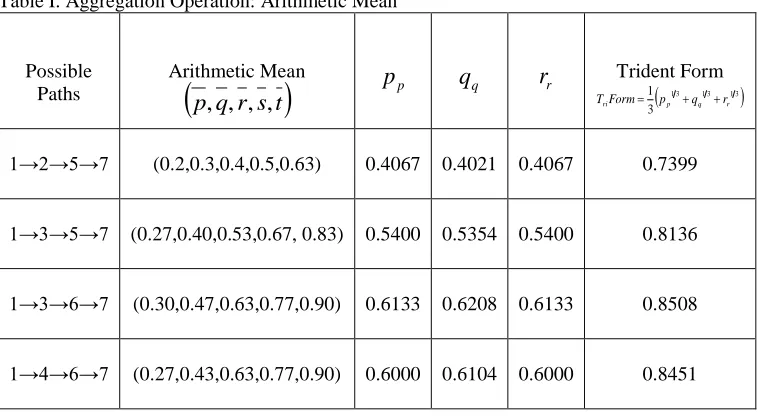
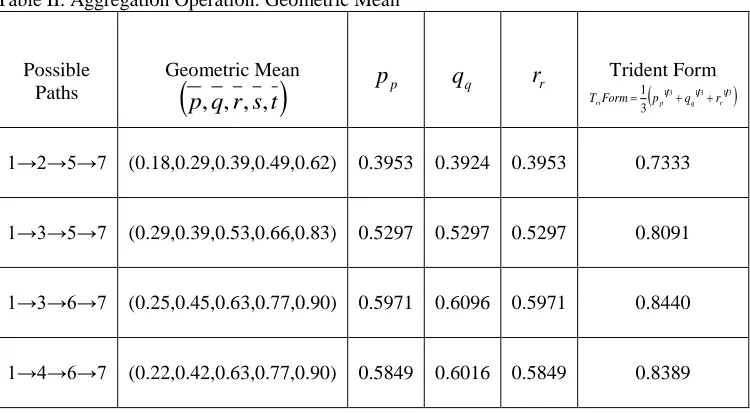
V. OPTIMALPATHDETERMINATIONUSINGTRIDENTFORM The calculation for the above connection network is shown in the following tables:
Table I. Aggregation Operation: Arithmetic Mean
Possible Paths
Arithmetic Mean
p
,
q
,
r
,
s
,
t
p
p
q
q
r
r
Trident Form
13 13 13
3 1
r q p riForm p q r
T
1→2→5→7 (0.2,0.3,0.4,0.5,0.63) 0.4067 0.4021 0.4067 0.7399
1→3→5→7 (0.27,0.40,0.53,0.67, 0.83) 0.5400 0.5354 0.5400 0.8136
1→3→6→7 (0.30,0.47,0.63,0.77,0.90) 0.6133 0.6208 0.6133 0.8508
Table II. Aggregation Operation: Geometric Mean
Possible Paths
Geometric Mean
p
,
q
,
r
,
s
,
t
p
p
q
q
r
r
Trident Form
13 13 13
3 1
r q p riForm p q r
T
1→2→5→7 (0.18,0.29,0.39,0.49,0.62) 0.3953 0.3924 0.3953 0.7333
1→3→5→7 (0.29,0.39,0.53,0.66,0.83) 0.5297 0.5297 0.5297 0.8091
1→3→6→7 (0.25,0.45,0.63,0.77,0.90) 0.5971 0.6096 0.5971 0.8440
1→4→6→7 (0.22,0.42,0.63,0.77,0.90) 0.5849 0.6016 0.5849 0.8389
Here in “Table.1”, the minimum value of Trident Form gives the optimum shortest path using the fuzzy aggregation operation: Arithmetic Mean (A.M) and in “Table.2”, the minimum value of Trident form gives the optimum shortest path using the fuzzy aggregation operation: Geometric Mean (G.M). The minimum value of Trident Form obtained in both the cases denotes the shortest path as 1→2→5→7.
Thus in both Arithmetic and Geometric Mean the minimum value of Trident Form occurs in the path 1→2→5→7.The minimum value among arithmetic and geometric mean is the geometric mean that is 0.7333. Thus Geometric Mean is comparatively better than the Arithmetic mean.
VI.CONCLUSION
This method is simple while comparing to other existing methods for finding the shortest path. In both the cases of aggregation operation, that is the arithmetic mean and in the geometric mean, the minimum value of the Trident Form gives the shortest path as 1→2→5→7. Also the minimum value among arithmetic and geometric mean is the geometric mean that is 0.7333. Thus Geometric Mean is comparatively better than the Arithmetic mean. Thus the optimum solution is 73.33. The obtained optimum solution is comparatively minimum and it is better than the optimum solution found using trapezoidal fuzzy numbers and it is given to be 80.30 [12].
VII. REFERENCES
[1] Zadeh, L, A., “Fuzzy Sets”, Information and Control, 8: 338-353, 1965.
[2] Dubois, D. and Prade, H., “Fuzzy sets and Systems”, Academic press, New York, 1980.
[3] Kauffman.A and Gupta.M.M, “Introduction to Fuzzy Arithmetic-Theory and Applications”: Van Nostrand Reinhold Company, New York, 1985.
[4] George, J, Klir. and Tina, A, Folger., “Fuzzy Sets, Uncertainty and Information”, Prentice Hall of India Pvt. Ltd., New Delhi, 1988. [5] Okada, S. and Soper, T., “Shortest Path Problem on a network with Fuzzy Arc Lengths” , Fuzzy Sets and Systems, 109(1):129-140, 2000. [6] Shan-Huo Chen and Chin Hsun Hseih, “Graded Mean Integration Representation of Generalized Fuzzy Number”, Journal of Chinese Fuzzy
System Association: Taiwan, 5(2):1-7, 2000.
[7] Shan-Huo Chen and Chin Hsun Hseih, “Representation, Ranking, Distance and Similarity of L-R type fuzzy number and applications, Australian Journal of Intelligent Information Processing Systems: Australia, 6(4): 217-229, 2000.
[8] Taha, H, A., “Operation Research – Introduction”, Prentice Hall of India Pvt. Ltd., New Delhi, 2004.
[9] Kasana, H, S. and Kumar, K, D., “Introductory Operation Research Theory and Applications”, Springer International, New Delhi, 2005. [10] Manju Pandey and Nilay Khare, “A New Aggregation Operator for Trapezoidal Fuzzy Numbers Based on the Arithmetic Means of the Left
and Right Apex Angles”, International Journal of Advanced Research in Computer Science and Software Engineering, 2, 2012.
[11] Khadar Babu, S. and Rajesh Anand, B., “Statistical Optimization for Generalised Fuzzy Number”, International Journal of Modern Engineering Research, 3(2): 647-651, 2013.
[12] Praveen Prakash, A. and Geethalakshmi, M., “Trident Form using Fuzzy Aggregation”, International Journal of Applied Engineering Research, 10(80): 202-205, 2015.
[13] Praveen Prakash, A. and M.Geethalakshmi, M., “Trident Form through Fuzzy Triangular Form”, International Journal of Applied Engineering Research, 10(80): 49-51, 2015.
[14] Praveen Prakash, A. and Geethalakshmi, M., “Sub-Trident Form using Fuzzy Aggregation”, International Journal of Engineering Sciences and Research Technology, 5(5): 679-685, 2016.