An UGC Autonomous Institution
(Approved by AICTE, permanently affiliated to JNTU, Hyderabad)
Vol. 8 No. 3 July-September 2019 (Special Issue)
ISSN (Online) : 2322-0449
ISSN (
) : 2277-6753
Department of Master of Business Administration
Abstract
This research aims 1) to study primary data in respect of morality, corruption and art bringing about to specify the framework of painting creation about anti-corruption and to promote knowledge and positive attitude of the students from the schools under The Office of the Basic Education Commission in Bangkok Metropolitan Region 2) to create paintings which compose of pattern, content, story and technique according to the researched data in order to create painting 3) to attempt to use the artwork with Grade 6 students from the schools under The Office of the Basic Education Commission in Bangkok Metropolitan Region 4) to evaluate the achievement and propose the guidelines for the painting creation 5) to develop the innovation of painting which had been researched and then was made as printing media campaigning against corruption for institutes. This research findings point out that 1. According to the study of pattern, content, story and technique, the painting creation is supposed to introduce content and story being connected with the current generation and showing current issues or reflection from some aspects of corruption through different stories as well as human behavior through face or symbolism. Also, teen vernacular is used to name the paintings. It is easy for young people to understand the meaning of paintings. Additionally, it hits the nail on the head and conforms to child's nature. The young would be more interested in content and story when looking at the paintings. Cartoon or fantasy pictures are used as symbols of pattern demonstration. The artwork's idea is not blocked to be in conformity of child's age. The research's prominent point entirely shows that the illustration of semi-realistic art using human's face and monster fits the age of target group, students, because of distinct technique and presentation method e.g. painting naming with teen vernacular to attract viewer's attention, painting's negative content straightforwardly presented. 2. According to the development of sketches, there are 20 out of 40 sketches chosen by professionals and painted as 70cm x 90cm paintings. The paintings are divided referring to their features: 1) portraits applying distortion method 2) symbolistic paintings. The painting certification from art professionals entirely is at high to very high level. Then, the paintings are
* Research Scholar, Haryana School of Business, Guru Jambheshwar University of Science & Technology, Hisar-125 001. ** Professor & Former Dean, Haryana School of Business & Director, HRD Centre, Guru Jambheshwar University of Science
& Technology, Hisar-125 001 [Corresponding Author].
Applying Knowledge of Morality and Ethics in the Development
and Creation of Paintings about Anti-corruption to Raise
Knowledge and Positive Viewpoints of Students in Bangkok
Metropolitan Administration
used with students from 3 different schools. 3. The evaluation of painting by the students totally is at high to very high level in every aspect. The guidelines to the painting creation are to focus on the semi-realistic art, content and story reflecting human behavior and the fact of corruption, simple composition, unlimited technique for creation, mass transfer and importantly age appropriateness.
Keywords: Painting, Creative Painting, Art enhance morality and ethic
Introduction
Unceasingly, Thailand faces severe issues of corruption considered as one of the main problems of the development of the nation. Moreover, in Thai society, they remain lastingly in the above-or-below levels; for example, vote-rigging in the national election, bribery and corruption by government agencies, and frauds committed by government authorities and private sectors, etc. In fact, corruption issues can be widely interpreted and differently manipulated in various forms and terms as follows: fraud, graft, and non-transparent work culture, etc. These are likely caused by insufficient compensation for life living, lack of comfort and need for wealth, etc. Therefore, as an independent constitutional organization, the Office of the National Anti-Corruption Commission (NACC) possesses the following duties:
1) To promote and inculcate awareness of a society founded on discipline, integrity, and ethics in Thai society; 2) To inspect and investigate the accuracy of the information with justice and fast, as well as to consider and encourage the improvement of legislation, rules, regulations, and orders; 3) To inspect the accuracy, actual existence of assets and liabilities, and diagnose government officials or senior government officials; 4) To promote and support research on anti-corruption according to the national strategic plan in order to establish drives and improvement under the constitution; and 5) To cooperative consistently and to conduct bilateral agreement with oversea anti-corruption organizations in ASEAN and other international countries.
Curbing effectively corruption issues requires various strategies and measures: cooperatively, practitioners in public and private sectors are on the lookout for evidence of impact and solutions. Therefore, in order to eradicate this problem from Thai society, strategic plans are focused to raise among the youth and children "morality and ethics" for themselves and Thai society. Actually, the globalization influence affects Thai society to focus and increase dramatically advances in economics and materialism. This might lead to many social problems in countries unprepared for globalization and in the overall social system, especially morality and ethics. (Anchalee, 2009, p. 31) Because of several social effects of corruption, many practitioners in public and private sectors are engaging various measures to protect and fix the mind as a fundamental aspect to live together in harmony for Thai people.
Therefore, the art content, applying the knowledge of morality, ethics, and anti-corruption and raising the positive viewpoints in students in Bangkok Metropolitan Administration, becomes interesting perspectives for youth and children. Furthermore, in aesthetic, artworks can express the beauty absorbed in mind through eyes. Viroon Tang-Charoen (2012, p.98) said that, in aesthetic, the artwork creation mainly concerned with beauty or the appreciation of beauty such as melodiousness, truth, or peace; in line with Charn-Narong Pornrungroj (2013, p.75) emphasized that art relates individuals to society and culture as a tool to improve body, wisdom, affection, and generosity until becoming a good person for a society.
As the man-made creation, art has resulted from the artist's wisdom presenting the positive creation and viewpoints, which have an impact on individuals and society. As a result, to experience artworks generally leads to aesthetic sense perception and generosity, defined as the basis of morality and ethics and the tool to sharpen the mind. Besides forms and shapes, the beauty value is the artist's strong intention in artworks which stimulate awareness of the audience's consciousness. Thansana Panya (2010, pp.120-121) said that the development of social potentials by using art was very important to children and persons in all professional groups whether in the organization, the companies, or the institutes; for example, doctors, engineers, commercial pilot, bank managers, etc. All these people agreed that art would help to imagine, to create and to relax the mind.
Besides oral and written speech, the paintings about anti-corruption to raise knowledge and positive viewpoints of students in Bangkok Metropolitan Administration, are consequently considered as another interesting way to help individuals and youth to understand negative effects and consequences of corruption. Likewise, the paintings allow the audience to experience aesthetic beauty.
In the paintings about anti-corruption to raise the knowledge and the positive viewpoints of students in Bangkok Metropolitan Administration, the techniques have been selected to stimulate and engage audience's interest in artworks by choosing the right media appropriate to audience's age and generations for communicating the artist's intention. In addition, the content, the story, and the presentation techniques mutually facilitate the audience to the reflection about morality and ethics, as well as the positive viewpoints of anti-corruption.
Objectives
1. Objective 1: To study the basic information on morality and ethics, and anti-corruption and art leading to the framework for creating the paintings about anti-corruption to raise the knowledge and the positive viewpoints of students in Bangkok Metropolitan Administration.
2. Objective 2: To create the painting works about anti-corruption: in fact, the content, the story, and the painting techniques are based on accord the information acquired in step (1) to raise the knowledge and the positive viewpoints of students in Bangkok Metropolitan Administration.
3. Objective 3: To experiment with the paintings on grade 6 primary students.
4. Objective 4: To evaluate the achievement and propose a guideline for the creation of the paintings about anti-corruption to raise the knowledge and the positive viewpoints of students in Bangkok Metropolitan Administration.
5. Objective 5: To develop the paintings to innovation by the research process and to create and publish the paintings about anti-corruption to related agencies.
Conceptual framework
Photo 1 Research conceptual framework
Research Methodology
Research step 1 (Research 1: R1) The researcher uses the content analysis methodology focusing on interpreting and coding. Data is analyzed to interpret the meanings and point mains for creating the paintings on the appropriate issue, form, content and painting techniques.
Development step 1 (Develop 1: D1) To create the paintings, the researcher creates 20 images of paintings (70 x 90 cm) with acrylic painting techniques. To begin with, in the design process, the researcher starts by sketching 40 images (27 x 37 cm) based on the information from Research step 1. Next, three qualified specialists with national and international experience in the art creation for at least ten years are invited to review and give feedback. Then, after having been edited according to the specialists, twenty sketches are selected on the second round by getting at least two approvals from the specialists. Finally, all twenty selected sketches are created on canvas (70 x 90 cm) with acrylic painting techniques.
The paintings have been certified by a team comprised of nine qualified experts as the following qualifications: working as art lecturer for at least ten years; mastering in communication and art designs applied arts, and fine arts; being acknowledged in domestic and international levels, and being an assistant professor. In the process of certificate for the paintings, the researcher uses the focus group discussions with the team with five opened questions, for example; "How is the form of the paintings able to point out the current situation about the corruption in Thai society?"; "What are the relation and the support between the form and content of the paintings?"; "How does the composition of the paintings relate and correspond to content and story?"; "What are the strong and weak points of these paintings?", etc.
The art certificate document constitutes not only the quantitative form and also the evaluation form on the quality of the paintings. In fact, this certificate form has a rating scale of five levels on these following points: 1) form of paintings to raise the knowledge and the positive viewpoints about corruption; 2) content and story to raise the knowledge and the positive viewpoints about anti-corruption; 3) composition of the paintings; and 4) three opened questions about the reasons to raise the knowledge and the positive viewpoints about anti-corruption. In addition, to evaluate the certificate form, the researcher creates a form, considered as a tool in order to analyze the accuracy of contents given by five art specialists. Moreover, data acquired during the focus group discussion is analyzed and interpreted.
1 is about general information with opened-ended and multiple-choice questions while part 2 aims to evaluate twenty paintings as the following points: 1) form to raise the knowledge and the positive viewpoints about corruption, 2) content and story to raise the knowledge and the positive viewpoints about anti-corruption, and 3) composition of the paintings. This questionnaire on a rating scale and three opened-ended questions has been overviewed by five art specialists. After the satisfying efficiency, the researcher collects data, chooses the target school and population, sets up exhibitions of the paintings for students, develop the questionnaire, and finally analyze quantitative data.
Development step 2 (Develop 2: D2) To evaluate the use and to search for the guidelines to create the paintings. After having created the painting works, the researcher experiments the paintings by setting up an exhibition for grade 6 primary students and allowing them to give feedback about the painting works. The researcher analyzes and interprets to synthesize the approach to create the next paintings or another type of artworks possibly used in the campaign for raising the knowledge and positive the viewpoints about anti-corruption as well as to stimulate awareness of morality and ethics in Thailand.
Research results
Research result from Research step 1 (Research1: R 1) To study the data of form, content, story, and painting techniques about anti-corruption to raise the knowledge and the positive viewpoints of students in Bangkok Metropolitan Administration, the target population is divided into five groups as follows: 1) Students in Bangkok Metropolitan Administration; 2) Teachers in Bangkok Metropolitan Administration; 3) Four officials of the Office of the National Anti-Corruption Commission; 4) Two government officials of Moral Promotion Center; and 5) Five artists who used to create artworks about morality and ethics.
The paintings facilitate to stimulate awareness of morality and ethics by the language of paintings communicating content and story nearly around the students, such as corruption in daily life, queue jumping, giving bribes to police officers, cheating on an exam, etc. In addition, the paintings communicate the content with the audience by images to reflect and to raise the positive viewpoints. In fact, the content of the paintings can present independently the positive or negative aspects of the effects and consequences of corruption, alternatively in realistic and semi-realistic styles. Actually, the positive content stimulates to creation while the negative pushes to fear. Regarding the painting techniques, they must be not complicated to communicate more clearly the artist's intention; for example, if the content aims to remind of technology, the acrylic paint should be used as the painting techniques. However, the choice of the color painting technique generally depends on the artist's intention.
2. Development Step 1 (Develop1: D1) To create the paintings with the form and the content to raise morality and ethics by the following:
of painting works as follows: 1) The form can be presented in two ways: realistic and semi-realistic; 2) The content can be expressed in positive and negative points, and 3) The painting techniques can be used independently, but not too complex.
To choose the paintings appropriate to ages and generations of the audience, the researcher creates the art certificate process as follows. To begin with, the researcher sketches 40 images with crayon and chalk paint techniques. The sketches are edited on the feedback of three art specialists. The researcher purposes, for the second time, the edited sketches to the art specialists who choose twenty sketches by this following criteria: the chosen sketch has to be approved by at least two art specialists. After that, the researcher develops all twenty chosen sketches into the paintings (70 x 90 cm.) on canvas with acrylic painting techniques.
Samples of sketches (Picture 2)
Picture: Three Heads Picture: No Need to Crush V.1 Picture: New Boss
Picture: Stuff Your Face, Sir. Picture: No Need to Crush V.2 Picture: Gimme Some, sir!
Picture: My Share, Please! Picture: Yum! Yum! Endless Delight!
Picture: Hero 4.0
Regarding the results of the art painting certificate about morality and ethics in the development and the creation of paintings about anti-corruption to raise knowledge and positive viewpoints of students in Bangkok Metropolitan Administration, appropriately to target population's generation, the content bases on current social situations and some perspectives of bribery and corruption in forme of storytelling symbolically on human behavioral and facial expressions. Accordingly, the art specialists have rated the paintings at the highest level; in fact, the highest mean painting is No Need to Crush V.2. ( = 4.66, S.D. = 0.70 ) (Table 1)
Table 1: The result of the art painting certificate about the content raising the knowledge and positive viewpoints about anti-corruption rated by the art specialists
Picture no. The content raising the knowledge and positive viewpoints about anti-corruption
Mean
( )
Standard deviation (S.D.)
Meaning Number
1. No Need to Crush V.2 4.66 0.70 มากที่สุด 1
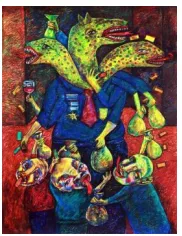
From Table 1, the overview of the study reveals that No Need to Crush V.2 rated by the specialists at the highest mean painting. (Picture no.3)
Picture: No Need to Crush V.2
Picture 3: The content of the paintings
Regarding the result of the certificate about the composition of the paintings, the research has acknowledged that the art specialists have rated the paintings at the highest level: in fact, the highest mean composition is No Need to Crush V.2 ( = 4.66, S.D. = 0.70) (Table 2)
Table 2: The result of the certificate about the composition of the painting works
Picture no. The composition of the painting works Mean
( )
Standard deviation (S.D.)
Meaning Number
From Table 2, the overview of the study shows that No Need to Crush V.2" is rated by the specialists at the highest mean composition. ( = 4.66, S.D. = 0.70 ) Likewise, the art specialists give feedback as follows. The elements of the composition of the paintings are interesting; in fact, the content is well communicated; the usage of vivid color and tone allows appropriately aestatic sense; and using animal heads in the paintings - heads of water monitor - is a symbolic of disgust and greed. Furthermore, The elements of the composition of the paintings have a clear focal point so that it is simple to interprete for young students. In fact, they ask themselves "Why?" and compare with the current social issues and stituations. Correspondingly, the elements of the composition of the painting are easy and not complicated. In fact, the use of 3-headed shapes of the creatures surrounding with cunning people seemingly in conflict symbolically reminds of the bad sample in society.
This series of paintings possesses various advantages as follows. To begin with, the paintings are mainly presented in fantasy images perfectly reflecting the personality and the mood of the paintings. In general, the composition is not complicated; meanwhile, the content of the painting is expressed in a semi-realistic by the images of creatures, appropriately suitable for the target population's ages and generations. Next, another advantage is the presentation method in the paintings. In fact, this series is presented in the form of fantasy and cartoon images, mainly defined as the language of the painting and particularly suitable for the target population's ages and generations. To point out, the images of the paintings not only interests the young audience but also encourages them to develop the ability of critical thinking.
However, some disadvantages have also been found in the paintings. For instance, the interpretation of images in the painting works widely varies and mainly depends on the audience's maturity and experience likely considered as an obstacle to the content understanding of the paintings. Consequently, to help the young audience to understand the artist's intention, the researcher can develop and create poster media, as a short description of the content, such as leaflets about the anti-corruption campaign which might help to communicate more clearly the content of the paintings. Indeed, the fact that the current social situations and events have been inferred in the paintings facilitates the target population to understand easily and rapidly the realities and facts of society as they recognize the real information from the current social situations and events.
is possible to interpret differently because of the audience's acquisition. Actually, the content in some paintings requires more time for the audience to think or to achieve a deeper understanding; meanwhile, for some paintings, they can rapidly understand or easily interpret the meanings of content. Then, the interesting point of the paintings is that the images are mainly defined as a tool to generate questions by allowing art, which encodes, as the driving force, the messages to persuade the audience to think of or even to question backward. Last, the use of vivid and strong colors in the paintings aims to induce the young audience to think and reflect on content; in fact, the use of colors attracts the youth and children from their eyes to their mind so that they acquire the knowledge by self-questioning. Accordingly, the control of the colors and tones in the painting helps to encourage the audience's acquisition.
3. Research step 2 (Research2: R2) To exhibit the painting works for the target population, focused on students in grade P.6 in three small, mid-sized and large schools in Bangkok Metropolitan Administration.
To begin with, the students from each school are allowed, for a day, to give their opinions and feedback. Next, the acquired data is analyzed by focusing on the following points: form, content, story, and painting techniques. Overall, the result of data analysis shows that, regarding the content, the painting work, which the students from small-sized school evaluated at the highest level, is Picture no.1: MEGA Project of Super-Heroes or ???????????????????????????? in Thai. ( = 4.74, S.D. = 0.44) Furthermore, relating to the composition of the painting, the young students evaluated, at the highest level, Picture No.1: Please give me a hand, Sir! or ??????????????? in Thai. ( = 4.80, S.D. = 0.40) (Picture no.4)
Picture: MEGA Project of Super-Heroes
Picture: Please give me a hand, Sir!
Picture no.4 The result of the painting work about the content and the composition assessed by students of the small-sized school
Picture: Please give me a hand, Sir!
Picture: New Boss
Picture no.5 The result of the painting work about the content and the composition assessed by students of the mid-sized school
The students of the large-sized school evaluated Picture no.1: Mr. BIG is coming! or ????????? in Thai at the highest level for the content of the painting ( = 4.74, S.D. = 0.44) and also at the highest level for the composition of the painting. ( = 4.74, S.D. = 0.44) (Figure no.6)
Picture: Mr. BIG is coming!
Picture no.6 The result of the painting work about the content and the composition assessed by students of the large-sized school
according to their ages and generations. In addition, regarding the content and the story in the painting, it is likely to reflect some perspectives on corruption. In fact, the content and the story can be delivered whether in human behavioral expressions such as facial and physical expressions, for instance, in the pictures No need to Crush V.1, Yum! Yum! Endless Delight!, Stuff your face, sir!, etc., or in symbolics, for instance, New Boss, MEGA Project of Super Heroes, Mission Complete! Let's Make a Deal!, No Need to Crush V.2, etc.
Next, the composition of the painting shouldn't be complicated or even contradictory to the content in order to correspond to the young audience's acquisition. In addition, the painting works should be named in language and wording of their ages and generations to stimulate their curiosity in the content as well as their comprehension of characteristics of each painting forms.
Moreover, the presentation of the content can be both in positive and negative styles. Actually, pointing out current social points and issues, symbolically presented in comics and fantasy, can generally reflect on the subconscious feelings without basing on any current reality so that the content language is likely to correspond to the acquisition of the audience's ages and generation. This helps to interest the youth and children's attention to reflect and interpret the implied meaning of the content by allowing the paintings to generate questions or issues to the audience.
Furthermore, regarding the art certificate by a team of nine art experts, NO need to Crush V.2 is certified at the highest level in the content. In fact, the composition elements of this painting symbolically present the content of greed and ugliness through using the animal head shape of the creatures (water monitor in the painting works), which is considered as a symbol that the young audience is able to interpret without difficulty the meaning. In addition, the result of the research experiment for the students' audience from different sized schools reveals as follows: for the highest mean content, MEGA Project of Super-Heroes, Please Gimme a Hand! and Mr. BIG is coming!; for the highest mean composition, Please Gimme a Hand! and Mr. BIG is coming!
In short, all images in the painting works have the use of the semi-realistic style, the content of the painting is presented by humans, and the human behaviors are reflected in the symbolic method. Undoubtedly, the approach of the painting creation in nearly future should base on the use of the semi-realistic style with the content which generally presents human behaviors and directly reflects the reality of corruption. Regarding the composition, it should not complicated; meanwhile, the method of the painting techniques is unlimited in order to independently create the painting works. However, the appropriateness of the young audience's ages and generations should be focused the most.
Discussion
communicate more efficiently than written speech. In fact, especially, the use of symbolics in the painting works mainly allow the audience to reflect, to question, and to interpret the meaning of content relating to various kinds of feelings; for example, love, compassion, or generosity, in order to raise positive viewpoints occurring after the reflection or the imagination. To point out, Channarong Pornrungroj (2001, p. 53-60) emphasized that, as advantages, creating artworks helped to build concentration and consciousness, to improve mind more delicate, to develop the ability of reasoning and the flexibility of thinking, and to decrease aggressive behavior. As a result, the fact that youth or children do creative activities on art facilitates to shape mind so that they become a more reasonable person with the improvement of the understanding of all things around them. Furthermore, the painting works can communicate the content which stimulates awareness of consciousness by pointing out the negative issues of corruption. In this case, current social situations and events are presented both in positive and negative aspects to the audience. Regarding the content, it should be clear, direct and uncomplicated so that the youth and children are mainly able to interpret the meaning of the content. Identically, the content reflects the perspectives and issues on corruption by implying morality and ethics in the paintings. However, it is likely to point out not only the pros of anti-corruption and also the cons of corruption to raise the young audience's positive viewpoints; correspondingly, in his theory of Cognitive Development, Piaget proposed that, as cognitive abilities, humans come to gradually construct the understanding of the world and interact with the surroundings around them by aligning, reorganizing, adjusting and adapting things around them with consistency and balance. Identically, the process of assimilation means to integrate external elements, mainly defined as a new experience, and reconstruct them fit into cognitive abilities. Correspondingly, Kittichai Suthasinobon (2012, p. 61-62) confirmed that artworks became an important material as the basic application tool to construct and improve human abilities, especially in youth and children, through activities of art and recreation. Accordingly, Kosoom Saijai (2007, p.126-127) told that the concept of using artworks as media material grew widely in the age of borderless transaction and information because of the speed of networking connection and the exchange of language and culture between countries. Identically, in the seminar of the art creation in ASEAN nations, academics and artists from ten ASEAN countries agree that, generally defined as a media material for relating the knowledge and the understanding to the artworks of each country, art can improve self-discipline; for example, spending and managing free time by art activities such as painting, clay sculpting, listening to music, or playing musical instruments, etc. Art activities allow children to learn how to help each other preparing and rearranging the equipment before and after the activities; as a result, this possibly decreases children's selfishness.
wide interpretation. Likewise, Thana Haemwongsa (2002, p.70) emphasized that an individual's art artworks came from experience, concept, and opinion of the surrounding by media material or tool. Identically, Viboon Leesuwan (2006, p.70) confirmed that art reflected an individual's mind on the form of artwork; in fact, people's artworks reflect their life story and people's life story reflects on their artworks. Therefore, in general meaning from people's perspectives and understanding, art is about the beauty, the reflection of social events, the relaxing tool, and the storytelling of thinking and perspectives, etc.
The form of the paintings about anti-corruption and raise of positive viewpoints can be presented in realistic and in semi-realistic. In fact, both of these forms can be generally used to create the paintings about anti-corruption, they can correspond appropriately to children's acquisition, and reflect the audience's knowledge, thinking, and improvement of imagination. Correspondingly, Suchard Sutthi (2000, p.208) told that artworks are technically a production of shape composed by lines, colors and weighing. In fact, corresponding to social and cultural contexts, such as attitude, language, belief, religion, etc., nowadays, the art form has explored a new form so that it looks so unusual or so complicated to reach the global audience's understandings.
Realistic artworks generally represent the subject matters so truthfully and directly that the audience can easily acquire and interpret the content by their experience. Moreover, the values of realistic are the audience's knowledge, understand and interpretation in realistic artworks.
Identical to realistic, semi-realistic art also attempts to represent art values but it can be presented in more various forms of artworks; as a result, the audience has the opportunity to enjoy different forms and to experience more widely. To emphasize, semi-realistic art stimulates the audience's imagination and self-questioning about the content in artworks. For instance, presented in realistic and in semi-realistic, the painting works about anti-corruption are differently addressed to the audience by using symbolic of cartoon and fantasy images in the paintings, mainly corresponding to the target population.
Painting techniques should various and not limited; actually, they are just a medium concretely reflecting the artist's intention. In fact, to limit art techniques or not depends on the creator. Moreover, by focusing on the success of the paintings, it is likely to value a medium for artworks on the coherence of presentation in content, story, and form. Similar to Supachai Singyabud (2003, p.67), painting strategies are the process of artwork creation particularly concentrating on materials, equipment, and art creation process. Actually, painting strategies mainly affect the diversity of creativity in art forms, which are resulted from the artist's experiment. Furthermore, to achieve the development of art techniques generally depends on their skills and favorite; however, it would rather choose strong and durable materials appropriately responding to the artist's knowledge, experience, and techniques.
to the art specialists team to select twenty images for the creation of the paintings about anti-corruption. Accordingly, the specialists give feedbacks as follows: the content is appropriate to the young audience's social context by reflecting symbolically perspectives towards corruption on facial human expressions in cartoon and fantasy images. To point out, expressed in semi-realistic, the paintings represent issues about corruption ironically on cartoon characters and the creatures.
The relation and the support between the form and content of the paintings are not complicated and appropriate to efficiently communicate the content to the young audience.
Regarding the relation and the support between form and content, uncomplicated drawings in the paintings can communicate the meaning to the young audience. In addition, the art specialists have selected the five best of the paintings as follows: 1) No Need to Crush V.2 addresses significantly the content by the use of water monitors symbolically reflecting greed and ugliness. 2) Hmm! Yummy!, which expresses in the use of strange shape humans reaching their hands for money and swallowing everything, reflects the symbolic meaning of modesty, adequacy, and self-sufficiency. 3) Three Heads expresses the content by using the symbolic shape of human faces. 4) Gimme Some, Srt! reflects the social issues symbolically on the shape of buffalo head with a human body representing negatively the bad simple. 5) New Boss communicates the content by the shape of the dog face representing an obsession with ways of squandering wealth.
To point out, all the five best of the paintings mainly reflect social issues about negative aspects of corruption on half beast-half human hybrid figures. Next, the tone and the value of bright colors have been used in the paintings. As the focal point in the middle, the composition is comprised of different shapes and sizes around the paintings. Moreover, the paintings allow the audience to self-questioning based on their acquisition by the use of animal-human hybrid shapes, which reflect ironically the content on corruption, social issues, and problems. As described, the paintings should express the content of corruption in various perspectives to simulate awareness of corruption issues amongst the youth and children.
Regarding the composition of paintings, the subject is placed in the center as a focal point and arranged uncomplicatedly, so the young audience can easily comprehend the implied content. Next, the shapes of cartoon and fantasy drawings are symbolically used to stimulate the audience's imagination and attention of reflection. Furthermore, colors facilitate the interpretation and the self-questioning about the content of paintings.
For disadvantages, the young audience is not able to achieve the deeper interpretation of content in some paintings because of the difference between knowledge, experience and content gap. To resolve this problem, the use of authentic social events and situations around the audience can be the greater choice.
The painting evaluation reveals that generally, the paintings have achieved to reflect the authenticity of corruption issues by presenting the negative aspects to raise positive thinking about anti-corruption; in fact, while considering problems and effects of corruption as bad samples, the young audience generally think of positive aspects in anti-corruption, like in Gimme Some, Sir!, Hmm! Yummy!, and Three Heads, etc. In addition, according to psychological perspectives, the names of paintings help children in the content interpretation. Although the content gap exists in some paintings, children are still able to comprehend the content by accessing themselves to knowledge. In other words, the content gap can stimulate curiosity amongst children because they search for new knowledge in their interest. Certified by the art specialists, the highest mean content to raise knowledge and positive viewpoints about anti-corruption is No need to crush V.2; meanwhile, the lowest mean content is Holiday Picnic. Obviously, the difference of these painting is the form presentation and the placement of composition; in fact, the previous knowledge and experience affect the understanding and meaning of content.
The result of Research step 2: To experiment with the paintings on the target population. The paintings are generally presented into two characteristics: human figures in distortion and human-beast hybrid, cartoon or fantasy figures. In fact, the paintings presenting human figures in distortion are No Need to Crush V.1, The Henchmen, Humm! Yummy!, Yum! Yum! Endless Delight!, Heroes 4.0, Holiday Picnic, etc. Meanwhile, the paintings presenting symbolically in human-beast hybrid figures are New Boss, Congratulations!, MEGA Project of Super-Heroes, etc. Next, during the art exhibition, these paintings mentioned above have been presented and evaluated by target students; in fact, the evaluation process takes an hour for each school. To point out, students from small-sized school rate the content at the highest scale in a level of 4-5 and the five best paintings as follows: 1) MEGA Project of Super-Heroes; 2) New Boss, In the Secret Chamber, and Gimme a Hand, Sir!; 3) Three Heads; 4) MR. Big Is Coming!; and 5) The Henchmen and Heroes 4.0.
Regarding the composition, the students rate the painting at the highest scale in a level of 4-5 and the five best painting as follows: 1) Gimme a Hand!; 2) New Boss; 3) MEGA Project of Super-Heroes, See No Evil, Ear No Evil, Speak No Evil!; 4) Mission Complete! Let's Make a Deal!; and 5) Three Heads.
According to the composition, the students rate the painting at the highest scale in a level of 5 and the five best painting as follows: 1) New Boss, Gimme a Hand, Sir! 2) MEGA Project of Super-Heroes; 3) Yum! Yum! Endless Delight!, Stuff your Face, Sir!, Let's share!; 4) No Need to Crush V.2, See No Evil, Ear No Evil, Speak No Evil!; and 5) Congratulations!, Gimme Some, Sir! Mission Complete!, Let's Make a Deal!, Three Heads.
The students from large-sized school the students rate the painting at the highest scale and the five best painting as follows: 1) MR.BIG is coming!; 2) Let's Share!; 3) MEGA Project of Super-Heroes; 4) Gimme a Hand, Sir!; In Secret Chamber; and 5) New Boss, and Heroes 4.0.
According to the composition, the students rate the painting on the highest scale in a level of strongly agree and the five best painting as follows: 1) MR.BIG is coming!; 2) New Boss, In Secret Chamber; 3) Gimme! Gimme!; 4) Gimme Some, Sir!, MEGA Project of Super-Heroes, The Henchman, Three Heads, Stuff Your Face, Sir!; and 5) Heroes 4.0.
The result of research step 2: To evaluate the application and the suggestions for the creation of the paintings about anti-corruption raising the positive viewpoints. Overall, the presentation form of paintings can be both in realistic, and in semi-realistic. Due to the difference between the audience's experience, the form and the elements should not be complicated for the interpretation; therefore, using the form concerns mainly the children's acquisition. The researcher has selected semi-realistic form to communicate the content about anti-corruption because it can allow the audience to achieve deeper reflection and to stimulate the imagination for finding out the answers from the content. Next, the use of symbols in a cartoon or fantasy images including they can reach the audience's interest. Undoubtedly, the use of wordings and slangs to name the paintings can help to raise understanding and support the content clearer. To point out, the students rate the content and the story at the highest mean of 5; in fact, human figures in distortion and images in the symbolic, cartoon, or fantasy drawings such as in Three Heads, Yum! Yum! Endless Delight!, etc.; symbolic or fantasy images, for instance, MEGA Project of Super-Heroes, New Boss, etc. To sum up, semi-realistic human figures in distortion and cartoon images correspond to the children's acquisition and allow them to enjoy the paintings, to raise the thinking and the imagination. However, the content can be presented in positive and negative ways to allow the audience to enjoy and experience the paintings according to their previous experience and knowledge. Generally, the form and the content should stimulate awareness about the bad aspect of corruption. Regarding the art techniques, they can be used independently but they should be simple and not complicated for the audience's ages and generations
Suggestions
2. The content presentation of paintings about anti-corruption should not be direct and easy to interpret the meaning.
3. The presentation should have cartoon drawings images which can get the children's attention into the content about corruption.
4. To publish and distribute the paintings through the research process to agencies for the campaign about corruption.
5. The paintings through the research process can be published in students' book in the educational curriculum about morality and ethics as well as about "NO Cheating" for students of educational establishments.
References
1. Suthasinobol, K. (2012). A Bouddhist Based Learning Process for the Pursuit of Complete Human. Ratchaburi: Thammaruk Publishing. (in Thai)
2. Saijai, K. (2007). Aesthetics in Early Childhood Art. Bangkok: Suan Dusit Rajabhat University. (in Thai)
3. Ponrungrot, C. (2002). Art: Audibility Visibility Sensibility. Bangkok: Format Associate
Publishing. (in Thai)
4. Panya, T. (2010). Waken the Genuis in Your Child. Bangkok: Amarin Book Center. (in Thai)
5. Haemwongsa, T. (2002). The Inspiration from Rattakosin Era 220: The Relation Between Art and Life. (n.p.): Tourism Authority of Thailand and the Faculty of Fine Art of Rajamangala University of Technology. (in Thai)
6. Leesuwan, W. (2006). Art Journal: What is an Art?. Bangkok: Silpa Bhirasri Foundation. (in Thai)
7. Tungjaroen, W. (2015). Vison, Art and Culture. Bangkok: Srinakharinwiroj University. (in Thai)
8. Sutthi, S. (2000). Teacher's Guide Book: Aesthetics: Art of Life. (Bangkok): The Project of Establishment of the Premises of the Faculty of Fine and Fine Arts of Suan Dusit Rajabhat University. (in Thai)
9. Singhayabut, S. (2003). The Criticism of Visual Art. Bangkok: Odian Store. (in Thai)