Optimization Process Parameters Of Aisi
1020 Gas Carburized Steel
Ramandeep Singh Sidhu
1, Gurbhinder Singh Brar
21
Guru Nanak Dev Engineering College, Ludhiana, Punjab, India.
2 Guru Nanak Dev Engineering College, Ludhiana,
Guru Kashi University,Talwandi Sabo, Bathinda, Punjab
Abstract- In this investigation various mechanical properties of AISI 1020 steel at different process parameters like carburizing temperature, soaking time, tempering temperature and temperature time were optimized using L9 Taguchi technique. Hardness, impact strength and wear resistance were taken as response variables. It is observed during investigation that heat treatment followed by quenching and tempering tremendously improves the hardness, impact strength and wear resistance of AISI 1020. In order to predict optical parameter, confirmation test was conducted for implementation of L9 Taguchi technique.
Key words- Gas carburization, AISI 1020 Steel, Taguchi method
I. INTRODUCTION
With the advancement of technology, materials with better tribological properties are in demand. Researchers are getting more interested in the improvement of fatigue behaviours of machines and structures. High strength steel is widely used in the structures of various machines such as compressors, aircrafts, and in space applications [1]. In order to achieve these improved tribological properties, various heat treatment processes have been developed for many years. The aim of present study is to review the surface hardening processes, and their pros and cons. In surface hardening process steel is heated and held above the critical temperature, and rapidly cooled in water, oil or molten salt baths. Surface hardening improves the wear resistance of the metal part without affecting the interior soft core [2]. This combination of hard and tough surface, soft core helps during impact shocks in many machine parts such as bearings, shafts and turbines etc.[3]. Therefore enhancement in mechanical properties of materials is always mandatory. The process of case hardening by carburizing is very old and most effective process for hard steel production of swords and knives from medieval times[4]. Charcoal was applied directly onto the metal in early times, but with the invention of new methods carbon bearing gases and plasmas are being used for effective case depths. Heat treatments like carburization cause extensive rearrangements of atoms in metals at elevated temperature and transfer carbon by molecules CO, CO2, CH4 and other hydrocarbons in metal matrix to produce variation in physical, chemical and mechanical properties [5, 6].In this process of heat treatment carbon is introduced into the surface of steel when it is heated with carbon bearing material (gas, liquid , and solid) in order to increase hardness and wear resistance of metal [7, 8]. Gaseous carburization is carried between 900-950 degree Celsius [9, 10]. Gas carburizing is done on highly stressed machine parts like transmission parts, car engine parts, roller and ball bearings, rock drill parts, wear parts, fatigue-stressed parts such as shafts etc.[11, 12].It has been reported in the existing published literature [13] that carburization led to improve the wear resistance and fatigue strength. Success of the carburized components mainly depends upon the atmosphere of the process, temperature and time[14, 15], and flexibility of gas carburizing process is main advantage i.e. atmospheric composition and gas exchange rate can be controlled during the operation [16].
II. EXPERIMENTAL PROCEEDURE
2.1. Material Preparation-
AISI 1020 low carbon steel was selected for present research. The specimens were prepared on the basis of AISI standard specimen of (10×10×55) mm. The chemical composition of low carbon steel (AISI 1020) used in this research is shown in Table 1.
Table 1 Chemical composition of low carbon steel (AISI 1020) material
Element C Si Mn P S Cr Ni Al Cu V Fe
Weight (;pp%)
2.2 Gas Carburizing Procedure-
First of all gas carburization of 9 specimens was done by taking two carburizing input parameters i.e. is carburizing temperature and soaking time process parameters and three different levels of each. After carburizing process, quenching of all material was done. In this type of carburization liquid methanol (CH3OH) sprayed into the furnace containing nitrogen gas. This system is very significant in nature because carbon monoxide concentration can vary in range between 15 vol. % to 33 vol. %. When carbon monoxide concentration is lower it is used for heat treatment processes such as annealing/tempering or stress relieving. At higher concentration it is used for carburization. Mainly proportion of nitrogen to methanol is similar as nitrogen to oxygen in air that is 1.9.[8, 18] Various ratio of nitrogen to methanol as shown in figure 1:-
Figure 1 Composition of the furnace atmosphere produced by injecting (above 850°C) different ratios of nitrogen/methanol in the furnace.[18]
As soon as one volume of methanol get enters into furnace it dissociates into one volume of carbon monoxide and two volumes of hydrogen. Following reaction takes place:-
CH3OH + 1.89 N2 CO + 1.89N2 + CH4 (1)
CO + 1.89N2 + CH4 +2.39 (0.209 O2+0.7905 N2) CO+2H2 +1.89 N2 (2)
2.3 Selection of Process Parameters
After studying the literature on carburization process four important parameters are selected in this study which were suggested by the previous researchers of concerned field [19-21]
Table 2 Levels for Various Factors Serial no Carburizing
temperature(°C)
Soaking time (hr.)
Tempering temperature(°C)
Tempering time (hr.)
1 870 4 200 0.5
2 900 5 240 1
3 930 6 280 1.5
III. RESULTS
The effects of carbon content on AISI 1020 carburized were observed after the experiment. Table no. 3 shows the results obtained after performing the tests i.e. are Rockwell hardness test, charpy test and wear test and table 4 represents the values observed by signal to noise (S/N) ratios and mean ratios using Taguchi analysis on hardness, impact strength and wear rate as response variable.
Table 3 Experimental results of carburized mild steel Serial
No..
Carburization Temperature(°C)
Soaking Time (hr.)
Tempering Temperature(°C)
Tempering time (hr.)
Hardness (Rc)
Impact strength(J)
1 870 4 200 0.5 54.0 33.5 46.8
2 870 5 240 1.0 55.0 33. 47.1
3 870 6 260 1.5 53.5 34 43.6
4 900 4 240 1.5 56.0 35.5 32.3
5 900 5 260 0.5 55.0 32.0 34.3
6 900 6 200 1.0 57 32.5 31.5
7 930 4 260 1.0 60.5 31.5 22.2
8 930 5 200 1.5 58.0 31. 23.6
9 930 6 240 0.5 61.4 32 22.0
Table 4 Observation of main effect of Mean and S/N ratio of hardness, toughness and wear rate
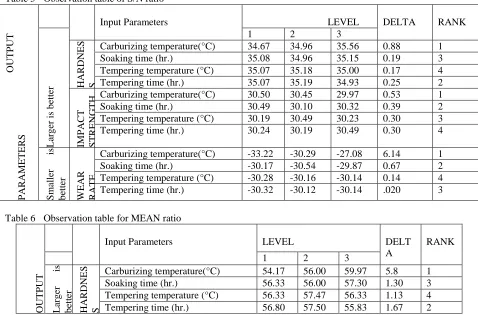
Table 5 and Table 6 represents response table of S/N ratio and MEAN of different input variables at different level there and there rank or their contribution in carburization process.
Table 5 Observation table of S/N ratio
OUT PUT PAR AM E T E R S
Input Parameters LEVEL DELTA RANK
L ar g er is b etter
1 2 3
HARDNE
S
S
Carburizing temperature(°C) 34.67 34.96 35.56 0.88 1
Soaking time (hr.) 35.08 34.96 35.15 0.19 3
Tempering temperature (°C) 35.07 35.18 35.00 0.17 4
Tempering time (hr.) 35.07 35.19 34.93 0.25 2
IMPACT STRENGT
H
Carburizing temperature(°C) 30.50 30.45 29.97 0.53 1
Soaking time (hr.) 30.49 30.10 30.32 0.39 2
Tempering temperature (°C) 30.19 30.49 30.23 0.30 3
Tempering time (hr.) 30.24 30.19 30.49 0.30 4
Sm aller is b etter W E AR R AT E
Carburizing temperature(°C) -33.22 -30.29 -27.08 6.14 1
Soaking time (hr.) -30.17 -30.54 -29.87 0.67 2
Tempering temperature (°C) -30.28 -30.16 -30.14 0.14 4
Tempering time (hr.) -30.32 -30.12 -30.14 .020 3
Table 6 Observation table for MEAN ratio
OUT PUT PAR AM E T E R
S Input Parameters LEVEL DELTA RANK
1 2 3
L ar g er is b et ter HARDNE S S
Carburizing temperature(°C) 54.17 56.00 59.97 5.8 1
Soaking time (hr.) 56.33 56.00 57.30 1.30 3
Tempering temperature (°C) 56.33 57.47 56.33 1.13 4
Tempering time (hr.) 56.80 57.50 55.83 1.67 2
Comparability Sequence
Larger is better Smaller is better
Hardness Toughness Wear rate
SNRA MEAN SNRA MEAN SNRA MEAN
No.1 34.6479 54 30.5009 33.5 -33.4049 46.8
No 2 34.8073 55 30.3703 33 -33.4604 47.1
No 3 34.5671 53.5 30.6296 34 -32.7897 43.6
No 4 34.9638 56 31.0046 35.5 -30.1841 32.3
No 5 34.8073 55 30.1030 32 -30.7059 34.3
No 6 35.1175 57 30.2377 32.5 -29.9662 31.5
No 7 35.6351 60.5 29.9662 31.5 -26.9271 22.2
No 8 35.2686 58 29.8272 31 -27.4582 23.6
IMPACT
STRENGT H
Carburizing temperature(°C) 33.50 33.33 31.50 2.00 1
Soaking time (hr.) 32.50 32.00 32.83 1.509 2
Tempering temperature (°C) 32.33 33.50 32.50 1.17 3.5
Tempering time (hr.) 32.50 32.33 33.50 1.17 3.5
Sm
aller
is
b
etter
W
E
AR
R
AT
E
Carburizing temperature(°C) 45.83 32.70 22.60 23.23 1
Soaking time (hr.) 33.77 35.00 32.37 2.63 2
Tempering temperature (°C) 33.97 33.80 33.37 0.60 4
Tempering time (hr.) 34.37 33.60 33.17 1.20 3
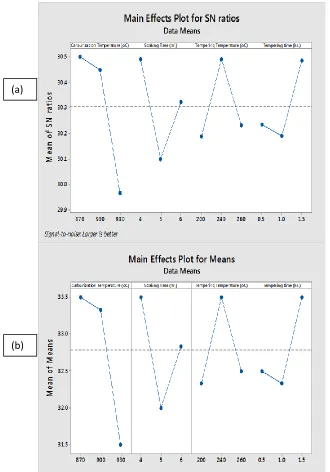
Figure 2 (a) and (b) Main effects plot for Mean and S/N ratio for Hardness.
Table 3.2, 3.3, 3.4 and Figure 3.1 and 3.2 showsthat input parameter Carburization temperature at level-3 contribute tremendously in order to obtain maximum hardness (Larger is better) of AISI 1020 steel. After carburization temperature second factor effected most is tempering time at level-2, then carburizing soaking time at level-3 tempering time followed by tempering temperature at level-2.
(a)
Figures 3 (a) and (b) Main effects plot for Mean and S/N ration for impact strength.
Table 4, 5 and Figure 3 (a) and (b) shows that minimum output parameter (smaller is better) wear rate was obtained at carburizing temperature at level-3 followed by carburizing soaking time at level-3 then tempering time at level-2 then tempering temperature at level-3.
(a)
Figure 4 (a) and (b) Main effects plot for Mean and S/N ratio for wear.
Table 3.3, 3.4 and Figure 3.5 and 3.6 shows that minimum wear (smaller is better) was obtained at carburizing temperature at level-3 followed by carburizing soaking time at level-3 ten tempering time at level-2 then tempering temperature at level-3.
IV. CONFIRMATION TEST
When whole optimization of process parameters take place it is easy to predict improvement in process parameters. The Carburizing temperature (°C) Level-3, Soaking time (hr.) Level-3, Tempering temperature (°C) Level-2 and Tempering time (hr.) Level-3 were used for confirmation test. It is observed that when Carburizing temperature at 930 °C, Soaking time 6 hr., Tempering temperature 240°C and Tempering time 1.5 hr., the final result obtained as hardness 62.5 Rc, impact strength 35.7 J, and wear rate 16.2 Micron. It is observed that L9 Taguchi technique improve multi responses in carburization process for AISI 1020 Steel.
(a)
V. CONCLUSIONS
Whole experiments were conducted in batch furnace and AISI 1020 used as work piece in order to determine to optimize input parameters. L9 Taguchi techniques were used in order to conclude different results are discussed below:
It is observed from Taguchi L9 analysis that hardness and wear rate improves with increase in most influence factor that is carburizing temperature. While impact strength goes on decrease with increase in carburizing temperature. After carburizing temperature most influence factor is carburizing soaking time. Maximum hardness and minimum wear obtained with increase in carburizing soaking time.
Tempering time was more influence parameter than that of tempering temperature.
After carburizing temperature, tempering time shows maximum influence in order to improve hardness. Tempering temperature has minimum influence on carburizing process.
.Confirmation result shows most suitable identical optical parameters for carburization of AISI 1020 steel. VI. REFERENCES
[1] Yana, N., et al., Effect of plasma nitrocarburizing on fatigue strength of SCM435 steel. Journal of Pressure Equipment and Systems, 2008. 6: p. 25-28.
[2] ČIUPLYS, V., et al., Increasing of Carbon Steel Durability by Surface Hardening. Stress, 2010. 600: p. 700. [3] Dossett, J. and G. Totten, Introduction to Surface Hardening of Steels. 2013.
[4] B. Edenhofer, D.J., M. Rink, K. Voges, Carburizing of steels. Thermochemical Surface Engineering of Steels., 2015(3): p. 485.
[5] Palaniradja, K., N. Alagumurthi, and V. Soundararajan, Optimization of process variables in gas carburizing process: a Taguchi study with experimental investigation on SAE 8620 and AISI 3310 steels. Turkish Journal of Engineering and Environmental Sciences, 2005. 29(5): p. 279-284.
[6] Prasannan, P., Carburization of steels) an overview. Indian J. Eng. Mater. Sci., 1994. 1(4): p. 221-228. [7] Oberg, E., et al., Machinery's handbook. Vol. 200. 2004: Industrial Press New York.
[8] Handbook, A.S.M., Volume 4. Heat treating, 1991.
[9] Asi, O., et al., The effect of high temperature gas carburizing on bending fatigue strength of SAE 8620 steel. Materials & Design, 2009. 30(5): p. 1792-1797.
[10] Astunkar, N. and A. Bonde, Effects of Carburizing on Wear Properties of Steels.
[11] Holm, T., Gas Carburizing and Carbonitriding, in Furnace atmospheres 1. AGA AB: SWEDEN.
[12] Stickels, C., Analytical models for the gas carburizing process. Metallurgical transactions B, 1989. 20(4): p. 535-546. [13] Todd, R.H., D.K. Allen, and L. Alting, Manufacturing processes reference guide. 1994: Industrial Press Inc. [14] Division, L.G. Furnace Atmospheres No. 1 Gas Carburizing and Carbonitriding.
[15] Karabelchtchikova, O., Fundamentals of mass transfer in gas carburizing. 2007, Worcester Polytechnic Institute.
[16] Sproge, L. and J. Ågren, Experimental and theoretical studies of gas consumption in the gas carburizing process. Journal of Heat Treating, 1988. 6(1): p. 9-19.
[17] Mamesta, Carburizing/ Carbonitriding - Surface hardening of steel An Aalberts industries company: Lomm. [18] Natarajan, S., Thermochemical Surface Engineering of Steels. Surface Engineering, 2015. 31(11): p. 875-878.
[19] Palaniradja, K., N. Alagumurthi, and V. Soundararajan, Hardness and case depth analysis through optimization techniques in surface hardening processes. Open Materials Science Journal, 2010. 4(2): p. 38-63.
[20] Kumar, S. and A. kumar Singh, OPTIMIZATION OF HEAT TREATMENT PROCESSES OF STEEL USED IN AUTOMOTIVE BEARINGS.
![Figure 1 Composition of the furnace atmosphere produced by injecting (above 850°C) different ratios of nitrogen/methanol in the furnace.[18]](https://thumb-us.123doks.com/thumbv2/123dok_us/1416800.1654755/2.612.123.486.177.389/figure-composition-atmosphere-produced-injecting-different-nitrogen-methanol.webp)