P R O C E E D I N G S
Open Access
Efficient protein structure search using indexing
methods
Sungchul Kim
1, Lee Sael
2, Hwanjo Yu
1*From
ACM Sixth International Workshop on Data and Text Mining in Biomedical Informatics (DTMBio 2012)
Maui, HI, USA. 29 October 2012
Abstract
Understanding functions of proteins is one of the most important challenges in many studies of biological processes. The function of a protein can be predicted by analyzing the functions of structurally similar proteins, thus finding structurally similar proteins accurately and efficiently from a large set of proteins is crucial. A protein structure can be represented as a vector by 3D-Zernike Descriptor (3DZD) which compactly represents the surface shape of the protein tertiary structure. This simplified representation accelerates the searching process. However, computing the similarity of two protein structures is still computationally expensive, thus it is hard to efficiently process many simultaneous requests of structurally similar protein search. This paper proposes indexing techniques which substantially reduce the search time to find structurally similar proteins. In particular, we first exploit two indexing techniques, i.e., iDistance and iKernel, on the 3DZDs. After that, we extend the techniques to further improve the search speed for protein structures. The extended indexing techniques build and utilize an reduced index constructed from the first few attributes of 3DZDs of protein structures. To retrieve top-k similar structures, top-10 ×ksimilar structures are first found using the reduced index, and top-kstructures are selected among them. We also modify the indexing techniques to supportθ-based nearest neighbor search, which returns data points less thanθ to the query point. The results show that both iDistance and iKernel significantly enhance the searching speed. In top-knearest neighbor search, the searching time is reduced 69.6%, 77%, 77.4% and 87.9%, respectively using iDistance, iKernel, the extended iDistance, and the extended iKernel. Inθ-based nearest neighbor serach, the searching time is reduced 80%, 81%, 95.6% and 95.6% using iDistance, iKernel, the extended iDistance, and the extended iKernel, respectively.
Introduction
The size of protein structure database such as the Protein Data Bank (PDB) continues to grow. PDB had around 1000 structures in 1992, but now it stores over 150,000 structures. In addition, the number of proteins with unknown functions is increasing due to efforts in structural genomics projects. Knowing the functions of proteins is crucial to many studies of biological processes. Especially, researchers need to know the key proteins that play an important role for severe deseases, and it is directly related to human life. Therefore, assigning functions to novel pro-teins is one of the most significant problems in proteomic study, and several methods have been developed to assign
functions to an unknown protein. Basically, the function of a protein can be identified by searching amino acid sequence database for similar sequences that the functions are already known. However, the 3D structures of proteins are more conserved than the sequences and using the structural information provide more reliable similarity measures.
Many methods have been introduced for pair-wise pro-tein structural search. They align the two structures and compute the Root Mean Square Deviation (RMSD) between the core atomic positions, e.g., alpha carbon coor-dinates, of the aligned proteins. However, most of methods based on structural alignment cannot be used to search structures against large database, since it has high compu-tational complexity. Sael et al. introduced a new approach for fast protein surface similarity search using 3DZDs [1]. * Correspondence: [email protected]
1POSTECH, Pohang, South Korea
Full list of author information is available at the end of the article
This approach does not consider individual residue/atom positions, or the arrangement of the secondary structure segments. 3DZD has three advantages: 1) fast k-nearest neighbor search, 2) rotational invariance, and 3) easy adjustment of the resolution of the structural representa-tion resolurepresenta-tion. In particular, using 3DZDs, it is possible to retrieve similar protein structures in seconds among 150k protein structures. However, few seconds are still too long for a real time search system, since response time increases further when multiple search requests are pro-cessed simultaneously. To enhance the searching speed, using indexing technique could be a good solution [2,3]. We exploit indexing techniques on 3DZDs in order to speed up protein structure search. Specifically, we apply two indexing techniques, iDistance and iKernel, on 3D-Surfer data set, and extend them for further speed up [4]. To fully take advantage of the indexing techniques, we
also provide θ-based nearest neighbor search which
returns data points less thanθto the query point. The experimental results show that the indexing techniques both decrease the searching speed, and our nearest neigh-bor search algorithms further speed up the protein struc-ture search. Speicifically, in top-knearest neighbor search, the searching time is reduced 69.6%, 77%, 77.4% and 87.9%, respectively using iDistance, iKernel, the extended iDistance, and the extended iKernel. Inθ-based nearest neighbor serach, the searching time is reduced 80%, 81%, 95.6% and 95.6% using iDistance, iKernel, the extended iDistance, and the extended iKernel, respectively.
This paper is organized as follows. We briefly intro-duce related works about protein structure search and top-k query search. Then, we explain iDistance, iKernel and the extended top-k query search method in combi-nation with iDistance and iKernel. Finally, we provide experimental results to verify the efficiency of our approaches, and conclusion with future works.
Related work Protein structure
A protein consists of a sequence of amino acid (AA) resi-dues. A sequence of AA residues folds into a 3-dimen-sional (3D) structure in space and forms a functional protein. A 3D structure of a protein is recorded in a pdb file format as a set of Cartesian coordinates of all the atoms in the protein. The 3D structure contains rich infor-mation relating to function and evolution of the protein.
Protein structure search
Earlier structural similarity measurements were designed for pair-wise analysis where the user only needed to com-pare handful of protein structures [5-7]. However, as the number of known structures increased more methods are proposed for similarity search in protein database [8,9]. One of the most intuitive approaches is to compare the
coordinates of corresponding residues or atoms of pro-teins after structural alignment [10,11]. Root Mean Square Deviation (RMSD) is often used as the similarity measure. Due to its high computational complexity, structure align-ment is done by using Dynamic Programming (DP) or its extensions [6,12,13].
There are major structure databases such as PDB, CATH [14], and SCOP [15] which provides only keyword search and browsing of pre-computed classification. Some database systems that are able to take a query structure are for the search includes Distance matrix ALIgnment (DALI) server [16], Vector Alignment Search Tool (VAST) search [17], and eF-site database [18]. Given a query protein structure, they need around an hour to finish searching their databases. Zeyar et al. sug-gests an indexing method called ProtDex for fast search in 3D protein structure database [19]. Although it per-forms faster than DaliLite [8], one of the most popular protein structure search algorithms, the search time of ProtDex takes over a few minutes and it is not practical for online database searches.
3D-Surfer
3D-Surfer is a new and efficient protein structural search system which represents protein structures based on 3D-Zernike Descriptor (3DZD). The major advantage of 3DZD is that it allows a fast k-nearest neighbor (k-nn) search of protein structures. It has been verified that the retrieved k-nn proteins by 3D-Surfer have similar func-tional and evolufunc-tional information in terms of SCOP clas-sification [20]. Some of the characteristics of the 3DZDs is that it is rotational invariant, and the resolution of the representation of protein structures are easily adjusted by changing the order, and descriptors of the lower order are contained in the descriptors of the higher order.
Nearest neighbor search algorithm
There is a long stream of researches on finding nearest neighbor search problem which is an optimization pro-blem for finding closest points in metric spaces. The simplest method is to compute the distance from the query point to every other point in the database. It has
O(Nd) complexity whereNis the number of data points
and dis the dimensionality of the data, and 3D-Surfer
also used this approach. For efficient top-k search, there have been various methods via space partitioning including X-tree, TV-tree, and SR-trees [21-23]. iDistance that we used here is also space partitioning method. There are other methods such as iKernel which is an indexing technique and designed for efficient cal-culation of support vector machine (SVM). The details of iDistance and iKernel are described in the methods. Note that those methods cannot be directly used for protein structure data, thus in this work we exploit the
Kimet al.BMC Medical Informatics and Decision Making2013,13(Suppl 1):S8 http://www.biomedcentral.com/1472-6947/13/S1/S8
3DZD of protein structures and apply indexing techni-ques on the 3DZDs.
Methods
In this section, we first introduce the protein structure dataset and their 3D-Zernike Descriptor (3DZD). Then, the descriptions of iDistance and iKernel methods and the proposed efficient top-k query search method based on the characteristics of 3DZD are provided.
Protein structural dataset and 3D-Zernike Descriptor 3DZDs are compact and rotationally invariant representa-tion of 3D structures. 3DZD has been successfully used for protein [1] and ligand structure analyses [24] as well. We provide brief description of 3DZD for reader’s conve-nience. Detailed description can be found in [25,26].
The 3DZD descriptors for protein structural dataset of 158781 number of protein chain structures was obtained through 3D-Surfer database. The entire structures in PDB was collected and processed on 2009 [27]. For each of the pdb files that contain one to several protein chains, the chains were separated and surfaces of each chain were obtained through molecular surface calculation program, MSROLL version 3.9.3 [28], and then voxelized. Each of the voxelized protein surface were used as a input to 3DZD conversion program and a vector of 121 numbers called invariants were computed.
In 3DZD construction, a given 3D functionf(x) that contains a surface information of protein is expanded into a series of Zernike-Canterakis bases defined as follows:
Zmnl(r, ϑ, ϕ) =Rnl(r)Ylm(ϑ, ϕ) (1)
where-l < m < l, 0≤l≤n, (n - l) is even,Ym
l (ϑ,ϕ)are
spherical harmonics, andRnl are radial functions con-structed to convert Zm
nl(r, ϑ, ϕ)to polynomials in the
Cartesian coordinates,Zm
nl(x). To obtain the 3DZD off(x),
3D Zernike moments need to be computed first. They are defined by expanding the orthonormal bases as follows:
m nl =
3 4π
|x|≤1
f(x)Z¯mnl(x)dx (2)
Then, the 3DZD,Fnl, is computed by normalizingmnl
as follows:
Fnl=
m=l
m=−l
(mnl)2 (3)
wherenis the order of 3DZD determining the
resolu-tion of the descriptor. Then, the norms allow rataresolu-tional invariance to the desriptor. For each pair ofnandl, 3DZD has a series of invariants, the numbers in the vector of
3DZD, wherenis ranged from 0 to the predefined order
(20 in this case).
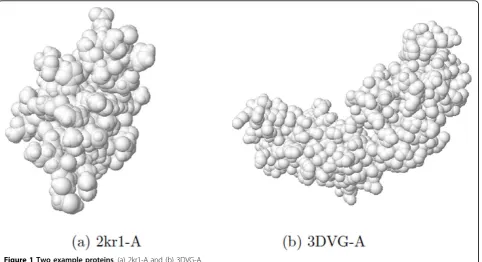
Figure 1 is an example of 3DZD of two proteins, triose-phosphate isomerase (PDB code: 2kr1-A) and interleukin-4 receptora-chain (PDB code: 3DVG-A). As you can see, two proteins have different structures overall and their descriptor also shows visible difference (Figure 2).
Indexing techniques
In this work, we exploit two indexing techniques: iDis-tance and iKernel. Two indexing techniques partition given data points into clusters and using the clusters to find k-nn. Note that both techniques exactly retrieve k nearest neighbor results given a query. The details of the two indexing methods follows.
iDistance
iDistance is an efficient indexing technique for k-nearest neighbor search in a high-dimensional metric space [29]. It depends on how data are partitioned and how refer-ence points for each partition are defined (we will hrefer-ence- hence-forth mention partition as cluster for terminology consistency between iDistance and iKernel). After clus-tering and reference point selection, each data point is indexed according to the distance between its reference points.
To build an index, the reference points are selected by data clustering. Although various clustering techniques can be used to select reference points, we have used k-means clustering. And then, data points are assigned its closest reference point. During the assignment process, the data point is recorded with the distance which is called iDistance and is used as a key for top-k search. The iDistance is computed as follows:
y=i×C+dist(p,Oi) (4)
wherey is iDistance of pointpini-th cluster, Oi, and
C is a constant used to stretch the data ranges of
indexes.
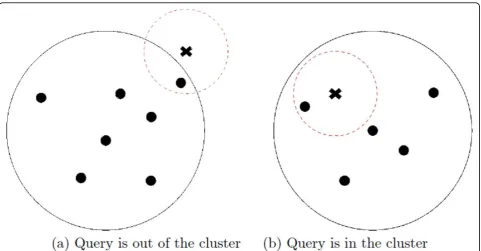
search the cluster inward and outward from the position ofq.
iKernel
iKernel is originally designed for the efficient learning of support vector machine (SVM) [30]. However, it is also applicable for top-k search for Euclidean distance. Similar
to iDistance, it first divide given data points to clusters where the clusters have set of rings which are the data structure defined for iKernel. Given a query, it searches k-nn by visiting each cluster and its rings.
To build an index, given data points are clustered intom
clusters and centroids of each clusters are computed in the
Figure 1Two example proteins. (a) 2kr1-A and (b) 3DVG-A.
Figure 23D Zernike descriptors of two example proteins. The dimension of 3DZD is 121.
Kimet al.BMC Medical Informatics and Decision Making2013,13(Suppl 1):S8 http://www.biomedcentral.com/1472-6947/13/S1/S8
feature space. Various clustering techniques can be applied. Then, based on those centroids and clusters, we can build an index by assigning data points into a set of rings in clusters as follows.
C1:{C1,1:x(1)1,1,x (2) 1,1,· · ·,x
(g)
1.1},{C1,2:x(1)1,2,x (2) 1,2,· · ·,x
(g) 1,2},· · · C2:{C2,1:x(1)2,1,x
(2) 2,1,· · ·,x
(g)
2.1},{C2,2:x(1)2,2,x (2) 2,2,· · ·,x
(g) 2,2},· · · · · ·
(5)
Note that each ring havegnumber of data points. The paramter gis user adjustable and need to be determined prior to index construction.
To process a k-nn of a query structure, we exploits the index and Minimal Possible Distance (MPD) [30]. MPD is the minimal possible distance between a queryqand ring
structure Ci,j. With this new notion of the MPD, k-nn
search works as follows. Given a query pointq, we first initialize a priority queueQwith a set of pair ¡Ci,j, MPD¿ of each cluster in the ascending order of their MPDs between theqwhere only the outermost ring is considered first. Then, at each iteration, the top entry ofQis popped. If a ring is popped, the data points in the ring are inserted toQwith the distance fromq, and if the popped item is a data point, it is simply added into top-k result since the priority queue ensures that all instances in the queue have
larger distances from q and also all rings have larger
MPDs betweenq.
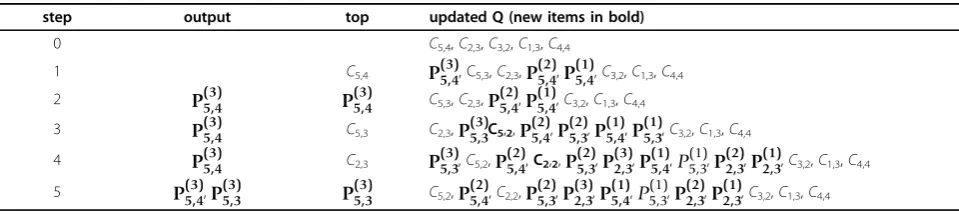
We now explain how top-k processing can be done with an example (Figure 4 and Table 1) when k = 2. In the queue,Q, rings or data points are ordered in the distance
in ascending order (In the table, the leftmost item has the lowest distance). At the first iteration,C5,4with the lowest MPD is popped. Then the distance from q to its instances, P5,4(2),P(2)5,4, andP(3)5,4, and the MPD to its inner ringC5,3, are computed and these instances are inserted back to Q (the second row in Table 1). At the second iteration, the top instanceP(3)5,4is added to output since it is guaranteed to be top-k. Then, the priority queue ensures that all data points in the queue are farther fromq. and all rings have larger MPDs toqwhich suggests that all the data points within these rings have larger distance toqas well. At the third iteration, the top instance, ringC5,3is popped and its data pointsP5,3(1),P(2)5,3, andP5,3(3)are added to the queue. At the fourth iteration, the top instance, a ringC2,3is popped and its instances P(1)2,3, P2,3(2), and P(3)2,3 are added to the queue. Lastly, the top instance, P5,3(3) is popped and returned as output. Then the top-k processing terminates since top k = 2 instances are identified.
Partitioning
For both indexing techniques, we require division of data set into clusters by assigning similar number of data points to each cluster. First method randomly selects reference points and assign remaining data points to their closest reference point. K-means clustering, which is one of the most widely used clustering meth-ods, is also tested. The goal of K-means clustering algo-rithm is to divide a set of points intokclusters so that the within-cluster sum of squares is minimized [31]. K-means algorithm is easily applicable to problems and
performance is often shown to be satisfying. However, it also has some disadvantages as the K-means algorithms is a local search procedure and it suffers from the ser-ious drawback that its performance depends on the initial starting conditions [32]. Therefore, in this work, we repeatedly cluster data points and conduct experi-ments, and select the best result.
Figure 5 shows that the number of data points assigned to clusters. As you can see, using K-means generates more stable clusters with similar amount of data points. If some clusters have larger number of data points than other ters, we need to search their region more than other clus-ters. Therefore, balancing the number of data points in clusters is required for efficient k-nn search. In experiment,
we compare those partitioning strategies in terms of search speed.
Extended top-k search based on 3DZD
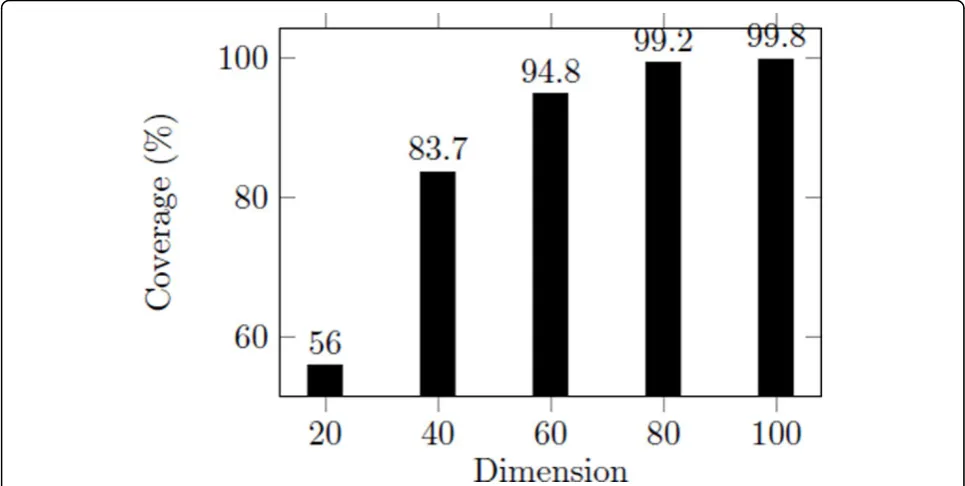
According to 3DZD, the descriptor vector has one nota-ble characteristic. The prior dimensions in the descrip-tor vecdescrip-tor indicate global shape and the posterior dimensions include more specific shape information. Based on this fact, we propose an extended top-k search approach for protein structure based on 3DZD. In this approach, the index is constructed based on the data set using only the prior half of original vectors. Retrieval result of top-250 using first 60 invariants in the descrip-tor vecdescrip-tors covered 94.8% of the top-25 retrieval result
Figure 4Top-2 query processing in iKernel. q is query point,Ciis i-th cluster, there are same number of data points in rings(Pni,j), andMPDi,j
is the mininum possible distance of j-th ring of i-th cluster.
Table 1 Top-2 query processing
step output top updated Q (new items in bold)
0 C5,4,C2,3,C3,2,C1,3,C4,4
1 C5,4 P(3)5,4, C5,3,C2,3,P5,4(2),P(1)5,4,C3,2,C1,3,C4,4
2 P(3)
5,4 P
(3)
5,4 C5,3,C2,3,P
(2)
5,4,P
(1)
5,4,C3,2,C1,3,C4,4
3 P(3)
5,4 C5,3 C2,3,P
(3)
5,3C5,2,P
(2)
5,4,P
(2)
5,3,P
(1)
5,4,P
(1)
5,3,C3,2,C1,3,C4,4
4 P(3)
5,4 C2,3 P(3)5,3,C5,2,P5,4(2),C2,2,P(2)5,3,P2,3(3),P(1)5,4,P(1)5,3,P2,3(2),P(1)2,3,C3,2,C1,3,C4,4
5 P(3)
5,4,P
(3)
5,3 P
(3)
5,3 C5,2,P
(2)
5,4,C2,2,P
(2)
5,3,P
(3)
2,3,P
(1)
5,4,P
(1) 5,3,P
(2)
2,3,P
(1)
2,3,C3,2,C1,3,C4,4
Kimet al.BMC Medical Informatics and Decision Making2013,13(Suppl 1):S8 http://www.biomedcentral.com/1472-6947/13/S1/S8
using the full descriptors as shows in Figure 6. In
addi-tion, finding top-k × 10 result using half dimension
takes less time than using basic indexing techniques (Figure 7) where iD-s and iK-s is the result of top-k× 10 for iDistance and iKernel using small dimensions, respectively, and iD-121 and iK-121 is the result of
top-kfor iDistance and iKernel using original 121 dimen-sions. This shows that using half of the descriptor for indexing allows a fast and accurate approximation of using the full descriptor.
Based on this observation, we introduce a new approach for top-k search as follows.
Figure 5The number of data instances assigned to clusters by random and k-means clustering. The solid line is random clustering, and the dashed line is K-means clustering.
1 Given a query protein Q, search top-k× 10 result using the indexing structure with 60-dim (the half of entire dimension).
2 Using the top-k× 10 results, find exact top-kresult.
Note that k× 10 is very small number compared to
the size of the database (around 1.6 million).
Threshold-based nearest neighbor search
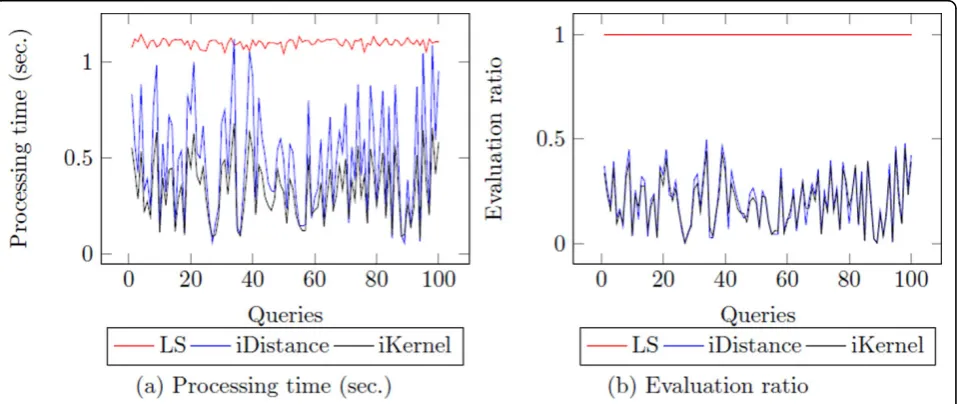
In preliminary experiments, we found that the proces-sing time/evaluation ratio of the top-k nearest neighbor search is very different depending on the queries. It is
different from the linear search which always shows sta-bility asq varies (Figure 8). Intuitively, we can see that if the distance betweenk-th nearest neighbor and query is large, both indexing techniques need to visit more clus-ters and the list of k-th nearest neighbor is frequently changed during the search procedure. In addition, if the distance between two proteins is large, it indicates that they are not similar in terms of their structural informa-tion and they do not share funcinforma-tional informainforma-tion as well. Therefore, we cast the nearest neighbor search task as threshold-based nearest search in order to guarantee
Figure 7The change of processing time as the dimension used for index increases. The number of clusters,M, is 866,<Δr,C >is<0.2, 4>, and the number of data points in each ring,gis 50.
Figure 8The distribution of processing time of fKNNs. The experiment is conducted with 100 randomly selected query proteins.
Kimet al.BMC Medical Informatics and Decision Making2013,13(Suppl 1):S8 http://www.biomedcentral.com/1472-6947/13/S1/S8
stable processing time/evaluation ratio with reliable results.
The nearest neighbor search can be solved based on two different user parameters of either the number of nearest neighbor,k, or the threshold of the distance between near-est neighbors and query,θ(From now on, we call the
sec-ond approach as θ-based nearest neighbor seach).
Therefore, we exploit the indexing techniques inθ-based nn search as well. Usingθ, a data point can be nearest neighbor, only if they have shorter distance to the query thanθ. To do this, in the linear scan, we need to check whether the distance between each protein structure and query is less thanθor not, we do not need to check the number of nearest neighbor,k. In the iDistance, we set the query range,rasθ. Then the number of visiting clusters and computing the distance between their data points ot query decreases, when the number of nearest neighbor with shorter distance thanθ has smaller thank. In the iKernel, the search process is terminated untill the Mini-mum Possible Ditance (MPD) of the popped instance is smaller thanθ. It also reduces the cost of visiting clusters and computing the distance bewteen the query and their data points. Note that, usingθ, the extended approaches always return the exact nearest neighbors.
Results
In this section, we verify the effectiveness of indexing tech-niques on top-k search of protein structures. Sael et al. showed that 3DZD works well on finding similar proteins in terms of functional and evolutionary characteristics based on SCOP classification [1]. The SCOP provides the ordering of all proteins of known structure according to their evolutionary and structural relationships. In addition, both of iDistance and iKernel are not approximate techni-ques and find exact top-k nn from database according to the structural similarity described by 3DZD. Therefore, we only measure the efficiency in terms of processing time and evaluation ratio. The evaluation ratio is computed as the fraction of accessed data points over the number of database (1 for linear scan since it access all data points in the data set). The processing time could be affected by the various factors including performance of machine, the number of users, and network environment. In contrast, the evaluation ratio shows consistent measure.
The experiments were conducted on the machine, Intel Core(TM) i7 CPU (3.40GHz), and 16 GB memory. In overall experiment, we used 100 data points that are randomly selected from data set, and averaged entire processing time and evaluation ratio.
The user parameters
There are a few parameters that are needed to be optimized in the iDistance and iKernel methods. In this section, we observe how the result varies as the user parameters varies
to select the best. We also observe how the cluster number affects the top-k search. We vary the partition data points using different number of clusters: 121, 242, 498, and 866. 121 is the dimensionality of data set, and 242 is the two times the dimensionality ([29] refers that this way works well on iDistance). And the others are according to SCOP classification hierarchy. 498 is the number of families, and 866 is the number of protein domains [15]. We assume that the numbers defined by domain experts could have good evidence of cluster number. The followings include the explanation of user parameters and their experimental result.
There are two user paramters:ΔrandCin iDistance.ris the distance radius of query region that indicates an area
that we need to search, andΔris the amount of value
added torafter each iteration, andCis used to obtain key value for index construction. Although we have conducted some experiments to tuneCas well, it seems not affect much on top-k search. Therefore, in this work, we setCas 4 by maintaining few of data instances are overlapped between clusters as [29] did. Figure 9 shows the changes of processing time and evaluation ratio asΔrincreases.
The results show that smallerΔrand larger number of
clusters generally performs better. It indicates that iDis-tance depends highly on the number of clusters. In con-trast to statement made by Jagadish et al. that using two times the dimension of data as the number of clusters often works well, the result show that when the data size is very large, large number of clusters is needed as well. Therefore, different from Jagadish’s work [29], it is likely that when the data size is very large, we have to use large cluster number as well.
For the optimized value, we decided to use 0.2 asΔr
and 866 as the number of clusters, since it shows the best result in terms of the evaluation ratio. Though it does not result out the best result in terms of processing
time, the difference among Δr is not that large
com-pared to the difference among the dimensions.
There is one parameter,g, in iKernel. The parametergis the number of data points in rings of the clusters. As men-tioned before, for top-k search, we visit the rings according to its MPD and add all data instances of the ring into the priority queue, which is sorted at the end of every itera-tion. Figure 10 shows that the best performance is obtained using the 50 when the number of cluster is 866. The result also seems that when the number of cluster is small, the amount of changes asgvaries becomes small. When the number of clusters is small, the number of rings decreases as well, so that the result affects bygless than when the number of clusters is large.
For the optimized value, we decided to use 50 as g
The comparison of clustering techniques
First, we compare the performance of the two clustering approaches: Random clustering and K-means clustering algorithm. In addition to normal clustering requirement of high inter-distance and low intradistance between the clusters, for efficient indexing purposes, we require that the size of clusters are balanced, that is clusters should have similar number of data points. Intuitively, if some clusters have more data points than others, search time for those clusters will be high. Table 2 shows that index-ing techniques with k-means clusterindex-ing, although slightly slower, have better evaluation ratio than random clustering. Therefore, the following results in later
sections use the result by the indexing techniques with k-means algorithm.
The number of nearest neighbor, k
Although we have fixed thekto 25 in the previous experi-ments, we explore the effect ofkand the performance. As
Figure 9The efficiency of top-k search using iDistance with variousΔr.Δris the amount of value added torafter each iteration in iDistance.
Figure 10The efficiency of top-k search using iKernel withg.gis the number of data points in each ring when iKernel is used.
Table 2 The effectiveness of clustering (Processing time (sec.)/Evaluation ratio)
iDistance iKernel
Random 0.34124/0.2132 0.26173/0.2251
K-means 0.3237/0.2 0.246/0.2122
Kimet al.BMC Medical Informatics and Decision Making2013,13(Suppl 1):S8 http://www.biomedcentral.com/1472-6947/13/S1/S8
expected, the processing time increases (Figure 11). How-ever, the increase processing time is less for iKernel than iDistance askincreases, and iKernel shows works faster than overall. In terms of the evaluation ratio, the result is different. Though the difference is small, iDistance shows better result than iKernel. It indicates that whenkbecomes large, iKernel needs to search more data points than iDis-tance since it adds all of data points in visited rings com-puting the distance between the data point and query. However, the overall processing cost is less for iKernel.
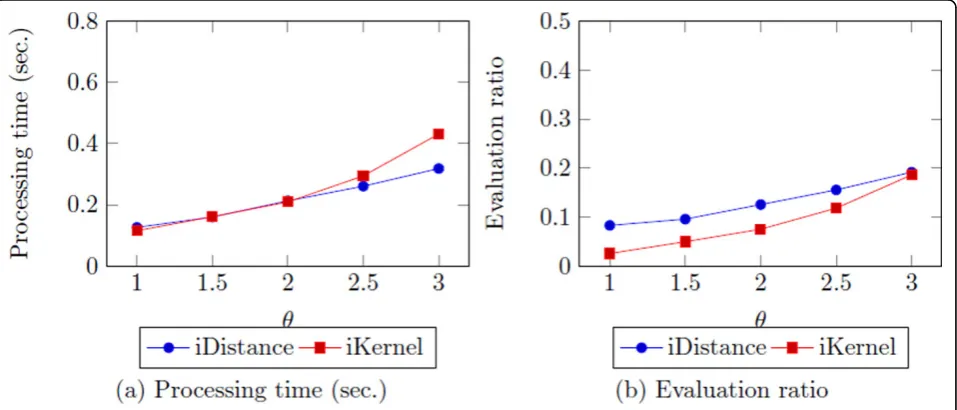
The filtering threshold,θ
In this section, we explore the effect ofθand the
perfor-mance. Asθincreases, the processing time/evaluation
ratio increases as well since we need to visit more clusters
and data points (Figure 12). However, still we can guaran-tee better and stable efficiency with exact results. Different from the result ofk, iDistance works faster than iKernel in many cases, even its evaluation ratio is larger than iKernel. It shows that iDistance is more rubost toθthan iKernel. When we usekas nn constraint, iKernel visits less number of data points and is terminated quickly since data points divided into rings which is more specific data structure than clusters. However, when we useθas nn constraint, iKernel visits more rings (and data points) than iDistance due to the same reason.
We also provide the ratio of queries not having nearest neighbors according to given queries, and the average number of nearest neighbors resulted fromθ-based near-est neighbor search (Figure 13). As easily expected, there
Figure 11The processing time/evaluation ratio as k increases.
are more nearest neighbors and less queries with no near-est neighbors asθincreases. When we setθas 2, the num-ber of nearest neighbor is reasonable (similar to 25), and about 20% of queries do not have results. We use 2 asθ for next experiments, since the processing time/evaluation ratio is reduced enough compared to the linear search and the nearest neighbors are close to the queries compared to top-knn search.
The stability of processing time/evaluation ratio
To show the stability of the θ-based nearest neighbor
search, we observe the distribution of the processing time/ evaluation ratio of the proposed methods. As shown before (Figure 8), when we find top-k nearest neighbors, the pro-cessing time/evaluation ratio is not stable according to
different queries. According to the Figure 14,θ-based nn search shows more stable performance than the top-knn search since usingθcan filter out many clusters and data points which have long distance. In addition, it always retrieves exact nearest neighbors having the distance to query less thanθ. Therefore,θ-based nearest neighbor search will be useful to some users who want to find near-est neighbors with tighten similarity to query protein.
The enhancement with the extended nearest neighbor search
In this section, the result of the extended approaches is compared to the best results of the basic approach dis-cussed in the previous section. Since we use optimal paramters based on previous experiments. First, we
Figure 14The distribution of processing time of fTNNs.
Figure 13The analysis ofθ-based nearest neighbor search. The number of nearest neighbors and the number of queries without nearest neighbors asθincreases.
Kimet al.BMC Medical Informatics and Decision Making2013,13(Suppl 1):S8 http://www.biomedcentral.com/1472-6947/13/S1/S8
provide the result of the proposed approaches in top-k
nearest neighbor problem (Table-3). In the table, the number in bracket is the ratio of actual top-25 result in top-25 result which are approximately obtained by the extended approach (which is same to the preliminary result, Figure 6). As you can see, the enhancement of iDistance and iKernel with basic top-ksearch is not that large, the extended approaches work much faster than basic approaches. In addition, iKernel always works fas-ter than iDistance. Among iKernel results, it looks like the basic approach works faster than the extension, but it is not. Note that when they access to data instance to compute inner products of vectors, in the case of basic approach, there are 121-dimensional vectors. However, in the case of the extended approach, the inner product takes 60-dimensional vectors. It indicates that if the difference is small between two approaches, the extended
approach may work better than the basic approach in real. In addition, when the number of query is small, the quality is comparable. However, when the number of query becomes large, the difference of processing time becomes larger as well.
Next, we conducted same experiments for the
pro-posed approaches inθ-based nearest neighbor search
(Table 4). Similar to Table 3, using index techniques works faster than the linear scan, and the extended approaches work much faster than the basic approaches. However, inθ-based nearest neighbor search, iDistance works faster than iKernel in many cases. The reason is described in Section. Accordingly, we conclude that iDis-tance is proper to find nearest neighbors which have shorter distance than the fixed distance, and iKernel is proper to find exact number of nearest neighbors. Gener-ally, in addition, the results show that the extended approaches further speed up the basic approaches in both of top-kandθ-based nearest neighbor search on the protein structure data set.
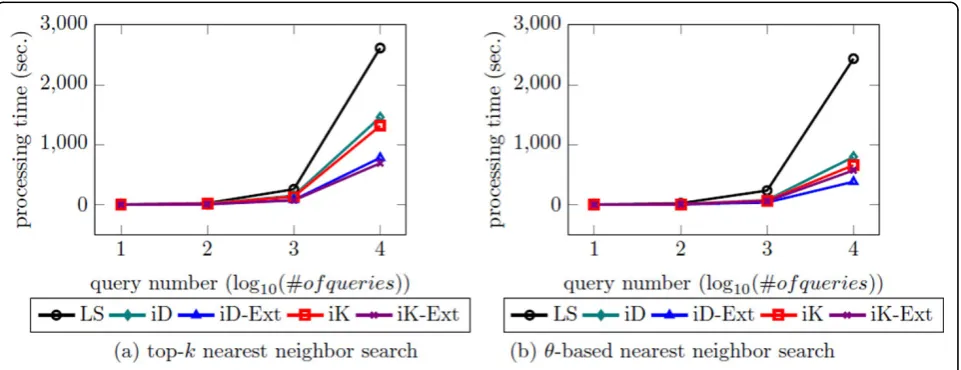
Simulation result
To support our statement more, we simulate the scenario that a number of users enter queries at the same time via multi-threading (Figure 15). According to the result, the basic approaches work faster than the linear scan and the extended approaches further speed up the basic approaches, and theθ-based nn search works much faster than the top-knn search since usingθwe can filter out more clusters (or rings) and data points. Usingk, iKernel works faster than iDistance which indicates that iKernel is more efficient to find exact number of nearest neigh-bor with new structure, ring. In constrast, however, using
θ, iDistance works faster than iKernel which indicates Table 3 The comparison of the proposed approaches in
top-knearest neighbor search (Proc. is processing time measured in second and Eval. is evaluation ratio)
LS iDistance iKernel
basic ext. basic ext.
Proc. 1.0567 0.3212 0.2387 (95.2) 0.2434 0.128 (95.2)
Eval. 1 0.3 0.202 (95.2) 0.1761 0.1993 (95.2)
Table 4 The comparison of the proposed approaches in θ-based nearest neighbor search (Proc. is processing time measured in second and Eval. is evaluation ratio)
LS iDistance iKernel
basic ext. basic ext.
Proc. 1.08 0.2128 0.0479 0.2091 0.087
Eval. 1 0.1254 0.0537 0.075 0.0222
that iDistance is more appropriate to find the nearest neighbor within the fixed distance,θ.
Conclusion
In this paper, we introduce an efficient indexing for pro-tein structure search where propro-tein structures are repre-sented as vectors by 3D-Zernike Descriptor (3DZD). When we retrieve top-knearest neighbors, using indexing techniques alone, we were able to make the search speed 77% faster compared to the prevoius version of 3D-Surfer that uses linear Euclidian distance scan between the 3DZDs in the database. We also proposed an extended version of the protein structure search based on the key observation that the prior dimension of the descriptor indicates global shape of the protein structure. Using the extended techniques it is improved up to 87.9%. When we retrieve nearest neighbor with shorter distance to the query thanθ, using indexing techniques alone, we were able to make the search speed 81% faster compared to the linear scan. Using the extended techniques it is improved up to 96%. For future work, we will improve the nearest neighbor search with indexing techniques by utilizing the characteristics of the query prior to searching. In addition, we will apply indexing techniques for protein binding site similarity search with other data set represented based on 3DZD as well.
Authors’contributions
Sungchul Kim designed models, conducted data analysis and experiments, and wrote the paper; Sael Lee designed the study, gave technical support, and wrote the paper; Hwanjo Yu gave conceptual advice, designed experiments and wrote the paper; All authors discussed the results and commented on the manuscript at all stages.
Competing interests
The authors declare that there are no competing interests.
Acknowledgements
This work was partially supported by Mid-career Researcher Program through NRF grant funded by the MEST (No. KRF-2011-0016029). This work was also supported by IT Consilience Creative Program of MKE and NIPA (C1515-1121-0003)
This work is based on an earlier work:“Indexing methods for efficient protein 3D surface search”, inProceedings of the ACM Sixth International Workshop on Data and Text Mining in Biomedical Informatics, 2012 © ACM, 2012. http://doi.acm.org/10.1145/2390068.2390078
Declarations
The publication costs for this article were funded by the corresponding author.
This article has been published as part ofBMC Medical Informatics and Decision MakingVolume 13 Supplement 1, 2013: Proceedings of the ACM Sixth International Workshop on Data and Text Mining in Biomedical Informatics (DTMBio 2012). The full contents of the supplement are available online at http://www.biomedcentral.com/bmcmedinformdecismak/ supplements/13/S1.
Author details
1POSTECH, Pohang, South Korea.2SUNY Korea, Incheon, South Korea.
Published: 5 April 2013
References
1. Sael L, Li B, La D, Fang Y, Ramani K, Rustamov R, Kihara D:Fast protein tertiary structure retrieval based on global surface shape similarity. Proteins2008,72:1259-1273.
2. Deng K, Zhou X, Shen HT, Liu Q, Xu K, Lin X:A multi-resolution surface distance model for k-NN query processing.VLDB2008, 1101-1119. 3. Shen HT, Huang Z, Cao J, Zhou X:High-dimensional indexing with
oriented cluster representation for multimedia databases.VLDBICME; 2009, 1628-1631.
4. Kim S, Lee S, Yu H:Indexing methods for efficient protein 3D surface search.Proceedings of the ACM Sixth International Workshop on Data and Text Mining in Biomedical InformaticsNew York: ACM; 2012, 41-48. 5. Gibrat JF, Madej T, Bryant SH:Surprising similarities in structure
comparison.Curr Opin Struct Biol1996,6:377-385.
6. Shindyalov IN, Bourne PE:Protein structure alighment by incremental combinatorial extension (CE) of the optimal path.Protein Eng1998,
11:739-747.
7. Singh AP, Brutlag DL:Hierarchical protein structure superposition using both secondary structure and atomic representations.Intl Syst for Mol Biol (ISMB)2008, 1013-1022.
8. Holm L, Sander C:Protein structure comparison by alighment of distance matrices.J Mol Biol1993,233:123-138.
9. Martin A:The ups and downs of protein topology: rapid comparison of protein structure.Protein Eng2000,13:829-837.
10. Mizuguchi K, Go N:Seeking significance in three-dimensional rotein structure comparisons.Curr Opin Struct Biol1995,5:377-382.
11. Kolodny R, Petrey D, Honig B:Protein structure comparison: implications for the nature of‘fold space’, and structure and function prediction.Curr Opin Struct Biol2006,16:393-398.
12. Kihara D, Skolnick J:The PDB is a covering set of amall protein structures. J Mol Biol2003,334:793-802.
13. Gerstein M, Levitt M:Using iterative dynamic programming to obtain accurate pairwise and multiple alignments of ptotein structures.Proc Int Conf Intell Syst Mol Biol1996,4:59-67.
14. Orengo CA, Michie AD, Jones S, Jones DT, Swindells MB, Thornton JM:
CATH-a hierarchic classification of protein domain structures.Structure
1997,5:1093-1108.
15. Murzin AG, Brenner SE, Hubbard T, Chothia C:SCOP: A structural classification of proteins database for the investigation of sequences and structures.J Mol Biol1995,247:536-540.
16. Holm L, Sander C:Touring protein fold space with DALI/FSSP.Nucleic Acids Res1998,26:316-319.
17. Madej T, Gibrat JF, Bryant SH:Threading a database of protein cores. Proteins1995,23:356-369.
18. Kinoshita K, Nakamura H:Identification of protein biochemical functions by similarity search using the molecular surface database eF-site.Protein Sci2003,12:1589-1595.
19. Aung Z, Fu W, lee Tan K:An efficient index-based protein structure database searching method.DASFAA2003.
20. Conte LL, Brenner SE, Hubbard TJ, Chothia C, Murzin AG:SCOP database in 2002: refinements accommodate structural genomics.Nucleic Acids Res
2002,30:264-267.
21. Ciaccia P, Patella M, Zezula P:M-tree: an efficient access method for similarity search in metric spaces.Nucleic Acids ResVLDB; 1997. 22. Keim D:Tutorial on high-dimensional index structures: Database support
for next decades applications.Nucleic Acids ResICDE; 2000. 23. Bruno N, Gravano L, Marian A:Evaluating top-k queries over
web-accessible databases.Nucleic Acids ResICDE; 2002.
24. Venkatraman V, Chakravarthy PR, Kihara D:Application of 3D Zernike descriptors to shape-based ligand similarity searching.J Cheminform
2009,1:19.
25. Canterakis N:3D Zernike Moments and Zernike Affine Invariants for 3D Image Analysis and Recognition.Image Analysis1999, 85-93.
26. Novotni M, Klein R:3D zernike descriptors for content based shape retrieval.SM2003.
27. La D, Esquivel-Rodríguez J, Venkatraman V, Li B, Sael L, Ueng S, Ahrendt S, Kihara D:3D-SURFER: software for high-throughput protein surface comparison and analysis.Bioinformatics2009,25:2843-2844. 28. Connolly ML:The molecular surface package.J Mol Graph1993,
11(2):139-141.
Kimet al.BMC Medical Informatics and Decision Making2013,13(Suppl 1):S8 http://www.biomedcentral.com/1472-6947/13/S1/S8
29. Jagadish HV, Ooi BC, Tan KL, Yu C, Zhang R:iDistance: An adaptive B-tree based indexing method for nearest neighbor search.Database Syst2005, 364-397.
30. Yu H, Ko I, Kim Y, Hwang S, Han WS:Exact indexing for support vector machines.Management of data.
31. MacQueen JB:Some methods for classification and analysis of
multivariate observations.Management of data Math statist and Prob1967. 32. nad J Lozano JP, Larranaga P:An empirical comparison of four
initializatoin methods for the k-means algorithm.Management of data
1999.
doi:10.1186/1472-6947-13-S1-S8
Cite this article as:Kimet al.:Efficient protein structure search using
indexing methods.BMC Medical Informatics and Decision Making2013
13(Suppl 1):S8.
Submit your next manuscript to BioMed Central and take full advantage of:
• Convenient online submission
• Thorough peer review
• No space constraints or color figure charges
• Immediate publication on acceptance
• Inclusion in PubMed, CAS, Scopus and Google Scholar
• Research which is freely available for redistribution