R E S E A R C H A R T I C L E
Open Access
Optimal vaccination schedule search using
genetic algorithm over MPI technology
Cristiano Calonaci
1†, Ferdinando Chiacchio
2†and Francesco Pappalardo
2†*Abstract
Background: Immunological strategies that achieve the prevention of tumor growth are based on the presumption that the immune system, if triggered before tumor onset, could be able to defend from specific cancers. In supporting this assertion, in the last decade active immunization approaches prevented some virus-related cancers in humans. An immunopreventive cell vaccine for the non-virus-related human breast cancer has been recently developed. This vaccine, called Triplex, targets the HER-2-neu oncogene in HER-2/neu transgenic mice and has shown to almost completely prevent HER-2/neu-driven mammary carcinogenesis when administered with an intensive and life-long schedule.
Methods: To better understand the preventive efficacy of the Triplex vaccine in reduced schedules we employed a computational approach. The computer model developed allowed us to test in silico specific vaccination schedules in the quest for optimality. Specifically here we present a parallel genetic algorithm able to suggest optimal vaccination schedule.
Results & Conclusions: The enormous complexity of combinatorial space to be explored makes this approach the only possible one. The suggested schedule was then tested in vivo, giving good results. Finally, biologically relevant outcomes of optimization are presented.
Keywords: Cancer, Optimization, Artificial intelligence, High performance computing
Background
The role of the immune system in tumor surveillance is today clearly established, and tumor immunologists are actively working to devise preventive and therapeutical vaccines against cancer. Living organisms are natural com-plex systems and modeling may play a crucial role since models can also be built with approximate and imperfect knowledge of the phenomenon, and model parameters (initial data, entities, relations between entities) can be adjusted to fit modeling results to experimental measure-ments [1].
Cancer immunoprevention is a recent development of tumor immunology that aims at preventing tumor onset with immunological means, in particular vaccines. The main challenge issuing from successful experiments in
*Correspondence: [email protected] †Equal contributors
2University of Catania, Catania, Italy
Full list of author information is available at the end of the article
genetically-modified mice is now to translate immunopre-vention to human situations. In this way, once the vaccine has been demonstrated to be effective in preventing the targeted tumor, it is necessary to find an optimal vaccina-tion schedule that minimizes both the administravaccina-tions of the vaccine and the eventually present side effects. Obvi-ously the time and the costs needed for an exhaustive search are prohibitive [2].
The evaluation of the antitumor efficacy of cancer vac-cines in mouse models (also here referred to asbiological models) is a required prelude to the clinical use of these treatments. Testing of some cancer vaccine features, such as the best conditions for vaccine administration, can be very difficult or even impossible only through experiments with biological models simply because a high number of variables need to be considered at the same time. This is where computational models can prove handy as they have shown to be able to reproduce enough biological complexity to be of use in suggesting new experiments [3,4]. This characteristic makes computer models suited
to perform “what-if ” analyses to elucidate relationships between different phenomena and to aid in the valida-tion or rejecvalida-tion of working hypotheses. Indeed, com-putational models can be used inaddition to biological models.
We developed an agent based model (ABM) of the effects of a vaccine designed to prevent mammary carci-noma in transgenic mice [5]. This model faithfully sum-marizes not only the outcome of vaccination experiments, but also the dynamics of immune responses elicited by the vaccine [6-10].
We then used a parallel genetic algorithm to search for an optimal vaccination schedule. The predicted schedules were testedin vivo, giving good results [11]. The approach plays the role of a virtual laboratory performing in a few daysin silicoexperiments that would take yearsin vivo.
In order to speed up the search for an optimal vac-cination schedule, our genetic algorithm is parallelized using Message Passing Interface (MPI). Furthermore, an improved master-slaves approach enabled us to exam-ine high performance measurements in terms of program execution time and load balancing.
The plan of the paper is the following. Firstly we briefly introduce the complexity of the biomedical system (inter-actions of immunity, vaccine and cancer); then we explain the motivation that leaded to the use of parallel com-puting. Section “The informatics infrastructure” briefly describes the core of the vaccine protocols evaluators and gives a formal definition of the optimization problem. Section “Parallelization” briefly introduces the definition of parallelization in computer science. Section “Parallel genetic algorithm” gives the details on the implementation of the parallel genetic algorithm; section “Results of PGA over MPI” presents the benchmarks of the approach and experimentally proves the good performance of the algo-rithm. Finally in Section “Discussion and Conclusions” we give our final considerations, highlighting the biologically relevant outcomes of optimization.
For the sake of completeness, we briefly introduce in this section the main features of the human immune system and the basic concepts of tumor immunology and cancer vaccines. Moreover, we focus on the potential of a special vaccine tested on HER-2/neu transgenic mice.
The immune system
The immune system responds to molecules identified as foreign (mainly components of microbes) to pre-vent infectious diseases, by various mechanisms alto-gether named immune response [12]. A first line of defense of the immune system is supported by the innate immunity that includes physical barriers, soluble medi-ators and specialized killer cells. The innate immune response remains essentially unaltered by repeated infec-tions. The adaptive immune system provides a second line
of defense against infections as it recognizes in a spe-cific way distinct components called antigens. Lympho-cytes are the cellular players of this elaborated response and are able to store information on the acquired anti-gen recognition, to improve the immune response to repeated exposures. Finally, the adaptive immunity is specific for foreign antigens and tolerant to autologous (self ) components.
The lymphocytes population includes millions of clones, each one with a different specific antigen receptor. This variability among lymphocytes receptors is the rea-son for lymphocytes ability to recognize a high number of different antigens. Lymphocytes are mainly divided in T and B cells, and bear antigen receptor molecules on their cell surface. All of these specialized cells and parts of the immune system offer the body protection against disease. This protection is called immunity.
Tumor immunology
Several clinical and preclinical studies highlighted a strong correlation between immune system weakness and dis-orderly cell growth. The immune system physiologically prevents tumor onset, but the incidence of neoplastic dis-eases proves that cancer immune surveillance is not com-pletely effective. Reasons for tumor progression could be related to transient immunodepression, reduced efficacy of the immune system response with aging and tumor cell acquisition of the capability to exploit immunological mechanisms and evade immune surveillance [13-15].
Immune attack made in response to tumors is moved by both innate and adaptive immunity, including many molecules and cellular entities that act together and in a cooperative way in order to limit cancer growth. Briefly, phagocytes (granulocytes and macrophages), actors of the innate immunity, directly destroy tumor cells and produce cell fragments. Antigen presenting cells (APC) pick up and process these fragments ultimately present-ing tumor antigens for lymphocyte recognition. Dendritic cells, which are professional APCs, uptake tumor antigens in the periphery then migrate to lymph nodes. More-over, natural killer (NK) cells kill tumor cells with a low MHC expression and play a key role in the defense against circulating metastatic cells.
Cancer vaccines
The idea of developing strategies to support the immune system against tumors has been producing several immunological approaches effectively able to limit tumor growth. These strategies can be passive as monoclonal antibodies administration, or active as vaccines [17]. The cure of established tumor masses by immunologi-cal strategies (immunotherapy) has produced poor results suggesting to address efforts to adequately stimulate immune system before tumor onset (immunoprevention), to protect the organism from specific cancers. Preclinical studies have shown that prevention is more effective than cure in the tumor immunology field [16].
Cancer vaccines actively enhance a specific immune response against target tumor antigens. Tumor antigens include a huge number of tumor-associated molecules mostly recognized by the immune system of the host as self, as they are also expressed by normal cells [18]. Consequently, a successful antitumor immune response against such self antigens requires to break the immune tolerance. Among many described tumor antigens, only a few molecules proved to be good target antigens. Tumor associated molecules that are essential for tumor growth and progression could be suitable cancer vaccine targets, since they cannot be easily downmodulated or negatively selected in precancerous lesions under the pressure of a specific immune attack. Lollini and colleagues have defined these molecules asoncoantigens[16,19].
Cancer immunoprevention in HER-2/neu transgenic mice The human epidermal growth factor receptor 2 (referred to as HER-2 or ErbB2) is a membrane tyrosine kinase over-expressed in 25-30% of human breast cancers [20]. HER-2 has been widely used as target for immunopreventive strategies often evaluated against mammary carcinogene-sis in rat HER-2/neu transgenic mice. A large number of studies have found treatments able to delay and/or reduce tumor onset up to a complete protection [19,21].
The Triplex cellular vaccine is one of the most effec-tive preclinical preveneffec-tive vaccine [19]. The vaccine is called Triplex because it has three main components: the target antigen, HER-2/neu, and two adjuvant stimuli, IL-12 and allogeneic MHC molecules. IL-IL-12 is needed to improve antigen presentation and consequently increase Th cell activation. Allogeneic MHC molecules are rele-vant to break the tolerance to HER-2/neu self antigen by stimulating multiple T cell clones and causing a broad pro-duction of immunostimulatory cytokines [17,22]. Mice were completely protected from mammary tumor onset by repeated administrations of the Triplex vaccine, start-ing at an early age (6 weeks of age). Untreated mice had multiple mammary carcinomas at six months of age while almost all vaccinated mice were tumor-free at one year of age doubling the life expectancy of these mice.
Methods & Results
The efficacy of the Triplex vaccine was related to the num-ber and distribution of administrations along the mouse life. The Triplex vaccine was administered in mice accord-ing to chronic protocol based on 4-week vaccination cycles, starting from 6 week of age for the entire lifetime of mouse or until one year of age, at least. Mice received four vaccine administrations over the first 2 weeks of each 4-week cycle [22]. Such a high number of vaccinations actually limits the clinical use of the vaccine because it reduces patients compliance and increases the risk of side effects. Only three vaccination cycles were insufficient [23].
The efficacy of a treatment is strongly dependent on its dosage and schedule of administration. Many factors have to be considered in defining a new treatment schedule. Individual diversity and risk of side effects must be taken into account. If the former has effects on the minimal (lower bound) dosage of a treatment, the latter establishes an upper bound on the maximum allowed dosage to avoid side effects such as toxicity. To determine the schedule of a new treatment the common practice is to make use of themedical consensus, a typical policy where a represen-tative group of experts in some medical areas commonly define the guidelines for the administration of a treatment, basing their decision on the state-of-the-art knowledge and past experimental evidence. It is worth to note that in vivo research focused in finding better vaccination proto-cols was discouraging, since it would require many sets of experiments in vivo, each lasting one year, with prohibitive costs.
It is now clear that the availability of a computational methodology that helps biomedical scientists to define optimized vaccination schemes would be very useful.
The informatics infrastructure
successfully. Aspecific interaction do not have a recogni-tion phase (e.g. DC ↔TAA). When two entities, which may interact, lie in the same lattice site then they inter-act with a probabilistic law. Both specific and aspecific interactions are stochastically determined using a proba-bility function, which depends from different parameters, computed via random number generators. Changing the seed of the random number generator one gets a differ-ent sequence of probabilistic evdiffer-ents. This simulate the biological differences between individuals who share the same events probabilities. In order to model the con-tinuous carcinogenic process of HER-2/neu transgenic mice, newborn tumor cells appear at each time step and are randomly placed on the lattice, whereas existing tumor cells duplicate. The simulation runs for a num-ber of steps, typically equivalent to more than 1 year of real time. If the total number of tumor cells exceeds a given threshold, which indicates the formation of a pal-pable tumor mass, the simulation is stopped. Individual diversity observed in the experimental set-up is simulated through the use of pseudo-random number generators. Pseudo-random numbers affect the outcomes of various probabilistic events at starting of the simulation (e.g. enti-ties initial position in the lattice) as well as all the events that happen during the simulation, such as the order and outcomes of interactions. Each run of the simulator ini-tialized with a given random number thus represents a
virtual mouse. Experimental variability among mice is given by the use of different seeds for the pseudo-random number generator.
The optimal vaccination schedule search problem
An optimal schedule maintains its efficacy with a mini-mum number of vaccine administrations. As in standard drug administration, the vaccine has to be effective for a high percentage of patients. In lack of quantitative meth-ods, this is usually achieved using medical consensus, i.e. a public statement on a particular aspect of medical knowledge available at the time it was written, and that is generally agreed upon as the evidence-based, state-of-the-art (or state-of-science) knowledge by a representative group of experts in that area. Our goal is therefore to have a quantitative approach, using simulators and opti-mization techniques, that can help biologists in designing vaccine protocols. It is worth to mention here the fun-damental definitions of the optimization problem we will deal with. Let us consider a time interval [ 0,T], in which we study the action of the vaccine on a set of virtual mice
S. This can be, for example, the time-length of thein vivo
experiment. We then discretize the given time interval in
N−1 equally spaced subintervals of widtht, i.e.{t1 = 0, t2, . . .,ti, . . ., tN = T}. The time intervalt cor-responds to the time of possible vaccine administrations, e.g. every 8 hours.
Let x = {x1,x2,. . .,xi,. . .xN} be a binary vector representing the sequence of vaccine schedule wherexi= 0/1 means respectively administration/no administration of the same quantity of vaccine at time ti. The number of vaccine administrations is given byn = Ni=1xi. The search spaceDfor this problem has therefore cardinality 2N. For T = 400 days, and t = 24 hours the cardi-nality is 2400which prevents any chance of an exhaustive search. Anyway, one wet biologists requirement is that vaccine administrations can be performed only twice a week (monday and thursday) and this is already con-sidered a very intensive vaccination schedule from an immunological point of view. Luckily, this greatly reduces the cardinality of the search spaceD, from 2400(∼10120) to 2114(∼1034).
To conclude, it is needed an optimization technique that can deal with this kind of complexity in reasonable time. In the following we will describe in details what we developed.
Parallelization
In the informatics field, parallelization is the activity that permits to exploit several computing resources working at the same time (in parallel), in order to speed up a computational process. With the increasing of the compu-tational power, parallelization is gaining more interest and several kind of solutions are now available, from the mul-ticore processors mounted in commercial computers to more complex distributed architecture made up of several machines.
There are two important aspects to consider when thinking to use the parallel approach:
• parallelization is not the solution for any type of application looking for a speed up,
• parallel architectures do not improve the
performance of traditional algorithms written to run on a single processor.
generally stored in the dynamic memories for the runtime execution (registers and RAM). Therefore, when dealing with parallelization both the hardware and the software play an important role for the execution of a code.
In general there are two main approaches for paralleliza-tion and the best choice depends on the type of problem to solve:
1. break up a complex routine into its subroutines and distribute them to different CPUs; in this case CPUs can access to a shared space of read-only memory in order to perform computations and have to
synchronize if a subroutine needs the results of another subroutine;
2. if the process consist of completely independent routines, parallelization can be performed
distributing these independent routines to different CPUs which synchronize their resources only at the begin and the end of the process.
While those applications that make use of the first approach could, at limit, turn back into a sequential run (when any subroutine need the results of the previous one), iterative simulations represent a good example of algorithm that can be solved using the second approach; in this case, ideally, the speed up increases linearly with the increasing of the number of CPUs.
For what concerns our optimization problem, among all tried different strategies used, the successful one was represented by the use of genetic algorithm (GA) like described in [16]. GA [27-29] is a search heuristic meth-ods used for the resolution of NP-complete problems characterized by the evaluation of a large number of possible solutions (population) through a fitness func-tion. For this reason, GA can be seen as an iterative algorithm which - at any generation (iteration) - selects the best set among all the available solutions of the population, in order to perform the evolutionary pro-cess and find out new and more suitable solution of the problem.
Parallel genetic algorithm
The GA used in [11] discovered a vaccination schedules able to avoid solid tumor formation. These results have encouraged the application and the improvement of the GA for the seek of the optimum vaccination protocol as, at the state of the art, the mentioned vaccination schedules did not prevent the cancer cells to reach an unsafe growth level and, moreover, did not protect a large percentage of our population ofvirtualmice. Having this in mind, we modified the GA in order to constrain the research of the optimum vaccination schedule on a more strict biological basis that consider the protection of alarge classof indi-viduals and not only a single mouse. For this reason, we
extended the population of mice and applied the same vac-cination schedules to 8 randomly chosen mice at the same time.
The GA has been implemented as in [30] with a simula-tor that acts as fitness function evaluasimula-tor for the individ-uals of the population, representing the possible vaccine schedules (or therapies). A GA with an attached simulator is a long and complex computational task and it requires a prohibitive amount of running time on a single CPU machine. Since, our GA strategy is based on a population of 80 individuals to be applied to 8 virtual mice for 150 generations, a run on a single CPU machine would require 8·80·150·Tfit, whereTfitis the time needed to evaluate the fitness function, i.e. to run the simulator. In the previous equation, the only variable term isTfit, as it depends on the performance of the hardware. If we suppose thatTfit in a traditional single CPU machine is about 30 seconds, the previous simulation scenario will take about 32 days.
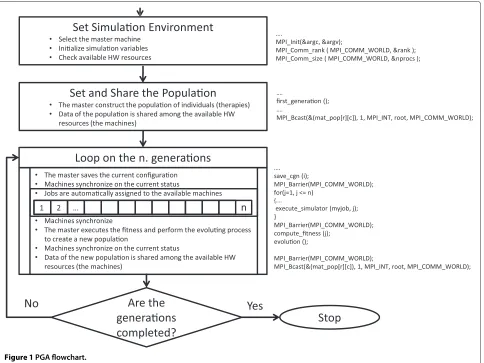
According to the parallel computing approaches described in the previous section, the parallel version of the GA (PGA) can be implemented as shown in Figure 1. Due to the nature of this algorithm, the MPI technology was used as it offers a complete set of library for the auto-matic distribution of the work loads to the pool of the machines available and the synchronization of the parallel jobs. When adopting the MPI protocol all the machines involved receive the same piece of code but, thanks to the function of the MPI library, they can run selected parts of it. In particular, MPI functions permit to automatically define a machine as the master which is in charge to execute the sequential parts of the code and configure all the simulation environment(see the operations sketched in the Set Simulation Environment); moreover the MPI functions will detect all the other resources allowing the master machine to synchronize them with the simulation data to use for the parallel jobs.
For what concerns our PGA, as it is shown in Figure 1, the algorithm consists of the following sequential steps
• Set Simulation Environment and Set and Share the Population, for the configuration and the
synchronization of the machines and
• a pure parallel segment of code inside theLoop on the n. generations where the discovered available resources are automatically configured to run assigned pieces of simulation (execute simulator) in parallel.
their computations synchronized, the Master collects and organizes these results in order to compute the fitness function and start the process of evolution for the enhancement of the population. The pro-cess will continue until the number of generations over.
Once parallelism is incorporated into the GA, signif-icant amounts of time can be saved. These results are significant also from a biological point, both in terms of time, mice and costs perspectives; they can be appreci-ated looking Table 1: the virtual laboratory implemented permitted to enlarge the number of therapies from 16 to 128, showing that it was possible to test a large amount of vaccine schedules within a reasonable period of time.
Results of PGA over MPI
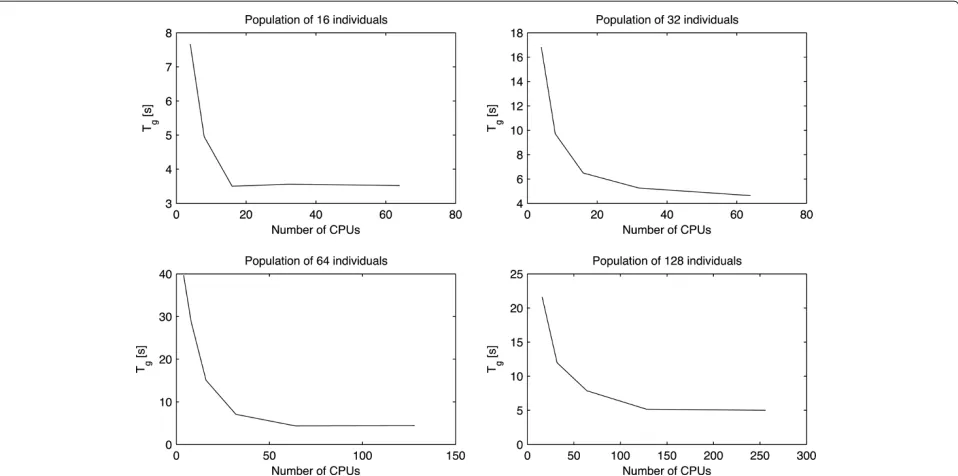
Figure 2 depicts the results of the simulations of Table 1, providing other interesting insights; in fact, it shows the linear decreasing of theTg (the time needed to perform
one genetic algorithm generation), due to the usage of an increasing number of CPUs. These set of data were collected fixing the number of individuals of the pop-ulation (from 16 to 128) scaling the number of CPUs from 4 to 256. For instance, let us to consider the top frame on the left of Figure 2, corresponding to the sim-ulations of the PGA with 16 individuals; according to the results of Table 1, the time to perform one genera-tion using 4 CPUs is about 7.66 minutes and doubling the number of CPUs to 8 the time needed decreases to 4.95 minutes. Again, if we double to 16 the number of CPUs the time ofTgkeeps lowering to 3.5 minutes, con-firming that it follows a negative slope typical of a linear function.
The same trend appears also looking at the other graph-ics and help to observe that the slopes of the curves become tinier to a threshold which indicates the lower bound for anyTg(from 16 to 128 individuals), no matter the number of CPUs exploited. This result does not have to surprise and suggests some important considerations; in fact, on one side they confirm the effectiveness of the
Table 1 Running time over different number of processors and therapies
#CPU # of therapies time per generation (mins)
4 16 7.667
8 16 4.955
16 16 3.503
32 16 3.560
64 16 3.525
4 32 16.824
8 32 9.715
16 32 6.488
32 32 5.261
64 32 4.639
4 64 39.663
8 64 28.804
16 64 15.069
32 64 7.072
64 64 4.345
128 64 4.486
16 128 21.591
32 128 11.975
64 128 7.862
128 128 5.158
256 128 4.997
The number of virtual mice are always set to 8
approach, showing the way how acting on the number of CPUs it is possible to scale linearly the time of computa-tion but, above all, they reveal what is the bottleneck of the algorithm beyond which the increasing of CPUs do not improve the performance of the computation. This limit is related to the contribute of
1. the waiting time due to the operations of synchronization among the CPU slaves and 2. the time of computation performed by the master
CPU, at the beginning of a new generation, for the construction of the new individuals of the PGA population (the vaccine schedules).
As it is highlighted in Table 1 this limit tends to increase from about 3.5 minutes for 16 individuals (using up to 16 CPUs) to 5 minutes for 128 individuals (using up to 128 CPUs). The reason why it cannot be lowered is that the operations of evolutions for theithgeneration (i.e., the updating of new individuals at the beginning of a genera-tion, typical of a genetic algorithm) cannot be parallelized and have to be performed always by the master CPU, once it has collected all the resulting data of the(i−1)th genera-tion coming from the slave CPUs; this result is highlighted
in Figure 3, showing how the time for the master CPU to process a new genetic population tends to increase with the number of individuals.
Discussion and Conclusions
Optimization theory has a long tradition and the tech-niques are numerous. Most of the practical problems in physics, engineering and applied mathematics can be formulated as optimization problems. From this perspec-tive the search for an optimized therapeutic protocol for the administration of a vaccine is no exception. In this article we have tried to show how this search for the best vaccine administration in terms of dosage and tim-ings can be formulated as an optimization problem and then, how it can be solved using well-known well known artificial intelligence methodologies over supercomputing infrastructures.
The quality of the optimized protocol is strictly related to the goodness of the model. In particular the direct or indirect effects of the therapeutic agents on the malig-nancy need to be carefully taken into account since the optimization algorithms rely on a scoring method that price the solutions on the basis of their effects. Having this said, it appears clear that the more sophisticated and detailed the model is, the higher the chances to obtain an efficacious effect of the optimized therapy once it goes to the test bed.
We started from a real question: is it possible to reduce the number of Triplex vaccine administrations and maintain a high preventive efficacy? This is a typi-cal clinitypi-cal question that. The work we have described in this article showed that modeling is a concrete tool for study of cancer immunopreventive strategies and there-fore can help in answering that question in the biomedical world.
From the biomedical point of view, the main outcomes of the suggested protocol, after its long term in vivo valida-tion, can be summarized as following. As predicted in sil-ico, many vaccinations of the Chronic protocol are redun-dant and can be avoided. A rapid priming of young mice is required for long-term protection from tumor onset, and the accuracy of mathematical modeling of early immune responses is critical. Finally, the model should take into account the ageing of the immune system. As presented in [11], the protocol of vaccination should be revised in the elderly hosts.
Figure 2Results of the simulations of Table 1.It shows the linear decreasing of theTg(time expressed in minutes) due to the usage of an increasing number of CPUs. These set of data were collected fixing the number of individuals of the population (from 16 to 128) scaling the number of CPUs from 4 to 256.
a master-slave approach that allowed us to have a good linearity scaling, optimizing the use of the available CPUs. Parallel computing was successfully applied in drug optimization, leading to the development of a real virtual lab to analyze and optimize vaccine protocol administra-tions.
It is worth to mention that, in the view of real possi-ble applications in biomedical informatics, for example in hospitals, it is unlikely that clinics or hospitals own HPC
Figure 3Time (in minutes) for the master CPU to process a new genetic population; it tends to increase with the number of individuals.
infrastructure dedicated to a virtual lab. However nowa-days computer science technology advances created HPC systems (think about multi-cores computers) that can fit in a doctor’s room.
To conclude, we can not forget what is the other side of the coin. Models are simplifications of reality and as a such can leave apart important aspects of the phenomenon under study. A good model needs to be based on clinical or preclinical data and its improvement needs to make use of available clinical and preclinical testing of predicted data. Only through a carefully checked adherence with reality we can hope that our model produces useful meaningful biological knowledge. Perhaps not perfectly accurate but at least instructive.
Competing interests
The authors declare that they have no competing interests.
Authors’ contributions
CC & FP developed the MPI architecture and wrote the code. FC makes the in silico experiments and performed the benchmarks. FP supervised the project. All authors read and approved the final manuscript.
Acknowledgements
We would like to thank Prof. Salvatore Cavalieri for his useful help in revising this paper. We thank CINECA consortium for the use of high performance computing infrastructure.
Author details
1CINECA, Bologna, Italy.2University of Catania, Catania, Italy.
References
1. Castiglione F, Motta S, Pappalardo F, Pennisi M:A modeling framework for immune-related diseases.Math Modell Nat Phenom2012,7(3):40–48. 2. Agur Z:Biomathematics in the development of personalized
medicine in oncology.Future oncology2006,2(1):39–42.
3. Pappalardo F, Palladini A, Pennisi M, Castiglione F, Motta S:Mathematical and computational models in tumor immunology.Math Modell Nat Phenom2012,7(3):186–203.
4. Alemani D, Pappalardo F, Pennisi M, Motta S, Brusic V:Combining cellular automata and lattice boltzmann method to model multiscale avascular tumor growth coupled with nutrient diffusion and immune competition.J Immunological Methods2012,376:55–68. 5. Pappalardo F, Lollini PL, Castiglione F, Motta S:Modeling and
simulation of cancer immunoprevention vaccine.Bioinformatics2005, 21(12):2891–2897.
6. Pappalardo F, Forero IM, Pennisi M, Palazon A, Melero I, Motta S:Simb16: modeling induced immune system response against
b16-melanoma.PLoS ONE2011,6:10: e26523. doi:10.1371/journal.pone.0026523 .
7. Pappalardo F, Halling-Brown MD, Rapin N, Zhang P, Alemani D, Emerson A, Paci P, Duroux P, Pennisi M, Palladini A, Miotto O, Churchill D, Rossi E, Shepherd AJ, Moss DS, Castiglione F, Bernaschi M, Lefranc MP, Bruna S, Motta S, Lollini PL, Basford KE, Brusic V:Immunogrid, an integrative environment for large-scale simulation of the immune system for vaccine discovery, design and optimization.Briefings in Bioinf2009, 10(3):330–340.
8. Pennisi M, Catanuto R, Pappalardo F, Motta S:Optimal vaccination schedules using simulated annealing.Bioinformatics2008, 24(15):1740–1742.
9. Halling-Brown M, Pappalardo F, Rapin N, Zhang P, Alemani D, Emerson A, Castiglione F, Duroux P, Pennisi M, Miotto O, Churchill D, Rossi E, Moss DS, Sansom CE, Bernaschi M, Lefranc MP, Brunak S, Lund O, Motta S, Lollini PL, Murgo A, Palladini A, Basford KE, Brusic V, Shepherd AJ:Immunogrid: towards agent-based simulations of the human immune system at a natural scale.Philos Trans Royal Soc A: Math, Phys Eng Sci2010,
368(1920):2799–2815.
10. Pennisi M, Pappalardo F, Palladini A, Nicoletti G, Nanni P, Lollini PL, Motta S:Modeling the competition between lung metastases and the immune system using agents.BMC Bioinformatics2010,11(SUPPL. 7) doi:10.1186/1471-2105-11-S7-S13.
11. Palladini A, Nicoletti G, Pappalardo F, Murgo A, Grosso V, Stivani V, Ianzano ML, Antognoli A, Croci S, Landuzzi L, De Giovanni C, Nanni P, Motta S, Lollini PL:In silico modeling and in vivo efficacy of cancer-preventive vaccinations.Cancer Res2010,70(20):7755–7763. 12. Abbas AK, Litchman AH, Pillai S:Cellular and molecular immunology. 7th
Edn. Philadelphia, PA, USA: Elsevier; 2011 .
13. Cavallo F, De Giovanni C, Nanni P, Forni G, Lollini PL:2011: the immune hallmarks of cancer.Cancer Immunol Immunother2011,60:319–326. 14. Dunn GP, Old LJ, Schreiber RD:The immunobiology of cancer
immunosurveillance and immunoediting.Immunity2004,21:137–148. 15. Finn OJ:Cancer immunology.N Eng J Med2008,358:2704–2715. 16. Lollini PL, Cavallo F, Nanni P, Forni G:Vaccines for tumour prevention.
Nat Rev Cancer2006,6(3):204–216.
17. Nanni P, Nicoletti G, De Giovanni C, Landuzzi L, Di Carlo E, Cavallo F, Pupa SM, Rossi I, Colombo MP, Ricci C, Astolfi A, Musiani P, Forni G, Lollini PL: Combined allogeneic tumor cell vaccination and systemic interleukin 12 prevents mammary carcinogenesis in her-2/neu transgenic mice.J Exp Med2001,194(9):1195–1205.
18. Novellino L, Castelli C, Parmiani G:A listing of human tumor antigens recognized by t cells.Cancer Immunol Immunother2005,54:187–207. 19. Lollini PL, Nicoletti G, Landuzzi L, Cavallo F, Forni G, De Giovanni C, Nanni
P:Vaccines and other immunological approaches for cancer immunoprevention.Curr Drug Targets2010,12:1957–1973.
20. Slamon DJ, Godolphin W, Jones LA, Holt JA, Wong SG, Keith DE, Levin WK, Stuart SG, Udove J, Ullrich A:Studies of the her-2/neu protooncogene in human breast and ovarian cancer.Science1989,244:707–712. 21. Ursini-Siegel J, Schade B, Cardiff RD, Muller WJ:Insights from transgenic
mouse models of erbb2-induced breast cancer.Nat Rev Cancer2007, 7:389–397.
22. De Giovanni C, Nicoletti G, Landuzzi L, Astolfi A, Croci S, Comes A, Ferrini S, Meazza R, Iezzi M, Di Carlo E, Musiani P, Cavallo F, Nanni P, Lollini PL:
Immunoprevention of her-2/neu transgenic mammary carcinoma through an interleukin 12-engineered allogeneic cell vaccine. Cancer Res2004,64(11):4001–4009.
23. Nanni P, Nicoletti G, Palladini A, Croci S, Murgo A, Antognoli A, Landuzzi L, Fabbi M, Ferrini S, Musiani P, Iezzi M, De Giovanni C, Lollini PL:
Antimetastatic activity of a preventive cancer vaccine.Cancer Res 2007,67:11037–11044.
24. Bianca C, Pennisi M:The triplex vaccine effects in mammary carcinoma: a nonlinear model in tune with simtriplex.Nonlinear Analysis: Real World Applications2012,13:1913–1940.
25. Bianca C, Pennisi M, Motta S, Ragusa MA:Immune system network and cancer vaccine.InInternational Conference on Numerical Analysis and Applied Mathematics: Numerical Analysis and Applied Mathematics, ICNAAM 2011, volume 1389, AIP Conference Proceedings; 2011:945–948.
26. Lollini PL, Motta S, Pappalardo F:Modeling tumor immunology.Math Models & Methods Appl Sci2006,16(7S):1091–1124.
27. Mitchell M:An Introduction to Genetic Algorithms. Boston, USA: The MIT Press; 1996.
28. Goldberg DE:A comparative analysis of selection schemes used in genetic algorithms, Foundations of Genetic Algorithms. San Mateo, California, USA: Morgan Kaufmann; 1991.
29. Corne D, Dorigo M, Glove F:New ideas in optimization. McGraw-Hill: Advanced Topics in Computer Science; 1999.
30. Pappalardo F, Pennisi M, Castiglione F, Motta S:Vaccine protocols optimization: In silico experiences.Biotechnol Adv2010,28(1):82–93.
doi:10.1186/1472-6947-12-129
Cite this article as:Calonaciet al.:Optimal vaccination schedule search using genetic algorithm over MPI technology.BMC Medical Informatics and Decision Making201212:129.
Submit your next manuscript to BioMed Central and take full advantage of:
• Convenient online submission
• Thorough peer review
• No space constraints or color figure charges
• Immediate publication on acceptance
• Inclusion in PubMed, CAS, Scopus and Google Scholar
• Research which is freely available for redistribution