S T U D Y P R O T O C O L
Open Access
Exploring multi-level system factors
facilitating educator training and
implementation of evidence-based
practices (EBP): a study protocol
Aubyn C. Stahmer
1,3,4,5*, Jessica Suhrheinrich
2,5, Patricia L. Schetter
1,4and Elizabeth McGee Hassrick
6Abstract
Background:This study examines how system-wide (i.e., region, district, and school) mechanisms such as leadership support, training requirements, structure, collaboration, and education affect the use of evidence-based practices (EBPs) in schools and how this affects the outcomes for students with autism spectrum disorder (ASD). Despite growing evidence for the positive effects of EBPs for ASD, these practices are not consistently or effectively used in schools. Although special education programs are mandated to use EBPs, there are very few evidence-based methods for selecting, implementing, and sustaining EBPs. Research focuses primarily on teacher training, without attention to contextual factors (e.g., implementation climate, attitudes toward EBPs, resource allocation, and social networks) that may impact outcomes. Using an implementation science framework, this project will prospectively examine
relations between system-wide factors and teachers’ use of EBPs and student education outcomes.
Methods/design:Survey data will be collected from approximately 85 regional special education directors, 170 regional program specialists, 265 district special education directors, 265 behavior specialists, 925 school principals, 3538 special education teachers, and 2700 paraprofessionals. Administrative data for the students with ASD served by participating teachers will be examined. A total of 79 regional-, district-, and school-level personnel will also participate in social network interviews. Mixed methods, including surveys, administrative data, and observational checklists, will be used to gather in-depth information about system-wide malleable factors that relate to positive teacher implementation of EBPs and student outcomes. Multi-level modeling will be used to assess system-wide malleable factors related to EBP implementation which will be linked to the trainer, teacher, and student outcomes and examined based on moderators (e.g., district size, Special Education Local Plan Area structure, teachers’ASD experience). Finally, a dynamic social network approach will be used to map EBP-related connectivity across all levels of the system for selected regions. Dynamic network analysis will be used to gauge the degree to which and ways that EBP trainings, resources, and interventions are shared (or not shared) among school staff.
Discussion:Results are expected to inform the development of system-wide interventions to improve the school-based implementation of EBPs for students with ASD.
Keywords:Multi-level system factors, Special education, Autism, Evidence-based practices, Implementation, Teacher training
* Correspondence:[email protected] 1
University of California, Davis MIND Institute, 2825 50th St, Sacramento, CA 95819, USA
3Department of Psychiatry and Behavioral Sciences, University of California, Davis, Sacramento, USA
Full list of author information is available at the end of the article
Background
The Centers for Disease Control (CDC) estimates that 1 in 68 children have an autism spectrum disorder (ASD; [1]). Long-term outcomes for this population are poor [2–5], and the annual cost in the USA is estimated to be $268 billion [6]. The service system accessed most often for school-age children with ASD is education (Brook-man-Frazee, Baker-Ericzen, Stahmer, Mandell, Haine, and Hough [7]). The number of children with ASD served by schools has grown fivefold from 93,000 in 2000 to 455,000 in 2011. The education system is res-ponsible for targeting a wide range of needs that interfere with a child’s ability to benefit from general education including improving learning skills such as attention and engagement and core symptoms of ASD.
The federal legislation known as “Every Child Suc-ceeds,” passed in 2015 [8], and the Individuals with Dis-abilities Education Act [9], both specify that the practices used in schools must be those supported by scientifically based evidence. Additionally, specific evidence-based practices (EBPs) for ASD have been identified for school personnel [10–13]. However, research indicates a large gap between research and school practices [14] with EBP for ASD not being routinely used in schools [15, 16]. Simi-lar to gaps in education, generally in ASD, teachers and other school-based providers can learn to use EBPs when trained by experts [17] but do not typically in-corporate EBPs into school-based programs over the long term [18–20]. This is problematic because chil-dren with ASD show significant gains when they re-ceive services implemented with high fidelity and when schools do not use interventions with proven efficacy; the courts can require them to provide costly alterna-tives, such as increased one-to-one intervention or placement in a private school [21, 22].
Scaling up interventions across multiple schools, dis-tricts and statewide present an additional challenge. Most state systems have a very limited capacity for scal-ing up interventions in ways that lead to meanscal-ingful im-provements in outcomes for students [23]. Based on the research in mental health systems, it is clear that facilita-tion of effective EBP use requires leadership coordin-ation and support at the school, district, and state levels; however, leaders at each of these levels have a very lim-ited understanding of the factors beyond their immedi-ate locale, such as system-wide policies and support, that may lead to gaps in the use of EBP in special educa-tion. While recent systematic reviews and meta-analyses of care coordination consistently report differences (of a moderate to medium effect size) in outcomes of mental health intervention and physical conditions management programs when collaborative practices within systems are compared to usual care [24–26], the “active ingredi-ents” that allow for systematic implementation of
coordinated care across systems remain obscure. There are critical gaps in evidence about the structure, func-tion, and benefits of team coordination across multiple systems.
School-based service for special education involves a team of providers and administrators to account for the complexity of care needed for this population of stu-dents. For example, California has 1028 school districts divided into 122 regional consortiums for the purpose of providing for all special education service needs of chil-dren in the regions. TheseSpecial Education Local Plan
Areas (SELPAs) work alongside school district staff to
meet the children’s educational and mental health needs. They offer varying levels of support and structure from taking an active role in effective implementation of EBPs by providing autism specialists to support training and implementation to simply providing oversight for com-pliance. High-level administrators at the SELPA and school district levels are responsible for the provision of educational and associated programming, including staffing allocation, curricula, and use of resources. Ad-ministrators report that scientific evidence does not readily affect their programming decisions [27]. Admin-istrators at both the district and SELPA level likely have a strong influence on the culture and climate related to the use of EBP as well as resource allocation for training, materials, and supervision in the use of new practices. Of course, principals play an important role in the lead-ership of an individual school site. However, only a small percentage of principals was special educators prior to their administrative roles and have limited professional training in special education [28]. Additionally, prelimin-ary data indicate teachers and other high-level school district staff perceive special education directors, mid-level specialists, and teachers as key decision-makers across phases of implementation for ASD programs as compared to school site principals [29]. Teachers and paraprofessionals are front-line EBP users. They are the ones to adapt and modify practices and to determine the use. At each level of administration, resource allocation, implementation climate, education, experience with ASD, attitudes toward EBP, and collaboration have the potential to affect EBP use. Therefore, systems and pro-cesses at multiple levels must be considered for imple-mentation in special education.
Conceptual model
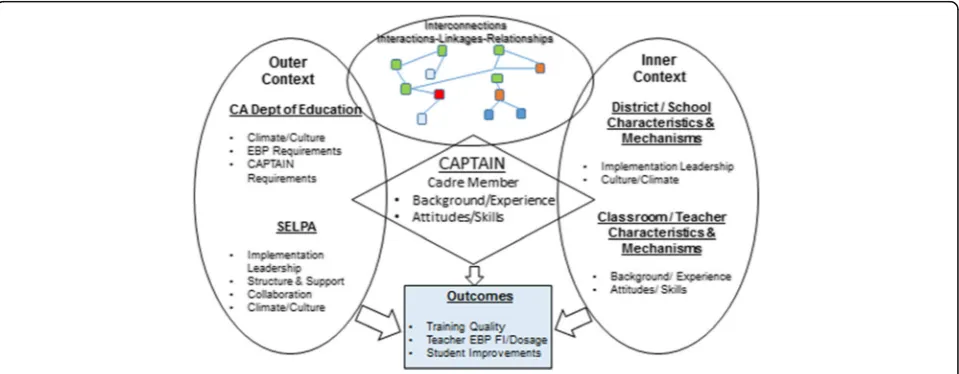
examining cross-level mechanisms linking specific imple-mentation interventions to targeted changes in provider behaviors [31]. We apply the Exploration, Preparation, Implementation, and Sustainment (EPIS) model [32] (see Fig. 1) to frame the proposed exploratory study of facili-tators and barriers to implementing statewide teacher training in EBP. EPIS was developed for a public child ser-vices context and integrates a multi-level framework to highlight factors influencing implementation, including outer (e.g., state and SELPA level climate and culture, leadership, and structure) and inner (e.g., leadership, teacher characteristics) contexts, and social connections within and among system levels. We will use this frame-work and a current implementation effort (CAPTAIN, see below) to explorecross-context malleable factorsand their potential influence on teacher training in EBP and student outcomes.
Data from previous studies of EBP implementation out-comes from community effectiveness trials provide spe-cific direction on promising factors related to EPIS that can be leveraged within growing, large-scale translation efforts. Several possible malleable factors including im-plementation leadership and climate, district-/SELPA-level resources and support, teacher attitudes toward EBP and teacher/paraprofessional skills, and social connections are associated with successful implementation [33, 34].
Implementation leadership can improve the climate for use of EBP [35]. Additionally, a clear relationship be-tween organizational culture and climate and child-level outcomes has been identified in educational settings for ASD [36]. Positive implementation climate coupled with
the use of support strategies (training availability, on-going monitoring of performance, etc.) has been linked to better sustainment of innovation, improved child out-comes and decreased staff burnout [37], and predicted higher EBP fidelity [36]. Provider attitudes toward EBP have been linked to practice behavior [38, 39] and have been shown to predict use of EBP [32, 40, 41]. Finally, there is considerable evidence that team coordination, when done well, can change the outcomes [42]. Coor-dination impacts treatment quality [43] and goal attain-ment [44] for children with ASD. All of these factors may be important for EBP implementation in special education and may be points of intervention to improve outcomes.
Current California implementation and scale up efforts The California Department of Education—Special Schools Division participated in a project sponsored by the National Professional Development Center for Aut-ism Spectrum Disorders (NPDC-ASD, 2009). As part of their implementation plan, the state developed the Cali-fornia Autism Professional Training and Information Network(CAPTAIN), a collaboration of service providers from three statewide support agencies: Special Education Local Plan Areas (SELPAs), California Regional Centers (RCs), and Family Resource Centers (FRCs). The goal was to establish a training and technical assistance net-work for service providers with a focus on EBP for ASD. CAPTAIN was established in 2012 and currently has over 400 members. A majority of members (77%) are SELPA/school district personnel from across California.
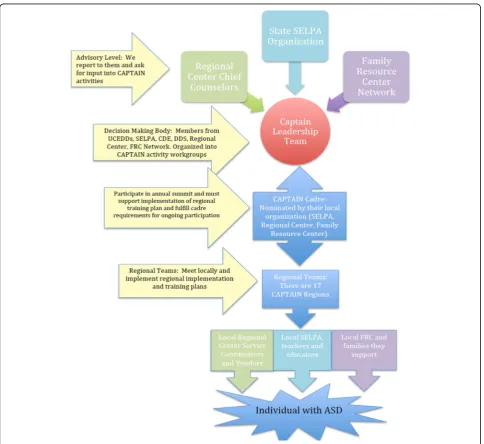
A leadership team of cross-agency representatives guides the training and support efforts of the organization (see Fig. 2 and http://www.captain.ca.gov for more informa-tion about CAPTAIN). CAPTAIN cadre members from each SELPA commit to provide a certain amount of training to teachers in their areas each year and to at-tend an annual conference on EBP. Preliminary data in-dicate successful outcomes in terms of increasing the frequency of training [45]; however, there is variability in the amount and types of training provided, and no
data are available regarding teacher or student out-comes. Additional data are needed to understand sys-tem- and educator-level factors that lead to successful implementation to maximize CAPTAIN efforts. Tar-geted exploration of the statewide CAPTAIN model as a platform for professional development will contribute to the limited data on how system-level practices affect school-based intervention and student outcomes not only for students with ASD but for all served by special education programs.
Research objectives (see Fig. 3)
1) Measure system-level factors that may relate to the teacher and student outcomes such as implementation climate and culture, communication and collaboration, and EBP readiness.
2) Measure the special education teacher outcomes (EBP training received, fidelity of implementation, dosage, and knowledge of EBP) and ASD student outcomes (time spent in the least restricted environment (LRE), disciplinary action, attendance, and IEP progress)
3) Measure potential moderation variables across three levels: SELPA/district (size, geography, structure), school (implementation leadership, attitudes toward EBP), and teacher (background, experience, attitudes toward EBP, climate)
4) Use innovative social network methodology to examine how collaboration across the multi-level system affects outcomes.
5) Assess moderation of system-level factors on CAPTAIN trainer outcomes (amount of time spent training, coaching, supporting trained staff ), teacher outcomes (EBP fidelity of implementation, dosage, EBP knowledge) use, and student outcomes (LRE, IEP progress, discipline/behavior, attendance).
Methods/design Study design
This exploratory study will use mixed methods that in-clude primary data collection from authentic educational settings at the SELPA, district, and school level and will access administrative student data. Components include a collection of multi-level survey data, student outcome administrative data, and in-depth interviews to conduct a social network analysis in a subset of programs.
Participants and recruitment strategy
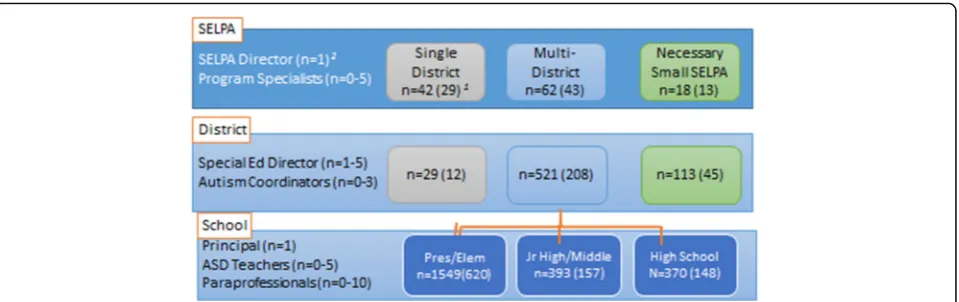
Our sample will include administrators and providers at multiple levels with data collected in a cascading format (see Fig. 4). We anticipate the participants will include SELPA directors (n= 85), SELPA program specialists (n
= 170), district special education directors (n= 265), school principals (n= 925), autism specialists/coordina-tors (n= 265), special education teachers (n= 1375 par-ticipants), and paraprofessionals (n= 2700 participants). We anticipate a total of approximately 5700 participants. The CAPTAIN cadre member will be included in their home SELPA/district and will also complete the CAP-TAIN survey and some additional information if they have a role as a trainer.
Students: Inclusionary criteria for students include (1) enrollment in a participating classroom and (2) a pri-mary educational classification of ASD. De-identified data for students in a particular district will be provided by the SELPA/district directors to the research team. Data will not be linked to specific students.
Survey data collection. We will use a web-based plat-form for survey distribution, and it will be available for completion over a 3-month period. The estimated re-sponse rate is 70% for SELPA directors and 50% of dis-tribution for all other populations [46]. SELPA directors will be contacted at their monthly state directors meet-ing and asked to complete the surveys. Directors will nominate all program specialists and special education directors from each district in their SELPA. Special edu-cation directors will give all autism/behavior coordina-tors and principals at elementary, K-12, middle, and high school campuses study information, and in turn, prin-cipals will provide information to their special education teachers and paraprofessionals serving children with ASD. CAPTAIN cadre members (trainers) will complete the surveys at an annual CAPTAIN conference, by phone or online. The research team will work with special education
directors to distribute surveys and answer questions about the project. Weekly follow-up emails will be made to any-one who has not yet completed the survey to answer any questions and facilitate survey completion.
Measures
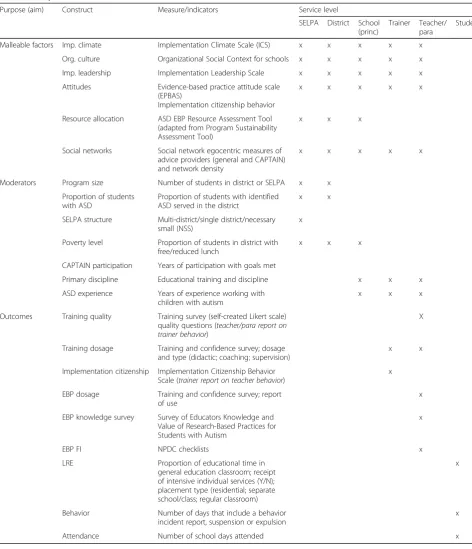
We have chosen measures based on the literature indi-cating system-level malleable factors that affect imple-mentation success. Table 1 lists the study measures and who will complete each measure. CAPTAIN cadre trainers will complete a set of measures, and student data will be obtained from appropriate state and district databases. Many of the implementation measures have multiple (slightly modified) versions for paraprofes-sionals, teachers, principals, and administrators.
Malleable factors
Implementation and Attitudes. The Implementation
Climate Scale (ICS; [47] as adapted by Lyon, Cook,
Locke, Ehrhart, and Aarons) measures employees’ shared perceptions of the policies, practices, proce-dures, and behaviors that are expected, rewarded, and supported in order to facilitate effective EBP implemen-tation. Organizational culture will be measured using
the Organizational Social Context (OSC [48]) for
schools which assesses organizational culture, climate, and work attitudes. The Implementation Leadership
Scale (ILS; [49] as adapted by Lyon, Cook, Locke,
Ehrhart, and Aarons) includes four subscales that assess the degree to which a leader is knowledgeable, support-ive, proactsupport-ive, and perseverant in implementing EBP. Participants will rate the leadership of the person at the next level (e.g., teachers will rate principals, paraprofes-sionals will rate teachers, trainers and special education directors will rate SELPA leader, principal will rate dis-trict leaders). Each leader will also rate themselves. Staff attitudes will be measured using The evidence-based practice attitude scale(EBPAS; [40] as adapted by Lyon, Cook, Locke, Ehrhart, and Aarons) that assesses four general attitudes toward adoption of EBIs: appeal, re-quirements, openness, and divergence.
Resource allocation. Resources for use of EBP for stu-dents with ASD will be measured using the ASD EBP
Resources Assessment Tool which has been adapted
from the Program Sustainability Tool v.2; 2013. The survey asks about environmental support from internal (e.g., district leadership) and external (public) sources, funding stability, organizational capacity to implement the practices, program evaluation methods, and pro-gram adaptation.
Collaboration and social network: Survey participants will report on the top five people they seek out for advice about EBP, their roles and how much their EBP advice network members talk with one another. The egocentric methods we propose for the CAPTAIN study are based on standard industry approaches, used Fig. 4Estimated participation across levels. Illustrates the identified sample. At the SELPA level, our goal is 70% participation with representation from at least 30 of the 42 single district SELPAs, 13 of the 18 necessary small SELPAs (NSS; all multi-district), and 43 of the 62 multi-district SELPAs for a total of 85 SELPA directors surveyed. Participating SELPA directors in multi-district SELPAs will be asked to distribute study information to district directors of special education/student services. SELPA directors will invite their program specialists. We anticipate a 40% response rate at each of the subsequent levels. District special education directors will be asked to distribute study information to all of their autism/behavior coordinators and principals/site administrators at elementary, middle, and high schools (including special education schools and preschools), who will then distribute to each special education teachers and paraprofessional educators serving children with ASD within their district. There are on average 8.6 schools per district. Principals will then invite each special education teacher (including resource specialists) and paraprofessionals serving children with ASD. This will vary by district as well as by student enrollment; however, there are approximately 3.7 special education teachers and 5.8 paraprofessional educators per school across the state. CAPTAIN cadre member trainers will be included in their home SELPA/district and will also complete some additional information if they have a role as a trainer.1Estimated number of people invited (estimated number participating); 2
routinely in publications over the past 40 years for sev-eral major social science survey work, including the NSF-funded General Social Survey (1985–2014), the Na-tional Longitudinal Study of Adolescent to Adult Health (1994–2008), and the National Social Life, Health, and Aging Project (2005–2015).
Moderators
Program size(measured by the number of students in each SELPA and district),the proportion of students with ASD in each district, andthe proportion of students with free and reduced lunchwill be obtained using the most recent data from the California Department of Education.SELPA
Table 1Study measures and timeline
Purpose (aim) Construct Measure/indicators Service level
SELPA District School (princ)
Trainer Teacher/ para
Student
Malleable factors Imp. climate Implementation Climate Scale (ICS) x x x x x
Org. culture Organizational Social Context for schools x x x x x
Imp. leadership Implementation Leadership Scale x x x x x
Attitudes Evidence-based practice attitude scale (EPBAS)
Implementation citizenship behavior
x x x x x
Resource allocation ASD EBP Resource Assessment Tool (adapted from Program Sustainability Assessment Tool)
x x x
Social networks Social network egocentric measures of advice providers (general and CAPTAIN) and network density
x x x x x
Moderators Program size Number of students in district or SELPA x x
Proportion of students with ASD
Proportion of students with identified ASD served in the district
x x
SELPA structure Multi-district/single district/necessary small (NSS)
x
Poverty level Proportion of students in district with free/reduced lunch
x x x
CAPTAIN participation Years of participation with goals met
Primary discipline Educational training and discipline x x x
ASD experience Years of experience working with children with autism
x x x
Outcomes Training quality Training survey (self-created Likert scale) quality questions (teacher/para report on trainer behavior)
X
Training dosage Training and confidence survey; dosage and type (didactic; coaching; supervision)
x x
Implementation citizenship Implementation Citizenship Behavior Scale (trainer report on teacher behavior)
x
EBP dosage Training and confidence survey; report of use
x
EBP knowledge survey Survey of Educators Knowledge and Value of Research-Based Practices for Students with Autism
x
EBP FI NPDC checklists x
LRE Proportion of educational time in
general education classroom; receipt of intensive individual services (Y/N); placement type (residential; separate school/class; regular classroom)
x
Behavior Number of days that include a behavior incident report, suspension or expulsion
x
structurewill be coded as (1) multi-district; (2) single dis-trict; or (3) necessary small SELPA (NSS). The level of
CAPTAIN participationwill be defined by the number of
years the SELPA has had a participating cadre member who has met the stated CAPTAIN training goals.Primary discipline is defined as the primary educational discipline as reported by the participant.
ASD experience will be the reported number of years
the participant has been working with students with ASD, in any capacity.
Outcomes
The training survey will include information about the
training quality as rated by the teachers receiving the
training. Training dosage will include the amount of training time provided for didactic training, coaching (practice with feedback), and ongoing supervision. The
Implementation Citizenship Behavior Checklist (ICBC;
[50] as adapted by Lyon, Cook, Locke, Ehrhart, and Aarons) assesses, via trainer rating, the behaviors educa-tors perform that exceed their expected job tasks to sup-port the implementation of EBP. EBP dosage will be measured using the classroom practice indicator [51] which has the teacher rate each practice for how often the practice is used during an average school day. The
Survey of Educators Knowledge and Value of
Research-Based Practices for Students with Autism [52] assesses
the current level of knowledge and value regarding spe-cific EBP. For each practice, the teachers/parapro-fessional participants indicate frequent usage on the
classroom practice indicatorthey will receive a fidelity of implementation form from the National Professional De-velopment Center Autism.Student outcome datawill be gathered through the California Special Education Man-agement Information System (CASEMIS). The 2015– 2016 student-level database contains student-level data relevant to this project including demographics, place-ment type and setting, attendance and behavior reports, and suspensions and expulsions. Data will be collected on attendance, the proportion of educational time the student spends in a general education classroom, num-ber of disciplinary referrals made, numnum-ber of behavior incident reports filed, and/or the number of days student was suspended or expelled from school.
Statistical analysis plan
We will begin by examining the independent associa-tions between each malleable factor and the trainer, teacher, and student outcome variables. Based on these results, we will include the factors that have a significant relationship with each outcome in our final models. All models will be hierarchical/multi-level except single-level modeling for outcomes on trainers. More specific-ally, single-level linear models, binary logistic regression
models, multinomial logistic models, and ordinal logistic models (proportional odds models) will be used for modeling continuous, binary, nominal categorical, and ordinal categorical outcomes, respectively, on the trainers. A four-level model will be used for the teacher outcome variables. A five-level model will be used for the student outcome variables. For models with dichot-omous outcome variables (i.e., least restrictive environ-ment, intensive individual services), a multi-level binary logistic regression model will be used. For all other models, multi-level linear models will be utilized for continuous outcomes. Multi-level multinomial logistic models will be employed for nominal categorical out-comes. Multi-level ordinal logistic models (multi-level proportional odds models) will be used for ordinal cat-egorical outcomes. Moderators will also be considered in the multi-level models as they relate to the outcomes.
Social network case study mapping the social dynamics of EBP implementation
We will use a dynamic social network approach to map EBP-related connectivity across all identified levels of the system for selected CAPTAIN cadre and their poten-tial collaborators participating the study [53, 54].
Participants: We will select two CAPTAIN cadre members, one high performing and one low performing, based on EBP fidelity and training intensity, from the three SELPA types for a total of six CAPTAIN cadre members. We will then identify and recruit potential collaborators for each of the six CAPTAIN cadre mem-bers from the SELPA (n= approximately 4 per SELPA), a randomly selected participating district associated with the SELPA (approximately one autism specialist), and two elementary schools (n= 10 staff per school) in the selected district for a total of 27 people per type of SELPA, for an overall total of about 81 people.
Social network measures: We will adapt a previously pilot-tested approach used to map thesocial dynamics of intervention(SoDI). The SoDI was successfully developed and piloted by McGhee Hassrick and colleagues [53, 54] in a previous NIH funded study (R21HD067865-01). The SoDI uses traditional social network analytics to map multiplex connectivity. The adapted SoDI will measure the density of three different person-to-person networks among people at the SELPA, district, school and class-room levels who are supporting and providing EBP in-tervention for children with ASD. Using descriptive analysis, we will compare the social networks of the high-performing cadres with those of the low-high-performing cadres, to determine how network configuration varies.
Data Analysis.We will use ORA software for dynamic
measures including EBP training, resources, and inter-vention use among school staff [55] to calculate patterns of alignment, using EBP exclusivity and EBP expertise measures. Once we have taken an inventory of EBP training, resources, and intervention activities, the im-pact that the CAPTAIN cadre has had on classroom practices can be more thoroughly assessed. These multi-nodal and multiplex inventories will help us to measure the system of EBP activities among school staff and their district and state partners. We can gauge the amount of social interaction people have with one another, and also the degree and ways EBP trainings, resources, and inter-ventions are shared or not shared, among school staff, including teachers, paraprofessionals, and principals.
Discussion
Identifying malleable factors that influence the imple-mentation of EBP across system levels for students with ASD will help policymakers and administrators make system-wide changes to positively impact teacher train-ing and effective use of EBP both for ASD and more generally. Characterization of malleable organizational factors with accompanying linkage to implementation and clinical outcomes is an innovative process with the potential to increase understanding of the mechanisms of action of system level implementation factors. The CAPTAIN statewide implementation effort provides a natural vehicle for examining facilitators and barriers to training and support for community providers. Out-comes will inform scale-up efforts for EBP implementa-tion broadly and implementaimplementa-tion science methods.
In addition, to our knowledge, no one has used formal social network analysis to capture multi-level collabor-ation among state-, district-, school-, and classroom-level stakeholders in the field of ASD. The proposed re-search will advance our scientific understanding of social determinants of treatment and outcomes for children with ASD and provide new conceptual tools for under-standing disparities in treatment and outcomes. The proposed study both compliments and redirects existing research by considering the configuration of the social networks of EBP supporters and providers across system levels, overcoming previous methodological barriers that constrain service research to only consider one level per study. In addition to new approaches in research, the proposed project provides the basis for new social net-work interventions in autism that strengthen the cap-acity of providers to work together to provide higher quality EBP for children with ASD.
Findings will add to the very limited research examin-ing cross-level mechanisms linkexamin-ing both inner and outer context factors to changes in provider behaviors [31] and to consumer outcomes. Data from this exploratory project will be used to develop an implementation
assessment intervention package that will address malle-able factors identified as important to the teacher and stu-dent outcomes. This project may provide a generalizable model for the development of multi-level implementation interventions across complex service settings.
Abbreviations
ASD:Autism spectrum disorder; CAPTAIN: California Autism Professional Training and Information Network; EBP: Evidence-based practice; EPIS: Exploration, Preparation, Implementation, and Sustainment
Acknowledgements
We would like to recognize the contributions of the CAPTAIN leadership team and supporting organizations including SELPAs, school districts, and the State Department of Education in the development and implementation of this project.
Funding
This study is funded through a grant from the Institute of Education Sciences, US Department of Education Grant: R324A140005. Dr. Jessica Suhrheinrich is also funded through an NIMH career development award K01MH109547. Patricia Schetter also receives funding to lead the CAPTAIN program from a HRSA Center for Excellence in Developmental Disabilities award: HHS-2016-ACL-AOD-DD-0121.
Drs. Stahmer and Suhrheinrich are investigators with the Implementation Research Institute (IRI), at the George Warren Brown School of Social Work, Washington University in St. Louis, through an award from the National Institute of Mental Health (R25 MH080916-01A2) and the Department of Veterans Affairs, Health Services Research and Development Service, Quality Enhancement Research Initiative (QUERI).
Availability of data and materials Not applicable
Authors’contributions
ACS, JS, and PLS conceived this evaluation study initially. ACS provided leadership and coordination in the development of the grant proposal, drafted and edited the final manuscript, and approved the final manuscript. JS contributed to the development of the grant proposal and provided substantial edits to the manuscript. EMH developed all aspects of the proposal and manuscript related to the social network procedures and data collections. PS participated in critically appraising the content of the manuscript. All authors read and approved the final manuscript.
Ethics approval and consent to participate
This project has been approved by the institutional review board of the University of California, Davis (1082466-2) and is being relied upon by San Diego State University, California State University, Channel Islands, and Drexel University.
Consent for publication Not applicable
Competing interests
The authors declare that they have no competing interests.
Publisher’s Note
Springer Nature remains neutral with regard to jurisdictional claims in published maps and institutional affiliations.
Author details
Institute, Drexel University, 3020 Market St, St 560, Philadelphia PA19104, USA.
Received: 15 November 2017 Accepted: 11 December 2017
References
1. Centers for Disease Control and Prevention (CDC). Prevalence of autism spectrum disorders—autism and developmental disabilities monitoring network, United States, 2010. Morb Mortal Wkly Rep. 2014;63(2) 2. Eaves LC, Ho HH. Young adult outcome of autism spectrum disorders.
J Autism Dev Disord. 2008;38(4):739–47.
3. Orsmond GI, Shattuck PT, Cooper BP, Sterzing PR, Anderson KA. Social participation among young adults with an autism spectrum disorder. J Autism Dev Disord. 2013;43(11):2710–9.
4. Roux AM, Shattuck PT, Cooper BP, Anderson KA, Wagner M, Narendorf SC. Postsecondary employment experiences among young adults with an autism spectrum disorder. J Am Acad Child Adolesc Psychiatry. 2013;52(9):931–9. 5. Shattuck PT, Narendorf SC, Cooper B, Sterzing PR, Wagner M, Taylor JL. Postsecondary education and employment among youth with an autism spectrum disorder. Pediatrics. 2012;129(6):1042–9.
6. Leigh JP, Du J. Brief Report: Forecasting the Economic Burden of Autism in 2015 and 2025 in the United States. J Autism Dev Disord. 2015;45(12):4135–9. 7. Brookman-Frazee L, Baker-Ericzen MJ, Stahmer AC, Mandell DS, Haine RA,
Hough RL. Involvement of youths with autism spectrum disorders or intellectual disabilities in multiple public service systesm. J Autism Dev Disord. 2009;2:201–19.
8. U.S. Government,“Every student succeeds act,”Congr. Rec., vol. 161, p. Public Law 114–195, 2015.
9. U. S. Department of Education. Individuals with Disabilities Education Improvement Act of 2004: U.S. Dep. Educ; 2004.
10. National Autism Center,“National Standards Report,”National Autism Center, Randolph, MA, 2009.
11. National Autism Center,“National Standards Report,”Randolph, MA, 2015. 12. Wong C, Odom SL, Hume KA, Cox AW, Fettig A, Kucharczyk S, Brock ME,
Plavnick JB, Fleury VP, Schultz TR. Evidence-based practices for children, youth, and young adults with autism spectrum disorder: a comprehensive review. J Autism Dev Disord. 2015;45(7):1951–66.
13. Odom SL, Boyd BA. Evaluation of comprehensive treatment models for individuals with autism spectrum disorders. J Autism Dev Disord. 2010;40(4):425–36.
14. Greenwood CR, Abbott M. The research to practice gap in special education. Teach Educ Spec Educ. 2001;24(4):276–89.
15. Stahmer A, Collings NM, Palinkas LA. Early intervention practices for children with autism: descriptions from community providers. Focus Autism Other Dev Disabil. 2005;20(2):66–79.
16. Mayton MR, Wheeler JJ, Menendez AL, Zhang J. An analysis of evidence-based practices in the education and treatment of learners with autism spectrum disorders. Educ Train Autism Dev Disabil. 2010;45(4):539–51. 17. Suhrheinrich J. Training teachers to use pivotal response training with
children with autism: coaching as a critical component. Teach Educ Spec Educ J Teach Educ Div Counc Except Child. 2011;34(4):339–49.
18. Cook BG, Landrum TJ, Tankersley M, Kauffman JM. Bringing research to bear on practice: effecting evidence-based instruction for students with emotional or behavioral disorders. Educ Treat Child. 2003;26:345–61. 19. Mandell DS, Stahmer AC, Shin S, Xie M, Reisinger E, Marcus SC. The role of
treatement fidelity on outcomes during a rancomized field trial of an autism intervention. Autism. 2013;17(3):281–95.
20. Suhrheinrich J, Stahmer A, Reed S, Schreibman L, Reisinger E, Mandell D. “Implementation challenges in translating pivotal response training into community settings”. J Autism Dev Disord. 2013.
21. N. R. Council and N. A. Press.“Educating children with autism,”National Research Council: Division of Behavioral and Social Sciences. Washington DC; 2001.
22. Kelman M. State disparitites in the diagnosis and placement of pupils with learning disabilities. J Learn Disabil. 1997;30(6):599–607.
23. Fixsen D, Blase K, Metz A, van Dyke M. Statewide implementation of evidence-based programs. Except Child. 2013;79(2):213–30.
24. Baumeister H, Hutter N. Collaborative care for depression in medically ill patients. Curr Opin Psychiatry. 2012;25:405–14.
25. Miller CJ, Grogan-Kaylor A, Perron BE, Kilbourne AM, Woltmann E, Bauer MS. Collaborative chronic care models for mental health conditions: cumulative meta-analysis and meta-regression to guide future research and implementation. Med Care. 2014;51(10):922.
26. Goodrich DE, Kilbourne AM, Nord KM, Bauer MS. Mental health collaborative care and its role in primary care settings. Curr Psychiatry Rep. 2013;15(8) 27. Honig MI, Coburn C. Evidence-based decision making in School District
Central Offices. Educ Policy. 2008;22(4):578–608.
28. Crockett JB. Special education’s role in preparing responsive leaders for inclusive schools. Remedial Spec Educ. 2002;23(3):157–68.
29. Suhrheinrich J, Dickson KS.“Mapping leadership structure in special education to tailor leadership intervention”. Paper presented at the Bi-Annual Conference of the Society for Implementation Reserach Collaboration; 2017. 30. Glisson C, Williams NJ. Assessing and changing organizational social contexts
for effective mental health services. Annu Rev Public Health. 2015;36(1):507–23. 31. Grol R, Bosch MC, Hulscher M, Eccles MP, Wensing M. Planning and studying
improvement in patient care: the use of theoretical perspectives. Milbank Q. 2007;85(1):93–138.
32. Aarons G, Hurlburt M, Horwitz SM. Advancing a conceptual model of evidnece-based practice implementation in public service sectors. Adm Policy Ment Heal Ment Heal Serv. 2011;38(1):4–23.
33. Stahmer AC, Brookman-Frazee L.“Testing a multi-level implementation model for translating evidence-based interventions fro ASD (TEAMS): methods and interventions”. Paper presented at the Bi-Annual Conference of the Society for Implementation Reserach Collaboration; 2017. 34. Lyon AR, Ludwig K, Romano E, Leonard S, Vander Stoep A, McCauley E. If
it’s worth my time, I will make the time’: school-based providers’ decision-making about participating in an evidence-based psychotherapy consultation program. Adm Policy Ment Heal Ment Heal Serv Res.
2013;40(6):467–81.
35. Aarons GA, Ehrhart MG, Farahnak LR, Hurlburt MS. Leadership and organizational change for implementation (LOCI): a randomized mixed method pilot study of a leadership and organization development intervention for evidence-based practice implementation. Implement Sci. 2015;10(11)
36. Dingfelder HE, Mandell DS. Bridging the research-to-practice gap in autism intervention: an application of diffusion of innovation theory. J Autism Dev Disord. 2011;41(5):597–609.
37. Novins DK, Green AE, Legha RK, Aarons GA. Dissemination and implementation of evidence-based practices for child and adolescent mental health: a systematic review. J Am Acad Child Adolesc Psychiatry. 2013;52(10):1009–1025. e18.
38. Casper ES. The theory of planned behavior applied to continuing education for mental health professionals. Psychiatr Serv. 2007;58(10):1324–9. 39. Henggeler SW, Chapman JE, Rowland MD, Halliday-Boykins CA, Randall J,
Shackelford J, Schoenwald SK. Statewide adoption and initial implementation of contingency management for substance-abusing adolescents. J Consult Clin Psychol. 2008;76(4):556–67.
40. Aarons G.“Mental health provider attitudes toward adoption of evidence-based practice: the evidence-evidence-based practice attitude scale (EPBAS)”. Ment Health Serv Res. 2004;6(2):61–74.
41. Reding MEJ, Chorpita BF, Lau AS, Innes-Gomberg D. Providers??? Attitudes toward evidence-based practices: is it just about providers, or do practices matter, too? Adm Policy Ment Heal Ment Heal Serv Res. 2014;41(6):767–76. 42. Onnela J-P, Waber BN, Pentland A, Schnorf S, Lazer D. Using sociometers to
quantify social interaction patterns. Sci Rep. 2014;4:1–8.
43. Ingersoll B, Dvortcsak A. Including parent training in the early childhood special education curriculum for children with autism spectrum disorders. J Posit Behav Interv. 2006;8(2):79–87.
44. Ruble LA, Dalrymple NJ, McGrew JH. The effects of consultation on individualized education program outcomes for young children with autism: the collaborative model for promoting competence and success. J Early Interv. 2010;32(4):286–301.
45. Suhrheinrich J, Dean M, Schetter P, Aspen A, Yasuda P. Statewide interagency collaboration to increase access to professional training in evidence-based practice. In: International Meeting for Autism Research; 2017.
46. Yun GW, Trumbo CW.“Comparative response to a survey executed by post, e-mail, & web form”. J Comput Commun. 2000;6(1).
48. Glisson C, Landsverk J, Schoenwald S, Kelleher K, Hoagwood KE, Mayberg S, Green P. Assessing the organizational social context (OSC) of mental health services: implications for research and practice. Adm. Policy Ment. Heal. Ment. Heal. Serv. Res. 2008;35(1–2):98–113.
49. Aarons GA, Ehrhart MG, Farahnak LR. The implementation leadership scale (ILS): development of a brief measure of unit level implementation leadership. Implement Sci. 2014;9:45.
50. Ehrhart MG, Aarons GA, Farahnak LR. Going above and beyond for implementation: the development and validity testing of the Implementation Citizenship Behavior Scale (ICBS). Implement Sci. 2015;10:65.
51. Hume K, Boyd B, McBee M, Coman D, Gutierrez A, Shaw E, Sperry L, Alessandri M, Odom S. Assessing implementation of comprehensive treatment models for young children with ASD: reliability and validity of two measures. Res Autism Spectr Disord. 2011;5(4):1430–40.
52. Williams CM, Fan W, Goodman G. Preliminary analysis of the‘survey of educators’knowledge and value of research-based practices for students with autism. Assess Eff Interv. 2010;36(2):113–30.
53. McGhee-Hassrick E, Carley K.“The Impact of School Design on Synchronizing Autism Interventions across Home and School”. Paper presented at the Society for Research in Child Development; 2015. 54. McGhee-Hassrick E, Carley K, Leventhal BL, Joseph K.“Autism Treatment
Inequalities and the Organization of Schooling”. Paper presented at the NIH Conference for Complex Systems, Health Disparities and Population Health: Building Bridges; 2015.
55. Carley K, Jeff R.“ORA: organization risk analyzer”. 2004.
56. Wasserman S, Faust K. Social network analysis: methods and applications. New York: Cambridge University Press; 1994.
• We accept pre-submission inquiries
• Our selector tool helps you to find the most relevant journal
• We provide round the clock customer support
• Convenient online submission
• Thorough peer review
• Inclusion in PubMed and all major indexing services
• Maximum visibility for your research
Submit your manuscript at www.biomedcentral.com/submit