S T U D Y P R O T O C O L
Open Access
Improving mental health care transitions
for children and youth: a protocol to
implement and evaluate an emergency
department clinical pathway
Mona Jabbour
1,2,3*, S. Reid
1,2,3, C. Polihronis
3,4, P. Cloutier
3,5, W. Gardner
5,6, A. Kennedy
3,7, C. Gray
3,8,9, R. Zemek
1,2,10,
K. Pajer
8,9, N. Barrowman
10,11and M. Cappelli
3,5,8,12Abstract
Background:While the emergency department (ED) is often a first point of entry for children and youth with mental health (MH) concerns, there is a limited capacity to respond to MH needs in this setting. Child MH systems are typically fragmented among multiple ministries, organizations, and providers. Communication among these groups is often poor, resulting in gaps, particularly in transitions of care, for this vulnerable population. The evidence-based Emergency Department Mental Health Clinical Pathway (EDMHCP) was created with two main goals: (1) to guide risk assessment and disposition decision-making for children and youth presenting to the ED with MH concerns and (2) to provide a streamlined transition to follow-up services with community MH agencies (CMHAs) and other providers. The purpose of this paper is to describe our study protocol to implement and evaluate the EDMHCP.
Methods/design:This mixed methods health services research project will involve implementation and evaluation of the EDMHCP in four exemplar ED-CMHA dyads. The Theoretical Domains Framework will be used to develop a tailored intervention strategy to implement the EDMHCP. A multiple baseline study design and interrupted time-series analysis will be used to determine if the EDMHCP has improved health care utilization, medical management of the MH problems, and health sector coordination. The primary process outcome will be the proportion of patients with MH-specific recommendations documented in the health record. The primary service outcome will be the proportion of patients receiving the EDMHCP-recommended follow-up at 24-h or at 7 days. Data sources will include qualitative interviews, health record audits, administrative databases, and patient surveys. A concurrent process evaluation will be conducted to assess the degree of variability and fidelity in implementation across the sites.
Discussion:This paper presents a novel model for measuring the effects of the EDMHCP. Our development process will identify how the EDMHCP is best implemented among partner organizations to deliver evidence-based risk management of children and youth presenting with MH concerns. More broadly, it will contribute to the body of evidence supporting clinical pathway implementation within novel partnerships.
Trial registration:ClinicalTrials.gov (NCT02590302)
Keywords:Clinical pathway, Mental health, Emergency department, Pediatric, Risk assessment, Service integration, Care transitions, Implementation, Scoring tools
* Correspondence:[email protected] 1
Division of Emergency Medicine, Department of Pediatrics, Children’s Hospital of Eastern Ontario, Ottawa, ON K1H 8L1, Canada
2
Faculty of Medicine, Department of Pediatrics, University of Ottawa, Ottawa, Canada
Full list of author information is available at the end of the article
Background
Approximately 80 % of children and youth with mental health (MH) problems do not receive any MH services [1–3]. However, this seems to be impacting emergency departments (EDs), which are a commonly used access point for care. Due to the scarcity of child and youth MH services, EDs have increasingly become the place that families present for help. In its baseline scorecard for child and youth MH within Ontario, Canada, the Institute for Clinical Evaluative Sciences (ICES) reported marked annual increases in ED presentations between 2009 and 2012 among youth for anxiety, mood, and substance abuse disorders [4]. At one Canadian ED, visits for MH concerns among children and youth increased, more than 50 % increase from 2010 to 2011 [5], far exceeding the 15 % increase in overall patient visits documented in the hospital administra-tive database.
Although families attempt to access treatment and ser-vices in these settings, EDs are ill equipped to manage these pediatric MH problems. EDs typically lack stan-dardized MH screening tools and pediatric MH expert-ise. In addition, with the complex and fragmented MH systems across North America [3, 6], many EDs lack defined, reliable, and integrated referral processes to appropriate community resources. Therefore, ED clini-cians have difficulty identifying the appropriate MH services to which to refer patients for follow-up care [7].
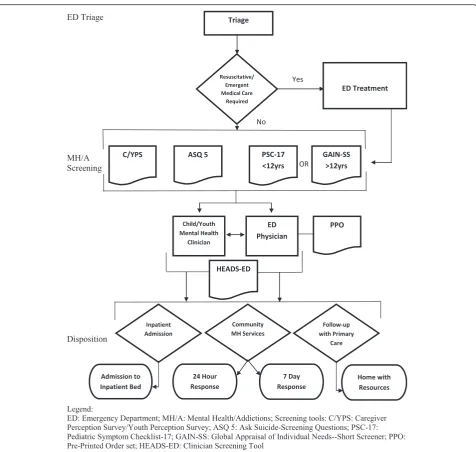
To address these concerns, a group of Canadian hos-pital and community-based professionals was commis-sioned by the Provincial Council on Maternal Child Health in Ontario to create a clinical pathway, known as the Emergency Department Mental Health Clinical Pathway (EDMHCP) for children and youth presenting with MH problems (see Fig. 1). The EDMHCP is designed to (i) improve early identification and interven-tion for CYMH issues, (ii) provide more timely access to community MH services, and (iii) reduce service gaps for vulnerable children and youth. It defines a standardized approach to risk assessment and dispos-ition decision-making and while improving access to appropriate needs-based MH care [8]. Finally, the EDMHCP aims to provide a seamless transition of care for children/youth and caregivers between the ED, outpatient hospital services and community MH agencies (CMHA), with tailored linkages to community resources through the HEADS-ED screening tool [9] incorporated within the pathway.
The overall aim of our project is to implement and evaluate impact of the EDMHCP in specific settings and to evaluate the implementation process. The purpose of this paper is to document the protocol for this 3-year mixed methods health services research project. Research objectives for this study are to:
1) Implement the EDMHCP using a theory-driven, evidence-based approach. The pathway will be implemented in four dyads of organizations, each dyad comprising an ED and an associated CMHA. 2) Evaluate clinical pathway effectiveness through
measurement of process and service outcomes. Our hypothesis is that a successfully implemented EDMHCP will lead to improved process and service outcomes.
3) Conduct a process evaluation of the pathway implementation strategy to assess the fidelity of the intervention delivered against the outcomes observed.
Methods/design
The protocol for this MH project was adapted from a recent ED clinical pathway implementation protocol [10]. Collaborating with site partners, a theory-based and tailored intervention strategy will be developed to implement the EDMHCP within each ED-CMHA dyad. A concurrent process evaluation will be conducted to assess the implementation strategy. For this protocol, we completed the CONSORT 2010 checklist for randomized trials [11].
Sampling
Setting and site selection
To assess EDMHCP feasibility in various settings, imple-mentation will occur in a staggered process in four Ontario exemplar ED-CMHA dyads with different pa-tient populations and workflows that do not currently utilize clinical pathways. Our exemplar ED sites include a pediatric specialized center with an annual patient cen-sus of 70,000, a high-volume community urban hospital (annual patient census 75,000), a low-volume rural hos-pital (annual patient census 25,000), and a high-volume general hospital in a smaller community (annual patient census 60,000).
Inclusion/exclusion criteria
are eligible for the pathway once they are clinically able to participate in a MH assessment in the ED (see Fig. 1).
Participants
Participants within each study site include ED staff and physicians, CMHA clinicians, and administrators, as well as patients (and their caregivers) presenting with MH concerns. Site champions will be identified for optimal local implementation.
Intervention strategy
As illustrated in Fig. 2, our intervention strategy will build on core components with findings from site visits and
qualitative interview findings to identify relevant behavior change techniques for our tailored intervention strategy.
Core components
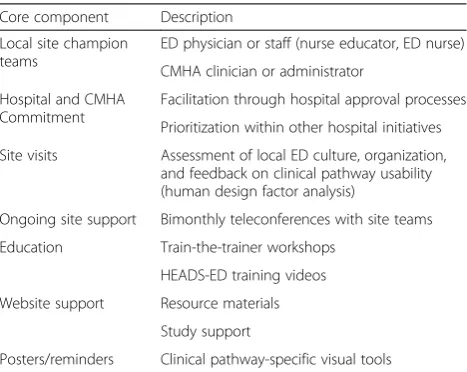
Based on experience in related provincial and regional implementations [12–15], we have provisionally selected core intervention components, as listed in Table 1. En-gagement of respected and influential champions at each site is a critical element in promoting and maintaining local interest in the pathway. Additional components in-clude education sessions, website support, posters, and reminders. Currently, an implementation toolkit for the EDMHCP is readily available online (http://www.pcmch. on.ca/health-care-providers/paediatric-care/pcmch-strate
gies-and-initiatives/ed-clinical-pathways/) [8]. These in-structions, measures, and training materials will be tailored for each site and hosted online during the imple-mentation phase on the HEADS-ED website [16]. While the study team will provide guidance and ongoing sup-port, site members will deliver relevant activities to ensure a realistic assessment of requirements for this and future implementations.
Theory-based design with knowledge user input
Further aspects of our intervention strategy will be based on the Theoretical Domains Framework (TDF), which consists of a set of conceptual determinants and associ-ated theoretical constructs that are believed to influence behavior and stimulate behavior change [17, 18]. The TDF provides a useful approach to identifying relevant behavioral determinants and designing interventions that will address these [19]. We have successfully conducted TDF-based focus groups with various urban and rural ED
teams on implementing the HEADS-ED screening tool [7], an integral component of the EDMHCP. For this study, additional TDF focus groups, with up to 10 participants, will be conducted at each CMHA to elicit perceptions re-lated to adopting the EDMHCP. Further guiding our strat-egy, we will assess organizational readiness and relevant factors for change through TDF-guided key informant (KI) interviews with one administrator at each site. All inter-views will be audiotaped and transcribed for analysis.
Site visits
Implementation will begin with site visits to further as-sess organizational issues within CMHAs and EDs, such as intake and flow of pediatric patients, specific and shared roles of health providers, and pathway fit and ac-ceptability. Infrastructure requirements and implementa-tion readiness will also be assessed. A structured site visit form will be used to take notes and guide visits at each ED or CMHA.
Intervention mapping
We will conduct a mapping exercise to link relevant be-havioral determinants among health providers identified through the qualitative interviews. We will then tailor our core strategy by applying known taxonomies of behavior change techniques [20, 21] to identify and select appropri-ate modes of delivery for a multifaceted intervention strat-egy that would go beyond simply educating for change. For example, methods may include facilitation, nudging, or systems change. Feasibility and practicality will be im-portant considerations to ensure implementation success.
Ongoing support and communication
Ongoing support will be provided to expedite pathway implementation and mitigate delays due to other organizational priorities. We will communicate monthly with site champions to support progress during implemen-tation and every 2 months in the post-implemenimplemen-tation phase to ensure sustainability. The project coordinator will communicate regularly to ensure target dates are met, using a process log to track reasons for delays that will be explored further in the post-implementation interviews.
Project phases
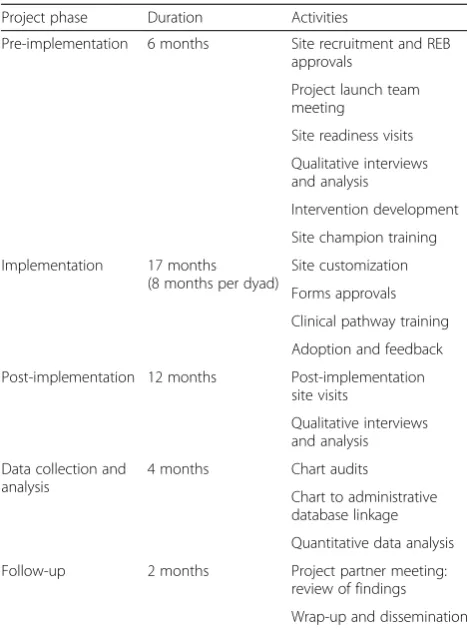
The project phases and designated timelines are outlined in Table 2. Once REB approval is secured at each site, the pre-implementation phase will proceed with the site readiness visits and qualitative interviews that will deter-mine the final tailored intervention strategies. The
im-plementation phasefor each dyad begins with a process to secure a written memorandum agreement between the ED and CMHA to ensure clarity of responsibilities and expectations integral to the pathway. Implementa-tion will proceed as per the tailored intervenImplementa-tion
Site Visits
Qualitative Interviews
Intervention Mapping
Final Tailored Strategy
Fig. 2Intervention strategyTable 1Implementation strategy core components
Core component Description
Local site champion teams
ED physician or staff (nurse educator, ED nurse)
CMHA clinician or administrator
Hospital and CMHA Commitment
Facilitation through hospital approval processes
Prioritization within other hospital initiatives
Site visits Assessment of local ED culture, organization, and feedback on clinical pathway usability (human design factor analysis)
Ongoing site support Bimonthly teleconferences with site teams
Education Train-the-trainer workshops
HEADS-ED training videos
Website support Resource materials
Study support
strategy. Completed pathway implementation requires,
at a minimum, the following: EDMHCP site
customization and committee approvals, delivery of at least two educational workshops for each organization, and EDMHCP availability in the ED. We have desig-nated an 8-month period for EDMHCP implementation within each dyad. Following initiation within the first dyad, subsequent dyads will begin implementation in a staggered pattern every 3 months to allow for optimal study team support and incorporating learning from ex-perience with previous dyads. In thepost-implementation
phase, qualitative interviews will explore experience with the implementation and site audits will be done to assess implementation status. We have defined the data collection periods as follows: (i) post-implementation, as the consecu-tive 9-month span that follows implementation completion plus an initial 3-month “settling in” time and (ii) pre-implementation, as a similar 9-month span prior to the intervention.
Evaluation
To assess the impact of the EDMHCP implementation and explore the factors leading to our eventual findings, we have planned a mixed methods evaluation approach employing both quantitative and qualitative evaluations,
as summarized in Table 3 and described further below. Additionally, a concurrent process evaluation will be conducted to assess the degree of variability and fidelity in implementation of the intervention within each dyad. This evaluation will include a process log, post-implementation site visits, and qualitative interviews.
Outcome measures
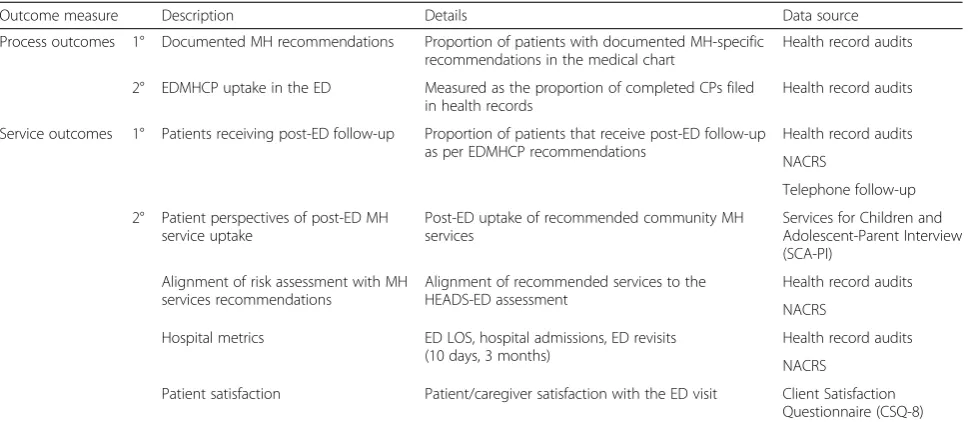
Table 4 provides a summary of study outcomes with the corresponding evaluation measures. The primaryprocess outcome is the proportion of patients with documented MH-specific recommendations, as defined by the project team and based on the EDMHCP, in the medical chart. The primary MH service outcome is the proportion of patients that receive the EDMHCP recommended follow-up: either within 24 h or 7 days post-ED visit, based on pathway defined risk level. Recognizing logistic and scheduling factors, a successful outcome will permit a 12-h or 3-day window for follow-up. Adherence, within-window adherence, and non-adherence will be analyzed separately. Secondary outcomes include (1) EDMHCP uptake in the ED, measured as the proportion of completed clinical pathway forms filed in the health record; (2) post-ED uptake of recommended community MH services, as measured by the Services for Children and Adolescent-Parent Interview (SCA-PI) tool [21]; (3) alignment of recommended services to the HEADS-ED assessment; (4) ED length of stay, hospital admissions, ED revisits (10 days and 3 months) obtained from health records and National Ambulatory Care Reporting Sys-tem (NACRS) data; and (5) patient/caregiver satisfaction with the ED visit as measured by the Services for Children and Adolescent-Parent Interview (SCA-PI) [22] and the Client Satisfaction Questionnaire (CSQ-8) [23].
Health record audits
To evaluate whether the intervention results in EDMHCP use among ED clinicians and documentation of MH-specific discharge recommendations, we will audit health records of relevant patients seen during alternate weeks in each 9-month pre- and post-implementation period. ICD10 codes (F codes, mental, and behavior disorders; X codes, intentional self-poisoning and self-harm; Y codes, poisoning and self-harm of undetermined intent) listed as
Table 2Description of project phases
Project phase Duration Activities
Pre-implementation 6 months Site recruitment and REB approvals
Project launch team meeting
Site readiness visits
Qualitative interviews and analysis
Intervention development
Site champion training
Implementation 17 months (8 months per dyad)
Site customization
Forms approvals
Clinical pathway training
Adoption and feedback
Post-implementation 12 months Post-implementation site visits
Qualitative interviews and analysis
Data collection and analysis
4 months Chart audits
Chart to administrative database linkage
Quantitative data analysis
Follow-up 2 months Project partner meeting: review of findings
Wrap-up and dissemination
Table 3Evaluation components
Quantitative evaluation Qualitative evaluation
Patient chart audits Patient surveys
Administrative data Process evaluation Process log Post-implementation
Site visits
primary or secondary diagnoses will identify relevant pa-tient charts during the study period. Abstracted data will include demographic and sufficient clinical data to deter-mine risk assessment, disposition plans, and adherence with EDMHCP recommendations. Two auditors, blinded to the study aims and protocol, will be trained to abstract and directly enter health records data into REDCap, an online database [24]. A data dictionary will be created to guide auditors and ensure standardized data collection procedures. Auditors will each abstract the same 50 charts to assess inter-rater agreement. This will be measured for key variables with a kappa coefficient and further training will be done until a prevalence and bias-adjusted kappa >0.6 is achieved.
Based on historical administrative data, the number of pediatric MH visits at the pediatric specialized center is expected to be approximately 2250 during each 9-month period. This sample size will permit estimation of a pro-portion at this site to within ± 2.1 %, conservatively as-suming a true proportion of 50 %. At the other extreme, the lowest number of pediatric MH visits during each 9-month period among the other three sites is expected to be approximately 61 at the rural hospital, which will per-mit estimation of a proportion to within ±12.5 %. Pool-ing across sites, the total sample size in each 9-month period is anticipated to be approximately 2503, which will permit estimation of a proportion to within ± 2.0 %.
Administrative databases
Administrative databases will be used to evaluate whether the pathway improves health care coordination and decreases subsequent ED utilization and wait times. We will use NACRS data from each hospital to assess
ED length of stay, hospital admissions, and number and frequency of repeat ED visits at 10 days and 3 months post the index ED visit. Data will be prospectively col-lected into a shared ED-CMHA database tool to assess CMHA service times (intake, full assessment and treat-ment) post-ED visit.
Health consumer surveys
Patient/caregiver surveys will be used to assess satisfac-tion with the ED visit and service within CMHAs. Be-cause the EDMHCP recommends CMHA referral intake within 7 days, we will use structured interviews and vali-dated measures to conduct a 10-day post-ED visit survey to assess ED visit satisfaction and whether CMHA intake has occurred. Patients or their caregivers will be con-tacted by e-mail, post, or phone within 7–10 days of the ED visit and will be given three follow-up measures by phone: (1) structured interview to determine if patients had initiated and received recommended MH services 10 days after being discharged from the ED; (2) the eight-item Client Satisfaction Questionnaire (CSQ-8) to determine patients’satisfaction with heath care services received in the ED as reported by caregivers or youth; and (3) The Services for Children and Adolescent-Parent Interview (SCA-PI) which describes pediatric MH services received across multiple settings, as re-ported by caregivers. To reduce respondent burden, for the purpose of this study, only eight questions concern-ing services received for MH issues have been selected. The SCA-PI will be used to measure patients’ use of community resources and document perceptions of the ED’s role in connecting them to MH services.
Table 4Study outcomes: process and service
Outcome measure Description Details Data source
Process outcomes 1° Documented MH recommendations Proportion of patients with documented MH-specific recommendations in the medical chart
Health record audits
2° EDMHCP uptake in the ED Measured as the proportion of completed CPs filed in health records
Health record audits
Service outcomes 1° Patients receiving post-ED follow-up Proportion of patients that receive post-ED follow-up as per EDMHCP recommendations
Health record audits
NACRS
Telephone follow-up
2° Patient perspectives of post-ED MH service uptake
Post-ED uptake of recommended community MH services
Services for Children and Adolescent-Parent Interview (SCA-PI)
Alignment of risk assessment with MH services recommendations
Alignment of recommended services to the HEADS-ED assessment
Health record audits
NACRS
Hospital metrics ED LOS, hospital admissions, ED revisits (10 days, 3 months)
Health record audits
NACRS
Patient satisfaction Patient/caregiver satisfaction with the ED visit Client Satisfaction Questionnaire (CSQ-8)
Process evaluation
To explore reasons for potential variation across in im-plementation effectiveness across the study sites, we will conduct a concurrent process evaluation by document-ing characteristics of our intervention, as well as the par-ticipants’ response to the delivery. This evaluation will assess the degree of variability and fidelity in implemen-tation across the sites, revealing the degree to which the intervention addressed the relevant factors for change. Specific components of this process evaluation will in-clude process logs, data from the post-implementation site visits, and qualitative interviews. Reasons for lack of completed implementation, should this occur at any site, will be detailed and further explored in the post-implementation phase interviews. Lessons learned will be documented and shared with site partners to promote sustained pathway use.
Process log
A process log will be used to longitudinally track key out-comes and capture issues related to site customization of documents, barriers and delays, workshop attendance and interest, ease of use, and degree of pathway uptake. Log
components will include interim survey feedback,
monthly updates from site champions, and implementa-tion progress with negotiated target dates. Addiimplementa-tional site support will be provided as needed, based on in-terim findings.
Site visits
Two months following completed implementation, struc-tured site visits will be conducted to assess accessibility and operational knowledge regarding the pathway. Find-ings will be compared to pre-implementation visits for each site.
Qualitative interviews
To explore organizational issues, team dynamics and other relevant issues impacting EDMHCP implementa-tion, post-implementation interviews will be held using TDF-based interview guides. On-site focus groups will be held with up to ten participants per organization. The focus group moderator will record field note observa-tions. As well, KI interviews will be conducted with an administrative lead for each organization. Additional focus group sessions or KI interviews will be held if data saturation is not achieved. All interview sessions will be audiotaped and transcribed for analysis.
Analysis
Quantitative analysis
Descriptive statistics (means and standard deviations for continuous variables or medians with interquartile ranges) will summarize EDs, CMHAs, and patient characteristics.
Frequencies and proportions for categorical variables will be reported. We will use a multiple baseline study design and conduct interrupted time-series analysis using seg-mented regression models, adjusting for site, with ARIMA autocorrelation structure [25–27] to evaluate whether the EDMHCP has resulted in improved health care utilization, medical management, and health sector coordination. Two-sidedpvalues less than 0.05 will be considered sta-tistically significant. Model estimates will be tabulated, to-gether with 95 % confidence intervals. We will also calculate hospital level summary measures including pro-portions in the pre- and post-intervention periods at each site and referred to each CMHA. An unweighted mean of the change from pre- to post-intervention will be calcu-lated for each hospital ED. The main effect measure will be calculated as the difference between the mean changes in intervention.
Qualitative analysis is integral to determine relevant factors and experience with EDMHCP use. Pre/post-site visits, focus groups, and KI interviews will yield com-plex data that will inform the intervention and pre-pare for the EDMHCP implementation (pre) and verify EDMHCP uptake status and assess stakeholders’ experiences regarding the intervention success. Inter-views will be audiotaped and transcribed. Using the TDF, two coders will independently analyze all tran-scripts and field notes. The analyses will be provided in an overall thematic format prior to the interven-tion and 6-month post-interveninterven-tion. To monitor pro-gress and pursue emerging themes, data collection and analysis will proceed iteratively and concurrently [28]. The qualitative analyst will feed relevant emer-ging themes back to the interviewer who will revise the interview guide as needed to capture new ideas. Inductive analysis will be managed using N-Vivo10 software and will occur in three phases: coding, using the TDF [18], and cat-egorizing/developing themes. For consistent application, codes will be operationally defined and placed into broad categories that correspond to the major units of analysis. As categories emerge, their theoretical properties will be defined. Comparisons between multiple categories will be conducted to locate similarities and differences between them. Categories will then be synthesized into themes.
Ethics and registration
Trial status
This project is currently in the pre-implementation phase, seeking local ethics approvals and data sharing agreement, and preparing the intervention strategy.
Discussion
By operationalizing best evidence into ED practices and formulating ED-CMHA partnerships through explicit agreements, the EDMHCP is poised to address current system gaps in addressing mental health for youth. This clinical pathway will standardize language and care pro-vided through improved communication and explicit expectations for transition between ED and CMHA set-tings. Our evaluation will also rigorously address re-quirements for success and inform scalability to other settings. Our research will identify effective strategies to inform EDMHCP adoption in any community and pro-vide knowledge on its impact by evaluating service inte-gration improvements for this vulnerable population.
While trials are more typically conducted with a complete intervention strategy specified in advance, the unique nature of our proposed implementation requires rich understanding of professional and system issues within each organizational context. Hence, the importance of in-corporating findings from our qualitative interviews and site visits to optimize likelihood of implementation success. Important aspects of our tailored intervention strategy include opportunities for providers at each site to identify strengths and barriers to EDMHCP implementation and the deliberate plan to include site leads in the modification process from the beginning. The planned site visits, quali-tative interviews, and continued communication will be helpful in generalizing the pathway implementation to other ED and CMHA settings of various sizes, staff, and urban/rural locations. Further, the tailored resources hosted on the HEADS-ED website [16] will be helpful reinforcement for sites that experience a high staff turn-over, particularly for new ED residents and staff.
Given the complexity and novel aspects of this inter-vention, we anticipate some challenges in promoting modifications to current workflows. Each dyad contains the often hectic and somewhat unpredictable ED envir-onment and the variability among CMHAs in their cap-acity and structure. Additionally, EDs and CMHAs do not typically interact closely, despite the shared patient population that moves between their settings. Other real-life issues such as budget restrictions, staff turnover, and competing project priorities have also been consid-ered in setting our project timelines. At this stage, these issues are not prohibitive for any of our proposed study sites; however, this is always subject to change. Such is the challenge of implementation research.
Our study findings will be relevant for health systems and professionals responsible for ensuring standardized,
quality care for children, and youth with acute MH con-cerns. To ensure our findings directly impact relevant service delivery areas, we have specifically recruited study team members with decision-making authority and/or influence on delivery of care for children and youth with MH concerns. We expect the protocol and findings can be customized and implemented in other EDs and CMHA settings. Equally important, this project will contribute further to implementation evidence rele-vant to use of clinical pathways and use of theory-based change strategies.
Abbreviations
CHEO, Children’s Hospital of Eastern Ontario; CMHA, community mental health agency; CSQ-8, client satisfaction questionnaire; ED, emergency department; EDMHCP, Emergency Department Mental Health Clinical Pathway; HEADS-ED, screening tool that includes home, education, activities, drugs, suicidality, emotions, and discharge resources; KI, key informant (interviews); MH, mental health; NACRS, National Ambulatory Care Reporting System; REB, Research Ethics Board; SCA-PI, services for children and adolescents-parent interview; TDF, Theoretical Domains Framework
Acknowledgements
We are grateful to the Canadian Institutes of Health Research (CIHR) and the Ministry of Health and Long-Term Care (MOHLTC) for their financial support of this project. We would like to acknowledge Nathalie Thibedeau for her contributions to the original grant submission. We would also like to thank our hospital site partners, community agency partners, and knowledge users for their letters of support.
Funding
The funding source in support of this protocol includes a CIHR (#337794) and MOHLTC (#6719) Partnerships for Health Systems Improvement Grant, June 2015 to June 2018. These funding bodies had no role in the study design, data collection, analysis, interpretation, nor writing of the manuscript.
Authors’contributions
MJ co-chaired the provincial working group to develop this ED clinical pathway. MJ’s clinical pathway protocol [10] was adapted for the current study. MJ, MC, PC, RZ, SR, AK, CG, RZ, and WG contributed to the adaptation of the clinical protocol and the design of the study. CP drafted of the manuscript based on the original protocol. NB conducted the sample size calculations. All authors read, contributed to, and approved the final manuscript.
Authors’information
The team includes clinical and research expertise in emergency department clinical pathways (MJ), emergency medicine (MJ, SR, RZ), community- and hospital-based pediatric MH (MC, PC, KP, AK, CG, RZ, CP), biostatistics and statistical methodology (NB, WG), scoring tool development (MC, PC, RZ, AK, CG, WG), emergency outreach (SR), community outreach (AK, KP), and knowledge translation (MJ, MC, PC, AK, KP, RZ, CP).
Competing interests
The authors declare that they have no competing interests.
Ethics approval and consent to participate
Ethics approval for this study has been granted at the coordinating site (Children’s Hospital of Eastern Ontario Research Ethics Board–CHEOREB# 15/146X). Prior to implementation within each dyad, REB approval will be obtained for each site hospital and CMHA. Informed consent will be sought for interviews and focus group meetings.
Author details
3Psychiatric & Mental Health Research, CHEO Research Institute, Ottawa, Canada.4Department of Psychology, Carleton University, Ottawa, Canada. 5Centre for Pediatric Mental Health Services and Policy Research, CHEO Research Institute, Ottawa, Canada.6Department of Epidemiology, University of Ottawa, Ottawa, Canada.7Psychology, Children’s Hospital of Eastern Ontario, Ottawa, Canada.8Department of Psychiatry, University of Ottawa, Ottawa, Canada.9Psychiatry, Children’s Hospital of Eastern Ontario, Ottawa, Canada.10Clinical Research Unit, CHEO Research Institute, Ottawa, Canada. 11Department of Statistics, University of Ottawa, Ottawa, Canada. 12Department of Psychology, University of Ottawa, Ottawa, Canada.
Received: 9 June 2016 Accepted: 18 June 2016
References
1. Kataoka SH, Zhang L, Wells KB. Unmet need for mental health care among U.S. children: variation by ethnicity and insurance status. Am J Psychiat. 2002;159(9):1548–55. doi:10.1176/appi.ajp.159.9.1548.
2. Hacker K, Arsenault L, Franco I, et al. Referral and follow-up after mental health screening in commercially insured adolescents. J Adolesc Health. 2014;55:17–23. doi:10.1016/j.jadohealth.2013.12.012.
3. Kirby MJL, Keon WJ. Out of the shadows at last: transforming mental health, mental illness and addiction services in Canada. The Standing Senate Committee on Social Affairs, Science and Technology; 2006. 4. MHASEF Research Team. The mental health of children and youth in
Ontario: a baseline scorecard. Toronto: Institute for Clinical Evaluative Sciences; 2015. (Online) Accessed 15 Mar 2016. ISBN 978-1-926850-55-9. 5. Children’s Hospital of Eastern Ontario. Advocacy Mental Health. Ottawa, Canada: http://www.cheo.on.ca/en/mentalhealth. Accessed 4 July 2016. 6. Richman B, Grossman D, Sloan F. Fragmentation in mental health benefits and
services: a preliminary examination into consumption and outcomes. In: Elhauge ER, editor. The fragmentation of US healthcare: causes and solutions. Toronto: Oxford University Press; 2010. p. 279–300. http://dx.doi.org/10.2139/ssrn.1460935. 7. MacWilliams K, Curran J, Racek J, et al. Barriers and facilitators to implementing
the HEADS ED: a rapid screening tool for pediatric patients in emergency departments. Pediatr Emerg Care. 2016. doi:10.1097/PEC.0000000000000651. 8. Provincial Council for Maternal and Child Health. Implementation toolkit:
emergency department clinical pathway for children and youth with mental health conditions. Prov Counc Matern Child Heal. Available at: http://www.pcmch.on.ca/wp-content/uploads/2015/09/1.0-Toolkit-ED_ Clinical_Pathway-Tookit_Oct_29_2014_Updated-PPO.pdf. Accessed 4 July 2016. 9. Cappelli M, Gray C, Zemek R, et al. The HEADS-ED: a rapid mental health
screening tool for pediatric patients in the emergency department. Pediatric. 2012;130(2):e321–7. doi:10.1542/peds.2011-3798.
10. Jabbour M, Curran J, Scott SD, et al. Best strategies to implement clinical pathways in an emergency department setting: study protocol for a cluster randomized controlled trial. Implement Sci. 2013;8(1):55. doi:10.1186/1748-5908-8-55. 11. Schulz KF, Altman DG, Moher D, et al. CONSORT 2010 statement: updated
guidelines for reporting parallel group randomized trials. Ann Int Med. 2010;152(11):726–32. doi:10.7326/0003-4819-152-11-201006010-00232. 12. Scott SD, Grimshaw J, Klassen TP, et al. Understanding implementation processes
of clinical pathways and clinical practice guidelines in pediatric contexts: a study protocol. Implement Sci. 2011;6:133. doi:10.1186/1748-5908-6-133. 13. Jabbour M, Reid S, Irwin D, et al. Clinical pathway-based pediatric emergency
outreach program: implementation and preliminary evaluation. Can J Hosp Pharm. 2014;67(3):240–5. http://dx.doi.org/10.4212/cjhp.v67i3.1362. Accessed 4 July 2016. 14. Lougheed MD, Olajos-Clow J, Szpiro K, et al. Multicentre evaluation of an
emergency department asthma care pathway for adults. CJEM. 2009;11(3):215–29. 15. Bhogal S, Bourbeau J, McGillivray D, et al. Adherence to pediatric asthma
guidelines in the emergency department: a survey of knowledge, attitudes and behaviour among health care professionals. Can Respir J. 2010;17:175–82. http://dx.doi.org/10.1155/2010/274865. Accessed 4 July 2016.
16. HEADS-ED, From screening to services. www.ottawa.heads-ed.com. Accessed 4 July 2016.
17. Michie S, Johnston M, Abraham C, et al. Making psychological theory useful for implementing evidence based practice: a consensus approach. Qual Saf Healthc. 2005;14(1):26–33. http://dx.doi.org/10.1136/qshc.2004.011155. Accessed 4 July 2016.
18. Cane J, O’Connor D, Michie S. Validation of the theoretical domains framework for use in behaviour change and implementation research.
Implement Sci. 2012;7(37):1–17. http://dx.doi.org/10.1186/1748-5908-7-37. Accessed 4 July 2016.
19. Michie S, Johnston M, Francis J, et al. From theory to intervention: mapping theoretically derived behavioral determinants to behaviour change techniques. Appl Psychol. 2008;57(4):660–80. doi:10.1111/j.1464-0597. 2008.00341.x.
20. Michie S, van Stralen MM, West R. The behaviour change wheel: a new method for characterizing and designing behaviour change interventions. Implement Sci. 2011;6(42):1–11. doi:10.1186/1748-5908-6-42.
21. Waltz TJ, Powell BJ, Matthieu MM, et al. Use of concept mapping to characterize relationships among implementation strategies and assess their feasibility and importance: results from the Expert Recommendations for Implementing Change (ERIC) study. Implement Sci. 2015;10(109):1–8. doi:10.1186/s13012-015-0295-0.
22. Jensen PS, Eaton Hoagwood K, Roper M, et al. The services for children and adolescents-parent interview: development and performance characteristics. J Am Acad Child Adolesc Psychiat. 2004;43(11):1334–44. doi:10.1097/01.chi. 0000139557.16830.4e.
23. Attkisson CC, Zwick RJ. The client satisfaction questionnaire: psychometric properties and correlations with service utilization and psychotherapy outcome. Eval Prog Plann. 1982;5(3):233–7.
24. Harris PA, Taylor R, Thielke R, et al. Research electronic data capture (REDCap)—a metadata-driven methodology and workflow process for providing translational research informatics support. J Biomed Inform. 2009;42(2):377–81. doi:10.1016/j.jbi.2008.08.010.
25. Hartmann DP, Gottman JM, Jones RR, et al. Interrupted time-series analysis and its application to behavioural data. J Appl Behav Anal. 1980;13(4):543–59. 26. Wagner AK, Soumerai SB, Zhang F, Ross-Degnan D. Segmented regression
analysis of interrupted time series studies in medication use research. J Clin Pharm Ther. 2002;27(4):299–309. doi:10.1046/j.1365-2710.2002.00430.x. 27. Zhang F, Wagner AK, Soumerai SB, Ross-Degnan D. Methods for estimating
confidence intervals in interrupted time series analysis of health interventions. J Clin Epidemiol. 2009;62(2):143–8. doi:10.1016/j.jclinepi.2008.08.007. 28. Morse J, Field P. Qualitative research methods for health professionals.
2nd ed. Thousand Oaks: Sage; 1995.
• We accept pre-submission inquiries
• Our selector tool helps you to find the most relevant journal
• We provide round the clock customer support
• Convenient online submission
• Thorough peer review
• Inclusion in PubMed and all major indexing services
• Maximum visibility for your research
Submit your manuscript at www.biomedcentral.com/submit