R E S E A R C H
Open Access
Identification of aspects of functioning, disability
and health relevant to patients experiencing
vertigo: a qualitative study using the international
classification of functioning, disability and health
Martin Mueller
1,2*, Edith Schuster
1, Ralf Strobl
1and Eva Grill
1,2Abstract
Purpose:Aims of this study were to identify aspects of functioning and health relevant to patients with vertigo expressed by ICF categories and to explore the potential of the ICF to describe the patient perspective in vertigo.
Methods:We conducted a series of qualitative semi-structured face-to-face interviews using a descriptive approach. Data was analyzed using the meaning condensation procedure and then linked to categories of the International Classification of Functioning, Disability and Health (ICF).
Results:From May to July 2010 12 interviews were carried out until saturation was reached. Four hundred and seventy-one single concepts were extracted which were linked to 142 different ICF categories. 40 of those belonged to the component body functions, 62 to the component activity and participation, and 40 to the component environmental factors. Besides the most prominent aspect“dizziness”most participants reported problems within“Emotional functions (b152), problems related to mobility and carrying out the daily routine. Almost all participants reported“Immediate family (e310)”as a relevant modifying environmental factor.
Conclusions:From the patients’perspective, vertigo has impact on multifaceted aspects of functioning and disability, mainly body functions and activities and participation. Modifying contextual factors have to be taken into account to cover the complex interaction between the health condition of vertigo on the individuals’daily life. The results of this study will contribute to developing standards for the measurement of functioning, disability and health relevant for patients suffering from vertigo.
Keywords:Vertigo (MeSH), Outcome assessment (Health Care) (MeSH), Qualitative research (MeSH), Classification (MeSH)
Background
Vertigo and dizziness are among the most common health problems in medical practice [1-5]. Vertigo and dizziness include both consequences of disease as well as definable disease entities such as benign paroxysmal positional vertigo, Meniere’s disease, or vestibular mi-graine. Irrespective of the various causes and underlying
health conditions, vertigo and dizziness have significant impact on functioning and overall quality of life of the affected individuals To give some examples, the most common peripheral-vestibular disorder benign paroxys-mal positioning vertigo – which is also the most fre-quent type of vestibular disorder –causes brief rotatory vertigo attacks, mainly triggered by rapid head move-ments, e.g. when turning around in the bed or lacing shoes. Central-peripheral disorders, which may be caused by brain ischemia, multiple sclerosis, or other permanent or transient brain lesions, can make vertigo attacks lasting from minutes to even weeks [6]. In addition, vertigo and dizziness are a considerable burden to economy and health care [4,7,8].
* Correspondence:[email protected]
1Institute for Medical Informatics, Biometry and Epidemiology,
Ludwig-Maximilians-Universität München, Marchioninistr 17, 81377 Munich, Germany
2
Integrated Center for Research and Treatment of Vertigo, Balance and Ocular Motor Disorders (IFBLMU), Ludwig-Maximilians-Universität München, University Hospital Munich, Marchioninistr. 15, 81377 Munich, Germany
Precondition of effective management and treatment of potentially disabling conditions like vertigo is – be-sides careful diagnosis of the underlying condition –the assessment of outcomes which are relevant to the pa-tient. This is not only important to monitor treatment effects but also to set goals and to plan therapy [6].
As summarized by Morris et al. [9] outcome measures in vertigo vary by the entities they are addressing,, such as subjective experience of disability or signs and symp-toms. Most of them reflect either the patients’or health professionals’ experience. As an example, the frequently used Dizziness Handicap Inventory [10] addresses the patients’ experience of the consequences of vertigo on daily living.
Most outcome measures are developed and validated on the basis of empirical findings or professional experi-ence [11]. However, none of them refer to a common theoretical framework. A theoretical framework is funda-mental for defining an outcome measurement and helps to ensure that the whole potential spectrum of issues is reflected [12].
In addition to the lack of theoretical foundation there is still no agreement on standards used to measure out-comes in patients with vertigo. This is illustrated by a re-cently published Cochrane Review in the field of vestibular rehabilitation which noted 15 different out-come measures of patients’complaints in 21 studies [13].
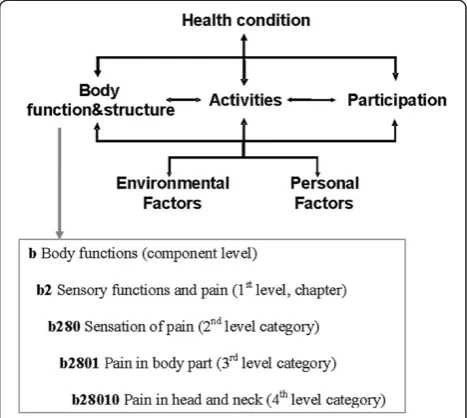
To address both these issues, the Integrated Center for Research and Treatment of Vertigo, Balance and Ocular Motor Disorders (IFBLMU) at the Ludwig-Maximilians-Universität in Munich set up a project that aims to de-velop an international standard for the description of functioning and disability in patients with vertigo and dizziness based on the International Classification of Functioning, Disability and Health (ICF). With the ICF, which is part of the family of international classifications of the World Health Organisation (WHO), there is a common theoretical framework for describing and meas-uring health and disability. The ICF models the indivi-duals' functioning and health as a complex interaction between a health condition and contextual factors. Add-itionally, the ICF classifies domains of functioning which are encountered in human life: Body structures and functions, activities and participation, along with their contextual Personal and Environmental Factors. The ICF classification contains more than 1400 hierarchically organized categories which describe the components of the ICF model in detail up to four levels (see Figure 1). One major goal of the ICF is to record and organize a wide range of information about health and health related states for individuals and populations. For the purpose of defining the contents of a comprehensive as-sessment, the ICF provides a universal language intended to be equally used and understood by health
professionals and patients. Thus, it can be used to organize and standardize issues most relevant for patients with vertigo or dizziness while respecting patients' perspective and experiences. The ICF therefore has the potential to serve as a useful comprehensive basis to standardize health information on the individual and the population level in patient care and research [14,15].
The development of this international standard is based on the protocol to develop ICF Core Sets [16-18] and will therefore incorporate the perspectives of affected individuals, of health professionals, of current research as well as the epidemiological perspective.
The objective of this paper is to investigate the per-spectives of patients with vertigo and dizziness on their experience of functioning and health using the ICF. Spe-cific aims were
(1)to identify aspects of functioning and health relevant to patients with vertigo expressed by ICF categories and
(2)to explore the potential of the ICF to describe the patient perspective in vertigo.
Methods
Study design
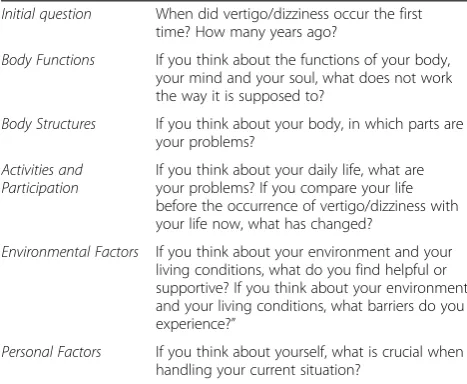
We conducted a series of qualitative semi-structured face-to-face interviews using a descriptive approach [19]. The interviews were audio recorded and transcribed ver-batim. The interviews were initiated as narrative inter-view. In the background, the interviewer had an interview guide that was designed to address the compo-nents of the International Classification of Functioning,
Disability and Health (ICF): Body Functions, Body Struc-tures, Activities and Participation, and the contextual factors Environmental and Personal Factors. The inter-view guide was developed using information of earlier focus groups and individual interview studies with the focus to explore relevant aspects of functioning and health in different populations [20,21]. The initial ques-tion and the opques-tional quesques-tions on ICF components are presented in Table 1.
Additionally collected data
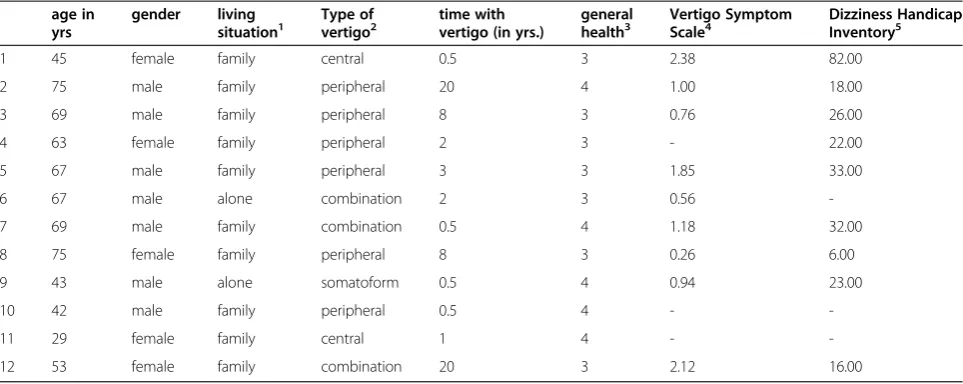
To describe the study sample, sociodemographic and disease specific data (age, sex, living situation, medical diagnosis) was collected. Vertigo was categorized as ei-ther central-vestibular vertigo, peripheral-vestibular ver-tigo, somatoform vertigo or combination of types. To describe an overall impression on participants’ health, they were asked to appraise their health on a 5-point-Likert scale ranging from one to five were one indicates best health. In addition, the impact of vertigo on health was appraised by the Dizziness Handicap Inventory (DHI) [10] and the Vertigo Symptoms Scale (VSS)[11]. The DHI addresses self-perceived handicap due to ves-tibular disorders. The score ranges from 0 to 100, with a higher score indicating greater handicap. The VSS addresses frequency and severity of dizziness symptoms within the last 12 months. The score ranges from 0 to 4, with a higher score indicating more frequent and more severe symptoms.
Participants
Patients were recruited at the outpatient dizziness clinic at the Integrated Center for Research and Treatment of Vertigo, Balance and Ocular Motor Disorders (IFBLMU) at the Ludwig-Maximilians-Universität in Munich. Po-tential participants were contacted and asked for their
willingness to contribute to a study by their physician in charge. In case of preliminary consent, the patients were provided with detailed information about the study. Informed written consent had to be signed prior to the beginning of the interview.
Inclusion criteria were over 18 years of age and adequate command of the German language. Positive vote of the ethics committee of the Medical Faculty of Ludwig-Maximilians-Universität in Munich was obtained prior to start.
The interviews took place subsequent to the consult-ation in the outpatient clinic in rooms of the hospitals. The interview was taken by an experienced registered nurse and bachelor student (EB) who was especially trained and ongoing supervised by the senior researchers (EG & MM). The interviewer was not part of the health care team.
Sample size
The sample size was determined by saturation. Satur-ation refers to the point at which an investigator has obtained sufficient information from the field [22]. In this study we defined saturation as the point during data collection and analysis when an interview revealed less than 5% additional ICF categories. The sampling strategy adopted the idea of theoretical sampling from the grounded theory methodology [23]. In the selection process the researchers tried to balance relevant charac-teristics of the patients, such as gender, age and disease, to assure maximum sensitivity and to ensure a max-imum of variety of experiences from the participants with different types of vestibular disorders to address those comprehensively.
Data analysis
Qualitative data analysis
The meaning condensation procedure [24] was used for the analysis of data content. In the first step, the inter-view transcripts were read through to get an overinter-view of incorporated meaningful concepts. In the second step, the text was divided into meaning units, and the domin-ating theme for this unit was determined. A meaning unit was defined as a specific unit of text either a few words or a few sentences with a common theme. In the third step, the specific concepts contained in the mean-ing units were identified. For quality assurance reasons, the qualitative data analysis was conducted independ-ently by two researchers trained in the methodology (MM, ES). The results were compared and discussed prior to further analysis.
Linking to the ICF
The identified concepts were linked to the categories of the ICF based on established rules by two health
Table 1 Interview scheme
Initial question When did vertigo/dizziness occur the first time? How many years ago?
Body Functions If you think about the functions of your body, your mind and your soul, what does not work the way it is supposed to?
Body Structures If you think about your body, in which parts are your problems?
Activities and Participation
If you think about your daily life, what are your problems? If you compare your life before the occurrence of vertigo/dizziness with your life now, what has changed?
Environmental Factors If you think about your environment and your living conditions, what do you find helpful or supportive? If you think about your environment and your living conditions, what barriers do you experience?”
professionals with expert knowledge of the ICF (MM, ES) [25]. According to linking rules, health professionals trained in the ICF are advised to attribute each concept to the ICF category representing this concept most pre-cisely. One concept can be linked to one or more ICF categories, depending on the number of themes con-tained in the concept. Consensus between the two health professionals was required to decide which ICF category should be linked to each identified concept. In case of a disagreement, a third person trained in the linking rules was consulted. In a discussion led by the third person, the two health professionals that linked the concepts sta-ted their pros and cons for the linking of the concept under question to a specific ICF category. Based on these statements, the third person made an informed de-cision. See Table 2 for a scheme of qualitative data ana-lysis and linking.
Results
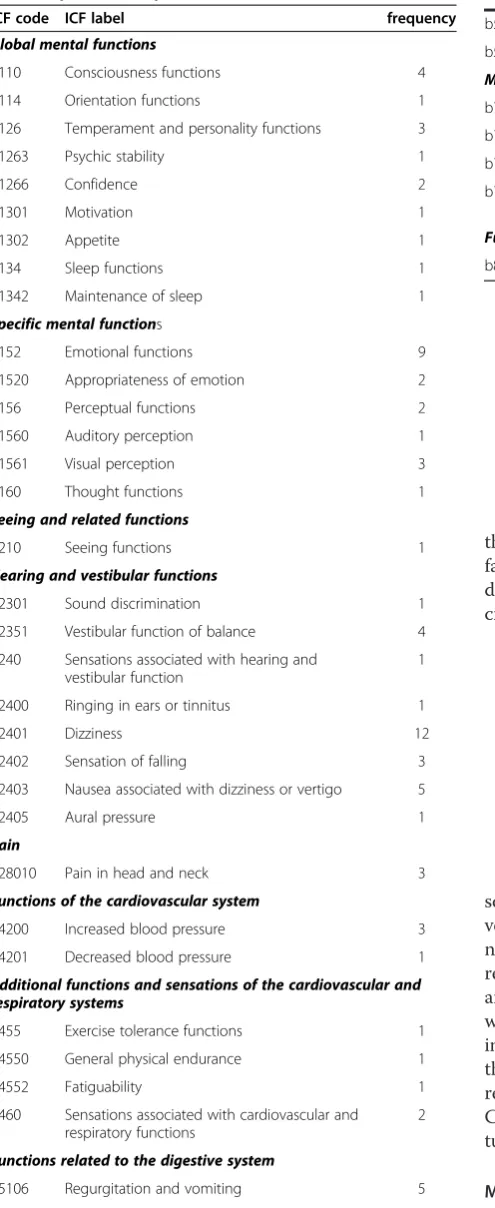
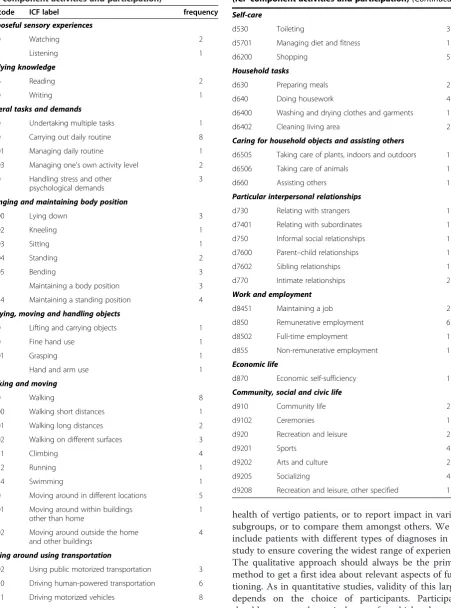
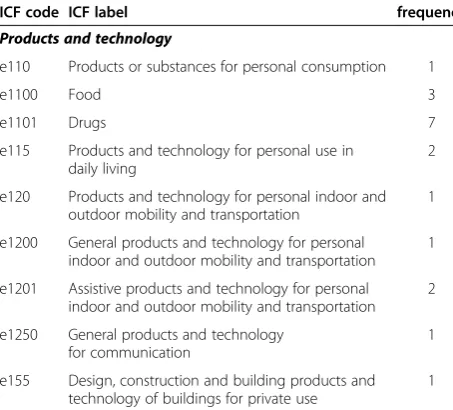
After 12 individual interviews from May until July 2010 saturation was reached. Characteristics of the partici-pants are displayed in Table 3. Four hundred and seventy-one single concepts were extracted from the interviews. Those identified concepts were linked to 142 different ICF-categories describing relevant aspects of functioning in our patients. 40 of those ICF categories belonged to the component body functions, 62 to the component activity and participation, and 40 to the component environmental factors (see Table 4, 5 and 6). None of the concepts could be linked to categories out of the component body structures. Four percent of all extracted concepts could not be linked to specific ICF categories. Most of them were related to ‘personal fac-tors’, specifically personal strategies of coping.
Besides the most prominent aspect “dizziness” which was reported by all participants, most participants (9) reported problems within “Emotional functions (b152)” including appropriateness, regulation and range of emo-tions. Eight participants reported problems related to mobility (including walking and related functions and driving motorized vehicles) and carrying out the daily routine. In addition, almost all participants (11) reported
“Immediate family (e310)”as a relevant modifying envir-onmental factor. The next most frequent envirenvir-onmental factor was “Drugs (e1101)”, which was mentioned by seven participants. The results of the analysis of all inter-views are shown in Tables 4, 5 and 6.
Discussion
Our study indicates that patients with vertigo or dizzi-ness consider many different aspects of functioning and health as relevant. Aspects from the component Activ-ities and Participation were most prominently captured, followed by aspects covering Body Functions. Various environmental and personal factors contributed to the multifaceted picture of functioning in vertigo. In our study the ICF turned out to be a useful tool to code vari-ous impairments and restrictions caused by vertigo and dizziness and to describe disease specific functioning and quality of life since the majority of concepts in patients’statements could be linked to the ICF.
Regarding the ICF component Body Functions partici-pants reported, apart from obvious aspects (e.g. sensa-tions associated with hearing and vestibular funcsensa-tions), orientation, temperament and personality functions, confidence, motivation, emotion, sleep, appetite and ex-ercise tolerance as relevant. It is commonly recognized that vertigo has considerable impact on quality of life, but the distinct components are often unclear. Generic instruments such as the SF-36 [26] give but a very gen-eral picture of impairment of mental functions. Anxiety and avoidance have been reported as psychological con-sequences of vertigo [1,27]. Also, emotional problems seem to be associated with vertigo [28]. Depression and somatization as well as increased obsessive-compulsive attitude have been observed [29].
“(. . .) It really gets me down.”(b152 Emotional functions, Pt. 6)
„Okay, just from the beginning, I wanted to be left alone (. . .) I didn’t want to go anywhere (. . .) And when I got such panic attacks. . .nervous break down. . .because I don’t want to go outside (. . .).(b152 Emotional functions Pt. 009)
“And at night it is like. . .sleeping properly. . .does not work any more.”(b134 Sleeping functions, Pt. 001) Of the ICF component Activities and Participation, 62 categories were mentioned as relevant in our study. This underlines how much the pathology interferes with daily life. The reported categories ranged from very basic ac-tivities such as watching, listening and reading to more complex items such as managing daily routine, using transportation, self-care and housework:
Table 2 Scheme of qualitative data analysis and linking
Interview text Meaning unit ICF category
“When things pass by quickly. . .This is what you have to avoid and you actually do avoid. . .Just like watching TV. I haven’t been watching TV since December.”(d110 Watching, Pt. 001)
“I really loved reading. At the moment I can’t really read, because I get dizzy after a little while.”(d166 Reading, Pt. 009)
“When you want to go by bus, you have to take a rest at the bus stop. . .and then you have to get in the bus fast. And you have to get out fast and again. . .have a rest at the bus stop. Everything gets more
complicated.”(d4702 Using public motorized transportation, Pt. 011)
“And I am happy to reach the toilet [without a vertigo attack]”(d530 Toiletting, Pt. 012)
“It’s worst when I have to do homework, for example when I have to hang curtains. . .”(d6402 Cleaning living areas, Pt. 008)
It is obvious that all movements and body positions that are likely to provoke attacks were reported as restricted.
„As soon as I was standing up. . .upright. . .[vertigo attacks occurred]. . .then walking was really hard (. . .).“(d4104 Standing, Pt. 006)
Almost all aspects of social participation were per-ceived as restricted, namely personal and formal rela-tionships, employment, leisure, sports and community life. This is in line with the work of Neuhauser and
colleges who showed in a large, community based study that up to 20% of individuals with vertigo avoid leaving the house [7]. Dizziness is known to impede activities of daily life [30] and to interfere with workplace activities [1]. Because attacks of vertigo are mostly uncontrollable and unpredictable, many patients suffer from the mere anticipation of the attack [31] which may be as restrict-ing as the pathology itself [10].
„Okay. . .but. . .now there is the vertigo (. . .) when I am standing in front of my customers, or employees. . . swaying. . .That doesn’t work!”(d730 Relating with strangers, d7401 Relating with subordinates, Pt. 009)
„[At work] I have to prepare these trolley tables all the time. Ist a permanent.. standing, bending, preparing. . . arround these trolleys. . .Then bringing them allover the building. . .four stories. . .I can’t imagine that I could handle this at the moment.”(d850 remunerative employment, Pt. 001)
“I would prefer going to work. But my ENT-doctor says that it’s too risky because of the spells. . .vomiting, high blood pressure, panic attacks,. . .”(d850 Remunerative employment, Pt. 001)
Environmental Factors were reported as interfering and interacting with functioning. Among those were fac-tors of the natural and built environment such as sounds, vibrations, climate, temperature, population density and architectural design. To give an example, paroxysmal positioning vertigo is suspected to be asso-ciated with temperature variation and air pollution [32].
Table 3 Characteristics of the participants
age in yrs
gender living
situation1 Type ofvertigo2 time withvertigo (in yrs.) generalhealth3 Vertigo SymptomScale4 Dizziness HandicapInventory5
1 45 female family central 0.5 3 2.38 82.00
2 75 male family peripheral 20 4 1.00 18.00
3 69 male family peripheral 8 3 0.76 26.00
4 63 female family peripheral 2 3 - 22.00
5 67 male family peripheral 3 3 1.85 33.00
6 67 male alone combination 2 3 0.56
-7 69 male family combination 0.5 4 1.18 32.00
8 75 female family peripheral 8 3 0.26 6.00
9 43 male alone somatoform 0.5 4 0.94 23.00
10 42 male family peripheral 0.5 4 -
-11 29 female family central 1 4 -
-12 53 female family combination 20 3 2.12 16.00
1
alone = living alone, family = living in a household together with family or partner. 2
central = central-vestibular vertigo, peripheral = peripheral-vestibular vertigo, somatoform = somatoform vertigo, combination = combination of types. 3
Self assessment, 5-point-Likert-scale (1 = best health). 4
Possible range: 0–4 (lower score = less severe and frequent symptoms). 5
„Yes. . ., in daily life. . .crowdy places. . .where a lot of people. . .and noisy. . .This is what I cannot tolerate at the moment.”(e2500 Sound intensity, e2151
Population density, Pt. 001)
„And as I’ve said before, when I’m walking, strolling in the sun, I feel that the vertigo is even more extreme.”
(e225 Climate, Pt. 008)
Likewise, family, friends, neighbors, colleagues and their attitudes were reported as relevant environmental factors. They can act as facilitators or barriers for the in-dividual affected by vertigo, since vertigo may change so-cial roles and behaviors, also towards others [33].
“I have two daughters. They give me a lot of support. And my husband.”(e310 Immediate family, Pt. 001)
„They, the people next to me, or acquaintances, too. . . When we went out for diner or to cinema. . .They knew that I suffer from vertigo attacks and that gave me the freedom. . .when I recognized: Oh! There is.... Then I could call them to help me:„Bring me to my car“(. . .).”
(e420 Individual attitudes of friends, Pt. 012)
In general, the ICF turned out to be a useful tool to de-scribe the situation, determinants and consequences of vertigo. Only few concepts reported by the patients could not be coded with ICF categories. Most of them were related to personal factors, mostly coping strategies. As an example, some patients reported to visit only places which are save if a vertigo attack occurs, such as build-ings that have staircases with handlebars, or places where they can lay down during a vertigo attack. Other patients reported to schedule trips or shopping more carefully. Coping strategies and resilience are reported in the litera-ture as major determinants of symptom severity [34].
Methodological considerations
It was not the intention of our study to draw generaliz-ing conclusions on experiences towards functiongeneraliz-ing and
Table 4 ICF categories relevant in patients with vertigo (ICF component body functions)
ICF code ICF label frequency
Global mental functions
b110 Consciousness functions 4
b114 Orientation functions 1
b126 Temperament and personality functions 3
b1263 Psychic stability 1
b1266 Confidence 2
b1301 Motivation 1
b1302 Appetite 1
b134 Sleep functions 1
b1342 Maintenance of sleep 1
Specific mental functions
b152 Emotional functions 9
b1520 Appropriateness of emotion 2
b156 Perceptual functions 2
b1560 Auditory perception 1
b1561 Visual perception 3
b160 Thought functions 1
Seeing and related functions
b210 Seeing functions 1
Hearing and vestibular functions
b2301 Sound discrimination 1
b2351 Vestibular function of balance 4
b240 Sensations associated with hearing and vestibular function
1
b2400 Ringing in ears or tinnitus 1
b2401 Dizziness 12
b2402 Sensation of falling 3
b2403 Nausea associated with dizziness or vertigo 5
b2405 Aural pressure 1
Pain
b28010 Pain in head and neck 3
Functions of the cardiovascular system
b4200 Increased blood pressure 3
b4201 Decreased blood pressure 1
Additional functions and sensations of the cardiovascular and respiratory systems
b455 Exercise tolerance functions 1
b4550 General physical endurance 1
b4552 Fatiguability 1
b460 Sensations associated with cardiovascular and respiratory functions
2
Functions related to the digestive system
b5106 Regurgitation and vomiting 5
b530 Weight maintenance functions 3
Table 4 ICF categories relevant in patients with vertigo (ICF component body functions)(Continued)
b535 Sensations associated with the digestive system 1
b5350 Sensation of nausea 1
Movement functions
b760 Control of voluntary movement functions 3
b7602 Coordination of voluntary movements 1
b770 Gait pattern functions 8
b780 Sensations related to muscles and movement functions
4
Functions of the skin
health of vertigo patients, or to report impact in various subgroups, or to compare them amongst others. We did include patients with different types of diagnoses in our study to ensure covering the widest range of experiences. The qualitative approach should always be the primary method to get a first idea about relevant aspects of func-tioning. As in quantitative studies, validity of this largely depends on the choice of participants. Participants should represent the typical range for which subsequent studies should be representative. The results of our study
Table 5 ICF categories relevant in patients with vertigo (ICF component activities and participation)
ICF code ICF label frequency
Purposeful sensory experiences
d110 Watching 2
d115 Listening 1
Applying knowledge
d166 Reading 2
d170 Writing 1
General tasks and demands
d220 Undertaking multiple tasks 1
d230 Carrying out daily routine 8
d2301 Managing daily routine 1
d2303 Managing one's own activity level 2
d240 Handling stress and other psychological demands
3
Changing and maintaining body position
d4100 Lying down 3
d4102 Kneeling 1
d4103 Sitting 1
d4104 Standing 2
d4105 Bending 3
d415 Maintaining a body position 3
d4154 Maintaining a standing position 4
Carrying, moving and handling objects
d430 Lifting and carrying objects 1
d440 Fine hand use 1
d4401 Grasping 1
d445 Hand and arm use 1
Walking and moving
d450 Walking 8
d4500 Walking short distances 1
d4501 Walking long distances 2
d4502 Walking on different surfaces 3
d4551 Climbing 4
d4552 Running 1
d4554 Swimming 1
d460 Moving around in different locations 5
d4601 Moving around within buildings other than home
1
d4602 Moving around outside the home and other buildings
4
Moving around using transportation
d4702 Using public motorized transportation 3
d4750 Driving human-powered transportation 6
d4751 Driving motorized vehicles 8
d498 Mobility, other specified 1
Table 5 ICF categories relevant in patients with vertigo (ICF component activities and participation)(Continued)
Self-care
d530 Toileting 3
d5701 Managing diet and fitness 1
d6200 Shopping 5
Household tasks
d630 Preparing meals 2
d640 Doing housework 4
d6400 Washing and drying clothes and garments 1
d6402 Cleaning living area 2
Caring for household objects and assisting others
d6505 Taking care of plants, indoors and outdoors 1
d6506 Taking care of animals 1
d660 Assisting others 1
Particular interpersonal relationships
d730 Relating with strangers 1
d7401 Relating with subordinates 1
d750 Informal social relationships 1
d7600 Parent–child relationships 1
d7602 Sibling relationships 1
d770 Intimate relationships 2
Work and employment
d8451 Maintaining a job 2
d850 Remunerative employment 6
d8502 Full-time employment 1
d855 Non-remunerative employment 1
Economic life
d870 Economic self-sufficiency 1
Community, social and civic life
d910 Community life 2
d9102 Ceremonies 1
d920 Recreation and leisure 2
d9201 Sports 4
d9202 Arts and culture 2
d9205 Socializing 4
should provide a first selection of patient-relevant items which have to prove its validity in terms of frequency and discrimination before being implemented in further appli-cations, such as future studies or clinical issues.
Limitations
Some limitations have to be mentioned. On the one side, selection of patients for the interviews might be biased towards individuals with milder disease who are capable to undergo an interview procedure. On the other side, patients seen in a specialized tertiary care dizziness clinic may be selected towards those with more severe symptoms or more chronic conditions. However, our findings have high face validity and are in line with the studies conducted in this field.
Altogether, our study gives a first impression from the patients' perspective using the ICF regardless of poten-tial selection bias.
Conclusions
From the patients’ perspective, vertigo has impact on multifaceted aspects of functioning and disability, mainly body functions and activities and participation. Modify-ing contextual factors have to be taken into account to cover the complex interaction between the health condi-tion of vertigo on the individuals’ daily life. While there are generic and disease-specific instruments to measure Quality of life which do encompass several of the aspects found in our study, the ICF offers a broader perspective and a full understanding of all the factors involved at in-dividual and health care level. The ICF has, therefore, a great potential to comprehensively describe functioning in vertigo for the assessment of burden of disease and treatment success. The results of this study will contrib-ute to developing standards for the measurement of functioning, disability and health relevant for patients suffering from vertigo.
Table 6 ICF categories relevant in patients with vertigo (ICF component environmental factors)
ICF code ICF label frequency
Products and technology
e110 Products or substances for personal consumption 1
e1100 Food 3
e1101 Drugs 7
e115 Products and technology for personal use in daily living
2
e120 Products and technology for personal indoor and outdoor mobility and transportation
1
e1200 General products and technology for personal indoor and outdoor mobility and transportation
1
e1201 Assistive products and technology for personal indoor and outdoor mobility and transportation
2
e1250 General products and technology for communication
1
e155 Design, construction and building products and technology of buildings for private use
1
Natural environment and human-made changes to environment
e215 Population 1
e2151 Population density 2
e225 Climate 3
e2250 Temperature 1
e245 Time-related changes 1
e2450 Day/night cycles 3
e250 Sound 2
e2500 Sound intensity 3
e255 Vibration 1
Support and relationships
e310 Immediate family 11
e315 Extended family 1
e320 Friends 4
e325 Acquaintances, peers, colleagues, neighbours and community members
1
e355 Health professionals 1
Attitudes
e410 Individual attitudes of immediate family members 2
e420 Individual attitudes of friends 2
e430 Individual attitudes of people in positions of authority
2
e445 Individual attitudes of strangers 5
e450 Individual attitudes of health professionals 4
Services, systems and policies
e515 Architecture and construction services, systems and policies
1
e5200 Open space planning services 1
e5351 Communication systems 1
e540 Transportation services, systems and policies 1
Table 6 ICF categories relevant in patients with vertigo (ICF component environmental factors)(Continued)
e5402 Transportation policies 1
e5600 Media services 2
e580 Health services, systems and policies 2
e5800 Health services 5
e5801 Health systems 2
e5802 Health policies 4
e590 Labour and employment services, systems and policies
1
Abbreviations
ICF: International classification of functioning disability and health; WHO: World health organization; SF-36: Short form (SF)-36 health survey;
IFBLMU: Integrated center for research and treatment of vertigo balance and ocular motor Disorders; DHI: Dizziness handicap inventory; VSS: Vertigo symptoms scale.
Competing interests
The authors declare that they have no competing interests.
Acknowledgements
We would like to express our gratitude to the participants for sharing their experiences in spite of the challenge of illness. We also thank the team of the outpatient dizziness clinic of theIFBLMUfor recruiting the patients and support during field work. This project was supported by funds from the German Federal Ministry of Education and Research under the Grant code 01 EO 0901. The authors bear full responsibility for the content of this publication.
Authors’contributions
MM and EG designed the study. ES carried out the interviews. MM supervised data collection. MM, RS and ES analyzed the data. All Authors interpreted the results and contributed in drafting the manuscript. All authors read and approved the final manuscript.
Received: 23 December 2011 Accepted: 27 June 2012 Published: 27 June 2012
References
1. Yardley L, Owen N, Nazareth I, Luxon L:Prevalence and presentation of dizziness in a general practice community sample of working age people.Br J Gen Pract1998,48:1131–1135.
2. Kroenke K, Price RK:Symptoms in the community. Prevalence, classification, and psychiatric comorbidity.Arch Intern Med1993, 153:2474–2480.
3. Neuhauser HK, von Brevern M, Radtke A, Lezius F, Feldmann M, Ziese T, Lempert T:Epidemiology of vestibular vertigo: a neurotologic survey of the general population.Neurology2005,65:898–904.
4. Gopinath B, McMahon CM, Rochtchina E, Mitchell P:Dizziness and vertigo in an older population: the Blue Mountains prospective cross-sectional study.Clin Otolaryngol2009,34:552–556.
5. Neuhauser HK:Epidemiology of vertigo.Curr Opin Neurol2007,20:40–46. 6. Brandt T, Dieterich M, Strupp M:Vertigo and dizziness: common complaints.
London: Springer; 2005.
7. Fielder H, Denholm SW, Lyons RA, Fielder CP:Measurement of health status in patients with vertigo.Clin Otolaryngol Allied Sci1996,21:124–126. 8. Neuhauser HK, Radtke A, von Brevern M, Lezius F, Feldmann M, Lempert T:
Burden of dizziness and vertigo in the community.Arch Intern Med2008, 168:2118–2124.
9. Morris AE, Lutman ME, Yardley L:Measuring outcome from Vestibular Rehabilitation, Part I: Qualitative development of a new self-report measure.Int J Audiol2008,47:169–177.
10. Jacobson GP, Newman CW:The development of the Dizziness Handicap Inventory.Arch Otolaryngol Head Neck Surg1990,116:424–427. 11. Yardley L, Masson E, Verschuur C, Haacke N, Luxon L:Symptoms, anxiety
and handicap in dizzy patients: development of the vertigo symptom scale.J Psychosom Res1992,36:731–741.
12. Scientific Advisory Committee of the Medical Outcomes Trust:Assessing health status and quality-of-life instruments: attributes and review criteria.Qual Life Res2002,11:193–205.
13. Hillier SL, Hollohan V:Vestibular rehabilitation for unilateral peripheral vestibular dysfunction.Cochrane Database Syst Rev2007, :CD005397. 14. Stucki G, Grimby G:Applying the ICF in medicine.J Rehabil Med2004, :5–6. 15. Ustun B, Chatterji S, Kostanjsek N:Comments from WHO for the Journal of Rehabilitation Medicine Special Supplement on ICF Core Sets.J Rehabil Med2004, :7–8.
16. Cieza A, Ewert T, Ustun TB, Chatterji S, Kostanjsek N, Stucki G:Development of ICF Core Sets for patients with chronic conditions.J Rehabil Med2004, :9–11.
17. Grill E, Ewert T, Chatterji S, Kostanjsek N, Stucki G:ICF Core Sets development for the acute hospital and early post-acute rehabilitation facilities.Disabil Rehabil2005,27:361–366.
18. Grill E, Stucki G:Criteria for validating comprehensive ICF Core Sets and developing brief ICF Core Set versions.J Rehabil Med2011,43:87–91. 19. Sandelowski M:Whatever happened to qualitative description?Res Nurs
Health2000,23:334–340.
20. Stamm TA, Cieza A, Coenen M, Machold KP, Nell VP, Smolen JS, Stucki G: Validating the International Classification of Functioning, Disability and Health Comprehensive Core Set for Rheumatoid Arthritis from the patient perspective: a qualitative study.Arthritis Rheum2005,53:431–439. 21. Coenen M, Cieza A, Stamm TA, Amann E, Kollerits B, Stucki G:Validation of the International Classification of Functioning, Disability and Health (ICF) Core Set for rheumatoid arthritis from the patient perspective using focus groups.Arthritis Res Ther2006,8:R84.
22. Karlsson G:Psychological Qualitative Research from a Phenomenological Perspective. Stockholm: Almquist & Wiskell International; 1995. 23. Glaser Barney G, Strauss Anselm L:The Discovery of Grounded Theory.
Strategies for Qualitative Research.: Aldine Transaction; 1967.
24. Kvale S:Interviews - An Introduction to Qualitative Research Interviewing.: Sage Publications; 1996.
25. Cieza A, Geyh S, Chatterji S, Kostanjsek N, Üstün B, Stucki G:ICF linking rules: an update based on lessons learned.J Rehabil Med2005,37:212. 26. Ware JE Jr, Sherbourne CD:The MOS 36-item short-form health survey (SF-36). I. Conceptual framework and item selection.Med Care1992, 30:473–483.
27. Tinetti ME, Williams CS, Gill TM:Health, functional, and psychological outcomes among older persons with chronic dizziness.J Am Geriatr Soc
2000,48:417–421.
28. Simon NM, Pollack MH, Tuby KS, Stern TA:Dizziness and panic disorder: a review of the association between vestibular dysfunction and anxiety.
Ann Clin Psychiatry1998,10:75–80.
29. Monzani D, Genovese E, Rovatti V, Malagoli ML, Rigatelli M, Guidetti G:Life events and benign paroxysmal positional vertigo: a case-controlled study.Acta Otolaryngol2006,126:987–992.
30. Kroenke K, Lucas CA, Rosenberg ML, Scherokman BJ:Psychiatric disorders and functional impairment in patients with persistent dizziness.J Gen Intern Med1993,8:530–535.
31. Eckhardt-Henn A, Dieterich M:Psychiatric disorders in otoneurology patients.Neurol Clin2005,23:731–749. vi.
32. Mariani P, Pelagatti M, Hahn A, Alpini D:Epidemiology of paroxysmal positioning vertigo: correlation with seasons, climate, and pollution.Int Tinnitus J2008,14:168–174.
33. Holmes S, Padgham ND:A review of the burden of vertigo.J Clin Nurs
2011.
34. Grunfeld E, Jahanshahi M, Gresty M, Bronstein A:Using locus of control measures with patients experiencing vertigo.Psychol, Health Med2003, 8:335–342.
doi:10.1186/1477-7525-10-75
Cite this article as:Muelleret al.:Identification of aspects of functioning, disability and health relevant to patients experiencing vertigo: a qualitative study using the international classification of functioning, disability and health.Health and Quality of Life Outcomes201210:75.
Submit your next manuscript to BioMed Central and take full advantage of:
• Convenient online submission
• Thorough peer review
• No space constraints or color figure charges
• Immediate publication on acceptance
• Inclusion in PubMed, CAS, Scopus and Google Scholar
• Research which is freely available for redistribution