R E S E A R C H
Open Access
Knowledge and performance of the Ethiopian
health extension workers on antenatal and
delivery care: a cross-sectional study
Araya Medhanyie
1,2,3*, Mark Spigt
2,4, GeertJan Dinant
2and Roman Blanco
3Abstract
Background:In recognition of the critical shortage of human resources within health services, community health workers have been trained and deployed to provide primary health care in developing countries. However, very few studies have investigated whether these health workers can provide good quality of care. This study
investigated the knowledge and performance of health extension workers (HEWs) on antenatal and delivery care. The study also explored the barriers and facilitators for HEWs in the provision of maternal health care.
Methods:In conducting this research, a cross-sectional study was performed. A total of 50 HEWs working in 39 health posts, covering a population of approximately 195,000 people, were interviewed. Descriptive statistics was used and a composite score of knowledge of HEWs was made and interpreted based on the Ethiopian education scoring system.
Results:Almost half of the respondents had at least 5 years of work experience as a HEW. More than half (27 (54%)) of the HEWs had poor knowledge on contents of antenatal care counseling, and the majority (44 (88%)) had poor knowledge on danger symptoms, danger signs, and complications in pregnancy. Health posts, which are the operational units for HEWs, did not have basic infrastructures like water supply, electricity, and waiting rooms for women in labor. On average within 6 months, a HEW assisted in 5.8 births. Only a few births (10%) were assisted at the health posts, the majority (82%) were assisted at home and only 20% of HEWs received professional assistance from a midwife.
Conclusion:Considering the poor knowledge of HEWs, poorly equipped health posts, and poor referral systems, it is difficult for HEWs to play a key role in improving health facility deliveries, skilled birth attendance, and on-time referral through early identification of danger signs. Hence, there is an urgent need to design appropriate strategies to improve the performance of HEWs by enhancing their knowledge and competencies, while creating appropriate working conditions.
Keywords:Community health workers, Health extension workers, Antenatal care, Primary health care, Maternal health care
* Correspondence:[email protected] 1
Department of Public Health, College of Health Sciences, Mekelle University, Mekelle, Ethiopia
2
CAPHRI, School for Public Health and Primary Care, Maastricht University, Maastricht, Netherlands
Full list of author information is available at the end of the article
Background
It is estimated around 358,000 maternal deaths from complications of pregnancy and child birth occurred worldwide in 2008. Of these, developing countries accounted for 99% (355,000) of deaths [1]. The vast ma-jority of maternal deaths are due to direct obstetrical complications, including hemorrhage, infection, eclamp-sia, obstructed labor, and unsafe abortion. Most obstetric complications occur around the time of delivery and cannot be predicted, but can be prevented with proper medical care [2]. In 2008, Ethiopia was among the six countries that contributed for more than 50% of mater-nal deaths in the world [3]. There is no evidence sug-gesting maternal mortality in Ethiopia is declining. In Ethiopia, 673 and 676 maternal deaths occurred in every 100,000 live births in 2005 and 2011, respectively [4,5].
Ethiopia is a signatory to the millennium development goals. Goal 5 targets the reduction of maternal mortality by 75% between 1990 and 2015 and calls for a target of 80% of births assisted by a skilled attendant by the year 2015 [6]. Skilled birth attendance is advocated as the
‘single most important factor in preventing maternal deaths’and the ‘proportion of births attended by skilled health personnel’is one of the indicators for millennium development goal 5 [6,7]. The World Health Organization (WHO) defines a skilled birth attendant as
‘an accredited health professional - such as a midwife, doctor or nurse - who has been educated and trained to be qualified in the skills needed to manage normal (un-complicated) pregnancies, childbirth and the immediate postnatal period, and in the identification, management and referral of complications in women and newborns’ [7].
Since the Alma-Ata Declaration on primary health care in 1978, community health worker cadres have been occurring in many countries across the globe [8]. Now-adays, the potential roles of community health workers within primary health care have received renewed atten-tion as a result of the HIV pandemic and due to the in-creasing acknowledgement of the critical shortage of human resources within health services [9-11].
Similar to other developing countries, Ethiopia has been training and deploying volunteer community health workers. With the aim of accelerating primary health care coverage and ensuring access to basic health ser-vices to the underserved rural population, the country launched a new community-based initiative called the Health Extension Program (HEP) in the year 2003 [12]. Under the umbrella of this program, cadres of commu-nity level health workers trained for 1 year, named health extension workers (HEWs), were deployed to rural areas. In relation to reducing maternal mortality, HEWs are trained on how to provide care to pregnant mothers through pregnancy, birth, and postnatal care. They are
part of the formal health structure and receive a monthly salary.
Very few studies have been published on the effective-ness of these HEWs since their deployment [13]. These studies have shown that HEWs are effective in improv-ing immunization, family plannimprov-ing utilization, and ante-natal care visits, but not in health facility deliveries and skilled birth attendance coverage [13-15]. Reviews have been published concerning the role of community health workers, highlighting successes and problems in other developing countries [16-19]. A systematic review done to assess the effectiveness of lay health workers showed promising benefits in promoting immunization uptake and improving outcomes for acute respiratory infections and malaria. However for other health issues such as birth attendance, there is insufficient evidence to justify recommendations which can guide policies and practices [10].
Considering that HEWs are not skilled birth atten-dants, it is recommended that the HEWs task should focus on the early identification of danger signs, danger symptoms, and complications in pregnancy and facilitat-ing immediate referrals of pregnant women when needed. However, it is not known whether the know-ledge of HEWs is adequate. Therefore, we examined the knowledge of HEWs on contents of antenatal care, danger signs, danger symptoms, and complications in three districts of Tigray region in Northern Ethiopia. In addition, we explored barriers and facilitators for HEWs in the provision of antenatal care, delivery care, and re-ferral services.
Methods Study design
The study employed a descriptive cross-sectional design.
Setting
The study was carried out in three selected districts of Tigray region, Ethiopia; namely Kilte Awlaelo, Saesi Tsadamba, and Degua Temben districts. Tigray is the most northern regional state of Ethiopia. The total population of the region was 4.6 million in 2010 [20].
Participants and sampling
Since all HEWs and health posts in the three selected districts were eligible for the study, we did not use any specific sampling technique. Rather, the focus was at en-suring participation of as many HEWs as possible. To do this we had the list of all kebeles in the districts and HEWs working in each kebele. A kebele is the smallest administrative unit in Ethiopia. It is synonymous with a village which has an average population of 5,000 people. After getting permission from Tigray regional health bureau to undertake the study, the data were then col-lected by travelling to each kebele to meet the HEWs for an interview.
Data collection
Initially a semi-structured interview type questionnaire on paper was prepared by reviewing guidelines and man-uals for HEWs. The questionnaire was divided into four sections. Section 1 was on the bio-data and characteris-tics of HEWs. Section 2 dealt with the availability of sup-plies, facilities, and logistics at health posts for maternal health care. This availability of supplies, facilities, and lo-gistics was confirmed by observation. Section 3 was about knowledge and performance of HEWs on contents of antenatal care, birth assistance, danger symptoms, danger signs, and complications in pregnancy and mak-ing referrals. Section 4 was about barriers and facilitators for HEWs in maternal health services provision.
This hard copy questionnaire was then converted to an online questionnaire using software called Episur-veyor and downloaded to a mobile phone (Nokia E71) [21]. Episurveyor is a web-based system which allows users to create a questionnaire online, download the questionnaire to a mobile phone, fill out the questinaire using the phone, send it to a server, view data on-line, and export data into statistical software for further analysis. Downloading an online created questionnaire on a mobile phone was possible directly through an internet connection at the mobile phone or downloading the online questionnaire first to a personal computer (PC) and then transferring it to a phone using Universal Serial Bus (USB). All the data collected can also be saved in the memory of the mobile phone and backed up to a remote server, where it can be analyzed later.
Prior to the actual data collection, the online question-naire downloaded on the mobile phone and using mo-bile phone for interview were pre-tested. The pre-test was done to assess clarity of the questions, time needed to finish the interview, and to know respondents’ com-fort to be interviewed using a questionnaire on a mobile phone. This pre-test was done by interviewing five HEWs who were not included in the actual study. One major finding of the pre-test was that few of the ques-tions had a long list of opques-tions and were found to be
time-consuming when asked using mobile phones. The interviewer had to scroll down and up several times to fill out the responses of respondents. Hence, we decided to exclude these few questions from the online question-naire and included them on paper instead. All the inter-views were conducted by the principal investigator. We chose the principal investigator; because new data col-lectors may not have been familiar with the mobile phone approach of data collection, and we had an inter-est to understand very well whether mobile phone data collection can be feasible for subsequent studies in the Ethiopian context.
Data analysis
The collected data which was submitted to the database server was exported to SPSS version 16 (SPSS Inc, Chicago, IL, USA) for analysis. Descriptive statistics was used to summarize the data and the results were pre-sented using frequency tables and percentages. To assess the knowledge of HEWs on contents of antenatal care counseling, danger symptoms, danger signs, and compli-cations in pregnancy, relevant questions from the ques-tionnaire had weights attached to them to create a composite score of knowledge. For the knowledge on contents of antenatal care counseling service, the max-imum score was 25 points and points were awarded on a discrete (whole number) rather than a continuous scale, based on the number of positive responses. Inter-pretation of scores was based on the Ethiopian university education scoring system. We used this scoring system, because we could not find a standard scoring system for evaluating the HEWs’ knowledge. Hence, we used the Ethiopian university scoring system by slightly modifying it into a four-scale ranking. Respondents whose scores were 80% or more were classified as having excellent knowledge on contents of antenatal care counseling; those who scored between 60% and 79% were classified to have good knowledge; those who scored between 45% and 60% were classified to have fair knowledge; and those who scored 45% and below were classified as hav-ing poor knowledge. We slightly modified the Ethiopian university scoring system into a four-scale ranking for convenience because the Ethiopian scoring system has a long list of levels. A similar approach was used to inter-pret the knowledge of HEWs on danger symptoms, dan-ger signs, and complications in pregnancy. Additional interpretations of scores were also made using the mean values of respondents’ knowledge. The mean and me-dian values for the knowledge scores were virtually the same.
Ethical consideration
purpose of the study and the use of mobile phones were explained to each respondent. A verbal consent to par-ticipate in the study was obtained from each respondent. Participants were also informed about their right to withdraw from the study at any time of the data collec-tion if they felt any discomfort.
Results
Characteristics of HEWs
A total of 50 out of 68 HEWs working in 39 health posts which cover a population of approximately 195,000 people were interviewed. The remaining 18 (26.5%) were not present in their working place or kebele during the period of data collection for different reasons such as meetings, training, maternity leave, or social reasons. All respondents were women and their age ranged from 22 to 38 and the mean age was 26.36 (SD: ±4). Thirty-six (72%) of them were married. Almost half (48%) of them had at least 5 years of work experience as a HEW.
Performance of HEWs in assisting births and referrals
Eighty-two percent of the HEWs received additional on job training on antenatal care, and clean and safe deliv-ery. Ninety-two percent of the HEWs had been assisting in births within 6 months prior to the data collection (Table 1). Within 6 months, a HEW assisted in 5.8 births on average. Only a few births (10%) were assisted at the health posts, the majority (82%) were assisted at home. HEWs rarely referred to a health center as is shown by the low percentages of HEWs who had made such a re-ferral. About 48% of the HEWs made a referral to health center during antenatal care, while 54% of them made referrals during labor and delivery. In addition, receiving professional assistance from midwives on obstetric care was rare. Only 20% of the HEWs had received profes-sional assistance from a midwife.
Characteristics of health posts
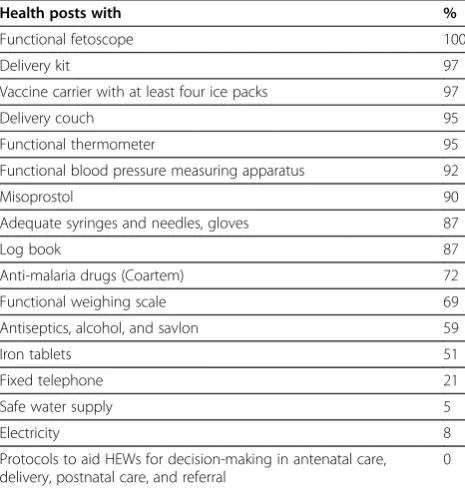
More than 85% of the health posts had a vaccine carrier, syringes and needles, functional blood pressure appar-atus, functional thermometer, delivery kit, delivery couch, and functional fetoscope (Table 2). Nevertheless, many of the health posts did not have basic infrastruc-tures such as electricity, water supply, and a fixed tele-phone (only available in 8%, 5%, and 21% of the health posts, respectively). Moreover, none of the health posts had any protocols to aid HEWs in decision-making related to maternal health care.
Knowledge of HEWs on contents of antenatal care counseling
The knowledge of HEWs concerning the contents of antenatal care counseling was poor. On average, a HEW knew 11 out of the 25 contents of ANC counseling
Table 1 Characteristics and performance of HEWs in assisting births and referral services (n=50)
Characteristics and performance %
Years of working experience as HEW
1 to 2 36
3 to 4 16
5 or more 48
HEWs with mobile phones 92
HEWs who received additional on job training on antenatal care, clean and safe delivery at least once
82
Performance of HEWs within 6 months prior to data collection
HEWs who made a referral of pregnant woman at least once during antenatal care visits to health center
48
HEWs who made a referral of pregnant woman during labor or child birth to health center
54
HEWs who received professional assistance related to antenatal care or birth care from midwives at least once
20
HEWs who assisted at least one birth 92
Number of births assisted by HEWs ( mean, 5.82; median, 4.00)
0 4
1 to 5 28
6 to 10 12
11 to 15 5
16 or more 1
Place of births at which HEWs assisted in births prior to data collection
Did not assist 8
Health post 10
Home 82
Table 2 Availability of facilities, supplies, and equipment at health posts (n=39)
Health posts with %
Functional fetoscope 100
Delivery kit 97
Vaccine carrier with at least four ice packs 97
Delivery couch 95
Functional thermometer 95
Functional blood pressure measuring apparatus 92
Misoprostol 90
Adequate syringes and needles, gloves 87
Log book 87
Anti-malaria drugs (Coartem) 72
Functional weighing scale 69
Antiseptics, alcohol, and savlon 59
Iron tablets 51
Fixed telephone 21
Safe water supply 5
Electricity 8
Protocols to aid HEWs for decision-making in antenatal care, delivery, postnatal care, and referral
asked during the interview. Only one respondent (2%) mentioned more than 80% of the 25 contents, nine of the respondents (18%) had good knowledge, 13 (26%) had fair knowledge, and 27 (54%) had poor knowledge. The contents of antenatal care counseling that were usu-ally known and discussed by HEWs with clients were the importance of institutional delivery (86%), taking extra amounts of food (86%), and taking iron folate (80%). Out of the 25 contents of antenatal care counsel-ing included in our survey, 14 of them had been known and discussed with clients by less than half of the HEWs (Table 3).
Knowledge of HEWs on danger symptoms, danger signs and complications in pregnancy
Similar to the knowledge of HEWs on contents of ante-natal care counseling, the general knowledge of HEWs on danger symptoms, danger signs, and complications was poor. On average, a HEW knew nine out of the 24 danger symptoms, danger signs, and complications asked during interview. No respondent received an
excellent score; only one (2%) had good knowledge, five (10%) had fair knowledge, and the majority 44 (88%) had poor knowledge. The most commonly known danger sign was vaginal bleeding which was mentioned by 98% of the HEWs while important danger symptoms such as severe headache and visual disturbance were known by less than half of the HEWs (Table 4).
Barriers and facilitators for HEWs in provision of antenatal care and delivery service for pregnant women
Lack of behavioral change among community to give birth at health facilities, low utilization of health posts by community, and absence of further education for HEWs were the three major reported barriers in provision of maternal health services as mentioned by 72%, 62%, and 56% of the HEWs, respectively (Table 5). HEWs mentioned the presence of volunteer community health workers, increasing proportion of women who were visiting HEWs or health facilities for antenatal care, and provision of maternity leave for pregnant women from safety net programs to be the main facilitators in provision of maternal health services.
Table 3 Reported contents of antenatal care counseling known and discussed by HEWs to client (n=50)
Contents of antenatal care counseling discussed %
Importance of institutional delivery 86
To take extra amounts of food 86
Give information about HIV/AIDS 82
Take iron folate tablets 80
Counsel on birth preparedness 76
Expected date of delivery 74
Importance of skilled birth attendant 72
To get checked up during pregnancy 64
To get TT vaccination 56
To save money for emergency 54
To seek care if there is a health problem 52
To keep environmental sanitation and personal hygiene 46
To give colostrum to the baby 46
To avoid heavy work 44
Antenatal care at least four visits 44
Tell about danger signs during pregnancy 40
No pre-lacteals 32
Exclusive breastfeeding 30
To take rest 26
Put the baby to breast immediately after delivery 24
To arrange for emergency transport 18
Delay bathing until after 24 h 18
To sleep under a bed net 14
Nothing to be applied to the umbilical stump 4
Lactational amenorrhea method 0
Table 4 Reported danger symptoms, danger signs, and complications of pregnancy known by HEWs (n=50) Danger symptoms, signs, or complications %
Vaginal bleeding 98
Prolonged labor (>24 h) 72
Baby’s hands or feet come first 72
Convulsions 58
Retained placenta 54
Edema 52
Anemia 46
High blood pressure 46
No fetal heartbeat 40
Mal-presentation 38
Severe headache 30
Multi-fetal pregnancy 30
Intrauterine fetal death 28
Severe vomiting 26
Offensive or irritating vaginal discharge 24
High fever 24
Low blood pressure 18
Visual disturbances (blurred vision) 12
Ruptured uterus 12
Prolapsed cord 8
Abdominal pain associated with episodes of fainting 2
Burning epigastric pain 0
Preterm rupture of membrane 0
Discussion
The HEWs of Ethiopia play a rather small role in assist-ing births. On average, a HEW assisted approximately six births per 6 months. Most deliveries took place at home without the necessary professional help or the ne-cessary facilities. The HEWs knowledge on danger symptoms, danger signs, and complications in pregnancy was poor. In relation to this, it was indicated that HEWs rarely referred a pregnant woman to a health center. Very few HEWs received professional support on obstet-ric care from a midwife.
Studies [13-15] showed that the deployment of HEWs has improved some aspects of maternal and child health such as family planning utilization, immunization up-take, and the number of antenatal care visits but not in health facility deliveries and skilled birth attendance
coverage. Nevertheless, these studies did not explore the reasons for HEWs’ low performance in promoting health facility deliveries and skilled birth attendance. Our study showed that one possible reason for the low performance of HEWs in stimulating behavioral change among the community and facilitation of referrals could be their poor knowledge on contents of antenatal care, danger signs, danger symptoms, and complications in pregnancy. Because of their poor knowledge, HEWs may not convince pregnant women to have birth plan-ning and preparedness to give birth at health facilities and assisted by skilled birth attendant. In addition, the HEWs may experience that the public still prefers to give birth at home; despite the fact that the importance of institutional delivery has been discussed with the cli-ents. This choice might be preferable considering the poor knowledge of the HEWs and lack of basic infra-structures at health posts, but it may be also due to a deep-rooted behavior and preference of the community to give birth at home. Given the HEWs are the key and main provider of primary health care services to the rural community in Ethiopia, improving their compe-tency and effectiveness on maternal health care is ur-gently needed. A study conducted among community health extension workers in Nigeria showed that com-munity health workers, who were backed by telephone consultations and working under the direct supervision of doctors, can improve quality of care to the satisfac-tion of most of their patients [16]. The recent introduc-tion of mobile phones could provide new opportunities for two-way communication between front-line health workers such as HEWs and skilled birth attendants such as midwives in health centers [22]. However, further researches are needed to investigate the potential impact of mobile phone-based applications in improving the performance of HEWs.
Looking from the HEWs’ perspective, our study showed the absence of further education to improve their career and knowledge, earning low salary, and work load were noted to be the main factors that hindered the HEWs from providing good quality of care. Therefore, it may be unrealistic to expect HEWs to play a key role in the improvement of maternal health care without addressing their needs in career promotion and other monetary incentives. Similar findings were observed in other studies on similar initiatives [18,19,23]. These studies showed that continuous training, transport means, adequate supervision, and motivation of commu-nity health workers through the introduction of financial incentives are among the key factors to improve the work of community health workers. Nevertheless, more studies are needed before we can be sure what the best and most cost-effective strategy is to improve the quality of care provided by the HEWs.
Table 5 Barriers and facilitators for HEWs in provision of antenatal and delivery care (n=50)
Barriers and facilitators reported by HEWs %
Barriers mentioned by HEWs
Lack of behavioral change (lack of awareness and wrong cultural beliefs)
72
Low utilization of health posts by community 62
No further education for HEWs 56
High work load of HEWs 48
Low competency of HEWs 44
Giving too much focus on environmental sanitation and less attention to maternal health care
38
Transportation problem 36
Health posts are less equipped (no water, electricity, waiting rooms, and so on)
34
Long walking distance and topographical problems 32
Low salary for HEWs 26
Less confidence of community on HEWs 16
No residence rooms at the health posts for HEWs 14
Less support for HEWs from kebele leaders 10
Meetings 10
Facilitators mentioned by HEWs
Presence of volunteer community health workers 62
Increasing proportion of women visiting HEWs or health facilities for antenatal care
60
Maternity leave from safety net program 46
Support from kebele administration 24
Support from supervisors 24
Presence of family health card for providing health education for women
20
Support from other sectors (women’s association/non-governmental organizations/agriculture sector)
20
Availability of supplies at health posts 10
Community mobilization and conversation 8
Some limitations of this study deserve attention. Al-though this study was carried out in rural districts, these districts were relatively near to urban towns. We also did not investigate actual care given by HEWs for ex-ample by non-participant observation. Presumably the situation is more severe in very remote areas and a simi-lar study [17] like ours, which included non-participant observation, showed that HEWs performed less well when compared to their reported knowledge. Therefore, although the situation observed in our study was far from ideal, we assume that the knowledge and perform-ance of HEWs might be poorer in reality.
We adapted the Ethiopian university scoring system to interpret HEWs’knowledge on contents of ANC coun-seling, danger signs, danger symptoms, and complica-tions in pregnancy. Although it might seem illogical to use the university scoring system for HEWs, it has no influence on the description we made, because basically we adapted the knowledge questions in the assessment from the guidelines, manuals, and log books of HEWs. All the knowledge questions were about the contents of ANC counseling, danger symptoms, danger signs, and complications that are expected to be known by HEWs.
Eighteen (26.5%) of the 68 HEWs who were working in the 39 health posts were not present in their working place or kebele during the period of data collection. They moved away from their working place for meet-ings, training, maternity leave, or social reasons. Their absence was not because they had different characteris-tics from the HEWs who were interviewed. Hence their exclusion from our study is not likely to influence the findings in this study.
In this study we explored the barriers and facilitators for HEWs in the provision of maternal health services through a questionnaire. However qualitative assess-ment either through focus group discussions or in-depth interviews with the HEWs might have been pre-ferable approach to explore these barriers and facilita-tors. Hence, we recommend further qualitative studies in this regard.
Conclusion
HEWs knowledge on contents of antenatal care counsel-ing, danger symptoms, danger signs, and complications in pregnancy was poor and there was no good referral system. Hence, there is an urgent need to design appro-priate strategies to improve the performance of HEWs by enhancing their knowledge and competencies, while creating favorable working conditions for HEWs in the rural areas.
Competing interests
The authors declare that they have no competing interests.
Authors’contributions
AM contributed to the design, data collection, analysis, and write-up. MS, GJD, and RB contributed to the design, analysis, and write-up. All authors read and approved the final manuscript.
Acknowledgements
This work was made possible through funding provided by‘Agencia Española de Cooperación Internacional para el Desarrollo (AECID)’, Madrid, Spain. We thank all health extension workers who took part in this study. We also extend our gratitude to Alex Little and Gebre Hishe for their support in language proofreading of this manuscript.
Author details
1Department of Public Health, College of Health Sciences, Mekelle University, Mekelle, Ethiopia.2CAPHRI, School for Public Health and Primary Care, Maastricht University, Maastricht, Netherlands.3Department of Medicine, University of Alcala de Henares, Madrid, Spain.4Department of General Practice, Tromso University, Tromso, Norway.
Received: 13 January 2012 Accepted: 4 November 2012 Published: 21 November 2012
References
1. WHO, UNICEF, UNFPA, World Bank:Trends in maternal mortality 1990–2008. Geneva: World Health Organization, United Nations Children Fund, United Nations Population Fund and The World Bank; 2010.
2. Ronsmans C, Graham WJ:Maternal mortality: who, when, where, and why.Lancet2006,368:1189–1200.
3. Hogan MC, Foreman KJ, Naghavi M, Ahn SY, Wang M, Makela SM, Lopez AD, Lozano R, Murray CJ:Maternal mortality for 181 countries, 1980– 2008: a systematic analysis of progress towards Millennium Development Goal 5.Lancet2010,375:1609–1623.
4. Central Statistical Agency (Ethiopia) and ORC Macro:Ethiopia Demographic and Health Survey 2005. Addis Ababa and Calverton, MD: Central Statistical Agency and ORC Macro; 2006.
5. Central Statistical Agency (Ethiopia) and ORC Macro:Ethiopia Demographic and Health Survey 2011. Addis Ababa and Calverton, MD: Central Statistical Agency and ORC Macro; 2012.
6. UN:United Nations Millennium Declaration A/55/L.2. New York, NY: United Nations; 2000.
7. World Health Organization:Reduction of maternal mortality. A joint WHO/ UNFPA/UNICEF/World Bank statement. Geneva: WHO; 1999.
8. World Health Organization, United Nations Children’s Fund:Report of the International Conference on Primary Health Care. Alma Ata: USSR; 1978:6–12. 9. Christopher JB, Le May A, Lewin S, Ross DA:Thirty years after Alma-Ata: a systematic review of the impact of community health workers delivering curative interventions against malaria, pneumonia and diarrhoea on child mortality and morbidity in sub-Saharan Africa.Hum Resour Health 2011,9:27.
10. Lewin S, Munabi-Babigumira S, Glenton C, Daniels K, Bosch-Capblanch X, van Wyk BE, Odgaard-Jensen J, Johansen M, Aja GN, Zwarenstein M, Scheel IB:Lay health workers in primary and community health care for maternal and child health and the management of infectious diseases. Cochrane Database Syst Rev2010, (3):CD004015. doi:10.1002/14651858. CD004015.pub3.
11. Lehmann U, Sanders D:Community health workers: What do we know about them? The state of the evidence on programmes, activities, costs and impact on health outcomes of using community health workers. Geneva: WHO Department for Health; 2007.
12. Federal Ministry of Health of Ethiopia:Health Sector Development Program III (2005/6-2009/10). Addis Ababa: Federal Ministry of Health of Ethiopia Planning and program department; 2005.
13. Koblinsky M, Tain F, Gaym A, Karim A, Carnell M, Tesfaye S:Responding to the challenge-The Ethiopian Health Extension Programme and back up support for maternal health care.Ethiop J Health Dev2010,
24(Special Issue 1):105–109.
14. Abraha MW, Nigatu TH:Modeling trends of health and health related indicators in Ethiopia (1995–2008): a time-series study.Health Res Policy Syst2009,7:29.
of maternal health services in rural areas in Ethiopia: a cross sectional study.BMC Health Serv Res2012,12:352.
16. Ordinioha B, Onyenaporo C:Experience with the use of community health extension workers in primary care, in a private rural health care institution in South-South Nigeria.Ann Afr Med2010,9:240–245. 17. Ijadunola KT, Ijadunola MY, Esimai OA, Abiona TC:New paradigm old
thinking: the case for emergency obstetric care in the prevention of maternal mortality in Nigeria.BMC Women’s Health2010,10:6. 18. Perez F, Ba H, Dastagire SG, Altmann M:The role of community health
workers in improving child health programmes in Mali.BMC Int Health Hum Rights2009,9:28.
19. Alam K, Tasneem S, Oliveras E:Retention of female volunteer community health workers in Dhaka urban slums: a case–control study.Health Policy Plan2012,27(6):474–486.
20. Central Statistical Agency of Ethiopia:Ethiopia national census first draft report 2007. Addis Ababa: Central Statistics Agency; 2008.
21. Episurveyor: [http://www.episurveyor.org/user/index]
22. Earth Institute:Barriers and Gaps Affecting mHealth in Low and Middle Income Countries: A Policy White Paper. Washington, DC: mHealth Alliance; 2010.
23. Teklehaimanot A, Kitaw Y, G/yohannes A, Girma S, Seyoum A, Desta H, Ye-Ebiyo Y:Study of working conditions of Health Extension Workers in Ethiopia.Ethiop J Health Dev2007,21:246–259.
doi:10.1186/1478-4491-10-44
Cite this article as:Medhanyieet al.:Knowledge and performance of the Ethiopian health extension workers on antenatal and delivery care: a cross-sectional study.Human Resources for Health201210:44.
Submit your next manuscript to BioMed Central and take full advantage of:
• Convenient online submission
• Thorough peer review
• No space constraints or color figure charges
• Immediate publication on acceptance
• Inclusion in PubMed, CAS, Scopus and Google Scholar
• Research which is freely available for redistribution