R E S E A R C H
Open Access
The German version of the Expanded
Prostate Cancer Index Composite (EPIC):
translation, validation and minimal
important difference estimation
Martin H. Umbehr
1,2*, Lucas M. Bachmann
3, Cedric Poyet
4, Peter Hammerer
5, Johann Steurer
2, Milo A. Puhan
6and Anja Frei
6Abstract
Background:No official German translation exists for the 50-item Expanded Prostate Cancer Index Composite (EPIC), and no minimal important difference (MID) has been established yet. The aim of the study was to translate and validate a German version of the EPIC with cultural adaptation to the different German speaking countries and to establish the MID.
Methods:We translated and culturally adapted the EPIC into German. For validation, we included a consecutive subsample of 92 patients with localized prostate cancer undergoing radical prostatectomy who participated the Prostate Cancer Outcomes Cohort. Baseline and follow-up assessments took place before and six weeks after prostatectomy in 2010 and 2011.
We assessed the EPIC, EORTC QLQ-PR25, Feeling Thermometer, SF-36 and a global rating of health state change variable. We calculated the internal consistency, test-retest reliability, construct validity, responsiveness and MID.
Results:For most EPIC domains and subscales, our a priori defined criteria for reliability were fulfilled (construct reliability: Cronbach’s alpha 0.7–0.9; test-retest reliability: intraclass-correlation coefficient≥0.7). Cross-sectional
and longitudinal correlations between EPIC and EORTC QLQ-PR25 domains ranged from 0.14–0.79, and 0.06–0.5
and 0.08–0.72 for Feeling Thermometer and SF-36, respectively. We established MID values of 10, 4, 12, and 6 for the urinary, bowel, sexual and hormonal domain.
Conclusion:The German version of the EPIC is reliable, responsive and valid to measure HRQL in prostate cancer patients and is now available in German language. With the suggested MID we provide interpretation to what extent changes in HRQL are clinically relevant for patients. Hence, study results are of interest beyond German speaking countries.
Keywords:EPIC, Prostate Cancer, Quality of Life Assessment
* Correspondence:[email protected]; [email protected]
1
Department of Urology, City Hospital Triemli of Zurich, Birmensdorferstrasse 497, 8063 Zurich, Switzerland
2Horten Centre of patient orientated research and knowledge transfer,
University of Zurich, Zurich, Switzerland
Full list of author information is available at the end of the article
Background
Prostate cancer is one of the most prevalent cancers in men. Due to the growing number of long-term survival rates [1], maintenance of health-related quality of life (HRQL) is crucial for prostate cancer patients and should be taken carefully into account when planning individual treatment strategies [2]. Data on effects and side effects [3] of different treatment modalities on HRQL are of great value to guide the physicians’advice and patients’decision on choice of treatment. Therefore, patient-reported outcome measures are required that ap-propriately assess relevant aspects of HRQL and that have well-established psychometric properties, i.e. the measures should be reliable, valid and able to detect pa-tient important changes in HRQL over time (minimal important difference, MID). A well-established MID of an instrument is particularly important for clinicians and researchers because it shows whether a specific change score derived from assessments before and after an intervention actually reflects a difference that is relevant for the patient.
Several generic and disease specific HRQL instruments have been introduced and recommended for prostate cancer patients so far [4]. One of the most established and frequently used instrument focussing on disease-specific aspects of prostate cancer and its therapies is the 50-item Expanded Prostate Cancer Index Composite (EPIC) [5]. The EPIC was evolved from the UCLA-Prostate Cancer Index (UCLA-PCI) [6] by an expert panel. Originally developed in the U.S. in English lan-guage, the EPIC has been translated and validated into several other languages such as Korean [7], Japanese [8], Brazilian [9] and Spanish [10]. In addition, two short form versions have been introduced, a 26-item (EPIC-26) [11] and a 16-item (EPIC-CP) [12] version. Although short versions of questionnaires are generally useful in clinical practice, a loss of precision in the assessment is inevitable when using them compared to the extensive versions. Therefore, the original and extensive EPIC 50-item version is valuable whenever detailed assessment is required. Compared to the other frequently used instru-ment, the European Organization for the Research and Treatment of Cancer Quality of Life Questionnaire– Prostate 25 (EORTC QLQ-PR25) tool [13], the EPIC seems to provide a better balanced performance to as-sess more in depths the various side effects independent of treatment modality finally chosen.
To our knowledge, no MID of the original EPIC 50-item version has been established so far, and, except for a translation of the EPIC-26 [14], no validated German version exists. Since over 100 million people worldwide are native German speakers, a German version of this important instrument is of great value. The aims of this study were to translate and validate the German version
of the EPIC with cultural adaptation to the different German speaking countries Germany, Austria and Switzerland, and to establish the MID for each domain of the instrument.
Methods
The unabridged version of the Material and methods section is presented in Additional file2.
The Expanded Prostate Cancer Index Composite (EPIC)
The EPIC consists of 50 items with Likert type response options contributing to the four domains Urinary, Bowel, Sexual and Hormonal. Each domain is divided into the two subscales Functional and Bother assessing symptoms severity and the extent of symptom-related HRQL impairment. The urinary domain is additional di-vided into the two distinct Incontinence and Irritation/ Obstruction subscales. Domains and subscales are pre-sented in 0–100 scales with higher scores representing better HRQL.
Translation and cultural adaptation
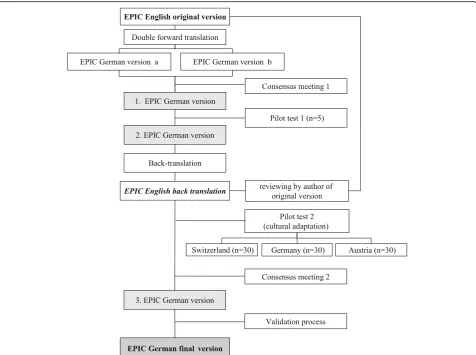
The translation and cultural adaptation process was based on the recommendations of the ISPOR Task Force international expert group [15] and followed a sequential forward and backward translation approach (Fig. 1). Two professional translators translated the original Eng-lish EPIC version into German. In a consensus meeting, five experts assessed the consistency of the translations, judged their face validity and agreed on a first German version. This first version was pretested in cognitive debriefings in five prostate cancer patients who agreed on a second German version. A professional translator translated this version back into English language which was then presented to the author of the original English version [5]. The second German version then was pre-tested in the three German speaking countries (Austria, Germany and Switzerland), each of them within thirty patients to assess the need for cultural adaptation. Fi-nally, the experts agreed on a third, final version of the German version of the EPIC (Additional file2).
Study population and study design
For the validation study, we recruited a subsample of patients who participated the Prostate Cancer Out-comes Cohort (proCOC) [16] who had a diagnosis of localized prostate cancer and underwent robotic radical prostatectomy within the Department of Urology of the University Hospital of Zurich between November 2008 and December 2010. The local Ethical Committee of the Canton of Zurich approved the study.
(internal consistency and cross-sectional construct validity). To assess test-retest reliability, a subgroup of participants completed the EPIC a second time one to two weeks later, before initiation of treatment. Follow-up assessments were conducted six weeks after treat-ment (longitudinal construct validity, responsiveness and MID).
Validation instruments
The European Organization for the Research and Treatment of Cancer Quality of Life Questionnaire– Prostate 25 (EORTC QLQ-PR25) [13] is a prostate spe-cific additional tool to the general quality of life instru-ment EORTC QLQ-C30 [17]. It includes 25 items with a 4-point Likert scale that contribute to the sexual activity and sexual functioning (scores 0–100; higher scores = higher level of functioning) and urinary symp-toms, bowel symptoms and hormonal treatment-related symptoms scales (scores 0–100, higher score = higher level of problems) [13]. For the EORTC-QLQ-C30, a MID of 5–10 has been established [17, 18], no
MID has been specifically reported so far for the pros-tate additional tool.
The Feeling Thermometer assesses generic health sta-tus on an analogue scale presented as a thermometer with 100 marked intervals (0 = dead to 100 = perfect health), a MID of 5 has been reported [19–21].
The SF-36 version 2.0 is a generic quality of life instru-ment that consists of 36 items describing 8 domains (scores 0–100; higher scores = better perceived state of health) [22,23]. MID between 7 and 12 have been sug-gested specifically for prostate cancer survivors [24].
The patients also rated the global change of their health state since baseline (after treatment) on a 5-point Likert scale at follow up, ranging from −2 (my health state worsened much) to + 2 (my health state improved much).
Statistical analysis
Table 1Mean scores of the EPIC summary domains and subscales and the validation instruments at baseline and at 6 weeks follow-up after robotic assisted radical prostatectomy and changes from baseline to follow-up
Measurement Baseline (n= 92)a 6-weeks follow-up (n = 92)a Change from baseline to follow-up (n = 92)a EPIC domain-specific summary scores
Urinary 90.0 (11.9) 61.7 (18.5) −28.3 (18.7)
Bowel 94.4 (7.8) 87.8 (11.6) −6.8 (11.0)
Sexual 61.1 (20.4) 17.5 (12.1) −44.0 (23.0)
Hormonal 90.5 (11.3) 87.2 (13.2) −3.3 (12.9)
Urinary subscales
Function 96.2 (9.6) 54.6 (21.8) −41.6 (22.1)
Bother 85.6 (15.2) 66.8 (18.3) −18.8 (19.5)
Incontinence 94.8 (13.4) 37.2 (27.4) −57.6 (27.4)
Irritation/obstruction 88.8 (12.9) 77.0 (17.4) −11.2 (18.8)
Bowel subscales
Function 93.8 (8.6) 88.3 (10.7) −5.7 (11.4)
Bother 95.1 (8.9) 87.4 (14.4) −7.7 (13.3)
Sexual subscales
Function 56.7 (21.9) 9.1 (11.3) −47.1 (22.4)
Bother 72.5 (23.8) 35.9 (28.2) −37.2 (32.8)
Hormonal subscales
Function 90.1 (12.7) 85.0 (14.9) −5.1 (15.4)
Bother 90.8 (11.3) 88.8 (12.8) −1.9 (12.3)
EORTC QLQ-PR25 symptom scales
Urinary symptoms 17.0 (16.0) 40.1 (20.8) 22.9 (19.4
Bowel symptoms 4.5 (7.9) 7.8 (9.5) 2.6 (10.3)
Hormonal treatment-related symptoms 6.5 (9.7) 11.9 (12.0) 4.7 (11.8)
EORTC QLQ-PR25 functional scales
Sexual activity 59.0 (25.4) 22.5 (24.6) −25.0 (30.6)
Sexual functioning 79.5 (19.0) 38.8 (19.4) −40.4 (25.6)
Feeling Thermometer 79.8 (15.5) 71.01 (17.3) −6.4 (19.7)
SF-36
Physical Functioning 96.7 (6.5) 77.3 (19.8) −19.4 (20.1)
Role-Physical 89.3 (19.9) 58.3 (27.0) −31.0 (29.8)
Bodily Pain 88.9 (17.9) 74.8 (27.4) −17.2 (31.1)
General Health 74.7 (16.5) 71.1 (17.0) −3.5 (16.1)
Vitality 38.6 (8.9) 31.3 (12.3) −7.2 (11.5)
Social Functioning 85.3 (20.7) 72.3 (28.2) −13.0 (31.1)
Role-Emotional 88.9 (18.9) 74.8 (27.4) −14.1 (26.9)
Mental Health 30.9 (6.7) 29.9 (8.3) −1.0 (7.5)
Abbreviations: EPICExpanded Prostate Cancer Index Composite,ERTC QLQ-PR25European Organization for the Research and Treatment of Cancer Quality of Life Questionnaire–Prostate 25 t
a
correlation coefficients (ICC; a priori defined: ≥0.70 [25]). To assess cross-sectional and longitudinal con-struct validity we used Pearson or Spearman’s rank cor-relation coefficients at baseline and at 6 weeks follow-up between the EPIC domain scores and the validation measures or the change sores, respecitvely. We a priori expected strong correlations (≥0.5) between the EPIC and the corresponding EORTC QLQ-PR25 scores and moderate correlations (0.3–0.5) between the EPIC and the Feeling Thermometer and selected SF-36 domain scores.
To quantify responsiveness, we assessed the standar-dised response mean (SRM) as the mean change score divided by SD of change score (a priori stronger effect sizes in urinary/sexual compared to bowel/hormonal domains expected). We established the MID by tri-angulation and used both anchor-based approaches (using EPIC domain change scores against the anchors “worsened” and“remained the same” of the global rat-ing of health state chance variable) and distribution-based approaches (standard error of measurement [SEM], Cohen’s effect size, empirical rule effect size) [26]. Analysis were performed using STATA version 13 [27].
Results
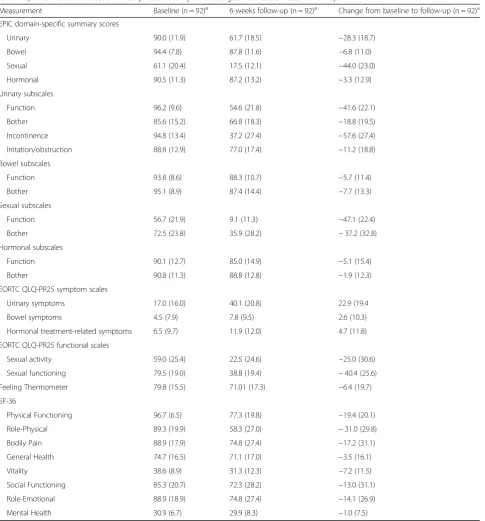
Ninety two consecutive participants of the proCOC study with localized prostate cancer and a mean age of 62.3 ± 7.1 years participated in the validation study and completed baseline assessments (before treatment) and 6 week follow-up assessments (after treatment). Mean scores of the EPIC summary domains and subscales and the validation instruments at baseline and at 6 weeks follow-up after robotic assisted radical prosta-tectomy and changes from baseline to follow-up are presented in Table1. A subsample of 44 participants of proCOC with a mean age of 62.5 ± 7.4 years completed the EPIC a second time before treatment to assess test-retest reliability, on average with 10.9 ± 13.3 days between the assessments.
Internal consistency and test-retest reliability
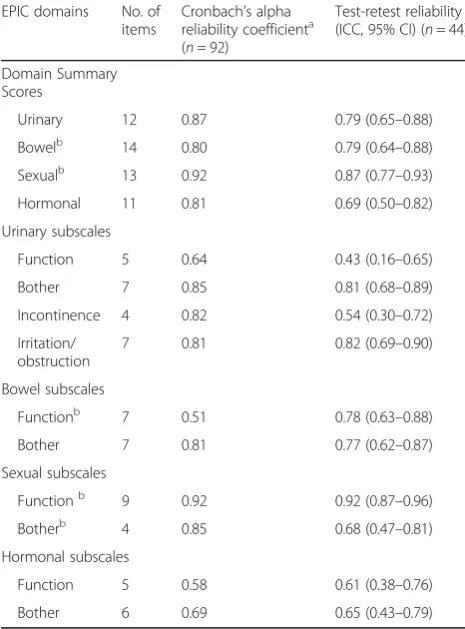
Characteristics of the EPIC domain and subscale scores and the results on internal consistency and re-producibility are presented in Table 2. In general, urine and sexual domain scores of the patients de-creased to a greater extent from baseline to 6 weeks follow-up than did bowel and hormonal domain scores. For the majority of the domain and subscale scores, Cronbach’s alpha values were within our a priori defined boundaries and test retest reliability above the threshold; ICCs of the domain scores were
between 0.69–0.87, of the subscales between 0.43– 0.92.
Construct (convergent) validity
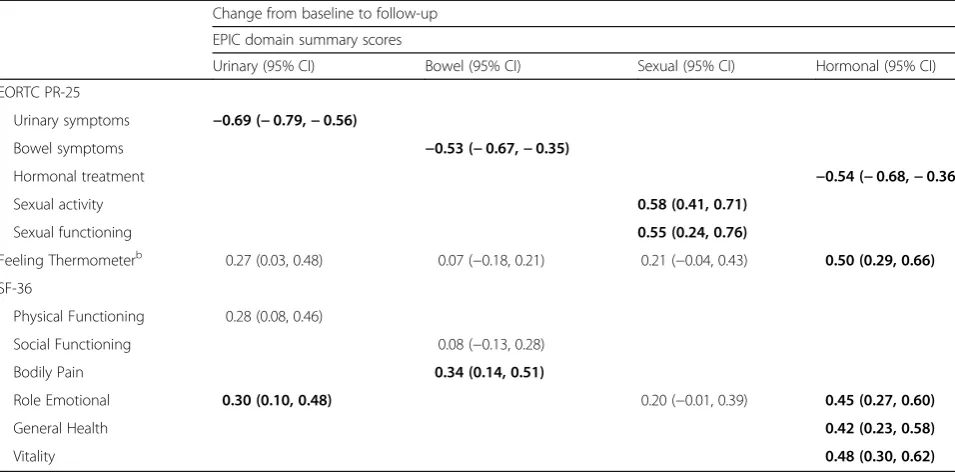
Tables 3 and 4 show correlation coefficients between the EPIC domain scores and the other validation in-struments according to whether they fulfilled our a priori assumptions regarding strength of correlation. Cross-sectional correlations (Table3) between the EPIC and the EORTC QLQ-PR25 domains ranged from 0.14–0.79. Correlations between the EPIC domains and the Feeling Thermometer and the SF-36 domains were weaker and ranged from 0.06–0.50 and 0.08–0.72, re-spectively. In most cases, correlations were stronger at 6 weeks follow-up than at baseline. Longitudinal corre-lations (Table4) between the change scores of the EPIC and EORTC QLQ-PR25 domains were all > 0.5. Change score correlations between the EPIC domains and the
Table 2Domain-specific summary and subscale scores of the German version of the EPIC at baseline and 6 weeks follow-up and results on internal consistency and reproducibilitya
EPIC domains No. of items
Cronbach’s alpha reliability coefficienta (n= 92)
Test-retest reliability (ICC, 95% CI) (n= 44)
Domain Summary Scores
Urinary 12 0.87 0.79 (0.65–0.88)
Bowelb 14 0.80 0.79 (0.64–0.88)
Sexualb 13 0.92 0.87 (0.77–0.93)
Hormonal 11 0.81 0.69 (0.50–0.82)
Urinary subscales
Function 5 0.64 0.43 (0.16–0.65)
Bother 7 0.85 0.81 (0.68–0.89)
Incontinence 4 0.82 0.54 (0.30–0.72)
Irritation/ obstruction
7 0.81 0.82 (0.69–0.90)
Bowel subscales
Functionb 7 0.51 0.78 (0.63–0.88)
Bother 7 0.81 0.77 (0.62–0.87)
Sexual subscales
Functionb 9 0.92 0.92 (0.87–0.96)
Botherb 4 0.85 0.68 (0.47–0.81)
Hormonal subscales
Function 5 0.58 0.61 (0.38–0.76)
Bother 6 0.69 0.65 (0.43–0.79)
Abbreviations: EPICExpanded Prostate Cancer Index Composite,ICCintraclass correlation coefficient
aCronbach’s alpha calculated using baseline scores b
Table 3Correlation coefficientsafor the EPIC domain summary scores with validation instruments at baseline and follow-up (n = 92b)
Baseline 6 weeks follow-up
EPIC domain summary scores EPIC domain summary scores
Urinary Bowel Sexual Hormonal Urinary Bowel Sexual Hormonal
EORTC PR-25
Urinary symptoms −0.70 −0.79
Bowel symptoms −0.42 −0.64
Hormonal treatment −0.58 −0.70
Sexual activity 0.68 0.14
Sexual functioning 0.66 0.25
Feeling Thermometerb 0.12 0.18 0.06 0.37 0.37 0.28 0.27 0.50
SF-36
Physical Functioning 0.40 0.47
Social Functioning 0.14 0.13 0.49 0.19
Bodily Pain 0.22 0.56
Role Emotional 0.08 0.61 0.36 0.62
General Health 0.47 0.59
Vitality 0.60 0.72
Abbreviations: EPICExpanded Prostate Cancer Index Composite,EORTC PR25European Organization for the Research and Treatment of Cancer Quality of Life Questionnaire–Prostate 25; Hormonal treatment = Hormonal treatment-related symptoms
aCorrelation coefficients according to distribution: Spearman’s rank correlation coefficients for not-normally distributed scores at baseline and 6 weeks follow-up.
Correlation coefficients are boldface font when they met our assumptions and normal font when they were higher or lower than expected b
Missing values: Correlations between EPIC and EORTC PR-25 domains: 3 to 13, except for EPIC sexual and EORTC PR25 sexual functioning domains (baseline = 23/ follow-up = 57); Correlations between EPIC domains and Feeling Thermometer: baseline = 24–25/follow-up = 9–10; Correlations between EPIC and SF-36 domains: all time points = 0–2
Table 4Correlation coefficientsafor the EPIC domain summary scores with validation instruments between change scores from baseline to follow-up (n = 92b)
Change from baseline to follow-up
EPIC domain summary scores
Urinary (95% CI) Bowel (95% CI) Sexual (95% CI) Hormonal (95% CI)
EORTC PR-25
Urinary symptoms −0.69 (−0.79,−0.56)
Bowel symptoms −0.53 (−0.67,−0.35)
Hormonal treatment −0.54 (−0.68,−0.36)
Sexual activity 0.58 (0.41, 0.71)
Sexual functioning 0.55 (0.24, 0.76)
Feeling Thermometerb 0.27 (0.03, 0.48) 0.07 (−0.18, 0.21) 0.21 (−0.04, 0.43) 0.50 (0.29, 0.66)
SF-36
Physical Functioning 0.28 (0.08, 0.46)
Social Functioning 0.08 (−0.13, 0.28)
Bodily Pain 0.34 (0.14, 0.51)
Role Emotional 0.30 (0.10, 0.48) 0.20 (−0.01, 0.39) 0.45 (0.27, 0.60)
General Health 0.42 (0.23, 0.58)
Vitality 0.48 (0.30, 0.62)
Abbreviations: EPICExpanded Prostate Cancer Index Composite,EORTC PR25European Organization for the Research and Treatment of Cancer Quality of Life Questionnaire–Prostate 25; Hormonal treatment = Hormonal treatment-related symptoms. CI=Confidence Interval
a
Correlation coefficients according to distribution: Pearson correlations coefficients for normally distributed change scores. Correlation coefficients are boldface font when they met our assumptions and normal font when they were higher or lower than expected
b
other validation instruments were weaker and ranged from 0.07–0.50.
Responsiveness to change and MID
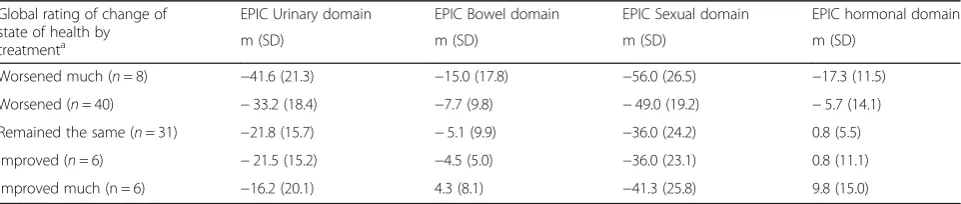
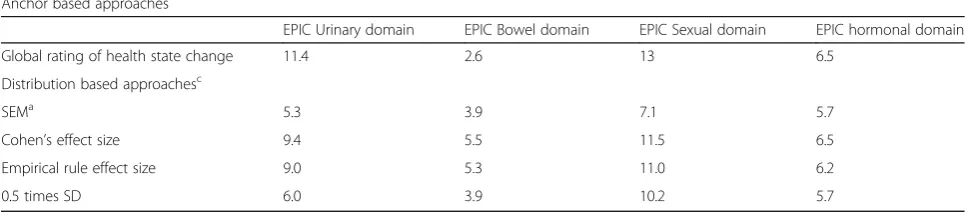
The SRMs of the EPIC change scores were −1.51 for the urinary domain,−0.62 for the bowel, −1.91 for the sexual and −0.26 for the hormonal domain. Table 5 shows the mean changes in the EPIC domains accord-ing to the global rataccord-ings of health state change. Table6 summarises the anchor and distribution based esti-mates. We established the MID by triangulation and suggest a MID of 10 for the urinary domain, 4 for the bowel domain, 12 for the sexual domain and 6 for the hormonal domain. Additional file 1: Tables S1 and S2 show the results for the EPIC subscales; in summary, we established for the urinary subscales MID between 9 and 12, for the bowel subscales 4 and 5, for the sex-ual subscales 11 and 13, and for the hormonal sub-scales 6 and 7 (Additional file1).
Discussion
With this study we provide a culturally adapted and thoroughly validated German version of the widely used EPIC 50-item questionnaire. The German EPIC showed good internal consistency, reproducibility and construct validity and was responsive to detect changes in patients with localized prostate cancer after radical prostatec-tomy. We established an MID of 10 for the urinary, of 4 for the bowel, of 12 for the sexual and of 6 for the hor-monal EPIC domains, respectively.
Compared to the participants of the original American development study [5] and some translation studies [7,9], the patients from our sample achieved slightly higher but similar EPIC scores at baseline. The exception was the sex-ual domain and subscales, for which our patients scored much higher, indicating a better HRQL in sexual aspects before treatment compared to the other populations.
All of the domain and most of the subscale scores fulfilled the a priori defined thresholds for consistency and test-retest reliability. The few exceptions were the urinary function subscale, which reached an insuffi-cient reproducibility, and, together with the bowel and
hormonal function subscales, also a low reliability. Interestingly, the test-retest reliability and internal consistency values of the EPIC domains and subscales in our study were very similar to those presented in the original development and validation study [5].
The usually moderate to strong correlations between the EPIC and the corresponding EORTC QLQ-PR25 domains suggest good convergent construct validity and confirm that the domains of the two questionnaires re-flect very similar constructs of HRQL in prostate cancer. The weaker correlations with selected and more generic SF-36 domains and the generic Feeling Thermometer were expected. Interestingly, the EPIC hormonal domain showed mostly the highest correlations with the more generic scales.
As expected, the urinary and sexual domains were much more responsive to the treatment than the bowel and hormonal domains. Radical prostatectomy predominantly affects sexual and urinary aspects of HRQL, especially soon after surgery. In contrast, other therapies such as radiotherapy would have affected rather bowel and hormonal components.
To our knowledge, we propose for the first time MID for the EPIC 50-item version. This is surprising, since there is growing awareness of the fact that outcome measurements need to be able to detect clinically rele-vant changes when used for evaluative purposes. MIDs have already been suggested for the two EPIC short form versions. The EPIC-26 [11] uses the same scoring system as the EPIC 50-item and retained the domain structure (only the urinary domain dropped and using the two urinary subscales urinary incontinence and urinary irritation/obstruction). Our suggested MIDs were mainly in the range of the established MIDs for the EPIC-26 (6–9 for the urinary incontinence, 5–7 for the urinary irritation/obstruction, 4–6 for bowel, 10–12 for sexual and 4–6 for the hormonal domain) [28]. The scores of the 16-item EPIC-CP [12] domains range from 0 to 12 and, therefore, the MIDs are not compar-able. However, also for this 16 item version, the MID was highest estimated for the sexual domain (1.6) and lowest for the vitality/hormonal (1.0) (MID for other
Table 5Mean changes in the EPIC domains according to global rating of health state change at follow-up
Global rating of change of state of health by treatmenta
EPIC Urinary domain EPIC Bowel domain EPIC Sexual domain EPIC hormonal domain
m (SD) m (SD) m (SD) m (SD)
Worsened much (n= 8) −41.6 (21.3) −15.0 (17.8) −56.0 (26.5) −17.3 (11.5)
Worsened (n= 40) −33.2 (18.4) −7.7 (9.8) −49.0 (19.2) −5.7 (14.1)
Remained the same (n= 31) −21.8 (15.7) −5.1 (9.9) −36.0 (24.2) 0.8 (5.5)
Improved (n= 6) −21.5 (15.2) −4.5 (5.0) −36.0 (23.1) 0.8 (11.1)
Improved much (n = 6) −16.2 (20.1) 4.3 (8.1) −41.3 (25.8) 9.8 (15.0)
Abbreviations: EPICExpanded Prostate Cancer Index Composite a
domains: 1.3 for urinary irritation/obstruction, 1.2 for bowel, 1.0 for urinary incontinence) [29].
Strengths of our study are the rigorous adherence to the international ISPOR guidance for the translation and validation of patient reported outcomes. The cultural adaption also took differences in mentalities between the German speaking countries into consideration and re-sulted in an instrument applicable in all of them. Fur-thermore, the assessments took place in a prospective cohort study with a priori defined hypothesis regarding results.
One limitation of the validation part of our study is that we included patients who underwent radical pros-tatectomy only and focused on short-term changes (6 weeks after treatment) to assess responsiveness and MID of the EPIC. As already stated and expected, the HRQL aspects of the domains urinary and sexual are more affected by this kind of treatment than the bowel and hormonal domains, which might challenge the generalizability of our results to prostate patient under-going other treatments such as external radiation or hormonal deprivation therapy, experiencing other side effects. However, it would be interesting to replicate the analyses in prostate cancer patients undergoing other treatments, particularly the assessment of the MID in these populations. Another limitation is that we used the anchors“worsened”and“remained the same” of the global rating of health state chance variable as anchor based approach to establish the MIDs. This implies that we assume the differences between “worsened” and “remained the same”to reflect to be minimally import-ant for patients, which we cannot be sure about. Unfor-tunately, the anchor EORTC QLQ-PR25 resulted in somewhat implausible values, probably due to the transformation of both instruments to 0–100 scales and the reverse scaling of some counterpart domains. An additional limitation is that for the method we used to test cross-sectional and longitudinal construct validity, correlation coefficients, the sample size of 92 patients is
rather small. However, the consequence of a smaller sample size is not different correlation coefficients (which depends more on how the population is se-lected) but that the estimates are more imprecise, i.e. that the confidence intervals around correlation coeffi-cients are wider compared to confidence intervals of correlation coefficients based on larger sample sizes.
Conclusions
The German version of the EPIC showed to be a reliable, valid and responsive instrument to detect changes in HRQL components due to prostate cancer treatment. With the suggested MIDs we provide interpretation to what extent changes in HRQL are clinically relevant for pa-tients. Hence, study results are of interest beyond German speaking countries.
Additional files
Additional file 1Table S1: Mean changes in the EPIC subscales according to global rating of health state change at follow-up.Table S2: Anchor- and distribution-based estimates of the minimal important differ-ence for the EPIC subscales (n= 92*). (DOCX 21 kb)
Additional file 2The Expanded Prostate Cancer Index Composite (EPIC). (PDF 45 kb)
Abbreviations
EORTC QLQ-PR25:The European Organization for the Research and Treatment of Cancer Quality of Life Questionnaire–Prostate 25; EPIC: Expanded Prostate Cancer Index Composite; HRQL: Health related quality of life; MID: Clinically minimal important difference; PCa: Prostate Cancer; SF-36: 36-Item Short Form Health Survey
Acknowledgements
We would like to thank Ms. Alexandra Veloudios, study nurse at University Hospital of Zurich, for her great effort in the proCOC study.
Funding
We would like to thank the following foundations for their valuable financial support of the study: Baugarten Foundation, Zurich, Switzerland; Swiss Life Jubilee Foundation, Zurich, Switzerland; Schwyzer Foundation, Zurich, Switzerland; Foundation for Urological Research, Zurich, Switzerland. None of these foundations had any further part than the above declared in the study.
Table 6Anchor- and distribution-based estimates of the minimal important difference for the EPIC summary domains (n= 92a)
Anchor based approaches
EPIC Urinary domain EPIC Bowel domain EPIC Sexual domain EPIC hormonal domain
Global rating of health state change 11.4 2.6 13 6.5
Distribution based approachesc
SEMa 5.3 3.9 7.1 5.7
Cohen’s effect size 9.4 5.5 11.5 6.5
Empirical rule effect size 9.0 5.3 11.0 6.2
0.5 times SD 6.0 3.9 10.2 5.7
Abbreviations: EPICExpanded Prostate Cancer Index Composite,SEMStandard error of measurement aMissing values: 0–2; SEM approach based on the test-retest subsample of 44 participants b
Averaged difference in mean change score in EPIC domains between those who rated their health state as“worsened”and“remained the same” c
Availability of data and materials
The dataset used during the current study are available from the corresponding author on reasonable request.
Authors’contributions
The authors’contribution has been as follows: concept and design (MHU, LMB, JS, MAP, AF); acquisition of data (MU, LMB); analysis and interpretation of data (MHU, LMB, CP, JA, MAP, AF); drafting of the manuscript (MHU, LBM, CP, MAP, AF); critical revision of the manuscript for important intellectual content (LMB, CP, PH, JS, MAP, AF); statistical analysis (LMB, MAP, AF); obtaining of funding (MHU, LMB, CP, JS); supervision (LMB, JA, MAP, AF). All authors read and approved the final manuscript.
Ethics approval and consent to participate
The local Ethical Committee of the Canton of Zurich approved the study and informed consent has been obtained by all patients.
Consent for publication
No data of an individual patients included in this study are contained in this manuscript, hence, no consent for publication must be obtained.
Competing interests
The author and the co-authors declare that they have no competing interests.
Publisher’s Note
Springer Nature remains neutral with regard to jurisdictional claims in published maps and institutional affiliations.
Author details
1Department of Urology, City Hospital Triemli of Zurich, Birmensdorferstrasse
497, 8063 Zurich, Switzerland.2Horten Centre of patient orientated research and knowledge transfer, University of Zurich, Zurich, Switzerland. 3Medignition AG, Zurich, Switzerland.4Department of Urology, University
Hospital of Zurich, Zurich, Switzerland.5Clinic of Urology, Städtisches Klinikum Braunschweig, Braunschweig, Germany.6Epidemiology, Biostatistics and Prevention Institute, University of Zurich, Zurich, Switzerland.
Received: 19 July 2017 Accepted: 5 February 2018
References
1. Trama A, Foschi R, Larrañaga N, Sant M, Fuentes-Raspall R, Serraino D, et al. Survival of male genital cancers (prostate, testis and penis) in Europe 1999– 2007: Results from the EUROCARE-5 study. Eur J Cancer. 2015;51:2206–16. 2. Bill-Axelson A, Garmo H, Holmberg L, Johansson J-E, Adami H-O, Steineck G,
et al. Long-term distress after radical prostatectomy versus watchful waiting in prostate cancer: a longitudinal study from the Scandinavian Prostate Cancer Group-4 randomized clinical trial. Eur Urol. 2013;64:920–8. 3. Sanda MG, Dunn RL, Michalski J, Sandler HM, Northouse L, Hembroff L, et al.
Quality of life and satisfaction with outcome among prostate-cancer survivors. N Engl J Med. 2008;358:1250–61.
4. Harrington S, Lee J, Colon G, Alappattu M. Oncology section EDGE task force on prostate cancer: A systematic review of outcome measures for health-related quality of life. Rehabil Oncol. 2016;34:27–35.
5. Wei JT, Dunn RL, Litwin MS, Sandler HM, Sanda MG. Development and validation of the expanded prostate cancer index composite (EPIC) for comprehensive assessment of health-related quality of life in men with prostate cancer. Urology. 2000;56:899–905.
6. Litwin MS, Hays RD, Fink A, Ganz PA, Leake B, Brook RH. The UCLA Prostate Cancer Index: development, reliability, and validity of a health-related quality of life measure. Med Care. 1998;36:1002–12.
7. Chung KJ, Kim JJ, Lim SH, Kim TH, Han DH, Lee SW. Development and validation of the korean version of expanded prostate cancer index composite: questionnaire assessing health-related quality of life after prostate cancer treatment. Korean J Urol. 2010;51:601–12.
8. Takegami M, Suzukamo Y, Sanda MG, Kamoto T, Namiki S, Arai Y, et al. The Japanese translation and cultural adaptation of Expanded Prostate Cancer Index Composite (EPIC). Japanese J Urol. 2005;96:657–69.
9. Alves E, Medina R, Andreoni C. Validation of the Brazilian version of the Expanded Prostate Cancer Index Composite (EPIC) for patients submitted to radical prostatectomy. Int Braz J Urol. 2013;39:344–52.
10. Ferrer M, Garin O, Pera J, Prats JM, Mendivil J, Alonso J, et al. Evaluation of the quality of life of patients with localizad prostate cancer: validation of the Spanish version of the EPIC. Med Clínica. 2009;132:128–35.
11. Szymanski KM, Wei JT, Dunn RL, Sanda MG. Development and validation of an abbreviated version of the expanded prostate cancer index composite instrument for measuring health-related quality of life among prostate cancer survivors. Urology. 2010;76:1245–50.
12. Chang P, Szymanski KM, Dunn RL, Chipman JJ, Litwin MS, Nguyen PL, et al. Expanded prostate cancer index composite for clinical practice: development and validation of a practical health related quality of life instrument for use in the routine clinical care of patients with prostate cancer. J Urol. 2011;186:865–72.
13. van Andel G, Bottomley A, Fosså SD, Efficace F, Coens C, Guerif S, et al. An international field study of the EORTC QLQ-PR25: a questionnaire for assessing the health-related quality of life of patients with prostate cancer. Eur J Cancer. 2008;44:2418–24.
14. Beyer B, Huland H, Feick G, Graefen M. Expanded prostate cancer index composite" (EPIC-26): Results of functional treatment in patients with localized prostate cancer. Urologe. 2015;54:1591–5.
15. Wild D, Grove A, Martin M, Eremenco S, McElroy S, Verjee-Lorenz A, et al. Principles of good practice for the translation and cultural adaptation process for Patient-Reported Outcomes (PRO) measures: report of the ispor task force for translation and cultural adaptation. Value Heal. 2005;8:94–104. 16. Umbehr M, Kessler TM, Sulser T, Kristiansen G, Probst N, Steurer J, et al.
ProCOC: the prostate cancer outcomes cohort study. BMC Urol. 2008;8:9. 17. QL Coordinator. EORTC QLQ-C30 Scoring Manual 2001.
18. Osoba D, Rodrigues G, Myles J, Zee B, Pater J. Interpreting the significance of changes in health-related quality-of-life scores. J Clin Oncol. 1998;16:139–44. 19. Devlin NJ, Krabbe PFM. The development of new research methods for the
valuation of EQ-5D-5L. Eur J Heal Econ HEPAC Heal Econ Prev Care. 2013; 14(Suppl 1):S1–3.
20. Puhan MA, Behnke M, Devereaux PJ, Montori VM, Braendli O, Frey M, et al. Measurement of agreement on health-related quality of life changes in response to respiratory rehabilitation by patients and physicians–a prospective study. Respir Med. 2004;98:1195–202.
21. Schunemann HJ, Griffith L, Jaeschke R, Goldstein R, Stubbing D, Guyatt GH. Evaluation of the minimal important difference for the feeling thermometer and the St. George’s Respiratory Questionnaire in patients with chronic airflow obstruction. J Clin Epidemiol. 2003;56:1170–6.
22. Ware JE, Sherbourne CD. The MOS 36-item short-form health survey (SF-36). I. Conceptual framework and item selection. Med Care. 1992;30:473–83. 23. Ware JE. SF-36 health survey update. Spine (Phila Pa 1976). 2000;25:2130–9. 24. Jayadevappa R, Malkowicz SB, Wittink M, Wein AJ, Chhatre S. Comparison of
distribution- and anchor-based approaches to infer changes in health-related quality of life of prostate cancer survivors. Health Serv Res. 2012;47: 1902–25.
25. Deyo RA, Diehr P, Patrick DL. Reproducibility and responsiveness of health status measures. Statistics and strategies for evaluation. Control Clin Trials. 1991;12:142S–58S.
26. Revicki D, Hays RD, Cella D, Sloan J. Recommended methods for determining responsiveness and minimally important differences for patient-reported outcomes. J Clin Epidemiol. 2008;61:102–9.
27. StataCorp. Stata Statistical Software: Release 13. College Station: StataCorp LP; 2013.
28. Skolarus TA, Dunn RL, Sanda MG, Chang P, Greenfield TK, Litwin MS, et al. Minimally important difference for the Expanded Prostate Cancer Index Composite Short Form. Urology. 2015;85:101–5.