SCITECH
Volume 4, Issue 1
RESEARCH ORGANISATION
August 17, 2015
Journal of Research in Business, Economics and Management
www.scitecresearch.com
Reactive Crisis Management Model
Parvinder Pal Singh
1, Harpreet Singh Chahal
21Corresponding Author, Research scholar,Department of Business Management, Guru Nanak Dev University Regional campus, Gurdaspur.
2Asst. professor, Department of Business Management,
Guru Nanak Dev University Regional campus, Gurdaspur.
Abstract:
Crisis is an ever present threat to an organization in our society. When a crisis occurs, an organization must act immediately to protect its reputation. There is a need of wide range study of crisis management. Various models regarding crisis management have been presented by various experts. These models are mainly proactive in nature having (1) Pre Crisis phase (2) Crisis phase (3) Post Crisis phase. Crisis management is a situation-based management system that includes clear roles and responsibilities and process related organizational requirements company-wide. As we know, crisis is an uncertain event, so preparing in advance for it is probably not possible. Even in diffusion of innovation theory it is discussed that during crisis, every employee should think out of the box and come up with novel ideas to overcome hard times. In this article, an attempt has been made to prepare a reactive crisis model which suggests a way to deal with crisis at the time it occurs. In this model, the crisis management protocol should follow three steps, namely, (1) GET (2) SET (3) GO. In first step, basic information regarding the crisis should be gathered viz, cause and severity of crisis. In second step, crisis management plans and teams should be formulated keeping in view the severity of crisis and the third step should deal with the execution of formulated plans with the help of crisis management team.
Keywords:
Crisis Management; Reactive Model; Communication; Management Teams.Introduction:
We are breathing in an age of crises (Lerbinger, 1997), so accepting and dealing with crises is becoming an actual test for both practitioners and researchers. Crisis is an evident feature of the business setting with the potential to harm any organization (Baker, 2001; Mitroff & Alpasian, 2003; Pauchant & Mitroff, 1992; Williams & Olaniran, 1998). Crises are random happenings that can Influence an organization’s sustainability, reliability and name (Baker, 2001; Mitroff, Shrivastava, & Udwadia, 1987).
Timothy Coombs (2007) defined crisis as a significant threat to operations that can have negative consequences if not handled properly. In crisis management, the threat is the potential damage a crisis can inflict on an organization, its stake holders and industry. A crisis can create three related threats: (1) public safety (2) financial loss and (3) reputation loss.
According to Hermann (1972), ―A crisis is a situation that threatens high priority goals of the decision-making unit, restricts the amount of time available for response before the decision is transformed and surprises the members of the decision-making unit by its occurrence".
Fearn-Banks (1996) defined a crisis as "a major occurrence with a potentially negative outcome affecting an organization, a company, or an industry, as well as its public, products, services, or good name".
aims are unachievable. During the onset of crisis, communication plays a very vital role and the media structures the public view about the crisis (Cornelissen, 2011). It is employed by an organization to defend its name and visibly structure the public opinion through media. It is very vital for an organization to have appropriate and speedy reply during a crisis. Its significance is further increased by the fact that due to the progress of social media, online buzzes can flow worldwide in very less time. According to Barton (2001), it is extremely vital for any organization to monitor media reportage very carefully to observe any feedbacks in a crisis. This is due to the fact that news media ―can be the principal adversaries in a crisis‖ (Fearn-Banks, 2009) as it sees itself as advocates for the public. The organization must communicate to and affect gatekeepers in news media in order to frame the public belief about the crisis and the organization in order to protect its status (Coombs, 2007). The recent outbreak of crisis of a common household product of Nestle is a good example of how media could play a vital role in formulating the public opinion.
Pearson and Clair (1998) noted that organizations will experience better success when crisis preparation and reaction rests with a crisis management team than with an individual person. During a crisis, generating and institutionalizing a constructive mind-set initiates with an effective crisis management team (Pearson et al., 1997) and the employees who are members of a crisis management team must possess effective communication and management skills. These skills permit team participants the chance to enable and discuss ideas between the different departments of the organization, monitor important assumptions that may influence the belief system of the crisis plan, attain employee thoughts on possible crisis and crisis management, and inspire new try-outs that could assist the organization in preparing for a crisis (Pauchant and Mitroff, 1992). In a similar manner, Fink (1986) stated that one of the first duty of the central core is to draw up a list of names for the crisis management team, so that when the crisis hits, no one has to sit around and wonder who ought to be called in. Good crisis management decreases loss and it may even increase a company’s repute.
Some Past Crisis Cases:
In September of 1982, seven deaths occurred due to the intake of Extra-Strength Tylenol that was laced with cyanide in Chicago area in Johnson & Johnson factory (Regester & Larkin, 2008). The news reports of the crisis initiated a flood of criticism against Johnson & Johnson across the country and it had to suffer severe financial losses (Pinsdorf, 1999).
In 1989, one ton foot oil tanker called Exxon Valdez, plunged into the rocks and was grounded on Bligh Reef in Prince William Sound (Alaska) which caused dispersal of approximately 11 million gallons of crude oil in the surrounding locality (Dougherty, 1992). This oil spillage is still considered ―America’s worst oil spill‖ and it brought lot of criticism for the company.
In 1993, two Cadbury chocolate bars were found infected with worms in Mumbai, India. The Maharashtra FDA quickly seized the chocolate stock at Cadbury's nearby manufacturing plant in Pune. The company was slow to respond initially but later released a report claiming that the infestation was not possible at the manufacturing phase. The FDA disagreed provoking a battle between the two and the brand was under extensive media attack. In response to the situation, Cadbury launched advertising promos with an educational PR project that targeted retailers and kept the media updated through press releases on the specific measures it was taking to correct its manufacturing and storing processes. The company also imported new machinery and changed the packaging of its Dairy Milk bars. Within eight weeks of the introduction of its new packaging and advertising campaign, sales had almost reached pre-crisis levels. (Sources: Rediff, Public Relations Consultants Association of India)
Two Domino’s Pizza employees posted a ridiculous video on YouTube showing one male employee ―violating standard health codes by intentionally contacting food with several of his orifices,‖ which caused a major crisis for Domino’s Pizza in 2011, affecting its sales (Ulmer, Sellnow, & Seeger, 2011).
In June 1999, Belgium and northern France was the site of a severe outbreak of health complaints related to intake of Coca-Cola products. The Belgian health authorities prohibited the sale and drinking of all soft drinks from the Coca-Cola for numerous weeks, and the health authorities from other countries also took strict actions against the company. Financial report of Coca-Cola Enterprises Inc. (Coca-Cola Enterprises Inc., 2000) shows that about 17 million unit cases of Coca-Cola and other soft drinks were recalled and existing stocks were destroyed, at an estimated cost of US$ 103 million (Anon, 1999a).
In 2010, Toyota recalled about 8.8 million vehicles for safety defects, including a problem where the car's accelerator would jam, which caused several deaths. Toyota initially couldn't figure out the exact problem, but it sent out PR teams to stop the media criticism. The upper management was unseen in the initial stages of the crisis, twisting public opinion further against the company. The company failed miserably in its initial crisis management stage but still it bounced back. It didn't take long for the public to recall Toyota's past reputation. The company offered extended warranties and increased marketing, taking benefit from its long-term track record and reassuring consumers about safety. (Sources: BrandZ and The Guardian)
organization is constantly at threat (Weiner, 2006). During crisis an organization should necessarily attempt to defend its status by means of adjusting communication to investors and framing the public outlook through the news media with press releases.
Theories for Crisis Management:
Various theories have been put forward by many experts for the crisis management. Some of the theories have been summarised below:
Structural Functions Systems Theory:
According to structural functions systems theory, communication plays a key role in crisis management and accurate movement of information across all orders is vital with transparency. Management must effectually communicate with employees and deliver them the essential information during the periods of crisis. Superiors must be in steady contact with subordinates, as overlooking people does not assist, instead makes circumstances worse. Leaders must take responsibility and direct the employees to give their best. (Dunlop, 1958)
Diffusion of Innovation Theory
Diffusion of innovation theory has been proposed by Everett Rogers. It supports the sharing of information during crisis conditions. During crisis every employee should think out of the box and come out with novel ideas to overcome the crisis and must be prepared with a substitute plan. Once an employee emanates up with a novel idea, he must not keep things to himself. Effective communication is vital to pass on ideas and information in sought after form (Kaminski, 2011).
Unequal Human Capital Theory
Unequal human capital theory has been proposed by Erika James (2010). According to this theory, inequality among employees leads to crisis at the place of work. Discrimination on the grounds of class, job profile as well as earnings leads to dissatisfied employees who ultimately play with the brand name, spread unjustified gossips and earn an evil name for the organization.
Proposed Model for Crisis Management:
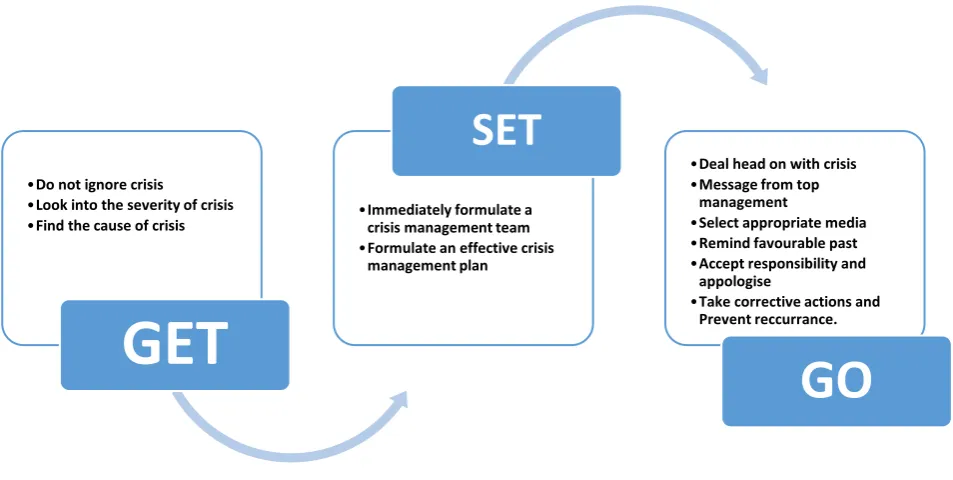
Various models have been proposed in the past to deal with crisis but all of them are proactive in nature. However, crisis being an uncertain event, the reactive crisis management model presented in the current article would have an advantage over proactive crisis management models. Laurence Barton (1994) suggested that the crisis is an ―uncertain event‖ which will cause possible negative impact on an organization. A reactive crisis model has been proposed in the present study (Figure 1). This three step model gives an idea about how to deal with the crisis at the time it occurs.
Figure 1: Proposed Reactive Crisis Management Model (Get, Set and Go).
•Do not ignore crisis
•Look into the severity of crisis •Find the cause of crisis
GET
•Immediately formulate a crisis management team •Formulate an effective crisis
management plan
SET
•Deal head on with crisis •Message from top
management
•Select appropriate media •Remind favourable past •Accept responsibility and
appologise
•Take corrective actions and Prevent reccurrance.
1) GET:
Do not ignore crisis: According to Millar & Heath (2003) a crisis can harm the organization’s tussles to build understanding and maintain equally advantageous relations with concerned parties whose support and good will the organization wants. It is further argued that crises are threats, denotation that they really do or have the potential to produce negative or unwanted outcomes (Coombs, 1999). Thus, an organization cannot merely overlook a crisis and expect, it will go away at some point (Fearn-Banks, 2009).
Check the Severity of crisis: Crisis severity lies in the findings of the beholder. From the company’s view, the happening that sets off a crisis might look unimportant. Yet, it could be enlarged by conditions or by media. Nestlé S.A., for example, misjudged the perceived severity of the situation when traces of ink were found in its baby milk at several European countries in 2005. Chairman and CEO Peter Brabeck-Letmathe openly termed the problem a ―storm in a teacup.‖ According to Nestle, and then confirmed by the European Commission, there was no threat to health from in taking the milk. But in the views of consumers and the affected countries’ food safety agencies, the problem was dreadful — and from a communications opinion, that was the view that counted.
Cause of crisis: It is very important to understand the cause of crisis. This is not a detailed research, but the reasons, why crisis has occurred. We can take a recent example of Maggi noodles. In this case the cause of crisis was presence of Lead and Monosodium Glutamate in the instant noodles.
2) SET:
Immediately formulate a crisis management team: The crisis management team has three basic tasks: making the crisis management plan, enacting it, and dealing with any snags not enclosed in it. (Coombs, 2007).Organizations that prepare for a crisis frequently employ the use of teams in making a crisis management plan (Dorn, 2000). Barton (2001) recognises the common fellows of crisis team as public relations, public, security, operations, finance and human resource. Yet composition would differ based on the nature of crisis. Mitroff, Harington and Gia (1996) highlight that preparation is required so that team members can practise making judgement in crisis condition. Coombs (2007), summarises the research and demonstrates how preparation increases the quality of a crisis team decision making and associated task performance. According to Coombs (1999), a crisis management team is a cross-functional assembly of people inside an organization which have been selected to handle crisis. The crisis management team should include employees from all departments within the organization. This method permits the organization to successfully react to numerous audiences when met with a corporate crisis (Barton, 1993)
Formulate an effective crisis management plan: a crisis management offers a list of crucial contact information cues of what exactly should be done in a crisis (Timothy coombs, 2007). Good crisis management requires an affective plan; even if it is just a plan to get to the roots of the crisis. It establishes when the company will communicate, so people do not have a reason or chance to fill in the gaps on their own. People are sensible and amazingly patient. People are also sluggish to pardon and believe again once the trust has been broken by lies, cover ups or dishonesties. Good crisis management takes the benefit of the goodness of the public and forms an environment to keep or reconstruct credibility (The cost of crisis management: How to save company by Russell B. Morgan). Checking what others have done in parallel circumstances could also offer a good idea of what ought to be done in the current condition.
3) GO:
Deal head on with crisis: It is obvious that whether a company has a crisis management plan or not, if a crisis does arise there is no escape from it. The company has to deal head on with it. The company best employees have to handle it and put the fire out. They have to take the immediate actions to defend the people and all those resources that are valuable to the company, comprising immaterial resources like goodwill and corporate image. Above all they have to react to crisis decisively with bravely, willpower, courage, self-respect and perseverance. Good crisis management can make a massive difference in easing the discomfort of handling and getting the company out of crisis sooner. (John Chong, 2004)
response, numerous people will have made up their minds and will have moved on to additional existing news. In other words, the company has to make the first imprint – or social media will create it for the company.
Select appropriate media for communication: The news media has direct contact to the listeners of an organization, so rather than escaping from media, use them as channel to communicate crucial messages (Weiner, 2006).Hence, it is vital to provide related information and communicate the organization’s upcoming actions to get through the crisis positively. Therefore, during a crisis the main job for an organization is to help the media cover the story precisely and with least criticism of the organization or company (Fearn-Banks, 2009).For example, PepsiCo Inc. was opposed with numerous claims that it had vended cans enclosing foreign articles such as syringes. The issue rapidly heightened into a national news story. With a crisis plan for product tampering in place and the support of the Food and Drug Administration, which had found no health threats linked to the claims, the crisis was taken to a termination within eight days only. Pepsi’s most intense communication tool was a video release that displayed the process of a can-filling, which convincingly established that it was impossible for objects to go in the cans during production. The video was broadcasted. This example shows the importance of promptness, which is significantly boosted by good research.
Remind brand’s favourable past: A company’s past is also an important aspect in whether consumers hold the brand guilty for a problem. Brands that have a past of like crises are more expected to be believed accountable for the critical state. On the other hand, consumers are less expected to blame the brand for wrong doing if the brand has a good and favourable standing. One more fascinating argument advancing by Coombs (1995) is that people are more prepared to excuse an organization with a past of positive acts rather than snags as an organization’s previous performance can be a significant aspect in a crisis. People always don’t know about an organization’s earlier performance, so this neutral state works in support of an organization (Coombs, 1995). A positive standing will lead main people and investors to wait to listen to the organization’s side before depicting assumptions about the crisis (Coombs, 2007). In order to have good relationships before a crisis, organizations must build up their reputation by adapting presentation so the actions voice for themselves rather than trying to raise up a decent lie to hide inferior performance (Regester & Larkin, 2008).
Accept Responsibility and Apologise: An organization is seen as rightly accountable or guilty for the crisis, the organization will have to guard its situation or may have to accept responsibility and apologize for the crisis (Cornelisse, 2011). If an organization has deliberately run the company into a crisis, then a tactic of separation the organization from the crisis is futile (Cornelissen, 2011). In addition, Cornelissen (2011) claims that ―Defensive strategies, such as denial or downplaying, logically become less effective as organizations are viewed as more responsible for the crisis‖. So, in such circumstances an organization requires to admit the complete accountability for the crisis, apologise and guarantee curative actions in the future. Corporate apology is a best fit with crisis communication because a crisis harms the corporate character thereby calling forward for defence (Coombs, Fradsen, Holladay & Johansen, 2010).
Take Corrective Actions and Prevent Recurrence: It is significant to state that a crisis does not mean that the life of an organization has ended (Fearn-Banks, 2009). Its standing can be scratched, but still remain to prosper in business. Fearn-Banks (2009) discusses that ―The public is forgiving if corrective actions are taken to avert recurrence. Communicate with the public and media about what is being done to avert a recurrence of the crisis and to safeguard them from any coming crises (Coombs, 2007). Organizations that offer a possible idea for recovery are more likely to be able to lessen doubt post-crisis (Ulmer, Sellnow, & Seeger, 2011). When an organization talks of actions it is taking to avert alike crisis, it is acknowledged as a corrective action, which is needed to present as quickly as possible in the crisis response, because it ―reduces psychological stress by reassuring stakeholders that their safety is a priority‖ (Coombs, 2007).
Conclusion:
viewpoint look to be more effective in actual crisis management situation (Uriel Rosenthal, Alexander Kouzmin: 1997) and in sensitizing decision makers to the rich understanding. If handled appropriately, the crisis can show the company’s strengths.
Bibliography:
[1] Anon, (1999a). Coke adds life, but cannot always explain it. Lancet, 354, 173.
[2] Baker, G. F. (2001). Race and reputation: Restoring image beyond the crisis in health. In R L. Heath (Ed.), Handbook of Public Relations. Thousand Oaks: Sage Publishers.
[3] Barton, L. (2001). Crisis in Organizations II. South-Western College Publishing –Thomson Learning, Cincinnati, OH.
[4] Barton L. (1993). Crisis in Organizations: Managing and communicating in the Heat of Chaos. Cincinnati, OH: College Division South-Western Publishers.
[5] BrandZ, The Guardian
[6] Cornelissen, J. (2011). Corporate Communication: A Guide to Theory and Practice (3rd. edition) London, Sage Publishers.
[7] Kaminski, J. (2011). Diffusion of Innovation Theory. Canadian Journal of Nursing Informatics, 6(2). Theory in Nursing Informatics Column. http://cjni.net/journal/?p=1444
[8] Coombs, W.T., Frandsen, F., Holladay, S.J., & Johansen, W. (2010). Why a concern for apologia and crisis communication? Corporate Communications: An International Journal 15(4): 337-349.
[9] Coombs, W.T. (2007), Situational Crisis Communication Theory. Corporate reputation review.
[10] Coca-Cola Enterprises, (2000). Coca-Cola Enterprises Inc., 2000. 1999 Financial Report.
http://www.cokecce.com/srclib/investor/1999_annual_report/cce99fin.pdf (accessed15.10.2001).
[11] Coombs, W. T. (1999). Ongoing crisis communication: Planning, managing, and responding. Thousand Oaks, CA: Sage Publishers.
[12] Coombs, W. T. (1999). ―Information and Compassion in Crisis Responses: A Test of Their Effects‖. Journal of Public Relations Research.
[13] Coombs, W. T. (1995). Choosing the right words: The development of guidelines for the selection of the ―appropriate‖ crisis response strategies. Management Communication Quarterly. 8(4): 447-476.
[14] Dorn, M. (2000). An Effective Crisis Response Team, School Planning & Management. 39, 18.
[15] Dougherty, D. (1992). Interpretive barriers to successful product innovations in large firms. Organization science. 3(2): 179-202.
[16] Dunlop, J. T. (1958). Industrial Relations Systems. New York: Holt Rinehart and Winston
[17] Fearn-Banks, K. (2009). Crisis Communication: A Casebook Approach. Third edition, Lawrence Erlbaum Associates, Publishers. Mahwah, New Jersey London. Retrieved 15 April, 2014, from
[18] http://www.asb.eblib.com.ez.statsbiblioteket.dk:2048/patron/FullRecord.aspx?p=446794.
[19] Fink, S. (1986). Crisis Management: Planning for the Inevitable. New York, NY: American Management Association).
[20] Herman, C. F., eds. (1972). International Crises: Insights from Behavioral Research. New York: Free Press. [21] James, E; Lynn. (2010). Leading Under Pressure. Routledge Academic.
[22] Chong, J. K. S. (2004). Six steps to better crisis management. Journal of Business Strategy. 25(2): 43-46. [23] Lerbinger, O. (1997). The Crisis Manager: Facing Risk and Responsibility. Lawrence Erlbaum Associates,
Mahwah, NJ, p-28
[24] Millar, D. P., & Heath, R. L. (Eds.). (2003). Responding to crisis: A rhetorical approach to crisis communication. Mahwah, NJ, Routledge.
[25] Mitroff, I. I., & Alpasian, M. C. (2003). Preparing for evil. Harvard Business School Publishers.
[26] Mitroff, I. I., Harrington, L., & Erick, K. (1996). Thinking about the unthinkable. Across the Board. pp 44-48. [27] Mitroff, I. I., Shrivastava, P., & Udwadia, W. A. (1987). Effective crisis management. The Academy of
Management Perspective. 1(4): 283-292.
[28] Pinsdrof, M.K. (1999). Communicating when your company is under siege, surviving public crisis. 3rd edition, Lexington, M.A. Lexington books, USA.
[29] Pearson, C. M., & Clair, J. A. (1998). Reframing crisis management. Academy of Management Review. 23(1): 59-76.
[30] Pearson, C. M., Misra S. K., Clair J.A. & Mitroff I.I. (1997). Managing the Unthinkable, Organizational dynamics. 26(2): 51-64.
[31] Pauchant, T. C., & Mitroff, I. I. (1992). Transforming the crisis-prone organization. 6th edition, San Francisco: Jossey-Bass, p-12.
[32] Pauchant T. C., & Mitroff I. I. (1992). Transforming the Crisis-Prone Organization: Preventing Individual, Organizational, and Environmental Tragedies. Jossey-Bass, San Francisco, CA.
[34] Rosenthal, U., & Kouzmin, A. (1997). Crises and Crisis Management: Toward Comprehensive Government Decision Making. Journal of Public Administration Research and Theory. 7(2): 277-304.
[35] Rediff, Public Relations Consultants Association of India
[36] Ulmer, R. R., Sellnow, T. L., & Seeger, M.W. (2011). Effective crisis communication: Moving from crisis to opportunity (2nd ed.). Thousand Oaks, CA: Sage Publishers.
[37] Weiner, B. (2006) Social Motivation, Justice, and the Moral Emotions: An Attributional Approach, Lawrence Erlbaum Associates, Inc., Mahwah, NJ.