_____________________________________________________________________________________________________
*Corresponding author: E-mail: [email protected];
Effect of Broilers Fed Diets Containing Different
Protein Sources at Starter Phase
I. S. Harande
1*1Department of Animal Health and Production, College of Agriculture, Zuru, Kebbi State, Nigeria.
Author’s contribution
The sole author designed, analysed, interpreted and prepared the manuscript.
Article Information
Editor(s): (1)Dr. Oguzhan Avci, Associate Professor, Department of Virology, Faculty of Veterinary Medicine, University of Selcuk, Turkey. (2)Dr. Jean Beguinot, Department of Biogeosciences, University of Burgundy, France. (3)Dr. Hazem Mohammed Ebraheem Shaheen, Professor, Department of Pharmacology, Faculty of Veterinary Medicine, Damanhour University, Egypt. Reviewers: (1) Olutosin A. Otekunrin, Federal University of Agriculture, Nigeria. (2)Marcelo Sebastião Rezende, Federal University of Uberlandia, Brazil. Complete Peer review History:http://www.sdiarticle4.com/review-history/51288
Received 20 July 2019 Accepted 24 September 2019
Published 25 October 2019
ABSTRACT
Performance of broilers chicken fed diets containing different protein sources were evaluated. One hundred and fifty (150) Ross 308 day-old chicks were shared into 3 experimental treatment groups, and each treatment group was replicated five times, with 10 chicks per replicate. Three treatment diets were prepared as follows: T1 contained GNC as the major protein source, T2 contained SBM as the major protein source, while T3 contained a combination of GNC and SBM as the two major protein sources. The results showed that feed intake was higher (P<0.05) for T2 and T3 compared to T1, even though body weight gain and water intake did not differ significantly between the treatments. The best FCR was obtained for T2 (P<0.05). It is concluded that feeding broilers diets containing either SBM or a combination of GNC & SBM enhanced performance compared to feeding GNC as the major source of protein.
Keywords: Broilers starter; diets; protein sources; performance.
1. INTRODUCTION
Agriculturalists and nutritionists are generally unanimous that developing the poultry industry in Nigeria is the fastest means of bridging the protein deficiency gap presently prevailing in the country [1]. The problem of malnutrition, particularly as regards protein, is common in most developing countries of the world, where the per capita animal protein intake per day represents about one-tenth of the level of intake in some developed countries. For instance, an estimate of egg consumption in Nigeria was 20-25 eggs per head per annum, compared with 20-250 in some developed countries [1]. [2] reported that Nigerians consumed the only 6.8g of animal protein per person per day, which is projected to reduce to 5.3g by the year 2010 [3]. On the other hand, the recommended protein intake by the World Health Organization is 67g, out of which 25g should come from animal sources [4] - because of their high quality in terms of essential amino acids content.
Since protein is composed of individual amino acids, the dietary protein requirements of monogastric animals should not be looked at from crude protein (CP) per se, rather it should consider the specific quantities of each of the individual amino acids contained in the diet. Furthermore, since protein synthesis has been shown to require 22 amino acids, these must all be considered physiologically essential to the animal [5,6].
Poultry can synthesize only 12 of the 22 amino acids [7]. Amino acids that can not be synthesized by an animal have been termed “indispensable” or “essential” amino acids while those that the animal can synthesize are referred to as “dispensable” or “non-essential” amino acids [7,8]. Essential amino acids must be supplied by the diet, and a sufficient amount of non-essential amino acids must also be supplied to prevent the conversion of essential amino acids into non-essential amino acids [6]. Although poultry production has been in practice in the semi-arid environment of North-Western Nigeria for a long period, many poultry farmers have engaged in the production without knowing the appropriate amino acid requirements for broilers in this ecological zone.
This study was aimed to evaluate the performance of broiler chickens submitted to
different protein source containing either
groundnut cake (GNC) or soybean meal (SBM)
as the major protein sources, or a combination of GNC and SBM. Performance of the birds was measured in terms of feed intake and live weight gain.
2. MATERIALS AND METHODS
2.1 The Study Area
The experiment was conducted at the Usmanu Danfodiyo University Poultry Production and Research Unit, located at the Sokoto State Veterinary Centre, Aliyu Jodi Road, Sokoto.
Sokoto State is located between latitudes 120
and 130 05’N and longitudes 408’ and 604’ E, in
the northern part of Nigeria, at an altitude of 350m above sea level [9]. The State falls within the Sudan savannah vegetation zone to the South and the Sahel Savannah to the North, with alternating wet and dry seasons. A hot dry spell extends from March to May and some time to June. A short, cool, dry period (Harmattan) lasts between late October and late February [10]. The mean annual rainfall is about 700mm. The rainy season starts from June to September, with a peak in August. Maximum temperature of 41°C has been recorded in April and a minimum of 13.2°C in January [9].
2.2 Experimental Procedure
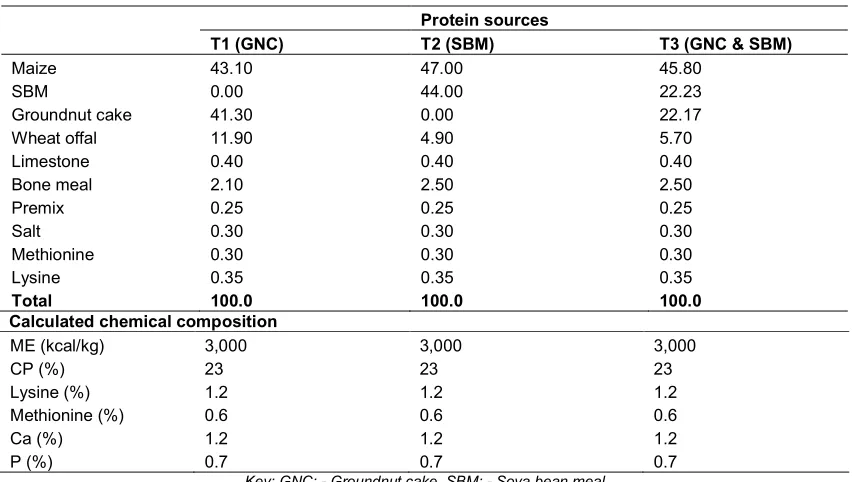
The experiment was conducted between May to July, in a four weeks experiment using one hundred and fifty-day old broiler chicks were used for the experiment. They were randomly divided into three treatment groups of 50 chicks each. Each treatment group was further divided into 5 replicates, with ten chicks per replicate. Three diets (representing treatments) were formulated as follows: Diet 1 contained GNC as the major protein source; Diet 2 contained SBM as the major protein source, and diet 3 contained a combination of GNC and SBM as the two major protein sources. The diets were formulated to contain 23% protein. The metabolizable energy level of the diets was maintained at 3,000 kcal/kg. The gross and chemical composition of the experimental diets is presented in Table 1.
Each treatment was fed one of the experimental
diets. Feed and water were offered ad-libitum.
Table 1. Gross and chemical composition of the experimental diets
Protein sources
T1 (GNC) T2 (SBM) T3 (GNC & SBM)
Maize 43.10 47.00 45.80
SBM 0.00 44.00 22.23
Groundnut cake 41.30 0.00 22.17
Wheat offal 11.90 4.90 5.70
Limestone 0.40 0.40 0.40
Bone meal 2.10 2.50 2.50
Premix 0.25 0.25 0.25
Salt 0.30 0.30 0.30
Methionine 0.30 0.30 0.30
Lysine 0.35 0.35 0.35
Total 100.0 100.0 100.0
Calculated chemical composition
ME (kcal/kg) 3,000 3,000 3,000
CP (%) 23 23 23
Lysine (%) 1.2 1.2 1.2
Methionine (%) 0.6 0.6 0.6
Ca (%) 1.2 1.2 1.2
P (%) 0.7 0.7 0.7
Key: GNC: - Groundnut cake, SBM: - Soya bean meal
2.3 Sources of Experimental Birds
The birds used for this experiment were sourced from Zarm Farm in Oyo State, Nigeria. The strains used are Ross 308 and were purchased at day old.
2.4 Data Collection
Feed intake was recorded daily by subtracting the amount offered from the leftover of the previous day. Bodyweight was monitored weekly and water intake was measured daily.
2.5 Statistical Analysis
The data collected were subjected to analysis of variance (ANOVA) using the Stat View Statistical Package [11].
3. RESULTS
3.1 Composition of Experimental Diets
The result obtained is in line with the requirement of protein and amino acids reported by [12]. Even though the diets were formulated to contain the same level of protein, calculated amino acids composition revealed that T1 (i.e. the diet containing GNC as the major protein source) was
deficient in isoleucine, lysine and threonine; while T2 (the diet containing SBM as the major protein source) was deficient in methionine. Only T3 (the diet containing a combination of GNC and SBM) satisfied the requirements for the amino acids analysed (Table 2).
3.2 Performance Characteristics
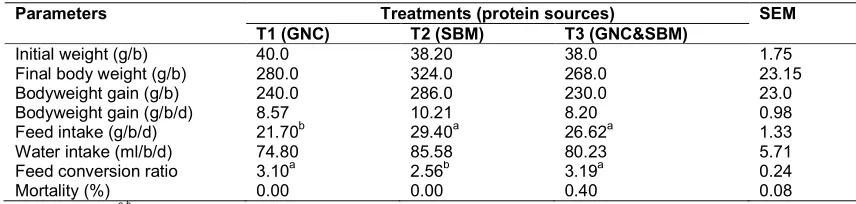
Initial live weights of the birds were 40.0, 38.2 and 38.0 gram per bird (g/b) for T1, T2 and T3 respectively (P >0.05). Final body weight did not differ significantly (P >0.05) between the
treatments even though the value recorded for T2 (324.0) was higher than the values
recorded for T1 (280.0) and T3 (268.0) (Table 3). However, feed intake differed
significantly between the treatments as the birds fed SBM (T2) or a combination of SBM &
GNC (T3) consumed significantly more feed (29.4 and 26.6 g/b/d respectively) compared to
those fed GNC as the major source of protein (T1) (21.7 g/b/d) (P<0.05). Water intake
followed a similar pattern, but in this case, the differences were not statistically significant
(Table 3). Feed conversion ratio (FCR)
Table 2. Balance of amino acids in the experimental diets
Amino acid Requirement Treatments (protein sources)
T1 (GNC) T2 (SBM) T3 (GNC & SBM)
Amount in feed
Balance Amount
in feed
Balance Amount
in feed
Balance
Arginine 1.25 2.12 +0.86 1.66 +0.40 1.92 +0.67
Glycine+serine 1.25 2.19 +0.94 2.35 +1.10 2.29 +1.04
Histidine 0.35 0.49 +0.14 0.63 +0.28 0.56 +0.21
Isoleucine 0.80 0.75 -0.05 1.08 +0.28 0.92 +0.12
Leucine 1.2 1.47 +0.26 1.95 +0.75 1.43 +0.23
Lysine 1.2 0.76 -0.34 1.41 +0.31 1.13 +0.03
Methionine 0.5 0.77 +0.27 0.37 -0.13 0.60 +0.10
Methio+cystine 0.9 1.88 +0.98 0.99 +0.09 1.23 +0.03
Phenylalanine 0.72 1.03 +0.31 1.15 +0.43 1.1 +0.38
Phenyl+tyrosine 1.32 1.9 +0.58 2.25 +0.93 2.09 +0.77
Threonine 0.80 0.64 -0.16 0.97 +0.17 0.82 +0.02
Tryptophan 0.20 0.23 +0.03 0.38 +0.90 0.30 +0.10
Valine 0.9 0.91 +0.01 1.18 +0.28 1.05 +0.15
Table 3. Performance of broilers fed diets containing different protein sources
Parameters Treatments (protein sources) SEM
T1 (GNC) T2 (SBM) T3 (GNC&SBM)
Initial weight (g/b) 40.0 38.20 38.0 1.75
Final body weight (g/b) 280.0 324.0 268.0 23.15
Bodyweight gain (g/b) 240.0 286.0 230.0 23.0
Bodyweight gain (g/b/d) Feed intake (g/b/d)
8.57 21.70b
10.21 29.40a
8.20 26.62a
0.98 1.33
Water intake (ml/b/d) 74.80 85.58 80.23 5.71
Feed conversion ratio 3.10a 2.56b 3.19a 0.24
Mortality (%) 0.00 0.00 0.40 0.08
a b
Means in the same row followed by different superscripts are significantly different (P<0.05)
4. DISCUSSION
In this study, the performance of birds fed either SBM or a combination of SBM and GNC was better than those fed GNC as the major protein source. These results agree with the earlier findings of [13] who reported better performance (P<0.05) of broilers fed either SBM or a combination of SBM and GNC compared to those fed GNC alone. [14] also observed a non-significant reduction in weight gain as SBM was
replaced with GNC in the diets of broilers. [15] also reported that using 100% GNC as the sole protein source for broilers lowers
body weight gain. Other workers have
also reported the superior performance of birds
fed either SBM or a combination of SBM and GNC compared to GNC alone [16,17] and
[18].
The better performance of birds on the diets containing either SBM or a combination of SBM and GNC could be associated with the more correctly balanced amino acid profile of SBM. [19,20] reported that the amino acid pattern of
SBM is better than that of GNC, as the latter is generally deficient in methionine, tryptophan and lysine. [21] also reported that GNC is deficient in lysine, methionine and threonine. [22] also reported that even though GNC contains large amounts of essential amino acids, its nutritive value tends to be limited by its marginal tryptophan and threonine contents.
The feed conversion ratio is a direct indication of how best the feed given to birds is turned to meat. In this experiment, birds fed SBM or a mixture of SBM and GNC were more efficient (P=0.05) in converting feed to gain. Earlier workers have made similar observations [19,20].
In this experiment, mortality was recorded only in T3 (4%); which falls within the accepted range of 0-5% of good management.
5. CONCLUSION AND RECOMMENDA-TIONS
It is concluded that feeding diets containing SBM or a combination of SBM & GNC as the major sources of protein positively influenced the performance of the birds; which could be attributed to the better amino acid profile of SBM.
It is recommended that further studies should focus on the determination of individual amino acids intake and their digestibilities, which will enable better appreciation of the utilisation of these nutrients. Due to the seasonal variation in the weather condition in this hot sub-humid zone of North-Western Nigeria, such studies should be conducted at different seasons of the year to explore the effect of environmental conditions on protein utilisation.
ETHICAL APPROVAL
As per international standard written ethical approval has been collected and preserved by the author(s).
COMPETING INTERESTS
Author has declared that no competing interests exist.
REFERENCES
1. Oluyemi JA, Roberts FA. Poultry
production in the warm wet climates, 2nd
edition, Spectrum Books Ltd., Ibadan, Nigeria. 2000;1-5.
2. Onwudike OC. Effect of different protein
levels on the performance of laying birds in a tropical environment, Tropical Animal Production. 1983;8(2):157-161.
3. Onifade AA. Comparative utilization of
fiber sources by broiler starter chicks. Ph.D Thesis, Department of Animal Science, University of Ibadan, Nigeria. 1993;1-6.
4. WHO. World Health Organization. World
Survey on Protein Recommendation for Humans, No. 35, Geneva; 2013.
5. Bedford MR and Summers JD. Influence of
the ratio of essential to non-essential
amino acids on performance and
carcass composition of the broiler chick. British Poultry Science. 1985;26:483- 491.
6. NRC. National Research Council.
Nutrients Requirements of Poultry. (9th
Rev. Edition). National Academic Press. Washington, D.C. 1994;2-12.
7. D’Mello JPF. Responses of growing
poultry to amino acids. In: Amino Acids in Farm Animal Nutrition. J.P.F. D’Mello (ed). CAB International, Wallingford, Oxon, UK. 1994; 2-8.
8. Leeson S, Summers JD. Protein and
amino acids. In: Scott’s Nutrition of the Chicken, 4th rev. ed. (Leeson S., and J.D. Summers, Eds). Ontario, Canada. 2001; 2-5.
9. Mammam AB, Oyebanji JO and Peter SW.
Nigeria: A people united, a future assured (survey and states). Gabumo Publicating Company Ltd. Calabar, Nigeria. 2000;2: 2-9.
10. Adamu AI. Influence of weather on human
health. A bioclimatic study of some
communicable diseases in Sokoto.
MSc. Thesis, Department of Geography, University of Ibadan. 1992;8-17.
11. SAS. Statistical Analysis System. User
Guide SAS/STA-t Version, 8th edition,
SAS, Institute, Inc. Cary, N. C., USA; 2003.
12. Nelson TS. Nutritional requirement,
biochemistry, and metabolism of calcium. In poultry. Ninth Revised Edition; 1984.
13. Mustapha R, Hakim AA, Azizullah SM,
Rab H and Ahmedu NS. Effect of various protein source feed ingredients on the
growth performance of broilers.
International Journal Medicinal Plant
Research. 2012;4:038-044.
14. Vandergrift WL, Knade DA, Tanksley TD
and Anderson SA. Effect of feeding high
soybean diets to pigs. Journal Animal
Science. 1983;57:873-880.
15. Aziz MA, Khandakar ZA, Islam M. Effect of
replacing protein soybean on the
performance of broiler chicken. Indian Journal Nutrition. 2001;1891:23-28.
16. Singh KS, Prasad CM and
Animal Feed Science Technology.1981;6: 63-71.
17. Subbaiah AW and Rao BS. Substitution of
groundnut cake with soybean meal in broiler rations. Indian Journal Poultry Science. 1984;19:119-123.
18. Dogan K and Agahzadah AM. Research
on the use of sunflower oil meals in broiler rations. Dogaturk Tarimve or Manilik Degisi. 1989;2:182-193.
19. Singh J, Zombode SS. Protein quality of
groundnut cake as influenced by
combining with other protein sources.
Indian Journal Poultry Science. 1986;21:
42-48.
20. Leeson S, Summers JD. Commecial
Poultry Nutrition, University Books,
Guelph, Ontarrio, Canada. 1991;12-23.
21. Oyenuga VA. Nigeria’s foods and
feedstuffs, University Press Plc. Ibadan, Nigeria; 1965.
22. Elegbede JA. Legume-nutritional quality
of plant food. In: Osagie, A.U and Eka,
O.U. (Ed), Post Havest Research
Unit, Depertment of Biochemestry,
University of Benin, Benin City Nigeria. 1998;53-83.
23. Adeniji AA. Replacement value of soya
bean meal with groundnut cake with or without fish meal supplementation in diets
of pullet ckicks. Journal Apply Science Research. 2008;4:1249-1252.
24. Mohan PR. Replacement of ground nut oil
cake with sunflower oil cake in broiler ration. Indian Journal Poultry Science. 1984;21:341-342.
25. Ghadge VN, Upase BT, Patil PV. Effect of
replacing groundnut cake by soybean meal on performance of broilers. Vet.World, 2009;2(5):183-184.
26. Aguihe PC, Kehinde AS, Fatokum BO,
Lekene B, Adelakum KM. Growth
performance and cost implication of utilizing processed groundnut cake in cockerel starter diets as a replacement for soybean. Proceedings of the Annual
Conference of the Nigeria Society
For Animal Production (NSAP). 2010;372-374.
27. ISA. Institut de Selection Animale, Guide
d’Elevage des Poulets de Chair. Service de Production et d’Assistance Technique, Quintin, France. 1996;3-10.
28. Dieumou FE, Adegbola TA, Doma
UD. Growth performance, carcass
characteristics and economics of
production of broilers fed diets with two sources of protein and two levels of wheat offal. Journal of Cereals and Oilseeds. 2013;4(4):42-47.
_________________________________________________________________________________ © 2019 Harande; This is an Open Access article distributed under the terms of the Creative Commons Attribution License
(http://creativecommons.org/licenses/by/4.0), which permits unrestricted use, distribution, and reproduction in any medium,
provided the original work is properly cited.
Peer-review history: