to their colonization of the oceans—are responsible for up to 50% of the planet’s atmospheric carbon fixation (22). They comprise a diverse group that can broadly be defined as uni-cellular (microalgae) or multiuni-cellular (macroalgae) photosyn-thetic organisms that lack roots, stems, leaves, conducting ves-sels, and complex sex organs (55). A single endosymbiotic event between a cyanobacterium-like organism and a non-photosynthetic eukaryote is thought to have given rise to the three basal groups of algae: the chlorophyta (from which higher plants arose), the glaucocystophyta, and the rhodo-phyta (Fig. 1).
The chlorophyta and the rhodophyta, via secondary and tertiary endosymbiotic events with different nonphotosynthetic eukaryotes, gave rise to algal groups with complex plastids (Fig. 1). Some groups, such as the apicomplexans (e.g., Plas-modium falciparum) subsequently lost the ability to photosyn-thesize, although they still retain plastids. The number of sym-bioses that have occurred during the evolution of algae has been heavily debated, and the details are discussed elsewhere (46), but there are likely to have been several events. Conse-quently, it is not surprising that the physiology and metabolism of algae are extremely varied. For example, while the majority of green algae contain a highly structured cell wall comprising glycoproteins (19), euglenophyta simply contain a protein layer (known as the pellicle) beneath the cell membrane, and the cell walls of diatoms are made from silica (24). Dinophyta, eu-glenophyta, and heterokontophyta contain members that are phagotrophic on bacterial prey, but this characteristic is absent from the groups with simple plastids. Furthermore, although most algae are regarded as free-living organisms, many dinoflagellates are closely associated with corals, and members of several algal groups live with fungi as lichens (13), providing photosynthate for their heterotrophic partner.
VITAMIN AUXOTROPHY IN ALGAE
The ability to photosynthesize has led to the perception of algae as autotrophic organisms requiring light and a mixture of inorganic nutrients only. However, studies by Lwoff and Dusi
cryptophyta require thiamine as a growth factor in culture (39). Over the following 40 years, many studies described algal spe-cies that required different combinations of three B vitamins: vitamin B12(cobalamin), vitamin B1 (thiamine), and vitamin
B7(biotin) (50). A compilation of all of the available data (see
Table S1 in the supplemental material; summarized in Table 1) reveals the widespread nature of vitamin auxotrophy within the algal kingdom. Of 306 species surveyed, more than half re-quired cobalamin, while 22% rere-quired thiamine and a smaller proportion (5%) required biotin. Remarkably, for all three vitamins, the algal species that have an obligate requirement for the different cofactors do not appear to fall into any one lineage, but rather auxotrophy is present in several unrelated phyla, indicating that it must have arisen independently several times through evolution. Even more surprisingly, this pattern is also mirrored within individual genera. For example, Hemato-coccusin the chlorophyta,Peridiniumin the dinophyta, Hym-enomonasin the haptophyta, andNitzschiain the heterokon-tophyta all have species that require cobalamin and others that do not (see Table S1 in the supplemental material). Similarly, the dinoflagellateGymnodinium brevisrequires all three vita-mins whereas G. spendens requires only cobalamin. For the auxotrophy to have evolved so frequently in algae, the simplest explanation is that it is due to the loss of a single gene. A plausible hypothesis would therefore be that species with a requirement for a particular vitamin have lost a gene involved in the biosynthesis of that cofactor. An intriguing parallel is seen with vitamin C auxotrophy in mammals, where loss of the terminal enzyme of the pathway has occurred in both primates and guinea pigs (10).
Until now, however, it has not been possible to test this hypothesis because nothing was known of the biosynthetic routes for vitamins in the algal kingdom and only very little was known about the roles of the cofactors in algal metabolism. With the advent of genome sequencing, our ability to address questions like this has been revolutionized. Currently, the se-quences of four algal genomes are available. The first to be-come available was that of P. falciparum (25), a unicellular nonphotosynthetic apicomplexan, which lives as a parasite in insects and humans and is the causative agent of the devastat-ing tropical disease malaria. The release of theP.falciparum genome sequence was quickly followed by that of Chlamydo-monas reinhardtii(www.jgi.doe.gov), a unicellular green alga, which is commonly isolated from soils in North America. Two further genome sequences were released in 2004;Thalassiosira pseudonanais an ecologically important centric diatom found * Corresponding author. Mailing address: Department of Plant
Sci-ences, University of Cambridge, Downing Street, Cambridge CB2 3EA, United Kingdom. Phone: 44 1223 330219. Fax: 44 1223 333953. E-mail: [email protected].
† Supplemental material for this article may be found at http://ec .asm.org/.
1175
on September 8, 2020 by guest
in many of the world’s oceans (2), andCyanidioschyzon merolae is a unicellular thermophilic red alga isolated from sulfate-rich hot springs (pH 1.5, 45°C) (42). In this article, we use the genome sequence data available for these four species to in-vestigate the question of vitamin metabolism in algae, thus providing the first clues as to why and how some algae have a requirement for these cofactors. Each vitamin will be discussed in turn before we focus on possible routes for their acquisition by algae, which, given the extremely low free concentrations of these nutrients in the natural environment, are likely to be complex.
BIOTIN
Biotin (vitamin B7) was discovered in 1901 as a
growth-promoting factor for yeast (69) and was finally isolated and
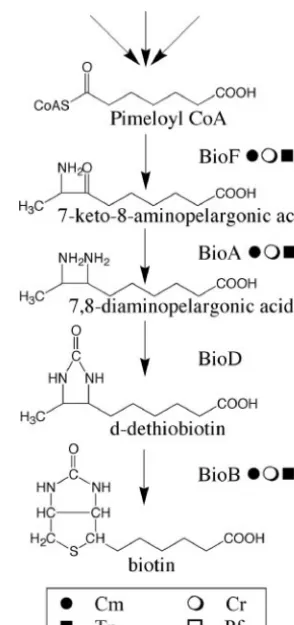
purified in 1941 (64). Biotin is a cofactor for several essential carboxylase enzymes (62), including acetyl coenzyme A (CoA) carboxylase, which is involved in fatty acid synthesis, and so is universally required. The molecule consists of an imidazole ring fused to a sulfur-containing tetrahydrothiophene ring with a fatty acid side chain (Fig. 2). In eubacteria, the first precursor for biotin synthesis is pimeloyl-CoA but the source of this differs among different species. Thereafter, the concerted ac-tion of four enzymes, BioF, BioA, BioD, and BioB, converts pimeloyl-CoA to biotin (20) (Fig. 2). In the budding yeast Saccharomyces cerevisiae, homologues ofbioA,bioD, andbioB, but notbioF, are present, so the source of 7-keto-8-aminopel-argonic acid remains unknown. The higher plantArabidopsis thalianacontains genes for BioF, BioA (also called BIO1), and BioB (also called BIO2) (3, 49), but the genome does not appear to contain a gene with sequence similarity to known bioDgenes. SinceA.thalianacan synthesize biotin de novo, the absence of a bioD gene from the genome suggests that in higher plants the conversion of 7,8-diaminopelargonic acid to FIG. 1. Summary of algal evolution. The three basal groups
chlo-rophyta, rhodophyta, and glaucocystophyta are shown with green, red, and blue plastids, respectively. Those groups derived from the chloro-phyta and rhodochloro-phyta by secondary endosymbioses are shown with the appropriate colored plastids. Tertiary endosymbiotic events are not shown in this diagram. The boxed phyla contain at least one organism with a sequenced genome.
FIG. 2. The biotin biosynthetic pathway as elucidated in eubacte-ria. There are several different pathways for the synthesis of pimeloyl-CoA. The gene names are followed by the symbolFindicating the presence of the gene inC.merolae(Cm), the symbolEindicating the presence of a gene inC.reinhardtii(Cr), the symbol■indicating that the given gene is present in the genome ofT.pseudonana(Tp), or the symbol䊐indicating that the gene is in the genome ofP.falciparum
(Pf). Genes with sequence similarity tobioFand bioAcan also be found in the genome sequence ofD.discoideum, while onlybioFcan be found inE.histolytica(see text for details).
TABLE 1. Vitamin requirements of the individual species detailed in the supplemental material compiled
under the different algal groupsa
Phylum No. of species
surveyed
No. of species requiring:
Cobalamin Thiamine Biotin
Chlorophyta 148 44 19 0
Rhodophyta 13 12 0 0
Cryptophyta 6 5 5 1
Dinophyta 27 24 7 7
Euglenophyta 15 13 11 1
Haptophyta 17 10 14 0
Heterokontophyta 80 47 11 5
Total 306 155 67 14
aOnly those species that have had their cobalamin, thiamine, and biotin
requirements assessed have been included in this survey, and for this reason those data do not include any glaucocystophytes, chloroarachnophytes, or api-complexans. A requirement for biotin is found only in species that contain complex plastids, i.e., those that have arisen as the result of secondary and tertiary endosymbiosis with a eukaryotic alga. Furthermore, every species that requires biotin also requires cobalamin, thiamine, or both.
on September 8, 2020 by guest
http://ec.asm.org/
D-desthiobiotin must be carried out by an as-yet-unidentified
enzyme.
Using the data from the literature (see Table S1 in the supplemental material), we found that 14 out of 306 species surveyed were biotin auxotrophs (Table 1). All of these are confined to algal groups with complex plastids, such as Amphi-dinium carterae (dinophyte) and Ochromonas danica (het-erokontophyte). Interestingly, all biotin auxotrophs also have a requirement for either cobalamin, thiamine, or both (see Table S1 in the supplemental material).C.reinhardtii,T.pseudonana, andC.merolaeare not biotin auxotrophs (see Table S1 in the supplemental material), and as they contain several biotin-dependent carboxylases, they must have a functional biosyn-thetic pathway. Whether or notP.falciparumrequires exoge-nous biotin is unknown. We used the BLAST algorithm (1) to query the latest versions of their genome sequences with the four bacterial biotin biosynthesis genes,bioF,bioA,bioD, and bioB. InC.reinhardtii,T.pseudonana, andC.merolae, we could identify genes with high sequence similarity tobioF,bioA, and bioB, but notbioD(Table 2), a situation analogous to that inA. thaliana. The coded boxes in Fig. 2 indicate the presence of these genes. Intriguingly,P.falciparumcontainsbioFonly and none of the other three genes, so it will be of interest to determine whether or not it requires the vitamin for growth. If not, it suggests that there is a different biotin biosynthetic route inP.falciparum. Two known biotin auxotrophs whose genomes have been completely sequenced are the single-celled amoebae Dictyostelium discoideum(17) andEntamoeba histolytica(38). E.histolytica, likeP.falciparum, is an obligate parasite that can
presumably obtain biotin from its host, whileD.discoideumis a slime mold that preys on soil microorganisms. The genomes of these two amoebae contain a gene with sequence similarity to bioF, while D. discoideum also contains a gene with se-quence similarity to bioA. Given our current knowledge of biotin biosynthesis in eukaryotes, it is not possible to conclude how biotin auxotrophy arose initially in these lineages. Never-theless, the simplest explanation is that it was caused by the loss of a single biosynthetic gene, although this might not be the same gene in every case.
THIAMINE
Like biotin, thiamine also plays a pivotal role in intermediary carbon metabolism. The active form of the vitamin is thiamine pyrophosphate (TPP), which is essential for all organisms. The cofactor associates with a number of enzymes involved in pri-mary carbohydrate and branched-chain amino acid metabo-lism, including pyruvate dehydrogenase, transketolase,␣ -keto-acid decarboxylase, and␣-ketoacid oxidase (57). Recent work on the biosynthesis of thiamine has mainly concentrated on three prokaryotic organisms, Escherichia coli, Salmonella en-tericaserovar Typhimurium, andBacillus subtilis(5). Thiamine consists of a thiazole and a pyrimidine moiety, which are pro-duced in separate branches of the biosynthetic pathway before being coupled together to produce thiamine phosphate. This is then further phosphorylated to produce the active cofactor TPP (Fig. 3). Many of the genes encoding thiamine
biosyn-thiC estExt_fgenesh2_pg.C_360009 (637) 12.129.1 (636) CMG171C (673)
thiD mtc_168251 (711) 54.158.1 (267) CMO125C (297) chr5.glimmerm_537 (310)
thiE mtc_168251 (7110 54.123.1 (1,930) CMP214C (308) MAL6PI.285 (545)
TPK gwW.1.690.1 (358) 30.73.1 (217) CMH016C (251)
thiM estExt_gwp_1H.C_30409 (242) PFL1920c (302)
Cobalamin metabolism
metE Chlre2_kg.scaffold_82000007 (842) CMJ234C (767)
metH estExt_GenewiseW_1.C_30026 (1,357) 65.17.1 (1,248)
cblE e_gwH.14.9.1 (1,381) 80.8.1 (579)
cblA 2.1075.1 (301)
cblB 89.13.1 (190)
mmcM 1.311.1 (726)
aModel numbers forC.reinhardtiiare the version 3.0 models, theT.pseudonanagenes correspond to the filtered version II models, theC.merolaegenes follow the
C.merolaegenome annotation models, and theP.falciparumgenes are either glimmerM, phat, or final models. Bacterial and yeast genes were used to search the algal
genomes by using tBLASTn, and hits with an expectation coefficient of less than E⫺20were considered significant. PS indicates that only part of the putative gene is
present in the genome sequence. ThethiH/Ogene products are isozymes that catalyze the same reaction.
on September 8, 2020 by guest
thetic enzymes from bacteria have been cloned, and in several cases the structures of the enzymes have been solved (60).
We have a less complete understanding of the pathway in eukaryotes, and what knowledge there is comes mainly from the yeastS.cerevisiae. The overall pathway is similar to that in bacteria, with thiamine monophosphate formed from thiazole and pyrimidine moieties, but the enzymes involved appear to be different. None of the bacterial genes have homologues in the yeast genome. In contrast, one enzyme of the thiazole branch,thi4, and one pyrimidine biosynthetic gene,thi5, have been cloned from yeast, but neither shows any sequence sim-ilarity to the bacterial enzymes. Furthermore,thiL is absent and the terminal enzyme of the pathway is thiamine pyrophos-phokinase (TPK), which pyrophosphorylates thiamine to form thiamine pyrophosphate (Fig. 3).
Thiamine was the first vitamin found to be an algal growth factor (39). Early studies on the specificity of this requirement showed that in some cases thiamine auxotrophy could be re-lieved by addition of the thiazole moiety to the growth me-dium, in others cases the pyrimidine moiety was sufficient, while in the final group of auxotrophs the full thiamine mole-cule was essential for growth (50). These studies show that in algae the thiamine biosynthetic pathway follows the same gen-eral pattern as in other organisms, with two separate branches to make each of the moieties, which are then combined to-gether to make thiamine (Fig. 3). Furthermore, the presence of some parts of the pathway in thiamine auxotrophs suggests that they require the vitamin because they have lost one or more of the essential genes involved in its biosynthesis.
C.reinhardtii,C.merolae, andT.pseudonanado not require
thiamine or any of the intermediates in its biosynthesis for growth, demonstrating that they can synthesize the vitamin de novo. BLAST searches with the thiamine biosynthetic genes fromE.coli, S.entericaserovar Typhimurium, andB.subtilis against the genome of the red algaC. merolaedemonstrates that it has all of the genes necessary to synthesize thiamine monophosphate via the bacterial route (Fig. 3 and Table 2). However, it does not contain a gene with similarity to bacterial thiamine monophosphate kinase (ThiL) and instead has a ho-mologue of the yeast TPK. The current versions of the C. reinhardtiiand T. pseudonana genomes suggest they contain the genes for most of the enzymes in the pathway, but they do not contain genes with sequence similarity to the short bacte-rialthiSgene, andC.reinhardtiialso lacks a gene with sequence similarity tothiG, which is involved in the synthesis of thiazole phosphate. Many of the enzymes in the thiazole branch are similar to those involved in molybdopterin biosynthesis, and so one must be careful when assigning a role to these proteins purely on the basis of sequence similarity. UnlikeT. pseudo-nana and C. merolae, C. reinhardtii contains a gene with se-quence similarity tothiM, which in eubacteria is involved in scavenging the thiazole moiety from the environment (60). However, inC.reinhardtiithis gene appears to be essential for thiamine biosynthesis, since mutations inthiMlead to thiamine auxotrophy (21). This suggests that synthesis of the thiazole moiety inC. reinhardtiifollows a route different from that in eubacteria. Another difference inC.reinhardtiiis that the ThiD and ThiE proteins are predicted to be part of the same large polypeptide (mtc_168251), with the central region correspond-ing tothiDand the 3⬘end containingthiE. The N terminus of FIG. 3. The TPP biosynthetic pathway. TPP is composed of a thiazole and a pyrimidine moiety, each synthesized through a separate pathway. The thiazole branch is shaded in gray. The bacterial genes responsible for each step are shown, followed by the symbolF,E,■, or䊐indicating the presence of the gene in different algae (see Fig. 2 for the key). Glyceraldehyde-3-phosphate (Ga3P) and pyruvate (Pyr) are combined to form DXP in the thiazole branch, while 5-aminoimidazole ribonucleotide is converted to hydroxymethylpyrimidine diphosphate (HMP-PP) in the pyrimidine branch. Prokaryotes use thethiLgene product to convert thiamine monophosphate to TPP, while eukaryotes appear to dephosphor-ylate thiamine monophosphate before pyrophosphorylating thiamine with TPK.
on September 8, 2020 by guest
http://ec.asm.org/
chlorophytes, such asScenedesmus obliquus,C.reinhardtii, and Chlorella fusca(14), andP.falciparum(53) use the DXP path-way exclusively, whereas the euglenophyteEuglena gracilisuses only the MEV pathway (14) and has an obligate requirement for thiamine, suggesting that DXP is not used in the biosyn-thesis of either thiamine or isoprenoids in this organism. The rhodophyte Cyanidium caldarum and the heterokontophyte Ochromonas danica use both the DXP and MEV pathways (14), but while C. caldarum does not require thiamine, O. danicahas an obligate requirement for the vitamin. This dem-onstrates that it is not simply the ability to synthesize DXP that determines whether or not an alga has a requirement for thi-amine.
The thiamine requirement of P. falciparum has not been categorically established, although previous reports have sug-gested that it possesses the enzymes that catalyze the final steps in the pathway (6). TheP.falciparum genome has a comple-ment of thiamine biosynthesis genes similar to that ofC. rein-hardtii, with the exception of thiC, suggesting that it cannot synthesize the pyrimidine moiety from 5-aminoimidazole ribo-nucleotide. It also lacks either athiLor a TPK gene but does have a gene for ThiM. Given the parasitic lifestyle ofP. falcip-arum, it is quite possible that it is able to acquire either thia-mine or its constituent parts from its host.
The two single-celled amoebaeE.histolyticaand D. discoi-deum require thiamine for growth, and none of the genes specific for thiamine biosynthesis are found in their genomes. Thus, although the currently available genome sequences do not allow us to determine the initial process leading to thia-mine auxotrophy, it appears that once this has arisen, there is no selection pressure for the retention of any of the biosyn-thetic genes and these are lost from the genome.
COBALAMIN
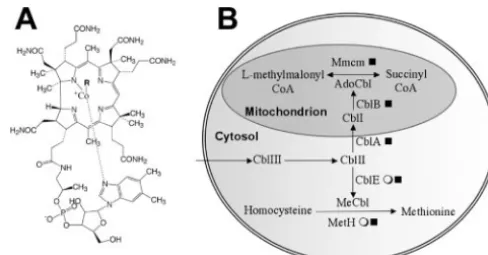
Cobalamin is a cobalt-containing tetrapyrrole related to chlorophyll and heme (Fig. 4A). Minot and Murphy first iden-tified this cofactor in the 1920s, when they described how they were able to cure the symptoms of pernicious anemia with liver extracts (44). The active factor was isolated (61) and crystal-lized (51) in 1948; it was given the name vitamin B12or, as it
contained cobalt, cobalamin. Cobalamin acts as a cofactor for enzymes that catalyze either rearrangement-reduction reac-tions or methyl transfer reacreac-tions. In bacteria there are more than 20 cobalamin-dependent enzymes (40), including those important for methanogenesis, but in eukaryotes there are
many fewer. In animals, there are two, methionine synthase and methylmalonyl-CoA mutase, which is involved in the uti-lization of odd-chain fatty acids (40). Higher plants have no cobalamin-dependent enzymes and so neither utilize nor syn-thesize cobalamin.
Cobalamin biosynthesis has been well characterized in bac-teria. There are essentially two alternative routes, comprising up to 20 enzymatic steps from the tetrapyrrole primogenitor uroporphyrinogen III (66). The first to be characterized was the so-called late-insertion pathway (4, 63), which has an ab-solute requirement for molecular oxygen (58) and in which the cobalt ion is inserted into the tetrapyrrole macrocycle after ring contraction. The second route is called the early-insertion pathway (54), where the cobalt ion is chelated before ring contraction and which can operate under anaerobic conditions. All archaea and many eubacteria are able to synthesize cobal-amin de novo, but several eubacteria lack the biosynthetic pathway. An example of the latter is E. coli, which utilizes cobalamin from the environment if it is available but is able to alter its metabolism in the absence of the cofactor.
More than half of all microalgae surveyed (Table 1; see Table S1 in the supplemental material) (11) have an obligate requirement for exogenous vitamin B12, leading to the
remark-able conclusion that auxotrophy is the norm rather than the exception in the algal kingdom, despite the fact that these organisms are photosynthetic. Of the algal species that did not require an exogenous supply for growth, some were found to take up cobalamin if it was available (11; see below). However, when grown in its absence, the cells did not contain measurable amounts of cobalamin. This demonstrates that, rather than being able to synthesize it, these vitamin B12-independent algae
had no need for the cofactor in their metabolism, a situation similar to that found inE.coli.
Inspection of the available algal genome sequences con-firmed these observations.T. pseudonana has an obligate re-quirement for vitamin B12, butC.reinhardtiiandC.merolaedo
highly modified tetrapyrrole ring to which a lower nucleotide loop is attached. R can be either a methyl (Me) or an adenosyl (Ado) group. (B) Genes involved in vitamin B12 metabolism in eukaryotic cells.
Those genes responsible for each step are shown, followed by the symbolEor■indicating the presence of the gene in different algae (see Fig. 2 for the key). Cobalamin derivatives (Cbl) and the oxidation state of cobalt are shown. Cobalamin containing Co3⫹ (CblIII) is converted to methylcobalamin, while cobalamin containing Co⫹(CblI) is converted to adenosylcobalamin.
on September 8, 2020 by guest
not require the vitamin. BLAST searches of theC.reinhardtii, C. merolae, and P. falciparum genomes did not identify any genes with sequence similarity to known cobalamin biosyn-thetic genes, and while a gene with sequence similarity tocbiP, encoding adenosyl-cobyric acid-a,c-diamide synthase, is present in the genome ofT.pseudonana (new V2.0 genewise 7.511.1), this organism does not possess any other genes re-quired for cobalamin biosynthesis (11). Thus, algae do not have the ability to synthesize cobalamin de novo, indicating that cobalamin auxotrophy is likely to have arisen because of an obligate requirement for the cofactor in algal metabolism rather than from the inability to synthesize it. It is interesting that this is different from the situation observed for thiamine and biotin auxotrophy, which appears to have arisen because of the loss of one or more genes involved in the biosynthesis of the cofactors.
Soon after the isolation of vitamin B12as the mammalian
anti-pernicious anemia factor (44), E. gracilis was shown to require the vitamin for growth (52). Early studies showed that the requirement of many auxotrophic algae for vitamin B12was
reduced, but not completely removed, if methionine was added to the culture medium (29). This observation can now be ex-plained by the fact that cobalamin is a cofactor for methionine synthase. More-recent studies (30) have shown thatE.gracilis contains a vitamin B12-dependent methionine synthase (also
called MetH), consistent with the idea that cobalamin plays a role in algal methionine biosynthesis.
Higher plants do not require vitamin B12 for methionine
biosynthesis because they contain vitamin B12-independent
methionine synthase (MetE) and not MetH. By contrast, ani-mals contain MetH and not MetE and thus require cobalamin. The recent genome-sequencing projects have demonstrated that both MetH and MetE can be found in different algae. WhileT.pseudonanacontains MetH only andC.merolae con-tains MetE only,C. reinhardtiicontains both enzymes (Table 2). In the presence of vitamin B12,C.reinhardtiiuses MetH but
in the absence of the vitamin it uses MetE (11). This phenom-enon is analogous to the situation in eubacteria such asE.coli, which also switch between MetE and MetH, depending upon the availability of exogenous cobalamin (68). MetH has a much higher turnover rate than MetE, and so it is a preferred route for methionine synthesis when cobalamin is present (27). In-terestingly, the two obligate parasites P. falciparum and E. histolyticado not appear to contain either methionine synthase, suggesting that they may acquire methionine from their hosts. In contrast, the genome ofD.discoideum, like that ofC. rein-hardtii, contains bothmetEandmetH.
The fact that addition of methionine does not completely remove vitamin B12auxotrophy in algae prompted some
inves-tigators to look for other vitamin B12-dependent enzymes. A
vitamin B12-dependent ribonucleotide reductase has been
par-tially purified fromE.gracilis(28), suggesting that this organ-ism may require cobalamin for DNA biosynthesis. This is con-sistent with the observation that DNA biosynthesis appears to be inhibited during vitamin B12deprivation. However, the
vi-tamin B12-dependent type II ribonucleotide reductase, which is
generally thought to be present in prokaryotes only, is one of three isoforms of ribonucleotide reductase (33). Other studies have shown that ribonucleotide reductase activity increases in E.gracilisduring vitamin B12deficiency (8), suggesting that, as
with many bacteria, there is more than one isoform of ribonu-cleotide reductase in this organism.
An alternative explanation for the reduction in DNA bio-synthesis during vitamin B12deprivation is that it is a result of
a perturbation of folate metabolism which results from re-duced methionine synthase activity; this enzyme uses folate as a cofactor. Such a metabolic abnormality, which is termed “folate trapping,” is characteristic of vitamin B12deficiency in
humans (59). Vitamin B12 auxotrophy in the green alga
Lobomonas rostratacan only be rescued when both folate and methionine are added to the culture medium together (11), demonstrating that folate trapping also occurs in algae and providing an explaining as to why earlier studies (29) could only partially rescue vitamin B12auxotrophy in algae with the
addition of methionine alone.
Crude cell extracts ofE.gracilishave been reported to con-tain methylmalonyl-CoA mutase activity (67), leading the au-thors to suggest that this organism contains a third vitamin B12-dependent enzyme. This enzyme catalyzes the reversible
conversion of succinyl-CoA to methylmalonyl-CoA. In mam-mals, methylmalonyl-CoA mutase is essential for the degrada-tion of odd-chain fatty acids (40), but in other organisms, the enzyme has a role in anaerobic metabolism during propionate fermentation, as well as in the biosynthesis of branched-chain fatty acids.E.gracilisis able to grow on propionate (67), pro-viding further evidence that an active methylmalonyl-CoA mu-tase may be present in the cell. A methylmalonyl-CoA mumu-tase gene is present in the genome ofT.pseudonana, and there is also an expressed sequence tag with sequence similarity to this gene from the diatomPhaeodactylum tricornutum(PTMM04237). Furthermore, the enzyme has recently been purified from the vitamin B12-dependent haptophytePleurochrysis carterae(45).
Interestingly, all of the algae that have been found to contain methylmalonyl-CoA mutase have complex plastids.
In mammalian cells, methylmalonyl-CoA mutase is located in the mitochondrion. The proteins CblA and CblB are thought to be responsible for the intracellular transport of cobalamin into the mitochondria of mammalian cells (15, 16). Proteins with sequence similarity to both CblA and CblB can be found in the genome ofT.pseudonana(Table 2), suggesting that the methylmalonyl-CoA mutase in this alga is likely to be located in the mitochondrion and that the machinery for the intracellular transport of cobalamin is conserved between an-imals and algae. Not surprisingly for organisms that do not contain methylmalonyl-CoA mutase,C.reinhardtii,C.merolae, andP.falciparumdo not possess genes with sequence similarity to cblA and cblB (Table 2) but both C. reinhardtii and T. pseudonana contain a gene with sequence similarity tocblE, which encodes methionine synthase reductase, required in or-ganisms containing MetH.
Why is it that so many algae have an absolute requirement for vitamin B12? The exact role of methylmalonyl-CoA mutase
in algae is not known, but the fact that E. gracilis can use propionate as a carbon source suggests that it allows these organisms to grow heterotrophically when vitamin B12is
avail-able. The isolation of an expressed sequence tag encoding this enzyme fromP. tricornutum, a vitamin B12-independent alga,
indicates that the presence of this enzyme in an algal cell does not in itself result in cobalamin auxotrophy. Instead, vitamin B12auxotrophy appears to be determined by the enzymes
on September 8, 2020 by guest
http://ec.asm.org/
many disparate algae indicates that the vitamins are available in the environment and that mechanisms exist for their uptake into algal cells. These three vitamins are all water soluble and comparatively stable, suggesting that they can be rescued by salvage. Indeed, thiamine-scavenging pathways are known in animals, fungi, and eubacteria (60). These vitamins are cofac-tors for a limited number of enzymes and are thus required in small quantities, reducing the pressure on biosynthetic flux and making salvage a viable option.
However, the uptake of these compounds is not as simple as it may at first seem because their concentration in the natural environment is extremely low. Indeed, the minute amount of these organic micronutrients has made them difficult to mea-sure (50). The concentration of vitamin B12 in seawater is
thought to vary between 0 and 3 ng/liter (9), and while higher levels have been reported in some freshwaters (12, 34), these levels are generally too low to support algal growth. Several studies have shown that different vitamin B12-dependent algae
require at least 10 ng/liter cobalamin in order to grow (50). Similarly, the concentrations of both thiamine and biotin in the natural environment are below that normally required in cul-ture, with thiamine levels typically varying between 8 and 15 ng/liter at different points in the Pacific Ocean and biotin varying between 1 and 4 ng/liter in the same regions (9). In the case of thiamine, the stability of the cofactor at the alkaline pH of seawater has been shown to be dependent on the temper-ature of the water, declining sharply between 10°C and 30°C (26). This makes acquisition of the free cofactor from solution an unlikely route for many marine organisms.
The observation that only trace amounts of these vitamins were present in natural waters led several investigators to ex-amine whether these compounds influence the productivity, and succession, of different species. Menzel and Spaeth (43) reported that moderate diatom blooms occurred in the Sar-gasso Sea when cobalamin concentrations were at their high-est, and several other studies have shown a link between algal productivity and vitamin concentrations (56, 65). Such obser-vations led to suggestions that algae were significant contrib-utors to the pool of vitamins found in these waters (43). While this may be true for thiamine and biotin, it cannot be the case for cobalamin since the biosynthetic pathway is not present in any eukaryotic organism (11).
The fact that only prokaryotes have the ability to synthesize cobalamin implies that all of the vitamin B12found in algae,
and indeed animals, must originally have been produced by bacteria. Fogg and Kurata noted that many algae grew more
the fact that more than half of all algae require the vitamin (Table 1), suggests that many algae form these symbiotic in-teractions in order to obtain the cofactor. Although there is no evidence that algae acquire thiamine directly from bacteria, such an interaction would explain why the level of free vitamin in natural waters does not limit algal growth. In support of this theory, Menzel and Spaeth, following their studies in the Sar-gasso Sea, found no evidence to suggest that vitamins limited algal productivity (43).
A number of dinoflagellate, euglenoid, and heterokont algae are phagotrophic on bacterial prey, as is the amoebaD. dis-coideum. Furthermore, some dinoflagellates are known to con-tain intracellular bacteria (48). In terms of organic micronu-trient acquisition, this provides an obvious route by which these organisms are able to take up their vitamins. All of the biotin-requiring algae fall into these groups, so the major route to biotin acquisition may be phagotrophy, and in organisms that do not have the ability to ingest bacteria, there may be strong evolutionary pressure to retain a functional biotin bio-synthetic pathway. One other noteworthy point is that these phagotrophic groups include species that contain cobalamin-dependent methylmalonyl-CoA mutase (Fig. 1), suggesting perhaps that, like humans, they use this enzyme for the deg-radation of odd-chain fatty acids from their prey.
Algal-bacterial interactions are not limited to delivery of vitamins.Halomonassp. has also been shown to improve the growth of the green alga Duniella balwardii under iron-deficient conditions, suggesting that the latter may be able to utilize bacterial siderophores (7, 35). Zoospores of the macroalga Ulva pertusahave been shown to recognize the quorum-sensingN-acyl-L-homoserine lactone molecules re-leased by bacterial biofilms, thereby facilitating the adher-ence of the zoospores to the surface (32). Even more re-markably, the morphology of the related alga Monostroma oxyspermumis dependent on a growth factor, thallusin, synthe-sized by marine bacteria; in the absence of the bacteria, the algal thallus does not form and instead the alga grows as a loose association of single cells (41).
CONCLUSIONS
Vitamins are defined as organic micronutrients that must be obtained in the human diet. The observation that three of these vitamins are also essential for many photosynthetic algae, which are generally assumed to be completely autotrophic, is surprising. We have used the emerging genome sequences to
on September 8, 2020 by guest
start to understand how this has arisen. For biotin and thia-mine, the requirement for an exogenous supply is likely due to the loss of one or more key biosynthetic enzymes (Table 2). In contrast, cobalamin biosynthesis is absent from algae alto-gether and auxotrophy has arisen because of the loss of a cobalamin-independent methionine synthase.
The question now is why have these requirements arisen, and why is vitamin auxotrophy so widespread? Because the cofactors are complicated to synthesize and required in trace amounts only, it is possible that there is a selective advantage in dispensing with the need to produce them, but this can only occur if there is a reliable external supply in their environment. At least for cobalamin, this comes from a symbiotic relation-ship with bacteria. There is now clear recognition that prokary-otic and eukaryprokary-otic organisms associate with each other (47) in order to exchange metabolites (7, 35) or to exploit unique biological niches. Furthermore, most eukaryotes do not appear to live in isolation; land plants form interactions with mycor-rhizae to obtain phosphate and with bacteria to obtain nitro-gen, while animals rely on intestinal flora for their wellbeing. It now seems likely that eukaryotic algae rely on other organisms for a source of essential vitamins, at least in some cases via a beneficial symbiosis. In the coming decades, both the enzymol-ogy and the regulation of these metabolic processes are likely to be explored in molecular detail.
ACKNOWLEDGMENTS
We thank Emmanuel College, Cambridge, United Kingdom, and the Biotechnology and Biological Sciences Research Council (BBSRC) of the United Kingdom for financial support. We also thank the European Union Viteomics Research Training Network (HPRN-CT-2002-00244) for funding and for providing a forum for helpful discussions and the U.S. Department of Energy Joint Genome Insti-tute, http://www.jgi.doe.gov/, for providing access to version 3 of theC.
reinhardtiigenome sequence for use in this publication.
REFERENCES
1.Altschul, S. F., and D. J. Lipman.1990. Protein database searches for
multiple alignments. Proc. Natl. Acad. Sci. USA87:5509–5513.
2.Armbrust, E. V., J. A. Berges, C. Bowler, B. R. Green, D. Martinez, N. H. Putnam, S. Zhou, A. E. Allen, K. E. Apt, M. Bechner, M. A. Brzezinski, B. K. Chaal, A. Chiovitti, A. K. Davis, M. S. Demarest, J. C. Detter, T. Glavina, D. Goodstein, M. Z. Hadi, U. Hellsten, M. Hildebrand, B. D. Jenkins, J. Jurka, V. V. Kapitonov, N. Kroger, W. W. Lau, T. W. Lane, F. W. Larimer, J. C. Lippmeier, S. Lucas, M. Medina, A. Montsant, M. Obornik, M. S. Parker, B. Palenik, G. J. Pazour, P. M. Richardson, T. A. Rynearson, M. A. Saito, D. C. Schwartz, K. Thamatrakoln, K. Valentin, A. Vardi, F. P. Wilkerson, and D. S. Rokhsar.2004. The genome of the diatomThalassiosira pseudonana:
ecology, evolution, and metabolism. Science306:79–86.
3.Baldet, P., C. Alban, and R. Douce.1997. Biotin synthesis in higher plants:
purification and characterization of bioB gene product equivalent from
Ara-bidopsis thalianaoverexpressed inEscherichia coliand its subcellular
local-ization in pea leaf cells. FEBS Lett.419:206–210.
4.Battersby, A. R., M. J. Bushell, C. Jones, N. G. Lewis, and A. Pfenninger.
1981. Biosynthesis of vitamin B12: identity of fragment extruded during ring
contraction to the corrin macrocycle. Proc. Natl. Acad. Sci. USA78:13–15.
5.Begley, T. P., D. M. Downs, S. E. Ealick, F. W. McLafferty, A. P. G. M. Van Loon, S. Taylor, N. Campobasso, H. J. Chiu, C. Kinsland, J. J. Reddick, and J. Xi.1999. Thiamine biosynthesis in prokaryotes. Arch. Microbiol.171:293– 300.
6.Bozdech, Z., and H. Ginsburg.2005. Data mining of the transcriptome of
Plasmodium falciparum: the pentose phosphate pathway and ancillary
pro-cesses. Malaria J.4:17–29.
7.Butler, A.1998. Acquisition and utilization of transition metal ions by marine
organisms. Science281:207–210.
8.Carell, E. F., and J. W. Seeger, Jr.1980. Ribonucleotide reductase activity in
vitamin B12-deficientEuglena gracilis. Biochem. J188:573–576.
9.Carlucci, A. F.1970. The ecology of the plankton off La Jolla, California in
the period April through September, 1967. II. Vitamin B12, thiamine and
biotin. Bull. Scripps Inst. Oceanogr.17:23–30.
10.Chatterjee, I. B.1973. Evolution and the biosynthesis of ascorbic acid.
Science182:1271–1272.
11.Croft, M. T., A. D. Lawrence, E. Raux-Deery, M. Warren, and A. G. Smith.
2005. Algae acquire vitamin B12through a symbiotic relationship with
bac-teria. Nature483:90–93.
12.Daisley, K. W.1969. Monthly survey of vitamin B12concentrations in some
waters of the English Lake District. Limnol. Oceanogr.14:224–228.
13.DePriest, P. T.2004. Early molecular investigations of lichen-forming
sym-bionts: 1986–2001. Annu. Rev. Microbiol.58:273–301.
14.Disch, A., J. Schwender, C. Muller, H. K. Lichtenthaler, and M. Rohmer.
1998. Distribution of the mevalonate and glyceraldehyde phosphate/pyruvate pathways for isoprenoid biosynthesis in unicellular algae and the
cyanobac-teriumSynechocystisPCC 6714. Biochem. J.333(Pt. 2):381–388.
15.Dobson, C. M., T. Wai, D. Leclerc, H. Kadir, M. Narang, J. P. Lerner-Ellis, T. J. Hudson, D. S. Rosenblatt, and R. A. Gravel.2002. Identification of the
gene responsible for the cblB complementation group of vitamin B12
-depen-dent methylmalonic aciduria. Hum. Mol. Genet.11:3361–3369.
16.Dobson, C. M., T. Wai, D. Leclerc, A. Wilson, X. Wu, C. Dore, T. Hudson, D. S. Rosenblatt, and R. A. Gravel.2002. Identification of the gene
respon-sible for the cblA complementation group of vitamin B12-responsive
meth-ylmalonic acidemia based on analysis of prokaryotic gene arrangements.
Proc. Natl. Acad. Sci. USA99:15554–15559.
17.Eichinger, L., J. A. Pachebat, G. Glockner, M. A. Rajandream, R. Sucgang, M. Berriman, J. Song, R. Olsen, K. Szafranski, Q. Xu, B. Tunggal, S. Kummerfeld, M. Madera, B. A. Konfortov, F. Rivero, A. T. Bankier, R. Lehmann, N. Hamlin, R. Davies, P. Gaudet, P. Fey, K. Pilcher, G. Chen, D. Saunders, E. Sodergren, P. Davis, A. Kerhornou, X. Nie, N. Hall, C. Anjard, L. Hemphill, N. Bason, P. Farbrother, B. Desany, E. Just, T. Morio, R. Rost, C. Churcher, J. Cooper, S. Haydock, N. van Driessche, A. Cronin, I. Good-head, D. Muzny, T. Mourier, A. Pain, M. Lu, D. Harper, R. Lindsay, H. Hauser, K. James, M. Quiles, M. Madan Babu, T. Saito, C. Buchrieser, A. Wardroper, M. Felder, M. Thangavelu, D. Johnson, A. Knights, H. Loul-seged, K. Mungall, K. Oliver, C. Price, M. A. Quail, H. Urushihara, J. Her-nandez, E. Rabbinowitsch, D. Steffen, M. Sanders, J. Ma, Y. Kohara, S. Sharp, M. Simmonds, S. Spiegler, A. Tivey, S. Sugano, B. White, D. Walker, J. Woodward, T. Winckler, Y. Tanaka, G. Shaulsky, M. Schleicher, G. Wein-stock, A. Rosenthal, E. C. Cox, R. L. Chisholm, R. Gibbs, W. F. Loomis, M. Platzer, R. R. Kay, J. Williams, P. H. Dear, A. A. Noegel, B. Barrell, and A. Kuspa.2005. The genome of the social amoebaDictyostelium discoideum.
Nature435:43–57.
18.Ekborg, N. A., J. M. Gonzalez, M. B. Howard, L. E. Taylor, S. W. Hutcheson, and R. M. Weiner.2005.Saccharophagus degradansgen. nov., a versatile marine degrader of complex polysaccharides. Int. J. Syst. Evol. Microbiol.
55:1545–1549.
19.Ender, F., K. Godl, S. Wenzl, and M. Sumper.2002. Evidence for autocat-alytic cross-linking of hydroxyproline-rich glycoproteins during extracellular
matrix assembly in Volvox. Plant Cell14:1147–1160.
20.Entcheva, P., D. A. Phillips, and W. R. Streit.2002. Functional analysis of
Sinorhizobium melilotigenes involved in biotin synthesis and transport. Appl.
Environ. Microbiol.68:2843–2848.
21.Ferris, P. J., E. V. Armbrust, and U. W. Goodenough.2001. Genetic structure
of the mating-type locus ofChlamydomonas reinhardtii. Genetics160:181–
200.
22.Field, C. B., M. J. Behrenfeld, J. T. Randerson, and P. Falkowski.1998. Primary production of the biosphere: integrating terrestrial and oceanic
components. Science281:237–240.
23.Fogg, G. E.1965. Algal cultures and phytoplankton ecology. University of Wisconsin Press, Madison.
24.Frigeri, L. G., T. R. Radabaugh, P. A. Haynes, and M. Hildebrand.2006.
Identification of proteins from a cell wall fraction of the diatomThalassiosira
pseudonana: insights into silica structure formation. Mol. Cell. Proteomics
5:182–193.
25.Gardner, M. J., N. Hall, E. Fung, O. White, M. Berriman, R. W. Hyman, J. M. Carlton, A. Pain, K. E. Nelson, S. Bowman, I. T. Paulsen, K. James, J. A. Eisen, K. Rutherford, S. L. Salzberg, A. Craig, S. Kyes, M. S. Chan, V. Nene, S. J. Shallom, B. Suh, J. Peterson, S. Angiuoli, M. Pertea, J. Allen, J. Selengut, D. Haft, M. W. Mather, A. B. Vaidya, D. M. Martin, A. H. Fair-lamb, M. J. Fraunholz, D. S. Roos, S. A. Ralph, G. I. McFadden, L. M. Cummings, G. M. Subramanian, C. Mungall, J. C. Venter, D. J. Carucci, S. L. Hoffman, C. Newbold, R. W. Davis, C. M. Fraser, and B. Barrell.2002.
Genome sequence of the human malaria parasitePlasmodium falciparum.
Nature419:498–511.
26.Gold, K., O. A. Roels, and H. Bank.1966. Temperature dependent
destruc-tion of thiamine in seawater. Limnol. Oceanogr.11:410–413.
27.Gonzalez, J. C., R. V. Banerjee, S. Huang, J. S. Sumner, and R. G. Matthews.
1992. Comparison of cobalamin-independent and cobalamin-dependent
me-thionine synthases fromEscherichia coli: two solutions to the same chemical
problem. Biochemistry31:6045–6056.
28.Hamilton, F. D.1974. Ribonucleotide reductase fromEuglena gracilis. A
5⬘-deoxyadenoslycobalamin-dependent enzyme. J. Biol. Chem.249:4428–
4434.
on September 8, 2020 by guest
http://ec.asm.org/
36.Kurata, A.1986. Blooms ofUroglena americanain relation to concentrations
of B group vitamins, p. 185–196.InJ. Kristiansen and R. A. Andersen (ed.),
Chrysophytes: aspects and problems. Cambridge University Press, Cam-bridge, United Kingdom.
37.Lange, B. M., T. Rujan, W. Martin, and R. Croteau. 2000. Isoprenoid biosynthesis: the evolution of two ancient and distinct pathways across
ge-nomes. Proc. Natl. Acad. Sci. USA97:13172–13177.
38.Loftus, B., I. Anderson, R. Davies, U. C. Alsmark, J. Samuelson, P. Amedeo, P. Roncaglia, M. Berriman, R. P. Hirt, B. J. Mann, T. Nozaki, B. Suh, M. Pop, M. Duchene, J. Ackers, E. Tannich, M. Leippe, M. Hofer, I. Bruchhaus, U. Willhoeft, A. Bhattacharya, T. Chillingworth, C. Churcher, Z. Hance, B. Harris, D. Harris, K. Jagels, S. Moule, K. Mungall, D. Ormond, R. Squares, S. Whitehead, M. A. Quail, E. Rabbinowitsch, H. Norbertczak, C. Price, Z. Wang, N. Guillen, C. Gilchrist, S. E. Stroup, S. Bhattacharya, A. Lohia, P. G. Foster, T. Sicheritz-Ponten, C. Weber, U. Singh, C. Mukherjee, N. M. El-Sayed, W. A. Petri, Jr., C. G. Clark, T. M. Embley, B. Barrell, C. M. Fraser, and N. Hall.2005. The genome of the protist parasiteEntamoeba histolytica.
Nature433:865–868.
39.Lwoff, A., and H. Dusi.1937. Le thiazol, facteur de croissance pour le flagelle
Polytoma ocellatum. C. R. Acad. Sci.205:882.
40.Marsh, E. N.1999. Coenzyme B12(cobalamin)-dependent enzymes. Essays
Biochem.34:139–154.
41.Matsuo, Y., H. Imagawa, M. Nishizawa, and Y. Shizuri.2005. Isolation of an
algal morphogenesis inducer from a marine bacterium. Science307:1598.
42.Matsuzaki, M., O. Misumi, I. T. Shin, S. Maruyama, M. Takahara, S. Y. Miyagishima, T. Mori, K. Nishida, F. Yagisawa, K. Nishida, Y. Yoshida, Y. Nishimura, S. Nakao, T. Kobayashi, Y. Momoyama, T. Higashiyama, A. Minoda, M. Sano, H. Nomoto, K. Oishi, H. Hayashi, F. Ohta, S. Nishizaka, S. Haga, S. Miura, T. Morishita, Y. Kabeya, K. Terasawa, Y. Suzuki, Y. Ishii, S. Asakawa, H. Takano, N. Ohta, H. Kuroiwa, K. Tanaka, N. Shimizu, S. Sugano, N. Sato, H. Nozaki, N. Ogasawara, Y. Kohara, and T. Kuroiwa.
2004. Genome sequence of the ultrasmall unicellular red alga
Cyanidioschy-zon merolae10D. Nature428:653–657.
43.Menzel, D. W., and J. P. Spaeth.1962. Occurrence of vitamin B12in the
Sargasso Sea. Limnol. Oceanogr.7:151–154.
44.Minot, G. R., and W. P. Murphy.2001. Treatment of pernicious anemia by
a special diet. 1926. Yale J. Biol. Med.74:341–353.
45.Miyamoto, E., F. Watanabe, Y. Yamaguchi, H. Takenaka, and Y. Nakano.
2004. Purification and characterization of methylmalonyl-CoA mutase from a photosynthetic coccolithophorid alga, Pleurochrysis carterae. Comp.
Bio-chem. Physiol. B BioBio-chem. Mol. Biol.138:163–167.
46.Moreira, D., and H. Philippe.2001. Sure facts and open questions about the
origin and evolution of photosynthetic plastids. Res. Microbiol.152:771–780.
genes ofSalmonella typhimurium. J. Bacteriol.175:3303–3316.
55.Round, F. E.1973. The biology of algae, 2nd ed. Edward Arnold, London, United Kingdom.
56.Sanudo-Wilhelmy, S. A., C. J. Gobler, M. Okbamichael, and G. T. Taylor.
2006. Regulation of phytoplankton dynamics by vitamin B12. Geophys. Res.
Lett.33:L04604.
57.Schowen, R.1998. Thiamine-dependent enzymes, p. 217–266.InM. Sinnott (ed.), Comprehensive biological catalysis, vol. 2. Academic Press, San Diego, Calif.
58.Scott, A. I., C. A. Roessner, N. J. Stolowich, J. B. Spencer, C. Min, and S. I. Ozaki. 1993. Biosynthesis of vitamin B12. Discovery of the enzymes for
oxidative ring contraction and insertion of the fourth methyl group. FEBS
Lett.331:105–108.
59.Scott, J., and D. Weir.1994. Folate/vitamin B12inter-relationships. Essays
Biochem.28:63–72.
60.Settembre, E., T. P. Begley, and S. E. Ealick.2003. Structural biology of
enzymes of the thiamin biosynthesis pathway. Curr. Opin. Struct. Biol.13:
739–747.
61.Smith, E. L.1948. Purification of the anti-pernicious anaemia factor. Nature
161:638.
62.Streit, W. R., and P. Entcheva.2003. Biotin in microbes, the genes involved in its biosynthesis, its biochemical role and perspectives for biotechnological
production. Appl. Microbiol. Biotechnol.61:21–31.
63.Uzar, H. C., A. R. Battersby, T. A. Carpenter, and F. J. Leeper.1987. Biosynthesis of porphyrins and related macrocycles. 28. Development of a pulse labeling method to determine the C-methylation sequence for vitamin
B12. J. Chem. Soc. Perkin Trans.1:1689–1696.
64.Vigneaud, V., D. B. Melville, and J. Rachele.1941. The preparation of free
crystalline biotin. J. Biol. Chem.140:763–766.
65.Vishniac, H. S., and G. A. Riley.1961. Cobalamin and thiamine in Long Island Sound: patterns of distribution and ecological significance. Limnol.
Oceanogr.6:36–41.
66.Warren, M. J., E. Raux, H. L. Schubert, and J. C. Escalante-Semerena.2002.
The biosynthesis of adenosylcobalamin (vitamin B12). Nat. Prod. Rep.19:
390–412.
67.Watanabe, F., K. Abe, Y. Tamura, and Y. Nakano.1996. Adenosylcobalamin-dependent methylmalonyl-CoA mutase isozymes in the photosynthetic
pro-tozoonEuglena gracilisZ. Microbiology142(Pt. 9):2631–2634.
68.Whitfield, C. D., E. J. Steers, Jr., and H. Weisbach.1970. Purification and properties of 5-methyltetrahydropteroyltriglutamate-homocysteine
trans-methylase. J. Biol. Chem.245:390–401.
69.Wildiers, E.1901. Nouvelle substance indispensable au developement de la
levure. Cellule18:313–316.