Proceedings of Business and Economic Studies
Review Article
Problems and Measures in Internal Control and Risk
Management of Drug Research and Development
Enterprises
Jun Liu*
Shanghai Mingda Biotech Co., Ltd., Shanghai, 201299, China
types of research and development of pharmaceutical products and the expansion of business scope, the traditional or conventional medicine management model is relatively lagging behind, and it has been unable to meet the requirements of the modern pharmaceutical enterprises development. In order to promote the development of pharmaceutical enterprises under these circumstances, internal control and risk management must be implemented properly.
2 Characteristics of internal control of drug
research and development enterprise
projects
The rapid development of the world economy and the intensification of market competition have resulted in increasing developments while facing enormous competitive pressures among the enterprises. The most influential factor of an enterprise is its products, as they can affect the sales and also the profits of enterprises[1]. Especially for pharmaceutical research
and development enterprises, the development and launching of new drug to the market, as well as competitive prices can bring huge profits to the enterprise. However, when the product expands to a certain extent in the market, up to plateau or saturation point, the sales volume will still be bound for a decline even if the product value is still flat. The decline in the range has affected corporate profits. Some pharmaceutical companies will employ low prices of their products to further expand the profit margin, or use the cost reduction method to maintain meager profits[2]. Research and development on the products
provides greater hope for survival in pharmaceutical enterprises. Product development and production is
Abstract: The internal control and risk management of drug research and development enterprises directly affects the survival and development of enterprises. With the development of information technology and the integration with the global economy, pharmaceutical companies are able to achieve more achievements in development while facing increasing competitive pressures. Finance is a pivotal spine of a company’s development. If the internal control and risk management of a company are not complete and comprehensive, the enterprise will inevitably turn into a crisis. Therefore, it is necessary to strengthen the analysis of the problems in the internal control and risk management of drug research and development enterprises, and propose corresponding solutions.
Keywords: Drug research and development enterprise, Internal control, Risk management, Problems, Measures
Publication date:December, 2019
Publication online: 31 December, 2019
*Corresponding author: Jun Liu, [email protected]
1 Introduction
The pharmaceutical research and development industry is an important industry that serves to the healthcare needs of the people. The development of enterprises is not only related to social and economic interests, but also related to the national economy and the people's livelihood. From the perspective of social service functions, this industry is very different from the others, and the associated risks are also greater. From the perspective of the development of modern pharmaceutical industry, with the increase in the
advantageous to enterprises with a background in research and development, and this would definitely is more conducive for the enterprises to seizing opportunities despite the intense competition in the same industry. However, the research and development (R&D) process is rather rough. If R&D fails or
ill-timed, etc., the company may face huge economic losses which may even lead to bankruptcies. Thus, most pharmaceutical companies do not invest too much in R&D (see Table 1). The smooth development of R&D lies not only in the R&D work itself, but also in the good internal control and risk management.
3 Problems underlying the internal control
and risk management of drug research
and development enterprises
The research and development of new products by pharmaceutical companies are conducive to enterprises which enable them to respond flexibly to the market changes, unleash their competitive advantages, and create more profits for enterprises. However, there are many risks and problems in the development of new drugs. For example, in the events that the new drug research and development fails, enterprises need to sacrifice more, from an economic sense, and they will not be compensated for their efforts. Despite the fact that some R&D products can achieve eventual success, the accompanying cost is still relatively high, which is usually higher than expected by the market. As a result, this causes a reduction in the economic benefits of the enterprise. The current development of pharmaceutical R&D enterprises face a number of problems as discussed in the following:
3.1 Insufficient research on pharmaceutical research and development
The market is the source of opportunities for business
development of an enterprise and the enterprise also creates business opportunities in the market. In order to understand the market, the enterprise must conduct adequate market research and fully understand the market situation, in order to design and explore new ways for success. However, some pharmaceutical companies did not do market research work in advance in the process of new product development, and did not consider the needs of customers. In an enterprise, the research and development of new products need to be based on the understanding of market demand and aim at improving the economic benefits of enterprises. Therefore, pharmaceutical R&D enterprises must conduct specific research on the market and then comprehensive information regarding the R&D of a product. The development of new pharmaceutical products needs to fully consider the research and development capabilities of technicians and the feasibility of research and development, and more importantly, the needs of the market[3]. If the market
demand is not considered in the development of new drugs, the investments in the R&D projects will definitely deemed as a waste. If, unfortunately, the new drugs are produced in huge amounts and they cannot be
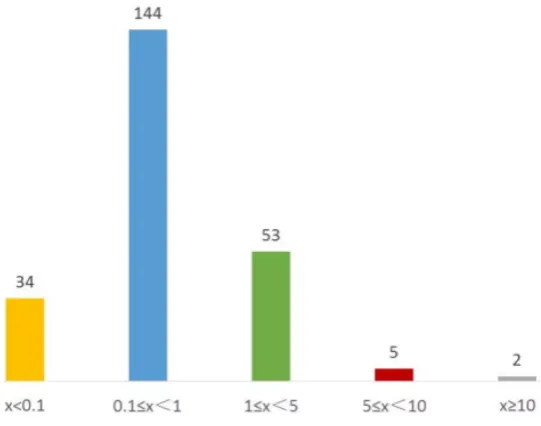
Table 2. Proportion of R&D expenditures of the listed pharmaceutical companies in China
accepted by the market or their degree of recognition is relatively low, the R&D projects for developing new drugs will definitely end up with failure. This will constitute a fatal blow to the enterprises as they cannot obtain large amounts of profits in the aftermath. Hence, the development of new drugs must take the market demand into consideration[4].
3.2 Insufficient investment in pharmaceutical research and development
At present, it is apparent to notice that most pharmaceutical enterprises lack of R&D investments for their development. This can be analyzed from two aspects. First, the investment in R&D funds. R&D funds are an important economic guarantee for the development and success of R&D projects. If R&D funds are insufficient and not in place, it will lead to restrictions on independent R&D. At the same time, R&D has periodicity, and R&D is a cyclical process. The simultaneous investment of R&D funds is achieved according to specific cycle conditions. If the company does not reserve sufficient R&D funds during the R&D process, it will inevitably lead to the failure of the company to pay the corresponding fees upon reaching the expiry date of the R&D funds, resulting in restrictions on the R&D of new products and waste of the enterprise finance. Most pharmaceutical companies in China currently have insufficient investments in
research and development of new drugs (see Table 2). Second, the investment of technologies. In the development of pharmaceutical R&D work, it is necessary to increase the input of technology. The technical input is also an important human resource factors for the smooth progress of R&D projects. Therefore, it is necessary to strengthen the investment in the core technical talents[5]. Enterprises need to
recruit talents with high technical level from technical personnel to carry out intense training. The original internal talents of enterprises are familiar with all aspects of product development and production; they understand which aspects require improvement, which components need to be upgraded, etc. With constant discoveries and explorations, the internal staff will accumulate invaluable work experiences and explore new development ideas. However, some pharmaceutical R&D companies have not developed a good talent recruitment and training model, which has resulted in under-recognition of excellent technical talents. Without maximizing the potential and use of the internal talents, the new product development will inevitably be accompanied with increased research and development costs. At the same time, due to technical limitations, the introduction of technical talents is limited[6]. In
addition, the R&D works will fall behind if the talents are recruited blindly without a clear plan for excellent technical talents recruitment.
3.3 Inadequate supervision of research and development funds of new drug
The drug research and development process is a key
of improper use of funds for R&D works in some pharmaceutical companies, the relevant costs have exceed far beyond the standard budget. Consequently, the company's hidden costs will increase greatly, further compressing the profit margins[7]. Moreover, if the
R&D project fails and the expenses are out of control, it will inevitably lead to a huge loss, causing a huge and devastating blow to the enterprise. Table 3 shows the results of the evaluation of the economic supervision of 30 pharmaceutical R&D enterprises.
3.4 Poor internal coordinations
The internal control and risk management of pharmaceutical R&D enterprises are not the particular responsibility of a certain department or a certain position. It is necessary for all employees to participate in the entire process. Any mistakes that happen at any control points in the internal control and risk management of the enterprise may result in the failure of the entire risk management system[8]. Therefore,
enterprises must properly coordinate the internal control departments. In order to improve the efficiency of the enterprise development, small accounting units will be used, so that all departments and individuals will start internal control and risk management in their own interests. At the same time, due to the imperfect concept of internal control and risk management, many departments are difficult to take the gains and losses of the overall interests of the company as the starting point in the implementation of the internal control system. This has led to a lack of coordination in the development of various departments, which has caused the internal control objectives of enterprises to deviate from the actual control. As the core of internal control, the finance department can only reflect the actual operation results of the enterprise, and it cannot manage the internal control situation before and during the event, which leads to the improper or inappropriate
implementation of the risk management work in the enterprise. Of note, the use of control measures after the accident does not prove to be helpful.
4 Measures and strategies for internal control
and risk management in pharmaceutical
research and development enterprises
4.1 Ensuring the adequacy of research
In the process of new drug research and development, it is necessary to do a good project feasibility analysis before the large-scale investment of funds, e.g. determining whether the R&D project is necessary, the degree of acceptance and recognition of the items in R&D, whether the technical ability can meet the requirements of the R&D projects, and whether mass production can be carried out. These questions in the analysis are required to be demonstrated. At the same time, enterprises need to collect opinions from potential customers, R&D departments and marketing departments while integrating the market’s technical requirements and development needs in the analysis. In consideration of market demand, they also need to ensure the level of R&D technology. From the beginning of the project application to the project review, approval, and the entire process risk control, the enterprises should ensure that the products to be made
in the R&D projects will meet the market demand, make sure that the R&D direction is scientific, reduce the company's risks asscoaited with research and development, and increase the revenues on investment of pharmaceutical R&D enterprises[9].
4.2 Ensuring rational and reasonable planned investments
The R&D work of pharmaceutical R&D enterprises is itself a form of intangible assets, and it is affiliated with uncertainties. From the perspective of R&D investment, not all R&D investments can generate revenues in the end. If the R&D is not successful, the company will put itself in jeopardy. There are two main ways to invest in R&D: using self-owned funds and using borrowed funds. Borrowed funds represent a form of financing investment of enterprises. The enterprises, if using the borrowed funds, needs to bear not only the investment cost, but also the corresponding interest. Once the R&D funding source is determined, it is necessary to first consider whether the existing capital of the enterprise can meet the R&D needs of the enterprise, and calculate the revenues on investment that can be brought to the enterprise in a short period of time, in order to shorten the recovery period of the enterprise as much as possible. After investing funds, the bank will accurately predict the rationality of the investment according to the market development trend, and prepare a reasonable development cost and budget system to ensure that the application of funds is rational. At the same time, the fund structure should be well planned, so that the funds can be invested to the right R&D projects at the right time according to the needs of the R&D project, and the R&D funds invested in each stage should also be properly controlled. The interruption of research and development due to R&D project funding problems should be prevented[10].
From the perspective of technical talents, in order to enable enterprises to obtain research and development potential, it is necessary to improve the knowledge of the internal technical personnel through training, and elevate the enthusiasm of R&D personnel through the improvement of incentive mechanism. While improving the value of the R&D personnel, the economic benefits of pharmaceutical R&D enterprises are bound to improve.
4.3 Strict control over the cost of pharmaceutical research and development
In the process of R&D in pharmaceutical enterprises, it
is necessary to properly control the relevant expenses, and establish an excellent internal control system based on the enterprise’s actual development, to ensure the scientific and standardized development of R&D, and to prevent the incidents of huge investments with inadequate management. The enterprises also need to effectively define the boundary of approval authority, and do a good job in the reimbursement and review of research and development funds. The pharmaceutical enterprises also need to formulate scientific standards and stringent standards for controlling expenses and expenditure, and at the same time perform regular checks on problems arising from the periodical expenditure. This is to achieve an integration of the research and development progress and their expenditures. In addition, they also need to organize group reviews to examine early expenditure or slow progress, in order to determine the problems in time, and make suitable adjustments. This is to prevent the insufficiency of R&D funds for the R&D works, avoiding the disruption of research and development. In addition, enterprises need to establish a comprehensive incentive, performance appraisal and accountability system, so that the internal control concept can permeate through various aspects of enterprise R&D, thereby reducing repeated experiments, reducing expenditures, and eliminating waste.
5 Conclusion
In summary, the pharmaceutical R&D enterprises possess a great deal of risks. If the internal control or risk management is not implemented well in the R&D process, the development of the enterprise will face insurmountable risks. Therefore, the pharmaceutical enterprises are necessary to do a good job in the internal control and risk management of pharmaceutical companies in combination with the development of pharmaceutical R&D enterprises and market demand.
References
[1] Zhang JF. Analysis on the related issues of internal control of the commercial pharmaceutical enterprxlises[J]. Finance and Accounting, 2019(19):237, 239.
[2] Yang S. Design of financial risk early warning and control system for pharmaceutical and chemical enterprises under network environment[J]. Bonding, 2019, 40(9):127–32. [3] Zhang NK, Zhao LF, Gao Y. Analysis of the Implementation
[4] Huang J. Problems and Countermeasures of Internal Control and Risk Management in Enterprises[J]. Accountant, 256(01):47–9.
[5] Chen D. Analysis of Internal Control and Risk Management of Chinese Enterprises[J]. Modern Marketing (later issue), 2017(4):20.
[6] Ding H. Analysis of Problems and Countermeasures i n I n t e r n a l C o n t r o l a n d R i s k M a n a g e m e n t o f Enterprises[J]. China International Finance (English), 2017(17):105–6.
[7] Jia HB. Construction of Risk Management Mechanism for Enterprise Internal Control[J]. Enterprise Reform and
Management, 2017(1):31, 35.
[8] Han B. Discussion on the Internal Control and Risk Management of Enterprises under the New Framework of COSO[J]. Modernization of Shopping Mall, 2018, 874(13):103–4.
[9] Wen YL. On Strengthening the Construction of Internal Control Management and Risk Management in Enterprises[J]. Modern Marketing (Chuangfu Information Edition), 2018, 176(08):70.