Fire Detection Using Cnn Approach
N Prabhu Ram, R Gokul Kannan, V Gowdham, R Arul VigneshAbstract: Fire outbreak is the common issue happening everywhere and the damage caused by this type of incidents is tremendous towards nature and human. Vision based fire detection system have recently gained popularity as compared to traditional sensor based fire detection system. However, the detection process by image processing technique is very tedious. We proposed a fire detection algorithm using Convolutional Neural Networks to achieve high-accuracy fire image detection, which is compatible in detection of fire by training with datasets. Number of images in the datasets taken for fire and non-fire are 3696 and 541 respectively. Totally, there are 4237 images. These images are rendered from video containing fire and some of those from internet. Out of which 2857 images are resized and reshaped to convert as training dataset and 1921 for testing dataset. The model is trained by applying convolution, activation functions and max pooling operation. By using different batch sizes and epoch values, the model is trained. The accuracy of model is 94%. Over the 1921 images, 1817 images are predicted correctly. Thus, we are getting with a high accuracy and high detection rate.
Index Terms: Convolution, machine learning, fire detection, neural networks.
—————————— ——————————
1
INTRODUCTION
Fire detection is crucial task for the safety of people. To prevent damages caused by fire, several fire detection systems were developed. One can find different technical solutions. Most of them are based on sensors, which is also generally limited to indoors. However, those methods have a fatal flaw where they will only work on reaching a certain condition. In the worst-case scenario, the sensors are damaged or not being configured properly can cause heavy casualty in case of real fire. Those sensors detect the particles produced by smoke and fire by ionization, which requires a close proximity to the fire. Consequently, they cannot be used for covering large area. To get over such limitations video fire detection systems are used. Due to rapid developments in digital cameras and video processing techniques, there is a significant tendency to switch to traditional fire detection methods with computer vision-based systems. Video-vision-based fire detection techniques are well suited for detecting fire in large and open spaces. Nowadays, closed circuit television surveillance systems are installed in most of the places monitoring indoors and outdoors. Under this circumstance, it would be an advantage to develop a video-based fire detection system, which could use these existing surveillance cameras without spending any extra cost. This type of systems offers various advantages over those standard detection methods. For example, the cost of using this type of detection is cheaper and the implementation of this type system is greatly simpler compare to those traditional methods. Secondly, fire detection system responds faster compared to any other traditional detection methods because a vision-based fire detection system does not require any type conditions to trigger the devices and it has the ability to monitor a large area.
2
RELATED
WORKS
Punam Patel, et.al., (2016) proposed a paper entitled Flame Detection using Image Processing Techniques. Proposed that the image-based fire detection needs a number of sequential frames from original video, which consists of fire and non-fire images. It consists of three main stages fire pixel detection using RGB and YCbCr color model, moving pixel detection and analyzing shape of fire colored pixels in frames. This method is applied on video sequences and then fire is detected[1]. Jareerat Seebamrungsat, et.al., (2014) proposed a paper entitled Fire Detection in the Buildings Using Image Processing. Proposed the use Colour Segmentation technique to segment fire from its background. The properties of the HSV and YCbCr colour models are used to separate the flame colours from the background. The HSV colour model is used to detect information related to colour and brightness. Then, they calculate the number of white frames by the difference of previous frames and actual frame for five frames consecutively[2]. Khan Muhammad, et.al., (2018) proposed a paper entitled efficient deep CNN based fire detection system and localization in video surveillance system. This system proposed the intelligent feature map selection algorithm is proposed for choose appropriate feature maps from the convolutional layers of the trained CNN, which are sensitive to fire regions.These feature maps allow a more accurate segmentation of fire compared to other handcrafted methods. Using this the size of the model was reduced from 238 MB to 3 MB, thus minimizing the cost and making its implementation Another feature of this system is the ability to identify the object which is on fire, using a pre-trained model[3]. Abdulaziz, et.al., (2018) proposed a paper entitled An Efficient Deep Learning Algorithm for Fire and Smoke Detection with Limited Data. Proposed a convolutional neural network and created a new small dataset of fire and smoke images to train and evaluate the model to solve the over fitting problem in training the network on a limited dataset, they improve the number of available training images using traditional data augmentation techniques. They collected a new dataset, which consists of fire, and smoke images dataset that can be used to train the network and test the data and this helps the network to learn fire and smoke features under different weather and light conditions[4]. Qingjie Zhang, et.al., (2016) proposed a paper entitled Deep Convolutional Neural Networks for Forest Fire Detection in International Forum ___________________________________
• Mr.N.Prabhu Ram is currently working as Assistant professor in Electronics and Communication Engineering in Kongu Engineering College,India,E-mail: [email protected]
• R.Gokul Kannan is currently pursuing Bachelor degree program in Electronics and Communication Engineering in Kongu Engineering College,India,E-mail: [email protected]
• V Gowdham is currently pursuing Bachelor degree program in Electronics and Communication Engineering in Kongu Engineering College,India,E-mail: [email protected]
3850 on Management, Education and Information Technology
Application by Aviation University of Air Force, Changchun. They use a small subset for developing and evaluating the algorithm. In this work, they investigated two types of classifiers: linear classifier and a non-linear one due to the size of our annotated dataset is small. They changed the number of outputs in last fully connected layer into two for our binary classification. In this network, they also reduced over fitting these are trained in just several hundred iterations and reaches both training and testing accuracy as high which is surprisingly good[5]. Sebastien Frizzi1, et.al., (2017) proposed a paper entitled Convolutional Neural Network for Video Fire and Smoke Detection in IEEE Transactions. The main objective their classification is to decide whether an image contains fire or smoke. They created three subsets of training 60% of images, Validation 20% and test 20%. To optimize the detection and localization of fire on a video, we must improve our training set. The training data has been realized with a computer composed of a microprocessor Intel Xeon (frequency CPU 3,1Ghz, RAM 16Go) and a graphic card GTX 980 Ti 2816 cores, 6 GB memories). In addition to that, they compare the algorithm to conventional methods over a wider variety of video fire images like different material, sources and ventilations the classification accuracy on the test set[6]. Muhammad Khan, et.al., (2017) proposed a paper entitled Early fire detection using convolutional neural networks during surveillance for effective disaster management. Proposed a framework, which avoids the tedious and time-consuming process of feature engineering and automatically learns rich features from raw fire data. In these, several kernels of different sizes are applied on the input data to generate feature maps. These features maps are input to the next operation known as subsampling or pooling where maximum activations are selected from them within small neighbourhood. The motivational reason of such inception is to avoid uncontrollable increase in the computational complexity and networks' flexibility to significantly increase the number of units at each stage. Moreover, these systems improve the high fire detection accuracy with minimum false alarms but the model size is comparatively high of around 240 MB[7].
3 METHODOLOGY
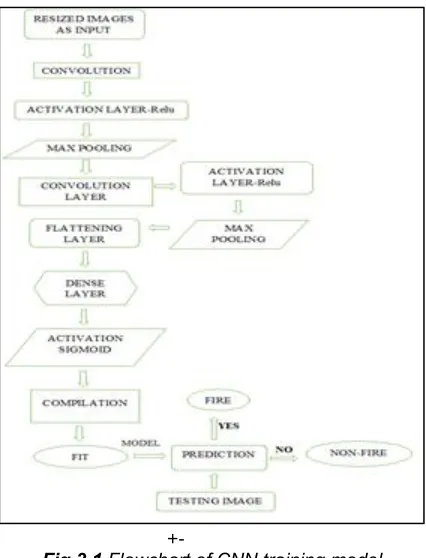
The methodology is proposed using CNN (Convolutional Neural Networks ) model. The image datasets are created from fire images captured by videos and converting it into frames. Some images in the dataset are added to dataset taken from GitHub[8]. Images are to be classified as fire and non-fire. Number of images in the datasets for fire and non-fire is 2316 and 541 respectively. Totally there are 2857 images. These images are resized as (300,300) and then reshaped as (-1,300,300,1) and stored as a linear array. This is given as a input to the convolutional layer. In these operations, several kernels of different sizes are applied on the input data to generate feature maps. The model consists of 64 convolution filters of size 3x3 each. The feature maps go through a ReLU activation function. This function updates positive portion of the feature map rapidly. These features maps are input to the next operation known as max pooling.
+-
Fig 3.1 Flowchart of CNN training model
These feature maps are subjected again to convolution layer and pooling layer which has kernel size of 3x3. Then a flatten layer which converts 2D feature maps into a vector that can be fed to fully connected layer. Among these three main operations, the convolution and fully connected layers contain neurons whose weights are learnt and adjusted for better representation of the input data during training process. A dense layer represents a matrix vector multiplication. The values in the matrix are the trainable parameters, which are updated during back propagation. Therefore, you get an m dimensional vector as output. Finally, we have an activation function such as Softmax to classify the outputs as fire and non fire. Softmax function provides a probability distribution that maps output to a 0 to 1 range.That’s why it is used as final layer of classifying model. The model is compiled using an Adam optimizer which provides an adaptive learning rate to find individual learning rate of each parameter. Categorical cross entropy loss function is used in this classification as only one result could be correct.
4
RESULTS
AND
DISCUSSION
Training of model with different batch sizes and number of epochs provide different accuracy.
Table 4.1 Comparison with different batch size and epochs
BATCH SIZE EPOCHS ACCURACY LOSS
32 10 0.9880 0.1220
16 10 0.9974 0.0216
64 10 0.9984 0.0107
Batch size is the number of samples to work through before updating the internal model parameters. A training dataset can be divided into one or more batches. The number of epochs is the number of times that the learning algorithm will work through the entire training dataset. Here, for a batch size of 64 and 10 epochs, the loss (0.0107) is very low and the accuracy is high. This is because when the batch size is increased, the loss is decreased.
4.1 CONFUSION MATRIX
The number of correct and incorrect predictions are summarized with count values and broken down by each class. The confusion matrix shows the ways in which your classification model is confused when it makes predictions. It gives us insight not only into the errors being made by a model but more importantly the types of errors that are being made. Actual labels (Y) and Predicted labels (Z) are used to compute the confusion matrix.
Table 4.2 General Confusion matrix
CLASS-1 PREDICTED
CLASS-2 PREDICTED CLASS-1
ACTUAL TP FN
CLASS-2
ACTUAL FP TN
Here,
Class-1 : Positive (Fire) Class-2 : Negative (Non-Fire)
True Positive (TP) : Actual is positive, and is predicted to be positive.
False Negative (FN) : Actual is positive, but is predicted negative.
True Negative (TN) : Actual is negative, and is predicted to be negative.
False Positive (FP) : Actual is negative, but is predicted positive.
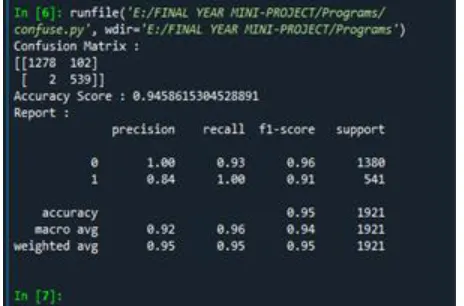
Fig 4.1 Confusion matrix and Classification report
Table 4.3 Obtained confusion matrix
CLASS-0 (POSITIVE) PREDICTED
CLASS-1 (NEGATIVE) PREDICTED CLASS-0
(POSITIVE) ACTUAL
1278 102
CLASS-1 (POSITIVE) ACTUAL
2 539
The number of originally positive images are 1380 and 1278 images are predicted as true positive (TP).The number of originally negative images are 541 and 539 images are predicted as true negative (TN).The number of originally negative images are 541 and 2 images are predicted as false positive (FP).The number of originally positive images are 1380 images and 102 images are predicted as false negative (FN). Therefore, 1817 images are predicted correctly and 104 images are falsely predicted.
Accuracy = (1817/1921) x 100 = 94.6% 6% of the images are falsely predicted.
False negative (%) = (102/1921) x 100 = 5.3% (102 images)
False positive (%) = (2/1921) x 100 = 0.1% (2 images) Total Falsely predicted = False negative + False positive = 5.3% + 0.1% = 5.4% (102 images)
Table 4.4Classification Report
CLASS PRECISION RECALL F1-SCOR E
SUPPOR T
0 (FIRE) 1.00 0.93 0.96 1380
1 (NON-FIRE) 0.84 1.00 0.91 541
ACCURACY 0.95 1921
MACRO AVERAGE 0.92 0.96 0.94 1921
WEIGHTEDAVERAG
E 0.95 0.95 0.95 1921
Accuracy is given by the relation:
𝑨𝒄𝒄𝒖𝒓𝒂𝒄𝒚 = 𝑻𝑷 + 𝑻𝑵 𝑻𝑷 + 𝑻𝑵 + 𝑭𝑷 + 𝑭𝑵
Accuracy = (1278 + 539) / (1278 + 539+ 2 + 102) = 0.94 Accuracy of 0.94 is obtained.
Recall is given by the relation:
3852 Recall = (1278) / (1278 + 102) = 0.92
Recall value of 0.92 is obtained. High Recall indicates the class is correctly recognized (small number of FN).
Precision is given by the relation:
𝑷𝒓𝒆𝒄𝒊𝒔𝒊𝒐𝒏 = 𝑻𝑷 𝑻𝑷 + 𝑭𝑷
Precision = (1278) / (1278 + 2) = 0.998
Precision value of 0.998 is obtained. High Precision indicates an example labelled as positive is indeed positive (small number of FP).
High recall, low precision: This means that most of the positive examples are correctly recognized (low FN) but there are a lot of false positives.
Low recall, high precision: This shows that we miss a lot of positive examples (high FN) but those we predict as positive are indeed positive (low FP).
F-measure:
Since we have two measures (Precision and Recall) it helps to have a measurement that represents both of them. We calculate an F-measure, which uses Harmonic Mean in place of Arithmetic Mean as it punishes the extreme values more.The F-Measure will always be nearer to the smaller value of Precision or Recall.
𝒇 𝑴𝒆𝒂𝒔𝒖𝒓𝒆 =𝟐 ∗ 𝑹𝒆𝒄𝒂𝒍𝒍 ∗ 𝑷𝒓𝒆𝒄𝒊𝒔𝒊𝒐𝒏 𝑹𝒆𝒄𝒂𝒍𝒍 + 𝑷𝒓𝒆𝒄𝒊𝒔𝒊𝒐𝒏
F-measure = (2 x 0.92 x 0.998) / (0.92 + 0.998) = 0.95 F-measure value of 0.95 is obtained. From this we infer that, the high value of F-measure indicates a better balance between precision and recall.
4.2 OUTPUT
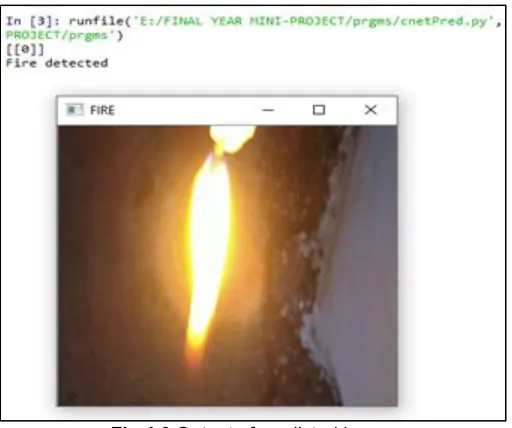
Fig 4.6 Output of predicted image
The input image is predicted as FIRE image.
Fig 4.7 Output of predicted image
The input image is predicted as NON-FIRE image.
5
CONCLUSION
AND
FUTURE
SCOPE
Fire is the most dangerous abnormal event, as failing to control it at an early stage can result in huge disasters leading to human, ecological and economic losses. Fire accidents can be detected using the cameras. So that, here we proposed a CNN approach for fire detection using cameras. Our approach can identify the fire under the camera surveillance. Furthermore, our proposed system balances the accuracy of fire detection and the size of the model using fine-tuning of datasets. We have obtained an accuracy of 94%. Also the F-measure value is 0.95. These values shows that the model gives a better prediction. We conduct experiments using datasets collected from recording of fire and verified it to our proposed system. In view of the CNN model’s reasonable accuracy for fire detection, its size, and the rate of false alarms, the system can be helpful to disaster management teams in controlling fire disasters in a short time. Thus, avoiding huge losses. This work mainly focuses on the detection of fire scenes under observation. Future studies may focus on deploying the model into raspberry pi and using necessary support packages to detect the real time fire by making challenging and specific scene understanding datasets for fire detection methods and detailed experiments.
6
REFERENCES
[1]. Punam Patel and Shamik Tiwari in(2016) proposeda paper entitledFlame Detection using Image Processing Techniques in International Journal of Computer Applications Volume 58– No.18.
[2]. Jareerat Seebamrungsat, Suphachai Praising, and Panomkhawn Riyamongkol in (2014)proposeda paper entitled Fire Detection in the Buildings Using Image Processing in Third ICT International Journal of IEEE Access in Department of Electrical and Computer Engineering.
based fire detection system and localization in video surveillance system at IEEE Transactions on Systems, Man, and Cybernetics Systems.
[4]. Abdulaziz and Young Im CHO in (2018) proposed a paper entitled An Efficient Deep Learning Algorithm for Fire and Smoke Detection with Limited Data in IEEE Explore Advances in Electrical and Computer Engineering.
[5]. Qingjie Zhang, Jiaolong Xu, Liang Xu and Haifeng Guo in ([2016) proposed a paper entitled Deep Convolutional Neural Networks for Forest Fire Detection in International Forum on Management, Education and Information Technology Application by Aviation University of Air Force, Changchun. [6]. Sebastien Frizzi1, Rabeb Kaabi, Moez
Bouchouicha, Jean-Marc Ginoux in (2017) proposed a paper entitled Convolutional Neural Network for Video Fire and Smoke Detection in IEEE Transactions.
[7]. Muhammad Khan and Jamil Ahmad in (2017) proposed a paper entitledEarly fire detection using convolutional neural networks during surveillance for effective disaster management.