3734
A Gamification Technique Through The Method
Of A Lesson Study In Teaching Probability
Maryann H. Lanuza, Richie V. Mendoza, Robert Jan R. Bayan, Levi Elipane, Kristine Anne C. Dimaculangan,Florabel F. Hilario
Abstract: Gamification Technique (GT) in education is a growing trend since the 21st-century learners are digital natives who are also innately playful, with a lesson study (LS), colleagues and experts will be continuously developed a lesson plan which helps to improve teaching and student learning, and perhaps evince contextual mathematical knowledge for teaching. More so, the purpose of the study aims to use the GT through LS in teaching probability courses to Senior High School (SHS) students. Specifically, the paper aims to document the use of GT in teaching simple and compound probability of events and to develop integrative gamification using manipulatives in teaching probability. A qualitative case study was adopted in which a team was created to conduct an LS. Results revealed that the use of gamification was perceived to be effective in teaching probability to SHS students. Also, manipulatives were utilized in which students' performances were graded based on the rules in each activity and according to the scoring rubric. Notwithstanding, the use of manipulative in each activity was effective in engaging learners in the teaching-learning process and in gaining an understanding of probability. Surprisingly, the use of probing questions was then recommended by the experts in the LS since they saw a more meaningful discussion in it. It was recommended to integrate the lesson to real-life experiences of the students aside from using typical examples found in the book. A positive note highlighted is its ability to foster cooperation and care for others among students. Notable observations can be linked to the qualities of the teacher in the effective facilitation of gamification. Now, what makes the LS essential is that it teaches the entire educators to be keen on emphasizing the objectives after implementing game-based activities that it is not about winning or gaining points but learning to cooperate and helping one another.
Index Terms: Mathematics Education, Games-based Strategy and Gamification Technique, Lesson Study, Probability, Whole Brain Teaching, Philippines
—————————— ——————————
1
INTRODUCTION
Mathematics has played a major role in bringing innovations reality. Many mathematical theories and models help solve real-world problems related to the use of numbers and computations. Infrastructure, nutrition, economics, and other forms of technology deals with Mathematics. Thus, it is considered one of the important subjects taken in educational institutions. Mathematics has several useful benefits for our minds. It develops reasoning and facilitates critical thinking and analytical thinking. Moreover, since Mathematics is applied in our daily lives it generates practicality to everyone. However, there are several negative impressions in Mathematics among students like ―Math is boring‖, ―it is abstract, very difficult to understand and it is not that motivating‖. These impressions push teachers to think of different teaching methods in Mathematics. One of which is the use of educational games. It is believed that its practice and implementing discipline with values will hook more the students’ interest and learning using strategies such as gamification and whole-brain teaching techniques. Gamification in education is a growing trend since the 21st-century learners are digital natives who are also innately playful. Kapp (2012) defines gamification as ―using gamebased mechanics, aesthetics and game thinking to engage people, motivate action, promote learning, and solve problems (p. xx).‖ David (2016)
cited the following as benefits from gamification in education: (1) students feel ownership over their learning; (2) more relaxed atmosphere; (3) more fun in the classroom; (4) students may uncover intrinsic motivation for learning; and (5) students are often more comfortable in gaming environments. On the other hand, Whole-Brain Teaching (WBT) technique is composed of seven core teaching techniques known as the Big Seven. These are Class-Yes, Five Classroom Rules, Teach-Okay, Switch, Scoreboard, Hands and Eyes, and Mirror. Advocates of WBT believed that the use of these techniques in the classroom improves students’ engagement, motivation, behavior and academic achievement (Biffle,2013). In this study, the gamification employed is not much driven by modern technology but makes use of manipulatives instead. Also, the games used are single-shot games that did not use point incentives and did not track level progress with badges and game boards. Each game was not given points to determine whose group won or lost but instead, tangible rewards such as candies and chocolates were given. With regards to Whole-Brain Teaching, only two of the seven core areas were utilized, which were ―ClassYes‖ and ―Teach-Okay‖. These techniques in teaching are believed to be useful in teaching Mathematics. However, there are concepts and lessons that are treated negatively (hated) by most students no matter how encouraging the teaching method is. This lesson is on Probability and Statistics. This might be because it deals with a complex process using technical terms. Historically, the mathematics of probability and statistics was first developed through analyzing games of chance such as the rolling of dice. The understanding of probability and statistics is dependent upon building a "mature" understanding of common random phenomena such as the rolling of dice or the blind drawing of balls from an urn (Kuzmak, 2016) which enable the learners to check for hidden bias or hidden assumptions leading to critical and analytical reasoning. Consequently, teachers feel drained or exhausted when the performance and behavior of their students do not meet their expectations. Plus the fact that integrating values education in
_______________________________________
• Maryann H. Lanuza and Richie V. Mendoza are from Department of Arts, Sciences, and Teacher Education City College of Calamba • Robert Jan R. Bayan is fomr Cavite State University
• Levi Elipane is from Philippine Normal University
3735
Math is challenging too. There is growing pressure for all teachers to become teachers of values even in Mathematics courses, through modeling, discussing, and critiquing values-related issues. Taplin (2017) stated that many educators are having the reasons where the state of society has reached a stage where it is more critical than ever to educate people in the traditional values of their culture. In the Philippine context, values education is indeed very important. This is the reason why it is continuously being taught in the basic education program and is required to be integrated into all learning areas. To verify this phenomenon, Lesson Study (LS) is applied. LS is a professional development process where teachers work collaboratively in examining their own practice of teaching in order to improve the learning experiences they have exposed to students. Lesson Study is not being able to come up with the best ―lesson‖; instead, the lesson just serves as a vehicle towards achieving intersecting goals on the improvement of teaching and student learning, and/or evincing contextual mathematical knowledge for teaching. (Elipane, 2012). Teachers may consider the use of LS to find new ways or techniques in teaching probability by improving the classroom instruction and to give the opportunity for the teacher’s professional development (Elipane, 2017). This study wanted to explore Filipino values through gamification and whole-brain teaching as strategies in teaching Probability to senior high school students. Generally, it focuses to determine how values education be integrated into Math, specifically in teaching Probability.
1.1.Research problem
This study aimed to determine how values can be into teaching Probability through gamification and whole brain teaching techniques. Specifically, it aimed to:
(a) Explore the use of gamification using manipulatives and the Whole Brain Technique in teaching Probability to Senior High School students;
(b) Accentuate values integration in teaching Probability through gamification and whole brain teaching techniques; and
(c) Determine the strengths and weaknesses of employing gamification and whole brain teaching techniques in teaching Probability.
2 METHODOLOGY
2.1 Research Design
The researchers were interested in student learning and values formation by engaging the students with lessons that incorporate the use of gamification and whole brain teaching techniques. A qualitative case study approach was adopted in which an LS team was created and worked on their specific goals. The practices and observations of the LS team were conducted and closely monitored, and in the process, a large amount of qualitative data in the form of observation logs and inputs gathered in the post-discussion were collected. The obtained qualitative data were transcribed verbatim and subsequently open coded to find common themes. This was followed by axial coding in order to find both what and from what the students learned for each of the emerged themes. The conduct of the LS followed the cycle provided in the Lesson Study Handbook by the Maths Development Team, Professional Development Service for Teachers, Ireland (2017).
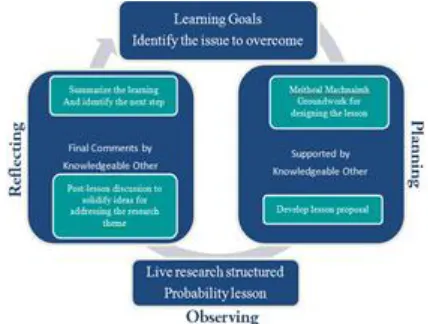
Figure 1. Paradigm of the Study
The team developed a systematic way to investigate how students learned from the lesson. It considered the type of data and evidence the team collected and how the observers observed and recorded data during the lesson. During the discussion and activities, the observers attended to how students interact with each other, how they answered the instructor’s questions, and how they explained their outputs. To assist in data collection, the team recorded the comments and suggestions given by the observers. The conduct of the LS followed the cycle provided in the Lesson Study Handbook by the Maths Development Team, Professional Development Service for Teachers, Ireland (2017). The Lesson Study includes three processes Planning, Observing and Reflecting. Initially, learning goals shall be set to overcome the identified issue. Thus, in the Planning stage, this is supported by the member of the team who is experts or with specialization related to the identified issue. After planning, the lesson will be exposed to learners which will then be observed by the team and some guest observers. Next to observation is making reflections on the planned lesson which was exposed to the learners commented by other experts in the teamIn this study, the gamification and whole-brain techniques were the method to teach the planned lesson which was observed by the team and then was processed in order to come up with a reflection.
Formulating Learning Goals
The LS team consisted of three mathematics instructors from different HEIs and one senior high school teacher. The team began by selecting a topic and goals for student learning using the Department of Education’s (DepEd) curriculum guide. Instructors selected a topic in the curriculum which was the probability of simple events in teaching 32 senior high school students from the Lyceum of the Philippines. The goals of the lesson include having the learners to determine the sample space of simple events, solve problems involving the probability of simple events, and explain the importance of probability in decision making. This is in the curriculum guide that reflects the values on solving problems and in making proper decision. The instructors aimed to meet these objectives with the use of gamification and whole brain teaching techniques.
Designing the Research Lesson
3736
technique. With gamification, game-design elements were added to incentivize a particular process by giving rewards, in this study, giving candies. Wiggins (2016) mentioned that rewards or incentives can add the result to intrinsic motivation in a given gamified process which invariably uses extrinsic rewards. Considering this, the team critically planned the activities to be included in the lesson to foster intrinsic motivation through team probability strategic games. These activities are namely: Rock, Paper, and Scissors‖; ―Game of Chances‖and ―Probability Themed Park‖. Each activity is followed by guide questions for discussion to process the concept being taught.
Teaching and Observing the Research Lesson
The research lesson was taught at the scheduled time arranged by a professor from Lyceum of the Philippines, Manila. One member of the team-taught the lesson and other members attended the class to collect data. Also, the team invited other graduate students as guest observers. Aside from observing how the teacher delivered the lesson, like in typical classroom observations, observers also focused on how students responded to the lesson. The observers gathered rich evidences related to the learning goal during the lesson, capturing the complexity of actual teaching and learning. The observers recorded detailed field notes which focused on specific types of student activity, student engagement, performance, thinking, and behavior.
Analyzing the Evidence
Soon after the lesson was taught, the team held a post- conference to examine the evidence related to the learning goals and reflected on the experience. The participants were composed of the LS team members and guest observers. The participants shared their observations and examined additional evidence from the lesson, such as students’ output, searching for patterns that may reveal important insights into teaching practice and student learning.
3 RESULTS AND DISCUSSIONS
This study aimed at determining if it is through gamification and whole-brain teaching techniques that values can be integrated effectively in teaching. Through an LS, the researchers came across the following categories to find new ways or techniques in teaching probability that focuses on the process and results on the (a) content and instruction and (b)
instructional materials. Theme:
1. Explore the use of gamification using manipulatives and the Whole Brain Technique in teaching Probability to Senior High School students;
2. Accentuate values integration in teaching Probability through gamification and whole brain teaching techniques; and
3. Determine the strengths and weaknesses of employing gamification and whole brain teaching techniques in teaching Probability.
A. On the Content and Instruction
Observations of the LS team revealed the importance of the choice of examples in the achievement of learning outcomes of students and the importance of the quality of the teacher in order to cater learning as crucial points under the area of content and instruction. As observed by some members of the team, the choice of examples in presenting the probability of
events mattered in the achievement of the learning outcomes of the students. The example itself gave confusion to the students, which led the teacher to be confused as well. When the teacher asked the students about the probability of drawing a consonant letter in the word ―RESPONSIBILITY‖, some students gave 9/12 as a response, while some said 9/14. When the student who answered 9/12 explained why such was the answer, the teacher seemed to be confused as well as the explanation was convincing.
Graduate Student 1: I noticed, I think everybody noticed the decrease in energy. Maybe if the correct answer to the problem was not obtained, then you (teacher) should have left it already, but then you carried the thought with you even on the succeeding topics. When she became doubtful about the 9/12, her energy went down already as she continued with the other topics.]
Post-Discussion Facilitator: The teacher?
Graduate Student 2: Yes, her (energy) went down. Because I know you (teacher) to be energetic, like during the first part, then it seems you were bothered by the 9/12.]
In the planning phase of the study team, they used the word ―responsibility‖ since they wanted to instill the value of responsibility after playing for a bet in tossing a single coin, two coins simultaneously, and throwing a single die; in the lesson they let the students to experience the joy of winning the gamble, or the regret in losing the game. The aim was to make the students realize that the accountability of managing the money (candies of the group in this case) in a gamble should be moderate and should be used only for bonding and entertainment rather than lead to addiction and greed. However, the problem itself caused the confusion since a phrase ―without repetition‖ should have been added to clearly define the probability that was being asked. In this case, the goal of instilling values was realized but the clarity of the concept was compromised. This claim is consistent to the study of Rowland, Huckstep, and Thwaites (2005) which concluded that the teachers’ ability in selecting suitable mathematical examples was strongly related to their mathematics content knowledge for teaching. This claim also correlates with the use of game- based strategy that defines what game is suited to a particular topic in Mathematics specifically in Probability. In addition, other members of the team pointed out the importance of situational or contextualized examples in which learners can see the relation of concepts in their everyday life.
3737
can connect that. Also, I was looking for, since you can actually divide the lesson into two or three meetings, how they can be denoted. Because you (teacher) were already asking them to write. So part of it, since they’re already writing, is how to denote events. Perhaps it’s a way of, since they already have intuitions, you can tell them how to do it. That is how an event should be written, since after all, you have been talking about definitions already. Okay, then in the treatment of examples, the examples were really good. It was discussed one by one. But you (teacher) went back to correct. It could have been better if you could have checked already (after the students discuss) for better recall. So that you don’t have to go back, and also for us to see if they have understood the concept which they can apply to the succeeding examples. Okay that’s all. All in all, congratulations again, make connections and thank you very much…]
Graduate Student 3: ―… it would be better if you created each examples to be situational…:
Graduate Student 4: ―…good thing to have examples with variations, but still be careful to the level of students’ comprehension and information overload…‖
Students do not care anymore the probability of getting a sum of seven in throwing two dice simultaneously but instead how the probability in these dice will help them somehow in their decision making. Using examples or word problems that students can relate with can make them understand the lesson better. If they can associate natural occurrences and real life experiences to what they are learning in the Mathematics classroom, that would be a good sign of learning. On another note, the quality of the teacher in facilitating learning was also observed to be an important factor on the area of content and instruction. Whole Brain Teaching is intended to be flexible, adaptable by any teacher to their own teaching methods. The ability of the teacher to use this strategy was shown to be of great importance in the success of its implementation. The same is true with the implementation of game-based approach wherein students can be freely active and participative in any learning activity to be presented as a game inside the classroom.
Graduate Student 4: Firstly, congratulations Ma’am for a very organized discussion. I will just what I learned from a seminar we attended earlier about charismatics. It was about what your (teacher) charisma inside the classroom is and how it affects the learning of students. Just like a while ago, the approach that you do, the way you talk (with the students). Maybe with the way you approach them, that’s also how they respond; maybe that’s why they cooperate and follow what you say.]
Teachers’ character charisma, knowledge charisma, humor charisma and teaching method exert significant and positive influence on students’ personal interest and situational interest. Lee, et. al (2013) added that knowledge charisma has the highest predictability for personal interest and situational interest, indicating that teachers’ professional abilities exert the highest level of influence on student interest in learning. Other members of the team commented on the importance of the teacher’s ability to maintain composure in the effective delivery of instruction.
Graduate Student 5: Well, some say that sometimes no matter how good your plan is, there really come glitches along the way so it seems it’s really part of chances. The probability of something… At any rate I still have to commend the teacher because I think when we teach, that really happens. Sometimes we lose our focus, but our composure remains so I think that’s really one of the best characteristics of a teacher.]
Graduate Student 6: Even if the teacher was not feeling well, the show must go on, as they say. Based from how I’ve known her (teacher) since we work in the same school, she can still give something more than what she was able to deliver today if she was not feeling well. But all in all, congratulations Ma’am, you did very well.]
It seems part of the nature of the Filipino teacher to still come to class and teach despite feeling unwell. Filipino teachers pretend to be fine and continue to deliver instruction since their primary reason is that ―the show must go on‖. They are very passionate about teaching and concerned about what will happen to their students if they will be absent. Such quality of the teachers in valuing their students’ learning can probably be felt by the students as well and thus hence their appreciation of the lesson. Another quality of a teacher that was noticed by some members of the team was how she managed the class through the Whole Brain Teaching strategies and some other prompts.
Graduate Student 7.…everything was really managed, even the groupings, that’s why it was not disorganized. Even if they (students) were asked to do countoff, the group was really managed. I was amazed by that…]
Graduate Student 8:…I was just a bit triggered that maybe you become over manipulative. There might be a tendency that the (students) become like robots seeming to lose their freedom with their creativity since you tell them everything that they have to do. At first, the 1-2-3-4-5, then the 1-2-3-4 teach. It was okay but when it became a series of instructions wherein seemingly everything that they have do is numbered, I became nervous that such pattern may continue that everything that they have to do is dictated.]
3738
attention of the students when the group activities become a bit chaotic. Also, the attention getter: the ―Class-Yes‖ component of WBT ensured the responsiveness of students as well. It was observed that the use of coding and conditioning were effective in maintaining order in the class despite using game-based strategy. However, the observation that repeated use of coding or classical conditioning techniques may lead to hindering students’ creativity is also worth noting. Thus, the teacher should exert effort to ensure that such techniques will not be misused or overused in the classroom. Meanwhile, the post-discussion facilitator gave meaningful remarks and suggestions on how to more effectively utilize probing techniques to deepen students’ understanding of the lesson.
Post-Discussion Facilitator: [Okay, so thank you very much for the lessons. First issue that I can see is really looking at the prior knowledge of the students; what their prior knowledge really is. So it seems that in that permutation problem, with the repetition, it was really…]
Post-Discussion Facilitator: So, there. Then, Ma’am asked about experiment, sample, definitions already so I don’t really know what the prior knowledge of the students is. I was thinking, isn’t it unfair for them (students) to be asked since they really do not have any idea about it? My suggestion is for you to make an activity, or what was that activity you used - Rock, paper, scissors, to look back at what they did and then identify, from there they already know what the outcomes are. From there the definitions of outcome, events, will come out. Then you will be the one to give (the definition) because there are things that are difficult to ask students to give especially if they really do not know about them. But good thing the students were really very easy to manage, they were very obedient. Plus, aside from being obedient, they were really good. So when you told them to discuss with their classmate the experiment, sample space, outcomes, they really discussed. Nobody chatted about other things. All of them talked about that. The students are really very good. Ah yah. Also again on probing, on questions, the probing responses, like the one in flipping of a coin. Flipping of one coin was okay. Flipping of two coins, what are the outcomes, the teacher asked. One student answered 2, and she repeated it around two times. So she said 2 three times. But you called (the student) the one who gave the correct answer 4. Perhaps it would have been nice to call the student who answered 2. Why (did she have such answer)? Perhaps she should have been called first, to determine the misconception which is for the benefit of all. It’s because the student who said 2 was very, she had the conviction to say 2. It seems that she knows it should be 2. Then when the answer was 4, I looked at her face and saw that she had questions. Why, it seems? Then again, those types of responses. Then, on throwing a die, the 6. When they placed their bet, their choices were only 3 or 4, why is that so? Maybe you could have asked the students, why did you choose 3 or 4 only? Usually we look at the middle. So when we look at 1 to 6, we look at the middle. But isn’t it that you (students) said that there are equal chances, so you (teacher) will connect. Deepen the discussion. So if there are equal chances why did you have a bias in the middle values?]
Post-Discussion Facilitator: Yes, scatter that. So that which is happening now. So probability. Uhm, yes she has
done a lot. I like, the 4… the preparation of activities that all of them are equally interesting. It’s just that I was looking for a little more deepening in the discussion but then again it cannot be covered in one lesson.]
As emphasized in the commentary, probing questions should be utilized to deepen the discussion of Probability. Probing is a highly effective technique to aid the students in making meaning of what is being taught to them. It is also an effective tool in checking for misconceptions, and in making the lesson more relevant to the experiences of the learner. Teachers must be conscious on what questions to ask and to dig deeper on the reasons why students have different answers in their mind. Also, through probing, the teacher may integrate values in the lesson.
B. On the Instructional Materials (IMs)
While gamification was a strategy employed in this study, it should be noted that manipulatives were utilized instead of online games. One objective of the study is to explore the effectiveness of using gamification through manipulatives in the effective teaching of Probability. Aside from manipulatives, conventional and technology-based instructional materials were also utilized. Instructional materials (IMs) develop a continuity of thought, this is especially true of motion pictures, as they provide experiences not, easily obtained through other materials and contribute to the efficiency, department and variety of learning (Samuel, 2009). It is worth exploring how important the integration of conventional instructional materials and manipulatives as well as technology are in making learning more real and meaningful to the learners. Even in the technology-driven 21st century, conventional IMs are still relevant if they make learning more meaningful. As concluded by Samuel (2009), the materials should not be substitute for learning but must contribute to the learning process itself. As observed by some members of the team, the use of manipulatives and PowerPoint presentation became effective in contributing to the learning process.
Graduate Student 9: Good thing to have a colorful but simple power point presentations, it is not too decorative, suited to the theme of the lesson (amusement park theme), do not involved too much animations and sound, just enough for a comprehensive presentation. It indeed reflects a 21st century teacher through the appropriate use of Information Communication Technology (ICT).
3739
note, some observations on the use of the other instructional materials specifically the static and posted materials were also worth mentioning.
Graduate Student 3: Uhm I don’t know but if I may suggest, since you used (gigantic slider) for the definition, it seems that the font size of the visual aid was a bit small. And we all know that the role of the visual aid is to aid both the learners and the teacher that it (IM) is not hard to open…then, it has to be the learning so if it is just a definition, probably just a static print would do rather than one that is hard (to open).]
Graduate Student 6: Good thing to have a theme-park design in the conventional IMs, and with element of surprise, (the gigantic slider) but make sure to practice the opening and closing of these IMs beforehand.
Graduate Student 6: Utilized the IMs well, there are creative stuffs (the gigantic waterfall card) on the board which contain the examples for leading mastery that were not used because of the time management. Static and posted IMs are helpful for the students’ retention on the concepts, theories and principles of the topic. While the intention of gigantic slider was to aid the students in remembering the definition of simple probability, it was designed creatively to add an element of surprise in the presentation of the definition. However, it was observed that opening and closing the gigantic slider became a bit difficult. Also, the printed text was not readable from the back of the room. These observations are well-noted in preparing more effective instructional materials.
Lastly, noticeable observation in the written remarks of the graduate students stated that:
Graduate Student 6: Written outputs of the students are still considered as IM in that particular lesson, although they were not considered as the one prepared by the teacher herself and seemed not to be in her hands already, still they were used as tools for learning to other groups in the class. The teacher was still the driver of what the expected minimum output must be produced. While doing the activity and answering the tasks, the teacher can meander around and reminding the students to write only the salient solutions on the provided piece for them to write larger font size. So that when the time of output presentations came, the teacher can process the presenters’ explanation by highlighting the ideas which needed to be emphasized that can be seen by everybody. Part of the third activity which is Probability Themed Park is for students to write their answers and present them to the class. How the students wrote their answers was also a way to integrate values. As suggested by Graduate Student 6, the teacher may emphasize that students should write their answers legibly and with a larger size since they were answering the problems not just for their own group’s sake but for the benefit of the whole class. The value of being considerate of others is also one good value to impart to students.
4 CONCLUSIONS AND RECOMMENDATIONS
In the light of the findings generated from this study, it can be concluded that gamification and whole- brain teaching techniques were effective tools in engaging the learners in the teaching-learning process. The use of manipulatives in
gamification highly encouraged the students to participate in the activities and also enabled them to make meaning of the concepts of simple probability. On the other hand, the whole-brain teaching techniques were effective in classroom management and in sustaining the students’ attention and focus on the discussion despite the various group games and activities. How values were accentuated in the probability lesson through gamification and whole brain teaching techniques was also established as some observations pointed to the effectiveness of the whole brain teaching techniques in fostering a responsive and obedient class, and the use of gamification in encouraging students to develop the values of cooperation and concern for others. Also, it is worth noting that the effective use of any strategy like gamification or whole brain teaching technique depends largely on the quality of the teacher using such strategy. While it was not the objective of the study to establish such, it was notable from the observations that the qualities of the teacher played an important role in the effective teaching-learning process. The charisma of the teacher in itself brings up values in class like mutual respect, obedience and a sense of responsibility. The choice of games and activities was also key to a clearer understanding of the concepts being presented. The teacher’s use of probing techniques was also recommended for a more meaningful discussion. While the use of gamification and whole brain teaching techniques has its strengths as mentioned above, there are also weaknesses that are worth noting. Gamifying the lesson may be more effective if probing questions will be utilized to make meaning of students’ responses in the activities. Also, one should be conscious not to overuse the whole brain teaching techniques as doing so may lead to having students become like robots.
5 REFERENCES
[1]. Bailey, T. (2002). Taking the problems out of word problems. Teaching PreK–8, 32(4), 60–61.
[2]. Biffle, C. (2013). Whole Brain Teaching for Challenging Kids (and the rest of your class, too!). Yucaipa, CA: Whole Brain Teaching LLC.
[3]. David L, "Gamification in Education," in Learning Theories, January 26, 2016, https://www.learning-theories.com/gamification-in- education.html.
[4]. Kapp, K. (2012). The gamification of learning and instruction game- based methods and strategies for training and education. San Francisco, CA: Pfeiffer. [5]. Kuzmak, S. (2016). What’s Missing in Teaching
Probability and Statistics: Building Cognitive Schema for Understanding Random Phenomena. Statistics Education Research Journal, v15 n2 p179-196.
[6]. Elipane, L.E. (2017). Introducing Lesson Study as a Professional Development Model in the Islands of the Philippines. Advanced Science Letters. 23. 1126-1129. 10.1166/asl.2017.7514.
[7]. Elipane, L.E. (2012): Integrating the essential elements of lesson study in pre-service mathematics teacher education, IND skriftserie no. 27, Copenhagen: Department of Science Education.
3740
[9]. Madondo, S.M. (2018). How Classical Conditioning Theory Damage or Improve University Students’ Attitude towards Inferential Statistics. A journal in International Journal of Research. Vol. 5, Issue No. 15. Available at https://edupediapublications.org/journals
[10]. Maths Development Team PDST (2017). A Handbook for Lesson Study: Including a Research Lesson Proposal Template. Ireland
[11]. Prabhu, N.S. (1990). There is no Best Method – Why? A journal in Teachers of English to Speakers of Other Languages, Inc. (TESOL) Quarterly, Vol. 24, No. 2. (Summer, 1990), pp. 161-176. Retrieved in http://citeseerx.ist.psu.edu/viewdoc/download?doi=10.1. 1.536.6857& rep=rep1&type=pdf last December 6, 2018.
[12]. Republic Act No. 10533. (2013) Enhanced Education Act of 2013.
[13]. S. No. 3286. Approved May 15, 2013. Retrieved from http://www.officialgazette.gov.ph/2013/05/15/republic-act-no-10533/ last December 8, 2018.
[14]. Rowland, T. (2008). The purpose, design and use of examples in the teaching of elementary mathematics. Educational Studies in Mathematics, 69(2), 149–163. [15]. Samuel, A. (2009). The Importance of Instructional
Materials in our Schools, An Overview. A Journal in ResearchGate. Available in https://www.researchgate.net/publication/322368912_T HE_IMPORT
ANCE_OF_INSTRUCTIONAL_MATERIALS_IN_OUR_ SCHOOL S_AN_OVERVIEW/download.
[16]. SEI-DOST & MATHTED, (2011). Mathematics Framework for Philippine Basic Education. Manila: SEI-DOST & MATHTED
[17]. Taplin, M. (2017). Teaching Values through a Problem Solving Approach to Mathematics. An article in Math Goodies. Institute of Sathya Sai Education, Hongkong.
Retrieved from
https://www.mathgoodies.com/articles/teaching_values last December 6, 2018.