3466
Design, Implementation And Performance
Analysis Iot-Secure Smart Card Based Parking
System (SSCPS) For Smart Cities
Michael Raj K, Dr S Albert Rabara,
Abstract: Internet of Things (IoT) is familiar with nowadays research topics. An interconnected vast number of smart devices provide better services. These devices have very little size, capacity, computational power, and usages. Now the population is increasing and traffic congestion is rising, the use of private vehicles has increased. Due to the traffic jam on the road. Because of the large transportation facilities in urban communities, parking is a major issue for individuals. Best parking frameworks are required. The proposed research work is a secure smartcard based parking system provides better parking techniques. This paper depicts the solution to Design, Implementation and Performance Analysis of a secure smart card-based parking system using the Internet of Things.
Index Terms: IoT, Security, Smart Card, Smart Parking.
—————————— ◆ ——————————
1.
INTRODUCTION
The term Internet of Things was presented by Kevin Ashton in 1998[1]. The Internet of Things is a novel worldview that enables the Internet to interface with a wide range of physical smart objects. Urban communities are closely guarded surveillance cameras, and most of those vehicles are decorated with GPS gadgets [2]. This research is an innovative secure smart card-based parking system that provides the ultimate solution for vehicle clients, districts and private parking proprietors. The system has a smart card attached car. This smartcard functions, eliminating the need for a security guard. This research provides effective security, simple and cost-effective to implement, and this research serves as a complete system. The smart card in this system is attached to the car. This card contains special UID in which only the cardholder can enter into the parking spot and the smart card readers will be fixed everywhere at the car parking spot. The reader reads the data from the user and sends to the microcontroller before parking. When the car exits from the parking centre the readers once again record the out time now. Checking the in and out times, the controller calculates the parking fare and automatically deducts the amount from the driver via parking card. The proposed Smart Card based Parking System is securely enhanced with the adoption of ECC. This proposed architecture enables a client to know the accessibility of parking spots. This paper depicts the I Section oversees fundamental part; Section II exhibits the Related Works. Section III presents the proposed Secure Smart Card based Parking System (SSCPS). Section IV presents the Experiment Analysis and results. The research work ends Section V that concludes the research work.
2
RELATED
WORKS
The existing studies for smart parking applications researchers have proposed different structures for the IoT smart environment. The internet and IoT have made clear how it works with the smart environments. However, some researchers approached different methods of smart parking are summarized below. Tomar et al. Three modules were presented: IoT-based WSN Centric Smart Street Parking Module, IoT-Based Data Center Smart Street Parking Module and IoT-Based Cloud-Centric Smart Street Parking Module. Jih-Fu Tu et al. providing a smart function with IoT based self-management parking by AAP through the mobile device. Use the mobile app to find nearby parking lots and free parking spaces. Detecting sensors are individually arranged on every one of the parking spots of the parking lot, wherein the parking spot detecting sensors is designed to detect a parking condition of the parking spot relating to the parking spot. After the successful occupancy of the vehicle parking drivers can get the time, the amount of parking through AAP. Kizilkaya et al. The authors present a smart parking system based on the binary search tree-based hierarchical algorithm for IoT-based smart parking applications this paper introduces energy and time. The editorial approach that can be used in auto parking applications and other similar IoT applications that require a search process. The author introduces a new approach that makes the searching process in car parking applications efficient in terms of time and energy. Also, they proposed two levels of hierarchy algorithms. Using these hierarchical algorithms searching for an empty spot becomes more time-efficient. Thomas et al. a prototype is proposed to solve the planning problems experienced in the proposed parking system and derives the essence of the genetic mechanism. In these system prototypes, the mathematical model and the genetic algorithm approach are used. shin et al. Numerous elements, several factors such as driving distance to the guided parking facility, walking distance from the guided parking facility to a destination, expected parking cost, and traffic congestion due to parking guidance, are considered in the proposed algorithm.
3 SECURITY
ARCHITECTURE
FOR
SECURE
SMART
CARD
BASED
PARKING
SYSTEM
This article discusses hardware components for the proposed ————————————————
• Mr. K Michael Raj, Research Scholar in the Department of Computer Science, St. Joseph’s College (Autonomous), Tiruchirappalli, Tamilnadu, India., E-mail: [email protected]
• Dr. S. Albert Rabara is working as Associate Professor in the Department of Computer Science, St. Joseph’s College (Autonomous), Tiruchirappalli, Tamilnadu, India. He has 21 years of experience in teaching and 13 years of experience in research. E-mail: [email protected]
3467
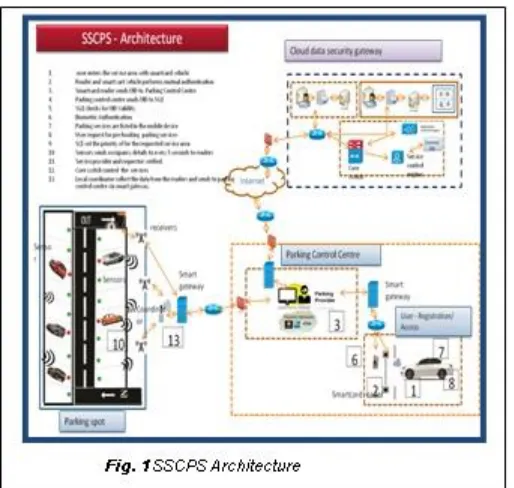
security architecture for the IoT Secure Smart Card based Parking System (SSCPS). The smart parking can be considered as the application of IoT. By pondering the present systems which are starting at now in IoT another procedure for the SSCPS is proposed. This proposed SSCPS avails security for application for the parking services. The SSCPS is composed of six key software components. It comprises of a Mobile Application, Parking Sensors, Smart Gateway, Cloud Data Security Gateway (CDSG), Smart Card (SC), and Smart Card Reader (SR). The system adopts the elliptical curve cryptography to guarantee authenticity, integrity, confidentiality, and privacy. The Smart Parking System includes an IoT enabled Smart Card (SC). It consists of Smart Reader, Bio Metrics Readers, Sensors, Mobile Devices, Smart Gateway, IR
sensors, LDR sensors. Installing the smart parking application in Smartphone, with the help of the parking application user can register their details such as UID, UPSD, DoB, Name, Aadhar Number, Vehicle Number, Vehicle Type, etc. The help of application users can reserve a parking lot before they enter in service area. The details of users and vendors are stored in the cloud environment. The user’s smartcard can have the users UID, Vehicle number, vehicle type, etc... The smartcard attached permanently in the smart vehicle. Services are enabled with various smartcard readers; a smartcard reader of the service area receives information such as UID, Aadhar Number, vehicle number, vehicle type, etc when the smart vehicle arrives. The smart card reader sends the received information to the parking control centre. The parking control centre verifies the received data with the cloud database through the CDSG (Cloud Data Security Gateway), the CDSG receives the request from the parking control centre and it verifies the users’ credentials and sends the verified information to the parking control centre. If the information matches the parking control centre it provides the available parking lot number. On the other side, the sensors sense the information from the parking positions whether the place is occupied or not. In case the position is already occupied by a vehicle a red light blinks if not occupied by a vehicle a green light blinks. This information is sent to the receiver too. Receivers send the
details to the local coordinator. The coordinator sends the information to the parking control centre via the smart gateway. The parking control centre verifies the parking status and allots a parking space according to the vehicle types. Then the parking control centre sends the parking occupancy details to the vehicle. This information is displayed on the smart screen after a particular lot is allotted. When the vehicle leaves from the parking place, the parking amount is calculated based on the parking time.
3.1 Hardware Module Circuit Diagram:
Fig. 2Circuit Diagram
Fig. 3Pin Diagram
2 Smart Parking hardware components:
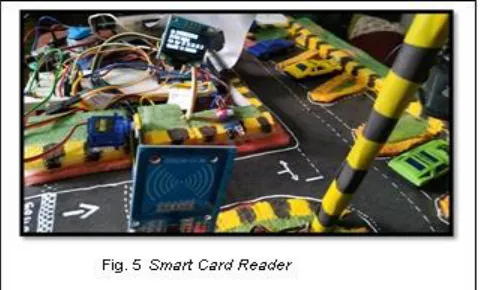
It comprises of a Smartcard Reader, IR Parking Sensors, Raspberry bi, Arduino Uno, led display, LDR Sensor, Camera.
IR Parking Sensors: The parking garage is outfitted with a sensor that can identify the closeness of a vehicle in it. IR sensor can measure the temperature of an object, as well as to detect motion. These types of sensors measure only infrared radiation and call it a passive IR sensor. Usually, in the infrared
Fig. 4 IR Sensors
3468
slot.
Smart Card: SSCPS adopts EPC Gen2v2 air interface standard active cards enabled with IoT, the range of the card is 860 MHz – 960 MHz UHF. A standard of the active card has ISO/IEC 14443 and ISO/IEC 7816. It contains an integrated circuit chip (ICC) to give computational power. It has an integrated circuit chip to provide computational power. This smartcard allows accessing information through contactless smart card readers in the field.
LDR Sensors: LDR sensors are used in the prototype. The sensors helped identify the unfilled parking slot to be allocated. LDR is a light-reliant resistor, which has high obstruction. Whose obstruction diminishes when light strikes on it. This type of sensor is commonly used in light sensor circuits in open areas to control the signal bulb. The occupancy status of the vehicle is updated with this sensor via the 802. 15.4 or NFC/RFID wireless medium. It sends the details to the parking information centre via SG. It checks the user details application allotted private key also checked and find out whether the user is authorized one is not. If any false conditions accurse it rejects the parking provisions. If the user is valid then they can go for payment mode.
Raspberry Pi
The Raspberry frequently called a credit card size computer. It is a lower cost and smaller size. It likewise bolsters input-output gadgets like keyboard mouse and monitor, it has worked in Bluetooth and wifi modules. it has its HDMI, USB ports CPU, audio video ,SD card slots etc.
Fig. 7 Raspberry Pi
Arduino Uno
The Arduino Uno is an ATmega328p based microcontroller board. It has 14 digital input/output pins,6 outputs 6 analog inputs, a 16 MHz ceramic resonator, a USB connection, a power jack, an ICSP header, and a reset button. It contains everything needed to support the microcontroller. We either need to connect it to a computer using a USB cable or power it with an AC-to-DC adapter.
Fig. 8 Arduino Uno
4 EXPERIMENTAL
ANALYSIS
4.1 Ping Response Time
To break down the time for the proposed secure smart card-based parking system architecture, the example information for the client demand is taken from 20 to 100 with an expansion of 50 client demands, with each request data being around 4 kbps. The IXIA generator creates traffic to around 30 Mbps, giving data transfer capacity to around 15 Mbps. Table 1 shows the information and Figure 9 delineates the reaction time taken by the proposed framework for 100 requesters. The outcomes show that there is just a negligible postpone which is only 10 milliseconds, in any event, for the 100 solicitations. It demonstrates the productivity of the proposed system in handling the solicitations quicker without any drops of the packets.
TABLE I
Total- Users System-Bandwidth (Mbps)
System- Round-Delay (Ms)
Drops %
20 0.464844 4 0%
30 0.929688 6 0%
40 1.394531 7 1%
50 1.524219 8 1%
60 1.859375 8 1%
70 2.25391 8 2%
80 2.789063 8 5%
3469 4.2 Request priority based response time
100 users are requesting from various places such as 10 from Palakkarai 15 from Thillainagar, 20 from Wooraiyur, from 25 from Srirangam 30 from Kattur assuming each one of the requester’s data 3kbps, the total bandwidth 1024 kb. When the requestor reaches the parking control centre through the mobile application it clarifies the request distance then service provided according to the priority
TABLE-II
Services
Request area Users Total- Drops (%)
Packet-System- Bandwidth (Mbps)
palakkarai 10 0 0.22968
Thillainagar 15 2 0.26417
wooraiyur 20 4 0.20507
Srirangam 25 6 0.15648
Kattur 30 8 0.96860
4.3 System Throughput
Performance testing is done to measure the work of the system and measurement, and the proposed framework performs at a given time. Jmeter, an open-source gadget, is used to analyze system performance. Sample tests have been performed with 20, 30, 40, 50, 60, 70, 80, 100, service users requesting the proposed system. System performance increases gradually up to 10 requests and continues to increase up to 100. At one point, the system has reached an enrichment point with some factors and decreases performance. However, the proposed system provides reasonable response time with service requests. The overall system performance is depicted in Figure 11. By the analysis of Performance results ensure that the proposed secure smart card-based parking system is highly proficient in request processing.
5
RESULTS
3470
6
CONCLUSION
The idea of IoT is quickly turning out to be increasingly more prominent with a variety of application areas. Today’s Growth of the Internet of things has many smart applications all its applications rapidly developed as protects like smart home smart health etc. In this article, we present Design, Implementation and Performance Analysis of Secure Smart Card based Parking System (SSCPS) for IoT-Smart City environment. The proposed 5 slots secure smartcard based parking system assists users to know about the availability of parking places through sensors and a Raspberry Pi. With the help of this system, the user can find the parking slots in Trichy city's main places, supermarkets, malls, organizations, and private places. Future work should be providing end to end high-level security for the IoT system.
REFERENCES
1. Masmoudi, Imen, Wiam Elleuch, Ali Wali, and Adel M. Alimi. "Smart Drivers’ Guidance System Based on IoT Technologies for Smart Cities Application." In International Conference on Hybrid Artificial Intelligence Systems, pp. 531-542. Springer, Cham, 2017.
2. Tomar, Pradeep, Gurjit Kaur, and Prabhjot Singh. "A prototype of IoT-based real time smart street parking system for smart cities." In Internet of Things and Big Data Analytics Toward Next-Generation Intelligence, pp. 243-263. Springer, Cham, 2018.
3. Fedchenkov, Petr, Theodoros Anagnostopoulos, Arkady Zaslavsky, Klimis Ntalianis, Inna Sosunova, and Oleg Sadov. "An Artificial Intelligence Based Forecasting in Smart Parking with IoT." In Internet of Things, Smart Spaces, and Next Generation Networks and Systems, pp. 33-40. Springer, Cham, 2018.
4. Kizilkaya, Burak, Mehmet Caglar, Fadi Al-Turjman, and Enver Ever. "Binary search tree based hierarchical placement algorithm for IoT based smart parking applications." Internet of Things 5 (2019): 71-83.
5. Thomas, Diya, and Binsu C. Kovoor. "A genetic algorithm approach to autonomous smart vehicle parking system." Procedia Computer Science 125 (2018): 68-76. 6. Shin, Jong-Ho, and Hong-Bae Jun. "A study on smart
parking guidance algorithm." Transportation Research Part
C: Emerging Technologies 44 (2014): 299-317.
7. Burhan, Muhammad, Rana Rehman, Bilal Khan, and Byung-Seo Kim. "IoT elements, layered architectures and security issues: A comprehensive survey." Sensors 18, no. 9 (2018): 2796.
8. Hong Ai, Fa Wang. "The design of the intelligent parking system for urban business districts",Transactions of the Institute of Measurement and Control, 2016
9. L. Hubert and P. Arabie, “Comparing Partitions,” J. Classification, vol. 2, no. 4, pp. 193-218, Apr. 1985. (Journal or magazine citation)