INTRODUCTION
Curcumin [1,7-bis (4-hydroxy-3-methoxyphenyl)-1,6-heptadiene-3, 5-dione] is the major yellow pigment extracted from turmeric, a commonly used spice, derived from the rhizome of the herb Curcuma longa Linn1. It is a naturallyoccurring polyphenolic phytochemical currently being examined in preclinical trials for cancer chemoprotective drug development, with pharmacological actions that including antioxidant1,2, anti-inflammatory3,4, and cancer chemopreventive actions5-7. Curcumin, the major yellow-orange pigment extracted from tur meric, may be responsible for much of the bioactive effects. In a recent study, products of curcumin reduction and conjugation had a reduced ability to inhibit cyclooxygenase-2 (COX-2) expression, which
Reverse phase high performance liquid
chromatographic method for the estimation of curcumin
YADAV VIVEK RAMSHANKAR*, SARASIJA SURESH,
VINAY PANDIT and S.B. PURANIK
Department of Pharmaceutics, Al-Ameen college of Pharmacy, Hosur Road, Bangalore - 560 027 (India).
(Received: June 08, 2008; Accepted: July 10, 2008)
ABSTRACT
A simple, precise, rapid and accurate, binary reverse phase high performance liquid chromatographic method has been developed for the determination of curcumin, Demethoxy curcumin and Bismethoxy curcumin with short run time. Chromatographic separation was achieved by using Merck C15-- (250 cm × 4.6 mm) Column with mobile phase tetrahydrofuran: 1% citric acid 35: 65 was used. The flow rate was 1.2 ml/min. The retention time for curcumin was 15.892 minutes. The proposed method was validated for sensitivity, selectivity, linearity, accuracy, precision, ruggedness, robustness and solution stability. The limit of detection and quantification of curcumin was between 1 to 500 ng/mL respectively for 50-µL injection volumes. Limit of detection and Limit of quantification was calculated by visualization and statistical methods. The % recovery of sample spiked standard ranged within 95-105 %. Method, system, interday and intraday precision was found to be within the limits of acceptance criteria. Method was found to be rugged when different analyst carried out analysis. The method was found to be sensitive and efficient with 4886.77 theoretical plates and 0.2046 mm HETP. The method was suitable for the quality control of curcumin therefore can be applied to both in vitro studies of curcumin formulations as well as drug estimation in biological samples.
Key words: Curcumin, HPLC, natural drug, limit of detection.
correlated to a decrease in the inhibition of prostaglandin biosynthesis when compared to intact curcumin, indicating that the metabolic conversion of curcumin results in pharmacologic deactivation8. Curcumin is also a potent scavenger of various reactive oxygen species (ROS) including superoxide anions2 and hydroxyl radicals2,9. In addition, there have been indications that curcumin may help prevent and treat patients with Alzheimer’s disease by reducing oxidative damage, plaque burden, and suppressing specific inflammatory factors10.
compound. Although several methods of detection for curcumin have been published, only one has reported a limit of quantitation below 10 ng/ml8. Of these methods, several involve spectrophotometric12, liquid chromatography-mass spectrophotometr ic13,14, and radiolabeled determination of curcumin15. HPLC methods have also been developed in order to quantitate curcumin in biological samples8,11,16,17. Ireson et al.8 utilized a HPLC gradient system that produced reasonable separation and sensitivity. The retention time for curcumin, however, was greater than 35 min. We therefore focused on developing a rapid and more sensitive HPLC binary method for the estimation of Curcumin.
EXPERIMENTAL Chemicals and reagents
Curcumin was obtained from Natural remedies manufacturing company Bangalore. Tetrahydrofuran and citric acid was obtained from Thomas Baker, India. Water was deionised by the Milli-Q Plus system (Millipore).
Instrumentation
The HPLC system consists of a Shimadzu SPD-10TVP, Binary pump equipped with a normal sample injector with a 50-microliter loop, SPD-10AVP variable wavelength UV detector and Spincotech station for data analysis.
Sample preparation
The stock solutions were prepared by dissolving5.0 mg of Curcumin was dissolved in 50 ml mobile phase to get a concentration of 1, 00,000 ng/ml. Analytical standard solutions for linearity were prepared by diluting the stock solution with tetrahydrofuran and 1% citric acid immediately prior to use. All the preparations were made in borosilicate glass tubes. The standard calibration curve was constructed in the concentration range of 1-100 ng/ ml, with concentration on X- axis, peak area on Y-axis and regression equation was calculated.
Chromatographic conditions
Chromatographic separations were achieved using a Shimadzu ODS C15,-- 1 cm long Guard column (4.6×250 mm, 5 µm). The mobile phase consisting of tetrahydrofuran: 1% citric acid
35:65 v/v was passed through a 0.22 mm membrane filter and degassed by ultrasonication under vacuum before use. The flow rate was maintained at 1.2 ml/ min and the effluent was monitored for UV absorption at 425 nm. The injection volume was 50 µL. All separations were performed at ambient temperature.
RESULTS Method development
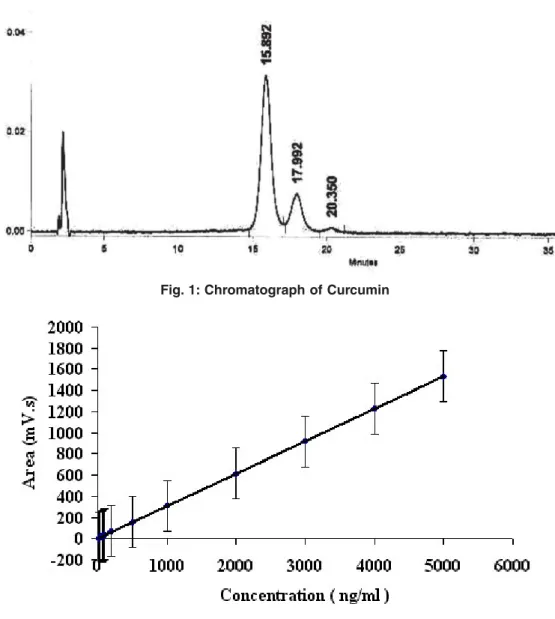
The objective of this study to develop method for the determination of Curcumin with short run time, which can also be used for its formulations. The column chosen for this study was 250 mm length, 4.6mm internal diameter and 5-micron particle size. Good sample separation was observed on silica based C15 Mark column using mobile phase tetrahydrofuran: 1% citric acid 35:65 v/v. The retention time of Curcumin was found to be 15.892 min. The system suitability results were given in Table 1.
Method validation
Limit of Detection (LOD) and Limit of Quantitation (LOQ)
The LOD and LOQ were calculated by instrumental and statistical methods. For the instrumental method LOD is determined as the lowest amount to detect and LOQ is the lowest amount to quantify by the detector. For statistical method LOD and LOQ determined by statistical formula.
LOD = 3.3 SD/S LOD = 10 SD/S
where, SD is standard deviation of y intercept of regression equation and S is slope.
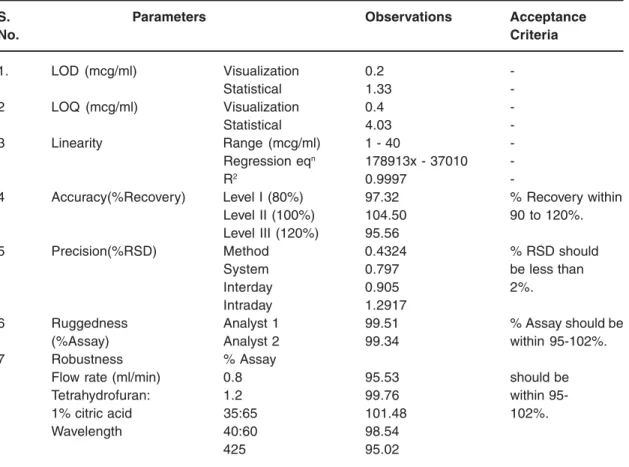
The values for the Limit of Detection and Limit of Quantification for are mentioned in Table 2.
Precision
Table 1: Validation data of Curcumin
S. Parameters Observations Acceptance
No. Criteria
1. LOD (mcg/ml) Visualization 0.2
-Statistical 1.33
-2 LOQ (mcg/ml) Visualization 0.4
-Statistical 4.03
-3 Linearity Range (mcg/ml) 1 - 40
-Regression eqn 178913x - 37010
-R2 0.9997
-4 Accuracy(%Recovery) Level I (80%) 97.32 % Recovery within
Level II (100%) 104.50 90 to 120%.
Level III (120%) 95.56
5 Precision(%RSD) Method 0.4324 % RSD should
System 0.797 be less than
Interday 0.905 2%.
Intraday 1.2917
6 Ruggedness Analyst 1 99.51 % Assay should be
(%Assay) Analyst 2 99.34 within 95-102%.
7 Robustness % Assay
Flow rate (ml/min) 0.8 95.53 should be
Tetrahydrofuran: 1.2 99.76 within
95-1% citric acid 35:65 101.48 102%.
Wavelength 40:60 98.54
425 95.02
Table 1: System-suitability report
Compound Asymmetry/ Capacity Efficiency (N) Eff/l [t.p/m]
(n=3) Tailing factor factor (No. of theoretical (Relative efficiency in
plates) plates per meter)
Curcumin 1.023 5.92 4886.77 37538
n = Number of determinations
Table 2: Recovery results of Curcumin in sample
Added Recovered %Recovery % RSD
(ng)(n=3) (n=6)
200 ng 197.49 ng 98.74 1.274
500 ng 497.92 ng 99.58 1.316
n = Number of determinations
0.812 %and 0. 856% % respectively. The results obtained confirm good precision of the method developed.
Linearity
Quantification of Curcumin in natural samples The standard addition and recover y experiments were conducted to determine the accuracy of the present method for the quantification of Curcumin samples.
The recovery of Curcumin was calculated from the slope and the intercept of the calibration curve drawn in the concentration range of 50-100000ng/ml. The percentage recovery of Curcumin was ranged from 98.6 % to 99.4 % in samples of Curcumin. The results were shown in Table 2. HPLC chromatograph of Curcumin in samples was shown in Figure 1.
Limit of detection
The limit of detection represents the concentration of analyte that would yield a signal to noise ratio equal to 3s(DL=3σ/S)5. The limit of detection for Curcumin was found to be 3.68 to 8.125 ng/ml for 50µL injection Volume. The limit of quantification represents the concentration of analyte that would yield a signal to noise ratio equal to 10σ ((DQ=10σ/S)5. Limit of quantification for Curcumin was 8.125 ng/ml for 50µL injection Volume.
Solution stability
Solution stability of Curcumin was studied
by leaving the solution (10 and 5000ng/ml prepared in diluent) in tightly capped ambered colour volumetric flasks at room temperature for three days. Content of Curcumin was checked for 12 hours interval and compared with freshly prepared solutions. No variation was observed in the content of Curcumin for the study period, which indicates that the Curcumin sample solutions prepared in the said diluents are stable for at least 3 days.
Ruggedness
The ruggedness was established by carrying out the assay of curcumin using the same chromatographic system and the same column by two analysts on a different day. The assay results were found within the acceptance criteria of 95 to 102% w/w, hence the proposed method was said to be rugged.
Robustness
It is the measure of capacity of an assay to remain unaffected by small but deliberate variations in method parameters and provide an indication of its reliability in normal usage. For the robustness study small variations in columns, mobile
phase, detection wavelength and flow rate have been performed and percentage assay of curcumin was calculated. The percentage assay in all varied chromatographic conditions was found within the acceptance criteria.
DISCUSSION
A simple and sensitive HPLC method was developed for Curcumin. This assay method provided excellent sensitivity, accuracy and precision, with relatively short retention time for Curcumin. This HPLC method can therefore be applied to both in vitro studies of Curcumin formulations as well as drug estimation in biological samples.
ACKNOWLEDGEMENTS
The authors would like to thank Prof. B.G. Shivananda, Principal, Al-Ameen College of Pharmacy for his kind support and encouragement. This study was supported by SRF grant to Vivek Yadav from Indian Council of Medical Research, India.
1. K.C. Das, C.K. Das, Curcumin
(diferuloylmethane), a singlet oxygen ((1)O(2)) quencher. Biochem. Biophys. Res. Commun. 295: 62 (2002).
2. A.J. Ruby, G. Kuttan, K.D. Babu, K.N. Rajasekharan, R. Kuttan, Anti-tumour and antioxidant activity of natural curcuminoids. Cancer Lett. 94: 79 (1995).
3. Literat, F. Su, M. Norwicki, M. Durand, R. Ramanathan, C.A. Jones, P. Minoo, K.Y. Kwong, Regulation of pro-inflammatory cytokine expression by curcumin in hyaline membrane disease (HMD).Life Sci. 70: 253 (2001).
4. W. Lukita-Atmadja, Y. Ito, G.L. Baker, R.S. McCuskey, Effect of Curcuminoids as Anti-Inflammator y Agents on the Hepatic Microvascular Response to Endotoxin. Shock 17: 399 (2002).
REFERENCES
5. J.A. Bush, K.-J.J. Cheung, G. Li, Curcumin induces apoptosis in human melanoma cells through a fasreceptor/caspase-8 pathway independent of p53 Exp. Cell Res. 271: 305 (2001).
6. A.J. Gescher, R.A. Sharma, W.P. Steward, Cancer chemoprevention by dietar y constituents: A salutary tale of failure and promise. Lancet. Oncol. 2: 371 (2001). 7. Z.-M. Shao, Z.-Z. Shen, C.-H. Liu, M.R.
Sartippour, V.L. Go, D. Heber, M. Nguyen, Sensitive and rapid isocratic liquid chromatography method for the quantitation of curcumin in plasma.Int. J. Cancer. 98: 234 (2002).
the Chemopreventive Agent Curcumin in Human and Rat Hepatocytes and in the Rat in Vivo, and Evaluation of Their Ability to Inhibit Phorbol Ester-induced Prostaglandin E2 Production. Cancer Res. 61: 1058 (2001).
9. C.A. Shih, J.K. Lin, of 8-hydroxydeoxy-guanosine formation by curcumin in mouse fibroblast cells. Carcinogenesis. 14: 709 (1994).
10. G.P. Lim, T. Chu, F. Yang, W. Beech, S.A. Frautschy, G.M. Cole, The curry spice curcumin reduces oxidative damage and amyloid pathology in an Alzheimer transgenic mouse. J. Neurosci. 21: 8370 (2001). 11. M.-H. Pan, T.-M. Huang, J.-K. Lin, Design,
synthesis, and cytostatic activity of novel cyclic curcumin analogues. Drug Metab. Dispos. 27: 486 (1999).
12. S. Oetari, M. Sudibyo, J.N.M. Commandeur, R. Samhoedi, N.P.E. Effects of curcumin on cytochrome P450 and glutathione S-transferase activities in rat liver. Vermeulen,
Biochem. Pharmacol. 51: 39 (1996). 13. X.-G. He, L.-Z. Lin, L.-Z. Lian, M.
Lindenmaier. Sesquiterpenoids in turmeric (Curcuma longa). J. Chromatogr. A. 818: 127 (1998).
14. R. Hiserodt, T.G. Har tman, C.-T. Ho, R.T. Rosen, Characterization of powered turmeric by liquid chromatography-mass spectrometry and gas chromatography-mass spectrometry. J. Chromatogr. A. 740: 51 (1996).
15. V. Ravindranath, N. Chandrasekhara, Absor ption and tissue distribution of curcumin in rats. Toxicology. 22: 337 (1982). 16. A. Asai, T. Miyazawa, Occurrence of orally administered curcuminoid as glucuronide and glucuronide/sulfate conjugates in rat plasma. Life Sci. 67: 2785 (2000).