DNA Based Methods in Intelligence - Moving Towards Metagenomics
Gabriella Mason-Buck1#, Eran Elhaik2#, Alexandra Graf3#, Jake Robinson4, Ewelina Pośpiech5,
Manuela Oliveira6, 7, 8, Josef Moser3, Patrick K. H. Lee9, Dedan Githae5, David Ballard1,
Tae-Hyuk Ahn10, Yana Bromberg11, Carlos S. Casimiro-Soriguer12, Eliza Dhungel10, Jolanta
Kawulok13, Carlos Loucera12, Feargal Ryan14, Alejandro R. Walker15, Chengsheng Zhu11,
Christopher E. Mason16,17,18, António Amorim6, 7, 8, Denise Syndercombe Court1,
Wojciech Branicki5,19*, Paweł P Łabaj5*
1 King’s Forensics, King’s College London, London, United Kingdom 2 Department of Biology University of Lund, Lund, Sweden
3 Department of Applied Life Sciences, University of Applied Sciences, FH Campus Wien, Austria 4 Department of Landscape, The University of Sheffield, Sheffield, United Kingdom
5Małopolska Centre of Biotechnology, Jagiellonian University, Kraków, Poland
6 Instituto de Investigação e Inovação em Saúde (i3S), Universidade do Porto, Porto, Portugal 7 Instituto de Patologia e Imunologia Molecular da Universidade do Porto (IPATIMUP), Porto, Portugal
8 Faculdade de Ciências, Universidade do Porto. Porto, Portugal
9 School of Energy and Environment, City University of Hong Kong, Hong Kong 10 Saint Louis University, Saint Louis, USA
11 Department of Microbiology and Biochemistry and Department of Genetics, Rutgers University, USA
12 Clinical Bioinformatics Area, Fundación Progreso y Salud (FPS), Sevilla, Spain 13 Silesian University of Technology, Gliwice, Poland
14 South Australian Health and Medical Research Institute, Adelaide, Australia 15 Department of Oral Biology, University of Florida, USA
16 Department of Physiology and Biophysics, Weill Cornell Medicine, New York, NY, USA
17 The HRH Prince Alwaleed Bin Talal Bin Abdulaziz Alsaud Institute for Computational Biomedicine, Weill Cornell Medicine, New York, NY, USA
18 The WorldQuant Initiative for Quantitative Prediction, Weill Cornell Medicine, New York, NY, USA 19 Central Forensic Laboratory of the Police, Warsaw, Poland
# The first three authors contributed equally
* Corresponding authors
Abstract:
Advancements in DNA methods and biotechnology have enabled forensic scientists to explore the DNA evidence found as part of a criminal investigation on a much more comprehensive and predictive level. This has led to a rise in research into DNA intelligence tools such as phenotypic prediction (i.e., eye and hair colour) and inference of biogeographical ancestry. Both of which can be applied to gain further insights about a scene or sample in question. Although microorganisms have played a role in forensics for decades, investigations were focused on the pathogenicity aspect, mainly to determine the cause and time of death. Recent progress in studying the human microbiome has implicated the potential use of this data in forensics. Since each individual, place, or item has its own microbial pattern, a new suite of tools are now available to be exploited in criminal investigations. Although there is much interest and potential for these emerging metagenomic and microbial forensic tools, best practices and reference ranges need to be established before they are implemented. Here,
we discuss existing DNA intelligence tools applied to forensic science, the application of microbial forensics and metagenomics along with the challenges and concerns that future developments entail.
1.
Introduction
DNA profiling of microsatellite markers (short tandem repeats, STRs) is the gold standard in human identification studies for criminal casework, as well as for the identification of human remains1–3. The methods used for DNA profiling have significantly improved in the last decade, allowing simultaneous analyses of multiple STR loci, while still maintaining functionality on both low quantity and reduced quality DNA. Analysis time has also been reduced and the use of simple capillary electrophoresis (CE) is still favoured4. Moreover, multiplex STR human identification methods currently on the market can provide information about the quality of the sample and include additional complementary markers for reliable sex determination5,6. An STR-based analysis relies on the ability to compare results obtained from a crime scene sample (casework sample) to a profile obtained from a known individual (reference sample)7,8. If the reference sample is unavailable and direct comparison cannot be made, the profile from the casework sample can be searched against a DNA database to look for direct matches or matches to potential relatives (familial searching).
In a number of serious criminal cases, DNA mass screenings using these technologies have been arranged. This method was first applied in 1987 to a case in the U.K., where 4,000 men aged between 17 and 34 provided either a blood or saliva sample with the aim of identifying the perpetrator of two sexual assaults and murders of young women. In 2018, the Dutch Police sampled 21,500 men with the aim of solving a 20-year-old murder9. However, mass screening is not considered a standard approach, since it is both laborious and expensive, and it creates ethical issues due to its coercive nature and the use of familial matching. When no direct or familial match can be assigned in the database, the case becomes “cold.” The work is then halted until either new evidence is found, or a decision is made to apply additional investigative tools to the case that may aid in identifying an individual.
from environmental or casework samples can provide independent and complementary intelligence to facilitate an investigation13,14. It has already been shown that it is possible to harness these profiles to infer information on the activity of individuals, the location where someone or something has been and what they were in contact with15,16.
In 2007, the National Research Council (US) Committee on Metagenomics identified the usefulness of metagenomics in the field of forensic science ‘to precisely identify and characterise microbes that have played a role in war, acts of terrorism, and crime events, thus contributing to discovering the source of the microbes and the party responsible for their use’17. Sequencing techniques for non-human DNA analysis have significantly advanced over the past five years, and the cost of using such tools become affordable18. However, proper implementation of metagenomics in forensics requires further basic research from sample selection to data analysis and it remains fraught with challenges (e.g., the effect of background contamination from a kit - the ‘kitome’ - from contamination in consumables and reagents) and uncertainties that constraint the process. Additionally, it is yet unclear which features of microbial communities are of primary interest in an intelligence or forensic perspective. Is it the selection of key species with predictive power in terms of geolocalisation, or marker panels of bacterial regions that will help to identify perpatrators of crime or bring new insights in to a crime scene? In the past decade, there has been a renewed interest in utilising genomic and metagenomic data to increase the predictive capabilities of intelligence tools, primarily using machine learning and artificial intelligence-based approaches, all of which can fundamentally change how we leverage these molecular methods in forensic science.
2.
Current DNA Intelligence tools
Any personally identifying characteristics, even the most elementary ones (e.g., sex or biogeographical ancestry), inferred from DNA found at a crime scene can provide important leads to an ongoing investigation. Forensic DNA intelligence has advanced considerably in predicting human appearance traits. The prediction accuracy of a genomic trait is often limited by the amount of explained heritability, such as the proportion of known genes and DNA variants involved in determining that trait. Other important factors to consider are the statistical methods used in prediction modelling and the size of the datasets available19. The availability of large genome-wide association study (GWAS) data for physical traits (such as the UK Biobank) has boosted scientific investigations in the field of DNA phenotyping and has been used to leverage immediate implementations to forensic genetics10. In the following, we review the leading state-of-the-art methods.
2.1 Human pigmentation (eye, hair and skin colour)
intermediate phenotype categories where modifying genes and gene-gene interactions gain significance10,21. Hence, prediction of blue and brown eye colour (depending mostly on the rs12913832 polymorphism in HERC2) and red hair colour (depending mostly on variation in the MC1R gene) are exceptionally accurate with a high Area Under the Curve of prediction, (AUC) of ~0.9 (where 1.0 is a perfect predictive ability). However, intermediate eye colour and other hair colour categories are predicted with lower accuracies (AUC<0.85)22,23. The selection of suitable DNA variants allowed the development of the first prediction models and tools of practical value in forensics. The HIrisPlex-S method based on targeted MPS and the use of an online prediction calculator is the most advanced tool for simultaneous prediction of eye, hair and skin colour to date24. Recent papers have shown that the next step in prediction of pigmentation traits may require genomics solutions and more advanced machine learning approaches25,26.
2.2 Hair morphology and baldness
The usefulness in predicting other head-hair features, such as hair shape and hair loss, has long been recognised in the field of forensic genetics. A recent large study demonstrated that 32 DNA variants can predict straight hair with AUC=0.66 in Europeans and AUC=0.79 in non-Europeans27. Though the importance of sex and age for hair loss prediction was already known, this study has also demonstrated their role in predicting hair shape. For men aged 50 and above, hair loss can be predicted using only 20 single nucleotide polymorphisms (SNP) (AUC=0.76)28. A recent GWAS study of 70,000 males reported that 71 genetic loci for hair loss
are responsible for ~38% of the variation observed29. These findings provide a good basis for
improving hair loss prediction systems in the future.
2.3 Height
As one of the most recognisable and stratifying physical traits – height – is highly heritable (up to 80%)30. Yet, while inferring height from DNA is a primary goal of forensic DNA phenotyping, the efforts put into the identification of genes that determine an individual’s height were fruitless for forensics. The height of an individual exhibits both high heritability and high variation, and it is controlled by the additive effect of thousands of DNA variants that increase the complexity and uncertainty in height prediction. Initial studies suggested that 180 variants can explain only about 10% of phenotypic variance31. Even when the number of predictors was increased to ~ 9500, less than 30% of height variance was explained32, which is insufficient for forensics. Another research indicated that tall stature predictions may be more practical in forensics33,34. Height predictions are expected to improve with more data, as shown with a recent genomic approach that used ~20k DNA variants and reported a better accuracy of height prediction (correlation between actual and predicted age ~0.61)30.
2.4 Facial Appearance
ability to identify individuals based on their faces is particularly powerful and has already become a ubiquitous feature of smart phone security access, but this ability is often restricted to specific continental groups, or confounded by genetic admixture from cross-regional ancestry35. From a genomic perspective, facial appearance is a complex combination of a large
number of traits and its genetics is still poorly understood. In recent years, there was increased use of deep learning methods to identify the genes responsible for shaping facial features; however, the first method for facial shape prediction proposed by Claes et al. 36
relies mostly on non-genetic information. The method uses genomic ancestry and gender to create a first sketch that the authors call “base-face,” which is then polished using information obtained via 24 SNPs associated with facial variation. Recently, Lippert and co-workers37
employed complex methods including 3D face morphology applied to whole-genome sequencing data of 1,061 individuals for the prediction of facial appearance and claimed to be able to re-identify individuals from their cohort. The study was heavily criticised38 on various grounds, primarily that the results did not differ from a simpler method that employed
age, sex, and self-reported ethnicity and failed to demonstrate actual identification. An alternative available approach predicts DNA characteristics from 3 Dimensional (3D) facial images, using a face-to-DNA classifier provided the facial image database is on site39.
2.5 Age estimation
Forensic DNA Phenotyping (FDP) in a broader context also includes age estimation and biogeographic ancestry inference. Ageing plays an essential role in many physical traits, including height, hair colour, hair loss or skin wrinkles, and thus is valuable and, in some cases, even critical for accurate prediction of human appearance traits. But even without these correlations, it has a tremendous impact on the profile of an individual. A real breakthrough in age prediction research was achieved through the identification of robust epigenetic markers in epigenome-wide association studies (EWAS) 40,41. DNA methylation has since been shown to predict age with far greater accuracy (age correlation = 0.96 and error = 3.6 years) compared to other methods, including determination of telomere length, measurement of the 4,977 bp deletion of mitochondrial DNA, age-dependent accumulation of advanced glycation end-products, racemization of aspartic acid and measurement of signal joint T-cell receptor rearrangement excision circles (sjTRECs) accumulation42. Discovery of
semen was proposed, demonstrating a completely different pattern of DNA methylation in sperm cells compared to somatic cells45.
2.6 Forensics genealogy
The Council for the Advancement of Forensic Genealogy defines forensic genealogy as ‘genealogical research, analysis and reporting in cases with legal implications’ 46 and although
the usage of DNA for forensic genealogy is not new, up until recently, it was limited to identify unclaimed decedents and military repatriation47. The identification of Joseph James DeAngelo (age 73), known as the “Golden State Killer,” who was found guilty with 26 counts of murder kidnapping48 committed during the 70s and the 80s was unfeasible prior to the genetic
genealogy era, although the FBI had his DNA samples from 198049. A DNA match with DeAngelo’s family members was only made possible when millions of people shared their DNA data and family trees through online platforms. This case demonstrated the limitation of state-owned National Criminal Intelligence DNA databases, which usually collect DNA only from accused and/or convicted felons and explore a limited set of STR markers that allow only a direct or familial searching50,51. Following this case, over 50 other cases were resolved using
a similar approach52, raising hope to solve additional “cold cases” and at the same time,
raising big expectations in the forensic community53. However, a wide array of ethical issues
and privacy concerns have also emerged54,55. In May 2019, after these concerns were ignored
by law enforcements, GedMatch, one of the major websites of genetic genealogy, restricted law enforcements access to their databases52. Due to the high potential of genetic genealogy to resolve cases, it is hoped that law enforcement and genealogy service providers should work together to alleviate privacy concerns while retaining access to commercial DNA databases. Concerns should also be made to “false positive” cases, for example, where a DNA match with an individual is due to receiving tissues from another individual56 rather than their actual involvement in the case.
3.
Predicting ancestry and the upcoming possibility to infer a sample
origin
3.1 Ancestry prediction
cities, such information is invaluable due to the tendency of migrants to segregate. These methods utilise between a few dozen57,59,60 to several thousand61 AIMs. For instance, the T allele of the SNP rs316598 is very rare in Africans (3-14%) but common (>37-77%) elsewhere62 and can be used to differentiate Africans from non-Africans. AIMs are typically validated by showing that: 1) samples of similar origins clustered together and apart from samples of different localities; and 2) samples exhibit a unique allele frequency pattern, calculated via STRUCTURE63 or ADMIXTURE64. Due to the cost of typing AIMs along with the ability to type poor quality and low quantity DNA samples, they are preferred in forensic analyses and forensic scientists have developed tools that can facilitate ancestry inference65,66. Some kits have also become commercially available for forensics (e.g., the ForenSeq DNA Signature Prep Kit67, Precision ID Ancestry Panel68). While AIMs were validated to classify individuals into distinct subcontinental populations, this does not answer the question of whether these populations are indeed genetically separated. Since the said methods rely on a limited set of reference populations and tools that were not designed for biogeography, the classification may also be an artefact inherent to the method69.
Notably, AIMs-based methods better predict the ancestry of one’s closest ancestors (e.g., parents) than their distant ones and do not predict the actual geolocation of the investigated individual directly. The geographical localisation of biological samples to their site or region of origin based on human DNA is assumed from the ancestry. For example, if one has two Italian parents, they are assumed to be Italians (from Italy). This assumption does not always hold, certainly when the prediction is inaccurate or the individual is highly admixed; however, providing hints on the previous location or even ancient origins of individuals connected to the crime scene (or items) may provide intelligence information complementary to the ancestry inference.
3.2 Sample origin
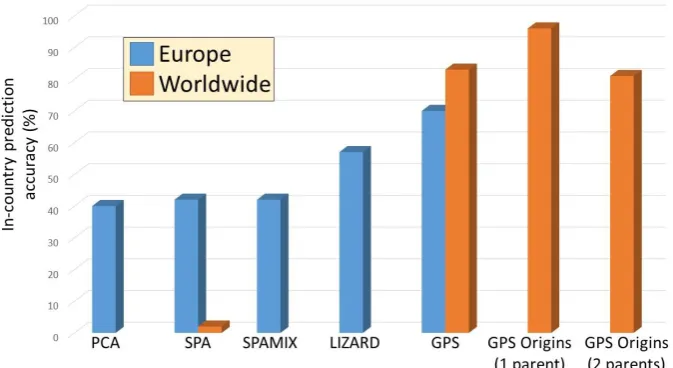
Despite its importance for forensic investigations, biogeographical capabilities matured slowly and received relatively little attention compared to ancestry. One of the reasons being that initial approaches did not properly translate the genetic distances between populations into geographical distances and suffered from many difficulties (Figure 1)70,71, such as modelling admixed individuals and being cohort-dependent, that is, an individual will be predicted to different regions based on the other individuals in the cohort. Spatial Ancestry Analysis (SPA), for example, failed to assign 98% of the individuals to their countries70. Their reliance on a large number of markers (entire SNP set) and low accuracy even for a handful of European countries, rendered these approaches inapplicable for research or forensic applications.
deviations are not the norm and otherwise provide clues as to the culture and heritage of individual of interest. Biogeographical analyses rest on three pillars: 1) the choice of markers, which should be common and ancestry informative, 2) the comprehensiveness of the reference populations, and 3) a model of the genetic-geographic relationships. Past attempts focused on each of these pillars separately with limited success, but a more recent method tried to conquer all three biogeography pillars at once. Relying on 40,000 – 130,000 AIMs, a comprehensive and global reference panel, and directly modelling the genetic-geographic relationships, the Geographic Population Structure (GPS) achieved a high prediction accuracy (Figure 1)70. However, localisation was not always corresponding with modern residency. For example, GPS tracked Ashkenazic Jews to Northeastern Turkey, a region dubbed “ancient Ashkenaz,” which their ancestors inhabited in the early centuries A.D., and Israeli Druze to Syria and Turkey, whence they emerged in the 11th century72. GPS Origins73 addressed GPS’s limitation in modelling two-way admixture, yet the modelling of more complex ancestries remained unaddressed and the cost of using a microarray, along with the DNA amount requirements, may prohibit forensic applications.
Figure 1. In-country prediction accuracy of biogeographical tools of the second and third generations. Results were curated from the literature (PCA74, SPA70,71, SPAMIX71, LIZARD71,
GPS70,75, and GPS Origins73)
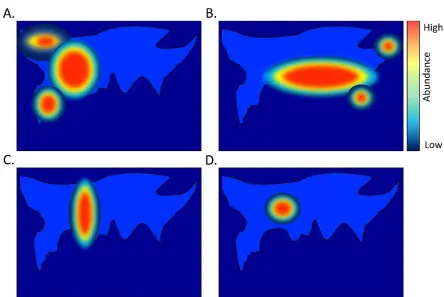
To overcome this critical limitation, the latest attempts in predicting biogeographical localisation no longer rely on human DNA, which does not change with geography, but rather the microbiome (Figure 2) 76. Participants of the CAMDA MetaSUB challenge (section 5) have already demonstrated that the structure of bacterial communities is geographically informative. The advantage of this approach to forensics is its reduced limitation on human DNA, which can be scarce in the crime scene. However, further work is needed to develop forensic-oriented genotyping platforms (e.g., DREAM77), refine biogeographical methods, calibrate them to the conditions of the crime scene, and test their reliability after various time periods.
Figure 2. An illustration of how microbiome data can be used for biogeographical applications. Heat maps (A-C) represent the abundance of three hypothetical bacteria as calculated from multiple sampling sites. All three bacteria were found in an object retrieved from a crime scene believed to belong to the suspect. To identify the geographical origin of the object and suspect (which could be different to their ancestry), on overlay of the heat maps (D) identifies the most likely geographical region (darkest red). This example underlines the potential of using global abundance data for thousands of bacteria.
Overall, the continuous improvement in the accuracy and resolution of biogeographical applications, either using genomics or metagenomics, can have major implications for forensics. The successful translation of genomic methods would provide more accurate information both at the country-wide level and for multiple countries whereas metagenomic applications can provide the most recent whereabouts of suspects. Therefore, biogeographical progress must be accompanied by a proper translation for forensics purposes. The combined information on gender, ancestry, physical appearance, biogeography, and whereabouts can provide invaluable intelligence to help progress forensic casework.
4.
Current use of metagenomic/microbial forensics
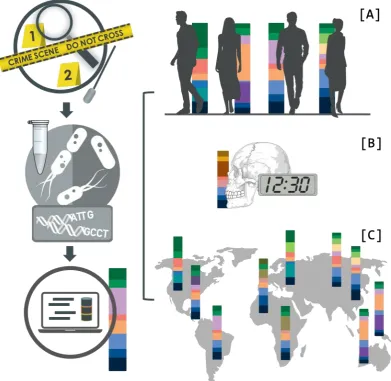
definition did not contain or even recognise the potential of the microbiome for DNA intelligence. Since then, microorganisms have aided in answering some of the most basic forensic questions, such as identifying individuals80, body fluid or body site prediction81,82, the estimation of Post Mortem Interval (PMI) 83–85, and determining the probable cause of death86–88 (Figure 3).
Figure 3. Illustration of the information that can be gained from the microbiome at a crime site, which could be used to identify individuals if no human DNA based identification is possible by e.g., reducing the suspect pool (A). It can help to accurately predict the time of death and help to elucidate the cause of death (B) and give hints toward geographical localisation of individuals or items (C).
4.1 Identifying individuals
time points per year)89. The human microbiome, especially skin associated species, are readily transferred to surfaces we come in contact with90,91. Several studies have shown that individuals can be detected and identified through items they came in contact with (e.g., as shown by Fierer et al.92 and Goga et al.93) by assigning shoes to their owners with 79% accuracy when samples from shoe insoles were compared with samples taken from plantar skin (n=14).
Other preliminary studies suggest that microbiome-based trace evidence could play an important role in providing intelligence in crime investigations. One such project is the Burglary Microbiome Project, which uses mock crime scenes and scientific sampling of homes, residents and intruders. The project employs the microbiome as a forensic tool using unique markers to identify the intruders94. Objects such as smoking pipes, medical devices, and telephones have been matched to individuals via skin microbiome sampling (targeted 16S rRNA) with a high degree of accuracy (75-100%)95. Microbiome data paired with machine learning approaches harbours great potential. One study reported matching all individuals with their microbiome samples (n=12)96. Schmedes et al.97 recently presented the hidSkinPlex, a targeted sequencing panel comprised of 286 skin microbiome markers aimed for forensic human identification. In their study, they tested the hidSkinPlex on the three body-sites of eight individuals (n=72) and reported an average accuracy of 94% (92% (foot), 96% (manubrium), 100% (hand)). Body site origin could be predicted with up to 86% accuracy. Microarrays have also proven to be useful in differentiating between faecal samples98,99. Microbiome studies on indoor air have shown that, in addition to the microbiome transferred through touch, a distinct microbial “cloud” surrounds the human body100. Therefore, under certain circumstances, indirect and less-intrusive sampling methods could be deployed. For example, an analysis of the airborne microbiome (aerobiome) has been able to identify the sex of residential occupants with an accuracy of 79% (n=91)101.
In addition to bacteria, whole metagenome sequencing (WMS) analyses include viruses, archaea, and eukaryotic DNA found in plants, fungi, and animals. The observation of the mycological profile of fungal spores has already proved useful in forensic casework. In one example, it was used to match clothing to a crime scene in a sexual assault case in England102. Additionally, transmission of viruses such as human immunodeficiency (HIV)103 or hepatitis C (HCV)104 can also be studied in this manner. Animals and their DNA can be found in casework and are often overlooked for their evidential value. Skin microbiome uniqueness has been studied in a number of animals: estrildid finches105, amphibians106, bats107, cetaceans108,109
4.2 Post-mortem interval (PMI) and cause of death
The microbial composition of a body goes through specific and predictable changes after death. These changes can, for example, be translated into a microbial reference “clock,” with which samples can be compared to determine the time of death112. Studies have shown that the use of microbial data can improve prediction accuracy, especially in the early decay stage113,114. Other studies have tested targeted sequencing approaches in combination with machine learning methods and found that the human skin microbiome together with soil microbiome markers provided the lowest error rates115. Zhang et al.116 predicted PMI, manner of death, and death event location using three machine learning approaches on targeted sequencing data (16S rRNA) derived from swabs taken during routine death investigation (n=188). The predictions showed accuracies ranging from 71% to 88%. Pechal et al. 117 also highlighted the potential of post-mortem microbiome analysis by reporting that it can be used as a predictor for the host’s antemortem health condition. There is abundant evidence that the composition of the human microbiome can be linked to disease phenotypes, psychological118 and physical119.
During an autopsy, the presence of specific microorganisms may act as bioindicators, providing useful insights concerning the cause of death18. For instance, in cases of drowning, bacterioplankton composition (freshwater, e.g.: Aeromonas spp., Pseudomonas spp. and Shewanella spp.; seawater e.g.: Vibrio spp., Photobacterium spp. and Listonella spp.) and salinity levels in the victim's blood act as bioindicators120,121; in cases of medical malpractice, microorganisms from the intestinal flora (e.g.: Enterococcus faecalis, E. faecium, E. casseliflavus, E. thailandicus and E. cloacae) in the peritoneal fluid and cardiac blood indicates possible colon perforation during colonoscopy122, while HIV103 and HCV104 can be linked to
cross-contamination or intentional spread of the disease; in cases of child abuse or negligence, abnormal infection agents (e.g.: Staphylococcus aureus, Escherichia coli, enterovirus, respiratory syncytial virus, rotavirus, adenovirus) in several tissue specimens, coupled with elevated values of C-reactive protein (CRP), may point out to transient inflammation, pain, and bacteraemia followed by toxaemia, potentially resulting in sudden infant death syndrome (SIDS) 123,124.
5.
Forensic microbiome intelligence - predicting sample origin
using metagenomic data
living in high and low altitudes126, suggesting an ability to infer geolocation based on altitudinal parameters.
The ubiquity, heterogeneity, transferability and soil composition (geoforensics) makes it especially useful as evidence in criminal investigations127. The ability to pinpoint the source of a sample based on the soil microbiome recently been demonstrated128. Habtom et al.15 found
that the geographic location was more important than soil type in determining microbial community composition (25m - 1000m; 5 sites, 2-4 soil types, 5 replicates). The potential of soil DNA metabarcoding to provide geolocation evidence has already spurred the interest in forensics. In the past few years, Ribosomal Intergenic Spacer Analysis (RISA) and 16S rRNA gene sequencing were used to discriminate between soil samples originating from a mixture of different substrates129. The first results showed that 18S rRNA gene sequencing provides greater discriminatory power over traditional Mid Infrared (MIR) spectroscopy at fine scales130.
5.1. The MetaSUB International Consortium and Critical Assessment of Massive Data Analysis
The forensic potential in metagenomic profiles was recognised in the early stages of the MetaSUB International Consortium131. The consortium aims to build molecular portraits of cities, with one branch focusing on biogeographical analyses and prediction132. Samples are collected in public transport systems during an annual sample collection event and subsequently processed for WMS. This growing unique and rich can be exploited for a number of applications76. In 2017 MetaSUB started a collaboration with the Critical Assessment of Massive Data Analysis conference (CAMDA)133, to develop, improve, and benchmark classification tools for metagenomic data in open-science based contest. The potential of this approach was shown at the CAMDA conference in 2017134–137 where a metagenomic classification challenge was posed based on MetaSUB data. Since then, the challenge has moved beyond constructing city-specific metagenomic profiles towards the applicability of predictive models in the: i) classification of a new sample from a known location (CAMDA 2018); and ii) prediction of sample origin from an unknown location (CAMDA 2019). Summarising, the presented approaches can be divided into three conceptual groups (see Supplement for a detailed description of methods):
training data, which hampers their performance for the moment, but further data collection efforts are ongoing76.
Functional approach141,142. Several studies have shown that species composition is less important than the presence or absence of certain functions required by a microbial community to settle a specific ecological niche143. The second strategy takes this finding into account and looks at the functional profile of a sample without prior taxonomic assignment144. More specifically, the analysis uses read data to predict genes or domains that encode for a specific function(s). These can sometimes be grouped into pathways for which a pathway coverage score can be calculated145. In the classification step, the functional signatures are used as input features. Notably, these have a clear biological meaning and can account for city-specific functional properties. A further development of this approach, especially with the use of advanced feature selection approaches, can also provide a novel perspective for microbiota-based biogeography prediction.
K-mer based approach146. In microbiome studies, about half of the data cannot be assigned
to any known species76,147. The third approach attempts to overcome this limitation by using all the data (from known and unknown species) directly to classify samples after reads are “cleaned” to remove adapters or any sequencing errors. Machine learning is then applied based on the characteristic of the environmental patterns of the DNA fragments (k-mers) or reads. Considering the potential size of the feature space, feature selection is crucial. Also, it must be noted that a k-mer based approach uses unstructured data, where the biological meaning of a sequence (e.g., synteny) is not well preserved.
Interestingly, all three approaches achieve a high classification accuracy [>90%] on the test data sets. However, results from the 2018 and 2019 challenges highlight the shortcomings in the original prediction of previously unknown samples138–142,146. An analysis of the results and
feedback from the participants made it clear that for a proper assessment - a bigger data set [better geo-resolution] and richer meta information would be beneficial. This will be further investigated in close collaboration with the CAMDA and MetaSUB communities and then applied in the upcoming CAMDA challenge(s).
6.
Challenges and Considerations for the Introduction of Metagenomics
for Intelligence
In the previous sections, we argued that metagenomics could be a powerful tool for intelligence purposes. However, before it can be integrated into the forensic toolbox, certain challenges have to be addressed. Sampling, sample treatment, and DNA extraction procedures strongly influence the quantity and quality of recovered metagenomic DNA148. Therefore, these processes could have a larger impact on the usefulness and comparability of results over the choice of the bioinfromatics analysis tools149. This highlights the need for
guarantee not only cross-laboratory, but batch comparability, both the sensitivity and reproducibility of the methods must be understood. Protocols should also reflect the necessity for consistent sampling procedures to be performed by forensic specialists at the crime site. Since the microbiome is ubiquitous, it is fundamental to minimise and control for background DNA from unwanted sources like the laboratory environment, or contamination through consumables and reagents (‘kitome’)150. Another consideration being made by laboratories implementing this type of work is the DNA extraction protocols to be used. If the sample collected is for the purpose of microbial and metagenomic DNA recovery, then a specific extraction protocol can be created and applied to maximise the recovery of DNA. It is difficult to extract DNA from some taxa due to their make-up (i.e. gram-stain, membrane composition). If this method is to be applied to a sample post-DNA extraction for human DNA using one of the standard extraction kits (e.g., QIAamp® DNA Investigator Kit, Qiagen) then consideration has to be made that some of the taxa present in the original sample will not be present in the DNA extract.
Another critical point for the practical implementation of metagenomics in forensic genetic investigations is the availability of instruments for metagenomic analyses. Although many forensic laboratories have made a step forward and incorporated medium-throughput DNA sequencers like the MiSeq™ (Illumina, CA) or the Ion S5™ (ThermoFisher Scientific, UK), most are more familiar with capillary electrophoresis (CE) techniques, methods and instruments. Current examples where targeted MPS solutions were employed by forensic DNA laboratories show promising results that lead to the conclusion that the field can benefit from this technology151–156.
6.1. Sample collection and wet-lab challenges
Determining the best methodology of sampling DNA at a crime scene is not a straightforward choice. Not only is the sampling tool important (swab, tape, spatula, etc.), but it is also important to identify the correct sampling location, number of replicates, suitable environmental negative controls and the optimial storage and transportation conditions (temperature, humidity). Previous experiences in recovering human DNA can be applied to metagenomic sample collection, yet the broad spectrum of metagenomic sampling options will require additional work. For example, although the majority of metagenomic studies report using cotton swabs to collect samples, the type and coating material varies, as does the swabbing solution148,157. Further research is needed to determine efficient swab or lift types, coating material or methods for metagenomic sample collection. The chosen method will depend on the surface or material, and the intended analysis approach.
and thus, universal DNA extraction methods would allow the whole spectrum of forensically relevant markers to be analysed. Depending on the nature of the samples obtained for metagenomic analysis, the matrix can be complex, containing inhibitors or other materials that may influence downstream analysis. Surface samples (including human skin) often result in very low DNA yields, hampering downstream analysis and resulting in a limited taxonomic and functional range158,159. Methods that include an amplification step, either a random priming strategy or targeted metagenomics such as a specific marker panel set are better suited and may be the only option for extremely low yield samples, but these too can introduce bias 160.
DNA contamination in laboratory kits and reagents (kitome) is a widespread phenomenon that is well known for its confounding effect on metagenome analysis, especially for low yield samples161,162. Several strategies have been proposed to eradicate DNA contamination, including UV irradiation, DNAse treatment or enzymatic digestion163, but all of these have disadvantages. To evaluate contamination, a comprehensive set of positive and negative controls is of utmost importance. It has also been proposed to establish a local database of common lab contaminants and exclude or downweigh these species in the downstream analysis164. Eisenhofer et al. 162 propose a checklist covering each step from experimental design to data analysis to keep contamination under control. This list has been developed with medical applications in mind but could be adapted for metagenomics in forensics as well.
6.2. Marker selection
As metagenomics encompasses the analysis of DNA from a range of taxa, the methodology used will be dependent on the question being asked. Analysis of the eukaryotic content of a sample can be supported and complemented by a bacterial profile. Depending on the availability of genetic material, a targeted approach can limit the information recovered from the sample and which marker sets to use will strongly depend on the insight the taxonomic group can provide for the specific case.
can result in chimeric sequences171 that contain 16S rRNA pieces from more than one organism. Recent advances in MPS have enabled scientists to sequence longer genomic regions. The application of this technique would negate the aforementioned challenges but would incur a higher cost and require higher yield and quality of DNA.
6.3. Computational and Bioinformatics challenges
It is expected that metagenomic sequencing data for forensic application will show varying levels of complexity, based on the origin of the sample, and characteristics caused by technical biases, based on the sample type and preparation methods. Furthermore, the large number of parameters describing the properties of the samples results in requirements that exceed the possibilities of conventional statistical and bioinformatic methods. As discussed above, machine-learning algorithms are, in principle, able to tackle these issues. Ideally, this should be done by the application of unsupervised or reinforcement learning approaches that involve the requirement of a significant amount of input data and powerful hardware. The high number of partly unknown influencing factors (e.g., unknown species, interactions in microbial communities, inaccuracies in sample preparation) will likely limit the possibilities of accurate predictions based on models that are trained solely from existing sample data. Therefore, and for the time being, the classification of taxonomic features and/or functional traits in metagenomes is still essential.
Both WMS and targeted sequencing have advantages and disadvantages in their applicability for intelligence purposes. Key requirements like fast processing time, ease of handling, and reproducibility have to be complemented with an analysis that correctly answers the investigative question. Targeted metagenomics, especially 16S rRNA, has a long history and, therefore, well-established protocols coupled with known biases. Extensive databases with reference data (e.g., Greengenes, SILVA, RDP) exist, although not all analysis tools use the most recent versions, and not all databases are maintained equally well172. Bioinformatics analysis is well established with QIIME173 and Mothur174 being widely accepted and commonly
applied tools. For all of the above reasons, as well as the larger reference databases, targeted metagenomics is currently more robust than WMS175. It can also potentially be more
sensitive, but only if a set of several target molecules is used to overcome the inherent biases of the method, and despite still relying on some form of sequencing, it cannot reach the breadth of a WMS approach96. Especially in cases where the available amount of DNA is limited, collective analysis of bacterial and eukaryotic (e.g., human) DNA enhances the information extracted from the sample. WMS also provides multi-layered data that can offer a long-term, incomparable advantage when applying machine learning, especially in k-mer and functional-based approaches.
hand, tend to be small and specialised towards certain organisms or fields150. In the past years, efforts have been made to increase the quality of data in public databases, but misclassifications are still not uncommon176–179, and recently it has been shown that many
species in metagenomic samples will result in a taxonomic best hit assignment, even though the actual species are novel and not yet present in the database137,180,181. Furthermore, new microbial genomes are deposited in public databases at a high rate, influencing the results by providing new and differing taxonomic assignments182. Regardless of the chosen analysis method, the database version and how often it is updated can have a paramount effect on the results.
In intelligence, a precise taxonomic assignment may not even be needed to provide useful information. More general microbial sequence profiles can be used for the geo-localisation of a sample or in predictive modelling. To extract a metagenomic profile from a sample and compare it to other profiles, it is more important that a method would consistently give robust results than for it to be highly sensitive. Marker gene panels offer faster processing times and are easier to handle, but the selection of species, genes or regions that should be used for optimal discrimination is still under active investigation97. Although metagenomics analysis is common in a variety of fields now, large datasets with a comprehensive geographical distribution, controlled protocols and enough replicates are still rare.
6.4. Metagenome Analysis Benchmarking and Standards
In recent years, the need for benchmarking and standardisation in the field has been recognised. The human microbiome183 and earth microbiome projects184 were crucial drivers in the standardisation of experimental design and protocols, especially for targeted microbiome analysis. In other areas of metagenomics analysis, international standards are also being developed, and the quality of results is expected to improve considerably185. The Critical Assessment of the Metagenome Interpretation (CAMI) initiative was founded to provide an independent evaluation of metagenomics software-based on comparable measures and simulated datasets186. These simulated datasets and real case study benchmark datasets are now available187 to evaluate the performance and accuracy of new software and pipelines. Since the choice of software combinations and parameters is often dependent on the sample features the analysis can also benefit from the use of in-silico standards137, simulated data that are spiked into the raw data to measure how well the selected pipeline is able to recover the expected taxonomic or functional assignment. This spike-ins can also be used to detect epigenetic states of the organisms, adding another layer of specificity and forensic application.
6.5. Ethical considerations
and funded the ELSI Research Program as an integral part of the HGP (National Human Genome Research Institute - NHGRI 2019), which was essential to its success. Traditionally, the microbial communities have been viewed as environmental factors188, but recent views call to consider humans as ‘superorganisms’ incorporating multiple symbiotic cell species189, or what is often called the holobiont. Such a view raise philosophical questions as to how integral the microbiome is to our conception as a human being190.
When the NIH Human Microbiome Project (HMP) was launched in 2007, one of its aims was to characterise the microbiomes of healthy human subjects at five major body sites to answer the questions of whether humans have a core microbiome, whether it remains stable throughout life, and whether there are predictive similarities within communities and environments191. Like the HGP, human microbiome research raises important ethical considerations in this relatively uncharted ethical landscape192.
Beyond the important issues around health, forensic scientists are also interested in the information gained from knowledge of the microbiome of our surroundings. Many commentators raise issues of privacy associated with the potentially unique personal microbial fingerprint or ‘cloud’193 that may, in addition, reveal our past exposures or movements that can infer group affiliation, ancestral origins, and socio-economic status. The forensic use of this information194 may be harmful for the individuals involved if, for example, the knowledge is linked to practices such as deportation or incarceration. The forensic potential of the microbiome is considerable and proactive and collaborative consideration of ELSI in forensic microbiome research is vital if we are to be able to make use of this private intelligence for community good and avoid personal harm.
7.
Conclusions
During the last decades, the advances in massively parallel sequencing (MPS) and genomics technologies, fuelled by the improvements in the field of machine learning, have resulted in copious quantities of high-quality sequences for the rapid analysis of extensive microbial communities from environmental samples195,196. Explorations into whole-genome and targeted metagenomics by forensic scientists have shown the benefits and potentials the method harbours. As discussed above, however, there are still a number of challenges associated with the use of metagenomics as a forensic investigative tool that needs to be addressed18.
and juries should receive further training to deal with this type of evidence - from sample collection through to analysis in the lab and finally, to the presentation of such evidence in written reports and in court.
The second challenge is the rigorous validation that each analytical method and step of the process (from sampling through to analysis) needs to go through for quality assurance. The key components required are: sensitivity, specificity, precision, accuracy, reproducibility, repeatability, the limits of detection, reportable range, false positive and negative ranges and robustness194,196. It should be emphasised that some of the protocols applied in non-human forensics have been adapted from techniques used for human forensics. Nevertheless, in the case of microbial communities, an additional level of complexity needs to be addressed. Especially, the effects of the choice in analysis methods on the statistical result, as well as the confidence/uncertainty of an analysis-based interpretation, need to be explored to decide on a reliable microbial forensic analysis protocol. There are also biological factors to account for when adapting protocols, as, contrary to humans, microorganisms are mostly haploid, reproduce asexually (clonal genetically indistinguishable individuals) and frequently are involved in horizontal gene transfer events198.
The third and last challenge relates to the creation of reliable and comprehensive databases for the accurate interpretation of the obtained results199. More work needs to be carried out to produce and curate reliable reference databases, genomic reference sequences, metadata and high coverage maps of the microbiome diversity across human populations200 as well as the environment. The temporal stability of the microbiome is an aspect that is essential when examining the databases. Some research has been carried out on the stability of the human microbiome – with conflicting results –, especially in relation to environmental samples. Indeed, temporal population dynamics within microbial communities needs to be addressed to discern how long a sample can be reliably detected after it was deposited at a crime scene. This parameter is likely to be dependent on the environment (temperature, humidity, traffic), the species, and also the local microbial community. Still, current applications of MPS in forensics show that targeted microbiome analysis, either based on 16S rRNA analysis or through new targeted DNA panels, would surely be welcomed by the forensic community. Using a targeted approach should also reduce the bioinformatics burden for forensic DNA laboratories by offering validated and easy to use solutions.
construction of effective response plans and would also act as a deterrent for terrorists. Metagenomics circumvents two of the major limitations associated with the “classical” studies of microbial communities: it is culture-independent; therefore information on the true diversity of a given ecosystem can be obtained (85-99% of microorganisms in nature that have not yet been cultivated)201 and it provides insights to the complex metabolic pathways
associated with these microorganisms (e.g., antimicrobial resistance or virulence factors).
References
1. Parsons, T. J., Huel, R. M. L., Bajunović, Z. & Rizvić, A. Large scale DNA identification: The ICMP experience. Forensic Science International: Genetics 38, 236–244 (2019). 2. Watherston, J., McNevin, D., Gahan, M. E., Bruce, D. & Ward, J. Current and emerging
tools for the recovery of genetic information from post mortem samples: New directions for disaster victim identification. Forensic Science International: Genetics 37, 270–282 (2018).
3. Linacre, A. M. T. in Reference Module in Chemistry, Molecular Sciences and Chemical Engineering (Elsevier, 2018). doi:10.1016/B978-0-12-409547-2.14203-9
4. Prinz, M. et al. DNA Commission of the International Society for Forensic Genetics (ISFG): Recommendations regarding the role of forensic genetics for disaster victim identification (DVI). Forensic Science International: Genetics 1, 3–12 (2007).
5. Parys-Proszek, A., Wróbel, M., Marcińska, M. & Kupiec, T. Dual amplification strategy for improved efficiency of forensic DNA analysis using NGM DetectTM NGMTM or
GlobalfilerTM kits. Forensic Sci. Int. Genet. 35, 46–49 (2018).
6. Elwick, K., Mayes, C. & Hughes-Stamm, S. Comparative sensitivity and inhibitor tolerance of GlobalFiler® PCR Amplification and Investigator® 24plex QS kits for Targeted (amplicon) analysis: In this well-established method a specific part of the DNA (gene) is amplified and mapped against a reference database. The most common target is
part of the small ribosomal subunit, 16S rRNA for bacteria204, the ITS region for fungi205,
and the 18S rRNA for other eukaryotes. The ribosomal region has the advantage that it contains highly conserved stretches, serving as primer regions, with several variable regions that allow discrimination between microbial groups. There are certain known shortcomings
and challenges with targeted analysis of the microbiome206. Apart from the biases associated
with the amplification process, the 16S rRNA does not always allow a species or even strain
resolution207, which might be necessary to distinguish between individuals or locations.
Other markers have been employed differentiate between species and strains, not discernible
through 16S rRNA analysis, most prominently, multilocus sequence typing (MLST)208. The
advantages of this method are its cost-effectiveness and low computational load.
Advantages: works for low DNA yield, does not need high sequencing depth, kingdom
specific, smaller curated reference databases
Disadvantages: amplification bias, poor species/strain resolution in some groups
Whole-metagenome analysis: In whole genome metagenomics, DNA is extracted from a sample without selection of a specific region and without amplification prior to sequencing. In contrast to targeted metagenomics, taxonomic as well as functional information can be derived directly from the data. It also carries the potential of de-novo assembly of microbial genomes, thereby investigating yet unknown species. Prokaryotic and eukaryotic DNA can
be analysed in one process.
Advantages: higher resolution, information on biochemical pathways without the need for
taxonomic assignment, works also for unknown species
Disadvantages: higher demand on resources, especially for genome assembly; more
challenging samples. Leg. Med. 32, 31–36 (2018).
7. Jobim, M. R., Gamio, F., Ewald, G., Jobim, M. & Jobim, L. F. Human identification using DNA purified from residues in used toothbrushes. Int. Congr. Ser. 1261, 491–493 (2004).
8. Tanaka, M. et al. Usefulness of a Toothbrush as a Source of Evidential DNA for Typing. J. Forensic Sci. 45, 14746J (2000).
9. Dutch police launch biggest-ever DNA hunt for boy’s killer. Phys.Org. (2018). Available at: https://phys.org/news/2018-01-dutch-police-biggest-ever-dna-boy.html.
10. Kayser, M. Forensic DNA Phenotyping: Predicting human appearance from crime scene material for investigative purposes. Forensic Sci. Int. Genet. 18, 33–48 (2015). 11. Børsting, C. & Morling, N. Next generation sequencing and its applications in forensic
genetics. Forensic Sci. Int. Genet. 18, 78–89 (2015).
12. Devesse, L. et al. Concordance of the ForenSeqTM system and characterisation of
sequence-specific autosomal STR alleles across two major population groups. Forensic Sci. Int. Genet. 34, 57–61 (2018).
13. Oliveira M, Arenas M, Pinto N, A. A. in Genética Forense: Del laboratorio a los Tribunales. 291–318 (2019).
14. Arenas, M. et al. Forensic genetics and genomics: Much more than just a human affair. PLoS Genetics 13, (2017).
15. Habtom, H. et al. Applying microbial biogeography in soil forensics. Forensic Sci. Int. Genet. 38, 195–203 (2019).
16. Lax, S. et al. Longitudinal analysis of microbial interaction between humans and the indoor environment. Science (80-. ). 345, 1048–1052 (2014).
17. The new science of metagenomics: Revealing the secrets of our microbial planet. The New Science of Metagenomics: Revealing the Secrets of Our Microbial Planet
(National Academies Press, 2007). doi:10.17226/11902
18. Oliveira, M. & Amorim, A. Microbial forensics: new breakthroughs and future prospects. Applied Microbiology and Biotechnology 102, 10377–10391 (Springer Berlin Heidelberg, 2018).
19. de los Campos, G., Vazquez, A. I., Hsu, S. & Lello, L. Complex-Trait Prediction in the Era of Big Data. Trends in Genetics 34, 746–754 (2018).
20. Sturm, R. A. & Larsson, M. Genetics of human iris colour and patterns. Pigment Cell and Melanoma Research 22, 544–562 (2009).
21. Pośpiech, E. et al. The common occurrence of epistasis in the determination of human pigmentation and its impact on DNA-based pigmentation phenotype prediction. Forensic Sci. Int. Genet. 11, 64–72 (2014).
22. Eiberg, H. et al. Blue eye color in humans may be caused by a perfectly associated founder mutation in a regulatory element located within the HERC2 gene inhibiting OCA2 expression. Hum. Genet. 123, 177–187 (2008).
23. Branicki, W. et al. Model-based prediction of human hair color using DNA variants. Hum. Genet. 129, 443–454 (2011).
24. Breslin, K. et al. HIrisPlex-S system for eye, hair, and skin color prediction from DNA: Massively parallel sequencing solutions for two common forensically used platforms. Forensic Sci. Int. Genet. 43, 102152 (2019).
26. Morgan, M. D. et al. Genome-wide study of hair colour in UK Biobank explains most of the SNP heritability. Nat. Commun. 9, (2018).
27. Pośpiech, E. et al. Towards broadening Forensic DNA Phenotyping beyond
pigmentation: Improving the prediction of head hair shape from DNA. Forensic Sci. Int. Genet. 37, 241–251 (2018).
28. Marcińska, M. et al. Evaluation of DNA variants associated with androgenetic alopecia and their potential to predict male pattern baldness. PLoS One 10, (2015).
29. Pirastu, N. et al. GWAS for male-pattern baldness identifies 71 susceptibility loci explaining 38% of the risk. Nat. Commun. 8, (2017).
30. Lello, L. et al. Accurate genomic prediction of human height. Genetics 210, 477–497 (2018).
31. Allen, H. L. et al. Hundreds of variants clustered in genomic loci and biological pathways affect human height. Nature 467, 832–838 (2010).
32. Wood, A. R. et al. Defining the role of common variation in the genomic and biological architecture of adult human height. Nat. Genet. 46, 1173–1186 (2014).
33. Liu, F. et al. Common DNA variants predict tall stature in Europeans. Hum. Genet. 133, 587–597 (2014).
34. Liu, F. et al. Update on the predictability of tall stature from DNA markers in Europeans. Forensic Sci. Int. Genet. 42, 8–13 (2019).
35. Behrman, B. W. & Davey, S. L. Eyewitness identification in actual criminal cases: An archival analysis. Law Hum. Behav. 25, 475–491 (2001).
36. Claes, P. et al. Modeling 3D Facial Shape from DNA. PLoS Genet. 10, (2014).
37. Lippert, C. et al. Identification of individuals by trait prediction using whole-genome sequencing data. Proc. Natl. Acad. Sci. U. S. A. 114, 10166–10171 (2017).
38. Erlich, Y. Major flaws in ‘identification of individuals by trait prediction using whole genome’. bioRxiv 1–5 (2017). doi:dx.doi.org/10.1101/185330
39. Sero, D. et al. Facial recognition from DNA using face-to-DNA classifiers. Nat. Commun. 10, (2019).
40. Horvath, S. DNA methylation age of human tissues and cell types. Genome Biol. 14, (2013).
41. Zbieć-Piekarska, R. et al. Development of a forensically useful age prediction method based on DNA methylation analysis. Forensic Sci. Int. Genet. 17, 173–179 (2015). 42. Yi, S. H., Jia, Y. S., Mei, K., Yang, R. Z. & Huang, D. X. Age-related DNA methylation
changes for forensic age-prediction. Int. J. Legal Med. 129, 237–244 (2015).
43. Hannum, G. et al. Genome-wide Methylation Profiles Reveal Quantitative Views of Human Aging Rates. Mol. Cell 49, 359–367 (2013).
44. Naue, J. et al. Chronological age prediction based on DNA methylation: Massive parallel sequencing and random forest regression. Forensic Sci. Int. Genet. 31, 19–28 (2017).
45. Lee, H. Y. et al. Epigenetic age signatures in the forensically relevant body fluid of semen: A preliminary study. Forensic Sci. Int. Genet. 19, 28–34 (2015).
46. Council for the Advancement of Forensic Genealogy (CAFG). Available at: http://www.forensicgenealogists.org/. (Accessed: 25th September 2019) 47. https://heinonline.org. Available at:
https://heinonline.org/HOL/Page?handle=hein.journals/miprobeslnj33&id=61&collec tion=journals&index=. (Accessed: 25th September 2019)
murder. Available at: https://www.nbcnews.com/news/us-news/dna-clears-accused-golden-state-killer-joseph-deangelo-1975-murder-n956566. (Accessed: 25th
September 2019)
49. Arango, T., Goldman, A. & Fuller, T. To Catch a Killer: A Fake Profile on a DNA Site and a Pristine Sample - The New York Times. The New York Times (2018). Available at: https://www.nytimes.com/2018/04/27/us/golden-state-killer-case-joseph-deangelo.html. (Accessed: 25th September 2019)
50. Karantzali, E., Rosmaraki, P., Kotsakis, A., Le Roux-Le Pajolec, M. G. & Fitsialos, G. The effect of FBI CODIS Core STR Loci expansion on familial DNA database searching. Forensic Sci. Int. Genet. 43, 102129 (2019).
51. Scudder, N., Robertson, J., Kelty, S. F., Walsh, S. J. & McNevin, D. Crowdsourced and crowdfunded: the future of forensic DNA? Aust. J. Forensic Sci. 1–7 (2018).
doi:10.1080/00450618.2018.1486456
52. Shapiro, E. How a DNA database’s new policy is changing police access and could hinder solving cold cases. ABCNews (2019).
53. Phillips, C. The Golden State Killer investigation and the nascent field of forensic genealogy. Forensic Sci. Int. Genet. 36, 186–188 (2018).
54. Syndercombe Court, D. Forensic genealogy: Some serious concerns. Forensic Sci. Int. Genet. 36, 203–204 (2018).
55. Berkman, B. E., Miller, W. K. & Grady, C. Is it ethical to use genealogy data to solve crimes? Annals of Internal Medicine 169, 333–334 (2018).
56. Zhang, S. A Woman’s Ancestry DNA Test Revealed a Medical Secret. (2019). Available at: https://www.theatlantic.com/science/archive/2019/09/woman-cord-blood-donor-dna-test/597928/. (Accessed: 25th September 2019)
57. Phillips, C. Forensic genetic analysis of bio-geographical ancestry. Forensic Sci. Int. Genet. 18, 49–65 (2015).
58. Moriot, A., Santos, C., Freire-Aradas, A., Phillips, C. & Hall, D. Inferring biogeographic ancestry with compound markers of slow and fast evolving polymorphisms. Eur. J. Hum. Genet. 26, 1697–1707 (2018).
59. Huckins, L. M. et al. Using ancestry-informative markers to identify fine structure across 15 populations of European origin. Eur. J. Hum. Genet. 22, 1190–1200 (2014). 60. Reiner, A. P. et al. Population structure, admixture, and aging-related phenotypes in
African American adults: The cardiovascular health study. Am. J. Hum. Genet. 76, 463–477 (2005).
61. Xu, S. & Jin, L. A Genome-wide Analysis of Admixture in Uyghurs and a High-Density Admixture Map for Disease-Gene Discovery. Am. J. Hum. Genet. 83, 322–336 (2008). 62. Consortium, T. 1000 G. P. et al. A global reference for human genetic variation.
Nature 526, 68 (2015).
63. Falush, D., Stephens, M. & Pritchard, J. K. Inference of population structure using multilocus genotype data: Linked loci and correlated allele frequencies. Genetics 164, 1567–1587 (2003).
64. Alexander, D. H., Novembre, J. & Lange, K. Fast model-based estimation of ancestry in unrelated individuals. Genome Res. 19, 1655–1664 (2009).
65. Binary AIM classification of individuals. (2019). Available at: http://mathgene.usc.es/snipper/.
(2012).
67. Illumina. ForenSeqTM DNA Signature Prep Kit Data Sheet. 36 (2015). doi:#
TG-450-9001DOC Material # 20000923 Document # 15049528 v01 68. Biosystems, T. A. Precision ID Ancestry Panel.
https://www.thermofisher.com/order/catalog/product/A25642 (2019).
69. Esposito, U., Das, R., Syed, S., Pirooznia, M. & Elhaik, E. Ancient ancestry informative markers for identifying fine-scale ancient population structure in eurasians. Genes (Basel). 9, (2018).
70. Elhaik, E. et al. Geographic population structure analysis of worldwide human populations infers their biogeographical origins. Nat. Commun. 5, (2014). 71. Margalit, Y., Baran, Y. & Halperin, E. Multiple-ancestor localization for recently
admixed individuals. in Lecture Notes in Computer Science (including subseries Lecture Notes in Artificial Intelligence and Lecture Notes in Bioinformatics) 9289, 121–135 (2015).
72. Marshall, S., Das, R., Pirooznia, M. & Elhaik, E. Reconstructing Druze population history. Sci. Rep. 6, (2016).
73. HomeDNA GPS Origins Ancestry Tests. (2016). Available at: https://homedna.com/product/gps-origins.
74. Yang, W. Y., Novembre, J., Eskin, E. & Halperin, E. A model-based approach for analysis of spatial structure in genetic data. Nat. Genet. 44, 725–731 (2012).
75. Das, R., Wexler, P., Pirooznia, M. & Elhaik, E. Localizing Ashkenazic Jews to primeval villages in the ancient Iranian lands of Ashkenaz. Genome Biol. Evol. 8, 1132–1149 (2016).
76. Danko, D. C. et al. Global Genetic Cartography of Urban Metagenomes and Anti-Microbial Resistance. bioRxiv 724526 (2019). doi:10.1101/724526
77. Elhaik, E. et al. The Diversity of REcent and Ancient huMan (DREAM): A New Microarray for Genetic Anthropology and Genealogy, Forensics, and Personalized Medicine. Genome Biol. Evol. 9, 3225–3237 (2017).
78. Budowle, B. et al. Building microbial forensics as a response to bioterrorism. Science 301, 1852–1853 (2003).
79. Van Ert, M. N. et al. Strain-specific single-nucleotide polymorphism assays for the Bacillus anthracis Ames strain. J. Clin. Microbiol. 45, 47–53 (2007).
80. Williams, D. W. & Gibson, G. Individualization of pubic hair bacterial communities and the effects of storage time and temperature. Forensic Sci. Int. Genet. 26, 12–20 (2017).
81. Nakanishi, H. et al. A novel method for the identification of saliva by detecting oral streptococci using PCR. Forensic Sci. Int. 183, 20–23 (2009).
82. Hanssen, E. N., Avershina, E., Rudi, K., Gill, P. & Snipen, L. Body fluid prediction from microbial patterns for forensic application. Forensic Sci. Int. Genet. 30, 10–17 (2017). 83. Burcham, Z. M. et al. Bacterial community succession, transmigration, and differential
gene transcription in a controlled vertebrate decomposition model. Front. Microbiol. 10, (2019).
84. Javan, G. T. et al. Human Thanatomicrobiome Succession and Time since Death. Sci. Rep. 6, (2016).
85. Metcalf, J. L. et al. A microbial clock provides an accurate estimate of the postmortem interval in a mouse model system. Elife 2013, (2013).