AUSTRALIAN POULTRY CRC
FINAL REPORT
Program 3A
Project No:
05-16PROJECT LEADER: H Nalini Chinivasagam
DATE OF COMPLETION: 30 September 2008
© 2008 Australian Poultry CRC Pty Ltd All rights reserved.
ISBN 1 921010 32 0
Re-use of chicken litter across broiler cycles – managing the food-borne pathogen risk
Project No. 05-16
The information contained in this publication is intended for general use to assist public knowledge and discussion and to help improve the development of sustainable industries. The information should not be relied upon for the purpose of a particular matter. Specialist and/or appropriate legal advice should be obtained before any action or decision is taken on the basis of any material in this document. The Australian Poultry CRC, the authors or contributors do not assume liability of any kind whatsoever resulting from any person's use or reliance upon the content of this document.
This publication is copyright. However, Australian Poultry CRC encourages wide dissemination of its research, providing the Centre is clearly acknowledged. For any other enquiries concerning reproduction, contact the Communications Manager on phone 02 773 3767.
Researcher Contact Details
Ms H N Chinivasagam
Department of Primary Industries and Fisheries 665 Fairfield Road
YEERONGPILLY QLD 4105
Phone: 07 3362 9454
Fax: 07 3362 9440
Email: [email protected]
In submitting this report, the researcher has agreed to the Australian Poultry CRC publishing this material in its edited form.
Australian Poultry CRC Contact Details PO Box U242
University of New England ARMIDALE NSW 2351
Phone: 02 6773 3767
Fax: 02 6773 3050
Contents
Executive Summary ... v
Introduction ... 1
Economic value ... 2
Pathogens of Relevance ... 2
Pathogen Reduction ... 2
Pathogen die-off ... 2
Pathogen Re-growth ... 3
Litter Piling ... 3
Conclusions ... 3
Objectives.... 4
Methodology ... 5
Industry Consultation... 5
Farm Identification ... 5
Overview of activities ... 5
CHAPTER 1 – LABORATORY AND FIELD VALIDATION STUDIES ... 7
Introduction ... 7
Materials and Methods ... 7
Litter ... 7
Bacteria ... 7
Laboratory Survival Experiments ... 7
Enumeration methods ... 7
E. coli ... 7
Salmonella... 7
Campylobacter ... 8
Staphylococcus spp. ... 8
Bacillus spp ... 8
Initial Litter Pile Study ... 8
Microbiology... 8
Physical measurements ... 9
Comparison of moisture measurement techniques ... 9
Results ... 10
Evaluation of microbiological methods ... 10
Survival of E. coli in poultry litter under laboratory conditions ... 10
Survival of Salmonella in poultry litter under laboratory conditions... 10
Typical biological and physical parameters of litter just after final pick-up ... 11
Initial litter pile study ... 11
Comparison of moisture measurement techniques ... 12
Discussion ... 12
Chapter 2 - Pathogen survival in litter ... 26
Materials and Methods ... 27
Farm selection ... 27
Litter management practices ... 27
Sampling from litter piles ... 28
Temperature measurements ... 30
Sample collection from spread litter during a chicken cycle ... 30
Environmental samples ... 32
Water activity ... 33
Moisture content ... 33
pH ... 33
Shed relative humidity (RH) ... 33
Salmonella die-off in piles through cycles 1 and 2 – Donnybrook ... 35
Campylobacter die-off in piles through cycles 1 and 2 – Donnybrook ... 35
Bacillus die-off in piles through cycles 1 and 2 – Donnybrook ... 35
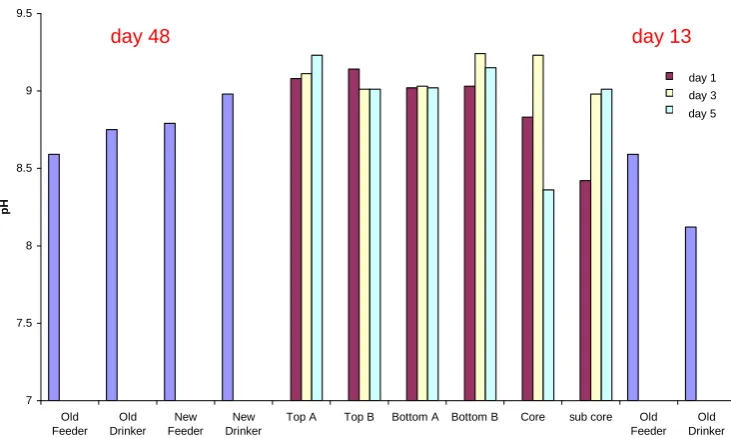
pH in piles through cycles 1 and 2 – Donnybrook ... 41
aW in piles through cycles 1 and 2 – Donnybrook ... 41
Relationship between aW and Moisture in piles through cycles 1 and 2 – Donnybrook ... 41
Relationship between temperatures at different pile locations in cycles 1 and 2 – Donnybrook ... 46
E. coli die-off in piles through cycles 1, 2 and 3 – Laravale ... 52
Salmonella die-off in piles through cycles 1, 2 and 3 – Laravale ... 52
Campylobacter die-off in piles through cycles 1, 2 and 3 – Laravale ... 53
Clostridium perfringens die-off in piles through cycles 1, 2 and 3 – Laravale... 53
Bacillus die-off in piles through cycles 1, 2 and 3 – Laravale ... 53
pH in piles through litter cycles 1, 2 and 3 – Laravale ... 65
aW in piles through litter cycles 1, 2 and 3 – Laravale ... 65
% Moisture and relationship between aW and Moisture in piles through cycles 1, 2 and 3 – Laravale ... 65
Relationship between temperature at different pile locations in cycles 1, 2 and 3 – Laravale ... 73
Environmental studies on Salmonella ... 81
Spread litter studies ... 84
Levels of E. coli at Donnybrook and Laravale through a chicken production cycle ... 84
Levels of Salmonella (and serovars present) at Donnybrook through a chicken production cycle ... 84
Levels of Salmonella (and serovars present) at Laravale through a chicken production cycle ... 85
Overall comments on Salmonella ... 85
Levels of Campylobacter at both Donnybrook and Laravale through the chicken production cycle ... 86
Levels of Clostridium perfringens at both Donnybrook and Laravale through the chicken production cycle ... 86
aW levels in litter at both Donnybrook and Laravale through the chicken production cycle ... 92
aW and moisture levels in litter at both Donnybrook and Laravale through the chicken production cycle ... 94
pH levels in litter at both Donnybrook and Laravale through the chicken production cycle ... 96
Litter temperatures at Donnybrook through the chicken production cycle ... 98
Litter temperatures at Laravale through the chicken production cycle ... 98
Overall comments on litter temperatures ... 99
Litter depths recorded at Donnybrook and Laravale through the chicken production cycle ... 106
Discussion ... 109
Litter and food-borne pathogen survival ... 109
Chicken litter a source of Salmonella and Campylobacter ... 109
Litter treatment and piles ... 110
Pathogen die-off and piles ... 110
Pathogens and the dual litter environment through the chicken cycle ... 111
Temperature and pathogens in litter ... 112
pH and pathogens in litter ... 113
Water activity and pathogens in litter ... 113
Appendix 1 ... 117
Chapter 3 Background information for the establishment for a code of practice for “in-shed pathogen reduction” of chicken litter (to be finalised in collaboration with industry) ... 119
A summary of key physical parameters ... 119
Temperature ... 119
Water activity, moisture and pH ... 122
Additional Factors ... 122
Simple monitoring equipment for a quality management process ... 122
A possible QA system ... 123
Illustrations relevant to a possible QA system ... 123
Acknowledgements ... 127
Executive Summary
There are perceptions that chickens raised on multi-batch litter may be exposed to higher levels of food-borne pathogen loads (such as Campylobacter and Salmonella) than chickens raised on freshly placed bedding material (i.e. single use litter). These perceptions also contribute to concerns that such increased levels of pathogens would thus increase the load of food-safety pathogens (Salmonella and Campylobacter) via chicken meat across the food process chain. Such perceptions have an impact not only on the producers who currently re-use litter but also impact on the environment in terms of disposal of litter, due to the possible re-entry of such pathogens to the food chain via the environment. Thus, there are increasing levels of restrictions on the approved end-uses of chicken litter which is destined for agricultural use. In contrast a situation where 100% of meat chickens are raised on fresh bedding material would not only greatly increase the demand for new bedding material but also contribute to an increase in demand for the already decreasing resource from an environmental and economic point of view. Thus in a climate where litter re-use already occurs, it is vital that a scientific basis for what occurs during re-use is established for the benefit of all concerned. Such information will not only benefit the producers but also generate previously unavailable Australian data on litter re-use and the fate of the key food-borne pathogens such as Salmonella and Campylobacter within a re-use litter scenario. Thus the objectives of this study can be broadly categorised as follows:-
Evaluate current practices adopted (e.g. litter pile-up) prior to re-use of litter for subsequent chicken cycles
To establish pathogen die-off that occurs during currently adopted methods of in-shed treatment of litter
To establish simple physical parameters to monitor this pathogen reduction and create an understanding of such reduction strategies to aid in-shed management of re-use litter
To carry out studies to assess the potential of the re-used litter (once spread) to support pathogens during a typical chicken production cycle.
To provide background data for the development of a simple code of practice for an in-shed litter pile-up process
The project consisted of extensive on-farm studies that were supported by laboratory studies. In both studies, the pile-up and the chicken production cycle, the presence and levels of food-safety pathogens (Campylobacter and Salmonella) as well as other key target bacteria (Bacillus spp, Clostridium perfringens and Escherichia coli) were evaluated at different stages of the process to evaluate the die-off potential of these organisms. A range of physical parameters i.e. temperature, pH, water activity and moisture content, were also recorded simultaneously during the testing for these organisms.
To achieve the above outcomes, two farms that had a long history of litter re-use were selected. The in-shed litter treatment process was followed on both farms, beginning after a full cleanout. Two litter pile-up processes were followed sequentially on the first farm and three of the five litter push-up processes were followed through on the second farm.
demonstrated a 6 log reduction. E. coli (an indicator organism), however, was present during the last day of the pile (during both cycles) on the first farm but was not detected on the second farm. This can possibly be linked to the fact that these particular piles had a generally lower temperature profile than that other piles examined in the study. Both Clostridium perfringens and Bacillus, spore forming organisms, were not impacted by the pile-up process. Hence all outcomes from the pile-up process suggest that this process has the potential to deal with the key pathogens (Salmonella and Campylobacter) within 4-6 days of pile-up. Thus these pile studies confirmed that the current practices on both farms achieved effective pathogen destruction. It is vital that these outcomes need to be supported by good in-shed management processes.
Based on some of the outcomes of the study it was noted that temperature alone did not contribute to pathogen die-off due to the fact, even in the presence of temperature variations, pathogen die-off was achieved. The other factors contributing to pathogen die-off were intrinsic litter parameters such as pH and water activities (available water for microbial growth). Whilst there were temperature variations across the pile locations, both water activity and pH did not show such marked variations. For example, while certain pile locations may not reach the key temperatures for inactivation a suitable pH can still result in high ammonia generation which will have a bacteriocidal effect or the prevailing water activities, especially in spread litter (prior to chickens) can act inhibitory for pathogen support.
These studies were also followed through to spread litter once spread through the grow-out end of the shed. The presence of re-used litter in the grow-out end and new litter in the brooder end presented a “dual environment” with the shed presenting a “dual set of conditions”. Importantly prior to chicken movement the piled and then spread re-used litter did not support any pathogen increase. Once the chickens moved across, there was not much difference between E. coli and Clostridium perfringens levels within these environments. Salmonella did show a tendency for a lower impact on re-used litter in terms of the variety of serovars and levels present. Campylobacter only appeared late in the cycles on both litter types. Overall there was no marked difference between both these litter environments once chickens were placed as well as through the chicken cycle, indicating no negative effects from the re-used litter.
Introduction
In Australia, almost all meat chickens are raised in sheds on litter. The floor of the shed is covered by a layer of bedding material which absorbs moisture. During the growth cycle, this bedding material is mixed with excreta, feathers and wasted feed by the stirring action of the chickens and becomes litter.
Around 70% of the chickens placed in Australia are grown on single batch litter. In this system, the sheds are cleaned out after each batch of chickens the litter disposed and replaced with new bedding material. The remaining 30% of the chickens are grown on multi batch litter, usually under the partial clean out method. In the partial clean out approach, the litter at the end of the batch is moved from the brooding end of the shed into grow-out end. Alternatively, in some systems, the litter at the brooder end is removed from the shed and sent off-farm. The litter remaining in the shed is then be heaped and subjected to a short composting period (4 – 10 days) and then spread in the grow-out end prior to chick placement. Clean bedding material is spread in the brooder end of the shed.
Management of poultry litter from sourcing the initial bedding material through to utilisation of spent litter (litter end-use) is a concern to the Australian poultry industry and community (Runge et al. 2007). Traditionally, poultry litter has been used as a fertiliser in intensive horticulture, citrus and cropping industries as well as in broad acre agriculture.
There is a range of materials that have been used as bedding material by the Australian poultry industry. Typically, materials that are by-products from other industries have been used and include: timber shavings, hard- and soft-wood sawdust, rice hulls, shredded paper, sunflower husks, woodchips, chopped straw and tea-tree fibre (the material left after the extraction of tea-tree oil). The type of material used as bedding depends on what is available, suitability and cost in the locations where the chickens are grown. Cost variation largely reflects availability and transport distances.
The volume of bedding material placed per unit area of house floor space varies according to the type of bedding material, depth of bedding desired and how much the material settles when spread on the floor (Runge et al. 2007). Moisture content of the litter is the main effect on the volume of material removed from a shed as damp litter tends to compact more than dry (friable through to dusty) litter. In approximately seven weeks, 1,000 meat birds produce approximately 1.5 tonnes of dry poultry litter comprising of 50% litter and 50% manure. Runge et al. (2007) estimated that there was approximately 4,274,000 m2 (more than 2,750 sheds) of shedding for meat production in Australia. By assuming there is 5.5 batches per shed per annum about 1.17 million m3 of bedding material is used producing approximately 1.60 million m3 of spent litter for utilisation. These estimates do not take into consideration the effects of litter decomposition on the volume of material produced. The volume of spent litter removed at the end of a batch is generally 1.5 – 2 times the volume of material originally placed in the shed (Runge et al. 2007).
food-The possible removal of the option to adopt multi-batch litter systems is of concern for the poultry industry. A situation where 100% of meat chickens were raised on fresh bedding material would greatly increase the demand for this material and would also increase the amount of litter to be removed from chicken meat sheds. At the same time, there are increasing levels of restrictions on the approved end-uses of chicken litter.
Economic Value
The Australian Chicken Meat Industry produces around 500 million birds (700,000 tonne of chicken meat) annually and has an annual retail value in excess of $3.6 billion. In 2003, chicken meat consumption per capita in Australia reached 34.1 kg. Consumption is forecast to rise to 36.5kg in 2005/06 – meaning that chicken would replace beef as the most popular meat of Australian consumers. Consumption of chicken meat has increased 27% over the past decade, and is expected to continue increasing at between 1-5% pa for at least the next five years. Approximately 98% of the total chicken meat production in Australia is consumed domestically.
The chicken meat industry has indicated that there is a high priority on the need to develop valid guidelines to ensure that the practice of multi-batch litter use can remain a management option for the sustainable production of a major food.
Pathogens of Relevance
Based on the available information in the literature, the pathogens of key importance in the issue of litter re-use are Salmonella and Campylobacter. Both of these pathogens have the potential to enter the food chain via the production system. The accepted means of transmission from chicken-to-human for these two pathogens is predominantly via the food chain or less commonly by direct chicken faecal-human oral transmission.
Pathogen Reduction
Pathogen reduction can occur in litter piles held for 1-2 weeks as a partial composting will occur. It is important to understand that litter piling is not composting. Composting is defined as a process in which the litter is mixed with a carbon source and then either passive or actively aerated over a period of 10-12 weeks.
Pathogen die-off
With either litter piling or full composting, there is a range of potential mechanisms that could be detrimental to pathogen survival in litter. The impact of these mechanisms could vary depending on whether the pathogens are subjected to a full, partial composting or simply a pile-up process. Such mechanisms include heat, microbial competition or nutrient destruction/depletion, and antagonism from indigenous microorganisms and time. Of these potential mechanisms, it is generally accepted that temperature and time are the major effects in pathogen killing. Antagonism from indigenous organisms and nutrient destruction/depletion are regarded as the major mechanisms of ensuring that pathogens do not re-grow.
Pathogen Re-growth
Pathogen re-growth is a newly emerging area of concern. Attention in this area has focussed on the fact that several studies have demonstrated that surviving Salmonella organisms in stored compost can re-grow to levels that pose health hazards. Recent work has suggested that the main control force preventing or limiting the re-growth of pathogens (Salmonella specifically) in compost is the indigenous microbial population (Sidhu et al. 2001).
As the indigenous population of compost declines with prolonged storage, the potential for Salmonella re-growth increases with prolonged storage of compost. Hence, the current recommendation of (Sidhu et al. 2001) is to have only minimal storage of compost after maturation has been achieved.
Litter Piling
The intention of litter piling (also called partial composting and deep stacking) is to achieve pathogen reduction/killing. The time period typically used in this technique means that there is no major effect on C:N ratio or the other nutrient aspects of full composting.
Conclusions
Overall, there is considerable literature evidence that the litter pile up process that is used by Australian producers has the potential to contribute to pathogen die-off, even though the piling process is of a short duration of around 7 days. However, there is no publicly available evidence of the effectiveness of the litter piling process in the Australian context.
The present set of trials have been designed to
Validate microbiological methodologies used to assess pathogen survival in piled litter
Assess the die-off of key food-borne pathogens during the pile-up process
Objectives
The objectives of the research were as follows:-
1. Perform shed trials to evaluate current practices for pathogen reduction in used chicken litter
2. Perform laboratory/pen trials to evaluate novel/alternative practices for pathogen reduction in used chicken litter
3. To establish simple physical parameters to monitor pathogen reduction 4. Identify effective and suitable pathogen reduction strategies
Methodology
This Chapter has been set out to provide an overview of the general methodological approach used in this project. In the following chapters, detailed methodologies that are specific for the various field and laboratory studies (microbiological, physical and field) were evaluated.
Industry Consultation
Regular consultation meetings were held with Dr Margaret McKenzie and Mr Gary Sansom. The initial industry consultations emphasised that the main concerns were the possible transfer of food-borne pathogens across the broiler cycles. This confirmed that the focus of the work is to develop an understanding and knowledge that will assist the industry in minimising the food-borne pathogen risk across broiler cycles when re-using litter.
Discussions were also held in relation to the following:
Litter material used
Turn-around times
Distribution and location of farms willing to participate in the trials
Clean-up procedures adopted following pick-up
The bedding material used by farms is variable. Since the most common material used in Queensland broiler sheds is pine shavings, it was decided to use farms that used pine shavings for the trials.
The typical turn-around time between broiler flocks is 7- 10 days. However, the time is dependent on a number of variables – which include overall company policy; the market demands and the supply of available birds.
With industry input, it was agreed to initially assess the impact (on food-borne pathogen levels) of the current litter re-cycling practices commonly adopted by industry. Based on the outcomes of these initial studies, the latter stages of the project will explore alternative approaches (using both field and laboratory experiments) to minimise the food-borne pathogen risk across broiler cycles.
Farm Identification
Consultation with industry resulted in the identification of two farms suitable for this study. One farm is located at Donnybrook (to the north of Brisbane) and the other farm is located at Laravale (south-west of Brisbane). The owners and managers of both farms willingly supported and assisted the work. These two farms had a long history of litter re-use and welcomed the approach of providing a scientific basis to their current practices.
Overview of activities
The work of this project consisted of two phases.
Areas of activity in the first phase were as follows:-
A) Evaluating suitable methods for assessing physical parameters of litter.
Litter moisture
Litter pH
Litter temperature
Litter water activity
B) Validating microbiological methods
Designing suitable samplers for collecting samples from the core of large litter piles as well as the surface of the piles
Validating microbiological methods
C) Using simple laboratory based methods to understand the survival pattern of pathogens under laboratory conditions
Survival pattern of Salmonella (and E. coli) in relation to pH and temperature
D) Preliminary field trials to aid in developing experimental design to test pathogen variation across broiler cycles
Simple field sampling to understand pathogen levels as soon as chickens have been removed
Simple field trial to understand the dimensions of a litter pile and assess variations across a pile and depths to which sampling will need to be undertaken as well as develop a random design for sample collection from a pile
Simple field trial to validate moisture assessment techniques
The second phase of the project consisted of on-farm trials. These studies involved trials of the ability of existing techniques (litter piling) to reduce the levels of Campylobacter and Salmonella in the litter. Thus no modification was done to the existing practices adopted by the individual farmers.
During these trials, physical parameters (pH, moisture, temperature) were evaluated as potential tools for monitoring/predicting pathogen reduction. Hence, the piles were intensively monitored for both physical and biological parameters. These parameters were moisture, temperature, water activity as well as levels of E. coli, C. jejuni/coli, Salmonella spp., Clostridium perfringens and Bacillus spp.
Chapter 1
Laboratory and Field Validation Studies
Introduction
The work described in this Chapter was aimed at validating both microbiological methods (for pathogen enumeration) as well as physical methods (for establishing profiles of parameters such as temperature and moisture content).
Materials and Methods
Litter
When performing laboratory based experiments, litter was obtained from near the end of a broiler cycle on either the Laravale or the Donnybrook farm.
Bacteria
All bacteria used in spiking experiments in this Chapter were field isolates originally obtained from broiler litter. The bacteria used were Salmonella enterica serovar Sofia and Salmonella enterica serovar Virchow. The isolates had been serotyped at the Institute for Medical and Veterinary Science in Adelaide. The isolates were kept stored at -7ºC and were revived as fresh sub-cultures as needed. The Salmonella isolates were grown on sheep blood agar or in tryptic soy broth.
Laboratory Survival Experiments
Freshly collected litter was weighed into replicate sterile plastic containers. In some experiments, the containers were kept open (to simulate aerobic conditions) or closed (to simulate anaerobic conditions). In some experiments, additional water was added to the containers to simulate high moisture conditions. As well, different incubation temperatures were used.
Enumeration methods
Brief details of the various enumeration methods used in this study are provided in the following subsections.
E. coli
E. coli enumerations were performed by a direct count method on Petrifilm (3M) and/or Chromocult Agar (Merck) (using both the original formulation and the new selective formulation). All incubations were in air at 36.5ºC.
the inoculated drop (indicating the presence of motile salmonella) were sub-cultured (from the outer hazy zone) onto XLD agar (Oxoid). In some work, XLT4 (Oxoid) plates were used in addition to the XLD plates. The XLD and the XLT4 plates were incubated at 37ºC. Presumptive Salmonella isolates were confirmed using the Obis kit (Oxoid) and by agglutination using a commercial polyvalent O antiserum (Difco). Most confirmed Salmonella isolates were then submitted to the Salmonella Reference Laboratory at the Institute for Medical and Veterinary Science for full serological identification.
A number of litter samples were examined using an Immunomagnetic Separation (IMS) method in parallel with a standard three tube MPN method as described above. In this approach, each incubated BPW was also subjected to IMS as described by the manufacturer (Dynal). The IMS material was then used to inoculate MSRV plates as described above. Campylobacter
The presence and number of C. jejuni/coli was determined using a three-tube MPN method. The selective enrichment broth used was Preston Broth (Nutrient broth No: 2 with antibiotics - Oxoid). The incubation of enrichment broths was at 37ºC for 4 hours and then 42ºC for 44 hours. Following enrichment, the tubes were inoculated directly onto modified Campylobacter charcoal deoxycholate agar-Preston – CCDA (Oxoid). In some experiments, the sub-culture was done after 24 and 48 hours of enrichment while in others, only the 48 hour sub-culture was used. The agar plates were incubated at 37ºC for 48 hours. All incubations were done under an atmosphere of 90% N2, 5% CO2 and 5% O2 provided by a
commercial sachet system (Oxoid). Presumptive Campylobacter isolates were then subjected to confirmatory phenotypic tests (catalase, oxidase, motility, characteristic cell shape) as previously described (Chinivasagam et al. 2004).
Staphylococcus spp.
The presence and number of Staphylococcus spp. was determined using a direct spread plate method on Baird Parker Agar (Oxoid). The plates were incubated aerobically at 37ºC for 48 hours.
Bacillus spp.
The presence and number of Bacillus spp. was determined using a direct spread plate method on Bacillus cereus Agar (Oxoid). The plates were incubated aerobically at 30ºC for 24 hours.
Initial Litter Pile Study
This study was performed on the Laravale farm. There were two litter piles in the study shed: a single use litter pile (from the brooder end of the shed) and a multiple-use litter pile (from the grow-out end of the shed). Figure 1.1 shows the physical dimensions of both piles. Both piles had been in place for two days.
Microbiology
For Campylobacter, Salmonella and Bacillus all surface samples of the single use pile were pooled and examined as a single sample. The two core samples were similarly pooled and examined. The same approach was used for the multi-use litter pile.
For Staphylococcus, the horizontal surface samples from the single use pile were pooled and examined as a single sample. The vertical surface samples of the single use pile were similarly pooled and examined as a single sample. The core samples of the single use pile were pooled and examined as a single sample. The same approach was used for the multi-use litter pile.
For E. coli all surface samples were examined separately. Within each pile type, the core samples were pooled.
Physical measurements
For moisture content, all vertical surface samples (from both piles) were examined separately. For the single use pile, the three horizontal surface samples were pooled. For the multi-use pile, the horizontal surface samples were combined into two pools. For both piles, the core samples were pooled. For, water activity and pH measurements, all surface samples were examined individually. The core samples (within a pile type) were pooled.
Moisture content was determined in a standard laboratory assay. The moisture samples collected were stored without air chilled until tested for moisture content. The moisture content was defined as the difference in weight of the litter sample before and after drying at 100ºC for 18 hours.
The water activity was determined in the field using a water-activity meter. - Safe Storage Quick Check.
The pH of the litter samples was determined by suspending 2 g of litter in 50 ml of distilled water. After allowing the suspension to stand at room temperature for 5 minutes, the pH was measured with a standard laboratory pH meter.
Litter temperatures were measured using a thermometer at different locations.
Comparison of moisture measurement techniques
Two different moisture measurement techniques were used in this work. The two methods were used to evaluate the moisture content of litter in shed containing broilers at 49 days of age.
Five different bays within the shed were selected – Bays 5, 10, 15, 20 and 25.
A field instrument designed to provide real-time moisture measurements of soil – a Theta Moisture Probe – was used in the field. The Theta probe was inserted to a depth of 4 cm and the moisture content recorded. The probe was used to take five different readings – close to the drinker line at each of the bays.
Results
Evaluation of microbiological methods
The results of comparing the various microbiological methods using litter samples collected at Days 35, 49 and 56 of the broiler cycle are presented in Table 1.1.
There were no marked or consistent differences between the results obtained with any of the three methods used for estimating E. coli levels.
The two different Salmonella selective agar plates, XLD and XL4T, gave identical results. The week old litter, deliberately left to age to increase stress on any Campylobacter present, gave the same count (0.3 MPN/g) in both MPN methods (with the difference in the MPN methods being the time of sub-culture from the enrichment broth – either after 24 hours or 48 hours).
A total of five different litter samples (both single and multi-use litter) were examined by both IMS and conventional MPN methods for Salmonella. The results are presented in Table 1.2. The IMS results were generally very similar to the results obtained by the conventional MPN method. Both litter samples that were negative by the conventional MPN were also negative in the IMS method. One litter that was a low positive in the conventional MPN method (1.1 MPN/g) was negative (<0.3 MPN/g) in the IMS method. Overall, there was no marked difference between the conventional MPN and the IMS supplemented MPN method.
Survival of
E. coli
in poultry litter under laboratory conditions
In this work, fresh litter and fresh litter with added water (to simulate wet litter conditions) were used. The litter samples were held in open or closed containers and incubated at 37ºC for 48 hours, then 45ºC for 48 hours and then 55ºC for 48 hours (to simulate a rising temperature within a litter pile). The initial E. coli count was 105 CFU/g. No E. coli was detected in any of the subsequent sampling times (samples were taken at every 48 hours) despite the minimum detection level being 103 CFU/g.
Survival of
Salmonella
in poultry litter under laboratory conditions
In this work, samples of fresh litter were held in plastic containers at 37ºC, either with the lid on (simulating anaerobic conditions) or lid off (simulating aerobic conditions). The treated containers were spiked with an overnight culture of two different strains of Salmonella. The initial spike resulted in a Salmonella count of 1.67 X 10⁸ CFU/g. After three days of incubation, the Salmonella count in the “open” container was 110 MPN/g – a reduction of around 106. No Salmonella was detectable in the “closed” container. As the minimum detection of the MPN method was 0.3 MPN/g, the reduction in Salmonella in the “closed” container was at least 108.
The pH of the initial litter was 9.43. After three days of incubation, the “open” container had a pH of 8.23 while the “closed” container had a pH of 9.3.
After 24 hours incubation, no Salmonella could be detected (minimum detection limit of 0.3 MPN/g) in any of the six spiked containers.
The initial pH of the litter was 8.42. Following incubation, the “anaerobic” (lid on) litter had a similar pH while the “aerobic” (lid off) litter had increased to 8.91.
Typical biological and physical parameters of litter just after final pick
up
The levels of key bacteria and the temperature of litter were determined immediately after the final chicken pick-up on the Donnybrook farm. For this third consecutive broiler cycle, the brooder end of the shed had single use litter while the grow-out end had the multi-use litter. The levels of the various bacteria are shown in Table 1.3. As well, the litter was held for one week at ambient in the laboratory and then re-examined for Salmonella and Campylobacter levels.
There was no marked difference in the E. coli levels in the single use and re-use litter (see Table 1.3).
Campylobacter was absent in both single use and re-use litter but Salmonella was present at a low level (0.7 MPN/g of litter) in the single use litter and absent from the re-use litter (see Table 1.3).
The stored litter showed no marked difference in Salmonella levels (see Table 1.3).
The in situ temperatures recorded for the litter are shown in Table 1.4. The results are an average of a multiple readings. Whilst not conclusive, it is interesting to note that the litter temperatures in the re-used litter were slightly higher than those present in the single use litter.
Initial litter pile study
Considerable difficulty was experienced in obtaining core samples within the litter pile using the grain sampler.
The results of the sampling for Campylobacter, Salmonella and Bacillus are set out in Table 1.5. While no Campylobacter were detected in any sample, a low level of Salmonella was detected in the surface sample from the multi-use pile.
There was no detectable E. coli (minimum detection level was 100 CFU/g) in any of the surface or core samples from the single use litter pile. Similarly, there was no detectable E. coli (minimum detection level was 100 CFU/g) in any of the core samples from the multi-use litter pile. However, there were detectable levels of E. coli in some of the surface samples in the multi-use litter pile (see Table 1.6).
The Staphylococcus levels did not show much variation – either between single or multi-use piles or from surface to core samples (Table 1.7).
Comparison of moisture measurement techniques
The results of the comparison of moisture measurement techniques are presented in Table 1.9.
Discussion
The purpose of the preliminary work described in this Chapter was to validate the various physical and microbiological methods and to provide some basic information to guide the final design of the formal, full-scale field trials.
From the various methodologies tested, suitable methods were identified for quantifying the key organisms in litter. Direct plating using Chromocult was adopted in favour of using Petrifilm for E. coli. There was little difference between the use of immunomagnetic separation following primary enrichment (BPW) and the use of selective enrichment (MSRV) for isolating Salmonella. Hence, the conventional selective enrichment was adopted for Salmonella. Campylobacter was successfully isolated using enrichment in Preston broth followed by plating onto mCCDA agar. For both Salmonella and Campylobacter, a MPN approach was adopted to quantify these two key organisms in litter.
The laboratory work showed a very poor survival of E. coli in poultry litter under laboratory conditions – with levels dropping at least by 100 within 48 hours of the litter being held at the relatively low temperature of 37ºC (regardless of any addition of moisture or whether the litter was held in open or closed containers). This poor survival could have been due to the development of volatile compounds such as ammonia, other microbial interactions within the litter or combinations of these factors. These studies will need to be validated in the field for litter piles in sheds.
A somewhat better survival occurred with Salmonella. Detectable levels of Salmonella were present in litter incubated at 37ºC for three days. The reduction in Salmonella levels was still marked, at least by 106. The drop in Salmonella counts was also evident when an incubation temperature of 45ºC was used – with a drop of at least 106 in both open and closed litter containers.
Clearly, litter pH (as well as other factors such as moisture content and water activity) impact on the survival of Salmonella (and E. coli) in litter. The laboratory based studies indicate that levels of both of these organisms are likely to fall markedly in piled litter in sheds. However, study under field conditions using actual litter piles in sheds are required to confirm these laboratory studies.
As part of the general preparation for the field studies, the levels of key bacteria in litter were determined immediately after the final chicken pick-up on one of our two study farms. The levels we found of E. coli and Salmonella were in the expected range based on the prior national litter survey (Chinivasagam et al. 2008a).
As noted in the Introduction section, the issue of the re-growth of Salmonella is now an issue of concern in bio-solids. Litter samples were stored for a week in the laboratory at ambient temperature to understand the possibility of re-growth of Salmonella under these conditions. The results (see Table 1.2) indicate that there was no marked re-growth of Salmonella in litter stored in this manner.
The initial pile study demonstrated that a grain sampler was not a good instrument for sampling deep within a litter pile. The litter is not as heavy as grain and thus does not easily collect in to the grain sampler (as in a silo). As a result of the problems with the grain sampler, a special sampling device that can be driven into the centre of the pile using a heavy mallet has been developed and will be used in the full field trials.
The initial litter pile study found a degree of variability in the E. coli levels present at various positions (both horizontal and vertical) in the surface of the pile. This finding is important in guiding the sampling strategy to be used in the full field studies. Full field studies will be designed in a manner to ensure that enough samples are collected to compensate for this variability across the pile when compositing samples. It is notable that the major variation detected occurs down the slope surface (with counts of E. coli varying by at least 100 fold). The physical measurements taken in the initial litter pile study provided valuable insight. The areas of high water activity seem to be contained to the core of the litter pile rather than the surface. However Salmonella spp were isolated from the surface samples. This preliminary study indicates that a good understanding needs to be developed between water activity, pH and temperature in relation to bacterial survival (and /or growth). An understanding also needs to be developed of the microbial interactions between the pathogens and other inherent flora. All these need to be understood in terms of volatiles produced such as ammonia – which probably are a contributing agent to the high pH seen in litter.
Thus such information will enable the development of suitable litter pile management / manipulation techniques in managing pathogen reduction between litter cycles.
It should be noted that the water activity was tested by collecting samples in the field, transporting them to the laboratory and then doing the water activity determinations. It was felt that this delay in analysis may mean that the measurements do not accurately reflect the situation in the field. During the field trials the water activity will be measured on-site directly from the piles.
Similarly litter temperatures will be logged electronically which will be a more convenient and accurate way to monitor temperature. The data generated ensured the purchase of suitable electronic data loggers.
There was a lack of correspondence between the simple field measurements of litter moisture obtained by use of Theta probe and the accepted “gold standard” laboratory assay. This failure of the Theta Probe probably reflects that the instrument was developed for soil moisture applications. The much less dense nature of litter when spread on the shed floor is a problem for this instrument. Thus, though not convenient, laboratory based methods for moisture measurement will be used in the field trials.
Overall the following was achieved in these preliminary studies:-
Microbiological methods for pathogen enumeration were validated
Moisture assessment methods were validated
A technique for determining water activity was established
Pathogen die-off potential was assessed both in the laboratory as well as during random shed sampling
A suitable sample collection strategy for collection of core sample by the development of core sampler specifically for collecting litter from piles was developed
Figure 1.1 Dimensions of litter piles (Laravale farm; August 2006)
Single Batch Pile
9.6 m
Multiple Batch Pile
~ 18.5 m
5.5m
Figure 1.2 Layout of sample sites on litter piles (Laravale farm, August 2006)
Single Batch Pile
Multiple Batch Pile
60cm
120cm
180cm
240cm
1 2 3
A B
Core
Surface
60cm
120cm
180cm
240cm
1 2 3 4 5 6 7
A B
Core
Table 1.1 Levels of bacteria in litter collected from the study shed at the indicated day of the broiler cycle
Cycle day
E. coli cfu/g
Coliforms cfu/g
Campylobacter jejuni/coli MPN/g
Salmonella MPN/g
Petrifilm Chromocult
Chromocult
(Selective) Petrifilm Chromocult
Chromocult (Selective)
24 hours - enrichment
48 hours -
enrichment
Day 36 330,000 570,000 540,000 570,000 130,000 310,000 0.3A 0.3A 0.3B
Day 49 580,000 87,000 NTC 380,000 130,000 NT NT >11,000 0.4 B
Day 56 1,800,000 4,000,000 NT 2,200,000 1,900,000 NT NT <0.3 <0.3 B
A
These Campylobacter results were obtained on litter held at 4ºC for one week prior to testing.
B
These are the results obtained using XLD agar. Identical results were obtained using XL4T agar.
C
Table 1.2 Results of comparison of conventional MPN and immuno-magnetic separation (IMS) in combination with MPN for the enumeration of Salmonella
Sample Salmonella Result (MPN/g)
Conventional MPN IMS/MPN
1 <0.3 <0.3
2 <0.3 <0.3
3 1.1 <0.3
4 1.1 1.1
5 1.5 0.7
Table 1.3 Levels of bacteria in litter and stored litter (Donnybrook farm, third cycle, July
2006)
Organism
Single Use Litter Re-use Litter
Drinker Line Feeder Line Drinker Line Feeder Line Salmonella
(MPN/g)
Initial 0.7 NDA <0.3 ND
After 1 week
storageB <0.3; <0.3 1.1; 1.1 0.3; 1.1 0.7; 1.5
Campylobacter (MPN/g)
Initial <0.3 <0.3 <0.3 <0.3
After 1 week
storageB <0.3; <0.3 <0.3; <0.3 <0.3; <0.3 <0.3; <0.3 E. coli
(CFU/g) 4.3 X 10
4
ND 1.0 X 10⁴ ND
A
ND = Not Done
B
Table 1.4 Litter temperatures (Donnybrook farm, third cycle, July 2006)
Temperature (ºC)
Single Use Litter Re-use Litter
Drinker Line Feeder Line Drinker Line Feeder Line
Mean 33.7 32.4 34.4 33.9
Maximum 32.9 32.9 34.7 33.7
Minimum 31.8 32.0 34.2 32.2
Table 1.5 Results of Campylobacter, Salmonella and Bacillus enumeration of litter pile
samples (Laravale farm, August 2006) Litter
Sample and Litter Type
Salmonella MPN/g
Campylobacter MPN/g
Bacillus CFU/g
Core
Single Use <0.3 <0.3 210,000
Surface
Single Use <0.3 <0.3 360,000
Core
Multi Use <0.3 <0.3 52,000
Surface
Table 1.6 Results of E. coli enumeration for surface samples from the multi-use litter pile (Laravale farm, August 2006)
Sample Type Position E. coli
Count (CFU/g)
Horizontal 1 <100
2 400
3 <100
4 <100
5 <100
6 <100
7 1,600
Vertical 60 cm <100
120 cm <100
180 cm 400
240 cm 18,000
Table 1.7 Results of enumeration of Staphylococcus spp. in litter pile samples (Laravale
farm, August 2006)
Sample Staphylococcus spp Count
(CFU/g) Vertical Pooled Surface
Single Use Litter 454
Horizontal Pooled Surface
Single Use Litter 331
Pooled Core
Single Use Litter 218
Vertical Pooled Surface
Multi Use Litter 672
Horizontal Pooled Surface
Multi Use Litter 280
Pooled Core
Table 1.8 Results of physical measurements of litter piles (Laravale farm, August 2006) Litter
Type
Sample
Type Position % Moisture Average % Aw (ºC) pH
Single Surface
(Vertical) 60 cm 28.4 0.63 (22.2) 9.10
Surface
(Vertical) 120 cm 25.4 0.69 (22.2) 8.77
Surface
(Vertical) 180 cm 27.4 0.64 (22.2) 8.97
Surface
(Vertical) 240 cm 27.8 0.64 (22.2) 8.86
Surface
(Horizontal) 1
26.7 (composite)
0.53 (22.4) 8.68
Surface
(Horizontal) 2 0.62 (22.3) 8.92
Surface
(Horizontal) 3 0.50 (22.0) 8.83
Core 21.0 0.92 (21.9) 8.80
Multi Surface
(Horizontal) 1
23.6 (composite)
0.67 (22.6) 8.82
Surface
(Horizontal) 2 0.61 (22.2) 8.97
Surface
(Horizontal) 3 0.52 (21.9) 8.98
Surface
(Horizontal) 4 0.63 (21.6) 8.86
Surface
(Horizontal) 5
24.8 (composite)
0.57 (21.4) 8.79
Surface
(Horizontal) 6 0.66 (21.2) 8.96
Surface
(Horizontal) 7 0.69 (21.1) 8.95
Surface
(Vertical) 60 cm 21.3 0.58 (21.1) 8.74
Surface
(Vertical) 120 cm 23.9 0.54 (21.2) 8.99
Surface
(Vertical) 180 cm 20.1 0.54 (21.3) 8.89
Surface
(Vertical) 240 cm 22.2 0.56 (21.7) 8.94
Table 1.9 Comparison of moisture measurement techniques on litter collected at Day 49 of broiler cycle
Sample Site (Bay Number)
Moisture % as determined by Theta Probe
Laboratory Reading 1 Reading 2 Reading 3 Reading 4 Reading 5 Mean
5 34 46 36 35 38 37.7 42.1
10 16 25 15 17 21 18.8 29.3
15 11 12 13 15 12 12.5 26.9
20 36 43 36 37 28 36.2 27.7
Chapter 2
Pathogen survival in litter
Litter or shed environments such as dust can harbor either Salmonella or Campylobacter or both at various stages over the chicken production cycle (Chinivasagam et al. 2008b). These two key pathogens are generally present in chicken and have the capability to persist under a combination of conditions that may prevail in various niches in the shed both during litter push-up and subsequent production cycles. However, Campylobacter is known to have a poor survival potential (Sanders et al. 2007), although it has been suggested that the organism has the ability to go into a viable but non-culturable state (Rollins and Colwell 1986). Such features can contribute either to the persistence or the elimination of either of these organisms during the treatment of litter within the shed. However, not only is there a lack of understanding on the survival mechanisms that may prevail in such environments, but there is also a lack of sufficient data with respect to the populations during treatment of litter intended to be reused within the shed.
An understanding will assist not only in the monitoring of in-shed processes and hygiene but also act as a measure of comparison for assessing the efficacy of treatment processes adopted. For example an understanding of the levels of an indicator organism such as E. coli could be used as an indicator of treatment efficacy. The issues of levels of target organisms as opposed to simple presence absence test is a key point, Santos et al. (2005) demonstrated that the Most Probable Method (MPN) both provided more information and was significantly more sensitive than the presence absence test procedure for Salmonella (in turkey faeces).
Previous studies carried out on pathogens in Australian chicken litter (both from single use and re-use farms) have shown litter to contain varying levels of Salmonella (103 – 105 MPN/g) and Campylobacter (103 – 107 MPN/g) through a broiler production cycle (Chinivasagam et al. 2008b) and can still be present shortly after post chicken pick-up (Chinivasagam et al. 2008a). This gives an indication of the extent of the populations of these organisms that can potentially be present in litter.
Thus this section specifically deals with the following:
The die-off of pathogens during the push-up process that is commonly adopted by some segments of the industry prior to re-use
The impact of pathogen survival through a cycle with the commonly adopted protocol following push-up i.e. the use of new litter in the brooder (for raising young chicks) end and the use of re-use litter in the grow out end
to contribute to pathogen die-off. Needless to say these simple physical parameters – once links have been established to pathogen die-off - could be easily monitored and managed to create unfavourable conditions for pathogen survival or proliferation.
The aim of the present study was to:
Produce microbiological data to enable an understanding of the survival patterns of the two key pathogens, Salmonella and Campylobacter and the indicator organism E. coli.
Relate these survival patterns to physical parameters such as temperature, moisture, pH and water activity as a means of developing field based relationships to be able to predict/understand pathogen survival patterns during the pile-up process.
Understand treated litter when used across a broiler cycle in the typical situation where this litter is used in the brooder end
The overall approach adopted was
(a) Follow pattern of pathogen die-off in piled litter across sequential pile-up processes (b) Follow pattern of pathogens in litter during several broiler cycles on re-used litter (c) Compare (a) and (b) across two farms in Queensland
Materials and Methods
Farm selection
The Donnybrook and Laravale farms described in Chapter 1 were used in these studies. Both farms were from same company and therefore the overall management styles were similar, although the details of the actual litter reuse practices differed slightly. The two farms were included to allow a better comparison of the impact of these slightly differing litter re-use practices. The farm studies commenced in October 2006 on both farms, and sampling was carried out alternatively on both farms between their respective cycles.
Litter management practices
For both farms, the first cycle began with a full clean-out and all new litter, thus a uniform starting point. Both farms used pine shavings as the bedding material.
pile-Sampling from litter piles
The physical dimensions of the litter piles were recorded.
Samples were collected from the piles using a formal randomised sampling method. Initially, the pile was divided into five segments. Using random numbers a single segment was selected and allocated to temperature measurements. This segment was not used for the collection of samples for other purposes.
Figure 2.1 Litter management practices on Donnybrook and Laravale farms
Figure 2.2 Sampling of litter pile. The green vertical lines indicate the five major segments
of the pile. The horizontal yellow lines show the segment that has been randomly selected for temperature measurements. The purple lines show the 50 cm sub-segments marked along the entire length of the pile.
Donnybrook farm
Temperature measurements
Temperature was measured continuously using a data logger (DataTaker DT80). For the litter piles, temperatures were measured near the surface (depth of 100 mm and 200 mm) near the top of the pile, in the mid-section of the pile and near the bottom of the pile at the three positions. Core temperatures at depths of 1 m, 1.5 m and 2 m, were measured at the mid-section of the pile and near the bottom of the pile. The actual positions used varied from pile to pile depending upon the availability of probes and pile dimensions. Figure 2.4 illustrates these locations.
Temperatures of spread litter were also measured using the DataTaker DT80. In this work, the temperature probes were placed into the spread litter in both the brooder (new litter) and grow-out (re-used litter) ends of the shed. As well, ambient air temperature was also recorded.
Sample collection from spread litter during a chicken cycle
This component of the trial is related to testing spread litter (both new and re-used) during a chicken cycle. Samples were collected from both the brooder and grow-out ends of the shed during a cycle.
Thus the shed was categorised into regions (see figure 2.5) as follows: N1 – New litter - the brooder end that received new litter
N2 – New litter - the brooder end that received new litter
Buffer - this area was not tested due to the possible mixing of both litter and remained as a buffer zone where no samples were collected
R1 – Re-use litter - the grow-out end that received treated litter via the pile-up process R2 – Re-use litter - the grow-out end that received treated litter via the pile-up process
Figure 2.3 Illustration of the sampling plan used for each daily sampling of litter piles.
Figure 2.5 Illustration of sampling zones used when sampling spread litter during a chicken cycle.
Environmental samples
Intensive weekly environmental sampling was performed on the Donnybrook farm. This work involved samples collected late in one broiler cycle and then weekly across the next broiler cycle. As with the litter sampling described above, the shed was regarded as consisting of a new litter section (the brooder section), a buffer zone and a re-used litter section (the grow-out end) (see Fig 2.5). No sampling was done in the buffer zone.
In the study, two sheds were examined across the same time period. The sheds were visited on alternative weeks. Shed 1 had curtain side walls while Shed 6 had solid side walls. Each week, four bays were randomly selected in both the brooder and grow-out end of the each shed. Dust from following surfaces was then sampled in of the selected bays:-
Drinker line Feeder line
Feeder/Drinker Suspension Ropes Bottom ledge of side wall
Top ledge of side wall
Surface of mini-vents in side wall Surface of ceiling curtain
Surface of heater (brooder end only) Surface of feeder pipe (grow-out end only)
NEW
REUSED
N1
N2
R1
R2
The sampling was done using a sterile moistened transport swab. The swab was used to sample a 25 cm2 in a zig-zag motion (both horizontally and vertically). The swab was then placed in transport media and transported on ice to the laboratory.
As well, the litter from the centre line of each of two bays was sampled as described previously. The litter was transported on ice to the laboratory.
Water activity
Water activity was tested for using a water activity meter (Water Activity- Decagon Safe Storage Quick Check). Water activity measurements were carried out on composite samples as soon as they were collected in the field. The probe was inserted into the sample bag after all air was eliminated and kept for about a minute until the readings were stable.
Moisture content
Once sampling preparation (i.e. compositing) was completed in the laboratory, a sub sample was drawn from the same quarter allocated for microbiological sampling. This sample was stored in a zip lock bag without headspace to minimise moisture loss and was stored at 4ºC for moisture analysis. The moisture content was determined as described in Chapter 1.
pH
The pH was measured using the composites used in the microbiological analysis. A 6 g sample of litter was mixed in 24 ml of distilled water and the pH recorded after standing for 5 min.
Shed relative humidity (RH)
This was determined using a Kestrel - Kestel 4000 Pocket Weather Tracker.
Microbiological analysis
All quantitative microbiological analysis was done using the methods described in Chapter 1. Additionally for Salmonella CHROMagar – Salmonella (Difco) was also plated in addition to XLD. All litter samples were also subjected to a presence/absence test for Salmonella. This presence/absence test was performed using 25 g of litter.
Some of the environmental samples, as detailed in the Results section, were subjected to a presence/absence test for Salmonella. For these environmental samples, the swab was placed in 10 ml of buffered peptone water which was then used for the enrichment step.
Selected Bacillus isolates were identified using a commercial kit (Bacillus Kit - API 5ºCH).
Results
Pile Studies
Table 2.1 Physical Dimensions and other information for Litter Piles
Farm General Details Pile Dimensions
Donnybrook cycle 1 Pile duration 6 days
October 2006 First chicken cycle
39,400 chickens Final Pick Up 16/10/2006
Pushed Up 17/10/2006 Litter - Pine shavings
Shed Moist
Pile 2
Height 1.7 m Length 9.8 m Depth 7.3 m Pile = litter with a single use
Pile 1
Height 1.87 m Length 14.5 m Depth 6.8 m Pile to be removed
Donnybrook cycle 2 Pile duration 5 days
January 2007 Second chicken cycle
~40,000 chickens Final Pick Up 2/1/2007
Pushed Up 3/1/2007 Litter - Pine shavings
Termed Pile A
Height 1.65 m
Length 9 m Depth 4 m Pile = litter with a single use
Termed Pile B
Height 1.1 m Length 7 m Depth 5 m Pile = litter with a single use
Laravale cycle 1 Pile duration 6 days
November 2006 First chicken cycle ~ 32,5000 chickens Final Pick Up 6/11/2006
Pushed Up 10/11/2006 Litter - Pine shavings
Only one pile
Height 2.2 m Length 17.2 m
Depth 5.3 m Pile = litter with a single use
Laravale cycle 2 Pile duration 4 days
January 2007 Second chicken cycle
~ 32,5000 chickens Final Pick Up 23/1/2007
Pushed Up 24/1/2007 Litter - Pine shavings High ammonia levels in shed
Only one pile
Height 2.1 m Length 28 m Depth 6 m Pile = litter from present and previous broiler cycle
Laravale cycle 3 Pile duration 5 days
April 2007 Third chicken cycle ~ 32,5000 chickens Final Pick Up 2.04.2007
Pushed Up 3.04.2007 Litter - Pine shavings
All old litter removed. This plie is singe use litter
Height 2 m Length 8 m Depth 3.5 m Pile = litter with single use and multiuse from last time, i.e. cycles 1 & 2
E. coli die-off in piles through cycles 1 and 2 - Donnybrook
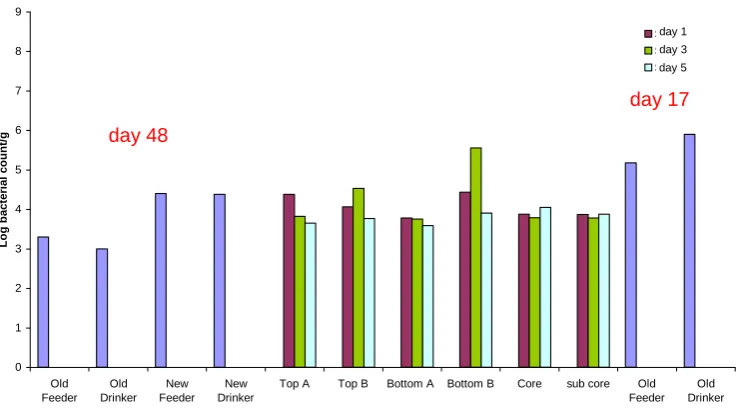
Figures 2.6 and 2.7 illustrate the die-off of E. coli over two sequential litter cycles. In both cycles, the pile-up process reduced E. coli levels. In cycle 1, E. coli was present at around 108 CFU per g in litter under feeders and at around 104.5 CFU per g in litter under drinkers (day 52). In the pile itself, the only sample positive for E. coli at day 6 was the Bottom Side B sample (Top samples, the other Bottom sample and the Core sample were below the detection limit). In the spread litter, prior to chicken entry, the E. coli levels were below the detection limit. In the second cycle, E. coli was detected in all locations on day 1. On day 3, E. coli was absent in one of the two Top samples, one of the two Bottom samples and the Core. E. coli was detected again in all locations except the Core on day 5, the last day of the pile (at levels 4 logs lower than in the litter prior to pick-up). The spread litter also yielded E. coli (at levels equivalent to that in the litter at pick up). However, this was probably due to the fact that chickens had already entered this section of the shed by the time of sampling. Overall, the levels of E. coli by the end of the pile up process were higher in cycle 2 than cycle 1.
Salmonella die-off in piles through cycles 1 and 2 - Donnybrook
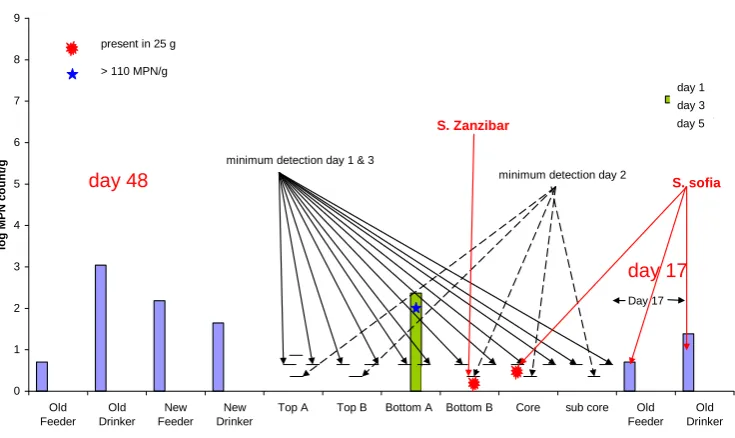
Figures 2.8 and 2.9 illustrate the die-off of Salmonella over two litter sequential cycles. Salmonella was detected in the litter before bird pick up prior to litter cycle 1 (day 52 of the chicken cycle) at levels of around 100 MPN/g. However, Salmonella was not detected at any sampling site at any time in the litter pile in cycle 1 or in the spread litter prior to chicken placement (day 2 of the next chicken cycle) (both by MPN testing and presence/absence testing of 25 g samples). In cycle 2, Salmonella was again present in the litter prior to the final pick-up at levels of around 100 MPN/g. Salmonella was detected in the early stages of the pile-up process (both Bottom samples were positive at day 1 of the pile) but no sample in the litter pile was positive at day 5. The spread litter was positive at around 100 MPN/g, probably due to the presence of young chicks on the litter (sample taken at day 17 of the chicken cycle and chickens were already present). No carry over of Salmonella from the piled litter to the subsequently spread litter appears to have occurred.
Campylobacter die-off in piles through cycles 1 and 2 - Donnybrook
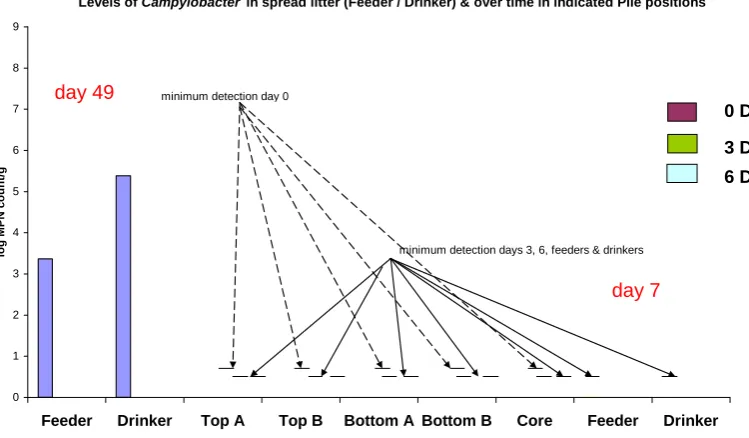
Figures 2.10 and 2.11 illustrate the die-off of Campylobacter over two sequential litter cycles. Campylobacter was present in the litter prior to final bird pick up in both cycles with the levels reaching 106 MPN/g (much higher than the Salmonella levels reported above). However, Campylobacter was not detected at any time point in any pile position in both litter cycles 1 and 2. For both cycles, the spread litter was negative for Campylobacter – even the sample collected after entry of chickens onto the litter.
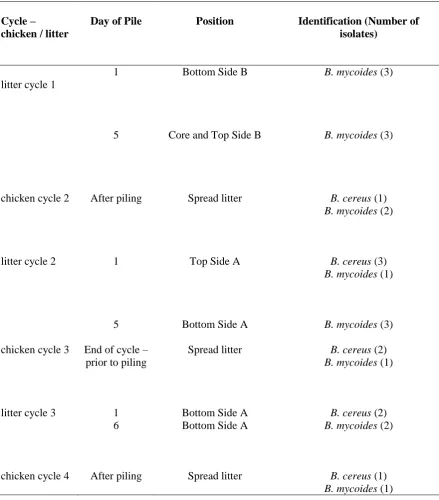
Bacillus die-off in piles through cycles 1 and 2 – Donnybrook
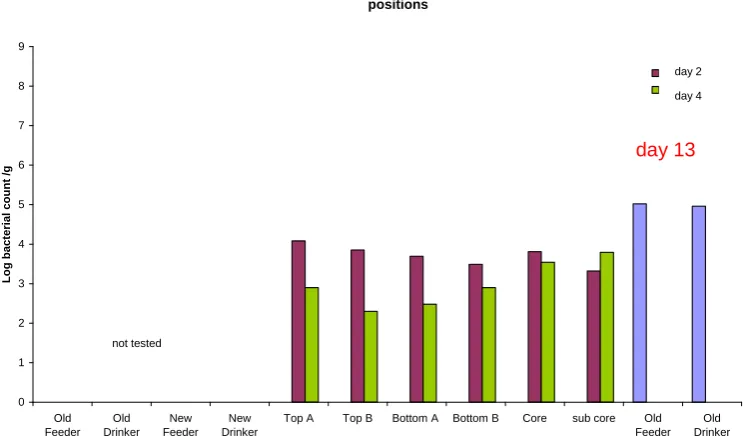
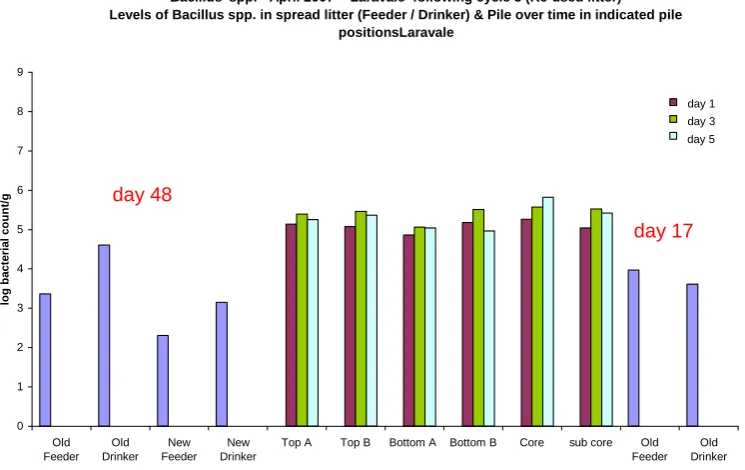
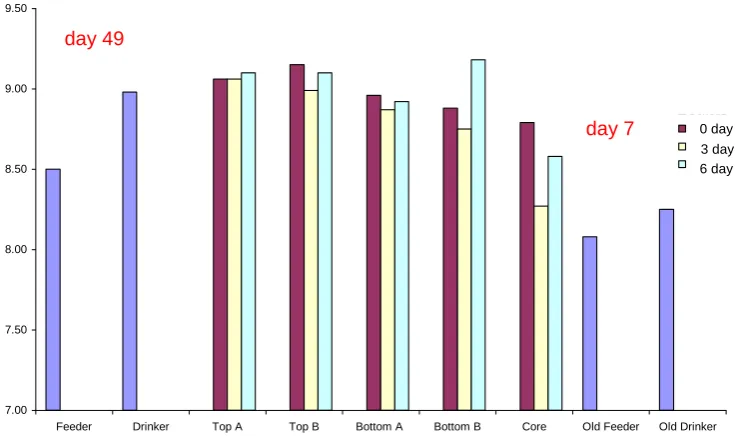
Figure 2.6 E. coli levels in litter at feeder and drinker (before and after litter piling) and in different positions in the litter pile over time (Donnybrook, litter cycle 1, October 2006). Chicken age when the litter was collected is shown in red font. There are three sampling days per pile position (with an absence of a bar indicating a level below the indicated detection level).
Donnybrook - October 2006 following cycle 1 (New Litter)
Levels of E. coli in spread litter (Feeder / Drinker) & over time in indicated Pile positions
0 1 2 3 4 5 6 7 8 9
Feeder Drinker Top A Top B Bottom A Bottom B Core drinker - after pile
feeder - after pile L o g bact er ial cou n t /g Series1 Series2 Series3 Series4 Series5 day 1 day 3 day 6 below detection limit
day 1, drinker /feeder
below detection limit day 3
below detection limit day 6
Figure 2.7 E. coli levels in litter at feeder and drinker (before and after litter piling) and in
different positions in the litter pile over time (Donnybrook, litter cycle 2 January 2007). Chicken age when the litter was collected is shown in red font. There are three sampling days per pile position (with an absence of a bar indicating a level below the indicated detection level).
Donnybrook - January 2007 following cycle 2 (re-used litter)
Levels of E. coli in spread litter (Feeder / Drinker) & Pile over time in indicated pile positions
0 1 2 3 4 5 6 7 8 9
old drinker old feeder new drinker new feeder Top A Top B Bottom A Bottom B Core drinker - feeder
-L o g b a c te ri a l c o u n t /g Series1 Series2 Series3 Series4 day 1 day 3 day 5 minimum detectionday, 3 & 5
day 17 day 52
day 2
Figure 2.8 Salmonella levels in litter at feeder and drinker (before and after litter piling) and in