1
Differences in the Bacteriome of Smokeless Tobacco Products with
Different Oral Carcinogenicity: Compositional and Predicted
Functional Analysis
Nezar Noor Al-hebshi 1,2,*, Fahd Ali Alharbi 3, Mohammed Mahri 4 and Tsute Chen 5
1 Department of Preventive Dentistry, College of Dentistry, Jazan University, 45142 Jazan,
Saudi Arabia
2 Kornberg School of Dentistry, Temple University, 3223 N Board Street, Philadelphia,
PA 19140, USA
3 Otolaryngology – Head and Neck Surgery Department, Faculty of Medicine, Jazan University,
45142 Jazan, Saudi Arabia; [email protected]
4 Department of Maxillofacial Surgery and Diagnostic Sciences, College of Dentistry, Jazan
University, 45142 Jazan, Saudi Arabia; [email protected]
5 Department of Microbiology, Forsyth Institute, Cambridge, MA 02142, USA; [email protected]
*Corresponding authors:
• Nezar Noor Al-hebshi, Kornberg School of Dentistry, Temple University, 3223 N Board Street, Philadelphia, PA 19140, USA. Email: [email protected]
2
Abstract
Smokeless tobacco (ST) products vary significantly in their oral carcinogenicity. Much is known
about the differences in chemical, but not bacterial, constituents of these products. In this study, we
explore the composition and function of the bacteriome in ST products from 4 countries using
q-PCR and 16S rRNA-based next generation sequencing. Thebacterial load (16S rRNA copies/gram)
was lowest in Swedish snus (3.4E+6) and highest in Yemeni shammah (6.6E+11). A total of 491
species-level taxa, many of which are potentially novel, belonging to 178 genera and 11 phyla were
identified. Species richness and diversity were highest for Swedish snus and lowest for Yemeni
shammah.Bacillus, Paenibacillus, and Oceanobacillus spp. were the most abundant in American
snuff; species of Pseudomonas, Massilia, Propionibacterium, Puniceispirillum and Gloeothece
predominated in Swedish snus. In Sudanese toombak, Facklamia, Desemzia, Atopostipes and
Lysinibacillus spp. accounted for the majority of the bacteriome. Yemeni shammah exclusively
contained Bacillus spp. PICRUSt functional prediction showed that genes encoding cadmium/zinc
and nickel transport systems were enriched in the presumptively “high carcinogenicity” products.
The bacteriome of ST products thus differed qualitatively, quantitatively and functionally. The
relevance of these differences, particularly with respect to nickel and cadmium, to oral
carcinogenesis warrants further investigation.
3
Introduction
Smokeless tobacco (ST) refers to forms of tobacco products that are used without burning. They are
usually chewed, sucked or applied to the gingiva, while fine-powdered products are sometimes sniffed
through the nose. ST is available in many forms that are used by populations across the five continents.
According to the International Agency for Research on Cancer (IARC) Working Group on the
Evaluation of Carcinogenic Risks to Humans, there is sufficient evidence to support carcinogenicity of
ST in humans and to consider it as a cause of cancers of the oral cavity, esophagus and pancreas [1].
This position, however, is not unanimous since different ST tobacco products seem to significantly
vary with respect to their carcinogenicity. For example, overall evidence strongly indicates that use of
Swedish snus poses a very small risk of oral cancer development and that use of American chewing
tobacco and moist snuff are associated with a very low risk [2-4]. On the contrary, strong association
has been reported from other parts of the world between oral cancers and use of certain types of ST,
including toombak and saffa in Sudan [5-7], shammah in Yemen and the South of Saudi Arabia [8-10],
and almost all forms of chewing tobacco in India [11,12]. This variation in carcinogenicity of ST
products has been mainly attributed to differences in the concentrations of carcinogenic chemicals
primarily tobacco-specific N-nitrosamines (TSNAs). Swedish snus and contemporary Americans
products, for example, have much lower concentrations of TSNAs and other carcinogens compared to
Sudanese toombak and Indian products [1].
What has not been explored adequately, while believed to have an important role in and accounts for
differences in the carcinogenicity of ST products, is their microbial content. Bacteria associated with
tobacco are known to reduce nitrate into nitrite, which in turn, reacts with tobacco alkaloids to form
4
recovered from chewing tobacco have been shown to experimentally induce exudation from oral
mucosa [14] suggesting that bacteria in ST products may also directly contribute to development of
oral cancer by inducing chronic inflammation [15]. However, literature on the microbiology of ST
products is sparse. Early reports, mostly by investigators of the tobacco industry, performed
identification and quantification of bacteria and fungi in fresh and processed tobacco, using
cultivation-based methods [15]. Recently, 16S rRNA-cultivation-based techniques including random fragment length
polymorphism (RFLP), denaturing gradient gel electrophoresis (DGGE), single strand conformation
polymorphism (SSCP) and sequencing have been used to characterize bacterial communities in fresh
and cured tobacco leaves as well as those associated with tobacco fermentation process [16-20]. These
studies revealed great deal of diversity and differences in the composition of microbiota associated with
the different forms of tobacco. One of them also demonstrated a correlation between the microbial
composition of tobacco and its content of TSNAs [20].
Cultivation-independent assessment of bacterial constituents of ready-to use ST products is limited to
one very recent study in which next generation sequencing (NGS) with Ion Torrent PGM’s chemistry
was employed to profile bacteria in American moist and dry snuff products as well as Sudanese
toombak [21]. Samples of Swedish snus were initially also included; however, amplifiable amounts of
DNA could not be recovered from them in that particular study. In addition, the V4 hypervariable
region alone was targeted by sequencing which, along with nature of the analysis pipeline used (OTU
calling with QIIME using Greengenes 13_5 sequences and taxonomy as reference) , hindered
taxonomic classification beyond the family level [22]. In the current study, we characterize the species
composition and predict the functional attributes of the bacterial community in ST products with
different carcinogenicity, namely samples of American moist snuff, Swedish snus, Sudanese toombak
5
Materials and methods
ST products – DNA extraction
Eleven, ready-to-use ST products were included in the study as follows: four brands of American moist
snuff (coded as A1-A4), 3 brands of Swedish snus (coded as S1-S3), a sample of Sudanese toombak
(SuT) and samples of 3 types of Yemeni shammah, namely black, yellow and green shammah (BS, YS
and GS, respectively). The American and Swedish products were bought from tobacco shops in New
York, USA, and Bergen, Norway, respectively. The Sudanese toombak and Yemeni shammah were
obtained from the local market in Khartoum, Sudan, and Gizan, Saudi Arabia, respectively. The
samples were stored at room temperature and DNA extraction was performed within 3 months of
purchase, and, in the case of American and Swedish product, before the expiration dates
A half gram of each product was suspended by vortexing for 10 seconds at full speed (3,300 rpm) in 2
ml TE buffer to recover bacterial cells and then briefly spun at 200 g to precipitate solid matter.
Five-hundred microliters of the resultant supernatant, as well as of a negative extraction control, were used
for DNA extraction, which involved an initial bead beating step followed by automated extraction on
a Maxwell® 16 Research Instrument (Promega, USA) using the Maxwell 16 Tissue DNA Kit
(Promega, USA) according to the manufacturer’s instructions. DNA concentration was measured using
a Qubit assay (Life Technologies, USA).
Determination of bacterial load
A quantitative polymerase chain reaction (qPCR) assay was performed to determine bacterial load in
the extracts. Each reaction was set up to include 5 µl 2X SYBR Green/AmpliTaq Gold DNA
Polymerase mix (Life Technologies, Applied Biosystems), 4 µl DNA template (or negative extraction
6
µM). For each sample, three dilutions were run in triplicate. To control for inhibition, another set of
reactions spiked with E. coli DH10B genomic DNA was run in parallel using the E. coli-specific, rpsL
primer set [23] (0.2 µM). A standard curve was generated by running 10-fold serial dilutions of E. coli
DH10B genomic DNA. Amplification was carried on a ViiA7 platform (Applied Biosystems, USA)
including an initial enzyme activation cycle at 95°C for of 10 min followed by 40 cycles of denaturation
at 95°C for 15 s, annealing at 55°C for 20 s and extension at 72°C for 30 s. The cycle threshold (Ct)
values were recorded and analyzed using ViiA7 v1.2 software. Bacterial load was calculated as 16S
rRNA gene copies per 1 gm tobacco sample.
Amplicon library preparation and sequencing
Library preparation and sequencingwere done at the Australian Centre for Ecogenomics according to
the workflow outlined by Illumina (manual 15044223 Rev. B;
http://support.illumina.com/content/dam/illumina-
support/documents/documentation/chemistry_documentation/16s/16s-metagenomic-library-prep-guide-15044223-b.pdf) with the exception of replacing the polymerase specified with the Q5 Hot Start
High-Fidelity 2X MasterMix (New England Biolabs, USA). Briefly, the degenerate primers 27FYM
(AGAGTTTGATYMTGGCTCAG) [24] and 519R (GWATTACCGCGGCKGCTG) [25], modified to
contain Illumina’s specific adapter sequences 803F and 1392wR, were used to amplify the V1-3 region
of the 16S rRNA gene using standard PCR conditions. The resultant PCR amplicons (~ 520 bp) were
then purified (Agencourt AMPure XP beads, Beckman Coulter, USA), indexed with unique 8-base
barcodes (Nextera XT v2 Index Kit sets A-D, Illumina, USA) and pooled together in equimolar
concentrations. A set of negative amplification controls (mastermix alone and with other reaction
components) were included for both the amplicon production and indexing reactions. Finally,
7
2x300 bp chemistry on a MiSeq platform (Illumina, USA) according to the manufacturer’s protocol
(targeted depth of 100,000 reads pre sample).
Preprocessing of sequencing data
The raw data were submitted to Sequence Reads Archive (SRA) under project no PRJNA339213.
Reads with mismatches in the primer sequences were filtered out before the latter were trimmed off.
The software PEAR [26] was then employed to stitch paired sequences using the following parameters:
minimum amplicon length=432 bp; maximum amplicon lengths= 522 bp; and P-value=0.001 (a lower
P-value reduces false positive rates but decreases read merging rates; program default is 0.01). The
merged reads were subsequently preprocessed using the mothur software package version 1.38.1 [27].
Firstly, to stringently minimize sequencing errors, reads with ambiguous bases, with homopolymers >
8 bases long or that did not achieve a sliding 50-nucleotide Q-score average of ≥35 were filtered out.
Secondly, the high quality reads were aligned using Needleman’s method to SILVA reference
alignment [28], and those with bad alignment (reads with start and end positions different than those of
the majority of the reads) were removed. Finally, the remaining reads were cleared of chimeras with
Uchime [29] using the self-reference approach, in which each read is checked against reads with higher
abundance in the same sample [30]
Taxonomy assignment algorithm
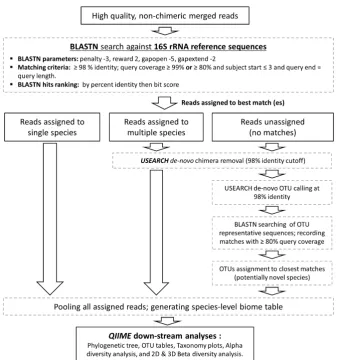
The high quality, non-chimeric reads were classified to the species level employing the BLASTN-based
algorithm illustrated in Figure 1. Briefly, reads were individually BLASTN-searched against NCBI’s
Microbial 16S rRNA gene reference sequence set
(ftp://ftp.ncbi.nlm.nih.gov/blast/db/16SMicrobial.tar.gz) supplemented with a modified version of the
8
version 14.5 (http://homd.org/index.php?name=seqDownload&file&type=R). These combined contain
22,002 well-curated, near full-length reference sequences representing a total of 13,164 microbial
species. NCBI’s BLAST version 2.2.28+ was run using the parameters and matching criteria shown in
Figure 1, ranking hits by percent identity and, when equal, by bit score. Reads were then classified to
the species level based on taxonomy of the top hit reference sequence. If a read returned top hits
representing multiple species (two in most cases), it was subject to secondary de novo chimera checking
with USEARCH program version v8.1.1861 [32] using a percent identity cutoff of 98% and if found
to be non-chimeric, was considered valid and assigned a multiple-species taxonomy. Reads with no
matches at the specified criteria were pooled together and subject to the de novo chimera checking as
above, and then to species-level de novo operational taxonomy unit (OTU) calling at 98% identity
cutoff using USEARCH. The resultant OTUs were labelled as potentially novel species and a
representative read from each was BLASTN-searched against the same reference sequence set again to
determine the closest species for taxonomy assignment.
Down-stream BIOM analysis
All assigned reads (unique species, multispecies and potentially novel species) were used to generate
species-level BIOM (Biological Observation Matrix) table for down-stream analysis with QIIME
(Quantitative Insights Into Microbial Ecology) software package version 1.9.1 [33]. The full BIOM
table was used to generate taxonomy plots from the species to kingdom level. The samples were then
randomly subsampled to obtain equal number of reads across samples, based on the sample with lowest
read count (rarefaction). The rarefied BIOM table was subsequently used to calculate species richness
and a range of alpha and beta diversity indices. The phylogenetic tree required for constructing the
UniFrac-based matrices used in some of the beta diversity analyses, was built dynamically from
9 Figure 1.Reads taxonomy assignment. A BLASTN-based algorithm used to classify the reads to the species level, and perform down-stream BIOM analysis.
Imputed functional predictions
Mothur was employed to reclassify the sequences using Wang’s method [34] and Greengenes 97%
OTUs (version 13.5) as reference; assign them to OTUs based on their taxonomy and generate a BIOM
(Biological Observation Matrix) table. Subsequently, PICRUSt (phylogenetic investigation of
communities by reconstruction of unobserved states) [35] was used to normalize the OTU table for 16S
rRNA copy number variations and then impute the functional bacterial content of each of the samples
based on KEGG orthologs (KO) and pathways. Based on evidence from the literature on their oral
10
while the Yemeni and Sudanese as “high carcinogenicity”. Differences in genes and pathways between
the two groups were explored using Linear discriminant analysis Effect Size (LEfSe) [36].
Results
Bacterial load of the ST products
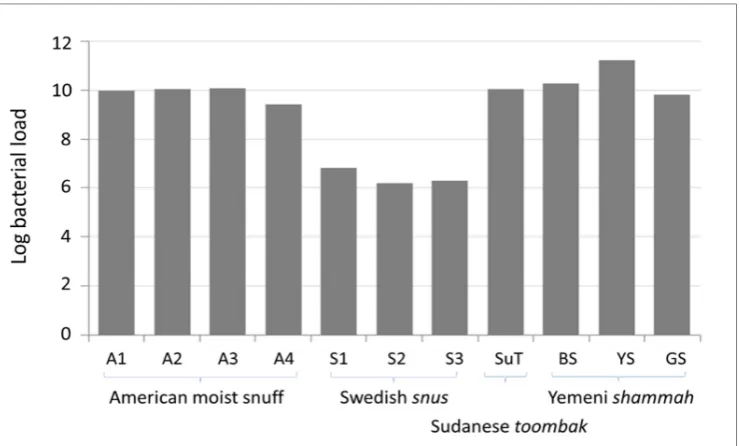
The log10-transformed, absolute bacterial 16S rRNA gene copy counts in each of the samples are
presented in Figure 2. The American, Sudanese and Yemeni samples, except YS, had comparable
bacterial load at around 1010 gene copies per gram. The load was higher by one log in YS (1.7E+11)
and lower by 4 logs in Swedish snus (3.4E+6). No amplification was observed for the negative
extraction control.
Figure 2. Bacterial load of the ST products expressed as log10-transformed 16S rRNA gene counts
per gram. Quantification was performed using q-PCR in triplicate.
Sequencing and data processing statistics
A total of 1,142,994 raw paired reads were obtained; the negative PCR controls did not generate any
11
Around 97% of the remaining reads could be successfully stitched with PEAR. At the stringent quality
filtration step, 93% of the merged reads were removed. Subsequent alignment and chimera check
removed a further 1.3%, leaving a final of 54, 970 high-quality, non-chimeric merged reads with an
average length of 489 bp. Applying the same read merging and quality-filtration algorithm to data
obtained from a mock community in a previous study [37] resulted in 10 fold reduction in sequencing
error rate (data not shown).
During the taxonomy assignment stage, 2,044 reads were identified as chimeras; the rest were
successfully classified to the species level. The final read count per sample ranged from 2265 for SuT
to 7955 for S2 (mean of 4811±1738 reads per sample). The results presented below were obtained
using a minimum read count per species (MC) of one. Results for higher MC cutoffs (2, 5, 10, 50 and
100) can be found at
(ftp://bioinformatics.forsyth.org/users/hidden_nezar/qiime_results_20160624/index.html).
Species richness, diversity and coverage
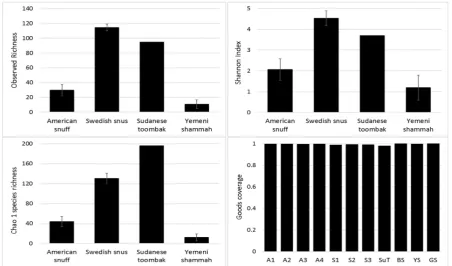
The observed and expected number of species (Chao1), Shannon index (α-diversity) and Good’s
coverage, calculated by rarefactionbased on the sample with lowest read count (2265 reads) are
presented in Figure 3. The observed species richness and diversity were highest for the Swedish snus
and lowest for the Yemeni Shammah. SuTshowed the highest expected number of species (Chao1)
but the lowest Good’s coverage, which is consistent with the rarefaction curves (Figure 4 A): by
extrapolation an additional 2,500 reads would have been required to obtain a coverage of 0.997 for
SuT. The result of principle component analysis (PCoA) based on weighted UniFrac is presented in
12
clustered with the Yemeni shammah, and the Swedish S1 that fell between the American and other
Swedish products. Grouping was found to be statistically significant by ANOSIM (P-value=0.01).
Figure 3. Species richness, α-diversity and coverage (mean ± SE) calculated by rarefaction analysis
13 Bacteriome identified in the ST products
A total of 11 phyla were identified in the samples as shown in Figure 5. The number of phyla per
sample ranged from 1 to 3 for the Yemeni samples, 3 to 5 for the American and Sudanese samples,
and 8 to 10 for the Swedish samples (Supplementary Table 1). Phylum Firmicutes accounted for >
99.7% of sequences in all American and Yemeni samples; it also predominated in SuT and S1.
Instead, Proteobacteria was the predominant phylum in S2 and S3, and accounted for a significant
proportion of the reads in S1. Actinobacteria was identified in all Swedish samples as well as in SuT.
S2 and S3 in addition contained considerable levels of Cyanobacteria, Bacteroidetes, Chloroflexi and
Fusobacteria.
Figure 5. Bacteriome of the ST products – phylum level. Stacked bars showing the relative abundance of bacterial phyla identified in each of the ST products.
The genus-level bacteriome of each of the ST samples is presented in Figure 6. A total of 178 genera
were identified, 36 of which were at relative abundance ≥ 1% (Supplementary Table 2). The
number of genera per sample ranged from 3 to 9 for the Yemeni shammah, 10 to 12 for the American
14
99% of the reads in the Yemeni varieties and American A1, and made up significant proportions in
A3, A4 and the Swedish S1. Paenibacillus was the predominant genus in A2, while Oceanobacillus
accounted for the majority of sequences in A3 and A4 as well as S1. The Swedish products S2 and S3
had a totally different profile with a mix of genera Massilia, Pseudomonas, Candidatus
Puniceispirillum, Gloeothece,Propionibacterium, Sphingonomas and Methylobacterium making up
the bulk of the bacteriome. SuT also had a unique composition with genera Desemzia, Atopostipes,
Facklamia, Lysinibacillus and Corynebacterium accounting for ~90% of the reads.
Fig 6. Bacteriome of the ST products – genus level. Stacked bars showing the relative abundance of bacterial genera identified in each of the ST products. Labels and names are shown for genera with relative abundance ≥ 3%.
Figure 7 illustrates the level bacteriome of each of the ST products. A total of 491
species-level taxa were identified, of which 66 had a relative abundance of ≥ 1% (Supplementary Table 3).
The number of species per sample ranged from 10 to 23 for the Yemeni shammah, 28 to 43 for the
American snuff, and 121 to 139 for the Swedish snus; 95 were detected in SuT. The most abundant
species in the American products were Bacillus safensis/pumilus (A1 and A3), Bacillus
15
Oceanobacillus profundus (A3 and A4). The predominant species in the Swedish varieties S2 and S3
were Pseudomonas aeruginosa, Massilia timonae, Propionibacterium acnes in addition to two
potentially novel species with no close relatives: the closest species were Puniceispirillum marinum
(90.85%) and Gloeothece membranacea (86.56%). S1 harbored a mixture of the species found in A4
and those identified in S2 and S3. In SuT, Facklamia tabacinasalis in addition to three potentially
novel species close to Desemzia incerta (96.59%), Atopostipes suicloacalis (96.98%), and
Lysinibacillus chungkukjangi (96.21%) accounted for the majority of the bacteriome. The
composition of the bacteriome varied significantly across the Yemeni samples. BS primarily
contained B. clausii and a novel species close to Bacillus persicus (96.8%), while YS harbored Bacillus
okhensis/wakoensis and two novel species close to Bacillus cellulosilyticus (97.6%) and Bacillus
alkalisediminis (97.59%). The latter novel species made the majority of the bacteriome of GS. To demonstrate
reproducibility of sequencing, we carried out comparison of bacterial species profile obtained from two
sequencing runs carried one year apart for 4 of the samples (see Supplementary Figure 1)
Figure 7. Bacteriome of the ST products – species level. Stacked bars showing the relative
16 Differentially enriched microbial genes and pathways
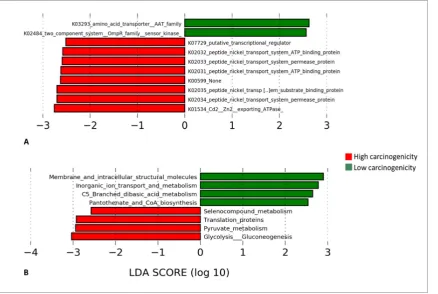
The microbial genes and pathways enriched in each of the two groups are presented in in Figure 8. At
the gene level, genes encoding cadmium/zinc transporting ATPase and peptide nickel transport system
permease and ATP binding proteins were enriched in the high carcinogenicity group while those
encrypting amino acid transporter AAT family and two-component system, OmpR family, sensor
kinase were overrepresented in the low carcinogenicity samples. At the pathway level, genes involved
in glycolysis/gluconeogenesis, pyruvate metabolism, translation and selenocompound metabolism
were significantly more abundant in the high carcinogenicity group, while those encoding membrane
and intracellular structural molecules and involved in inorganic iron transport and metabolism,
C5-branched dibasic acid metabolism and pantothenate and CoA biosynthesis were the most significantly
overrepresented in the low carcinogenicity products.
17
Discussion
The purpose of this study was to elucidate the differences in composition and function of the
bacteriome among ready-to-use ST products with different oral carcinogenicity. The ST products
were selected so as to include the most commonly consumed brands/types in each of the four
countries. In fact, this is the first study to perform microbial profiling of Swedish snus and Yemeni
shammah. One limitation, however, is that only one sample per product was examined, missing the
opportunity to assess variation in microbial composition across batches. Another limitation is that
there is a possibility that part of the microbiome in the samples was not captured because DNA
extraction was performed on a supernatant rather than the solid material; however, the idea was to
avoid high plant DNA background in the extracts. The SuT had lower coverage than other samples,
i.e. did not reach saturation, but was still included in the analysis.
By sequencing the V1-V3 region with Illumina’s 2x300 paired-end chemistry and merging the
resultant reads, relatively long reads (472-562 bp) where generated which improved taxonomic
resolution. Using a BLASTN-based algorithm inspired from previous work [31], we ventured to
classify the reads to the species level. Very stringent read quality-filtration was implemented which,
while negatively impacted on sequencing depth by eliminating the majority of reads (another study
limitation), ensured the lowest possible sequencing errors rate and in turn maximized reliability of
the species-level assignment. Nevertheless, the results of classification should be interpreted with
caution. The reference databases used comprise mainly 16S rRNA sequences of named species.
Therefore, a species to which a read is assigned may not necessarily be the same species from which
the read was obtained but the closest named species to it. Despite the limitation, this is probably
more informative than limiting classification to higher ranks. For comparison purposes, we in fact
18
database. The taxonomy assignments were almost identical at the phylum level and largely
comparable at genus level, although a significant proportion of the reads especially in SuT could not
be classified at genus level by the Bayesian classifier (data not shown).
As expected, the Swedish snus harbored far lower bacterial counts than the other products, which is
consistent with the fact that Swedish snus products are subject to pasteurization during their
manufacturing process, and also explains the low levels of TSNAs present in them [38]. Possibly, a
considerable proportion of the quantified DNA in the Swedish sample represented non-viable
bacteria. The Yemeni YS had the highest microbial load. The levels of TSNAs in Yemeni shammah
have not been yet established, but can be assumed to be high in view of the strong association
between shammah use and oral cancer [8,10]. The American, Sudanese and Yemeni products had
comparable bacterial loads. However, studies indicate that they significantly vary with respect to
their TSNA content [39]; SuT in particular has very high concentrations of TSNAs [40]. Obviously
then, the levels of TSNAs in ST products differ not only as function of total microbial load but
probably also as a function of microbial community composition. Indeed, a very recent study has
found the TSNA concentrations in tobacco leaves to correlate positively with the proportions of
Firmicutes and inversely with those of Proteobacteria [20]. Interestingly, Firmicutes was the
predominant phylum in the American, Sudanese and Yemeni products in this study, while
Proteobacteria was the major phylum in the Swedish products.
Tyx et al. [21] recently reported on the microbiology of American moist snuff and Sudanese
toombak using sequencing of the hypervariable region V4. Although description of the results was
limited to the family level, the supplementary material did provide genus-level information that can
19 Staphylococcus and an unclassified genus of the family Aerococcaceae were identified as the
predominant genera in the American moist snuff, which is markedly inconsistent with the current
study in which Paenibacillus, Oceanobacillus and Bacillus were the most abundant genera in the
corresponding samples. Desemzia, Facklamia, Lysinibacillus and Atopostipes, 4 out of the 5 most
abundant genera in SuT in the present study, were either not detected or detected at very low
abundance in their SuT samples, in which Corynebacterium, Staphylococcus and an unclassified
genus of the family Aerococcaceae made up the bulk of the microbiome instead. While these vast
differences in results between the two studies may be explained in part by methodological
variations, they probably reflect genuine differences in the microbial composition of samples used
in the two studies. Since the products were coded in both studies, it is very likely that the two
studies included different brands of American moist snuff. SuT is produced widely across Sudan in
non-standard production settings, so its microbiological composition can be expected to vary
significantly as a function of where and how it is produced. Obviously, a larger-scale study
including representative samples of each ST product would be necessary to resolve this question.
Despite having the lowest bacterial load, the Swedish snus displayed the highest diversity at all
taxonomic levels. With the exception of S1, which looked like a blend of A4 and S2/S3, the
Swedish products were almost free of the phylum Firmicutes; a significant proportion of the
sequences belonged to human-associated taxa, namely M.timonae,P. aeruginosa and P. acnes,
which probably represent contamination at a later stage of production. Interestingly, the presence of
genus Pseudomonas in tobacco has been shown very recently to inversely correlate with TNSAs
levels [20]. Novel, probably environmental, taxa also accounted for a considerable fraction of the
reads in the Swedish products. The Yemeni Shammah showed the lowest diversity, with almost all
20
SuT also represented novel species. Isolation and characterization of the novel species from Yemeni
shammah and SuT is, therefore, warranted, not only to ascertain their ability to accumulate nitrites,
but also to assess their direct effects on oral epithelium.
Differences in predicted functions between the presumptively low carcinogenicity and high
carcinogenicity products at the pathway level did not seem to be relevant to oral carcinogenesis.
However, the differences at the gene level did. Genes encoding cadmium/zinc and nickel transport
systems were enriched in the presumptively “high carcinogenicity” products, suggesting these heavy
metals are present at higher concentrations in them. Cadmium is considered as a carcinogen by the
International Association on Cancer Research (IACR) [41]. Interestingly, it is also present in ST
products [42], although its role in oral carcinogenicity has not been assessed. Nickel is linked in the
literature to nasal and lung cancers [43]; recently, it has also been implicated in oral cancer [44,45].
In addition, it has been detected in ST products [46]. Together, this suggests, keeping in mind this is
only based on predictive functional analysis, that cadmium and nickel may be important
carcinogens in Yemeni and Sudanese ST products.
A microbial community with high nitrate reducing but low nitrite reducing properties (incomplete
denitrification) is probably required to support formation of high levels of TSNAs in tobacco [13].
Predictive metagemonic analysis (PICRUSt), however, did not show a significant difference in
abundance of nitrate or nitrite reductase genes between the low and high carcinogenicity product
groups, although, the formate- dependent and NO forming nitrite reductase genes tended to be
enriched in the Swedish snus samples (data not shown). In fact, production of TSNA is not only
dependent on ability of bacteria to accumulate nitrites but also on environmental factors e.g.
21
TSNA levels were not directly measured in the samples included in this study, the attempts made
here to correlate between the bacterial composition and the assumed TSNA concentrations based on
the literature are at best speculative.
Conclusions
The current study demonstrates that ST products differ qualitatively, quantitatively and functionally
in their bacterial composition. However, a larger scale study involving more representative samples
of each type is required to uncover the full breadth of microbial diversity across theseproducts. The
high taxonomic resolution used here helped identify the reads to the closest species; several
potentially novel species were identified. The possibility that some of these species contribute to
oral carcinogenesis, either via influencing levels of TSNAs or directly inducing chronic
inflammation, warrants further investigation. Imputed functional prediction did not demonstrate a
difference in potential for TSNA production between low and high carcinogenicity products;
however, it did suggest that the presumptively high carcinogenicity products have higher
concentrations of nickel and cadmium; this needs to be confirmed using whole metagenome
sequencing as well as chemical analysis.
Supplementary material
Supplementary Table 1. List of all phyla identified and their abundance in each of the ST products.
Supplementary Table 2. List of all genera identified and their abundance in each of the ST products.
Supplementary Table 3. List of all species-level taxa identified and their abundance in each of the
22 Supplementary Figure 1. Reproducibility of sequencing. Comparison of results from two
sequencing runs, one year apart, for 4 of the ST products.
Acknowledgments
The study was funded by Deanship of Scientific Research at Jazan University, Saudi Arabia (grant
#1434-M5-27). We would like to thank Mr. Fuad Alnajjar, Dr. Niyaz Al-hemiari and Prof. Asaad
Khalid for their help with obtaining the American moist snuff, Swedish snus and Sudanese toombak
samples, respectively. We are also thankful to Dr. Mona Abulfutooh for providing valuable
information about the ST industry in the world. We thank Professor Emeritus Newell Johnson for
facilitating arrangements with the Australian Centre for Ecogenomics and for critical reading of the
manuscript.
Authors' contributions
Nezar Al-hebshi conceived the study, arranged for sequencing of the samples, performed the
bioinformatic preprocessing of the raw data, contributed to the development of the classification
algorithm and wrote the first draft of the manuscript. Tsute Chen developed the bioinformatic analysis
pipeline. Fahd Alharbi and Mohammed Mahri contributed to the study design, collection of tobacco
samples and overall supervision of the research project. All authors approved the final version of the
manuscript.
Conflict of interests
23
References
1. IARC Working Group on the Evaluation of Carcinogenic Risks to Humans; International Agency for Research on Cancer. Smokeless tobacco and some tobacco-specific n-nitrosamines. In A review of human carcinogens: Personal habits and indoor combustions, volume 100 e, World Health Organization; distributed by WHO Press: Lyon, France; Geneva, 2012; Vol. E100, pp 267-321. 2. Lee, P.N.; Hamling, J. Systematic review of the relation between smokeless tobacco and cancer in
europe and north america. BMC Med 2009, 7, 36.
3. Rodu, B.; Jansson, C. Smokeless tobacco and oral cancer: A review of the risks and determinants. Crit Rev Oral Biol Med 2004, 15, 252-263.
4. Weitkunat, R.; Sanders, E.; Lee, P.N. Meta-analysis of the relation between european and american smokeless tobacco and oral cancer. BMC Public Health 2007, 7, 334.
5. Elbeshir, E.I.; Abeen, H.A.; Idris, A.M.; Abbas, K. Snuff dipping and oral cancer in sudan: A retrospective study. Br J Oral Maxillofac Surg 1989, 27, 243-248.
6. Idris, A.M.; Ahmed, H.M.; Malik, M.O. Toombak dipping and cancer of the oral cavity in the sudan: A case-control study. Int J Cancer 1995, 63, 477-480.
7. Idris, A.M.; Ahmed, H.M.; Mukhtar, B.I.; Gadir, A.F.; el-Beshir, E.I. Descriptive epidemiology of oral neoplasms in sudan 1970-1985 and the role of toombak. Int J Cancer 1995, 61, 155-158.
8. Allard, W.F.; DeVol, E.B.; Te, O.B. Smokeless tobacco (shamma) and oral cancer in saudi arabia. Community Dent Oral Epidemiol 1999, 27, 398-405.
9. Scheifele, C.; Nassar, A.; Reichart, P.A. Prevalence of oral cancer and potentially malignant lesions among shammah users in yemen. Oral Oncol 2007, 43, 42-50.
10. Nasher, A.T.; Al-Hebshi, N.N.; Al-Moayad, E.E.; Suleiman, A.M. Viral infection and oral habits as risk factors for oral squamous cell carcinoma in yemen: A case-control study. Oral Surg Oral Med Oral Pathol Oral Radiol 2014, 118, 566-572 e561.
11. Muwonge, R.; Ramadas, K.; Sankila, R.; Thara, S.; Thomas, G.; Vinoda, J.; Sankaranarayanan, R. Role of tobacco smoking, chewing and alcohol drinking in the risk of oral cancer in trivandrum, india: A nested case-control design using incident cancer cases. Oral Oncol 2008, 44, 446-454.
12. Znaor, A.; Brennan, P.; Gajalakshmi, V.; Mathew, A.; Shanta, V.; Varghese, C.; Boffetta, P.
Independent and combined effects of tobacco smoking, chewing and alcohol drinking on the risk of oral, pharyngeal and esophageal cancers in indian men. Int J Cancer 2003, 105, 681-686.
13. Wei, X.; Deng, X.; Cai, D.; Ji, Z.; Wang, C.; Yu, J.; Li, J.; Chen, S. Decreased tobacco-specific nitrosamines by microbial treatment with bacillus amyloliquefaciens da9 during the air-curing process of burley tobacco. Journal of agricultural and food chemistry 2014, 62, 12701-12706. 14. Rubinstein, I.; Pedersen, G.W. Bacillus species are present in chewing tobacco sold in the united
states and evoke plasma exudation from the oral mucosa. Clin Diagn Lab Immunol 2002, 9, 1057-1060.
15. Pauly, J.L.; Paszkiewicz, G. Cigarette smoke, bacteria, mold, microbial toxins, and chronic lung inflammation. J Oncol 2011, 2011, 819129.
16. Huang, J.; Yang, J.; Duan, Y.; Gu, W.; Gong, X.; Zhe, W.; Su, C.; Zhang, K.Q. Bacterial diversities on unaged and aging flue-cured tobacco leaves estimated by 16s rrna sequence analysis. Appl Microbiol Biotechnol 2010, 88, 553-562.
17. Zhao, M.; Wang, B.; Li, F.; Qiu, L.; Wang, S.; Cui, J. Analysis of bacterial communities on aging flue-cured tobacco leaves by 16s rdna pcr-dgge technology. Appl Microbiol Biotechnol 2007, 73, 1435-1440.
24 19. Su, C.; Gu, W.; Zhe, W.; Zhang, K.Q.; Duan, Y.; Yang, J. Diversity and phylogeny of bacteria on
zimbabwe tobacco leaves estimated by 16s rrna sequence analysis. Appl Microbiol Biotechnol 2011, 92, 1033-1044.
20. Law, A.D.; Fisher, C.; Jack, A.; Moe, L.A. Tobacco, microbes, and carcinogens: Correlation between tobacco cure conditions, tobacco-specific nitrosamine content, and cured leaf microbial community. Microb Ecol 2016, 72, 120-129.
21. Tyx, R.E.; Stanfill, S.B.; Keong, L.M.; Rivera, A.J.; Satten, G.A.; Watson, C.H. Characterization of bacterial communities in selected smokeless tobacco products using 16s rdna analysis. PLoS One 2016, 11, e0146939.
22. Mizrahi-Man, O.; Davenport, E.R.; Gilad, Y. Taxonomic classification of bacterial 16s rrna genes using short sequencing reads: Evaluation of effective study designs. PLoS One 2013, 8, e53608.
23. Vanwonterghem, I.; Jensen, P.D.; Dennis, P.G.; Hugenholtz, P.; Rabaey, K.; Tyson, G.W. Deterministic processes guide long-term synchronised population dynamics in replicate anaerobic digesters. ISME J 2014, 8, 2015-2028.
24. Frank, J.A.; Reich, C.I.; Sharma, S.; Weisbaum, J.S.; Wilson, B.A.; Olsen, G.J. Critical evaluation of two primers commonly used for amplification of bacterial 16s rrna genes. Appl Environ Microbiol 2008, 74, 2461-2470.
25. Lane, D.J.; Pace, B.; Olsen, G.J.; Stahl, D.A.; Sogin, M.L.; Pace, N.R. Rapid determination of 16s ribosomal rna sequences for phylogenetic analyses. Proc Natl Acad Sci U S A 1985, 82, 6955-6959. 26. Zhang, J.; Kobert, K.; Flouri, T.; Stamatakis, A. Pear: A fast and accurate illumina paired-end read
merger. Bioinformatics 2014, 30, 614-620.
27. Schloss, P.D.; Westcott, S.L.; Ryabin, T.; Hall, J.R.; Hartmann, M.; Hollister, E.B.; Lesniewski, R.A.; Oakley, B.B.; Parks, D.H.; Robinson, C.J., et al. Introducing mothur: Open-source,
platform-independent, community-supported software for describing and comparing microbial communities. Appl Environ Microbiol 2009, 75, 7537-7541.
28. Pruesse, E.; Quast, C.; Knittel, K.; Fuchs, B.M.; Ludwig, W.; Peplies, J.; Glockner, F.O. Silva: A comprehensive online resource for quality checked and aligned ribosomal rna sequence data compatible with arb. Nucleic Acids Res 2007, 35, 7188-7196.
29. Edgar, R.C.; Haas, B.J.; Clemente, J.C.; Quince, C.; Knight, R. Uchime improves sensitivity and speed of chimera detection. Bioinformatics 2011, 27, 2194-2200.
30. Schloss, P.D.; Gevers, D.; Westcott, S.L. Reducing the effects of pcr amplification and sequencing artifacts on 16s rrna-based studies. PLoS One 2011, 6, e27310.
31. Al-Hebshi, N.N.; Nasher, A.T.; Idris, A.M.; Chen, T. Robust species taxonomy assignment algorithm for 16s rrna ngs reads: Application to oral carcinoma samples. J Oral Microbiol 2015, 7, 28934.
32. Edgar, R.C. Search and clustering orders of magnitude faster than blast. Bioinformatics 2010, 26, 2460-2461.
33. Caporaso, J.G.; Kuczynski, J.; Stombaugh, J.; Bittinger, K.; Bushman, F.D.; Costello, E.K.; Fierer, N.; Pena, A.G.; Goodrich, J.K.; Gordon, J.I., et al. Qiime allows analysis of high-throughput community sequencing data. Nature methods 2010, 7, 335-336.
34. Wang, Q.; Garrity, G.M.; Tiedje, J.M.; Cole, J.R. Naive bayesian classifier for rapid assignment of rrna sequences into the new bacterial taxonomy. Appl Environ Microbiol 2007, 73, 5261-5267.
35. Langille, M.G.; Zaneveld, J.; Caporaso, J.G.; McDonald, D.; Knights, D.; Reyes, J.A.; Clemente, J.C.; Burkepile, D.E.; Vega Thurber, R.L.; Knight, R., et al. Predictive functional profiling of microbial communities using 16s rrna marker gene sequences. Nat Biotechnol 2013, 31, 814-821. 36. Segata, N.; Izard, J.; Waldron, L.; Gevers, D.; Miropolsky, L.; Garrett, W.S.; Huttenhower, C.
25 37. Kozich, J.J.; Westcott, S.L.; Baxter, N.T.; Highlander, S.K.; Schloss, P.D. Development of a dual-index
sequencing strategy and curation pipeline for analyzing amplicon sequence data on the miseq illumina sequencing platform. Appl Environ Microbiol 2013, 79, 5112-5120.
38. Stepanov, I.; Jensen, J.; Hatsukami, D.; Hecht, S.S. New and traditional smokeless tobacco: Comparison of toxicant and carcinogen levels. Nicotine Tob Res 2008, 10, 1773-1782.
39. Hatsukami, D.K.; Ebbert, J.O.; Feuer, R.M.; Stepanov, I.; Hecht, S.S. Changing smokeless tobacco products new tobacco-delivery systems. American journal of preventive medicine 2007, 33, S368-378. 40. Idris, A.M.; Nair, J.; Ohshima, H.; Friesen, M.; Brouet, I.; Faustman, E.M.; Bartsch, H. Unusually high
levels of carcinogenic tobacco-specific nitrosamines in sudan snuff (toombak). Carcinogenesis 1991, 12, 1115-1118.
41. IARC Working Group on the Evaluation of Carcinogenic Risks to Humans; International Agency for Research on Cancer. Cadmium and cadmium compounds. In A review of human carcinogens: Arsenic, metals, fibres and dusts, volume 100 c, World Health Organization; distributed by WHO Press: Lyon, France; Geneva, 2012; Vol. 100 C, pp 121-141.
42. Janbaz, K.H.; Qadir, M.I.; Basser, H.T.; Bokhari, T.H.; Ahmad, B. Risk for oral cancer from smokeless tobacco. Contemp Oncol (Pozn) 2014, 18, 160-164.
43. Grimsrud, T.K.; Peto, J. Persisting risk of nickel related lung cancer and nasal cancer among clydach refiners. Occup Environ Med 2006, 63, 365-366.
44. Su, C.C.; Lin, Y.Y.; Chang, T.K.; Chiang, C.T.; Chung, J.A.; Hsu, Y.Y.; Lian Ie, B. Incidence of oral cancer in relation to nickel and arsenic concentrations in farm soils of patients' residential areas in taiwan. BMC Public Health 2010, 10, 67.
45. Yuan, T.H.; Lian Ie, B.; Tsai, K.Y.; Chang, T.K.; Chiang, C.T.; Su, C.C.; Hwang, Y.H. Possible association between nickel and chromium and oral cancer: A case-control study in central taiwan. Sci Total Environ 2011, 409, 1046-1052.
46. Arain, S.S.; Kazi, T.G.; Afridi, H.I.; Talpur, F.N.; Kazi, A.G.; Brahman, K.D.; Naeemullah; Arain, M.S.; Sahito, O.M. Estimation of nickel in different smokeless tobacco products and their impact on human health of oral cancer patients. Nutr Cancer 2015, 67, 1063-1074.
47. Andersen, R.A.; Burton, H.R.; Fleming, P.D.; Hamilton-Kemp, T.R. Effect of storage conditions on nitrosated, acylated, and oxidized pyridine alkaloid derivatives in smokeless tobacco products. Cancer Res 1989, 49, 5895-5900.