RVC OPEN ACCESS REPOSITORY – COPYRIGHT NOTICE
This author’s accepted manuscript may be used for non-commercial purposes in accordance with Wiley Terms and Conditions for Self-Archiving.
The full details of the published version of the article are as follows:
TITLE: Population variability in animal health: Influence on dose‐exposure‐response relationships: Part II: Modelling and simulation
AUTHORS: Marilyn N. Martinez, Ronette Gehring, Jonathan P. Mochel, Devendra Pade, Ludovic Pelligand
JOURNAL: JOURNAL OF VETERINARY PHARMACOLOGY AND THERAPEUTICS PUBLISHER: Wiley
Population Variability in Animal Health: Influence on Dose-Exposure-Response Relationships: Part II: Modeling and Simulation
Marilyn N. Martinez* a, Center for Veterinary Medicine, US Food and Drug Administration, 7500 Standish Place, Rockville, MD 20855 [email protected]
Ronette Gehring, Professor, Utrecht University , Utrecht · Institute for Risk Assessment Sciences, The Netherlands, [email protected]
Jonathan P. Mochel, Iowa State University, College of Veterinary Medicine, Department of Biomedical Sciences, 50011-1250 Ames, IA, USA. [email protected]
Devendra Pade, Simcyp Limited (a Certara Company), Sheffield, United Kingdom [email protected]
Ludovic Pelligand, Associate Professor in Clinical Pharmacology and Anaesthesia, Dip. ECVAA, Dip. ECVPT, Department of Clinical Services and Sciences and Department of Comparative Biomedical Sciences, The Royal Veterinary College, Hatfield, UK
Abstract:
During the 2017 Biennial meeting, the American Academy of Veterinary Pharmacology and Therapeutics hosted a one-day session on the influence of population variability on dose-exposure-response relationships. In Part I, we highlighted some of the sources of population variability. Part II provides a summary of discussions on modeling and simulation tools that utilize existing pharmacokinetic data, can integrate drug physicochemical characteristics with species physiological characteristics and dosing information, or that combine observed with predicted and in vitro information to explore and describe sources of variability that may influence the safe and effective use of veterinary pharmaceuticals.
* Communicating author
a This article reflects the views of the author and should not be construed to represent
Modeling and Simulation to Accelerate Understanding Sources of Variability in Animal and Translational Health.
Introduction
Computational modeling and simulation (M&S) is rapidly increasing in its acceptance as an important tool for describing, predicting and understanding how chemicals interact with biological systems (Lin et al., 2016). It can facilitate our appreciation of the sources of pharmacokinetic (PK) variability in a population, be it due to endogenous (e.g., enzyme polymorphisms, gender, age) or exogenous (drug-drug interactions, nutrients, disease, stress) factors. When applied correctly, M&S can decrease the financial and societal costs of drug development by optimizing study designs and by reducing the size and numbers of in vivo studies, thus satisfying the principles of Replacement, Reduction and Refinement (the “3R’s). The availability of powerful desktop computers and user-friendly software have eliminated barriers to applying computational modeling in veterinary pharmacology and has shifted the challenge from one of software accessibility to that of its appropriate use.
Within the framework of the M&S arsenal, Monte Carlo simulations can be used to address uncertainties associated with interacting variables within real-life scenarios. Using repetitive random sampling from known distributions of model parameters, population dose-exposure characteristics can be generated. A well-known example of this application is the estimation of pharmacokinetic-pharmacodynamic (PK-PD) cutoff values when establishing
antimicrobial clinical breakpoints. For example, using the distribution of PK parameter values derived from population PK studies, a specified dosing regimen, and a PK-PD target, we can define the minimum inhibitory concentration (MIC) at which 90% of the treated patients will achieve that PK-PD target (Maaland et al, 2013). Alternatively, it can be used to estimate the doses needed to achieve some targeted therapeutic effect (Dorey et al., 2017; Rey et al., 2014).
Approaches to the development of models describing and predicting blood level profiles can be described as top-down, bottom-up, or middle-out (Jamei et al., 2009; Tsamandouras et al., 2015).
Top-down: The fitting of blood level profiles to mathematical equations that define pertinent PK parameters and describe the location (e.g., means and medians) and variability associated with these parameters. The variability is further modeled in an effort to explain the sources of this variability (population subgroupings). The explained sources of variability can then be separated from the unexplained (random) error. The top-down approach can be used to support individualized dosage adjustments or to predict the dose-exposure relationships that may be observed in individuals that are within the modeled subgroup. These models are often empirical in nature and lack interpretability in terms of specific mechanisms (Duwal and von Kleist, 2016). However, they satisfy the principles of parsimony (also known as ‘Ockham's Razor’) whereby the descriptive model is optimized with the fewest parameters.
Bottom-up: A systems approach integrating drug physicochemical characteristics, patient characteristics, drug PK (where volume of distribution and clearance can be specifically modeled in accordance with observed PK profile information), transporter function, and enzyme abundance and kinetics. The models are used to predict the distribution of blood level profiles likely to be observed across a patient population. These models are also invaluable for exploring “what if” scenarios, for identifying the rate limiting factors in drug absorption and clearance, predicting drug-drug interactions, for dosage regimen selection, and for predicting dose-exposure relationships in the presence of polymorphisms in enzyme or transporter functions (Darwich et al., 2017; Margolskee et al., 2017):
Depending upon the available information and the objective for employing this method, the bottom-up approach may be executed using either fully mechanistic or semi-mechanistic models:
Fully mechanistic model: PK predictions are generated by integrating the full PBPK
in vitro metabolism data. Since the resulting models do not rely on any in vivo data to arrive at the model input parameters, these are considered fully mechanistic models. However, purely mechanistic models are often difficult to establish due to information gaps present in the necessary in vitro metabolic data. For this reason, in vivo
clearance estimates (e.g., from published sources, potentially from a different population than that being modeled) are input into the model and a retrograde calculation used to derive an “in vitro intrinsic clearance”. That estimated value is used to generate the species-specific systemic clearance value using physiological scaling parameters to harness the inter-individual variability of that species (T’jollyn et al., 2015). Such models still qualify as being fully mechanistic because predictions reflect all identified sources of population variability.
Semi-mechanistic model: existing PK data such as volume of distribution and
clearance are set as the specified model parameter values. In this case, the opportunity to estimate the inter-individual variability is lost. However, a fully mechanistic approach can still be used to explore the process of oral drug absorption. Semi-mechanistic methods are often used when establishing in vivo/ in vitro
correlations, predicting formulation effects on drug bioavailability, or for formulation optimization.
Middle-out: This is a hybrid of bottom-up and top-down approaches where observed clinical data (‘top down’) are examined from the perspective of predictions derived through the use of mechanistic models (bottom-up). The resulting fitted output values are used to refine the PBPK model in accordance to the changes necessary to minimize the difference between observed and fitted values (Tsamandouras et al., 2015; Zhuang and Lu, 2016). While this approach to M&S can potentially be a powerful alternative to traditional compartmental or population-based modeling methods, it is important to recognize it also has a substantial risk of generating model parameter values that while providing a good fit to the observed data, may lack biological relevance (or may lack logical rationalization as to the fitting of that parameter). Therefore, investigators should use the middle-out approach with great caution, acknowledging the potential limitations in their data interpretation and in predictions
generated via model extrapolation.
Nonlinear mixed-effects (NLME) models
NLME modeling is typically a top-down approach that is used to describe the disposition kinetics of therapeutic drugs and to identify sources of population PK variability.
Prior to the 1970’s, population parameters were estimated by pooling the individual subject data into a single concentration-time profile, ignoring between-subject differences (referred to as ‘naïve pooling’). In subsequent years, the individual subject data were fitted separately and the average parameter values were determined. This method of data analysis is often referred to as a ‘two-stage approach’. Both naïve pooling and two stage approaches are subject to potential bias due to problems with dosing compliance or to missing data (Mould and Upton, 2012).
A major shift in population PK characterization occurred when NLME models integrated into the therapeutic drug monitoring of heart disease patients to optimize their digoxin dosing regimens (Sheiner et al., 1972). The authors proposed a quantitative approach for analyzing clinical sparse data, recognizing that the relationship between observed data and model parameters was non-linear.
When using naïve pooling or two stage methods, between-subject variability is perceived as ‘noise’ that should be overcome. Consequently, these approaches often lead to the use of complex study designs and restrictive inclusion criteria (Ette and Williams, 2004). In contrast, the core attribute of NLME models is its ability to separate the (between- and within-subject) variability from the measurement error (noise). In so doing, much of the between-subject variability can be explained by identifying influential population
characteristics (e.g. age, bodyweight, gender or breed). These characteristics can then be incorporated into the model structure to further expand its exploratory value. The residual (unexplained) variations in drug concentrations or responses consists of within-subject variability, inter-occasion variability (e.g. change in oral bioavailability between dosing sequences), bioanalytical measurement error, and model misspecification (i.e., approximation errors associated with the mathematical description of the true underlying biology).
disposition and/or responses. They can also be used as a framework to conduct meta-analysis studies across various published literature (Li et al., 2014, 2015; Ogungbenro and Aarons, 2014), an application that could have widespread applications in veterinary pharmacology. Within animal health, published examples of NLME modeling are also available (e.g., Silber et al., 2010; Cox et al., 2011; Fink et al., 2013; Pelligand et al., 2016, Mochel et al., 2013a, 2014, 2015) and have been described in a recent review article by Bon et al. (2017). Interested readers can refer to these publications for further details.
Physiologically-Based Mechanistic Oral Absorption Modeling in Dogs:
Physiologically based pharmacokinetic (PBPK) models linked with in vitro – in vivo
extrapolation (IVIVE) techniques form a bottom-up platform integrating diverse information related to species (physiology & anatomy) and drug parameters. The models then translate these diverse sources of information into a description of drug PK properties, enabling investigators and clinicians to prospectively predict PK profiles. These predictions can be used to reduce the need for in vivo data and is particularly useful during initial stages of drug product development (predicting the impact of formulation and/or patient characteristics on dose-concentration-exposure relationships). However, model qualification and verification ultimately necessitates an evaluation of how well the in silico predictions compare to that of the actual in vivo data.
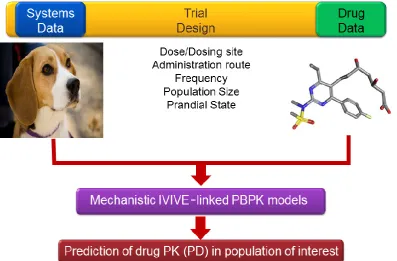
The Simcyp PBPK platform (human and animals) is based on an original and unique concept of an ‘inter-linked component’ structure that enables a separation of trial design parameters (dose, route, frequency of administration etc.), animal (species) parameters (system-anatomy, physiology etc.) and drug parameters (drug physicochemical characteristics). When
interacting with each other via mechanistic – IVIVE models, these parameters determine predicted values for drug absorption, distribution, metabolism, transport and elimination (Jamei 2016) (Figure 2).
Using this framework, other complex modular components can be added such as: a. The Advanced Dissolution, Absorption and Metabolism (ADAM) model to
mechanistically predict absorption of orally administered drugs
Although this discussion has focused on the Simcyp PBPK platform, numerous other programs are also available. Each one presents its own unique set of attributes and
assumptions and the selection of one over the other often reflects personal preference (e.g., see Margolskee et al., 2017b). Examples of available software tools include GastroPlusTM (http://www.simulations-plus.com/assets/GastroPlus_1-24-17.pdf), GI-Sim (Sjögren et al,
2013), and PK-SimR (http://www.systems-biology.com/products/PK-Sim.html).
Regardless of the platform selected, when a well-informed PBPK model is coupled with reliable estimates of intrinsic drug parameter values (internal validation) and its performance has been confirmed using external datasets (external validation), the prediction model
becomes more robust. This approach is commonly referred to as an ‘in vitro-in vivo extrapolation linked PBPK approach’ (PPBK-IVIVE) (Rostami, 2012). Furthermore, the separation of systems (species) parameters from the drug parameters also enables the
investigation of ‘what-if’ scenarios and model extrapolation. This extrapolation may take the form of translating data generated in a normal healthy beagle population to predict profiles that may occur in a population of dogs from another breed, to dogs expressing an enzyme or transporter polymorphism with a given polymorphism (enzyme or transporter), or in dogs associated with a difference in a particular physiological attribute such as altered renal function, faster gastrointestinal transit time, or a difference in the percentage of body fat.
There are numerous published examples where PBPK software has utilized canine-specific population models to explore the critical factors influencing in vivo drug absorption. For example:
The importance of particle size on the oral absorption of a low solubility compound,
cilostazole, was studied using PK-SimR in beagle dogs (Willmann et al., 2012).
A comparison of human and canine oral absorption of various experimental
formulations of ciprofloxacin was generated using GastroPlusR (using both the human
observation that sustained release ciprofloxacin formulations are inappropriate for use in dogs (Martinez et al., 2016, 2017).
The ability to model the effect of food on oral bioavailability was explored for weak
acids (mavacoxib and celecoxib) in dogs using the beagle population module of Simcyp (Martinez et al., 2013). Food effects in dogs were also accurately modeled
for cilastazole using PK-SimR in beagle dogs (Willmann et al., 2012).
Most recently, a mechanistic approach was applied for predicting the oral
bioavailability of danazol when administered across a range of formulations to beagle
dogs. Predictions were subsequently verified using published in vivo data. Using the
ADAM model that divides the dog gastrointestinal tract (GIT) into 9 segregated segments (stomach to the colon), the rate of drug dissolution, permeability, gut metabolism and fraction absorbed (fa) were mechanistically predicted. A unique aspect of the ADAM model is its ability to assess the dynamic behavior of GIT fluid volumes based on GI transit times (GITT), GIT secretion rates and absorption rates. The impact of formulation both on in vivo dissolution and absorption were explored. Preliminary results from this work were presented at the European Association of Veterinary Pharmacology and Toxicology meeting in 2015 (Pade et al., 2015), and the full study is currently submitted for publication (Pade et al., 2018).
Unfortunately to date, there is a gap in the publication of studies using in silico models to
support drug development in dogs even though software programs such as GastoPlusR,
PK-SimR, and SimcypR have physiology modules specifically tailored to the beagle dog.
Hopefully, these examples of the insights and of the efficiency that can be gained by using PBPK approaches will stimulate the application of this tool to support formulation
development, for understanding the factors that can influence the absorption and in vivo dissolution of oral drug formulations, and sources of variability that can exist across a population of dogs.
Practical Implications of Population Variability in the Animal Health Industry
Uncertainty regarding the current regulatory framework concerning population variability in the drug development business?
From the perspective of human therapeutics, the importance of considering both genotypic and phenotypic variability is recognized and therefore has been incorporated into the regulatory guidances both of the US Food and Drug Administration (FDA) Center for Drug Evaluation and Research (CDER) and of the European Medicines Agency (EMA). In addition to general guidelines on population PK (CHMP/EWP/185990/06 and FDA GFI 1999) and on the use of PBPK models (CHMP/211243/2014 and FDA draft GFI 2016), specific guidelines are now available for a variety of factors that can alter drug
dose-exposure-response relationships. Furthermore, the CHMP/37646/2009 and FDA GFI 2013 encourage early implementation of pharmacogenomics testing during the clinical phases of product development to promote a more complete understanding of the kinds of PK and PD variability that should be considered within the target patient population.
The potential impact of genotypic and phenotypic variability has not been comparably appreciated or addressed by either the US or by the European regulators of veterinary drug product applications. Currently, due to the absence a legal framework supporting a
requirement for the submission of PK data, the FDA Center for Veterinary Medicine (CVM) cannot routinely require such information to be generated as part of a new animal drug application. In contrast, PK data generated at the clinical dose are required within Europe for veterinary drug registration and the EMA’s Committee for Medicinal Products for Veterinary Use (CVMP) has published a draft guideline on the conduct of PK studies in the target animal species
(http://www.ema.europa.eu/docs/en_GB/document_library/Scientific_guideline/2017/11/WC
500238890.pdf).
It is interesting to note that the 2017 CVMP draft guidance includes concepts of population PK as was originally addressed in the January 2016 EMA/CVMP concept paper titled “Concept paper for the revision on the guideline for the conduct of pharmacokinetic studies in target animal species (EMEA/CVMP/133/99-Final)”. This concept paper briefly pointed to the need to consider sources of veterinary PK variability as potentially captured via
pharmacogenetic variation on population dose-exposure-response relationships. In that regard, should be noted that this approach has already been used to support pre- and post-marketing adjustments in dosage regimen for the veterinary drug, mavacoxib (Cox et al., 2011).
The other mention of population variability within the veterinary regulatory framework is embedded in the latest revision of the Guideline for the demonstration of efficacy for veterinary medicinal products containing antimicrobial substances (EMA/CVMP/627/2001-Rev.1). For the selection of clinical breakpoints for veterinary antimicrobial drugs, the guideline encourages the use of Monte Carlo simulations (see supra), using PK data for stochastic estimation of antimicrobial exposure in the target population at the licensed dose.
Pinpointing the origin of the variability in veterinary species:
Although not originally conducted to support veterinary drug development, thestudy by Paulson et al. (1999) was a landmark paper within veterinary community because it revealed a genetic origin for the large differences in celecoxib metabolism observed across a group of 242 laboratory beagles. Since then, similar within-breed variability in PK (driving the
observed variability in the duration of clinical efficacy) was reported with the veterinary drug cimicoxib (Jeunesse, et al., 2013). Although clinically relevant variability in population PK was not observed among studied client-owned dogs (representative of 4 different breeds), Part I of this AAVPT meeting report provides numerous examples of clinically relevant polymorphisms now recognized across veterinary species (Martinez et al., submitted for publication)
Understanding some of the potential reasons for sub-optimal responses is grounded in the link between PK and PD (Toutain and Lees, 2004), population variability (sources of animal variability identified through the inclusion of explanatory covariates), and inter-occasion variability (where the kinetics may vary within the same subject dosed one several occasions). Sources of PD variability include the variability associated with disease
expression, the time course of its clinical manifestation, and the relationship between drug exposure and clinical effect. Experienced clinicians can address the issue of PD variability by: (i) monitoring the clinical response (e.g., the blood pressure in response to
curve, international normalized ratios for anticoagulation); (iii) the use physiologically relevant information to adjust dosage (e.g., carboplatin dose informed by GFR in cats, see Bailey et al. 2009); and (iv) relying on therapeutic drug monitoring. Nevertheless, adverse drug reactions (including lack of efficacy) still occur due to variability in dose-exposure-response relationships.
What could the future look like?
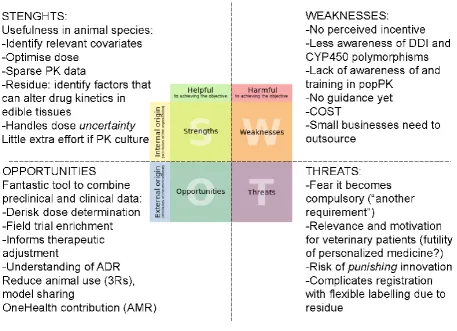
The “hot button question” was whether (when) it is appropriate to document variability in the target population within the drug development process? A SWOT
(Strength/Weakness/Opportunity/Threat) analysis was proposed based upon results obtained when interviewing a sample of representative members of the veterinary industry, regulatory bodies and academia (Figure 3):
The results of this analysis can be summarized as follows:
Perceived Strengths:
Internal resources can contribute to the usefulness of documenting population variability in animal species through: (i) identification of relevant covariates; (ii) dose optimization; (iii) providing an opportunity to use sparse PK data to document clinical population behavior; (iv) the identification of factors that can alter drug kinetics in edible tissues; and (v) provision of an approach for handling situations where dose is uncertain (for example when the drug is given to a group in food or water). With the availability of PK competency within a drug company, a small increase in effort (e.g., training) could yield highly rewarding results.
Perceived Weaknesses:
veterinary population PK; and (iv) concerns associated with potential additional cost, time delays, regulatory oversight, and the need to outsource these analyses.
Perceived Opportunities:
M&S approaches serve as highly effective tools for combining preclinical and clinical data to: (i) de-risk dose-determination studies; (ii) enrich clinical trial design (allows for the recruitment of an animal population that is more likely to respond to the drug); (iii) inform the drug sponsor of conditions that may necessitate therapeutic drug adjustments; and iv) provides a strong basis for the understanding of adverse drug reaction by clinicians and during post-marketing surveillance. Moreover, M&S provides an important mechanism by which once can reduce animal use (3Rs), especially though model and data sharing, thereby promoting a OneHealth solution to the problem of antimicrobial resistance.
Perceived Threats:
Expressed concerns resisting the documentation of variability in target population include: (i) the fear that variability documentation may become an additional compulsory requirement imposed by regulators; (ii) a perceived lack of relevance and motivation for this information in veterinary medicine; (iii) concerns that regulators will punish innovation (lack of reward and more constraints imposed); and iv) this could lead to a re-opening of flexible labelling concepts to address potential needs to adjust dose or withdrawal times as a function of drug-drug interactions or population subgroups.
Future recommendations:
Based upon recommendations and expressed comments received during this one-day session, it is concluded that the following initiatives should be explored to encourage and facilitate the adoption of population variability characterization by the veterinary drug industry:
certain studies (e.g., dose-determination studies) and/or the acceptability of confirming efficacy in one or (or limited) dosage regimens in clinical trials. Industry-government discussions should occur early during the drug application process to facilitate
implementation of population PK-PD as part of the application dossier.
Academia and industry should be encouraged to increase their level of interaction through the development of collaborative research projects, the sharing of expertise, and through the development of model banks such as those provided by the Drug Disease Model Resources (DDMoRe) consortium (http://www.ddmore.eu/). In veterinary drug development, innovation in population PK and pharmacometrics is often driven by academic centers rather than by government due to the limited resources of regulatory agencies. Scientific associations such as the AAVPT, the European Association of
Veterinary Pharmacology and Toxicology (EAVPT), the AHMSS, and specialist colleges such as the European College of Veterinary Pharmacology and Toxicology (ECVPT) should rejuvenate and develop comprehensive training programs in pharmacometrics and computational pharmacology to meet the evolving needs of the industry and of the animal health community
(http://www.ema.europa.eu/docs/en_GB/document_library/Minutes/2009/11/WC5000099 23.pdf).
Training should be offered to promote progression to different competency tiers, including: (i) basic “essential awareness”; (ii) intermediate knowledge and skillset development for assessors at regulatory agencies; and (iii) expert scientist through the development of tailor-made courses. Importantly, joint training for assessors and pharmaceutical industry could help stakeholders and regulators to “speak the same language”.
Software developers can play a pivotal role in ensuring the acceptance and use of PK/PD and population PK modelling and PBPK software by outreach to non-specialist scientists within industries. This outreach could take the form of webinars and workshops.
Concluding Thoughts
When studying the pharmacology of a drug, the modeling approach (top-down versus
can be invaluable for providing an initial understanding of the interactions that can occur between the drug and a biological system. Empirical (model fitting) approaches are also appropriate if the research goal is very specific (e.g., to compare the bioavailability between two formulations of a given drug). As our knowledge about a drug increases, the
development of mechanistic models become possible, and these can then be used to extrapolate and predict the outcomes of different ‘what-if ‘scenarios to gain insights into formulation effects and population differences in drug exposure.
While therapeutic drug monitoring has contributed to an appreciation of the population variability in human medicine, it has been rarely used within the framework of veterinary medicine. Considering that, for example, 105 genotypes have been identified for human CYP2D6 (with 29 of these associated with little to no activity)
[http://www.cypalleles.ki.se/l], it is easy to see the challenges that would accompany efforts to predict population variability solely based on genetics. To address this gap and in addition to therapeutic drug monitoring, several in silico tools are available to help unravel these and other complex situations. Whether it involve the use of mechanistic models to understand the PK implications of polymorphic forms of drug metabolizing enzymes and transporters or the use of computational models to identify critical covariates within a population, the
availability of mechanistic models enables experimental data (both in vivo and in vitro) to be far more information-rich than it has been in the past. We can continually adjust our
expectations as more data are collected across a range of samples from the population of animal patients.
sources of population variability and how to appropriately apply in silico modeling procedures, appreciating its pharmaco-statistical underpinnings and recognizing the importance of identifying/challenging their model’s underlying assumptions.
It is the hope of the authors of this report that the information conveyed in Part II illustrate the strengths and opportunities for the described M&S approaches to improve the efficiency of the drug product development process (formulation optimization, clinical trial design, and safety and effectiveness trial analysis), to provide information to veterinary practitioners that will support prescribing practices that are in accordance with factors that may influence product safe and effective use, and to serve as an evaluation tool for regulators during pre-market product assessment, protocol development, and during the evaluation of potential causes for adverse post marketing experience reports. It is now up to the community of veterinary pharmacologists and those of us involved in the development and/or regulation of veterinary pharmaceutical to generate and use this information appropriately.
Conflict of interest statement
REFERENCES:
Bailey, D.B., Rassnick, K.M., Prey, J.D. & Dykes, N.L. (2009) Evaluation of serum iohexol clearance for use in predicting carboplatin clearance in cats. American Journal of Veterinary Research, 70(9), 1135-1140.
Bon C, Toutain PL, Concordet D, Gehring R, Martin-Jimenez T, Smith J, Pelligand L, Martinez M, Whittem T, Riviere JE, Mochel JP (2017) Mathematical modeling and simulation in animal health. Part III: Using nonlinear mixed-effects to characterize and quantify variability in drug pharmacokinetics. Journal of Veterinary
Pharmacology and Therapeutics, Dec 11. doi: 10.1111/jvp.12473.
Cox, S.R., Liao, S., Payne-Johnson, M., Zielinski, R.J. & Stegemann, M.R. (2011)
Population pharmacokinetics of mavacoxib in osteoarthritic dogs. Journal of Veterinary Pharmacology and Therapeutics, 34(1), 1-11.
Darwich, A.S., Margolskee, A., Pepin, X., Aarons, L., Galetin, A., Rostami-Hodjegan, A., Carlert, S., et al., (2017) IMI -Oral biopharmaceutics tools project - Evaluation of bottom-up PBPK prediction success part 3: Identifying gaps in system parameters by analysing in silico performance across different compound classes. European Journal of Pharmaceutical Sciences, 96, 626-642.
Devalapally, H., Silchenko, S., Zhou, F., McDade, J., Goloverda, G., Owen, A. & Hidalgo, I.J. (2013) Evaluation of a nanoemulsion formulation strategy for oral bioavailability enhancement of danazol in rats and dogs. Journal of Pharmaceutical Sciences, 102(10), 3808-3815.
Dorey, L., Pelligand, L., Cheng, Z. & Lees P. (2017) Pharmacokinetic/pharmacodynamic integration and modelling of florfenicol for the pig pneumonia pathogens
Duwal, S. & von Kleist, M. (2016) Top-down and bottom-up modeling in system
pharmacology to understand clinical efficacy: An example with NRTIs of HIV-1. European Journal of Pharmaceutical Sciences, 94, 72-83.
Ette, E.I. & Williams, P.J. (2004) Population pharmacokinetics I: background, concepts, and models. Annals of Pharmacotherapy, 38(10), 1702-1706.
Fink, M., Letellier, I., Peyrou, M., Mochel, J.P., Jung, M., King, J.N., Gruet, P. & Giraudel, J.M. (2013) Population pharmacokinetic analysis of blood concentrations of
robenacoxib in dogs with osteoarthritis. Research in Veterinary Science, 95(2), 580-587.
Jamei, M. (2016) Recent Advances in Development and Application of Physiologically-Based Pharmacokinetic (PBPK) Models: a Transition from Academic Curiosity to Regulatory Acceptance. Current Pharmacology Reports, 2(3), 161-169.
Jamei, M., Dickinson, G.L. & Rostami-Hodjegan, A. (2009) A framework for assessing inter-individual variability in pharmacokinetics using virtual human populations and integrating general knowledge of physical chemistry, biology, anatomy, physiology and genetics: A tale of 'bottom-up' vs 'top-down' recognition of covariates. Drug Metabolism and Pharmacokinetics, 24(1), 53-75.
Jeunesse, E.C., Schneider, M., Woehrle, F., Faucher, M., Lefebvre, H.P. & Toutain, P.L. (2013) Pharmacokinetic/pharmacodynamic modeling for the determination of a cimicoxib dosing regimen in the dog. BMC Veterinary Research, 9, 250.
Lee, C.A., Neul, D., Clouser-Roche, A., Dalvie, D., Wester, M.R., Jiang, Y., Jones, J.P., 3rd, Freiwald, S., Zientek, M. & Totah, R.A. (2010) Identification of novel substrates for human cytochrome P450 2J2. Drug Metabolism and Disposition: The Biological Fate of Chemicals, 38(2), 347-356.
Li, M., Gehring, R., Tell, L., Baynes, R., Huang, Q. & Riviere, J.E. (2014) Interspecies mixed-effect pharmacokinetic modeling of penicillin G in cattle and swine. Antimicrobial Agents and Chemotherapy, 58(8), 4495-4503.
Lin, Z., Gehring, R., Mochel, J.P., Lavé, T. & Riviere, J.E. (2016) Mathematical modeling and simulation in animal health - Part II: principles, methods, applications, and value of physiologically based pharmacokinetic modeling in veterinary medicine and food safety assessment. Journal of Veterinary Pharmacology and Therapeutics, 39(5), 421-438.
Liversidge, G.G. & Cundy, K.C. (1995) Particle size reduction for improvement of oral bioavailability of hydrophobic drugs: I. Absolute oral bioavailability of
nanocrystalline danazol in beagle dogs. International Journal of Pharmaceutics, 125(1), 91-97.
Maaland, M.G., Papich, M.G., Turnidge, J. & Guardabassi, L. (2013) Pharmacodynamics of doxycycline and tetracycline against Staphylococcus pseudintermedius: proposal of canine-specific breakpoints for doxycycline. Journal of Clinical Microbiology, 51(11), 3547-3554.
Margolskee, A., Darwich, A.S., Pepin, X., Pathak, S.M., Bolger, M.B., Aarons, L., Rostami-Hodjegan, A. et al. (2017a) IMI - oral biopharmaceutics tools project - evaluation of bottom-up PBPK prediction success part 1: Characterisation of the OrBiTo database of compounds. European Journal of Pharmaceutical Sciences, 96, 598-609.
Margolskee, A., Darwich, A.S., Pepin, X., Pathak, S.M., Bolger, M.B., Aarons, L., Rostami-Hodjegan, A. et al., (2017b) IMI - Oral biopharmaceutics tools project - Evaluation of bottom-up PBPK prediction success part 2: An introduction to the simulation
exercise and overview of results. European Journal of Pharmaceutical Sciences, 96,
610-625.
Martinez, M., Mistry, B., Lukacova, V., Polli, J., Hoag, S., Dowling, T., Kona, R., & Fahmy, R. (2016) Use of modeling and simulation tools for understanding the impact of
formulation on the absorption of a low solubility compound: ciprofloxacin. AAPS
Journal, 18(4), 886-897.
Martinez MN, Mistry B, Lukacova V, Lentz KA, Polli JE, Hoag SW, Dowling T, Kona R, & Fahmy RM. Exploring canine-human differences in product performance. Part II: Use of modeling and simulation to explore the impact of formulation on ciprofloxacin in
vivo absorption and dissolution in dogs. AAPS Journal, 19(3), 712-726.
Mochel, J.P. & Danhof, M. (2015) Chronopharmacology of the renin-angiotensin aldosterone system in dogs: the value of pharmacokinetic/ pharmacodynamic modeling. Journal of Veterinary Pharmacology and Therapeutics, 38(Suppl 1:1.), 173.
Mochel, J.P., Fink, M., Bon, C., Peyrou, M., Bieth, B., Desevaux, C., Deurinck, M., Giraudel, J.M. & Danhof, M. (2014) Influence of feeding schedules on the chronobiology of renin activity, urinary electrolytes and blood pressure in dogs. Chronobiology International, 31(5), 715-730.
Mochel, J.P., Fink, M., Peyrou, M., Desevaux, C., Deurinck, M., Giraudel, J.M. & Danhof, M. (2013a) Chronobiology of the renin-angiotensin-aldosterone system in dogs: relation to blood pressure and renal physiology. Chronobiology International, 30(9), 1144-1159.
Mochel, J.P., Fink, M., Peyrou, M., Soubret, A., Giraudel, J.M. & Danhof, M. (2015) Pharmacokinetic/Pharmacodynamic Modeling of Renin-Angiotensin Aldosterone Biomarkers Following Angiotensin-Converting Enzyme (ACE) Inhibition Therapy with Benazepril in Dogs. Pharmaceutical Research, 32(6), 1931-1946.
model-based approaches in veterinary pharmacology. Journal of Veterinary Pharmacology and Therapeutics, 36(5), 417-419.
Mould, D.R. & Upton, R.N. (2012) Basic concepts in population modeling, simulation, and model-based drug development. Clinical Pharmacology and Therapeutics:
Pharmacometrics and Systems Pharmacology, 1, e6.
Ogungbenro, K. & Aarons, L. (2014) Physiologically based pharmacokinetic modelling of methotrexate and 6-mercaptopurine in adults and children. Part 1: methotrexate. Journal of Pharmacokinetics and Pharmacodynamics, 41(2), 159-171.
Pade, D., Jamei, M., Rostami-Hodjegan, A. & Turner, D.B. (2018) Application of the MechPeff model to predict passive effective intestinal permeability in the different regions of the rodent small intestine and colon. Biopharmaceutics and Drug Disposition, 38(2), 94-114.
Pade, D., Martinez, M., Mistry, B., Jamei, M., & Rostami-Hodjegan, A. (2015) Use of physiologically based pharmacokinetic (PBPK) models to support canine drug product development. Journal of Veterinary Pharmacology & Therapeutics 38 (Suppl. 1), 99.
Paulson, S.K., Engel, L., Reitz, B., Bolten, S., Burton, E.G., Maziasz, T.J., Yan, B. &
Schoenhard, G.L. (1999) Evidence for polymorphism in the canine metabolism of the cyclooxygenase 2 inhibitor, celecoxib. Drug Metabolism and Disposition: The
Biological Fate of Chemicals, 27(10), 1133-1142.
Pelligand, L., Soubret, A., King, J.N., Elliott, J. & Mochel, J.P. (2016) Modeling of Large Pharmacokinetic Data Using Nonlinear Mixed-Effects: A Paradigm Shift in Veterinary Pharmacology. A Case Study With Robenacoxib in Cats. Clinical Pharmacology and Therapeutics: Pharmacometrics and Systems Pharmacology, 5(11), 625-635.
simulation to determine pharmacodynamic cutoffs of amoxicillin to establish a
breakpoint for antimicrobial susceptibility testing in pigs. American Journal of
Veterinary Research, 75(2), 124-131.
Rostami-Hodjegan, A. (2012) Physiologically based pharmacokinetics joined with in vitro-in vivo extrapolation of ADME: a marriage under the arch of systems pharmacology. Clinical Pharmacology and Therapeutics, 92(1), 50-61.
Sheiner, L.B., Rosenberg, B. & Melmon, K.L. (1972) Modelling of individual
pharmacokinetics for computer-aided drug dosage. Computers and Biomedical Research, 5(5), 411-459.
Silber, H.E., Burgener, C., Letellier, I.M., Peyrou, M., Jung, M., King, J.N., Gruet, P. & Giraudel, J.M. (2010) Population pharmacokinetic analysis of blood and joint synovial fluid concentrations of robenacoxib from healthy dogs and dogs with osteoarthritis. Pharmaceutical Research, 27(12), 2633-2645.
Sjögren E, Westergren J, Grant I, Hanisch G, Lindfors L, Lennernäs H, Abrahamsson B, Tannergren C. (2013) In silico predictions of gastrointestinal drug absorption in pharmaceutical product development: application of the mechanistic absorption model
GI-Sim. European Journal of Pharmaceutical Sciences49(4), 679-698.
Takano, R., Furumoto, K., Shiraki, K., Takata, N., Hayashi, Y., Aso, Y. & Yamashita, S. (2008) Rate-limiting steps of oral absorption for poorly water-soluble drugs in dogs; prediction from a miniscale dissolution test and a physiologically-based computer simulation. Pharmaceutical Research, 25(10), 2334-2344.
Toutain, P.L. & Lees, P. (2004) Integration and modelling of pharmacokinetic and
pharmacodynamic data to optimize dosage regimens in veterinary medicine. Journal of Veterinary Pharmacology and Therapeutics, 27(6), 467-477.
Tsamandouras, N., Rostami-Hodjegan, A. & Aarons L. (2015) Combining the 'bottom up' and 'top down' approaches in pharmacokinetic modelling: fitting PBPK models to observed clinical data. British Journal of Clinical Pharmacology, 79(1), 48-55.
Willmann. S., Thelen, K., & Lippert, J. (2012) Integration of dissolution into
physiologically-based pharmacokinetic models III: PK-Sim®. Journal of Pharmacy and Pharmacology, 64(7), 997-1007.
Zhuang, X. & Lu, C. (2016) PBPK modeling and simulation in drug research and development.
Acta Pharmaceutica Sinica B., 6(5), 430-440.
Author Contribution Statement:
Although this was a collaborative effort, the following were primary areas of contributions for the individual authors:
MNM: Abstract, Introduction, Conclusions, Decision on manuscript contents RG: NLME models
JM: NLME models DP: PBPK models
LP: Practical implications of population variability in the animal health industry
Figure 1. An illustration of the interrelationship and unique attributes associated with the top‐ down, bottom‐up and middle out approaches to M&S