On the arrow of spacetime
Alexandre Harvey-Tremblay1*
1 Independent researcher
* Correspondence: [email protected]
Version November 20, 2018 submitted to Preprints
Abstract: Consistent with special relativity and statistical physics, here we construct a partition
1
function of space-time events. The union of these two theories resolves longstanding problems
2
regarding time. We will argue that it augments the standard description of time given by the
3
(non-relativistic) arrow of time to one able to describe the past, the present and the future in a manner
4
consistent with our macroscopic experience of such. First, using Fermi-Dirac statistics, we find
5
that the system essentially describes a "waterfall" of space-time events. This "waterfall" recedes in
6
space-time at the speed of light towards the direction of the future as it "floods" local space with
7
events that it depletes from the past. In this union, an observerOwill perceive two horizons that
8
can be interpreted as hiding events behind them. The first is an event horizon and its entropy hides
9
events in the regions thatOcannot see. The second is a time horizon, and its entropy "shields" events
10
fromO’s causal influence. As only past events are "shielded" and not future events, an asymmetry in
11
time is thus created. Finally, future events are hidden by an entropy prohibitingOfrom knowing the
12
future before the present catches on.
13
Keywords:Statistical Physics; Special Relativity; Arrow of Time
14
1. Introduction 15
1.1. Time
16
The connection between time in statistical physics and time in special relativity are both well
17
established (Popper [1], Layzer [2], Davies [3], Zeh and Page [44], Callender [5], Price [6], Landsberg
18
[7], Halliwellet al.[8], Carroll [9]). On the one hand, we have the statistical emergence of a macroscopic
19
arrow of time, and on the other, we have a causal relationship between space-time events limited by
20
the speed of light. As most other theories consider time to be little more than some reversible variable,
21
the claims made regarding time by these two theories pack quite a lot of heat (figuratively). Thus,
22
to further investigate the nature of time, a promising avenue might be to ask: what about time in
23
"statistical physics∪special relativity" — is it possible to combine causality (in the sense given by
24
special relativity) with the arrow of time? As it turns out, in doing so (achieving the combination) we
25
are rewarded with quite a lot of insight. First, let’s clarify the motivation for this union.
26
1.2. Problem 1: The direction of time
27
We recall the well-known thought experiment in which Maxwell’s demon (Maxwell [10], Knott
28
[11], Thomson [12], Leff and Rex [13]) consumes good information to return a macroscopic system
29
to some initial low-entropy state. An observer might naively conclude that the (macroscopic) arrow
30
of time (Weinert [14]) is reversed, but inspection of the global system reveals that Maxwell’s demon
31
produced entropy in amounts at least equal to the information consumed (Szilard [15], Landauer
32
[16], Bennett [17]).
33
Taking the universe to be the global system, and sub-systems to be local, equivalent thought
34
experiments can be produced. Borrowing terms from special relativity, we might say that the arrow of
35
time holds globally, but not locally. Gotcha! A global property in a non-relativistic theory is bound to
36
violate causality.
37
Or as George F R Ellis (Ellis [18]) states:
38
"The arrow of time locality issue: If there is a purely local process for determining the
39
arrow of time, why does it give the same result everywhere? [...] Local determination has
40
to arbitrarily choose one of the two directions of time as the positive direction indicating
41
the future; but as this decision is made locally, there is no reason whatever why it should
42
be consistent globally. If it emerges locally, opposite arrows may be expected to occur in
43
different places."
44
Resolving this issue is, of course, an interesting result of the model. In the model, the arrow of
45
space-time cannot be reversed by Maxwell’s demon, even locally, because the space-like entropy of the
46
sub-system, associated with the system’s past, grows throughout the cycle proportionally to the speed
47
of light. The causal influence of the system (which propagates at the speed of light in all directions), is,
48
in this model, the macroscopic system that would need to be reversed by Maxwell’s demon to reverse
49
the arrow of time. Thus, Maxwell’s demon cannot succeed unless it violates the speed of light.
50
1.3. Problem 2: Macroscopic time
51
If we were to only rely on time-symmetric differential equations (e.g. classical mechanics, unitary
52
evolution, etc.), there would be no meaningful difference between the past, the present, and the future.
53
Basically, time would be a point on a line and we could solve our equations as far into the future or
54
into the past as we wanted. This is quite far from our day-to-day experience of time.
55
Consistent with our macroscopic experience of time, the arrow of time improves the connection
56
between "time in the equations" and "time in real life" by giving it a direction favored by entropy. This
57
is better, but, as we will argue, not yet complete.
58
We will now scope our work by formulating some contemplation questions to elucidate what is
59
missing from the arrow of time, along with some leading questions to guide the discussion towards
60
the solution presented in this paper. Let’s start with two questions specifically related to the arrow of
61
time:
62
1. It is very unusual in science to have a quantity which sets the direction of another, but whose
63
magnitudes are not proportional. For instance, we can imagine an experiment which attains
64
thermodynamic equilibrium very quickly (e.g. an explosion), and one which takes a long time
65
(e.g. Earth’s core cooling off to room temperature). But in each case, the clocks are ticking at the
66
same rate. Why is the rate of passage of time not proportional to the magnitude of the arrow of
67
time, if its direction is correlated to it?
68
2. Special relativity sets the magnitude for the time evolution of an observerOin its own frame of
69
reference to be proportional to the speed of light. Leading question: Why is the direction of time
70
set by statistical physics, but its magnitude is set by special relativity, two seemingly unrelated
71
theories?
72
Furthermore, there is a noticeable difference between the past, the present, and the future that is
73
not captured by the arrow of time. An image that I like to use is that of an observer regretting the past,
74
worrying about the future, and acting (or failing to act) in the present. Consistent with causality,O 75
ought not to experience the other permutations, such as regretting the future or worrying about the
76
past.
77
Or, again, as George F R Ellis (Ellis [18]) states:
78
"As the nature of existence is different in the past and in the future - Becoming has meaning.
79
Different ontologies apply in the past and future, as well as different epistemologies"
80
With this image in mind, a further series of questions arises:
81
1. SupposeOgoes bird watching. Say the birds are observed for 20 years byO. ThenOshould
82
know a lot more about those birds today thanO did 20 years ago. O’s conclusion that time
has passed is evidenced by the existence of a "log of observations" maintained byO, and not
84
so much on the fact that the birds of today are ever so slightly closer to final cosmological
85
thermodynamic equilibrium than the birds of 20 years ago. Let’s emphasize the dichotomy:
86
the arrow of time points towards higher entropy (more hidden information), butOconcluded
87
that time moves forward by building up a log of events (gaining information). IsOmaking a
88
mistake by using a log of events to conclude as to the passage of time, instead of estimating the
89
system’s overall entropy as per the arrow of time? As George F R Ellis puts it, "we are aware of
90
the flow of time because of the existence of records of the past" (Ellis [18]). Leading question: Is
91
O’s construction of a log of events contributing to increasing the entropy of the system? What if
92
O’s log is complete (it lists all space-time events) — in this case, isO’s behavior of producing
93
information by increasing entropy the opposite of Maxwell’s demon? Perhaps it is "Maxwell’s
94
angel"? (Touchette and Lloyd [19], Parrondoet al.[20])?
95
2. Generally, if the universe started from a low entropy Big Bang and is evolving into a high entropy
96
state and that entropy is associated with a loss of information, what sort of compensation is there
97
to offset this loss? Leading question: Can the information gained by observing a system over time
98
be accumulated and is it enough to offset the information lost by the action of the arrow of time?
99
Can a statistical system aware of events reconcile both notions? From Landauer’s aphorism,
100
since "information is physical" (Landaueret al.[21]) where and how would his information be
101
stored(Gooldet al.[22], Streltsovet al.[23], Adessoet al.[24])?
102
3. Why is the causal connection between past, present and future asymmetric (Halliwellet al.[8])?
103
For example,Oopens the fridge and notices that there is milk in it.Owonders why the milk
104
is there. It would make no sense to appeal to the future to justify the presence of milk in the
105
present. Thus saying, "the milk is in the fridge becauseOwill drink it tomorrow and therefore
106
it must be here today forOto be able to drink it tomorrow — that’s why it is there!" makes no
107
sense becauseOcould simply elect not to drink the milk and the milk will still be in the fridge
108
today. It’s similar to how some people feel absolutely certain that they will win the lottery at the
109
next draw, and thus will buy a ticket today in an attempt to set up the present to be as consistent
110
as possible with the anticipated future winnings, only to witness the attempt fail. However, the
111
reverse explanation easily makes sense: the milk is in the fridge today becauseObought it at
112
the supermarket yesterday and put it in the fridge this morning. Why does the "algorithmic
113
reconstruction" of the past based on present evidence work, but the same reconstruction fails
114
when applied to the future? Using purely time-symmetric differential equations we would get a
115
different story: the present would fix both the past and the future! We could even appeal to the
116
future to justify the present. The "arrow of causality" that we experience fails to emerge from
117
exactly solvable time-symmetric differential equations.
118
4. FromO’s present, the future appears to have multiple outcomes that could occur (e.g:Ocould
119
elect to drink or not to drink the milk — we won’t know until tomorrow) (Eddington [25]).
120
Leading question: Is there an entropy that we could have missed, but is nonetheless associated
121
withO’s possible futures that somehow gets reduced asOtravels forward in time, as the present
122
unravels? Does this entropy prohibitO’s knowledge about the future?
123
Combining special relativity with statistical physics will allow us to account for the past, the
124
present, and the future as three distinct regimes of time in a manner consistent with experience and
125
with the points raised in these questions. Let us now describe in greater detail how this will be done.
126
1.4. Outline
127
We consider two approaches that we could use to combine statistical physics with special relativity.
128
One approach is to make the standard quantities of statistical physics (e.g., entropy, temperature)
129
Lorentz-invariant. Using this methodology, we are rewarded with a frame-independent partition
130
function. The result of this approach yields non-relativistic statistical physics in the limitc→∞. This
131
is the approach taken by Giorgio Kaniadakis (Kaniadakis [26]).
Another approach is to seek a statistical ensemble whose macroscopic description relates to
133
special relativity. As special relativity is concerned with the relationship between space-time events,
134
this approach elects to make special relativity emergent (via an equation of state) from a statistical
135
ensemble of space-time events. In this case, special relativity is an emergent behavior caused by the
136
random statistics of space-time events.
137
The latter approach is the one that will be taken in this paper. Not only does it paint a seductive
138
picture of time and space, but it is also attractive because of its ability to explain the nature of
139
macroscopic time.
140
Using Fermi-Dirac statistics over an ensemble of space-time events, we show (section3.3) that the
141
space-time counterpart to the arrow of time is a "waterfall of events". Like the arrow of time, it too has
142
a direction: it recedes in space-time at the speed of light towards the direction of the future (section
143
3.4). Furthermore, as it recedes, the waterfall of events floods the present with immediate events and
144
depletes the past of events. As we will see, this behavior connects to the three regimes of time (section
145
3.7and4).
146
1.5. Improvements upon prior work
147
The prior work closest to ours are probably the works of (Jacobson [27]) and the works of (Verlinde
148
[28]), in which general relativity, classical gravity and the law of inertia are derived from statistical
149
physics. To derive the law of inertia, Verlinde [28] considers a length conjugated with an entropic
150
force, then under injection of the Unruh temperature, finds F = ma. To derive general relativity,
151
Jacobson [27] considers an area conjugated with an entropic surface tension, then under multiple
152
reasonable assumptions (Raychaud-Huri equation, local energy conservation, Null-horizons, etc.)
153
recovers Einstein’s fields equations. Thus, a pattern is beginning to emerge in the literature in which
154
some laws of physics are consistent when formulated as having their origin in entropy. Here, we
155
extend their work by placing time on equal entropic footing as these authors have done for length and
156
area. Specifically, we will consider a time conjugated to an entropic power in the context of emergent
157
special relativity.
158
2. A statistical ensemble of events 159
Our goal for this section will be to recover the "features" of special relativity strictly using the
160
facilities of statistical physics. In this case, we would say that special relativity is an emergent property
161
of the constructed statistical ensemble. Even the speed of light will not be taken as an axiom, but it will
162
instead be a property emergent from the construction. How will we do that? First, we have to interpret
163
the speed of light as a tool to hide information. Specifically, the speed of light hides information
164
regarding events whose intervals to the observer are space-like. Interpreted as such, we can then use
165
the entropy in statistical physics to achieve the same purpose as the speed of light (hide information),
166
provided that we "place" the entropy appropriately in the system.
167
For instance, we can imagine an observerOwhose event horizon is defined by the usual light cone
168
of special relativity. We can then describe this light cone entirely using notions of statistical physics by
169
analyzing the number of configurations of events outside the horizon and associating it to an entropy.
170
We deduce that, to prevent faster-than-light communication, all possible configurations of events
171
outside the event horizon must be of maximal entropy (e.g., equally likely within the priors) so as to
172
be void of information from the perspective ofO. This entropy thus hides events outside the horizon.
173
Attributing an entropy to events separated by a horizon in order to connect to thermodynamics has
174
been done since at least 1973 by J.D. Bekenstein (Bekenstein [29]). Furthermore, from G. W. Gibbons
175
and S. W. Hawking’s 1977 article (Gibbons and Hawking [30]), I quote:
176
"An observer in these models will have an event horizon whose area can be interpreted as
177
the entropy or lack of information of the observer about the regions which he cannot see."
The part missing from the picture of time, we suggest, is to apply the same line of reasoning to
179
configurations of future events. We ask, how many configurations of future events are compatible
180
with the present state? First, we pose this assumption: since the present is caused by the past (not the
181
future), there exists strictly more than one configuration of future states compatible with the current
182
present. The use of the quantifierstrictly more than oneis important here as if it were not the case (i.e.
183
there is only one configuration of future events), then the present would be "caused/determined"
184
by the future as much as by the past. Causality would be time-symmetric. This assumption is the
185
foundation of the past/future asymmetry we recover in this union. For instance, an observer trying to
186
pre-solve time-symmetric exact equations will, due to this entropy, fail to predict which of the possible
187
futures will actually occur. However, once the future has become present, solving those same equations
188
backward will go as expected. We, of course, assume that an observer has no prior knowledge of his
189
future (no foresight). Thus, configurations of compatible future events must be of maximum entropy
190
otherwise information about the future would be available toO(foresight).
191
Using this strategy, we can obtain a system of statistical physics over space-time events that
192
follows the rules of special relativity.
193
Other emergent features we would like to have (briefly listed and to be expanded in section3)
194
are: a) recovering the fundamental equation of special relativity, linking time to spacedx=cdtfrom
195
the equation of state; b) having the entropy at the horizon corresponding to the Bekenstein-Hawking
196
entropyS=kBA/(4L2p); c) having the speed of light defined as an emergent property of the system,
197
which is constant and that cannot be exceeded; d) connecting time-like separated events with a
198
"time-like entropy" and space-like separated events with a "space-like entropy"; e) having an emergent
199
arrow of space-time that generalizes the arrow of time to special relativity. This list of requirements
200
might sound like the statistical system would be complicated to describe, but all it takes is maximizing
201
the entropy on average t (system age) and x (system size), and everything we need will emerge out of
202
it. Let’s get started.
203
2.1. Background
204
We suppose a 3+1 space-timeM4in spherical coordinates{r,θ,φ,t}. Under isotropic assumptions
205
{dθ =0,dφ= 0}the space-time is simplified to a 1+1 space-timeMwith coordinates{r,t}, and it
206
enforces the constraint thatr∈R≥0. Additionally, we pose thatt=0 is the origin of the system, and 207
thust∈R≥0. Finally, we denote an observer byO. 208
2.2. Events
209
LetQbe the set of events inM. We define the functionsrandtas mapping each eventq∈Qto
210
its space-time position inMas:
211
r:Q→R≥0[meters] (1)
t:Q→R≥0[seconds] (2)
2.3. Macroscopic system of events
212
We consider a macroscopic system defined for a set of eventsQand two macroscopic quantities
213
(the priors): an average event-timet∈ R≥0, and an average event-distancer ∈ R≥0. We offer two 214
justifications for these priors.
215
Mathematical justification: First, to treat the events as microscopic elements of a macroscopic
216
system of statistical physics, we are required to take the averages of the quantitiesr(q)andt(q)as the
217
priorsrandtof the macroscopic system when we derive the Gibbs ensemble under an appropriate
218
notion of equilibrium. This is analogous to taking the average energyEas the macroscopic description
219
of a system microscopically described by energy levelsE(q), under the assumptions of thermodynamic
equilibrium. Another example would be taking an average volumeVover the possible volumesV(q),
221
etc..
222
Physical justification:
223
Math notwithstanding, this is a physics paper and thus, the priors must be physically justified.
224
First, consider that in usual special relativity, the observer is conceptually understood to be the origin of
225
the system, and as such its light cone extends to infinity both in the past and in the future. Empirically
226
however, this is not the quite the case. The past light cone of any observer that we find in nature (e.g.
227
of real observers) does not extend to infinity in the past, but terminates at the Big Bang. Thus, such
228
real observers come with a prior light cone of a certain size and age. For instance, the light cone of a
229
present-day observer will come with priors regarding the size of its light cone and the origin is not the
230
observer, but instead coincide with the Big Bang at(0, 0). In this context, the priors are essentially the
231
initial conditions regarding the size of the light cone of real observers respective to the origin of the
232
system.
233
This accounts for the priors being non-null, but it doesn’t yet answer why these priors are average
234
values instead of exact values. To address this, let us first give a classical example, then we will justify
235
it more fundamentally.
236
1. If we were to request five hundred independent measurements of the size of the present-day
237
particle horizon, we would likely get five hundred slightly different values. Thus, in the case
238
where the values of the priors are empirically derived, we would end up with an average
239
experimental value with some expected fluctuations over the set of measurements. This argument
240
is purely classical, but we can make it fundamental by evoking notions of quantum mechanics.
241
2. In the formalism of special relativity, the observer O is point-like and the size of the light
242
cone expanding away fromOcan be measured to arbitrary precision. Ergo, the theory is not
243
aware of the quantum mechanical restrictions on the precision of measurements. Assume that
244
instead of being point-like,Ois of a size described by its Compton wavelength. In this case,
245
since the observer is not point-like, the dimension of the light cone expanding from it can no
246
longer be considered arbitrarily precisely, even fundamentally. Thus, in this context we would
247
expect that any attempt at measuring the dimensions the surface of the light cone will exhibit a
248
certain statistical character preventing its measurement to a precision exceeding the Compton
249
wavelength of the object of reference.
250
Referencing the Compton wavelength has previously and successfully been done before in an
251
analogous context regarding the Black Hole information paradox, general relativity, black hole entropy
252
and statistical physics in (Hawking [31]) and to entropy over positional information in (Verlinde [28]).
253
Here, we will soon recover the Compton wavelength explicitly from the equation of state (equation
254
25), and by doing so we will be able to show that the system exactly connects to a gamut of related
255
physical laws including the law of inertia, the Unruh temperature, the Bekenstein-Hawking entropy
256
(equation27). For these reasons, interpreting the Compton wavelength as a limitation on the size of the
257
observer does appear to be the proper physical relation to limit the precision of the point-like observer
258
in the context of statistical physics∪special relativity, as it will make the union nicely fit into many
259
prior results of physics.
260
2.4. Gibbs ensemble of events
261
Under the principle of maximum entropy, we seek the probability distributionρ:Q → {p ∈
262
R|0≤p≤1}and∑q∈Qρ(q) =1 which maximizes the entropyS:
263
S=−kB
∑
q∈Q
ρ(q)lnρ(q) (3)
and subject to the priorstandr
t=
∑
q∈Q
ρ(q)t(q) (4)
r=
∑
q∈Q
ρ(q)r(q) (5)
We maximize the entropy using the well-known method of the Lagrange multipliers.
265
L= −kB
∑
q∈Q
ρ(q)lnρ(q)
!
+λ0
∑
q∈Q
ρ(q)−1
!
+λ1
∑
q∈Q
ρ(q)t(q)−t
!
+λ2
∑
q∈Q
ρ(q)r(q)−r
!
(6)
MaximizingLwith respect toρ(q)is done by taking its derivative and posing it equal to zero:
266
∂L
∂ρ(q) =−kBlnρ(q)−kB+λ0+λ1t(q) +λ2r(q) =0 (7) Solving forρ(q)we obtain:
267
ρ(q) =exp
−
kB+λ0+λ1t(q) +λ2r(q)
kB
(8)
From the constraint 1=∑q∈Qρ(q), we can find the value forλ0: 268
1=
∑
q∈Q
ρ(q) (9)
=
∑
q∈Q
exp
−k
B+λ0+λ1t(q) +λ2r(q)
kB
(10)
=exp
−
kB+λ0
kB
∑
q∈Q
exp(λ1t(q) +λ2r(q)) (11)
We define the partition functionZto be
269
Z:=
∑
q∈Q
exp(λ1t(q) +λ2r(q)) (12)
Then, we rewriteρ(q)usingZ, we poseλ1:=1/t0andλ2:=−1/r0and we obtain the probability 270
distribution:
271
ρ(q) = 1 Zexp
1 t0t
(q)− 1 r0r
(q)
(13)
where 1/t0 with units [1/(seconds)] and −1/r0 with units [1/(meters)] are the Lagrange 272
multipliers (a justification for the choice of signs will be provided after the results in section4.3).
273
Finally, we obtain the equation of state:
dS=−kB t0
dt+kB r0
dr (14)
which represents the macroscopic evolution of the system, and wherekBis Boltzmann’s constant.
275
The reason why the author has elected to produce the explicit derivation of the Gibbs ensemble for
276
this system is to show clearly that a Gibbs ensemble of statistical physics (such as the one here) can
277
legitimately be constructed without the introduction of an emergent temperature (as a Lagrange
278
multiplier) associated with thermodynamic equilibrium. Thus, the present system holds outside of
279
thermodynamic equilibrium, although another type of equilibrium is required on the 1/t0and−1/r0 280
Lagrange multipliers. Perhaps the name "tempo-dynamic equilibrium" is fitting? In this case, the
281
Lagrange multipliers 1/t0and−1/r0would be the "tempo-ture" of the system. 282
Definition: We will define "light-like" entropy, "time-like" entropy, and "space-like" entropy. Each
283
is obtained by solvingdSin (14) but under different conditions. The first refers todSat tempo-dynamic
284
equilibrium (1/t0dt=1/r0dr). The second refers to the case where 1/t0dt>1/r0dr, and the third to 285
1/t0dt<1/r0dr. 286
Remark: Since the universe is not at uniform temperature, cosmological thermodynamics has
287
been focused on the study of event horizons, which admits temperatures (Hawking [31], Unruh [32]).
288
Resisting the temptation to include an averageE, and thus relaxing the requirement that the system be
289
at thermodynamic equilibrium with a uniform temperaturetwas a key insight which opened the door
290
to apply statistical physics away from the surface of horizons, and within the volume of the enclosing
291
surface. This is possible at "tempo-dynamic" equilibrium. As we will see, instead of admitting
292
a uniform temperature (as in the thermodynamic equilibrium case), a system at tempo-dynamic
293
equilibrium admits a uniform maximum speed.
294
3. Results 295
3.1. Tempo-dynamic quantities
296
Consistent with the standard interpretation of statistical physics, physical quantities that are
297
extensive are conjugated with an intensive quantity. For instance the volumeVin statistical physics is
298
extensive and combining the volume of two sub-systems increases the volume by the sumV1+V2=V 299
(extensive), but the pressure is not added: p1=p2=p(intensive). Experimentally, two systems with 300
different pressuresp1 6= p2can be joined together, but this breaks the thermodynamic equilibrium 301
until the pressures equalize. Likewise, a process which consumest1seconds followed by a process 302
consumingt2seconds consumes a total oft1+t2 = tseconds (extensive) while its conjugate time 303
is intensive (1/t0is a constant Lagrange multiplier). Same goes with position: adding two meters 304
end-to-end doubles the length (extensive) whereas its conjugate position, as it is a Lagrange multiplier,
305
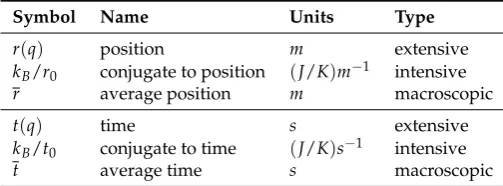
remains the same (intensive). These quantities are summarized in the Table (1).
306
Table 1.The relevant tempo-dynamic quantities
Symbol Name Units Type
r(q) position m extensive
kB/r0 conjugate to position (J/K)m−1 intensive
r average position m macroscopic
t(q) time s extensive
kB/t0 conjugate to time (J/K)s−1 intensive
A
O
B
c:
=
r
0
/
t
0r
t
Figure 1.A tempo-dynamic cycle in time and space is reminiscent of the structure of a light cone in special relativity.
3.2. Tempo-dynamic cycles in time and space
307
Equation (14), as it references a timetand a distancer, imposes requirements on the entropy of
308
the system as the light cone expands. To investigate the behavior, let’s us take Figure (1) as an example
309
of a simple tempo-dynamic cycle involving time and space. The cycle is reminiscent of a light cone,
310
but it makes additional claims about the entropy. The transitions along the cycle are:
311
1. isospatial process: While transiting fromOtoAand by keeping the distance constant (dr=0),
312
the system decreases its entropy :dS/dt=−kB/t0. 313
2. isotemporal process: While transiting fromAtoBand by keeping the time constant (dt=0), the
314
system increases its entropy :dS/dL=kB/r0. 315
3. isentropic process: While transiting fromBtoOand by keeping the entropy constant (dS=0),
316
the system’s size increases at a characteristic constant speed :dr/dt=r0/t0. 317
3.3. Fermi-Dirac statistics of events
318
We consider that an event can occur at most once (whatever happens to Schrödinger’s cat, for sure,
319
it doesn’t die twice), and thus we will use Fermi-Dirac statistics to study the occupancy distribution of
320
events. In the case of (14), its Fermi-Dirac distribution under the assumption thatµ=0 is:
321
n(q,t0,r0) =
1
expt1
0t(q)−
1
r0r(q)
+1
(15)
To better understand what is going on with this equation (Fermi-Dirac statistics over space and
322
time quantities), it helps to first illustrate the Fermi-Dirac statistics of bothr(q)andt(q)in isolation.
323
Therefore, consider these Fermi-Dirac distributions applicable tor(q)andt(q), respectively. In each
324
case, one of the two quantities has been made constant for the purposes of simplification. The two
325
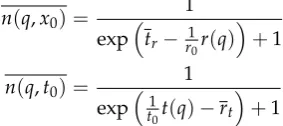
distributions (16) and (17) are illustrated in Figure2a and2b, respectively. The equations are:
326
n(q,x0) = 1
exptr−r10r(q)
+1
(16)
n(q,t0) = 1
expt1
0t(q)−rt
+1 (17)
Now we are ready to investigate the Fermi-Dirac distribution given in (15) as illustrated in Figure
327
3.
t
rr
/
t
r<
n
>
Fermi
-
Dirac
a
)
Occupancy of r for
t
rr
tt
/
r
t<
n
>
Fermi
-
Dirac
b
)
Occupancy of t for
r
tt
rr
/
t
r<
n
>
Bose
-
Einstein
c
)
Occupancy of r for
t
rr
tt
/
r
t<
n
>
Bose
-
Einstein
d
)
Occupancy of t for
r
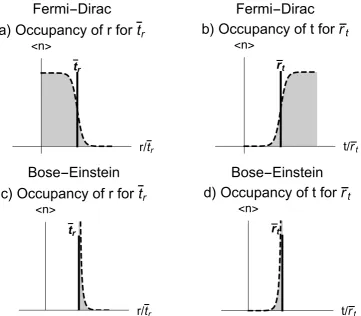
tFigure 2. a)Fermi-Dirac statistics (equation16) over the occupancy of space-time events in relation to their distance fromr=0, while holding the average timetrconstant. The shape of the curve is of the
familiar shape and direction as the well-known distribution applicable to energy levels. The slope at tris correlated to the value ofr0and is analogous tokBTin the case of energy levels.b)Fermi-Dirac
statistics (equation17) over the occupancy of space-time events in relation to their timet, while holding the average positionrtconstant. The shape is the same as the previous case, but its direction is mirrored
at thertline.c)andd): We argue at the end of section3.3that Bose-Einstein statistics are inapplicable
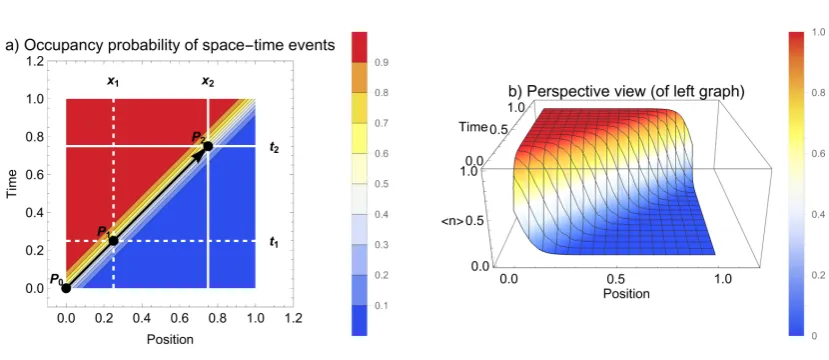
Figure 3. Fermi-Dirac statistics over the occupancy of space-time events (equation 15and with
µ=0). Red means an occupancy rate of 100%, whereas blue means 0% (and with rainbow colors for intermediate values).a)The slicest1andt2have the same shape as Figure2a. The slicesx1andx2 have the same shape as Figure2b. As the system goes fromP1toP2, occupied past states are depleted as distance states become saturated. The slope of the line fromP1toP2is the speed of light, associated with the ratio of the tempo-ture of the system.b)The image on the right is a perspective view of the image on the left.
Description: For the future, the occupancy rate of events is saturated (future events are upcoming).
329
For the past, the occupancy rate of events is depleted (past events are gone). An observerOevolving
330
fromP1toP2will, inO’s present, experience a transfer in the saturation of the occupancy of future 331
events to a saturation in the occupancy of events in space. This is the point at which we introduce the
332
analogy of the waterfall of events flooding space. Along withO, this "waterfall of events" recedes in
333
space-time at the speed of light towards the direction of the future as it "floods" local space with events.
334
Ois prohibited by entropy from knowing future events until the waterfall recedes appropriately. Past
335
events are depleted from the system following the passage of the waterfall. SinceOsees no occupied
336
past events, O’s future in space-time lies in the forward time direction, and the waterfall recedes
337
towards the future. Let’s prove this direction in the next section, and then return to this discussion in
338
section4.
339
A note on Bose-Einstein statistics: We believe that Bose-Einstein statistics (BE) are inappropriate
340
for the description of events for the following reasons:
341
1. Repeating an event that has already occurred (if such a thing is even possible) is not expected
342
to contribute to the information of the system. For instance, re-measuring Schrödinger’s cat
343
multiple times over does not make it more or less dead than it already is (if dead, or alive
344
otherwise). Generally, performing a quantum measurement on a quantum system already in an
345
eigenstate leaves the system unchanged. Thus, we would expect events to be registered only
346
when they first occur; that is to say, their informational contribution occurs at most once.
347
2. The occupancy rate of events described by Bose-Einstein statistics falls quickly away from the
348
observer and reaches near-zero well before reaching the event horizon of the light cone. Thus, the
349
argument that the occupancy rate of events represents those events that are causally connected
350
to the observer, does not hold under Bose-Einstein statistics.
351
3. Under Bose-Einstein statistics, future states are depleted and both the past and the inside of
352
the event horizon are undefined. Figure (2c) and (2d) show that Bose-Einstein statistics are
only defined for the future and for outside of the event horizon. This is inconsistent with event
354
horizons in special relativity.
355
4. Under Bose-Einstein statistics, the present occurs at a mathematical singularity which is,
356
obviously, undesirable.
357
3.4. Arrow of time
358
Our goal here is to prove that the waterfall recedes in the direction of the future.
359
Let us first investigate the production of entropy over time in (14). To do so, we divide each side
360
of (14) bydtthen multiply it byr0/kB. We obtain:
361
r0
kB
dS dt =
r0
t0 −dr
dt (18)
First, we note that as both−1/r0and 1/t0 are Lagrange multipliers, then bothr0 andt0are 362
uniform in the system. The ratior0/t0is a speed[meters/seconds]and is also uniform. 363
Second, we note that (18) represents an inflection point in the production of entropy in the system
364
atdS/dt=0. Specifically, whendS/dt<0, the entropy of the system decreases as a whole, which
365
is prohibited by the second law of thermodynamics. This occurs if the macroscopic system (randt)
366
shrinks (dr/dt<0) or grows slower than the ratior0/t0. 367
Discussion: We now conclude, based on the two points mentioned, that the arrow of time points
368
towards the future of the macroscopic system whose growth in space-time is prohibited by the second
369
law of thermodynamics from being less than the ratio of the tempo-ture. Now that we know the
370
minimum growth rate, we might wonder, what, if anything, prevents the system from exceeding the
371
ratio? Answer: the observer does not see events beyond the horizon because the occupancy probability,
372
given by Fermi-Dirac statistics, sharply drops to zero at the horizon. This limits the growth rate of the
373
system as perceived byOto the ratio of its tempo-ture.
374
3.5. Recording the passage of time
375
We integrate equation (14). We get:
376
Z
dS=−kB t0
Z
dt+kB r0 Z
dr (19)
∆S=−kB t0∆t
+kB r0∆r
+C (20)
This relation leads to two inequalities:
377
0≤ −∆S≤ kB
t0∆t 0
≤∆S≤ kB
r0∆r (21)
The first, involving time, relates the minimum amount of information (−∆S) that must be acquired
378
to prove that time has passed by a certain amount∆t. It is interpreted in the sense that the passage of
379
time∆trequires the logging of an event−∆S. The second, involving space, relates an entropy (∆S)
380
to the minimum increase in the size of space∆rrequired to accommodate it. Let us now study this
381
behavior in more detail by constructing an (abstract) thermodynamic engine that converts time to
382
space.
383
3.6. Space-time engine
384
We will define a thermodynamic engine that converts time to space. The engine is comprised of
385
a detector and a tape. The engine can write one bit on the tape atr=0. It can also shift the tape to
the right by one increment∆r(in preparation to write the next bit). For purposes of idealization, we
387
consider that the engine never runs out of tape. Finally, and without loss of generality, it helps for the
388
purposes of the illustration to consider the more familiar case where the system is at thermodynamic
389
equilibrium. Thus, we pose thermodynamic equilibrium to the inequalities with these replacements:
390
kB/t0 := P/T where P is a power in [Joules/seconds], and kB/r0 := F/T where F is a force in 391
[Joules/meters], and whereTis a temperature in[Kelvins]. We get:
392
0≤ −∆S≤ P
T∆t 0≤∆S≤
F
T∆r (22)
To ease the abstraction, we can picture a concrete system sharing similar characteristics (with
393
some limitations), such as a seismograph tracing seismic data (collected over time) on a rolling tape
394
(stored in space). The cycles of the engine occur in parallel and are completed over a time period∆t.
395
Each cycle represents a logical step in the process (not chronological). They are:
396
1. Shifting the tape to the right by∆ris favored by entropy as it increases it by∆S. Thus, an entropic
397
forceFemerges which pulls on the tape. For this engine, we associate this increase in entropy to
398
an undefined memory address (∆S=kBln 2) which becomes available at position 0 of the tape
399
when it is shifted by∆r.
400
2. The detector clicks (it produces information). To register the click,∆tincreases as∆Sis decreased.
401
To pay the energy cost to decrease the entropy, the detector draws a powerPfrom the engine
402
over the time period∆t.
403
3. Finally, the engine writes the bit associated with the click in the undefined memory address of
404
the tape. This reclaims the energy of the shift (F∆r) that produced the entropy and instead makes
405
it available to power the detector (P∆t).
406
This engine has an interesting property: the further along the tape one looks, the further back in
407
time the information on the tape refers to. At tempo-dynamic equilibrium, the tape is shifted at the
408
speed of light towards the right, and its farthest bit refers to the very first thing that has been recorded.
409
Ergo, this engine produces a light cone.
410
3.7. Gamut of related laws
411
Let us calculate the entropy at the horizon for the system then we will be in a good position to
412
discuss these results.
413
We can show that the entropy at the horizon is no greater than the Bekenstein-Hawking entropy
414
(Bekenstein [29], Hawking [31], Susskind [33]). To derive it, we must be consistent with the conditions
415
permitting the derivation of the Bekenstein-Hawking entropy in the first place: event horizons have a
416
temperature (Hawking [31], Unruh [32]).
417
First, we pose dt = 0. Then, the first step of the proof will involve taking the system at
418
tempo-dynamic equilibrium (14) and making it into a system that is also at thermodynamic equilibrium.
419
To do so, we must insert a temperature into the system while keeping in mind that 1/r0is a Lagrange 420
multiplier and, thus, is uniform at equilibrium. Preserving the units while injecting a temperature,
421
we pose the relationkB/r0 := F/T(whereFis a force in[Joules/meters]andTis a temperature in 422
[Kelvin]), and we get:
423
dS= F
Tdr (23)
For the system to be at thermodynamic equilibrium (and thus to admit a temperature), we are
424
looking for a temperature associated with black-body radiation and applicable to an object under the
425
action of a force. Within the context of special relativity, this is of course the Unruh effect (Unruh
[32], Fulling [34], Davies [35]), whose characteristic temperature is given byT:= (¯ha)/(2πkBc)and
427
applicable to an object undergoing accelerationF:=ma. Making the replacements intoF/T, we get
428
both the ratioF/TandTto remain uniform as required, and we obtain:
429
F
T =2πkB mc
¯
h (24)
Since the massmcan change, we have to insert the ratioF/TintoS = TFr, then take the total
430
derivative ofS:
431
dS=2πkBmc
¯
h dr+2πkB rc
¯
hdm (25)
where ¯h/(mc)is the well-known reduced Compton wavelength. Here, the first term is acting as
432
the factor of proportionality between the entropy and the distance (Verlinde [28]). In the case ofdr,
433
we find that the Compton wavelength mediates the intensity of the fluctuations around the average
434
valuer, consistent with our justification of the priors in section2.3. We notice that the higher the mass,
435
the higher the entropy. Since the most massive object for a givenr(radius) is a black hole, we pose
436
r:=2Gm/c2(the Schwarzschild radius) as the upper limit on entropy. The black hole also has the
437
benefit of being isotropic with respect to its center, consistent with our assumptions in section (2.1). We
438
now use the Schwarzschild radius to replacerwithmwhere appropriate to simplify (25) to:
439
dS=8πkB
Gm ¯
hc dm (26)
After integrating, we getS=4πkBGm2/(hc¯ ) +C, whereCis an integration constant. Then, by
440
posingA:=4πr2s =16πG2m2/c4and using the Planck lengthLp:=
√ ¯
hG/c3, we get a boundary on 441
the size of the entropy as:
442
S≤kB A
4L2
p
+C (27)
which is proportional to the surfaceAand includes the factor 1/4. This result serves as a sanity
443
check: The Bekenstein-Hawking entropy is recovered! Naturally, we interpret the surface as an event
444
horizon and the ratio of tempo-turer0/t0as the speed of light. 445
4. Discussion 446
We can now understand how, precisely, recording events connects to (and even produces) the
447
arrow of time. To investigate this, instead of considering the second law of thermodynamics as a
448
logically independent axiom, we will inject it into an equation of state in order to study its contribution
449
quantitatively. We recall the second law of thermodynamics which state that the entropy of a system
450
stays constant or increases (dS≥0), but never decreases. In the context of the arrow of time, we are
451
interested in the second law of thermodynamics as it pertains to time.
452
dS
dt ≥0 (28)
We can rewrite this inequality using a functionCas follows:
∂S ∂t
V,N,E
=C whereC≥0 (29)
Formulated as such, the arrow of time is mathematically equivalent to (28), but in this format
454
it is more immediately recognizable as a candidate thermodynamic law. For instance, the laws of
455
thermodynamics regarding entropy, volume and particle number are often expressed as:
456
∂S ∂E
V,N
= 1 T
∂S ∂V
E,N
= p T
∂S ∂N
E,V
=−µ
T (30)
To turn (29) into a valid thermodynamic law, it suffices to replace C with −P/T under an
457
appropriate equilibrium situation, wherePis an entropic power in[Joules/seconds]andT is the
458
temperature in[Kelvin]. Taking these laws, along with (29), we can summarize them into an equation
459
of state:
460
dE=TdS−pdV+µdN+Pdt (31)
where the last termPdtis responsible for enforcing the arrow of time explicitly within the equation
461
of state itself.
462
To make sense of this equation of state, it helps to imagine a quantum gas whose molecules are
463
under continuous measurements by the environment. First, recall that in the quantum case, the results
464
of measurements are intrinsically random and therefore to reverse the system, contrary to the classical
465
case, it is not sufficient to simply know, with infinite precision, the initial state of the air molecules (as
466
per Laplace’s demon). In the quantum case each random measurements produced by the environment
467
over time would have to be recorded in the degrees of freedom of the environment to make the history
468
of the system complete in the information theoretic sense.
469
A problem however arises while doing this. The memory requirements of the log of event will
470
outgrow any finite system, unless the system grows too. Why? Consider a gas at thermodynamic
471
equilibrium. The quantum molecules are continuously being measured by the environment even at
472
equilibrium and thus the system must store a perpetually growing log of events. To accommodate the
473
growing log, the system must somehow grow its memory proportionally to the rate at which events
474
are produced. This is why special relativity emerges as an entropic law in this context. Indeed growing,
475
at the speed of light, an event horizon (which bears an entropy) around the system guarantees that
476
the memory requirements for storing all such events as they occur in time are met. The entropy on
477
the surface of this event horizon is sufficient to make the system thermodynamically-reversible in
478
time, and thus the log of events is complete. From this, we are now ready to discuss how the past, the
479
present and the future emerges from these properties.
480
4.1. Three regimes of time
481
Reprising our discussion over the system’s qualitatively different description of the past, the
482
present, and the future, we now study the entropy dynamics of both time and distance in the context
483
of entropic special relativity. As concluded in section (3.7), when time is ignored, an observer perceives
484
the the space-like entropy to be the Bekenstein-Hawking entropy. However, the situation is different at
485
tempo-dynamic equilibrium when time is included. In this case, we find that the entropy reduction of
486
increasing thetquantity exactly compensates the entropy increase associated with increasing ther
487
quantity. From this, we would find that the observer, at tempo-dynamic equilibrium, always sees an
488
entropy of 0 in the present (plus an integration constant, to be neglected from the discussion). How do
489
we make sense of this result?
First we note that in the quantum case, unlike Laplace’s demon in the classical case, knowing the
491
initial conditions of the system is not sufficient to replay it. However, with both the initial conditions
492
and the log of events, we have enough information to replay the system from the beginning even
493
in the quantum case. As this information is sufficient to fix the present to a single solution, then
494
any additional information beyond it is therefore necessarily redundant which is why, inevitably, we
495
obtained the Bekenstein-Hawking entropy, as an upper bound on entropy, in this case.
496
The surface of the event horizon can be interpreted as keeping a record of all events relevant
497
toO’s present that have transpired since the Big Bang, in an manner complete in the information
498
theoretic sense such that the present state of the observer can be exactly recovered by replaying the log
499
from the initial conditions and under an appropriate quantum theory.
500
We describe each regime of macroscopic time as follows:
501
• Present: We associate light-like entropy with the uniquely determined present. As stated, the
502
present has an entropy of 0. It is uniquely determined by the initial conditions of the system
503
plus the log of random events that have occurred since the beginning of the system up to the
504
present time. As a result, the observer cannot be in a superposition of multiple presents and
505
consequently, we expect the observer to "measure" Schrödinger’s cat as either dead or alive, but
506
not as a superposition of both.
507
• Past: We associate space-like entropy with a trace of the past. As the waterfall recedes in
508
space-time, it leaves a trace of events in the degrees of freedom of space. An observer can, by
509
inspecting the trace, find evidence for a consistent past to account for the present. The horizon
510
produced by the depletion of past events under Fermi-Dirac statistics prohibitsOfrom going
511
backward or interacting with past events (Figure2b) directly. A similar horizon, also enforced by
512
state depletion, is found at the edge of the event horizon in space (Figure2a).
513
• Future: Finally, we associate time-like entropy with the future. The observer is prohibited from
514
peeking into its future (increasingtabove tempo-dynamic equilibrium) until it is imminent.
515
Indeed, an observer peeking into the future (without first waiting for the waterfall to recede
516
appropriately) will hit negative entropy (contradiction). The observer can hypothesize about
517
its possible futures, but the actual future is made final no sooner than in the present when the
518
entropy hits 0. This negative entropy prevents the macroscopic system from growing faster than
519
allowed by tempo-dynamic equilibrium.
520
So why do we think there is an entropy in the gas of the room I am in, for instance, if the entropy
521
of the present is allegedly zero? This is because I do not know all the bits of the log of events, thus,
522
I can successfully approximate the gas in the room as an entropic system. Partial knowledge of the
523
trace of events byOlimits the uniqueness of the reconstruction of the past achievable byObased on
524
the analysis of the trace, as it represents the number of logs of events that are compatible with the
525
observer’s unique present under partial knowledge of the log.
526
What about the arrow of time? This now accounts for only half of the story. The waterfall of
527
events, as it recedes in space-time, creates two arrows related to time. The first arrow is the familiar
528
one. The entropy associated with the degrees of freedom of space ((kB/r0)dr) increases as time moves 529
forward. The second arrow acts in the reverse direction on the degrees of freedom of time ((−kB/t0)dt). 530
With it, the entropy associated with time decreases as time moves forward because future possibilities
531
are consumed to create a present.
532
4.2. Falsifiable prediction
533
From equation (14), and preserving the units, we impose thermodynamic equilibrium on the
534
system with the replacementkB/t0:=P/TwherePis a power[Joules/seconds]andTis a temperature 535
[Kelvin]. By further posingdr=0. We get:
TdS=−Pdt (32) This equation predicts that an entropic power can be made to emerge if information is produced
537
(or consumed) over time and at constant temperature. This prediction regarding the possibility of an
538
emergence of an entropic power should be relatively easy to show experimentally.
539
4.3. Note on the signs of the Lagrange multipliers
540
The signs of the Lagrange multipliers were chosen for the following reasons: 1) Starting with
541
(14) and posingdS=0 we getdr=cdt(wherec:=r0/t0). This is the fundamental relation of special 542
relativity connecting space to time. Thus, the signs of the Lagrange multipliers must be opposite. 2) In
543
the derivation of the Bekenstein-Hawking entropy, we have usedF=ma, and notF=−ma. Thus, the
544
Lagrange multiplier of−1/r0must be negative. 3) The combination of reason one and two implies 545
that the sign of 1/t0must be positive. 546
5. Conclusion 547
We conclude that the statistical physics of space-time events admit the following:
548
1. The speed of light as the ratio of the tempo-ture of the system.
549
2. A waterfall of events receding towards the future and flooding the present with events.
550
3. A surface boundary to maintain the average growth of the system consistent with the speed
551
of light and causality. This limits the entropy of the inner system proportionally to its area
552
(Bekenstein-Hawking entropy).
553
4. A description of all three regimes of time (past, present, and future) distinctly from one another,
554
and in a manner consistent with our macroscopic experience of said regimes. Specifically:
555
(a) The observer perceives the macroscopic present with an entropy of 0, negating the possibility
556
of being in a superposition of multiple possible presents,
557
(b) The observer cannot peak into the future without hitting negative entropy (contradiction),
558
(c) The observer cannot observe past events as their occupancy is depleted. At best, an attempt
559
to reconstruct the past can be made based on a forensic analysis of the present. With partial
560
knowledge of the log of events, this reconstruction is not uniquely determined as multiple
561
logs of events lead to the same present.
562
Funding:This research received no external funding
563
Conflicts of Interest:The author declares no conflict of interest.
564
References 565
1. Popper, K.R. The arrow of time.Nature1956,177, 538–538.
566
2. Layzer, D. The arrow of time. Scientific American1975,233, 56–69.
567
3. Davies, P.C.W.The physics of time asymmetry; Univ of California Press, 1977.
568
4. Zeh, H.D.; Page, D.N. The physical basis of the direction of time, 1990.
569
5. Callender, C. Thermodynamic asymmetry in time2001.
570
6. Price, H. Time’s arrow & Archimedes’ point: new directions for the physics of time; Oxford University Press,
571
USA, 1997.
572
7. Landsberg, P. Time in statistical physics and special relativity. InThe Study of Time; Springer, 1972; pp.
573
59–109.
574
8. Halliwell, J.J.; Pérez-Mercader, J.; Zurek, W.H.Physical origins of time asymmetry; Cambridge University
575
Press, 1996.
576
9. Carroll, S. From eternity to here: The quest for the ultimate arrow of time. Dutton, New York2010.
577
10. Maxwell, J.C.Theory of heat; Longmans, Green, 1891.
11. Knott, C.G. Quote from undated letter from Maxwell to Tait.Life and Scientific Work of Peter Guthrie Tait.
579
Cambridge University Press1911, p. 215.
580
12. Thomson, W. The sorting demon of Maxwell. R. Soc. Proc, 1879, Vol. 9, pp. 113–114.
581
13. Leff, H.; Rex, A.F.Maxwell’s Demon 2 Entropy, Classical and Quantum Information, Computing; CRC Press,
582
2002.
583
14. Weinert, F.The scientist as philosopher: philosophical consequences of great scientific discoveries; Springer Science
584
& Business Media, 2004.
585
15. Szilard, L. Über die Entropieverminderung in einem thermodynamischen System bei Eingriffen
586
intelligenter Wesen.Zeitschrift für Physik1929,53, 840–856.
587
16. Landauer, R. Irreversibility and heat generation in the computing process. IBM journal of research and
588
development1961,5, 183–191.
589
17. Bennett, C.H. Notes on Landauer’s principle, reversible computation, and Maxwell’s Demon. Studies In
590
History and Philosophy of Science Part B: Studies In History and Philosophy of Modern Physics2003,34, 501–510.
591
18. Ellis, G.F.R. The arrow of time and the nature of spacetime.Studies in History and Philosophy of Science Part
592
B: Studies in History and Philosophy of Modern Physics2013,44, 242–262.
593
19. Touchette, H.; Lloyd, S. Information-theoretic limits of control.Physical review letters2000,84, 1156.
594
20. Parrondo, J.M.; Horowitz, J.M.; Sagawa, T. Thermodynamics of information.Nature physics2015,11, 131.
595
21. Landauer, R.; others. Information is physical. Physics Today1991,44, 23–29.
596
22. Goold, J.; Huber, M.; Riera, A.; del Rio, L.; Skrzypczyk, P. The role of quantum information in
597
thermodynamics—a topical review. Journal of Physics A: Mathematical and Theoretical2016,49, 143001.
598
23. Streltsov, A.; Adesso, G.; Plenio, M.B. Colloquium: quantum coherence as a resource.Reviews of Modern
599
Physics2017,89, 041003.
600
24. Adesso, G.; Bromley, T.R.; Cianciaruso, M. Measures and applications of quantum correlations. Journal of
601
Physics A: Mathematical and Theoretical2016,49, 473001.
602
25. Eddington, A.The nature of the physical world: Gifford lectures (1927); Cambridge University Press, 2012.
603
26. Kaniadakis, G. Statistical mechanics in the context of special relativity.Physical Review E2002,66, 056125.
604
27. Jacobson, T. Thermodynamics of Spacetime: The Einstein Equation of State.
605
[https://arxiv.org/abs/gr-qc/9504004v2].
606
28. Verlinde, E.P. On the origin of gravity and the laws of Newton. Journal of High Energy Physics2011,2011, 29.
607
doi:10.1007/JHEP04(2011)029.
608
29. Bekenstein, J.D. Black holes and entropy.Physical Review D1973,7, 2333.
609
30. Gibbons, G.W.; Hawking, S.W. Cosmological event horizons, thermodynamics, and particle creation.
610
Physical Review D1977,15, 2738.
611
31. Hawking, S.W. Black hole explosions? Nature1974,248, 30.
612
32. Unruh, W.G. Notes on black-hole evaporation. Phys. Rev. D 1976, 14, 870–892.
613
doi:10.1103/PhysRevD.14.870.
614
33. Susskind, L. The world as a hologram. Journal of Mathematical Physics1995,36, 6377–6396.
615
34. Fulling, S.A. Nonuniqueness of Canonical Field Quantization in Riemannian Space-Time. Phys. Rev. D
616
1973,7, 2850–2862. doi:10.1103/PhysRevD.7.2850.
617
35. Davies, P.C.W. Scalar production in Schwarzschild and Rindler metrics. Journal of Physics A: Mathematical
618
and General1975,8, 609.