For Peer Review
Road towards Lean Six Sigma in Service Industry: A Multi-Factor Integrated Framework
Journal: Business Process Management Journal
Manuscript ID BPMJ-08-2015-0118.R2 Manuscript Type: Original Article
Keywords: Operations management, Business excellence, Lean Six Sigma, Critical success factors, Multiple Case-studies, Service Industry
For Peer Review
1
Road towards Lean Six Sigma in Service Industry:
A Multi-Factor Integrated Framework
Abstract
Purpose - This study adopted a multiple case-study approach, of three companies, in order to identify the factors affecting Lean Six Sigma (L6σ) implementation in service
industry.
Design/methodology/approach – Secondary data were collected through companies’ documents, written procedures and quality assurance policies. Primary data were
collected through a number of in-depth interviews with managers and quality experts.
Findings - The analysis of qualitative data gathered through in-depth interviews with managers in all three cases resulted in the emergence of variety of CSFs regarding L6σ
implementation in service industry. As it can be seen the great majority of the factors
have been identified in all three cases. Moreover the analysis shows that there are two
categories of factors emerged.
Originality/value – This study has four major contributions. Firstly, it provides an intergraded multifactor framework regarding the implementation of L6σ in service
industry. In particular, this study contributes with three more particular factors that
influence the implementation of L6σ in services, namely top-management active
involvement, HR support activities, and practices & systems. Secondly, it focuses on the
responses of managers, who play the critical role in the adoption of L6σ. Thirdly,
For Peer Review
2 supports and expands current literature on the key success factors of L6σ application.
Finally, it provides future ideas to explore and develop more the suggested L6σ
framework.
Key words: Lean Six Sigma, Critical Success Factors, Systems Approach, Multiple Case-studies, Service Industry
Article Classification: Research paper
Introduction
It has been argued that traditional management tools cannot cope effectively with
current business complexities (Itkin, 2008; Chee, 2008). Therefore, a lot of companies
continuously attempt to develop and implement new management ideas (Saravanan,
2006; Chang, 2006). A question that emerges is what are the special conditions that
affect the adoption of such practices in different than manufacturing organisations and
industries. A prime example of such practices is Lean Six Sigma (L6σ) which is a
synthesis of Six Sigma (6σ) and Lean Management (LM). L6σ targets to maximize
shareholder value by achieving fast improvements in customer satisfaction, quality cost,
and speed of the process (Sunhilde & Simona, 2007; Hill et al. 2011).
By implementing this methodology, companies could improve business
environment and therefore performance. It is an approach that is focused on quality and
continuous improvement, based on the participation of all employees (Lubowe & Blitz,
2008). L6σ has been applied in manufacturing industry and in some cases in services
and get good results, increasing efficiency of procedures and improving product quality
(Bowen & Youngdahl, 1998; Engelund et al. 2009).
For Peer Review
3 L6σ can be considered as another evolution of management tools in order to
face increased competition and market shifts (Caldwell, 2006a). However, the main
challenge for L6σ are the special factors that influence its application in companies.
These factors seem to be related to both success and failure of quality management
systems (Moosa & Sajid, 2010). In other words, it has been widely argued that the
application of operations management techniques is not only based on technical factors,
but it is mainly associated with organisational-oriented factors like culture, climate,
working environment, policies and procedures (Hope & Mϋhlemman, 2001; Noronha,
2003; Ayoob, et al. 2003; Psychogios & Wilkinson, 2007).
Nevertheless, the emphasis on the exploration of the factors above seem to be
neglected from the current literature. In other words, there is a need to investigate the
factors that are critical for the success or failure of such an inititative.These factors are
known as critical success factors (CSFs) that are important in order to achieve effective
levels of quality management (Saraph et al. 1989), organizational goals (Hardaker &
Ward, 1987; Fishman, 1998; Hayes, 2000; Henderson & Evans, 2000), and
organizational performance (Guimaraes et al. 1996; Dwyer et al. 2000).
There are several studies that investigate CSFs of quality initiatives.
Traditionally the most of these studies concern total quality management (TQM)
programs (Yusof & Aspinwall, 1999), lean production (Achanga et al. 2006), and Six
Sigma (Antony & Banuelas, 2002). There are also some studies referring to L6σ
(McManus, 2008; Ferguson, 2007; Lane 2008; Carreira, 2005; Arnheiter & Maleyeff,
2005), but it seems that main emphasis is on manufacturing industry. The service
industry, which traditionally is a more challenging organisational ‘space’, seems to be
neglected for the application of such concept (Psychogios et al. 2012). In this respect the
For Peer Review
4 purpose of this paper is to explore and comprehend the CSFs related to the application
of L6σ.
Moreover, since it is well documented that LM and 6σ approaches are
complementary under a quality management philosophy tool (Antony et al. 2003;
Näslud, 2008; Burgess, 2010; Vince, 2008; Shan et al. 2008) a more holistic approach
like this of systems science seems to be more capable of embedding philosophical and
cultural aspects of lean with the rigorous scientific approach of six sigma through a
unified hard / soft systems philosophy. In this respect, Pepper & Spedding (2010)
suggest that LM and 6σ should be combined through the integrated management of
quality, a scientific approach and an ‘all-one-team’ approach “which optimises systems
as a whole and focuses on the right strategies in the correct places”. They conclude that
any such model should be: strategic and process focused; balanced between the two
philosophies to harness the recognised advantages of both; balanced between
complexity and sustainability; and structured around the type of problem experienced.
In similar vein, more recent scientific evidence revealed that while practitioner guides
prescribe brief implementation models they do not describe how they should be adapted
to particular organizational contexts (Orme et al. 2013). The existing approaches for
frameworking L6σ methodology do not provide evidence towards soft systems thinking
(Orme et al. 2013). Therefore in this study is built on this argument, considering
systems approach as very useful one in understanding a complex process such as L6σ.
In this respect, we argue that the factors influencing the application of L6σ in service
industry cannot be seen and understood isolated to each other, but as a whole under the
formulation of a multifactor framework.
The article is structured in six sections. The first section briefly introduces the
concept of L6σ. The second section reviews the current literature related to L6s
For Peer Review
5 application while the third one presents study’s research rationale. The fourth section
explains the research methodology applied while the fifth one analyses the main
findings. Finally, the paper is completed with a concluding section.
Lean Six Sigma
As a synthesis of 6σ and LM, L6σ incorporates principles and concepts from both of
them. 6σ suggests that there is a direct correlation between the defects appearing in
products and customer satisfaction. 6σ based its success on the use of statistical methods
for identifying defects and improving processes and at the same time responding to the
voices of customers (Sharma & Chetiya, 2009; Fazzari & Levitt, 2008). Also 6σ is a
methodology that improves business processes based on understanding, controlling
variation and reduces cost of poor quality (Bendell, 2006; De Mast, 2006; Kanji, 2008;
Harry, 1998; Chang-Tseh, 2007).
In addition, LM provides a set of standard solutions to common problems and
optimizes processes across the entire value chain, but lacks organizational structure,
analytical tools and quality control (De Koning et al. 2008). The most challenging
issues that organizations face are excess and waste of processes and their results. The
waste constitutes mainly of resources, time, manpower and capital. In today's business
environments companies need to reduce costs in order to offer cheaper and better
quality services. The reduction in costs can be achieved if the organization attacks
systematically on waste (Ferguson, 2007; Lane, 2008). According to LM rhetoric, the
improvement in quality can be achieved by the limitation of every aspect that does not
add value within the organization (Cooper, 2008).
Although 6σ and LM have different backgrounds, they have similar goals.
Nevertheless several of the businesses today have adopted one of the two approaches
For Peer Review
6 they found that competitiveness can be improved up to a point (Carreira, 2005). Beyond
the positive results that can be achieved, Lean cannot bring a process under statistical
control, while 6σ alone cannot dramatically improve the speed of the production process
and reduce invested capital (Carreira, 2005). Therefore, a combination between the two
methods is required (Arnheiter & Maleyeff, 2005). The combination may result on the
reduction of process variation and elimination of waste (Furterer & Elshennawy, 2005;
Jing, 2009; Antony et al. 2003). In this respect, L6σ concept emerged as a balanced
approach between the two concepts, attempting to create a synergy between their
functionalities (Arnheiter & Maleyeff, 2005; Ferguson, 2007) and create extra value to
organizations. L6σ integrates 6σ and LM processes, where LM aims on cycle time and
waste elimination while 6σ seeks to eliminate defects and reduce variation (Lubowe &
Blitz, 2008).
The implementation of L6σ in a company should not be considered as the sum
of many individual improvement projects, but complementing and simultaneous
implementing approaches of LM and 6σ. L6σ organization is the one where L6σ
philosophy expanded in all business operations and units, establishes a culture and
environment of creativity and innovation (Lubowe & Blitz, 2008). In this respect, it is
critical to explore the special conditions that facilitate or/an inhibit L6σ application.
L6σ Implementation Factors
CSFs are those key aspects of activity that produce very satisfactory results critical for
an organization to achieve its goals (Bullen & Rockart, 1981). CSFs can be considered
as major starting points for the L6σ implementation process. According to the literature,
CSFs seem to be the key aspects of accomplishing companies’ visions to improve
For Peer Review
7 customer satisfaction and delivery of quality outcomes. Thus, the purpose in this section
is to discuss the CSFs that affect the L6σ implementation.
Exploring the literature we can distinguish several CSFs that influence L6σ. In
particular, literature emphasizes on the integration of L6σ with business strategy
(Lubowe & Blitz, 2008; Fornari & Maszle, 2004; Antony et al. 2007; Kamensky, 2008),
customer satisfaction (Antony et al. 2003; Antony et al.. 2007; Andel, 2007; Lubowe &
Blitz, 2008), committed leadership (Laosirihongthong et al. 2006; Maleyeff, 2007;
Stuenkel & Faulkner, 2009; Carleysmith et al. 2009; Ladhar, 2007) and quality-driven
organizational culture (Furterer & Elshennawy, 2005; Maleyeff, 2007; Lubowe & Blitz,
2008; De Koning et al. 2006; De Koning et al. 2008; O’Rourke, 2005). At the same
time, L6σ literature focuses on aspects like training (Anthony et al. 2003; Ladhar,
2007; Caldwell, 2006a; Antony et al. 2004; Delgado et al. 2010) and teamwork
(Neuhaus & Guarraia, 2007). Finally, it gives special attention to project management
issues (Antony et al. 2004; Laosirihongthong et al. 2006; Ladhar, 2007; Breyfogle,
2008), and the importance of technical systems (Kamensky, 2008). It is important
though to examine in more details the most important CSFs as indicated in many
studies.
One of the most critical factors widely investigated is leadership. In the
methodology of 6σ, leadership holds a decisive role for its success (Antony &
Fergusson, 2004; Laosirihongthong et al. 2006; Carleysmith et al 2009). Also, the
effectiveness of LM needs to be supported by strong leadership that binds workers to
form multifunctional and self-working groups, which can apply the tools and techniques
of eliminating waste (Al-Najem et al. 2012). The emergence of leaders’ role is included
as key evidence in various early studies of L6σ (Antony et al. 2003; Lubowe & Blitz,
2008) as well. Many authors (Shah et al. 2008; Marhevko, 2008; Byrne et al. 2007;
For Peer Review
8 Kumar et al. 2006; Johnson, 2006; Caldwell, 2006b; Furterer & Elshennawy, 2005;
Thompsen, 2005) agree that L6σ is a methodology that demands dynamic decisions,
total participation of all employees, total confidence in the process towards the target
and loyalty to the process. In this respect, active leadership is critical since it is the one
that does not hesitate to take the subversive decisions and inspire the employees in order
to be more efficient, consistent, committed, and satisfied, in order to meet the principles
of L6σ (Antony et al. 2003; Lubowe & Blitz, 2008). Byrne et al. (2007) argue that
leaders must be driven by a vision based on market demands and in their own abilities.
They also add the fact that leadership should aim to a constant innovation and to be
committed to operational change that leads to success. According to other authors,
leadership helps in changing the attitude of the personnel, empowerment readiness, and
improvement of production processes and in business efficiency but also, focus on
customers in order to achieve innovation and economic performance (Byrne et al. 2007,
Thompsen 2005).
Beyond leadership, organisational culture is another critical factor that impacts
the application of L6σ. It is perhaps the most difficult component needed to be changed
in a company which wants to integrate successfully L6σ (Tata & Prasad, 1998; Hope &
Muhlemann, 2001; Noronha, 2003; Ayoob et al. 2003). This is the reason why various
authors have emphasized that aspect for the application of quality management
initiatives (Psychogios & Wilkinson, 2007). The cultural obstacle is mainly related to
employee resistance who fear any change and future variations in their day-to-day
practices.
L6σ literature has recorded specific causes of L6σ-oriented change failure. Three
potential pitfalls may prevent proper culture change, the misinterpretation of
standardization, the devaluation of the role of diversity and how to use the released
For Peer Review
9 capacity (Johnstone et al. 2011). For Johnstone et al. (2011), the failure of recognition
of the importance of unwritten rules and tacit assumptions, which characterize their way
of acting and performing, is one of the main factors for the failure of culture change that
L6σ requires. Byrne et al. (2007), suggest that specific cultures can inhibit L6σ
application due to the lack of the appropriate procedures, appropriate discipline and
entrepreneurial philosophy, that encourages significant innovations on an ongoing basis.
According to Hilton & Sohal (2012) the types of culture which have a positive effect on
L6σ are: group culture (participation, teamwork, facility leaders, people and
obligations), development culture (creativity, flexibility, entrepreneurial leaders,
innovation and new resources) and rational culture (efficiency, focus on target
achievements leaders, orientation to the objectives and competition).
Another vital factor for L6σ initiative is innovation. Innovation is the use of
knowledge in producing and delivering new products or services that consumers require
(Hoerl & Gardner, 2010). However, a question raised from researchers is whether the
L6σ helps or restricts the innovation philosophy and vice versa (Johnstone et al. 2011;
Polk, 2011; Carleysmith et al. 2009; Scheeres, 2009; Fowler, 2008; Lubowe & Blitz,
2008; García-Porres et al. 2008; Byrne et al. 2007). L6σ grows through formal
procedures, roles and ways of thinking limits the freedom for creativity and
consequently the possibility to express some form of innovation. At the same time, an
innovation culture may be proved antithetical on the application of strict procedures and
tools that L6σ requires. However, there are research evidence supporting that L6σ
creates a beneficial environment in terms of creativity and innovation (Carleysmith et
al. 2009; Johnstone et al. 2011; De Koning, 2008; Fowler, 2008). Other authors (Byrne
et al. 2007; Lubowe & Blitz, 2008; García-Porres et al. 2008; Polk, 2011; Scheeres,
2009), investigated and analysed the ways that L6σ organisations can achieve
For Peer Review
10 innovation and excellent financial performance. Their findings suggest that L6σ
organisations succeeded to have an integrated culture of innovation according to four
attributes they developed: a) the innovative vision that is based on customer insights, b)
a group of leaders who are committed to continuous innovation, c) the alignment across
the entire range of business and d) organizational skills that have made innovation an
everyday routine.
In conclusion, there are both institutional and contextual factors. Also, these
factors could be categorized into generic that applied in all types of organizations and
sectors, as well as in organisational-specific (corporate culture, national mentality and
working habits, particular PMS, quality system) and in industry-specific (services or
manufacturing) (Psychogios et al. 2012). However, the major issue with the majority of
the above studies is that they mainly developed in manufacturing. However, L6σ
methodology is not a standardized procedure so it can be used in various sectors and
various industries (Pande et al. 2000; Cross, 2007; Dreachslin, 2007). Nevertheless, it
seems that service industry is still neglected from the research agenda of many scholars.
This industry set a clear challenge for every quality initiative.
L6σ application in Service Industry
Recent literature shown that there is an increased interest is implementing L6σ in the
service industry (Naslund, 2008; Byrne et al. 2007; Brett & Queen, 2005).However,
there is a limited number of studies that attempt to identify the critical success factors
that affect L6σ in services (Psychogios et al. 2012; Psychogios & Tsironis, 2012).
For example, Vavra (2007) argues that L6σ can be successful in services when it
lasts for a long time, which also depends on the level of its maturity. According to
Hilton & Sohal (2012), a successful L6σ project in service organisations deploys in five
For Peer Review
11 stages, the launch, the early success, the scale replication, the institutionalization and the
culture transformation. Another way of evaluating L6σ success in services is related to
four parameters, like total quality, process efficiency, responsiveness and cost (De
Koning et al. 2008, Shah et al. 2008). In similar vein, the successful implementation of
L6σ in services depends on the level of competences and roles of the individuals that
run L6σ project (i.e. black belts) (Mehta, 2007, Hilton & Sohal 2012).
On the other hand, what seems to lack from service organisations is a systematic
approach of business change and improvement (Naslund, 2008). These companies fail
to properly implement L6σ either due to the lack of appropriate leadership, or to the
incorrect selection of candidates for leadership positions that can take an inactive role
and involvement (Brett & Queen, 2005). Moreover, successful implementation of L6σ
in services requires its integration with continuous improvement philosophy (Pojasek,
2003), which means that a shallow confrontation with the project cannot result in its
success (Malik & Blumenfeld, 2012).
Gibbons (2006) emphasizes on improvement of the οverall equipment
effectiveness using L6σ. Mazzola et al. (2007) focuses on the ways in which Lean and
6σ can drive process improvement actions. Pojasek (2003) examines the initiatives that
need to be taken for a successful L6σ implementation. Pusporini et al. (2012) explain
how the use of L6σ achieves maximum competitiveness of new service delivery. Vavra
(2007) & Naslund (2008) indicate that the proper implementation of L6σ increases
operational readiness for change. In similar vein, Leduc et al. (2010) involved the
operational learning as a factor that can lead to business change and thus the
achievement of objectives of L6σ. Arumugam et al. (2012) pointed out that the
observation function as a tool with a very important contribution to the success of L6σ
projects.
For Peer Review
12 Kondić & Maglić (2008) argues that the most critical factor for the success of
L6σ in services is customer satisfaction. Manville et al. (2012) rank as the most
important CSFs the enthusiasm, the support and commitment of senior management, the
connection of L6σ to business strategy, its connection with the client, understanding the
techniques and tools, the selection and the priority programs, and finally, training and
education. Timans et al. (2012) agree with the above criteria, but go further by adding
the personal experience of the upper management team members with L6σ projects, the
development of leadership skills. They also emphasize some factors that prevent the
success such as the internal resistance, the unavailability of resources, changing
business objectives and lack of leadership.
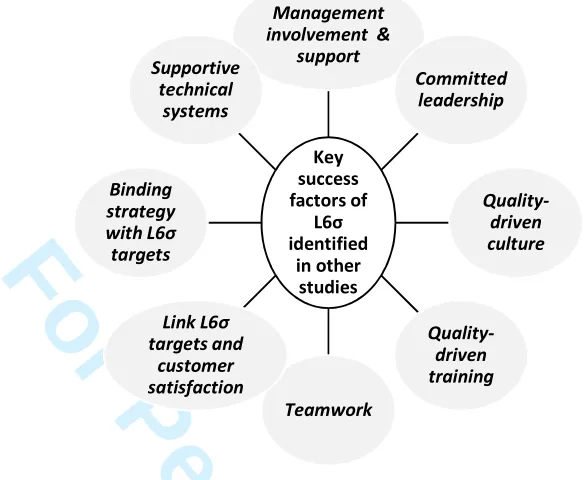
An important conclusion from the above literature is that there is a generic
agreement that the success of every L6σ initiative depends on specific CSFs in service
industry as it is depicted in figure 1. The great majority of scholars agree that there is a
group of factors while others focuses on single ones. Also, CSFs of L6σ application in
service industry could be classified in facilitators or inhibitors. The former influence
positively the process while the latter are considered as barriers to L6σ successful
implementation (Psychogios & Tsironis, 2012; Psychogios et al. 2012). Moreover, all of
the studies above recognize the importance of the CSFs in L6σ and some conclude that
these factors play a much more significant role in comparison to previous quality
initiatives like TQM and JIT (Naslund, 2008).
Insert here figure 1
Rationale of the study
Literature suggests that CSFs like leadership, strategic orientation, teamwork, technical
approaches (metrics-systems), and training affect L6σ application in the service
For Peer Review
13 industry. The previous list is complemented by the appropriate organizational culture
which emphasizes on quality improvement and customer satisfaction. However, the
in-depth exploration of the interrelationship of the CSFs seems to be neglected by the
literature. What is missing is a holistic framework which integrates and interrelates the
CSFs that can contribute to our understanding regarding the implementation of L6σ.
Since the majority of the above factors have emerged mainly in studies conducted in
manufacturing industry, service industry seems to be a more complex and challenging
business field for L6σ application. Therefore, it seems that L6σ research needs to turn
their attention towards service organisations (De Koning et al. 2008; Su et al. 2006).
At the same time, the entire lean program and six sigma can be organized and
implemented within the basic structure of the Systems Approach (Pojasek, 2003). The
Systems Approach offers an ideal way to coordinate lean and six sigma. Neither lean
nor six sigma has a simplified means for determining continuous improvement and
tracking it. They may track costs, but not performance. By contrast, the Systems
Approach, L6σ can cope effectively and efficiently with current business demands.
(Itkin, 2008; Chee, 2008; Pojasek, 2003). According to (Clegg & Orme, 2012) L6σ is a
holistic soft systems methodology (SSM), which is the most suitable approach for
improving human activity systems, rather than hard systems thinking which is more
suitable for mechanistic or physical systems. However a clear concise model has not yet
been produced (Pepper & Spedding, 2010). Thus, the current challenge is to produce a
unified model of lean management and six sigma improvement that is systematic,
systemic and holistic which can be used to optimize systems as a whole (Clegg & Orme,
2012). The risk of not applying systems approach to L6σ improvement initiatives is that
different levels (or pitches) of thinking (e.g. philosophy, methodology and tools) and
For Peer Review
14 their potential overlap will go unrecognized; and thus their potential impact on
organizational performance will be reduced (Clegg & Orme, 2012).
In this respect, the present study attempts to expand our understanding regarding
the factors influencing the application of L6σ in services by adopting a system view. In
particular, by analyzing research evidence gathered in three distinctive companies that
applied L6σ, attempts to argue in favor of a multi-factor framework that can be critical
in its application.
Research Methodology
This study followed a multiple case-study approach as the most appropriate considering
the exploratory nature of the study (Voss et al. 2002; Nonthaleerak & Hendry, 2008;
Christy & Wood, 1999; Goodman, 1999). Qualitative research is particularly
well-suited to service industry investigations (Gilmore & Carson, 1996; Psychogios &
Priporas, 2007) and useful in case-driven research approaches (Ellram et al. 2004). This
is even more important when the phenomenon and the context under investigation are
not easily separated (Yin, 2003a, 2003b). A multiple case-study approach can also
provide more in-depth evidence in understanding complex relationships related to
operations and supply chain management (Ellram, 1996), which are associated with the
concept of L6σ. Furthermore, through this research approach someone can identify
links between theory and method (Dubois & Araujo, 2007). In addition, an empirically
valid theory can be supported mainly by multiple case-studies (Eisenhardt & Graebner,
2007) that can explore and explain better social phenomena that cannot be identified
easily through other methods (Eisenhardt, 1989a 1989b). In a similar vein, Flyvbjerg
(2006) argues that through a case study approach we can explore things that cannot
easily identified with other methods. Also, an in-depth multiple case-study approach can
For Peer Review
15 increase the ability of organisational actors to take better decisions and improve
performance (Rendtorff, 2015). Finally, through a multiple case-study approach
comparisons of events and data across cases can be developed (Voss et al. 2002;
Nonthaleerak & Hendry, 2008).
Furthermore, the qualitative approach it is more suitable for capturing complex
relationships (Delgado et al. 2010), for exploring the impact of different factors on
quality management tools, like L6σ (Psychogios & Priporas, 2007). Finally, managers
are more likely to participate in a qualitative process of investigation (Coldwell, 2007).
Therefore, since the aim of the study was to explore an integrated framework of CSFs
that potentially affect the adoption of L6s in services, a qualitative approach was more
appropriate.
In particular, three companies operating in service industry have been identified
as critical cases where L6σ has been applied. Company A (CA) operates in
telecommunication industry, Company B (CB) operates in airline industry and
Company C (CC) operates in Insurance industry. Primary data were collected by
conducting face-to-face in-depth interviews with managers that involved in the L6σ
application process. The interview questionnaire was a semi-structured one with
open-ended questions. The semi-structured interview can provide explanations of why things
happened (Creswell, 2003). In addition, the open-ended questions allowed participants
to develop their own views (Denscombe, 2003) on issues related to inter-organisational
relationships and dependence between the
. The interview guide employed covered a variety of different issues
such as key service performance aspects and how they are measured and dependencies
among operations and quality targets of the companies.
For Peer Review
16 A purposive sampling approach was used in order to select the interviewees
(Patton, 1990).The sample within the cases was based on the position that respondents
held in the organization and their functional involvement in the implementation process.
Managers that involved in the L6σ application process were selected from a variety of
business areas like administration, quality assurance, human resources, sales, marketing,
operations, and IT. Also, some of the managers interviewed were experts in 6σ (Black
Belts and Green Belts). In total 47 interviews were conducted, 15 in Company A
(telecommunication) 18 in Company B (airline) and 14 in Company C (insurance).
Interviews conducted in an open manner guaranteeing that the participants
would freely respond the issues under investigation. All interviews conducted in English
language as the all of the participants are using English as their day-to-day working
language. The interviews began with questions developed to collect information
regarding interviewees’ involvement in the process of L6σ, in order to ensure that the
participants shared a sufficient understanding of the process under investigation. The
interviews recorded after permission taken and they transcribed shortly after occurred
attempting to increase reliability (Eisenhardt, 1989b).
Company’s documentation related to quality programs, such as procedures and
quality management policies were used as secondary data. The analysis of the
secondary data contributed to the design of the interview questionnaire. Also, secondary
information helped to triangulate data and to increase overall validity (Marshall &
Rossman, 1999).
Within-case analysis was conducted manually, in parallel with data collection, to
understand the main types of L6σ (inter)dependencies. Following the work of Miles &
Huberman (1994), the data were pulled together in a database and categorised in terms
of source type (interview transcripts and documents). The data was coded to facilitate
For Peer Review
17 analysis, in accordance with practice (Krippendorff, 1980; Dubois & Gadde, 2002).
Open coding procedures were used (Strauss & Corbin, 1990). Through this method
emphasis was given in the identification of key-words related to the scope of the study.
These key-words and their interrelations were subsequently adjusted considering also
themes emerging from the data as well as additional theoretical insights from the L6σ
theory. Open codes were successively grouped into higher level categories using an
axial coding approach (Strauss & Corbin, 1990). Furthermore, searching for cross-case
patterns, the method followed was the construction of an array, in order to identify
similarities and differences per category case (Voss et al. 2002). Finally, key findings
were identified by using a pattern matching approach (Yin, 2003b) and then discussed
with reference to the existing L6σ literature.
Findings
The analysis of qualitative data gathered through in-depth interviews with managers in
all three cases resulted in the emergence of variety of CSFs regarding L6σ
implementation in service industry (Voss et al, 2002; Meredith, 1998). In particular, the
multiple case-studies deployed allowed comparison of events that provided more
generic conclusions (Nonthaleerak and Hendry, 2008). This approach also contributed
in the exploration of the impact of different contextual factors on operations
management tools and techniques (Delgado et al, 2010; Psychogios and Priporas, 2007;
Mangen, 1999). In addition, taking into consideration the nature of services, the analysis
of the qualitative data provided more robust results regarding the application of L6σ
(Gilmore and Carson, 1996).
For Peer Review
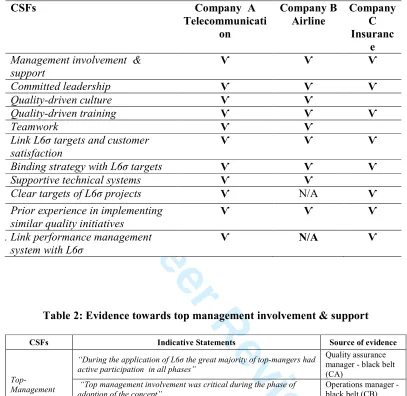
18 Table 1 depicts in more detail the sources of the CSFs according to the case each
one emerged after the interviews with managers. As it can be seen the great majority of
the factors have been identified in all three cases. Moreover the analysis shows that
there are two categories of factors emerged.
Insert here table 1
It is important though to see in more details how these factors are supported with
evidence provided by the three cases investigated. Top management involvement &
support was identified as a factor that facilitates the process. This finding, presenting in
table 2, seems to be in line with findings from previous studies (Lubowe & Blitz, 2008;
Antony et al. 2003; Carleysmith et al. 2009).
Insert here table 2
Similarly, strong and committed leadership seems to be critical for L6σ
implementation in service industry (see table 3). The leadership aspect can widely be
observed in all of interviewees’ responses. Indicative of a committed leadership is the
fact that the majority of functions are coordinated by top executive officers in all cases
explored.
Insert here table 3
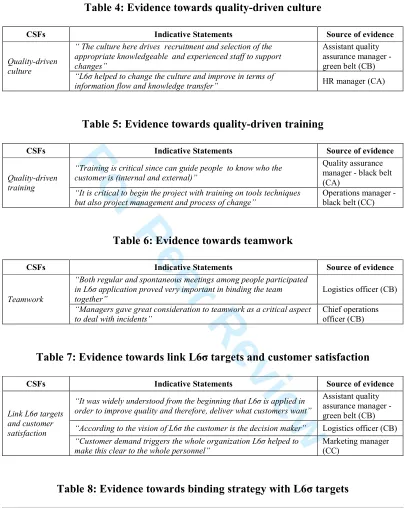
In addition, Quality-driven organizational culture (see table 4) seems to
facilitate the process of overcoming barriers for successful implementation, which is
aligned with the suggestion that quality management systems demand organizational
culture change (Furterer & Elshennawy, 2005; Maleyeff, 2007).
Insert here table 4
For Peer Review
19 Continues training is also critical for L6σ application, and especially this
training related to project management tools and development of soft skills (see table 5).
Previous studies seem to support similar arguments (Antony et al. 2003; Caldwell,
2006a; Ladhar, 2007).
Insert here table 5
Moreover, the emphasis on teamwork in problem solving (see table 6) and
collective decision-making process, seems to be substantial in L6σ, at least for the two
out of the three cases explored. This again supports similar findings by Neuhaus &
Guarraia (2007).
Insert here table 6
Direct link between L6σ and customer satisfaction (see table 7) is considered to
be the guiding principle for implementation of L6σ. This is in line with literature
(Antony et al. 2003; Antony et al. 2007; Lubowe & Blitz; 2008). L6σ projects need to
start with transfer of the Voice of the Customer (VoC) to the Voice of Processes (VoP)
and of course the synthesis between the VoC and the Voice of the Business (VoB)
(Psychogios, et al. 2012).
Insert here table 7
In addition, strategic orientation of quality improvement initiatives (see table 8)
has been proved as another important element of the successful application of L6σ. The
interviewees’ arguments show that a strong relation between the two facilitates the L6σ
process, which seems to be also supported by the current literature (Lubowe & Blitz,
2008; Fornari & Maszle, 2004; Antony et al. 2007; Kamensky, 2008).
Insert here table 8
For Peer Review
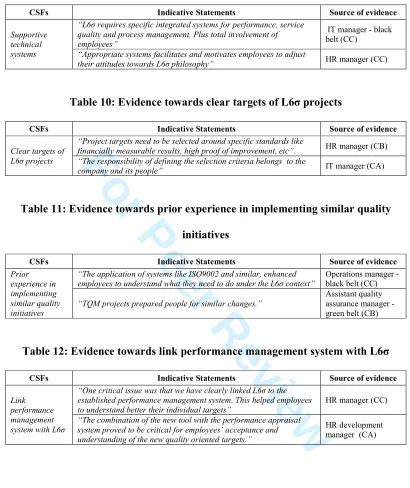
20 Moreover, supportive Technical systems like appropriate tools, techniques as
well as supportive IT systems (see table 9), have been considered as extremely
substantial in the proper application of L6σ, at least for the two industries investigated,
namely telecommunication and airline. This finding seems to support similar findings
by Kamensky (2008), that argues in favor of an appropriate infrastructure with technical
approaches that can facilitate L6σ.
Insert here table 9
Finally, clear targets for L6σ projects (see table 10) is confirmed in the two out
of three cases as important aspect of L6σ implementation, which is also confirmed by
the existing literature (Antony et al. 2004; Laosirihongthong et al. 2006; Ladhar, 2007;
Breyfogle, 2008).
Insert here table 10
Nevertheless, this study identified two other factors that seem to be equally
significant in L6σ implementation. The first is referred to prior implementation of other
quality management initiatives, (see table 11) such as ISO, EQA, etc. This provides the
necessary experience for the employees regarding quality management. Also the
documentation of all the processes, required by prior systems, such as ISO, seem to
facilitate L6σ. Therefore, it seems that this experience provides the appropriate
knowledge and expertise for L6σ application. It is interesting to mention that most of
the interviewees suggested that it would have been better first to deploy L6σ in the
organization and then ISO standards, because in that case ISO standards implementation
would have been more formal. In other words, prior deployment of quality management
practices seems to facilitate L6σ implementation.
For Peer Review
21 Insert here table 11
Similarly, almost all interviewees from the two out of the three companies
agreed that integration of L6σ with the performance management system (see table 12)
can facilitate the implementation process of the former. This integration motivates
managers and employees to increase the level of commitment and involvement. For
instance, a group of interviewees pointed out that the integration is necessary in order to
minimize subjective performance evaluation of individuals that leads to wrong results.
Insert here table 12
Several authors agreed that the management involvement and commitment are
important aspects in the service industry for L6σ and any other quality practices
implementation (Abdullah et al., 2008; Worley & Doolen, 2006; Chakrabarty and Tan,
2007 Cotte et al., 2008;
Appiotti and Bertels, 2010; .
!" # $
%
& '
( & %
(
&Psychogios, et. al., 2012).
For Peer Review
22
Discussion and Conclusions
The present study addressed a series of CSFs for implementation of L6σ in three service
companies. Analysing current L6σ literature and investigating the particular
organizations, we can support the view that these factors can be seen as facilitators.
Current research confirmed that the CSFs analysed in the previous section are not
consist only a significant framework of L6σ application, but also a good investigation
tool in a potential application of such a system.
Moreover, an integrated framework can be emerged from the synthesis of these
factors. Figure 2 presents the proposed L6σ application framework for service
organisations. This framework consists of three new components that are equally critical
aspects that encompass the whole framework and concerns the totality of the L6σ
implementation is service organisation.
Insert here figure 2
The above multifactor framework needs three main aspects in order to be
implemented successfully. In particular, every single continuous improvement paradigm
requires strong leadership that is associated with commitment and support coming from
the top of the organisation and applied accordingly to every single hierarchical level.
Also, human resources (HR) support activities and practices & systems seem to be
another two critical aspects. Every component consists of the CSFs revealed from the
present study.
The active involvement of top management plays a significant role as a
prerequisite for the implementation of L6σ and can be considered as a major issue of the
suggested framework. This involvement starts with the commitment of the management
towards the need of applying such a concept for achieving competitive advantage. The
For Peer Review
23 commitment occurs when managers have realized that it is imperative that the operation
of the business in an innovative way and that the chosen approach is one of the best
options. The sense of imperativeness depends on the current position in terms of the
customer requirements, stakeholder expectations, the strategic positioning, and the
economic performance.
It is also critical these factors to be framed by the additional HR support
activities. Clear definition of roles and responsibilities is needed. The implementation
of every improvement initiative requires the existence of a group that will lead the
effort. While all employees need to understand the vision of L6σ and eventually to be
able to apply some of the techniques of the process to improve their work, managers
need lead this effort. The goal of the leading team is to support every effort and
individual. They are responsible of the proper training of the team members and other
workers and to empower the efficient collaboration among employees on specific
abilities and skills of decision making processes. Additionally, teams will have to set
clear goals, take responsibility, manage crises and to have effective partnerships with
other groups. The L6σ needs teamwork, with many capabilities for effective
collaboration and problem solving (George et al. 2004).
Furthermore, this aspect is related to the resources based view (RBV) of the
organization. The role of the HR on the firm success has been documented as very
important (Newbert, 2007). Employees, regardless of their position in the hierarchy,
have certain skills. The reason that the right choice of the human resources is considered
vital for the successful implementation of business change is the fact that policy and
strategy of HRM is at the heart of organizational system. The management must realize
that need to use all the experience and skills of employees, along with specialized tools
and systems, aligning them with organizational vision, goals and business strategies
For Peer Review
24 (Pekka-Economou & Lykogianni, 2005). The task of management is to strengthen the
core values and capabilities (core competences) of workers in order to achieve the
perfection of the organizational system (Dahlgaard & Dahlgaard-Park, 2006).
Employees, strategically placed in key positions, will contribute in this way greatly to
the successful transition to the new situation. Through cooperation and participation,
while providing continuous education and training, respectfulness of their efforts and
ultimately empowering them to make decisions that will make their work easier, but
also the objectives of management, provided all the guarantees for employee
satisfaction (Pekka -Economou & Lykogianni, 2005). Satisfying this in turn leads
employees to become a driving force for the company that is trying to change the
structures and to implement a new methodology.
The third aspect concerns practices and systems. It is a set of supporting actions,
tools and computerised systems. Practices and systems existence are essential for
assuring L6σ promises. The correct selection and use of practices and systems is a vital
factor of any successful L6σ implementation plan. This factor includes simple and
complex tools that can cover all functions of the project. Before any implementation the
availability of resources within the company, the usage and scope of each practice and
systems and project’s characteristics should be considered carefully.
In a recent study a structural equation model (SEM) developed in order to
support this framework with more robust quantitative evidence gathered from a large
number of companies (Tsironis, 2014). Although this study is an ongoing one, the
model showed the relationships among factors which their existence is necessary for the
acceptance and survival of L6σ initiatives. This framework can be seen as the
managerial basis for visualizing in every organization the meaning of L6σ as
organizational change process.
For Peer Review
25 Beyond the above arguments, the main limitation of the study is the fact that in
all three cases only managers and top-administrators were approached. Frontline
employees who are also directly involved in L6σ approach, may offer a more clear view
on issues related to the impact of critical factors on L6σ application. Therefore, it is
critical for future studies to investigate first-line employees that always play an equally
substantial role in the application of integrated quality management initiatives like L6σ
(Psychogios et al. 2009).
Moreover, it would be critical for future research to clarify the CSFs identified
by this study. In other words, more combined methodologies need to be applied
targeting to widely explore the influence of the factors on L6σ application as well as to
investigate in depth the hidden agenda of its implementation. Also, further research
should emphasise the exploration of the application of the above framework in other
than service industry. Furthermore, it is critical to understand that beyond the generic
factors, there are specific ones applied in specific contexts that need to be taken into
account. Finally, a critical point for a future research would be the quantification of each
one of the three components suggested. This would enhance a wider survey that could
provide rich evidence towards the support of such a model.
Beyond the above suggestions we can strongly argue that this study has four
major advantages. Firstly, it expands our understanding regarding the implementation of
L6σ in three different service industries, in which the application of management
models is more complex and problematic. Secondly, it focuses on the responses of
managers, who always play the most significant role in the adoption of such techniques.
Thirdly, supports current literature on the key factors of L6σ application. Finally, it
contributes to our understanding of L6σ process in services, by proposing a multifactor
framework.
For Peer Review
26 This framework of L6σ application in service industry can be used in facilitating
two main issues: first, it can facilitate managers of service industries to understand the
aspects of L6σ method in their organisations. Second, it can guide managers in
recognising the key factors that potentially will influence the effective implementation
and therefore the success of L6σ in service organisations, where by default the
application of such practices is much more challenging in comparison to manufacturing.
Though the framework needs to be treated as a dynamic one rather than as a static and
future research can contribute in recognising the nature of the dynamic factors in service
industry.
For Peer Review
27
References
Andel, T. (2007). Lean & Six Sigma Traps to Avoid. Material Handlin Management,
62(3), pp. 23-28.
Abdullah, M. M., Uli, J. & Tari, J. J. (2008). The influence of soft factors on quality
improvement and performance: Perceptions from managers. The TQM Journal, 20(5), pp. 436-452.
Achanga, P., Shehab, E., Roy, R., & Nelder, G. (2006). Critical success factors for lean
implementation within SMEs. Journal of Manufacturing Technology
Management, 17(4), pp. 460-471.
Al-Najem, M., Dhakal, H., & Bennett (2012). The role of culture & leadership in lean
transformation: a review & assessment model. International Journal of Lean Thinking, 3 (1). pp. 119-138.
Antony J., & Banuelas R. (2002). Key Ingredients for the effective implementation of
Six Sigma program. Measuring Business Excellence, 6(4), p.p. 20-27.
Antony, J. & Fergusson, K. (2004). Six-Sigma in the software industry: Results from a
pilot study. Managerial Auditing Journal, 19(8), pp. 1025–1030.
Antony, J., Escamilla, J.L., & Caine, P. (2003). Lean Sigma. Manufacturing Engineer,
82(2), pp. 40-42.
Antony, J., Foutris, F., Banuelas, R., & Thomas, A. (2004). Using Six Sigma.
Manufacturing Engineer, 83(1), pp. 10-12.
Antony, J., Kumar, M., & Cho, B.R. (2007). Six Sigma in Service Organizations:
Benefits, challenges, difficulties, common myths & success factors. International
Journal of Quality & Reliability Management, 24(2), pp. 294-311.
Appiotti, M. & Bertels, T. (2010). Achieving competitive advantage through Lean
thinking. Journal of financial transformation, 101-104.
Arnheiter, E., & Maleyeff, J. (2005). The integration of lean management & Six Sigma.
The TQM Magazine, 17(1), 5-18.
Arumugam, V., Antony, J., & Douglas, A. (2012). Observation: a Lean tool for
improving the effectiveness of Lean Six Sigma. The TQM Journal, 24(3), pp. 275
- 287.
Ayoob, A., Deshmukh G. S., & Gupta D. A, (2003). Critical Success Factors of TQM.
Production Planning & Control, 14(1), pp.3-14.
For Peer Review
28 Bendell, T. (2006). A Review & Comparison of Six Sigma & the Lean Organisations.
The TQM Magazine, 18(3), p.255-262.
Bowen, D.E. & Youngdahl, W.E. (1998). Lean Service: In Defense of a
Production-Line Approach. International Journal of Service Industry Management, 9(3), pp.207 – 225.
Brett, C., & Queen, P. (2005). Streamlining Enterprise Records Management with Lean
Six Sigma. Information Management Journal, 39(6), pp. 58-62.
Breyfogle III, F. (2008). Better Fostering Innovation: 9 Steps That Improve Lean Six
Sigma. Business Performance Management, 6(3), pp. 16-20.
Bullen, C.V., & Rockart, J.F. (1981). A Primer on Critical Success Factors. Center for
Information Systems Research Working Paper No. 69, 1981.
Burgess, D. (2010). Lean Six Sigma: Red hot relevance. Quality. 49(6), p. 42-45.
Byrne, G., Lubowe, D., & Blitz, A. (2007). Using a Lean Six Sigma approach to drive
innovation. Strategy & Leadership, 35(2), pp. 5-10.
Caldwell, C. (2006a). Lean-Six Sigma tools for rapid cycle cost reduction. Healthcare Financial Management. 60(10), pp. 96-98.
Caldwell, C. (2006b). A high quality of care. IEEE Engineering Management Review, 34(1), pp. 15-21.
Carleysmith, S.W., Dufton, A.M., & Altria, K.D. (2009). Implementing Lean Sigma in
pharmaceutical research & development: a review by practitioners. R&D Management. 39(1), pp. 95-106.
Carreira, B. (2005). Lean Manufacturing that works. New York, NY: Amacom.
Chakrabarty, A. & Tan, K. C. (2007). The current state of six sigma application in
services. Managing Service Quality, 17(2), 194-208.
Chang, H. (2006). An Empirical Evaluation of Performance Measurement Systems for
Total Quality Management. Total Quality Management & Business Excellence, 17(8), pp. 1093-1109.
Chang-Tseh, H. (2007). Information technology & Six Sigma implementation. Journal
of Computer Information Systems, 47(4), pp. 1-10.
Chee, C. S. (2008). Measuring success. Enterprise Innovation, 4(1), pp. 16-17.
Christy, R., & Wood, M. (1999). Researching Possibilities in Marketing. Qualitative Market Research: An International Journal, 2(3), pp189-197.
For Peer Review
29 Clegg. B., & Orme R. (2012). Systems of Systems: Pure, & Applied to Lean Six
Sigma. In A. V. Gheorghe (Ed.), System of Systems (p.p. 57-76). Rijeka: In-Tech.
Coldwell, D. A. L. (2007). Is Research that is Both Causally Adequate & Adequate on
the Level of Meaning Possible or Necessary in Business Research? A Critical
Analysis of some Methodological Alternatives. Electronic Journal of Business Research Methods, 5(1), p.47-58.
Cooper, R. (2008). Maximizing productivity in product innovation. Research Technology Management, 51(2), pp. 47-58.
Cotte, P., Farber, A., Merchant, A., Paranikas, P. & Sirkin, H. L. (2008). Getting more
from Lean. BCG Publication,
<http://www.bcg.co.jp/documents/file15326.pdf>[Retrieved October 22, 2015]
Creswell, J. W. (2003). Educational research. Thousand Oaks, CA: Sage.
Cross, C. (2007). Business in Special Forces. Industrial Engineer, 39(10), pp. 26-30.
Dahlgaard, J. J., & Dahlgaard-Park, S. M. (2006). Lean Production, Six Sigma Quality,
TQM & Company Culture. The TQM Magazine, 18(3), p.263-281.
De Koning, H., Does, R.J.M.M., & Bisgaard, S. (2008). Lean Six Sigma in financial
services. International Journal of Six Sigma & Competitive Advantage, 4(1), pp.
1-17.
De Koning, H., Verver, J.P.S., Heuvel, van den J., Bisgaard, S., & Does, R.J.M.M.
(2006) Lean six sigma in healthcare. Journal of Healthcare Quality, 28(2), pp.
4-11.
De Mast, J. (2006). Six Sigma & Competitive Advantage. Total Quality Management,
17(4), p.455-464.
Delgado, C., Ferreira, M., & Branco, C.M. (2010). The implementation of lean Six
Sigma in financial services organizations. Journal of Manufacturing Technology
Management, 21(4), pp. 512–523.
Denscombe, M. (2003). The Good Research Guide for Small-scale Social Research Projects. Maidenhead, UK: Open University Press.
Dreachslin, J. (2007). Applying Six Sigma & DMAIC to Diversity Initiatives. Journal
of Healthcare Management, 52(6), pp. 361-367.
Dubois, A. & Araujo, L. (2007). Case research in purchasing & supply management:
Opportunities & challenges. Journal of Purchasing & Supply Management, 13(3), pp. 170-181.
For Peer Review
30 Dubois, A., & Gadde, L. E. (2002). Systematic combining: An abductive approach to
case research. Journal of Business Research, 55(7), pp. 553-560.
Dwyer, S., Richard, O. C., & Chadwick, K. (2003). Gender diversity in management &
firm performance: The influence of growth orientation & organizational culture.
Journal of Business Research, 56, p.p. 1009-1019.
Eisenhardt, K. M. (1989a). Agency theory: An assessment & review. Academy of Management review, 14(1), pp. 57-74.
Eisenhardt, K. M. (1989b). Building Theories from Case Study Research. The Academy
of Management Review, 14(4), pp. 532-550 .
Eisenhardt, M.K., & Graebner E.M. (2007). Theory building from cases: Opportunities
& challenges. Academy of Management Journal, 50, pp. 25-32.
Ellram, L.M. (1996). The use of case study method in logistics research. Journal of
Business Logistics, 17(2), pp. 93-138.
Ellram, L.M., Tate, W.L., & Billington, C. (2004). Understanding & managing the
services supply chain. Journal of Supply Chain Management, 40 No. 4, pp. 17-32.
Engelund, E.H., Breum, G., & Friis, A. (2009). Optimisation of large-scale food
production using lean manufacturing principles. Journal of Foodservice, 20(1), pp.4-14.
Fazzari, A. J., & Levitt, K. (2008). Human Resources as a Strategic Partner: Sitting at
the Table with Six Sigma. Human Resource Development Quarterly, 19(2),
p.171-180.
Ferguson, D. (2007). Lean & six sigma: The same or different? Management Services,
51(3), 12-13.
Fishman, A. (1998). Critical success factors, key to attaining goals. Inside Tuscon Business, 8(17), 10-12.
Flyvbjerg, B. (2006). “Five Misunderstandings About Case-Study Research. Qualitative
Inquiry, 12, pp. 219-245.
Fornari, A., & Maszle, G. (2004). Lean Six Sigma leads Xerox. Retreived from:
http://www.xerox.com/downloads/usa/en/n/nr_SixSigmaForumMag_2004_Aug.p
df.
Fowler, N.E. (2008). Lessons learned through deploying an unconventional design for
lean six sigma deployment program. 66th Annual Technical Conference of the Society of Plastics Engineers, 3, pp. 1539-1543.
For Peer Review
31 Furterer, S., & Elshennawy, A. K. (2005). Implementation of TQM & Lean Six Sigma
Tools in Local Government: a Framework & a Case Study. Total Quality Management & Business Excellence, 16(10), pp. 1179-1191.
García-Porres, J., Ortiz-Posadas, M.R., & Pimentel-Aguilar, A.B. (2008). Lean Six Sigma applied to a process innovation in a Mexican health Institute's Imaging Department. 30th Annual International Conference of the IEEE Engineering in
Medicine & Biology Society, pp. 5125-5128.
George, M., Rowlands, D., & Kastle, B. (2004). What is Lean Six Sigma? New York, NY: McGraw-Hill.
Gibbons, P. (2006). Improving overall equipment efficiency using a lean Six Sigma
approach. International Journal of Six Sigma & Competitive Advantage, 2(2), pp.
207-32.
Gilmore, A., & Carson, D. (1996). Integrative qualitative methods in a services context.
Marketing Intelligence & Planning, 14(6), 21-26
Goodman, R. (1999). The Strengths & Difficulties Questionnaire: A research note.
Journal of Child Psychology & Psychiatry, 38(5), 581-586.
Guimaraes. T, Yoon Y., & Clevenson, A. (1996). Factors important to expert system
success: a field test. Information & Management 30(3), 119–130.
Hardaker, M., & Ward, B. K. (1987). How to make a team work. Harvard Business Review, 65(6), 112 - 119.
Harry, M.J. (1998). Six sigma: a breakthrough strategy for profitability. Quality Progress, 31(5), pp.60-4.
Hayes, B.J. (2000). Assessing for lean six sigma implementation & success. Six Sigma
Advantage, Retrieved from: http://software.isixsigma.com.
Henderson, K.M., & Evans, J.R. (2000). Successful implementation of Six Sigma:
benchmarking General Electric Company. Benchmarking: An International Journal, 7(4), pp.260 – 282.
Hill, A.V., Weiyong, Z., & Gilbreath, H.G. (2011). Discipline your Lean Sigma
programs. Industrial Engineer, 46(6), p.48-52.
Hilton, R.J., & Sohal, A. (2012). A conceptual model for the successful deployment of
Lean Six Sigma. International Journal of Quality & Reliability Management, 29(1), pp. 54-70.
For Peer Review
32 Hoerl, R.W., & Gardner, M.M. (2010). Lean Six Sigma, creativity, & innovation.
International Journal of Lean Six Sigma. 1(1), pp.30 - 38.
Hope, C., & Muhlemann, A. (2001). The Impact of Culture on Best Practice Production/
Operations Management. International Journal of Management Reviews, 3(3), pp.
199-217.
Itkin, D. (2008). The effect of business ownership change on occupational employment
& wages. Monthly Labour Review, 131(9), pp. 3-23.
Jing, G.G. (2009). A Lean Six Sigma BREAKTHROUGH. Quality Progress, 42(5),
24-31.
Johnson, P. (2006). Leadership for lean six sigma. IIE/ASQ Lean and Quality Conference and Expo 2006, pp. 26.
Johnstone, C., Pairaudeau, G., & Pettersson, J. (2011). Creativity, innovation & lean
sigma: a controversial combination? Drug Discovery Today, 16(1/2), pp. 50-57.
Kamensky, J. (2008). Is Lean Six Sigma Cool? PA Times, 31(4), p. 9.
Kanji, G. K. (2008) Reality check of Six Sigma for Business Excellence. Total Quality
Management, 19(6), p. 575-582.
Kondić, Ž., & Maglić, L. (2008). Improvements at quality management system using
methodology lean six sigma. Tehnicki Vjesnik, 15(2), pp. 41-47.
Krippendorff, K. (1980). Content analysis. An introduction to its methodology. Newbury Park, CA: Sage.
Kumar, M., Antony, J., Singh, R. K., Tiwari, M. K., & Perry, D. (2006). Implementing
the Lean Sigma framework in an Indian SME: a case study. Production Planning & Control, 17(4), pp. 407–423.
Ladhar, H. (2007). Effective Lean Six Sigma Deployment in a Global EMS
Environment. Circuits Assembly, 18(3), pp. 40-45.
Lane, G. (2008), Lean made your way. Industrial Engineer, 40(2), 34-38.
Laosirihongthong, T., Rahman, S., & Saykhun, K (2006). Critical Success Factors of
Six-Sigma Implementation: An Analytic Hierarchy Process based study.
International Journal of Innovation & Technology Management, 3(3), pp. 303-319.
Leduc, A., Hadley, G., & Ratzlaff, M. (2010). Immersive learning using Lean Six Sigma
methodology in the Manufacturing Engineering Technology capstone course. 117th Annual ASEE Conference & Exposition, pp.18.
For Peer Review
33 Lubowe, D., & Blitz, A. (2008). Driving Operational Innovation Using Lean Six Sigma.
Business Performance Management, 6(3), pp. 10-15.
Maleyeff, J. (2007). Improving Service Delivery in Government with Lean Six Sigma. IBM Center for The Business of Government.
Malik, A., & Blumenfeld, S. (2012). Six Sigma, quality management systems & the
development of organisational learning capability: Evidence from four business
process outsourcing organisations in India. International Journal of Quality & Reliability Management, 29(1), pp. 71 - 91.
Mangen, S. (1999). Qualitative research methods in cross-national settings.
International Journal of Social Research Methodology, 2(2), pp. 109-124.
Manville, G., Greatbanks, R., Krishnasamy, R., & Parker, D. (2012). Critical success
factors for Lean Six Sigma programmes: a view from middle management.
International Journal of Quality & Reliability Management, 29(1), pp. 7-20. Marhevko, J.D. (2008). Kick Starting a Successful Lean Six Sigma System. Quality
Texas Foundation.
Marshall, C., & Rossman, G.B. (1999). Designing Qualitative Research, 3rd ed. Thousand Oaks, CA: Sage.
Mazzola, M., Gentili, E., & Aggogeri, F. (2007). SCOR, lean & Six Sigma integration
for a complete industrial improvement. International Journal of Manufacturing Research, 2(2), pp. 188-97.
McManus, K. (2008). So long Six Sigma? Industrial Engineer, 40(10), 18.
Mehta, M. (2007). Blending lean & six-sigma to create a synergistic model for production & business processes. IIE Annual Conference & Expo 2007, pp. 37.
Meredith, J. (1998). Building operations management theory through case and field
research. Journal of Operations Management, 16(4), p. 441-454.
Miles, M.B., & Huberman, A.M. (1994). Qualitative Data Analysis: An Expanded Sourcebook, 2nd ed. Newbury Park, CA: Sage.
Moosa, K., & Sajid, A. (2010). Critical analysis of six sigma implementation. Total
Quality Management & Business Excellence, 21(7), 745-759.
Näslund, D. (2008). Lean, Six Sigma & Lean Sigma: Fads or Real Process
Improvement Methods? Business Process Management Journal, 14(3), p.269-287.