on implicit attitudes and behavioural intentions associated with intimate partner violence. Sex Roles, 81 (12). pp. 115.
Downloaded from: http://insight.cumbria.ac.uk/id/eprint/3999/
Usage of any items from the University of Cumbria’s institutional repository ‘Insight’ must conform to the following fair usage guidelines.
Any item and its associated metadata held in the University of Cumbria’s institutional repository Insight (unless stated otherwise on the metadata record) may be copied, displayed or performed, and stored in line with the JISC fair dealing guidelines (available here) for educational and notforprofit activities
provided that
• the authors, title and full bibliographic details of the item are cited clearly when any part of the work is referred to verbally or in the written form
• a hyperlink/URL to the original Insight record of that item is included in any citations of the work • the content is not changed in any way
• all files required for usage of the item are kept together with the main item file. You may not
• sell any part of an item
• refer to any part of an item without citation
• amend any item or contextualise it in a way that will impugn the creator’s reputation • remove or alter the copyright statement on an item.
The full policy can be found here.
What about the Male Victims? Exploring the Impact of Gender Stereotyping on Implicit
Attitudes and Behavioural Intentions Associated with Intimate Partner Violence
Elizabeth A. Bates
University of Cumbria
Linda K. Kaye
Edge Hill University
Charlotte R. Pennington
University of the West of England
Iain Hamlin
University of Strathclyde
Author Note
Elizabeth A. Bates, Department of Psychology, University of Cumbria; Linda K. Kaye,
Department of Psychology, Edge Hill University; Charlotte R. Pennington, Department of Health
and Social Sciences, University of the West of England; Iain Hamlin, School of Psychology,
University of Strathclyde
Correspondence concerning this manuscript should be addressed to Elizabeth A. Bates,
Department of Psychology, University of Cumbria, Fusehill Street, Carlisle, Cumbria, CA1
Abstract
Although intimate partner violence (IPV) is considered stereotypically as a gendered
phenomenon, empirical evidence contradicts such gender asymmetry in reported rates of
victimisation and perpetration. The current research explored the impact of stereotype priming
on implicit attitudes associated with IPV victimisation (Study 1) and perpetration (Study 2), and
further examined behavioural intentions associated with hypothetical gendered scenarios of IPV.
Participants recruited in the United Kingdom were primed with either stereotype congruent,
incongruent or no information about IPV victimisation (Study 1, n = 122) or perpetration rates
(Study 2, n = 101). They then completed an Implicit Association Test and reported their
subjective norms, self-efficacy, behavioural intentions, and outcome expectancies pertaining to
different scenarios depicting gendered IPV. Findings indicate that priming an incongruent
stereotype did not impact significantly on implicit or explicit attitudes toward IPV. Gendered
scenarios were found to be influential on explicit attitudes, with IPV less likely to be identified
toward male victims and considered more acceptable compared to when the victim was female.
Moreover, individuals reported feeling more capable and likely to intervene in an act of IPV
when the victim was female compared to male, were more likely to report such an incident, and
anticipated greater outcomes. These findings highlight the need for an inclusive research
approach that recognises men’s victimisation.
Keywords: Intimate Partner Violence; Stereotypes; Implicit Association Test; Gender;
What about the Male Victims? Exploring the Impact of Gender Stereotyping on Implicit
Attitudes and Behavioural Intentions Associated with Intimate Partner Violence
Traditionally, Intimate Partner Violence (IPV) has been considered a gendered
phenomenon with the perception that most victims are women (Dobash & Dobash, 1979;
Scarduzio, Carlyle, Lockwood Harris, & Savage, 2017; see Dutton & Nicholls, 2005 for a
critical discussion). This is supported by crime statistics in the United Kingdom indicating that
8.5% of women compared to 4.5% of men report having experienced some form of IPV within a
period of a year, equivalent to 1.4 million and 700,000 victims, respectively (Office for National
Statistics, 2015). Consequently, research has been dedicated to understanding this gender
asymmetry, focusing largely on the historically and socially constructed influence of patriarchy
in allowing men to control and dominate their female partners (Fisher, 2013; Sugarman &
Frankel, 1996; Walsh, Spangaro, & Soldatic, 2015). Indeed, statistics gathered from clinical
samples (e.g., men in prisons, women in shelters) indicate that most victims of IPV are women
(Johnson 1995, 2006; Lövestad, Löve, Vaez, & Krantz, 2017).
Crime surveys and clinical samples, however, may not be representative of true
victimisation rates. It is well documented that men are reluctant to report assaults or seek medical
help (Douglas & Hines, 2011; Drijber, Reijnders, & Ceelen, 2013; Felson & Paré, 2005; Galdas,
Cheater, & Marshall, 2005), which may be attributable to the societal perception of masculine
gender roles (e.g., self-reliance, emotional control and power; Addis & Mahalik, 2003).
Moreover, the lack of available services dedicated to male victims of IPV means that there is no
equivalent clinical victimisation sample (Bates, Graham-Kevan, Bolam, & Thornton, 2017).
Overcoming such limitations, research utilising large-scale community samples and self-reports
relationships (Archer, 2000; Bates & Graham-Kevan, 2016; Bates, Graham-Kevan, & Archer,
2014) and that this aggression is often bidirectional (Langhinrichsen-Rohling, Misra, Selwyn, &
Rohling, 2012; Whitaker, Haileyesus, Swahn, & Saltzman, 2007).
Although some research argues that men are more likely to perpetrate acts of IPV
compared to women (Centers for Disease Control and Prevention, 2011; Menard, Anderson, &
Godboldt, 2009), others argue that women are more frequently violent toward men (Archer,
2000; Dutton, 2006) and engage in more coercion and control (Bates et al., 2014). The
antecedents of IPV perpetration for men and women are clearly complex, particularly when
considering the various forms of aggression used (see Archer, 2000). Despite emerging reports
of gender symmetry, negative gender role stereotypes pertaining to male IPV perpetration and
female victimisation within heterosexual relationships prevail within Western society (Scarduzio
et al., 2017 Seelau & Seelau, 2005). Specifically, societal views appear to frame men as
perpetrators and women as victims of IPV.
Gender stereotypes relating to IPV perpetration and victimisation are potentially harmful;
if society deems women to be the targets of IPV, then this is likely to be related to lower societal
concerns surrounding male victimisation (Felson & Feld, 2009; Sorenson & Taylor, 2005).
Highlighting the significance of this issue, research employing hypothetical gendered IPV
scenarios has shown that individuals view an act of violence as less serious in cases where the
victim is male and the perpetrator is female (Erickson et al., 2017; Scarduzio et al., 2017;
Sylaska & Walters, 2014). Furthermore, women’s violence is prone to be judged as contextually
dependent, with individuals searching for wider, external explanations for such behaviour
(Sorenson & Taylor, 2005). In support of this pattern, recent research has found that mock jurors
explanations of self-defence and greater sympathy for women as explanations for their decisions
(Hodell, Wasarhaley, Rose Lynch, & Golding, 2014). These widely held societal views might
contribute to a greater reluctance for men themselves to report acts of IPV and to seek help
compared to women because they feel that they do not have the support to speak about their own
experiences (Felson & Paré, 2005). In turn, this under-reporting may result in male victimisation
not being identified as a priority for increased funding or resource provision (Bates et al., 2017).
This is a highly pertinent concern and calls for empirical evidence to identify the impact of
stereotypical conceptions on others’ intentions to recognise female perpetration and to report
instances of male victimisation and people’s perceptions of this as a crime.
Although the literature examining the impact of negative societal stereotypes on attitudes
and associated behaviours is plentiful (Macrae, Stangor, & Hewstone, 1996; Nelson, 2009), little
is known about the impact of stereotype priming in the context of IPV. Stereotype priming refers
to conditions in which an individual’s awareness of a known stereotype is activated (consciously
or otherwise; Blair & Banaji, 1996), leading to behaviours consistent with that stereotype
(Ambady, Paik, Steele, Owen-Smith, & Mitchell, 2004; Dijksterhuis & Bargh, 2001; Wheeler,
Javis, & Petty, 2001; Wheeler & Petty, 2000). From this perspective, it is plausible that attitudes
and behaviours associated with acceptance of male victimisation may differ based on whether a
prime adheres to (congruent) or is divergent from (incongruent) gender-related stereotypes.
Specifically, it may be expected that stereotype congruent primes (e.g., “higher female victim
rates”) will lead to greater recognition of female relative to male victimisation. Conversely,
incongruent-stereotype primes (e.g., “there are equal rates of female and male victimisation”)
may play a role in dissociating victimisation as a women-only concept and promote more
(incongruent prime) might also be more motivated to report men’s victimisation compared to
those who receive a stereotype congruent prime.
Even when gender stereotypes are not endorsed explicitly, they may still operate without
conscious awareness (i.e., implicitly). As such, it is particularly important to assess the influence
of stereotype priming on implicit attitudes toward victims and perpetrators of IPV. Implicit
attitudes are automatically activated evaluations and are measured through implicit attitude
measures, such as the Implicit Association Test (IAT; Greenwald, McGhee, & Schwartz, 1998).
Such measures proffer a more reliable means of assessing automatic associations, such as gender
stereotyping, compared to explicit reports that have greater susceptibility to social desirability
(Rohmer & Louvet, 2012). Furthermore, implicit biases have been found to strongly correlate
with behaviour when assessing socially sensitive issues (Greenwald, Poehlman, Uhlmann, &
Banaji, 2009; Nosek et al., 2009), however, there is debate as to whether changes in implicit
attitudes translate into similar changes in behaviour (see Forscher et al., 2017; Nosek, Hawkins,
& Frazier, 2012 for debates).
Within this reasoning, we consider presentation of stereotypically congruent information
to be a key factor in determining potential effects on attitudes. That is, implicit attitudes toward
IPV may be reinforced by stereotype congruent information about IPV victimisation (e.g.,
women more likely to be victims than men). Conversely, stereotype incongruent information
(e.g., equal rates of victimisation) may weaken these implicit associations. In line with this
argument, recent research has shown that priming counter-stereotypical exemplars may be one of
the most effective interventions in changing prejudicial implicit attitudes (Lai et al., 2014).
Accordingly, the current research aims to establish whether stereotype congruent or incongruent
perpetration as a gendered phenomenon. Evidence of this nature would be highly relevant,
particularly for enhancing societal acceptance of male victimisation and indeed female
perpetration.
In addition to exploring implicit attitudes associated with gendered perceptions about
IPV, the current research aims to investigate behavioural intentions associated with hypothetical
gendered scenarios of IPV and the applicability of other key socio-cognitive factors in this
context. The Theory of Planned Behaviour (TPB; Ajzen, 1985, 1987, 1991; Ajzen & Madden,
1986) proposes that a number of explicit attitudes guides behavioural intentions (see Armitage &
Conner, 2001, for a meta-analyses), such as perceptions of subjective norms, self-efficacy, and
outcome expectancies. Subjective norms, in this case, refer to an individual’s perception that
others would endorse a given behaviour (Rhodes, Jones, & Courneya, 2002), such as deciding
whether or not significant others would report an act of IPV. Self-efficacy relates to an
individual’s perception of their ability to accomplish a particular task (Terry & O’Leary, 1995),
such as feeling confident to report an act of IPV. Finally, outcome expectancies refer to the
perception that a given behaviour will result in a desired outcome (Williams, Anderson, &
Winett, 2005), which is particularly relevant when considering whether an individual’s intention
to report instances of IPV is underpinned by the belief that this would result in appropriate
punitive action.
Underpinned by TPB and the widely held view of IPV as a gendered phenomenon, we
predict that individuals may report higher subjective norms, self-efficacy, behavioural intentions,
and outcome expectancies in instances of female victimisation and male perpetration. In addition
to this hypothesis, we also obtained measures of identification and acceptability of IPV relating
and female victimisation as more violent or harmful behaviour and, correspondingly, less
acceptable compared to if the perpetrator was female and the victim male (de Groot & Steg,
2006).
Finally, we explored whether individuals’ endorsement of hostile or benevolent sexist
beliefs correspond to their behavioural intentions associated with IPV. Hostile sexism reflects
negative stereotypes and evaluations about women, implying they are inferior to men. In
contrast, benevolent sexism reflects stereotypes that may appear more positive (e.g., women need
to be protected) but are still broadly damaging (Glick & Fiske, 1996). Societal patriarchy has
been proffered as one of the most prominent theoretical accounts of understanding IPV (Fisher,
2013; Sugarman & Frankel, 1996; Walsh et al., 2015) and beliefs about traditional gender roles
have been found to be linked to IPV behaviours, particularly in women (Bookwala, Frieze,
Smith, & Ryan, 1992; Santana, Raj, Decker, Marche, & Silverman, 2006). These beliefs are thus
worthy of empirical investigation in the context of implicit attitude endorsement and behavioural
intentions associated with IPV.
In two experiments, we experimentally manipulated the presentation of congruent and
incongruent gender stereotypes to examine their influence on implicit attitudes toward IPV
victimisation (Study 1) and perpetration (Study 2). In addition, we examined behavioural
intentions to report acts of IPV based on hypothetical gendered scenarios. Accordingly, both
studies were underpinned by three research questions: (a) To what extent do congruent and
incongruent stereotype primes impact upon implicit gendered attitudes relating to male
victimisation (Study 1) and female perpetration (Study 2)?; (b) To what extent does an
incongruent, relative to congruent, stereotype prime result in enhanced behavioural intentions to
what extent do other socio-cognitive factors (i.e., self-efficacy, subjective norms, behavioural
intentions, and outcome expectancies) vary in respect of scenarios depicting male versus female
victimisation (Study 1) and male versus female perpetration (Study 2)?
Study 1: IPV Victimisation
In Study 1 we examined the impact of stereotype priming on acceptance of IPV male
victimisation. Specifically, we aimed to establish the extent to which stereotype incongruent
relative to congruent information could enhance acceptance toward male IPV victimisation.
Within this, we assessed implicit attitudes toward male versus female victimisation, as well as
behavioural intentions to report male victimisation, using hypothetical scenarios. In addition, we
focused on how stereotype priming and gendered hypothetical scenarios impacted upon
self-efficacy, subjective norms, behavioural intentions, and outcome expectancies associated with
reporting IPV victimisation.
Method
Participants and design. The study consisted of a 3 (Stereotype Condition: Stereotype
Congruent, Incongruent, Control) x 2 (Vignette Victim gender: Female Victim, Male Victim)
mixed-design, with stereotype condition as a between-participants factor and vignette victim
gender as a within-participants factor. A total of 149 participants were recruited initially through
an online survey, examining ostensibly “attitudes toward aggression.” A total of 27 participants
(18.12%) were removed from the final analyses for partially completing the online study, with
this attrition rate lower than most online surveys (see Welch & Barlau, 2013). One participant
was excluded subsequently from data analysis due to responding too quickly on the IAT (over
30% of trials < 300 ms; Greenwald et al., 2003). This resulted in a final sample of 122
British, 11 (9%) Other White, 4 (3.2%) Asian or Asian British, 3 (2.5%) Black British, 3 (2.4%)
White Irish, 3 (2.4%) Other Mixed, with the remaining 4 (2.5%) preferring not to
identify/missing. These participants were assigned randomly to the stereotype congruent (n =
40), stereotype incongruent (n = 39) or control condition (n = 43) by a computer algorithm.
Manipulations and measures. Participants received one of three priming manipulations
that corresponded to the experimental conditions and pressed a computer key to confirm that
they had read the prime. Specifically, participants assigned to the stereotype congruent condition
read the following:
As you may know, figures show that it is more common for women to be victims
of intimate partner violence compared to men. Among people subject to four or
more incidents of domestic violence from the perpetrator of the worst incident
(since age 16) 89% were women.
Participants in the stereotype incongruent condition were primed with the following information:
“Recent research has found that there is an equal victimisation rate between males and females.
However, there is still a difference in people’s perceptions of males versus female victimisation
of intimate partner violence.” Finally, we employed a control condition in which participants
were provided with general information about the nature of the study:
We are interested in researching factors which are related to perceptions of
domestic violence victimisation, specifically intimate partner violence (IPV)
towards an opposite sexed other. In particular, this study aims to assess factors
which might be associated with IPV perceptions and associated actions.
to measure their implicit attitudes toward IPV victimisation. This computerised task works on the
premise that people should be quicker to match attributes with superordinate concepts when they
are associated strongly in memory compared to concepts that are associated weakly (Greenwald
et al., 1998). The IAT was completed via an online JAVA-based platform and required
participants to categorise various evaluative attributes (e.g., Strong/Weak, Dominant/Passive,
Aggressive/Non-aggressive, Woman/Man, Female/Male) into four superordinate categories of
“Female Victim”, “Male Victim”, “Strong” and “Weak.” Participants completed seven blocks of
the IAT, undergoing 20 trials on practice blocks and 40 trials on critical blocks, with blocks
counterbalanced between participants (Greenwald et al., 1998). IAT d-scores were computed in
line with a recommended scoring algorithm (c.f., Greenwald, Nosek, & Banaji, 2003; Nosek,
Greenwald, & Banaji, 2005). Positive d-scores indicate that participants were quicker to
associate “Male Victim – Strong” and “Female Victim – Weak” compared to the reversed
mapping (negative d-scores), thus revealing a stronger implicit attitude to consider women as
“weak” and men as “strong”. IAT scores are bound between -2.00 and +2.00, and in line with
Cohen’s (1992) effect size guidelines, associations can be categorised as small (.20), medium
(.50), and large (.80).
Socio-cognitive outcomes. Upon completing the IAT, participants read two gendered scenarios in a vignette depicting the following heterosexual instance of IPV toward a male or
female victim: “Your [male/female] friend comes to you extremely agitated and says [his/her]
[girlfriend/boyfriend] hit [him/her] last night. You can see that your friend is very panicky.”
After each gendered scenario, they completed an 8-item questionnaire to assess socio-cognitive
outcomes (adapted from the existing literature on TPB; Terry, Hogg, & White, 1999).
report if they witnessed this” and “Most of my friends and peers think that me reporting in this
instance would be desirable”), self-efficacy (“I feel confident I would be able to report this” and
“I would find it difficult to report this”), behavioural intentions (“I would report if I witnessed
this” and “I would tell my friend to report this”), and outcome expectancies (“I would expect that
if I was to report, this would result in appropriate action” and “I expect this situation could be
easily resolved”). Participants responded to these items on a 5-point scale from 1 (strongly
disagree) to 5 (strongly agree). Each item for the four socio-cognitive subscales correlated
significantly with its corresponding item for both the female (all r > .37, p < .001) and male (all
r > .42, p < .001) vignette conditions. A mean score was computed for each subscale for
analysis.
Identification and acceptability of IPV behaviours. Based on each of the vignettes, participants were asked to complete one question each that assessed their identification of the
behaviour as an act of IPV: “To what extent do you perceive that this scenario is referring to an
act of intimate partner violence”, rated from 1 (Not at all) to 5 (Definitely). They also completed
a second item to assess the perceived acceptableness of the behaviour: “Please indicate the extent
to which you perceive the act being referred to was acceptable,” rated from 1 (Not at all
acceptable) to 5 (Definitely acceptable).
Beliefs about sexism. Sexist beliefs were measured using the Ambivalent Sexism Inventory (Glick & Fiske, 1996). This 22-item measure consists of two subscales; benevolent
sexism (e.g., “Women should be cherished and protected by men”) and hostile sexism (e.g.,
“Women are too easily offended”), with respondents answering on a 6-point scale from 0
(strongly disagree) to 5 (strongly agree). Two items were removed from the benevolent sexism
were removed from the hostile sexism sub-scale (items 7 and 18) to increase internal consistency
(α = .80). A mean score was computed for each subscale such that higher scores indicate greater
sexism.
Procedure. Participant recruitment was undertaken through online advertising, and
participants were instructed to complete the online experiment in a quiet location without
distractions. After reading the briefing sheet and providing informed consent, participants were
randomly assigned to one of three stereotype conditions in which they were primed with either
stereotype congruent, incongruent or no information (control) regarding rates of IPV
victimisation. They then indicated that they had read the priming information by pressing an
assigned computer key, after which the IAT was presented automatically. The IAT was
counterbalanced so that each participant started on a different trial-type, and stimulus items were
presented quasi-randomly across blocks. Upon completing the IAT, participants received two
hypothetical gendered vignettes, one depicting an instance of male IPV victimisation and another
depicting female victimisation. These were not counterbalanced. Based on each of the vignettes,
participants were asked to complete two questions that assessed theiridentification of the
behaviour as an act of IPV and the acceptableness of this behaviour. They were then asked to
complete questions regarding subjective norms, self-efficacy, outcome expectancies, and their
behavioural intentions to report this act of IPV. Finally, they completed a measure of benevolent
and hostile sexism before being debriefed.
Analytic strategy. A one-way between-subjects Analysis of Variance (ANOVA) was
first conducted to examine the influence of stereotype condition on implicit attitudes toward IPV,
with a follow-up one-sample t-test conducted to assess participants’ implicit attitudes against a
Stereotype Congruent, Incongruent, Control) x 2 (Victim gender: Female Victim, Male Victim)
ANOVAs were conducted to explore the impact of stereotype condition and gendered vignette
condition on subjective norms, self-efficacy, behavioural intentions, and outcome expectancies.
Bonferroni corrections were address possible Type I error. We then assessed non-significant
effects for pairwise comparisons of focal interest using equivalence tests (see Lakens, 2017;
Lakens, Scheel, & Isager, in press; for theory; McCarthy et al., 2018 for working example). Here
we specified a moderate effect size (d ∆L = - .50, ∆U = + .50; Cohen, 1992) as our smallest
effect size of interest (SESOI) in line with prior studies showing that counter-stereotypic
exemplars reduce implicit associations (Lai et al., 2014). A significant TOST result indicates that
the comparison was statistically within the equivalence bounds and we did not detect our SOSOI.
Conversely, a non-significant equivalence test indicates that the data are inconclusive (i.e., the
confidence interval encroaches the equivalence bounds on one side of the test; see Ialongo,
2017). Supplementary File 1 in the online supplement provides detailed analyses.
Results
Implicit attitudes. There was no significant main effect of stereotype condition on
implicit attitudes toward IPV, F(2, 119) = .09, p = .915, ηp2 = .001. Specifically, priming
stereotype congruent, incongruent or no information pertaining to IPV victimisation rates did not
appear to influence implicit attitudes. Equivalence tests indicated that the observed effect sizes
were statistically within the equivalence bounds and smaller than our SESOI, p < .05. A
one-sample t-test (with a test value of zero denoting a neutral preference) indicated that participants’
displayed a weak stereotype endorsement (M = .19, SD = .33) that males victims were strong and
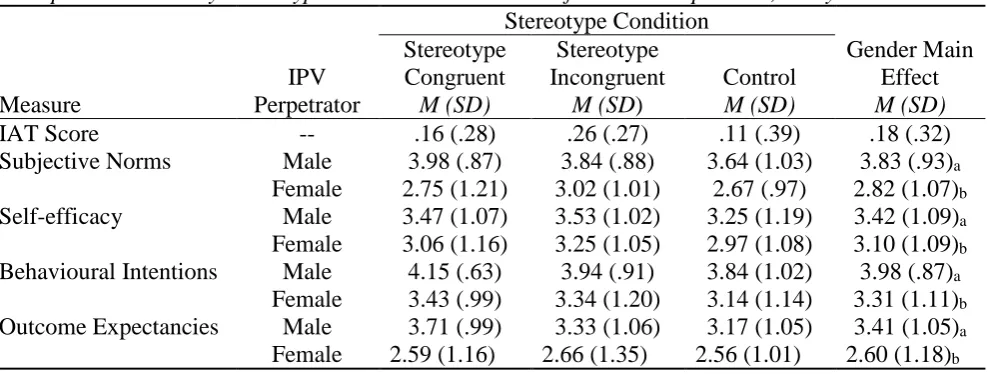
Socio-cognitive outcomes. There was a significant main effect of victim gender on
subjective norms, F(1, 119) = 134.39, p < .001, ηp2 = .53. Pairwise comparisons indicated that
participants reported significantly higher subjective norms for the female victim relative to the
male victim condition (see Table 1 for means). There was no significant main effect of
stereotype condition, F(2, 119) = 2.90, p = .087, ηp2 = .04, and no interaction between stereotype
condition and victim gender, F(2, 119) = 1.90, p = .154, ηp2 = .03. The observed effect sizes
between the stereotype incongruent and congruent condition, as well as the stereotype
incongruent and control condition, for the male victim vignette were not significantly within the
equivalent bounds (p > .05), suggesting that the data are inconclusive.
Similarly, there was a significant main effect of victim gender on self-efficacy, F(1, 119)
= 47.33, p < .001, ηp2 = .29, with participants reporting that they felt more capable of intervening
in an act of IPV toward a female relative to male victim (see Table 1). There was no significant
main effect of stereotype condition, F(2, 119) = 1.92, p = .152, ηp2 = .03, and no interaction
between stereotype condition and victim gender, F(2, 119) = .1.78, p = .173, ηp2 = .03. The
observed effect sizes between the stereotype incongruent and congruent condition, and the
stereotype incongruent and control condition for the male victim vignette were not significantly
within the equivalent bounds (p > .05) and the data are inconclusive.
There was also a significant main effect of victim gender on behavioural intentions, F(1,
119) = 36.04, p < .001, ηp2 = .23, with participants indicating that they would feel more likely to
report an incident of IPV when the victim was female compared to male (see Table 1). There was
no significant main effect of stereotype condition, F(2, 119) = .16, p = .852, ηp2 = .003, and no
significant interaction between stereotype condition and victim gender, F(2, 119) = .06, p = .938,
victim vignette was significantly within the equivalent bounds (p < .05). However, the effect size
between the incongruent and congruent condition for the male vignette was not significantly
within these equivalence bounds (p > .05). Overall, this suggests that stereotype incongruent
information may not increase behavioural intentions to report an act of IPV against a male
victimisation compared to stereotype congruent information.
Finally, there was a significant main effect of victim gender on outcome expectancies,
F(1, 119) = 75.75, p < .001, ηp2 = .39, with participants anticipating greater expectancies of
action being taken when reporting a female compared to male IPV victim (see Table 1). There
was no significant main effect of stereotype condition for outcome expectancies, F(2, 119) = .68,
p = .509, ηp2 = .01, but there was a significant interaction between stereotype condition and
victim gender, F(2, 119) = 3.10, p = .049, ηp2 = .05. Pairwise comparisons indicated that
participants in the stereotype congruent, incongruent, and control conditions all reported that
they would anticipate greater outcomes for female compared to male victims. This difference
was significantly greater for the stereotype incongruent condition (p < .001, d = 1.08) compared
to both the control (p < .001, d = .58) and stereotype congruent conditions (p < .001, d = .82).
The observed effect sizes between experimental conditions for the male vignette, however,
suggest that the data are inconclusive (p > .05).
In respect of the additional measures of identification and acceptability of the behaviour
depicted in the vignette, two paired sample t-tests were performed between vignette conditions
(i.e., victim gender). These analyses revealed that participants accurately identified the act as
IPV, but they were more likely to identify this act toward a female (M = 4.51, SD = .75)
compared to a male victim (M = 4.18, SD = .90), t(121) = 4.38, p < .001, d = .39. Similarly,
significantly less so when the victim was female (M = 1.12, SD = .40) compared to when the
victim was male (M = 1.34, SD = .61), t(121) = -3.72, p < .001, d = .43.
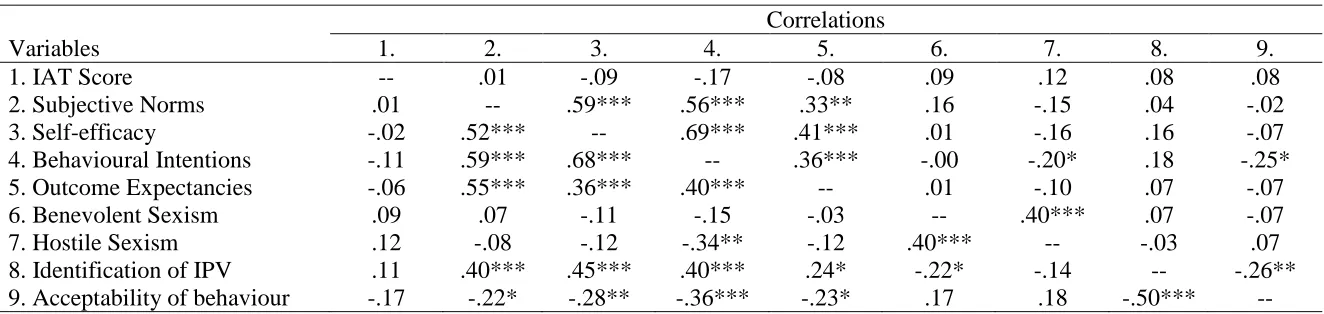
Finally, correlation analyses explored the relationship between implicit attitudes and
explicit socio-cognitive outcomes with hostile and benevolent sexist attitudes. Findings indicated
that there was a weak, negative relationship between both benevolent and hostile sexism and
perceived behavioural intentions in the male vignette condition (see Table 2). In addition, there
was a weak, negative relationship between hostile sexism and self-efficacy in the male vignette
condition. This suggests that as benevolent and hostile sexism increased, there was less
anticipated intention to act when the victim was male. Moreover, as hostile sexism increased,
individuals felt they were less able to act when the victim was male. Furthermore, there was a
weak, positive relationship between the IAT scores and hostile sexism, for both the male victim’s
and female victim’s vignette; this suggests their implicit attitudes were consistent with these
perceptions of traditional gender roles for either victim type. There were no other significant
relationships between benevolent or hostile sexism and the other socio-cognitive outcomes for
the female and male vignettes (ps > .05).
Discussion
Study 1 explored the impact of stereotype priming on both implicit attitudes and
perceptions associated with hypothetical instances of male and female IPV victimisation. The
findings indicate that priming either congruent or incongruent stereotypes pertaining to IPV
victimisation did not impact significantly on implicit attitudes or socio-cognitive factors. The
only significant pattern was that participants were quicker to associate female victims with
“weak” and male victims with “strong.” This finding suggests that priming participants with
dissociating implicit endorsements of gendered victimisation. Further, these stereotype primes
did not appear to significantly influence explicit attitudes regarding intentions to act, the ability
to intervene, or perceptions of subjective norms surrounding male IPV victimisation, with
equivalence tests indicating the data are inconclusive.
Nevertheless, gendered scenarios depicting IPV had a significant impact on
socio-cognitive attitudes with participants reporting higher subjective norms, self-efficacy, behavioural
intentions, and outcome expectancies when the victim depicted in the vignette was female
compared to male. Additionally, although participants identified the behaviour as IPV and
generally rated it as unacceptable, they were significantly more likely to identify this behaviour
as an act of IPV and less likely to see it as acceptable when the victim was female relative to
male. Finally, both benevolent and hostile sexism were negatively associated with behavioural
intentions for the male vignette, and hostile sexism was negatively associated with self-efficacy.
That is, higher sexism endorsement was related to lower perceptions of feeling able to intervene
and act, but only in cases where the victim was male.
Study 2: IPV Perpetration
The findings of Study 1 indicate that presenting incongruent stereotypes may not be
effective in reducing both implicit and explicit attitudes toward IPV victimisation, with attitudes
toward male victims appearing to be particularly unfavourable. Specifically, individuals are
much less likely to identify IPV toward a man and, worryingly, view it as more acceptable
compared to the same behaviour shown toward a woman. Correspondingly, they may be less
likely to intervene and feel that any preventative actions may not result in appropriate action
being taken. Study 2 aimed to extend these findings, focusing on IPV perpetration to establish
attitudes toward perpetration. Specifically, it is not entirely clear whether the stigma associated
with male victims is in respect of men themselves being victims or toward women as
perpetrators. Accordingly, Study 2 aimed to examine the influence of stereotype priming on
attitudes toward IPV perpetration and whether the gender of the perpetrator influenced
behavioural intentions to report instances of IPV.
Method
Participants. The study consisted of a 3 (Stereotype Condition: Stereotype Congruent,
Incongruent, Control) x 2 (Vignette Perpetrator Gender: Female Victim, Male Victim)
mixed-design. A total of 153 UK participants were recruited initially through an online survey, with a
total of 43 (28.10%) removed for not completing the study fully and nine for completing the IAT
too quickly. This resulted in a final sample of 101 UK participants (Mage = 26.48, SD = 9.24,
range = 18–62); 59 (58%) women; 76 (75.2%) White British, 10 (9.9%) Other White, 3 (4%)
Other Mixed, 4 (4%) Asian British, 2 (2%) Black British, 2 (2%) Chinese, 2 (2%) Other Asian,
with the remaining 2 (2%) preferring not to identify. Participants were randomly assigned to the
stereotype congruent (n = 34), incongruent (n = 35) or control condition (n = 32) by a computer
algorithm.
Manipulations and measures. All measures and procedures were equivalent to those
employed in Study 1. The only exception was that the stereotype primes and the IAT target
categories referred to IPV perpetration rather than victimisation. Two items were removed from
the benevolent sexism scale (items 6 and 13; a = .71) and one from the hostile sexism scale (item
1; a = .67) of the ASI to increase internal consistency. Consistent with Study 1, inter-item
correlations were all significant for both the female (all r > .59, p < .001) and male vignettes (all
Stereotype priming manipulation. Participants assigned to the stereotype congruent condition were primed with the following information: “As you may know, figures show that it
is more common for men to perpetrate acts of intimate partner violence compared to women.
There is also a difference in people’s perceptions of males versus female perpetration of intimate
partner violence.” Participants in the stereotype incongruent condition were primed with the
following information: “Recent research has found that there are no differences between men
and women in rates of intimate partner violence perpetration. However, there is still a difference
in people’s perceptions of males versus female perpetration of intimate partner violence.”
In line with Study 1, a control condition was utilised in which participants were briefed with
general information about the nature of the study. Upon reading these stereotype primes and
completing the IAT, participants read two gendered scenarios in a vignette depicting a
heterosexual instance of IPV toward a male or female perpetrator: “Your [male/female] friend
comes to you and tells you that [he/she] hit [his/her] [girlfriend/boyfriend] last night.”
Participants then went on to complete measures of outcome expectancies, subjective norm,
self-efficacy, and behavioural intentions.
Results
Implicit attitudes. A one-way between-subjects ANOVA revealed no significant impact
of stereotype condition on implicit attitudes toward IPV perpetration, F(2, 98) = 2.13, p = .124,
ηp2 =.04. The effects observed between the stereotype incongruent and control condition, as well
as the stereotype incongruent and congruent condition, were not significantly within the
equivalent bounds, suggesting the data are inconclusive. A follow-up one sample t-test revealed
that, consistent with Study 1, participants showed a weak stereotype endorsement (M = .18, SD =
Socio-cognitive outcomes. A series of 3 (Stereotype Condition: Stereotype
congruent, Incongruent, Control) x 2 (Vignette Perpetrator Gender: Female Perpetrator, Male
Perpetrator) ANOVAs were conducted to explore the impact of stereotype condition and
perpetrator gender on subjective norms, self-efficacy, behavioural intentions, and outcome
expectancies. Bonferroni corrections were applied to reduce familywise error. For subjective
norms, a significant main effect of perpetrators gender was found, F(1, 98) = 99.43, p < .001, ηp2
= .50, with participants reporting significantly higher subjective norms for the male perpetrator
vignette (see Table 3). There was no significant main effect of stereotype condition, F(2, 98) =
.94, p = .395, ηp2 = .02, and no interaction between stereotype condition and perpetrator gender,
F(2, 98) = 1.52, p = .224, ηp2 = .03. The observed effects between the stereotype incongruent and
control condition, as well as the stereotype incongruent and congruent condition, for the female
perpetrator vignette was not significantly within the specified equivalence bounds, suggesting the
data are inconclusive.
Similarly, there was a significant main effect of perpetrators gender on self-efficacy, F(1,
98) = 13.03, p < .001, ηp2 = .12, with participants reporting they felt more capable of intervening
in the instance of a male compared to female perpetrator (see Table 3). No significant main
effects of stereotype condition were found, F(2, 98) = .67, p = .513, ηp2 = .01, and there was no
interaction between stereotype condition and perpetrator gender, F(2, 98) = .26, p = .771, ηp2 =
.01. The observed effects between the stereotype incongruent and control condition, as well as
the stereotype incongruent and congruent condition, for the female perpetrator vignette were not
significantly within the equivalent bounds, suggesting the data are inconclusive.
There was also a significant main effect of perpetrator gender on behavioural intentions,
report an incident of IPV if the perpetrator was male compared to female (see Table 3).
However, there was no significant main effect of stereotype condition, F(2, 98) = .90, p = .412,
ηp2 = .02, and no interaction between stereotype condition and perpetrator gender, F(2, 98) = .19,
p = .830, ηp2 = .004. The observed effect between the stereotype incongruent and control
condition for the female perpetrator vignette was not significantly within the specified
equivalence bounds; however, the effect between the congruent and incongruent condition for
the female vignette was significantly equivalent. As such, stereotype incongruent information
regarding IPV perpetration did not appear to enhance behavioural intentions to report a female
perpetrator of IPV compared to stereotype congruent information.
There was a significant main effect of perpetrator gender on outcome expectancies, F(1,
98) = 56.22, p < .001, ηp2 = .37, with participants feeling that action would more likely be taken
against a male compared to female perpetrator of IPV (see Table 3). There was, however, no
significant main effect of stereotype condition, F(2, 98) = .68, p = .510, ηp2 = .01, and no
interaction between stereotype condition and perpetrator gender, F(2, 98) = 2.26, p = .110, ηp2 =
.04. The observed effect between the stereotype incongruent and control condition for the female
perpetrator vignette was not significantly within the equivalent bounds. However, the effect
between the congruent and incongruent condition for the female perpetrator vignette was
significantly equivalent. This suggests that stereotype incongruent information regarding IPV
perpetration did not appear to enhance perceived outcomes that reporting a female perpetrator of
IPV would result in a desired outcome, compared to stereotype congruent information.
In respect of the additional measures of identification and acceptability of the behaviour
depicted in the vignette, two paired sample t-tests were performed. These analyses revealed that
act when it was perpetrated by a man (M = 4.66, SD = .64) compared to a woman (M = 4.26, SD
= .99), t(100) = 4.34, p < .001, d = .47. Similarly, although participants indicated the behaviour
in the vignette was not acceptable, it was seen as significantly less so when the perpetrator was
male (M = 1.22, SD = .58) compared to when the perpetrator was female (M = 1.63, SD = 1.01),
t(100) = - 4.39, p < .001, d = .50.
Finally, correlation analysis examined whether implicit attitudes or socio-cognitive
outcomes correlated with hostile and benevolent sexist attitudes (see table 4). There was a weak,
negative relationship between hostile sexism and behavioural intentions in both the male and
female victim vignette. This suggests that those scoring higher on the hostile sexism scale were
less likely to anticipate intervening in either gendered scenario. Additionally, there was a
moderate negative relationship between benevolent sexism and identification of IPV in the
vignette with a female perpetrator. This suggests that as benevolent sexism increases, individuals
are less likely to identify a violent act by a woman as an instance of IPV. There were no other
significant relationships between benevolent and hostile sexism and the implicit and
socio-cognitive outcomes for the female and male vignette (ps > .05).
Discussion
Study 2 explored the impact of stereotype priming on both implicit and explicit
perceptions associated with male and female perpetration of IPV. Findings indicate that priming
stereotype congruent or incongruent information did not significantly influence participants’
implicit endorsement of gendered IPV perpetration or their behavioural intentions associated
with reporting IPV. However, it is important to note that equivalence testing indicated that the
elucidate the impact of stereotype priming on implicit and explicit attitudes toward IPV
perpetration and to provide reliable estimates of effect size.
Consistent with Study 1, participants revealed a weak implicit stereotype endorsement,
perceiving male perpetrators as “strong” and female perpetrators as “weak.” In contrast, the
gender of the perpetrator depicted in the hypothetical vignettes was found to be impactful upon
explicit attitudes toward IPV. Specifically, subjective norms, self-efficacy, behavioural
intentions, and outcome expectancies were significantly higher during instances of male
compared to female perpetration. Although participants identified the behaviour as IPV and
generally rated it as unacceptable, they were significantly more likely to identify the behaviour in
this vignette as IPV and less likely to see it as acceptable when the perpetrator was male
compared to female. Indeed, this pattern shows the opposite direction of effects compared to
Study 1 whereby victimisation was depicted, highlighting the worrying indication that
participants perceive female victimisation and male perpetration as more unacceptable when
compared to male victimisation and female perpetration.
General Discussion
The studies presented here explored both implicit and explicit attitudes associated with
hypothetical instances of IPV. These were framed in respect of victimisation (Study 1) and
perpetration (Study 2) to assess whether priming congruent or incongruent stereotypes would
strengthen or lessen gendered attitudes toward IPV. Across both studies, the findings indicated
that there was no significant impact of gender stereotype priming on implicit or explicit attitudes
toward IPV victimisation or perpetration, with equivalence tests indicating that the data are
inconclusive. Rather, the findings indicate that participants implicitly held stereotypical beliefs
victimisation. Furthermore, although participants identified IPV behaviour in both vignettes and
rated it as unacceptable, there was a clear perception that violence between partners involving a
male perpetrator and female victim was more readily identified as IPV and judged as more
unacceptable compared to when the perpetrator was female and the victim male. Furthermore,
these characterisations are associated with participants’ perceptions about their ability to
intervene and their intentions to report male victimisation (Study 1) and female perpetration
(Study 2).
It could be argued that gender stereotypes relating to IPV victimisation and perpetration
are deeply ingrained within societies, and it is therefore not surprising that incongruent
stereotypes did not have a significant influence on implicit attitudes or self-reported perceptions
associated with IPV. This explanation is supported by the finding that across both studies,
participants showed an implicit endorsement for perceiving women as “weak” and men as
“strong” regarding IPV, regardless of stereotype condition. This pattern is indicative of how
normative societal perceptions are, and it highlights the need for research to investigate and
remedy these issues.
The issues presented around attitudes toward male victims are apparent, but what is less
clear is whether the stigma and stereotypes stem from the dissonance of men as victims or
women as perpetrators. As such, Study 2 helped elucidate this issue and found equivalent
outcomes for depictions of male victimisation and female perpetration. This is perturbing
because campaigns which aim to increase acknowledgement of men’s victimisation may not
benefit from presenting information regarding equal victimisation and perpetration rates between
men and women. Indeed, research within the social psychological literature suggests that the
childhood and are then socially reinforced throughout adulthood (Bussey & Bandura, 1999). This
may influence the endorsement of stereotypes about gender, violence, and victimisation and
highlights the significant challenge of changing and reducing such perceptions. Simply raising
awareness of the diversity of IPV victims may not be impactful enough in addressing the
inherent nature of these stereotypes, which suggests that gender norms need tackling earlier in
socialisation before they become too rigid. This is supported by research which suggests that
men may be unlikely to report instances of IPV because they feel embarrassed for not confirming
to dominant societal expectations (Hogan, 2016). One way of tacking these ingrained stereotypes
and reducing the stigma associated with male victimisation might be to encourage men to share
their stories and experiences of IPV.
It could be argued that the inconclusive influence of stereotype primes on implicit and
explicit attitudes may be that the primes employed were not personalised or emotive enough to
change attitudes. Further, the context of priming plays an important role in the effectiveness of
their messages (Kindermann, 2017). As such the current study may have benefited from using
more personalised primes, such as encouraging the person to imagine their friends in a stereotype
congruent or incongruent situation and how they would feel, or to show a video vignette
depicting a male/female perpetrator and victim in an instance of IPV. From a practical
perspective, this suggests that the usual informational or factual campaigns may best capitalise
on a more personalised or emotive approach to be more effective in awareness-raising and in
encouraging behaviour-change.
Across both studies, participants were also more likely to perceive instances involving
male victimisation (Study 1) and female perpetration (Study 2) as more acceptable and less likely
supports previous research which has found that people perceive violence against women as
being more serious than toward men and that they will search for external attributions for
women’s violence (Erickson et al., 2017; Harris & Cook, 1994; Hodell et al., 2014; Sorenson &
Taylor, 2005). Further, research has demonstrated that individuals are more likely to condemn
and report men’s assaults on women compared to any other gender combination, regardless of
the level of violence that may have been committed by a woman (Felson & Feld, 2009). These
findings, coupled with those from the current study, indicate there is a need to address
perceptions of women’s aggression and ensure it is taken as seriously as men’s.
It is disappointing to see that efforts of awareness training within the last decade may not
have impacted considerably on how we generally perceive male victims of IPV, with negative
stereotypes still prevailing (Scarduzio et al., 2016). This failure creates lower societal concern
surrounding male victims, and thus compounds the stigma that they experience and the
likelihood of them reporting IPV (e.g., Felson & Feld, 2009). When outside the home, men are
more likely to be involved in same-sex non-intimate aggression (Archer, 2004), which impacts
on the stereotype of them being the more aggressive sex, and consequently means their motives
around aggression are often not explored. In contrast, people often seek to understand women’s
motivations when they are aggressive (e.g., self-defence, psychopathology) because it creates
dissonance with what we understand as socially appropriate behaviour for women (Bates, in
press). This can be impactful when we do consider women’s violence in the criminal justice
system, with some studies suggesting jurors may have more sympathy for women and be more
lenient with them (Hodell et al., 2014).
Some feminist models suggest patriarchy is the social norm that is most influential to IPV
were related to behavioural intentions, these did not correlate with the other socio-cognitive
attitudes or implicit perceptions. Felson (2002) suggests that chivalry is in fact more prominent
in inhibiting men’s violence toward women. Chivalry dictates that men (and other women)
should protect women from harm, and it means that there is a greater moral condemnation of
violence when the victim is a women and also more serious punishments for the offenders. This
notion is supported by studies showing women are consistently more likely to receive help from
men, with men being more likely to give help than women (Eagly & Crowley, 1986). These
gender differences have been found to be more pronounced when there were audiences present
(Eagly & Crowley, 1986), suggesting that this chivalrous effect is normative.
Limitations and Future Research Directions
The current research has several limitations that warrant acknowledgement. The first is
that we only explored perceptions of IPV associated with heterosexual relationships. Less
research has been conducted more generally to investigate perceptions of LGBTQ+ relationship
violence, and this is an issue that needs to be addressed in future research. This fuller coverage
can be achieved by using fully gender-crossed designs, which acknowledge both the gender of
the victim and the gender of the perpetrator when examining the impact of stereotype priming,
such as 2 (victim gender: female, male) x 2 (perpetrator gender: female, male) designs (see
Erickson et al., 2017).
Findings from Study 1 indicate that incongruent stereotype information did not
significantly influence implicit attitudes toward IPV victimisation, and equivalence tests allowed
us to statistically reject effects larger than our SESOI (see Lakens, 2017; Lakens et al., inpress).
However, equivalence tests also indicated that the data are inconclusive when examining the
Furthermore, the data investigating the impact of these primes on self-efficacy and subjective
norms (Study 1 & 2) and outcome expectancies (Study 1) were inconclusive. These tests
indicated that the confidence intervals around the observed effect sizes were wide, and therefore
we recommend future studies with larger sample sizes to reliably examine the effect of
stereotype-incongruent information on implicit attitudes and explicit socio-cognitive IPV
attitudes.
Given the unbalanced gender ratio within Study 1, and small sample of men recruited, we
were unable to explore whether participants’ own gender had an impact on attitudes toward IPV
victimisation due to concerns of statistical power. Exploratory analyses indicate that there were
no significant differences between male and female participants when examining subjective
norms, self-efficacy, behavioural intentions, outcome expectancies, or for benevolent or hostile
sexism. Such findings allay concerns that there may have been uncovered gender differences in
explicit attitudes, particularly in Study 1, which were not addressed. Implicit attitudes, however,
did significantly differ between genders, with male participants more strongly endorsing that
men are “strong” and women are “weak” compared to female participants. Such exploratory
analyses were replicated within Study 2, which had a more gender balanced sample. As such, we
recommended that future research aims to recruit a more gender-balanced sample when
investigating issues pertaining to gendered IPV. Similarly, future research efforts should
examine explicit and implicit attitudes toward IPV beyond Western cultures. Indeed, research
reveals cultural variations in IPV rates and attitudes toward it; where there is gender equality in
terms of societal power in a culture, there is likely to be more parity in IPV perpetration and
An additional limitation includes the potential issue of order effects within the current
study. Specifically, participants completed the male IPV vignette scenarios first followed by the
female, which may have influenced their responding on this measure. It is possible that women’s
perpetration and men’s victimisation would have been viewed differently if not being preceded
by a comparator condition. Further to this, it is worth acknowledging that we did not
operationalise baseline measures for implicit and explicit attitudes. As such, it is not possible to
fully establish whether there was an equal distribution of attitudes across conditions before the
experimental priming.
Finally, it is worth noting that we focused exclusively on physical forms of IPV, which
represents only one form of aggression that may occur between intimate partners. Previous
commentaries highlight issues in measuring behavioural control (Armitage & Conner, 2001),
suggesting that individual’s perceptions of control are unlikely to be representative of actual
control in any given situation, due to the prevalence of illusions of control (Langer, 1975; Lerner,
1977). However, given evidence that women are often more coercive and controlling than men
(Bates et al., 2014), developing more reliable ways of assessing behavioural control within
intimate partner relationships would be a fruitful avenue for future research.
Practice Implications
Participants identified the behaviour within both vignettes as IPV, and indeed rated it as
unacceptable for both. However, they were significantly more likely to do so when the victim
was a woman and the perpetrator, a man. This finding is contrary to some assertions that IPV is
seen as acceptable within society and that violence against women is tolerated (Dobash &
Dobash, 1979). In contrast, our findings indicate that female victims are more likely to receive
men. This pattern provides an indication that prevention campaigns about violence against
women has been successful in raising awareness of IPV and ensuring people intervene to protect
women; however. the same cannot be said for male victims.
There are significant barriers that exist to men’s help-seeking, and many issues prevent
men from reporting their IPV experiences—for example, fear of not being believed, fear of being
laughed at, and fear of false counter-allegations (Bates, 2017). Indeed, in a system where
provision is often more oriented toward working with women as victims, men have reported
frustrations with trying to access support, as well as experiences of being treated as perpetrators
(Hines, Brown, & Dunning, 2007). If a man reports his experience to services such as the police
and either is not believed or does not have his case taken seriously, the psychological impact can
be significant. Research shows that experiences such as these perpetuate victimisation and lead
to further trauma through the criminal justice system (McCarrick, Davis-McCabe, &
Hirst-Winthrop, 2016). Men’s perceptions of these attitudes around IPV in their friends/family, as well
as within service provision, is likely to impact on their decision-making around help-seeking.
Furthermore, our results indicated no significant impact of the incongruent prime on
socio-cognitive measures such as behavioural intentions. This finding means that presenting
people with information about IPV rates being similar is not likely to be enough to challenge
people’s perceptions of their intended behaviours. This conclusion is concerning because these
embedded gender norms and societal perceptions affect men’s perceptions of their victimisation
in a way that stops them from seeking help. Such societal perceptions therefore need to be
addressed at a deeper level before campaigns that raise awareness can be effective; this could be
achieved through early educational awareness which aims to discourage these traditional gender
Conclusion
In the first known of its kind, the current research established attitudinal outcomes
associated with male IPV victimisation and female perpetration, therein extending existing
debates on how gendered perceptions of IPV may present different situational effects upon
beliefs. It seems, however, that stereotypical gendered perceptions hold true across victimisation
and perpetration contexts and that presenting counter-stereotypes (incongruent priming) does not
significantly reduce stereotypical conceptions. Such stereotypes are concerning because they fail
to recognise that men can also be victims of heterosexual IPV. Our findings contribute new
evidence on implicit gender stereotypes in respect to IPV victimisation and perpetration that is
novel in this area of research. Specifically, we found that implicit attitudes toward IPV are stable
across situational conditions (victimisation and perpetration) and do not appear to be influenced
by priming interventions. Further there are clear explicit perceptions about greater acceptability
and less identification of male victimisation and female perpetration, highlighting a greatly
worrying societal norm. Our findings suggest that more needs to be done to counter gender
stereotypes associated with IPV and, importantly, move beyond the notion of IPV as a gendered
phenomenon. With recent research indicating that women can be as aggressive as men in
relationships (Bates et al., 2017), there is a need for policy to reflect men’s increasing needs as
victims. Current practice in victim support is focused almost entirely on women, but this leaves a
References
Addis, M. E., & Mahalik, J. R. (2003). Men, masculinity, and the contexts of help seeking.
American Psychologist, 58, 5-14. https://doi.org/10.1037/0003-066X.58.1.5
Ajzen I. (1985). From intentions to actions: A theory of planned behavior. In J. Kuhl & J.
Beckmann (Eds.), Action control (pp. 11-39). Berlin, Heidelberg: Springer.
Ajzen, I. (1987). Attitudes, traits, and actions: Dispositional prediction of behavior in personality
and social psychology. In L. Berkowitz (Ed.), Advances in experimental social psychology
(Vol. 20, pp. l-63). New York: Academic Press.
Ajzen, I. (1991). The theory of planned behavior. Organizational Behavior and Human Decision
Processes, 50, 179-211. https://doi.org/10.1016/0749-5978(91)90020-T
Ajzen, I., & Madden, T. J. (1986). Prediction of goal-directed behavior: Attitudes, intentions, and
perceived behavioral control. Journal of Experimental Social Psychology, 22, 453-474.
Ambady, N., Paik, S. K., Steele, J., Owen-Smith, A., & Mitchell, J. P. (2004). Deflecting
negative self-relevant stereotype activation: The effects of individuation. Journal of
Experimental Social Psychology, 40, 401-408. https://doi.org/10.1016/j.jesp.2003.08.003
Archer, J. (2000). Sex differences in aggression between heterosexual partners: A meta-analytic
review. Psychological Bulletin, 126, 651-680.
https://doi.org/10.1037/0033-2909.126.5.651
Archer, J. (2004). Sex differences in real world settings: A meta-analytic review. Review of
General Psychology, 8, 291-322. https://doi.org/10.1037/1089-2680.8.4.291
Archer, J. (2006). Cross-cultural differences in physical aggression between partners: A
social-role analysis. Personality and Social Psychology Review, 10, 133-153.
Armitage, C., & Conner, M. (2001). Efficacy of the theory of planned behaviour: A
meta-analytic review. British Journal of Social Psychology, 40, 471-499.
https://doi.org/10.1348/014466601164939
Bates, E. A. (in press). Contexts for women’s aggression against men. Encyclopaedia of
Evolutionary Psychological Science.
Bates, E. A. (2017, November). Hidden victims: Men and their experiences of domestic violence.
Paper presented at ManKind Initiative Conference, London, UK.
Bates, E. A., & Graham-Kevan, N. (2016). Is the presence of control related to help-seeking
behavior? A test of Johnson’s assumptions regarding sex-differences and the role of
control in intimate partner violence. Partner Abuse, 7, 3-25.
https://doi.org/10.1891/1946-6560.7.1.3
Bates, E. A., Graham-Kevan, N., & Archer, J. (2014). Testing predictions from the male control
theory of men’s partner violence. Aggressive Behaviour, 40, 42-55.
https://doi.org/10.1002/ab.21499
Bates, E. A., Graham-Kevan, N., Bolam, L. T., & Thornton, A. J. V. (2017). A review of
domestic violence perpetrator programs in the UK. Partner Abuse, 8, 3-46.
https://doi.org/10.1891/1946-6560.8.1.3
Blair, I. V., & Banaji, M. R. (1996). Automatic and controlled processes in stereotype priming.
Journal of Personality and Social Psychology, 70, 1142-1163.
https://doi.org/10.1037/0022-/3514.70.6.1142
Bookwala, J., Frieze, I. H., Smith, C., & Ryan, K. (1992). Predictors of dating violence: A
Bussey, K., & Bandura, A. (1999). Social cognitive theory of gender development and
differentiation. Psychological Review, 106, 676-713.
https://doi.org/10.1037/0033-295X.106.4.676
Centers for Disease Control and Prevention. (2011). National intimate partner and sexual
violence survey: 2010 summary report. Atlanta: Author.
Cohen, J. (1992). A power primer. Psychological Bulletin, 112, 155-159.
https://doi.org/10.1037/0033-2909.112.1.155
de Groot, J., & Steg, L. (2006). Impact of transport pricing on quality of life, acceptability, and
intentions to reduce car use: An exploratory study in five European countries. Journal of
Transport Geography, 14(6), 463-470.
Dijksterhuis, A., & Bargh, J. A. (2001). The perception-behavior expressway: Automatic effects
of social perception on social behavior. In M. Zanna (Ed.), Advances in experimental
social psychology (pp. 1-40). London: Academic Press.
Dobash, R. E., & Dobash, R. P. (1979). Violence against wives: A case against the patriarchy.
London: Open Books.
Douglas, E. M., & Hines, D. A. (2011). Helpseeking experiences of men who sustain intimate
partner violence: An overlooked population and implications for practice. Journal of
Family Violence, 26, 473-485. https://doi.org/1007/s10896-011-9382-4
Drijber, B. C., Reijnders, U. J. L., & Ceelen, M. (2013). Male victims of domestic violence.
Journal of Family Violence, 28, 173-178. https://doi.org/10.1007/s10896-012-9482-9
Dutton, D. (2006). The gender debate and the feminist paradigm. In Dutton, D. G. (Ed.)
Dutton, D. G., & Nicholls, T. L. (2005). The gender paradigm in domestic violence research and
theory: Part 1 – The conflict of theory and data. Aggression and Violent Behavior, 10,
680-714. https://doi.org/10.1016/j.avb.2005.02.001
Eagly, A. H., & Crowley, M. (1986). Gender and helping behavior: A meta-analytic review of
the social psychological literature. Psychological Bulletin, 100, 283-308.
https://doi.org/10.1037/0033-2909.100.3.283
Erickson, K. A., Jonnson, M., Langile, J. I., & Walsh, Z. (2017). Victim gender, rater attitudes,
and rater violence history influence perceptions of intimate partner violence. Violence and
Victims, 32, 533-544. https://doi.org/10.1891/0886-6708.VV-D-15-00086
Felson, R. B. (2002). Violence and gender reexamined. Washington, DC: American
Psychological Association.
Felson, R. B., & Feld, S. L. (2009). When a man hits a woman: Moral evaluations and reporting
of violence to the police. Aggressive Behavior, 35, 477-488.
https://doi.org/10.1002/ab.20323
Felson, R. B., & Paré, P. (2005). The reporting of domestic violence and sexual assault by
nonstrangers to the police. Journal of Marriage and Family, 67, 597-610.
https://doi.org/10.1111/j.1741-3737.2005.00156.x
Fisher, C. (2013). Changed and changing gender and family roles and domestic violence in
African refugee background communities post-settlement in Perth, Australia. Violence
Against Women, 19, 833-847. https://doi.org/10.1177/1077801213497535
Forscher, P. S., Lai, C. K., Axt, J., Ebersole, C. R., Herman, M., Devine, P. G., &