distributed counting
Costas Iordanou
MPI, Germany
Nicolas Kourtellis
Telefonica Research, Spain
Juan Miguel Carrascosa
Cyprus University of Technology
Claudio Soriente
NEC Laboratories Europe
Ruben Cuevas
Universidad Carlos III de Madrid
(Telematics Engineering
Department & UC3M-Santander
Big Data Institute)
Nikolaos Laoutaris
IMDEA Networks Institute
ABSTRACT
Being able to check whether an online advertisement has been targeted is essential for resolving privacy controversies and implementing in practice data protection regulations like GDPR, CCPA, and COPPA. In this paper we describe the de-sign, implementation, and deployment of an advertisement auditing system calledeyeWnder that uses crowdsourcing to reveal in real time whether a display advertisement has been targeted or not. Crowdsourcing simplifies the detection of targeted advertising, but requires reporting to a central repository the impressions seen by different users, thereby jeopardizing their privacy. We break this deadlock with a privacy preserving data sharing protocol that allows eyeWn-derto compute global statistics required to detect targeting, while keeping the advertisements seen by individual users and their browsing history private. We conduct a simulation study to explore the effect of different parameters and a live validation to demonstrate the accuracy of our approach. Un-like previous solutions,eyeWndercan even detect indirect targeting,i.e., marketing campaigns that promote a product or service whose description bears no semantic overlap with its targeted audience.
1
INTRODUCTION
Targeted advertising offers the possibility of delivering tai-lored advertisements (in the followingads) to users based on their interests and demographic properties. It has helped the advertising industry reach high growth rates and revenues (23.2% growth and $23.9B in Q1 ’18 in US only) [13], has created lots of jobs, subsidized the delivery of free services, and funded a lot of digital innovation. Of course, to deliver targeted ads, so-called AdTech companies need to detect users’ interests and intentions which is done by monitoring visited pages, searched terms, social network activity,etc.
In its principle, the concept of targeted (or personalized) advertising appears benign: offering to consumers products and services that they truly care about, instead of irrelevant ones that distract or annoy. It is in its implementation and actual use where controversies start arising. For example, tracking should respect fundamental data protection rights of people, such as their desire to opt-out, and should keep clear from sensitive personal-data categories, such as health, polit-ical beliefs, religion or sexual orientation, protected by data protection laws like GDPR [23] in Europe and the California Consumers Privacy Act (CCPA) [52] in US. Similarly, sensi-tive demographic groups, like children, should be protected from data collection and targeting as mandated, for example, by FTC’s COPPA [1] regulation in US. Unfortunately, this is not always the case, as made evident by the continuous pres-ence of the topic in the news and public debates [12, 49], or the conducted investigations and placed fines [50]. A direct consequence of concern around privacy is the rise in popu-larity of anti-tracking and ad-blocking tools [2, 3, 22, 28, 44]. This surge of software can choke the web of its advertising revenues. To avoid a Tragedy of the Commons triggered by eroding privacy [37], companies offering web services need to gain back the trust of their users. An important step in this direction would be to provide users with the ability to single out and report ads that violate privacy norms and laws.
The networking, measurements, and distributed systems community has been active in the development of a new breed of transparency tools [37] for end users, data pro-tection authorities, and the advertising sector’s own self-regulation initiatives. Initial efforts went to detecting online price discrimination [30, 31, 42, 43] followed by tools for detecting targeted advertising [16, 38–40, 46, 54]. Having the ability to verify the deja vu feeling arising when running into seemingly familiar offerings is important for user em-powerment and goes beyond mere curiosity. For example, it
1
can allow a user to check whether marketers have respected his opt-out signals, expressed through Do-Not-Track [21], AdChoices [4], or any of the numerous self-regulation ini-tiatives put forth by the advertising sector. Moreover, if a user runs into an ad related to sensitive, and hence protected, data category, he should be able to verify whether this has been targeted, or is appearing for other reasons. The latter is not always trivial, as with the so called "re-targeted" ads displaying products and services visited by the user in the recent past. Behavioral targeting can be more general and, for example, display to a user a pair of sneakers of brand B’ at store S’ because the user viewed a pair of sneakers of brand B at store S. A pair of jeans may then be displayed due to the previously viewed sneakers. Detecting such indirect targeting quickly becomes a guessing game, and is, there-fore, of little use to the monitoring and enforcement of data protection laws.
Early work on detecting targeting has employed artificially created “personas”,i.e., browsers scripted to visit certain pages that allude to clear demographic types [9, 16, 38, 39], as “bait” for measuring whether ad delivery channels target these demographic types. In the “offline” version of the same approach, researchers have looked at passively collected web click-streams to detect correlations between the pages visited by real users and the ads delivered to them [7, 40, 55]. While these studies have made important contributions, in general, they have been designed to operate offline, at a low scale, or using simulated personas. In this paper, we aim at addressing the following question: “Can we detect ad targeting with real users, in real time, and at large scale?”
Our contributions:In this paper, we propose a novel, scal-able, and real-time ad detection approach, and implement it on real user’s devices. Instead of using “personas” and auto-mated bots to collect ads from artificial visits to pages, we rely on a custom protocol for collecting statistics about the actual ads encountered by real users while browsing online. We show that a surprisingly simple count-based heuristic can detect targeting with high precision. This simple heuristic is based on the observation that targeted ads tend to “follow” specific users across multiple domains, while being seen by relatively fewer users than non-targeted ones. The heuris-tic can be computed in real-time and in a scalable fashion. Furthermore, it is agnostic to how users’ information was collected, and to how impressions were auctioned and deliv-ered. This “black box” approach only looks for correlations between users and advertisements, and is, thus, robust to detection countermeasures [8]. Evading it, would require eliminating such correlations, which goes against the spirit and the essence of targeted advertising.
Crowdsourcing is a powerful tool for detecting targeted ads, but requires users to report the ads they encounter in different websites. The second technical contribution of
our work is a protocol for exchanging this information in a privacy-preserving manner. We leverage a wealth of previ-ous work on privacy-preserving aggregate statistic compu-tation [18, 36, 41], to compute aggregate statistics required by the ad detection algorithm, while keeping the ads seen by users1and their browsing history private. In particular, we design a privacy-preserving protocol to compute distri-bution of ads seen by users. Different from previous work in this area, we face the challenge of protecting not only the distribution of the ads, but the ads themselves. This problem was recently framed by [25] as the problem of estimating “unknown unknowns”. The techniques presented in [25] are based on differential privacy and require clients to report their “real” distribution as well as distributions computed using n-grams of the labels (in our case, ad URLs). As such, their technique fits scenarios where labels are short and not random. We take a different approach and propose a tech-nique that is less involved and works with any label size.
We have implemented our count-based heuristic and the privacy-preserving protocol to support it in a distributed system that we calleyeWnder. The third contribution of our work is the deployment, validation, and measurement study executed usingeyeWnder.
Our findings:We have been operatingeyeWnder live for more than one year with close to 1000 users in order to get feedback on matters of user experience and desired fea-tures. This user base includes 100 paid volunteers from Fig-ureEight [26] who have agreed to lend their data to our validation efforts. We have also conducted extensive simula-tion studies in which we could control how advertisements are displayed. Our findings are as follows:
- Our simulations show that it only takes 6 to 7 repetitions of an ad to make it detectable byeyeWnder. Even with such low repetition frequency, our algorithm achieves a false negative rate of less than 30%. Tuning the algorithm can bring the false negative rate to below 10%, at the expense of requiring around 5 more repetitions. More importantly, false positives, i.e., non-targeted ads classified as targeted, are typically close to zero, and reach up to 2% only in the most extreme corner scenario that we have evaluated. Having very low false posi-tives means that wheneyeWnderclassifies an ad as targeted, then it most probably is. This is fundamental, if the tool is to be used for reporting suspected data protection violations. - The above simulations are aligned with the results from our
live validation with real users and advertising campaigns that are not under our control. Count-based ad detection, even with as few as 100 users, yields high precision, with true positive and true negative rates of 78% and 87%, respectively. - Privacy-preserving crowdsourcing allows to compute the
aggregate statistics required by the ad detection mechanism
1Note that targeted ads can reveal user interests [17].
while keeping user browsing history and received ads private. In particular, the privacy-preserving protocol has a negligible effect on the quality of the computed statistics.
- We have detected several examples of indirect targeting that existing content-based techniques (i.e., semantic overlap between the user profile and the received ad) are unable to detect, as well as signs of advertising bias towards different demographic traits.
- We make available our plugin via the Chrome Store, for wide testing and use from end-users, privacy researchers and auditors2.
2
BACKGROUND AND REQUIREMENTS
2.1
Types of online ads
In the rest of the paper, we will refer to ads as either targeted or non-targeted. Furthermore, we will distinguish targeted ads between Directly- and Indirectly-targeted ads.
Targeted vs. Non-targeted ads:Targeted adsare selected based on data about the user visiting a website. The exact algorithms used are trade secrets of the different AdTech companies but it is widely accepted that such algorithms rely upon user demographic information (gender and age), geo-location information (GPS coordinates, IP address or Base-station id), behavioral information extracted from user online activity (websites visited, searched terms, social net-work activity,etc.). The form of targeted advertising based on behavioral attributes is referred to asOnline Behavioral Advertising (OBA)whereas ads regarding a previously vis-ited webpage offering products or services (e.g., a website offering hotels) is referred to asRetargeting[9].
Non-Targeted adsare shown irrespectively of the user visiting the website. This class of ads includes static ads (shown to all users visiting a website based on a private deal between advertisers and publishers), as well as contextual ads (ads matching the context/topic of the website,e.g., a sports ad appearing on a sports website).
Direct vs. Indirect targeting:Direct targetingis the most obvious form of targeting. In this case, an advertiser inter-ested in selling products of a certain category (e.g., fishing products) targets users tagged as interested in such category (i.e., fishing). Most of previous work has focused on analyzing this type of targeting [16, 38, 39].
Indirect targetingis applied when marketers may target a certain group of users with offerings that have no direct se-mantic overlap with the category this group has been tagged with. For instance, it has been reported that fans of the Walk-ing Dead TV series were targeted with pro Donald Trump material [11]. This would be an example of indirect targeting, since the targeted user group (Walking Dead fans) has no immediate semantic overlap with the advertised offering. To
2http://www.eyewnder.com/views/index
the best of our knowledge,eyeWnder is the first proposal that tackles indirectly targeted ads.
2.2
Requirements
Next, we enumerate the most important requirements of a system for real-time detection of targeted ads. Such re-quirements have emerged from reviewing the limitation of existing approaches found in the literature. In Section 9 and Table 3 we provide an extensive comparison between our solution and existing proposals.
Generality:The detection mechanism should be able to an-alyze any web-based display ad. It should not be limited to a specific ecosystem (e.g., Facebook advertising) where more information about the user or the ad may be available, or platform (e.g., AdChoices initiative [4]). Moreover, detec-tion should work independently of the tracking mechanisms used for collecting user data, interests, and intentions (be it via cookies, browser fingerprinting, or user contributed information such as searches or social network activity).
Precision:The mechanism should allow untrained users for auditing, and potentially reporting, offending ads. Therefore it is essential to have a high detection precision in terms of True Positives (TP) and True Negatives (TN). Validation should be carried out using publicly available data,i.e., with-out requiring special access to silo-ed data from AdTech delivery channels, Telcos, marketing campaigns, or other gatekeepers of such information that, generally speaking, have no incentive to make it public.
Simplicity:The detection method should be as simple as possible, so that it can be implemented as a distributed system with most of the functionality and code running on the end-user device (browser).
Real time operation:A user should be able to request au-diting of a particular ad appearing in his browser, and the system should respond within at most few seconds.
Scalability:The detection method should be able to handle a large number of users (in the order of tens of thousands) without special requirements on the back-end, including CPU load, memory, storage, and bandwidth consumption. Resource consumption must be limited to “control plane” rather than “data plane” tasks, to make the method scale.
Ad-fraud avoidance:Differently from previous work [16, 38, 39], the method should avoid fake visits to pages, since fake visits contribute to fake ad impressions and click-fraud.
Detection of indirect targeting:The detection method
should be able to detect both direct and indirect targeting.
User privacy protection:The method should not jeopar-dize the privacy of end-users by,e.g., requiring them to share sensitive data such as their browsing history or ads seen.
3
ETHICAL CONSIDERATIONS
We have obtained ethical approval from our institutions and the funding agencies to conduct this research. More-over, we have obtained explicit consent from users, before installing our extension through the FigureEight platform interface [26], to collect and process the anonymous data used in this paper.
4
A COUNT-BASED ALGORITHM
In this section, we describe a count-based algorithm for de-tecting targeted ads using only frequency counts of impres-sions seen by users across different domains. The algorithm is inspired by simple observations on how targeted ads be-have, namely 1) targeted ads tend to “follow” targeted users across multiple domains, and 2) targeted ads are seen by relatively fewer users than non-targeted ads.
4.1
Algorithm description
Our algorithm is simple and is based on the above remarks. By observation (1), if a given adαis targeting a specific user u, that user is likely to encounterαacross multiple domains. Therefore, the algorithm counts the number of different do-mains (#Dodo-mainsu,α) where useruhas seenα, and labels the ad as targeted if that number crosses a threshold that we call Domainsth,u. Similarly, by observation (2), ifαis
tar-getingu, most likely very few other users will seeαduring their browsing activity, i.e., only users that share similar in-terests withu. Therefore, the algorithm counts the number of different users (#Usersα) that have seenα and labelsα as targeted if that number is below the Usersth threshold. Note that the algorithm annotates an ad as targeted if both conditions holds.
Given an adα, the number of domains where a user has seenα, along with the corresponding Domainsth,uthreshold are dependent on useruand, thus, can be computed locally. On the other hand, computing the number of different users that have seenα, as well as the Usersththreshold requires a global view of the system.
4.2
Algorithm details
Threshold estimation:
A fundamental design choice of our algorithm is how to compute the Domainsth,u and Usersththresholds. We empir-ically evaluated different options based on several moments of the distributions (the mean, the median, the standard de-viation, and possible combinations thereof). We eventually settled for the mean of the distribution since it offered the best trade-off between accuracy and the data we require from our users. For the sake of clarity, we do discuss all the alternatives we have considered but, in Section 7.2.3, we
3
4
1 Crawler
2
Back-end Server
Database Browser
Extensions
.. .
Evaluation
5
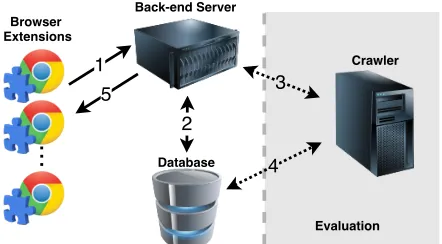
Figure 1: Architecture overview of theeyeWnder
sys-tem and the information flow between entities.
demonstrate the performance difference for a few of these options and show why we settle for the mean.
In order to be able to set the Domainsth,uthreshold, we
re-quire a minimum amount of information from users. Similar to [51], we require that users have visited at least 4 domains that serve ads within the last 7 days. If this minimum require-ment is not met, our algorithm refrains from making a guess for lack of sufficient data.
Time-window selection:Our algorithm operates in time
intervals in order to update the Usersththreshold, since users can continuously receive and report ads during their nor-mal browsing sessions. We select a time window of one week based on the following observations. First, users tend to browse differently during weekdays and weekends [10]. Therefore, we consider a week as a natural time period where both weekdays and weekend are captured, allowing us to study users’ behavior in both types of days. Second, we con-sider how targeted ads behave, which aggressively follow the user for a few days and gradually fade-out over time. Thus, a window of seven days is sufficiently large to capture targeting and allows to collect enough historical information for the algorithm to operate. In fact, we directly contacted 4 large DSP platforms and confirmed that the majority of ad-campaigns they serve last a week or more. Note that the Domainsth,u threshold is per individual user, thus, can be updated in real-time within each user’s browser.
5
THE
EYEWNDER
SYSTEM
In this section, we describe the high level components of the system and the information flows between them.
The high level architecture ofeyeWnderis depicted in Fig-ure 1. The system consists of four components: the browser extension instances, a back-end server, a centralized data-base, and a crawler server.
Browser extension:The extension performs the following functions: (1) Collects information about the ads rendered to the user. (2) Reports information to the back-end server (Figure 1, arrow 1) through the privacy-preserving protocol
of Section 6. (3) Classifies ads as targeted or non-targeted, by leveraging the algorithm of Section 4.1.
The actual algorithm that classifies ads as targeted vs. non-targeted consists of just a few lines of JavaScript code. Identifying and collecting info about ads is more involved. Indeed, different ad delivery channels use a multitude of techniques for delivering display ads. Several of them go at great lengths to make programmatic detection of their code difficult, in an attempt to evade ad-blocking software. Our extension runs an ad-detection algorithm to automati-cally detect ads within a page, and a landing page detection algorithm to infer the pages where ads lead once clicked. Our ad-detection algorithm is similar to the one of AdBlock-Plus [2]. Our goal, however, is just to analyze an ad, and not to block it.
In order to avoid click-fraud, the landing page detection algorithm does not click on the ad, but rather applies a series of heuristics to discover the landing URL. In particular, the algorithm examines<a>HTML tags to extract the URL from thehreffield; alternatively, the algorithm looks foronclick events and extracts the URL if it exists3. In case of JavaScript code, we run a regex to detect any URL-like strings within the script text. In all the above cases, if the detection algorithm finds a URL that does not belong to well-known ad networks, we consider the URL as the ad landing page. Otherwise, we refrain from resolving the URL in order to avoid click-fraud. A similar technique was used in [34, 46]. In case of ads with randomized landing page URLs (e.g., malicious ads [53] or customized dynamic ads [5]), we use the ad content (i.e., the image URL,etc.) to uniquely identify the same advertisement across different impressions. To identify ad networks that use randomized landing page URLs we use the methodology described in [15].
Back-end server:The server maintains the #Usersα
coun-ters and computes the corresponding Usersththreshold. By leveraging the privacy-preserving protocol of Section 6, the server receivesblindedreports from the extensions, aggre-gates them, and extracts an estimate of the number of users that have seen an ad—thereby computing the #Usersα coun-ters. The server also computes the Usersththreshold by apply-ing the methodology of Section 4.2; the computed threshold is then distributed to clients (Figure 1, arrow 5).
Database:We use MySQL to store system metadata, such
as, active users within the system, historic anonymized data reported by users,etc.(Figure 1, arrow 2). We also store ag-gregated data that we need for evaluation purposes.
Crawler server:This component is used only for evaluation purposes, and is responsible for collecting ad-related data on specific webpages. The crawler is controlled by the back-end
3In some cases theonclickevent is redirected to a JavaScript function
instead of a URL redirection.
server and can be instructed to visit specific websites upon request (Figure 1, arrow 3). Specifically, the crawler server visits audited pages to collect ads with a clear browsing pro-file (empty browser cache and an empty set of cookies). These ads are then used for deciding whethereyeWnderhas indeed classified accurately an ad as targeted (in which case the crawler should not encounter it during a visit). The crawler can launch multiple instances of a clean profile browser with theeyeWnderextension installed, and store the detected ads directly into the database (Figure 1, arrow 4).
6
PRIVACY PRESERVING PROTOCOL
In this section, we detail a privacy-preserving protocol that allows the back-end server to compute the #Usersα counters while clients keep the ads they have seen private.
We leverage techniques used in many proposals for privacy-preserving aggregated statistics [18, 36, 41]. The basic idea is that each userblindshis report before sending it to the server. Blinding factors are agreed upon by all users and are such that if the server aggregates all reports, the blinding cancels out and the aggregate statistic (e.g., the sum of all reports) becomes available to the server. In a nutshell, one can think of the blinding factors as additive random shares of 0. If users report a vector of values, they should compute separate blindings for each position of the vector. One fun-damental assumption underlying the design just described is that all parties in the system (i.e., users and the server) can enumerate the whole set of elements to be reported. In our scenario, this set—we denote it byA—includes all ads seen by at least one of our users. Therefore, its size may be large and, most importantly, users may not be able to enumerate it. For example, user Alice may not know what ads have been seen by user Bob. In such settings, one could use synopsis data structures for multi-sets that admit aggregation. For example count-min-sketches [29] (CMS) or spectral bloom filters [19] can be used. In this work, we use CMS as they allow us to bound the probability of error, as well as the error itself.
6.1
Count-min-sketch
A CMS X is a bi-dimensional array withd =⌈lnT/δ⌉rows andw =⌈e/ϵ⌉columns, whereTis the number of elements to be counted. All the cells of the sketch are initialized to 0 anddpairwise-independent hash functions{hj :{0,1}∗→ [w]}1≤j≤dare chosen.
The encoding of an elementxiis done by callingX.update(xi) that incrementsX[j,hj(xi)]by 1, for 1≤j ≤d.
The estimated frequency ¯cxi of elementxi is retrieved by
callingX.query(xi)that outputs minjX[j,hj(xi)]such that: (1)cxi ≤c¯xi
(2) ¯cxi ≤cxi +ϵ
Í
j=1..Tcxjwith probability 1−δ
wherecxi is the true frequency of elementxi.
IneyeWnder, each user encodes the set of ads he has seen in a CMS data structure, and blinds each cell before sending it to the server. The server aggregates all CMSes so that all blindings cancel out, and obtains the aggregate CMS encod-ing the multi-set of ads seen across all users. If users share an additive random share of 0 for each cell of the CMS, this design allows for a privacy-preserving aggregate statistics framework for scenarios where the set of elements to be counted is (a) large and (b) not enumerable by each party.
This design is similar to the one shown in [41], that in turn, extends techniques presented in [36]. However, the clients in [41] can enumerate the set of elements to be reported and, therefore, [41] presents a less challenging scenario.
We also face an additional challenge, that, to the best of our knowledge, has not been addressed by existing privacy-preserving aggregate statistic techniques. Data structures like spectral bloom filters or CMS allow to query for the estimate frequency of a given elementx. That is, the querier (i.e., our server) must enumerate all the ads encoded in the aggregate CMS, in order to learn the distribution of ads as seen by users. Of course, the server cannot do so and our privacy goal forbids clients from sending the URLs of the ads to the server. We overcome this problem as follows.
We map the URL of anad ID in[1,|A|]by means of a pseudo-random function (PRF). The latter is keyed to pre-vent the server from computing the mapping on its own. In particular, given an ad URLx, its ad ID is computed as y=F(k,x)whereF is a PRF andkis a cryptographic key. For each ad seen by a user, the extension computes the corre-sponding ad ID and encodes it in the CMS. Note that without knowledge ofk, it is not possible to relate ad URLx to its identifiery.
Rather than hard-coding the keykin the extension, we bor-row from previous research on Oblivious Pseudo-Random Function (OPRF) [27] and introduce an additional server to help clients mapping ad URLs to ad IDs. Theoprf-server holds the secret keykand aids clients to computey=F(k,x)
for a given ad URLx. As the name suggests, the server is “oblivious” to the input of the PRF so thatx remains pri-vate to the user.4 While such a design choice requires an additional server, we note that previous work uses a simi-lar approach in order to improve the overall security of an application [24, 35]. In a real-world deployment, the oprf-server may be instantiated by already-deployed trusted-third parties such as certification authorities, EFF,etc.
In practice, we have to (over)estimate|A|in order to mini-mize collisions when mapping an ad URL to an ad ID. How-ever, by overestimating|A|, the server is likely to query the
4We note that in order to avoid a single point of failure, mapping function
can be distributed to multiple servers by definingFas the XOR of the output of multiple OPRFs, each computed with its own secret key.
CMS for ad IDs that correspond to none of the encoded ads (i.e., a false positive). Nevertheless, later we show that a CMS is robust to false positives by design.
In the following, we provide details of the protocol.
Blinding factors:We borrow from Kursawe et al. [36] who have shown how a set of users can agree on random shares of 0. In particular, letN be the number of users andM be the number of elements to be blinded (e.g., the number of cells in a CMS). Also, denote byxi,y=дxi, the private and
public key of userui, respectively. Here,д is a generator of a cyclic groupGof orderq, where Computational Diffie Hellman is hard. Assume that the public key of each user is available to all other users in the system,e.g., by means of a public bulletin board like an online forum5. At rounds, user ui generates a blinding factor for them-th cell as:
bi[m]= N
Õ
j=1,j,i H(yxi
j ||m||s) · (−1)i>j
where(−1)i>j is equal to 1 ifi>j, or to−1 otherwise. Note that each user can locally compute his blinding factors by simply using the public keys of all other users. Note also that for anym, we haveÍN
i=1bi[m]=0,i.e.,bi[m]is an additive random share of 0.
OPRF:We leverage the RSA-based OPRF in [33]. Given an RSA triple(N,d,e)where N is the product of two distinct primes of sufficient length andd,e ∈Zϕ∗(N)are such that ed≡1 modϕ(N), the PRF on inputxis defined asG(H(x)d)
whereH : {0,1}∗ → Z
N is a hash function mapping
ar-bitrary strings to elements ofZN, andG : ZN → {0,1}l
H :{0,1}∗ →Z
N is a hash function mapping elements of
ZN to strings of arbitrary lengthl. The oprf-server
gener-ates the RSA triple (via a suitable key-generation algorithm) and publishesN,ewhile keepsdprivate. Given an ad URL x, the client issues a request asx′ =H(x)re. That is, the client mapsxtoZN and blinds the result by multiplying it with a random group elementrraised to thee-th power. The server “signs” the request by computingy=(x′)d. Finally, the server recoversy′=yr and outputsy=G(y′). Note that
y′=yr = (xr′)d = (H(xr)re)d =H(x)rdred =H(x)dsinceed =1 modϕ(N). The protocol guarantees that the server learns nothing aboutx whereas the client learns nothing aboutd, and it is a PRF under the one-more RSA assumption [33].
CMS computation:Userui starts with an empty CMSXi. For each newly received adx, the user engages in an OPRF protocol with the oprf-server to obtain the corresponding ad IDy, and encodesyin the CMS by callingXi.update(y).
When asked to report its CMS, the user blinds each cell ofXi with the blindings computed as shown above. That
is, the client computes the blinded CMS ˆXi by computing
5The board may be as well hosted at the back-end server.
ˆ
Xi[j]=Xi[j]+bi[j]for 1≤j ≤mwheremis the number of cells in the CMS. Finally, the client sends ˆXi to the server.
Aggregation and unblinding: Finally, the server aggre-gates all received CMSes by computingX =Í
iXˆi where the
sum is cell-wise and, for each ad IDi ∈ {1, . . .|A|}it obtains the estimated frequency by queryingX.query(i).
Fault-tolerance:Our aggregation technique requires that all users report their blinded CMSes, so that the server can aggregate them and cancel out the blindings. If a user fails to report its CMS, aggregation of the remaining ones at the server results in a CMS with random noise in each of its cells. In order to tolerate missing reports, the server and the clients who have sent their reports must go through an additional round of interaction to “adjust” their blindings and cater for the blindings of the non-reporting clients (see [41]). The protocol takes only two rounds—one where the server reports the list of “missing” clients and another round where the clients send their CMSes obfuscated with the updated blinding factors.
Security:The security of our scheme follows from the secu-rity of the protocol to compute blindings proposed in [36]. We tweak the protocol by using an OPRF to map ad URLs to a set that is enumerable by the server. By the security provi-sions of the OPRF protocol, given an ad IDy, it is impossible to retrieve its original URL without knowledge of the key held by the oprf-server.
We stress that our protocol remains secure against an honest-but-curious server, and this is an assumption com-mon to many other systems that address privacy issues when computing statistics on crowdsourced data [18, 36, 41].
7
EVALUATION
In this section, we first evaluate the overhead of our privacy preserving protocol. Second, we present a controlled simu-lation study to assess the robustness of our algorithm and the effect of key parameters on its performance. Third, we present a live validation of the entire system with real ads and the 100 real users recruited via FigureEight [26].
7.1
Performance and overhead of the
privacy preserving protocol
First, we assess the communication overhead due to the CMS and compare it with the average communication overhead if clients were to upload their contributions in cleartext. We fixδandϵto 0.001 and assume the size of a cell in the CMS to be 4 bytes. The size in bytes of the CMS totals to 185, 196, and 207KB, for an input size6 of 10k, 50k, and 100k, respectively. If users were to report their contribution in cleartext, each user would simply report a vector of URLs. Since our dataset suggests that users see 35 unique ads on
6The number of ads to be counted.
2 4 6 8 10
# Users 0.00
0.05 0.10 0.15 0.20 0.25 0.30
Probability Density
Week 1 Actual Week 1 CMS Week 2 Actual Week 2 CMS Week 3 Actual Week 3 CMS
Act_Th: 2.25 CMS_Th: 2.30 Act_Th: 3.26 CMS_Th: 3.33 Act_Th: 2.54 CMS_Th: 2.62
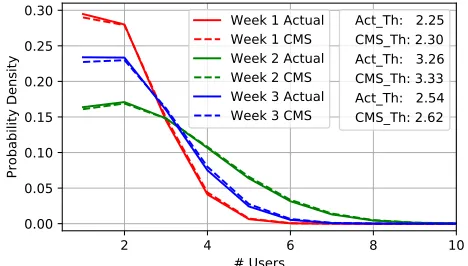
Figure 2: The effect of the privacy preserving protocol on the computation of the #User distribution and its threshold for three different weeks.
average, the communication overhead for the average user amounts to roughly 3.5KB (assuming 100-characters URLs using Unicode encoding). Nevertheless, some users with a large number of ads to report can see their communication overhead rise up to hundreds of KB (some users in our dataset reported around 250 unique ads).
Next, we assess the communication and computation over-head required to compute the blinding factors. Exchanged data between the server and a client amount to 0.38MB and 1.9MB for 10k and 50k users, respectively. The computation time at the client totals 30 seconds for 1k users and a sketch of size 5k. Our results are in line with results reported in [41]. We stress that both operations are carried out once per week and can run in the background.
Also, the time to map the URL of an ad to its ID, using the oprf-server, is always less than 500ms and requires exchang-ing two group elements (e.g., 1024 bits each). We stress that the mapping is done once per (unique) ad. It can be carried out as ads are received and results can be stored locally so that they are available when the CMS must be computed.
Finally, we empirically show the effect of the privacy pre-serving protocol on the computation of the #Userα
distri-bution and its threshold. Figure 2 compares the distribu-tion computed with cleartext reports versus the distribudistribu-tion computed using the privacy-preserving protocol based on (blinded) CMSes. The figure shows the difference using data from three different weeks in our dataset. Furthermore, the figure reports the threshold value computed on cleartext data, and the threshold value computed on the outcome of the privacy-preserving protocol. The latter leads to a slightly higher threshold and this is due to the collisions that may happen when mapping ad URLs to ad identifiers.
To sum up, the overhead due to privacy-preserving proto-col does not impose an unbearable toll on users. The protoproto-col to map ad URLs to identifiers is very lightweight and the
mapping is carried out as new ads are encountered. The protocol to report the CMS requires a few (i.e.2 or 3) MB of data to be exchanged, assuming 50k users. This is done once per week and the communication complexity scales linearly with the number of users. Further, the error on the estimated distribution due to the privacy-preserving protocol is small as shown in Figure 2.
7.2
Controlled simulation study
The count-based algorithm of Section 4.1 and its automated parameter tuning described in Section 4.2 can lead to false negatives,i.e., targeted ads classified as non-targeted, and false positives,i.e., non-targeted ones classified as targeted. In this section, we study the circumstances and the frequency of such misclassification via controlled simulation experi-ments. Out of the two metrics, the most important are the false positives. This has to do with a major use case for eye-Wnder, which is to report illegal targeting, as explained in the introduction. Therefore, wheneyeWnderclassifies an ad as targeted we want this to be precise with high probability so that investigations are not triggered by mistake. On the other hand, failing to detect a targeted ad is relatively less important since no investigation is launched in this case.
7.2.1 False negatives.As described earlier, our algorithm
uses the fact that the same ad “follows” a user across multiple domains as an indication of targeting. But how intense should this following be before our algorithm has a chance to detect it? If a targeted ad appears only once, then certainly it is indistinguishable from any non-targeted ads. Considering the other extreme, if it appears in all the pages visited by a user, then it obviously becomes easy to detect. Next, we study the effect of theFrequency Cap i.e., the number of repetitions (or re-appearances) of a targeted ad on the ability of our algorithm to detect and classify it correctly. Notice that this parameter is not known to us, nor uniform across advertisers and therefore we study its effect in our simulation model by assigning to it different values. The Frequency Cap is used by advertisers to avoid annoying targeted users with too many repetitions of the same ad. In our validation study appearing later in Section 7.3 we demonstrate that our system is indeed robust to the magnitude of values used in practice, but remaining unknown to us.
7.2.2 False positives.The same ad can be encountered in
multiple websites without being targeted. Such is the case, for example, of large-scale “brand awareness” campaigns paid by large corporations to display their offering in many mainstream and even niche websites without targeting any particular individual. Such ads will appear to be chasing a user across websites, when in reality they are not. Of course, our algorithm also checks to see that the ad is not seen by
Table 1: Simulation configuration parameters
Variable name Value
Number of users 500
Number of websites 1000 Average user visits 138 Average ads per website 20 Percentage of targeted ads 0.1
1 2 3 4 5 6 7 8 9 10 11 12
Frequency cap
0
20
40
60
80
100
False Negative %
Mean
Mean+
Median
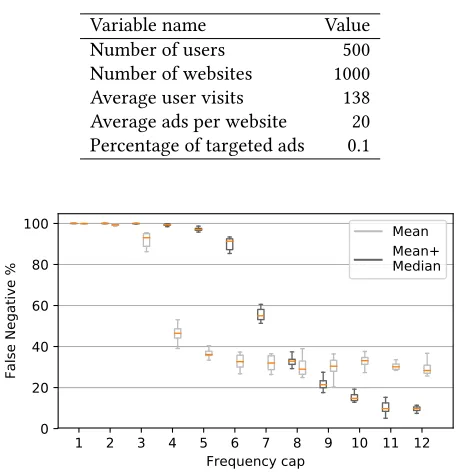
Figure 3: False Negatives % Vs. Frequency Cap using two different thresholds (Mean, Mean+Median) for both variables (#Usersα, #Domainsu,a)
many other users ofeyeWnder, but non uniform user interests can lead to misclassification as shown next.
7.2.3 Simulation results.We have built a custom
simula-tor, based on [14], capable of simulating users, websites, and ad campaigns. The main parameters of the simulator and pre-set values for our basic configuration, are depicted in Table 1.
Figure 3 shows that even few repetitions of a targeted ad make it detectable by our algorithm with high probability. Setting the Usersth and Domainsth,u thresholds according to theMeanvalue of the corresponding counters (see Sec-tion 4.2) brings false negatives to below 30% with just 6-7 repetitions of an ad. Using as threshold theMean+Median value requires a higher number of repetitions for detection but drops false negative even further to 10%. Our experi-ments with real users in the next section are in agreement with these results. In those experiments we set the thresholds using Mean to make sure we can have detection even with a smaller number of repetitions for a targeted ad.
Regarding false positives, we have run several different simulations in which a subset of users visits a subset of sites that happen to be running large static campaigns. These users get to see the same ad in different websites not because they are being targeted but because the ad happens to be
in all the websites they visit. If the remaining users (the majority) visits different websites, then misclassification may appear for the initial subset of users. Still, this happens with probability below 2% in more than 30 different parameter configurations that we have tried. This result is also validated by our experiments with real users. False positives can be further reduced by grouping users in more homogeneous groups in terms of browsing patterns (e.g., geographically or based on age group,etc.).
7.3
Live validation of
eyeWnder
Our simulation results have shown that wheneyeWnder clas-sifies an ad as targeted then this is accurate with very high probability (false positives <2%), whereas when it classifies an ad as non-targeted the accuracy is again high (false nega-tives 10-20%). In this section we want to validate the above results with a live experiment involving real users and cam-paigns. This is inherently difficult due to the lack of publicly available ground truth about which ads are targeted and which not (see Requirements in Section 2.2). The situation becomes even more challenging when the evaluation has to be performed for a system used by real end-users (as opposed to offline evaluation based on network traces), over a variety of ad delivery channels (as opposed to a single channel,e.g., facebook ads [6, 48, 54]). Still in this section we perform such a live validation and show that it leads to consistent results with those of our simulation study.
7.3.1 Datasets.We use three different datasets. The first
dataset is created with the help of a crowdsourcing platform named FigureEight [26]. We collected data during three con-secutive weeks from a population of 100 users with varying level of activity. The dataset includes in total 6743 ads. We call this dataset the“eyeWnder dataset”and we use it as input to the count-based algorithm that classifies the collected ads. In addition, we also ask the FigureEight users to label the ads that they receive as targeted or not. For this purpose, we instruct the users to provide labels to all the ads they receive while surfing the web. We call this subset of labeled ads the “F8 dataset”.
The last dataset we use is collected by the crawler during the same three weeks. It includes several visits and ad col-lections to any website in whicheyeWnderhas classified an ad7. We call this dataset,“CR dataset”and use it to identify statically placed ads as done in [16, 46].
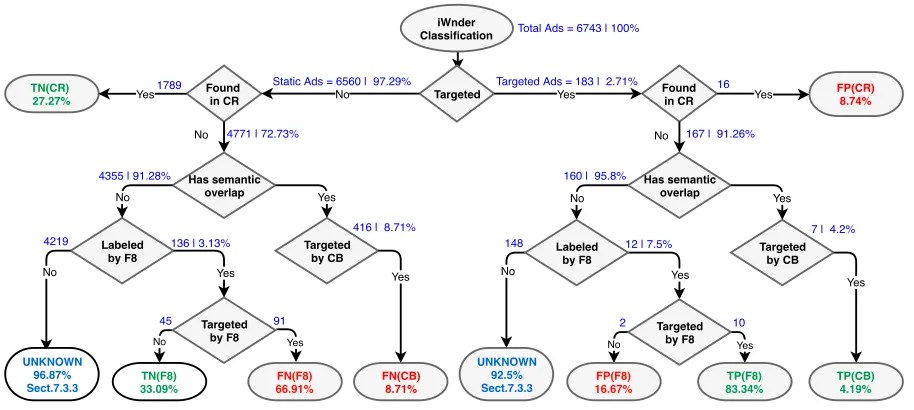
7.3.2 Methodology.Figure 4 presents the work-flow of
our evaluation methodology. The idea is to compare the classification derived byeyeWnder against the classification
7Note that for evaluation we are using full information on our test users
after having been granted full consent. The privacy preserving protocol is developed for the actual operation of the system beyond evaluation.
from the crawled dataset (denoted by CR in the figure), the classification from a content-based detection heuristic (CB)8, and the classification from FigureEight users (F8). These comparisons yield False Positives (FP), False Negatives (FN), True Positives (TP), True Negatives (TN), as well as UN-KNOWN rates. As we will explain shortly, results derived by comparing against the crawler arecorrect with high prob-ability(namely FP(CR), TN(CR)). Results derived by com-paring against the content-based heuristic or FigureEight arelikely correct(namely TP(CB), FN(CB), TP(F8), TN(F8), FP(F8), FN(F8)). The justification for the above is that the content-based heuristic and FigureEight are themselves sub-jective means of classifying an ad. Users have limitations in detecting bias or discrimination [47], whereas the content-based heuristic is just another heuristic whose validation faces the same challenges with the validation ofeyeWnder. Since, however, the heuristic is a reasonable one, and the users have been selected carefully, we assume that their clas-sifications will be more right than wrong. Ads falling under UNKNOWN are ads for which it is impossible to assess pre-cision by the previous means. We handle them separately in Section 7.3.3. Next, we traverse the evaluation flow-chart of Figure 4 from top to bottom, starting from the right branch.
Ads classified as targeted: If an ad is classified as targeted byeyeWnder, we check to see if the crawler happens to see the same ad. If this happens, then we have a false positive with high probability, since targeted ads should not be en-countered by a crawler having empty browsing history.
If the crawler does not see the ad, then we proceed to check if the ad shares any semantic overlap with the user, using the methodology described in [45]. If it does, then, and only then, we check to see if the content-based heuristic also classifies it as targeted. We do this check in order to identify the set of ads in whicheyeWnderand the content-based heuristic have a chance to agree. Such ads can only beDirecttargeted ads because the content-based heuristic can only detect those (see Section 2.1). In our evaluation, we check for semantic overlap using the content-based heuristic which implies that if the ad has semantic overlap with the user,eyeWnderand the content based heuristic will agree by default9yielding a likely true positive.
8We have adapted the methodology of [16] to operate with real users instead
of personas. For each user, we have selected the most significant categories of the pages he visits to create his profile. We used categories appearing at least T times in different websites. We have used T = 20 since in the context of this paper we are seeking precision rather than recall. We classify an ad as targeted if the main category of its landing page (as obtained from AdWords) matches one of the categories in the user profile.
9It might appear as redundant to check both for semantic overlap and
agreement with the content-based heuristic, since we use the latter also for semantic overlap. We have kept both stages for generality, since semantic overlap could be checked with alternative methods than our content-based heuristic.
iWnder Classification
Targeted Found
in CR
Yes Yes FP(CR)
8.74%
Has semantic overlap
No
UNKNOWN 92.5% Sect.7.3.3
No
Targeted by CB
Yes
TP(CB) 4.19%
Yes
Found
in CR No
TN(CR)
27.27% Yes
No
Yes No
Labeled by F8
Yes No
Targeted by F8
TP(F8) 83.34% FP(F8)
16.67%
Has semantic overlap
Labeled by F8
Targeted by CB
Yes No
No
UNKNOWN 96.87% Sect.7.3.3
Yes No
Targeted by F8
TN(F8) 33.09%
FN(F8) 66.91%
FN(CB) 8.71%
Yes Yes
Total Ads = 6743 | 100%
Static Ads = 6560 | 97.29% Targeted Ads = 183 | 2.71% 16
167 | 91.26% 1789
4771 | 72.73%
416 | 8.71% 4355 | 91.28%
4219 136 | 3.13%
91 45
7 | 4.2% 160 | 95.8%
12 | 7.5% 148
10 2
Figure 4: The evaluation tree for precision performance of theeyeWnderclassification of targeted ads.
If an ad does not share semantic overlap with the user, we check to see if FigureEight users have tagged it. Notice here that FigureEight users have classified only a subset of the ads that they have seen. If they have not provided a classification, then the ad is added to UNKNOWN. Otherwise, if their classification agrees witheyeWnder, we have a likely true positive, else a likely false positive.
Ads classified as non-targeted: If an ad thateyeWnder classifies as non-targeted is seen by the crawler, then this produces a true negative. If the ad has semantic overlap with the user, then, as explained before, the content-based heuristic will classify it as targeted, thereby yielding a likely false negative foreyeWnder. If the ad does not have semantic overlap with the user, we check to see if FigureEight users have classified it. If they have not, it goes to UNKNOWN. If they have classified as targeted, it produces a false negative foreyeWnder. If they have classified it as non-targeted, then we have a likely true negative foreyeWnder.
7.3.3 Dealing with the unknown.Due to the lack of ground
truth, a high rate of classified ads (148 targeted and 4219 non-targeted) have ended up in the two UNKNOWN groups of Figure 4, for which we cannot evaluate precision using the crawler, the content-based heuristic or FigureEight. In this section, we perform extra analysis to resolve non-targeted UNKNOWNs into likely-TN or likely-FN, and the targeted UNKNOWNs into likely-TP or likely-FP.
– Non-targeted UNKNOWN: In this case, both count-based and content-based classification have identified these ads as non-targeted. However, these ads were not manually tagged by FigureEight users. Hence, we select a random set of 200 of these ads and manually inspect them. In particular, we
consider the profile of the user receiving the ad, in order to manually determine if the ad is targeting such a profile. – Targeted UNKNOWN: This group includes 148 ads that
eye-Wnderclassified as targeted, but CB and FigureEight users did not. Hence, they may be either FP or some form of tar-geting (e.g., indirect) that escapes CB or FigureEight users. A preliminary manual inspection showed that several of them seemed to be retargeted ads [9]. To verify this, we manually visited the landing page associated to each ad, and afterwards we visited some of the domains where the ad re-appeared according to our dataset. The experiment was set up for testing the repeatability of the suspected retargeting. When the experiment led to retargeting, it meant that our initial guess was correct, and we considered the classification to be a likely TP.
For the remaining ads, we evaluated if they could be in-direct OBA ads. To this end, we performed a correlation analysis between the topics of the ad’s landing page and the profiles of the users receiving that ad. If there exists statis-tically significant correlation between some of the ad’s and the user’s topics, but these topics are not semantically over-lapping, then we interpret it aslikely indirect OBAad, and the classification is a likely TP. Some examples of ads that we identified as indirect OBA are the following: (1) Male users who exhibit interest in computers, electronics, cars, etc., but receiving ads from a dating website (perhaps a classic indi-rect targeting of single male users). (2) Users with interest in computers, electronics, and programming, but receiving ads from KFC, a famous fast food restaurant. (3) Users with interest in websites related to beauty products, fitness, body care,etc., receiving ads related to seafood. Finally (4) users
who showed interest in governmental websites, internet ser-vices, insurance serser-vices,etc., receiving ads related to real estate and housing.
7.3.4 Results.The rates in Figure 4 along with the results
from our analysis of unknown ads reveal that the overall rate oflikelyTPs is 78%. From these, 10% have been identi-fied by CB or FigureEight users. The rest are associated to retargeting or indirect OBA. Our analysis also reveals a TN rate of 87%. In particular, 27% arehighly probableTNs, since these ads have been marked as non-targeted by both, eyeWn-derand the crawler. The remaining 60% arelikelyTNs. This percentage has been derived from our manual inspection of non-targeted UNKNOWN.
Based on these results, we claim that our method meets the high precision requirement defined in Section 2, which guarantees that, for instance, users willing to report a privacy incident related to an ad have high confidence that the ad is indeed targeted.
We acknowledge that there is still room for improvement, since, as the evaluation shows,eyeWndersometimes fails to detect ads classified as targeted by CB (416) or F8 (91). This is mainly due to two factors. First, as we further dis-cuss in Section 10, we have evaluatedeyeWnderwith just a few users, which is close to a worst-case analysis given the crowdsourced nature of the system. Second,eyeWnderhas been configured to maximize the precision rather than recall for reasons discussed in Section 2. We are confident that with a bigger dataset, our existing count-based detection would perform better. We could also come up with more elaborate heuristics to improve performance. Our objective in this pa-per, however, is to make the point that even with few users, simple count-based detection yields precise classification for both directly and indirectly targeted ads.
Evading detection of targeted ads:Finally, in this para-graph we discuss the situations where advertisers are in-tentionally trying to evade the detection of targeted ads. Our system is robust to that since there is a lot of inherent randomness in the current way ads are delivered, yet eye-Wnderidentifies such ads with good accuracy even with few hundreds of users. For an adversary to defeat detection it will have to effectively give up targeting or do it very mildly which would, effectively, go against the very idea of targeting and his business model.
8
SOCIO-ECONOMIC BIASES
In this section, we leverage the social, economic and demo-graphic information we have from the volunteers and the datasets of Section 7.3.1, to look for potential socio-economic biases of ad targeting.
Table 2: Logistic regression modeling for targeted ads
Variable OR SE Z-val P>|z| 95% CI
Gender
female 0.255 0.407 -3.356 8e-4∗∗∗∗ 0.107-0.539 male 0.174 0.383 -4.566 5e-6∗∗∗∗ 0.076-0.348
Income
30k-60k 1.446 0.145 2.538 0.0111∗∗ 1.088-1.924 60k-90k 1.521 0.187 2.249 0.0245∗∗ 1.052-2.187 90k-... 0.525 0.343 -1.878 0.0603∗ 0.257-0.996
Age
20-30 1.031 0.407 0.075 0.9404 0.488-2.450 30-40 1.428 0.405 0.880 0.3790 0.679-3.388 40-50 1.964 0.422 1.599 0.1098 0.899-4.788 50-60 0.745 0.489 -0.601 0.5475 0.291-2.022 60-70 2.654 0.477 2.044 0.0409∗∗ 1.069-7.087
OR: Odds Ratio, SE: Standard Error, CI: Confidence Interval
∗∗∗∗p<0.001,∗∗∗p<0.01,∗∗p<0.05,∗p<0.1
8.1
Logistic regression analysis
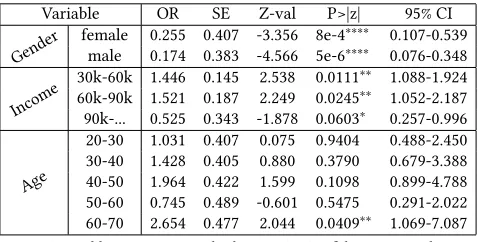
The demographic data provided by our volunteers include information such as gender (G), age (A), income level (L), employment status (E),etc.We want to investigate these independent, nominal and ordinal factors, and how they associate with the type of advertisement delivered to the participating users. In practice, the type of ad is the depen-dent variable (D) in our model, receiving a binary status of “static” or “targeted” advertisement. Using these input data, we perform a binomial logistic regression on the 4 indepen-dent variables to model the 1 depenindepen-dent variable, in the form: D∼G+A+L+E.
In reality, we tested several configurations for the model, including pairwise interactions between all independent fac-tors, as well as removing incrementally each one of them to test if the model improved its predictive performance. In fact, in the case of “employment status”, it was removed from the model as it was deemed non-useful with ananovalikelihood ratio test, with non-significant impact in the final produced model. Here, we only report the experimental setup that yielded a logistic regression model with most statistically significant results, in form:D∼G+A+L, considering 0-30k and 1-20 the base levels for income and age, respectively.
8.2
Findings
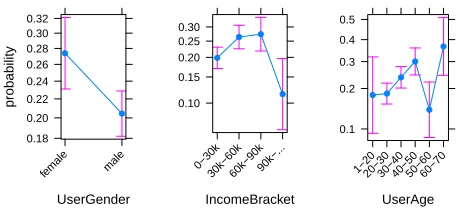
The results of the logistic regression are shown in Table 2. Also, in Figure 5 we plot the effects of the three variables and all their corresponding levels, with respect to the expected probability for a user to receive targeted ads. From these results, we make the following observations:
– Gender bias: From our analysis, we find statistically signifi-cant effect on the factor of gender. In particular, women are more likely to be targeted by advertisers than men, and this result is significant atp <0.001.
– Economic bias: Our results show that as the income level of a user increases from 30k to 60k, and from 60kto 90keuros,
UserGender
probability
0.18 0.20 0.22 0.24 0.26 0.28 0.30 0.32
female male
●
●
IncomeBracket 0.10
0.15 0.20 0.25 0.30
0−30k 30k−60k60k−90k90k−...
● ● ●
●
UserAge 0.1
0.2 0.3 0.4 0.5
1−2020−3030−4040−5050−6060−70
● ● ●
●
● ●
Figure 5: Predicted probability for a targeted advertise-ment to be delivered to a user, vs. three independent variables with statistically significant levels.
Table 3: Comparison of characteristics of main tar-geted ad detection solutions.
[20] [7] [40] [16] [38] [39] [46] eyeWnder
Fake Impressions † † † † † † †
Click-fraud † † *
Privacy-preserving ✓
Real-users ✓ ✓
Personas • • • • • •
Operates in Real-time ✓ ✓
High scalability ✓ ✓
Operates Offline † † † † † †
Topic-based • • • •
Correlation-based • • •
Count-based •
†Negative,✓Positive,•Neutral,*Unspecified - (Within the context of this work)
he or she is more likely to be targeted by advertisers, and this is statistically significant atp <0.05. However, when the income level becomes too high (i.e., above 90k euros), the expected probability of targeted advertising is reduced. We conjecture that advertisers profile users to construct economic capacities for each one, and adjust their targeting campaigns accordingly to optimize click-through and sale rates. Online advertisements targeting very wealthy users may have proven to be less profitable than other income brackets, and thus, such users are less targeted.
– Age bias: From the odds ratio scores, it appears that increas-ingly older users are more probable to be targeted by adver-tisers. However, some of the age brackets are less populated by ads and users and thus, our results are not statistically significant, but only demonstrate a consistent trend.
9
RELATED WORK
Table 3 summarizes and compares existing proposals for detecting targeted advertisements. From a methodological view, these solutions can be grouped intotopic-based[7, 16, 40, 46], andcorrelation-baseddetection [20, 38, 39].
Topic-based solutions perform content-based analysis to extract the relevant topics on a user’s browsing history and
the ads he receives. Then, using different heuristics and statis-tical means, targeted ads are identified as those having topics that share some semantic overlap with the user’s browsing history. Topic-based detection could, in principle, be applied to real users, as we have done for evaluation purposes in Section 7. Existing work, however, has only used it in con-junction with artificially constructedpersonas,i.e., robots that browse the web imitating very specific (single-topic) demographic groups [7, 16], or to emulate real-users offline using click-streams [40].
The only topic-based solution meant to be used by real users is MyAdchoice [46], which has been implemented in the form of a browser extension. This extension is available only under request, and based on the information reported in the paper, it has been only used in a beta-testing phase by few tens of friends and colleagues. Independently of the specific pros and cons of individual solutions, topic-based detection presents some common limitations. The most im-portant being that it can only detect direct interest-based targeted advertising. It is unable to detect other forms of targeting based on demographic or geographic parameters, as well as indirect targeting (see Section 2.1 for definitions). Correlation-based solutions treat the online advertising ecosystem as a blackbox and apply machine learning and sta-tistical methods to detect correlations between the browsing behavior and other characteristics of a user (OS, device type, location,etc.) and the ads he sees. For instance, XRay [38] and Sunlight [39] create for each persona severalshadow ac-counts. Each shadow account performs a subset of the actions performed by the original persona. By analyzing the common actions performed by shadow accounts receiving the same reaction from the ecosystem (i.e., the same ad), the authors can infer the cause of a targeting event. AdFisher [20] uses similar concepts to find discrimination practices, for instance, in the ads shown to men vs. women. As with topic-based de-tection, this technique presents important challenges related to scalability and practical implementation. Moreover, they are not suitable for real-time targeting detection. With the exception of [46], no previous work has been implemented as a tool for end-users. Most of them, including [46], rely on content-based analysis, thereby suffering from scalability issues and inability to detect indirect targeting.
Parallel to efforts from the research community, the Eu-ropean Interactive Digital Advertising Alliance (EDAA) has developed YourAdChoices [4]. It is a self-regulation program in which companies that deliver targeted ads voluntarily add an icon that, if clicked by a user, offers some form of explanation of why the user received the ad. This technique scales and works in real time. It only works, however, with companies participating in the program. It also assumes full trust on the reported explanations, something that has been
challenged by recent works [20].eyeWnderoffers the oppor-tunity to conduct independent audits, which are useful for end-users, data protection authorities, as well as for the cred-ibility of ad-choices and related self-regulation initiatives.
10
CONCLUSIONS AND FUTURE WORK
We have showed that a simple count-based heuristic can de-tect targeted advertising without having to perform complex content-based analysis,i.e.without having to understand se-mantically webpages or received ads. To be able to run such an algorithm, one needs a crowdsourced database of how many users have seen each ad. Such a crowdsourced database can be built efficiently and without jeopardizing user pri-vacy,i.e., without requiring users to report the actual ads they have seen, nor the websites where they encountered them. Our count-based heuristic and privacy preserving crowd-sourced approach have been implemented in a first of its kind distributed system calledeyeWnder, which allows users to audit any encountered ad impression in real-time to check whether it is targeted or not. We have developed a detailed validation methodology for the difficult problem of assessing the accuracy of an ad detection method using only publicly available information.
Crowdsourcing simplifies the ad detection problem. Any crowdsourcing method, however, has two Achilles’ heels: privacy risks and bootstrapping its user-base. We have ad-dressed the first and taken only very preliminary measures for the second. For example, we circulated it among other researchers, and enlisting some users for pay. This has per-mitted us to conduct a preliminary evaluation ofeyeWnder and show that the count-based approach is indeed promis-ing. Our current effort is to scale up our user-base. To do so, we will use traditional means,e.g., seeking more expo-sure through media, or getting help from data protection authorities to enlist users. Scaling up the user-base will help us refine our count-based ad detection method, evaluation, and probably yield many more interesting findings. This, however, remains a task for future work.
ACKNOWLEDGEMENTS
The research leading to these results has received funding from the European Union’s Horizon 2020 Research and In-novation Programme under grant agreements No 653449 (project TYPES), No 786669 (project CONCORDIA), No 786741 (project SMOOTH) and Marie Sklodowska-Curie grant agree-ment No 690972 (project PROTASIS). The paper reflects only the authors’ views and the Agency and the Commission are not responsible for any use that may be made of the information it contains.
REFERENCES
[1] 1998. Children’s Online Privacy Protection Act (COPPA). https://www.ftc.gov/enforcement/ rules/rulemaking-regulatory-reform-proceedings/
childrens-online-privacy-protection-rule. (1998). [Online: ac-cessed 30-January-2019].
[2] adblockplus.org. 2019. Adblock Plus. Surf the web without annoying ads! https://adblockplus.org/. (2019). [Online: accessed 30-January-2019].
[3] adguard.com. 2019. Adguard AdBlocker browser extension. https://adguard.com/en/adguard-adblock-browser-extension/ overview.html. (2019). [Online: accessed 30-January-2019]. [4] Digital Advertising Alliance. 2019. YourAdChoices. http://
youradchoices.com/. (2019). [Online: accessed 30-January-2019]. [5] Inc. Amazon Technologies. 2016. Personalized Landing
Pages. https://patentimages.storage.googleapis.com/72/fb/61/ 7dd01f31aca7be/US20160180389A1.pdf. (2016). [Online: accessed 30-January-2019].
[6] A. Arrate, J. G. Cabanas, A. Cuevas, M. Calderon, and R. Cuevas. 2019. Large-scale analysis of user exposure to online advertising on Face-book.IEEE Access(2019).
[7] P. Barford, I. Canadi, D. Krushevskaja, Q. Ma, and S. Muthukrishnan. 2014. Adscape: Harvesting and Analyzing Online Display Ads. InProc. of the Conference on World Wide Web, (WWW’14).
[8] M. Bashir, S. Arshad, E. Kirda, W. Robertson, and C. Wilson. 2018. How Tracking Companies Circumvented Ad Blockers Using WebSockets. InProc. of the Internet measurement conference, (IMC’18).
[9] M. Bashir, S. Arshad, W. Robertson, and C. Wilson. 2016. Tracing Information Flows Between Ad Exchanges Using Retargeted Ads. In
Proc. of the USENIX Security Symposium, (SEC’16).
[10] D. Boughareb and N. Farah. 2011. Toward a Web Search Personalization Approach Based on Temporal Context. InProc. of Digital Information and Communication Technology and Its Applications.
[11] P. Bradshaw. 2016. It’s official: The Walking Dead helped elect Donald Trump. https://www.theguardian.com/commentisfree/2016/nov/23/ walking-elect-dead-trump-immigration-zombies. (2016). [Online: accessed 30-January-2019].
[12] C. Brooks. 2017. Invasion of Privacy: What Consumers Think of Personalized Online Ads. http://www.businessnewsdaily.com/ 4632-online-shoppers-personal-ads.html. (2017). [Online: accessed 30-January-2019].
[13] Interactive Advertising Bureau. 2018. IAB Internet Advertising Revenue Report. https://www.iab.com/wp-content/uploads/2018/11/ REPORT-IAB-Internet-Advertising-Revenue-Report-HY-2018.pdf. (2018). [Online: accessed 30-January-2019].
[14] S. Burklen, P. J. Marron, S. Fritsch, and K. Rothermel. 2005. User Centric Walk: An Integrated Approach for Modeling the Browsing Behavior of Users on the Web. InProc. of the 38th Annual Symposium on Simulation, (ANSS’05).
[15] M. Butkiewicz, D. Wang, Z. Wu, H. V. Madhyastha, and V. Sekar. 2015. KLOTSKI: Reprioritizing Web Content to Improve User Experience on Mobile Devices. InProc. of the 12th USENIX Conference on Networked Systems Design and Implementation, (NSDI’15).
[16] J. M. Carrascosa, J. Mikians, R. Cuevas, V. Erramilli, and N. Laoutaris. 2015. I Always Feel Like Somebody’s Watching Me: Measuring On-line Behavioural Advertising. InProc. of the Conference on Emerging Networking Experiments and Technologies, (CoNEXT’15).
[17] C. Castelluccia, M. Kaafar, and M. Tran. 2012. Betrayed by Your Ads!: Reconstructing User Profiles from Targeted Ads. InProc. of the Confer-ence on Privacy Enhancing Technologies, (PETS’12).
[18] C. Castellucciae, A. C-F. Chan, E. Mykletun, and G. Tsudik. 2009. Effi-cient and Provably Secure Aggregation of Encrypted Data in Wireless Sensor Networks.ACM Trans. Sen. Netw.5 (2009).
[19] S. Cohen and Y. Matias. 2003. Spectral Bloom Filters. InProc. of the International Conference on Management of Data, (SIGMOD’03). [20] A. Datta, M. C. Tschantz, and A. Datta. 2014. Automated Experiments
on Ad Privacy Settings: A Tale of Opacity, Choice, and Discrimination.
CoRRabs/1408.6491 (2014).
[21] Electronic Frontier Foundation EFF. 2019. Do Not Track. https://www. eff.org/issues/do-not-track. (2019). [Online: accessed 30-January-2019].
[22] eff.org. 2018. Privacy Badger blocks spying ads and invisible track-ers. https://www.eff.org/privacybadger. (2018). [Online: accessed 30-January-2019].
[23] European Commission. 2018. Data protection in the EU, The General Data Protection Regulation (GDPR); Regulation (EU) 2016/679. https: //ec.europa.eu/info/law/law-topic/data-protection/. (2018). [Online: accessed 30-January-2019].
[24] A. Everspaugh, R. Chatterjee, S. Scott, A. Juels, and T. Ristenpart. 2015. The Pythia PRF Service. InProc. of the 24th USENIX Security Symposium.
[25] G. C. Fanti, V. Pihur, and Ú. Erlingsson. 2016. Building a RAPPOR with the Unknown: Privacy-Preserving Learning of Associations and Data Dictionaries.PoPETs(2016).
[26] FigureEight. 2019. Human-in-the-loop for Machine Learning. https: //www.figure-eight.com/. (2019). [Online: accessed 30-January-2019]. [27] J. M. Freedman, Y. Ishai, B. Pinkas, and O. Reingold. 2005. Keyword Search and Oblivious Pseudorandom Functions. InProc. of the Second International Conference on Theory of Cryptography, (TTC’05). [28] ghostery.com. 2019. Ghostery - Cleaner, faster, and safer browsing.
https://www.ghostery.com/. (2019). [Online: accessed 30-January-2019].
[29] C. Graham and S. Muthukrishnan. 2005. An improved data stream sum-mary: the count-min sketch and its applications.Journal of Algorithms
55 (2005).
[30] A. Hannak, G. Soeller, D. Lazer, A. Mislove, and C. Wilson. 2014. Mea-suring Price Discrimination and Steering on E-commerce Web Sites. InProc. of the Internet measurement conference, (IMC’14).
[31] C. Iordanou, C. Soriente, M. Sirivianos, and N. Laoutaris. 2017. Who is Fiddling with Prices? Building and Deploying a Watchdog Service for E-commerce. InProc. of the Special Interest Group on Data Communication, (SIGCOMM’17).
[32] iWnder. 2019. iWnder Simulator. Withheld for double blind review. (2019).
[33] S. Jarecki and X. Liu. 2009. Efficient Oblivious Pseudorandom Function with Applications to Adaptive OT and Secure Computation of Set Intersection. InProc. of the 6th Theory of Cryptography Conference on Theory of Cryptography, (TTC’09).
[34] H. Javaid, H. K. Khalil, Z. A. Uzmi, and I. A. Qazi. 2017. Online Adver-tising Under Internet Censorship. InProc. of the 16th ACM Workshop on Hot Topics in Networks, (HotNets’17).
[35] S. Keelveedhi, M. Bellare, and T. Ristenpart. 2013. DupLESS: Server-Aided Encryption for Deduplicated Storage. InProc. of the 22th USENIX Security Symposium.
[36] K. Kursawe, G. Danezis, and M. Kohlweiss. 2011. Privacy-Friendly Aggregation for the Smart-Grid. InProc. of the Privacy Enhancing Technologies, (PETS’11).
[37] N. Laoutaris. 2018. Data Transparency: Concerns and Prospects.Proc. of the IEEE106 (2018).
[38] M. Lecuyer, G. Ducoffe, F. Lan, A. Papancea, T. Petsios, R. Spahn, A. Chaintreau, and R. Geambasu. 2014. XRay: Enhancing the Web’s
Transparency with Differential Correlation. InProc. of the USENIX conference on Security Symposium, (SEC’14).
[39] M. Lecuyer, R. Spahn, Y. Spiliopolous, A. Chaintreau, R. Geambasu, and D. Hsu. 2015. Sunlight: Fine-grained Targeting Detection at Scale with Statistical Confidence. InProc. of the Conference on Computer and Communications Security, (CCS’15).
[40] B. Liu, A. Sheth, U. Weinsberg, J. Chandrashekar, and R. Govindan. 2013. AdReveal: Improving Transparency into Online Targeted Advertising. InProc. of the Workshop on Hot Topics in Networks, (HotNets’13). [41] L. Melis, G. Danezis, and E. De Cristofaro. 2016. Efficient Private
Statistics with Succinct Sketches. InProc. of 23rd Annual Network and Distributed System Security Symposium, (NDSS’16).
[42] J. Mikians, L. Gyarmati, V. Erramilli, and N. Laoutaris. 2012. Detecting Price and Search Discrimination on the Internet. InProc. of the Hot Topics in Networks, (HotNets’12).
[43] J. Mikians, L. Gyarmati, V. Erramilli, and N. Laoutaris. 2013. Crowd-assisted Search for Price Discrimination in e-Commerce: First Results. InProc. of the Conference on emerging Networking EXperiments and Technologies, (CoNEXT’13).
[44] noscript.net. 2019. NoScript Firefox Extension. https://noscript.net/. (2019). [Online: accessed 30-January-2019].
[45] F. Papaodyssefs, C. Iordanou, J. Blackburn, N. Laoutaris, and K. Papa-giannaki. 2015. Web Identity Translator: Behavioral Advertising and Identity Privacy with WIT. InProc. of the 14th ACM Workshop on Hot Topics in Networks, (HotNets’15).
[46] J. Parra-Arnau, J. P. Achara, and C. Castelluccia. 2017. MyAdChoices: Bringing Transparency and Control to Online Advertising.ACM Trans. W