thesis, University of Dundee.
Downloaded from: http://insight.cumbria.ac.uk/id/eprint/4604/
Usage of any items from the University of Cumbria’s institutional repository ‘Insight’ must conform to the following fair usage guidelines.
Any item and its associated metadata held in the University of Cumbria’s institutional repository Insight (unless stated otherwise on the metadata record) may be copied, displayed or performed, and stored in line with the JISC fair dealing guidelines (available here) for educational and notforprofit activities
provided that
• the authors, title and full bibliographic details of the item are cited clearly when any part of the work is referred to verbally or in the written form
• a hyperlink/URL to the original Insight record of that item is included in any citations of the work
• the content is not changed in any way
• all files required for usage of the item are kept together with the main item file.
You may not
• sell any part of an item
• refer to any part of an item without citation
• amend any item or contextualise it in a way that will impugn the creator’s reputation
• remove or alter the copyright statement on an item.
The full policy can be found here.
RODERICK DUNDAS HUNTER
Doctor of Philosophy
Duncan of Jordanstone College of Art & Design
University of Dundee
Table of Contents
Table of Figures ... V Acknowledgements ... X Declaration ... XI Abstract ... XII
1. INTRODUCTION ... 1
1.1. Background ... 1
1.2. Research Enquiry ... 3
1.3. Methodology ... 6
1.4. Scope of the Research ... 9
1.5. Definitions ... 10
1.6. Structure of the written component ... 12
2. CONTEXTUAL REVIEW ... 16
2.1. Introduction and Structure ... 16
2.2. Beyond ‘East’ and ‘West’ through The Eternal Network: Networked Artists’ Communities as Counterpublics of Cold War Europe ... 18
2.2.1. Sputnik, Cold War Technologies and New Network Architectures ... 20
2.2.2. Network consciousness: Documenta 6 Satellite Telecast; Robert Filliou and György Galántai ... 22
2.2.3. Mieko Shiomi: Poetry as a Spatial Cartography of Events ... 27
2.2.4. A ‘second public sphere’, totalitarianism and The NET Manifesto ... 29
2.2.5. Observations: Networks, Systems and Geopolitical Topologies ... 32
2.3. Curating the Network-Artwork After Globalisation ... 33
2.3.1. What is a Network? What is an Artwork?... 34
2.3.2. The Field of Network-Artworks ... 35
2.3.3. The Whispered Art History of The Eternal Network ... 37
2.3.4. Curating (and) The Eternal Network ... 38
2.3.5. Curating The Eternal Network as Postmedium and Postmedia Condition... ... 41
2.3.6. The World in 24 Hours Revisited ... 47
2.3.7. The Network-Artwork: No Success Like Failure / No Failure Like Success ... 49
2.3.8. Observations: Artistic, Curatorial and Network Behaviours ... 51
2.4. From Analogue Globalism to Digital Globalisation ... 52
2.4.1. The Biennale as condition and critique of globalisation ... 54
2.4.2. Digitality and globalisation ... 55
2.5. Summary: The Possibility of Redecentralisation And Redistribution 63
3. CURATORIAL PRACTICE ... 66
3.1. Introduction to Practice ... 66
3.2. Ante/Biennale: Events, Performances and Exhibitions 2012–2015 .... 68
3.2.1. Still Waiting in the Network Eternally [online event] Decentralised Networker Congress 2012, various global locations, 2–4 November 2012. ... 68
3.2.2. The Hunter Ideal (After Robert Filliou) [online event], Art’s Birthday 2013, Various Global Locations, 17 January 2013 ... 73
3.2.3. Video Breakfasting Together, If You Wish (After Robert Filliou) [online/offline performance], ISEA 2013, Sydney, Australia, 11 June 2013 ... 80
3.2.4. The School of Human Activity [offline performance workshop], The Days of Performance Art, L’viv, Ukraine, 5-7 September 2013 ... 88
3.2.5. Reflection on Ante/Biennale: Events, Performances and Exhibitions 2012-2015 ... 95
3.3. The Next Art-Of-Peace Biennale 2015-2017 (17.01.2015-17.01.2017) .. 97
3.3.1. www.peacebiennale.info [web platform], 17 January 2015 – present ... 97
3.3.2. What Is Peace?: A Celebration Of Art's 1.000.052nd Birthday [online/offline network event], Art’s Birthday 2013, Richard Saltoun Gallery, London, England, 17 January 2015 ... 110
3.3.3. The Last Art-of-Peace Biennale [exhibition], Richard Saltoun Gallery, London, England, 13 February - 20 March 2015 ... 116
3.3.4. From ART Biennale to PEACE Biennale! [postal art action], Venice, July 2015 ... 123
3.3.5. The (unfinished) All Day Video Breakfast [online network event], Art’s Birthday 2016, various global locations, 17 January 2016 ... 127
3.3.6. A Permanent Conversation About Peace 2017 onwards [online network event], Art’s Birthday 2017, various global locations, 17 January 2017 – present ... 132
3.3.7. Reflection on The Next Art-of-Peace Biennale 2015-2017 ... 136
3.4. Post/Biennale: Events, Performances and Exhibitions 2018 ... 138
3.4.1. What Is Peace? (Answer Here) [exhibition and performances] Visual Research Centre, Dundee Contemporary Arts, Dundee, Scotland, 4 May– 2 June 2018 ... 139
3.4.1.1. A Permanent Conversation About Peace [online network event] ... 141
3.4.1.2. Internet Buddha (after Nam June Paik) [online/offline installation] .... 141
3.4.1.3. What Is Peace? (Answer Here) [online/offline performance] ... 143
3.4.1.4. The Inauthentic Earth Flag [readymade] ... 144
3.4.1.5. Research at The Centrespace (After Robert Filliou And Louwrien Wijers) [installation]... 146
3.4.1.6. The Next Art-of-Peace Biennale 2015-2017 Logo [vinyl print] ... 147
3.4.1.7. D I G I T I S I N G [online/offline performance] ... 149
4. CONCLUSION ... 156
4.1. Introduction ... 156
4.2. Question One: How can The Eternal Network be curated after globalisation? ... 159
4.3. Question Two: What are both the opportunities and limitations of curating network art practice given current dependence on Internet technologies? ... 162
4.4. Reflection on methodology ... 165
4.5. Contribution to knowledge ... 168
4.6. Suggested further research ... 169
Bibliography ... 171
APPENDICES ... 183
Appendix I: Interview with György Galántai, Artpool Art Research Centre, Budapest, 6 April 2012... 183
Appendix II: CRUMB (Curatorial Resource for Media Upstart Bliss) online discussion... 198
Appendix III: Performance Text from Video Breakfasting Together, If You Wish (after Robert Filliou) [online/offline performance], ISEA 2013, Sydney, Australia, 11 June 2013 ... 200
Appendix IV: The Last Art-of-Peace Biennale, Richard Saltoun Gallery, London ... 208
Appendix V: Proposal for The Paradox Fine Art European Forum Biennial Conference ... 215
Appendix VI: Proposal for The 1st PARSE Biennial Research Conference on TIME ... 218
Appendix VII: Proposal of The All Day Video Breakfast, Furtherfield, London. ... 220
Table of Figures
FIGURE 1: MESSAGE HISTORY, PERFORMANCE_ART_NETWORK DISCUSSION LIST [SCREENSHOT]
HTTPS://GROUPS.YAHOO.COM/NEO/GROUPS/PERFORMANCE_ART_NETW
ORK/INFO [ACCESSED 5 DECEMBER 2018]. 13
FIGURE 2: COLLECTIF INTER/LE LIEU, QUÉBEC, PASSPORT OF THE LES
TERRITOIRES NOMADES / THE NOMAD TERRITORIES, 1994-97. 14 FIGURE 3: NETTIME: NOMAD TERRITORIES [SCREENSHOT]
HTTPS://NETTIME.ORG/LISTS-ARCHIVES/NETTIME-L-9606/MSG00016.HTML
[ACCESSED 5 DECEMBER 2018]. 14
FIGURE 4: RESEARCH MAP FOR ‘CURATING THE ETERNAL NETWORK AFTER
GLOBALISATION’, 25.10.2012 15
FIGURE 5: FURTHERFIELD: DO IT YOURSELF WITH OTHERS (DIWO) ILLUSTRATION, 2007. AVAILABLE AT
HTTP://ARCHIVE.FURTHERFIELD.ORG/EXHIBITIONS/DO-IT-OTHERS-DIWO-E-MAIL-ART [ACCESSED 8 JULY 2018]. 60
FIGURE 6: JAYA KLARA BREKKE, WITH SIGNIFICANT CONTRIBUTION BY THE GENERAL INTELLECT/COLLECTIVE CONSCIOUSNESS: BREAKING CHAINS AND BUSTING BLOCKS: COMMENTARY ON THE SATOSHI (HIPPOCRATIC) OATH FOR BLOCKCHAIN DEVELOPERS, 2017 (CATLOW ET.AL. 2017, P. 97).
IMAGE COURTESY JAYA KLARA BREKKE. 63
FIGURE 7: RODDY HUNTER: STILL WAITING IN THE ETERNAL NETWORK, 2012. 68 FIGURE 8: RODDY HUNTER: STILL WAITING IN THE ETERNAL NETWORK, 2012.
SCREENSHOT OF CONTRIBUTION TO DECENTRALISED NETWORKERS' CONGRESS 2012, VARIOUS GLOBAL LOCATIONS,
HTTP://DNC2012.RODDYHUNTER.INFO 70
FIGURE 9: ART’S BIRTHDAY 2000, WESTERN FRONT’S WEBSITE
[SCREENSHOT]. COURTESY PETER COURTEMANCHE. AVAILABLE AT: HTTP://FRONTPROJECTS.NFSHOST.COM/2000/ARTSBIRTHDAY/
[ACCESSED 10 JUNE 2018]. 74
FIGURE 10: ART’S BIRTHDAY 2000. WESTERN FRONT’S WEBSITE
[SCREENSHOT]. COURTESY PETER COURTEMANCHE. AVAILABLE AT: HTTP://FRONTPROJECTS.NFSHOST.COM/2000/ARTSBIRTHDAY
[ACCESSED 10 JUNE 2018]. 74
FIGURE 11: RODDY HUNTER: LE HUNTER IDÉAL, 2013 [SCREENSHOT]. COURTESY PETER COURTEMANCHE. AVAILABLE AT:
HTTPS://WWW.ARTSBIRTHDAY.NET/2013/INDEX.PHP [ACCESSED 20 MAY
2018] 76
FIGURE 12: RODDY HUNTER: LE HUNTER IDÉAL (AFTER ROBERT FILLIOU), 2013 [SCREENSHOT], ART’S BIRTHDAY 2013, VARIOUS GLOBAL
LOCATIONS, HTTP://ARTSBIRTHDAY.RODDYHUNTER.INFO. 77 FIGURE 13: RODDY HUNTER: LE HUNTER IDÉAL (AFTER ROBERT FILLIOU),
2013 [SCREENSHOT], ART’S BIRTHDAY 2013, VARIOUS GLOBAL
LOCATIONS, HTTP://ARTSBIRTHDAY.RODDYHUNTER.INFO 78 FIGURE 14: RODDY HUNTER: LE HUNTER IDÉAL (AFTER ROBERT FILLIOU),
2013 [SCREENSHOT], ART’S BIRTHDAY 2013, VARIOUS GLOBAL
LOCATIONS, HTTP://ARTSBIRTHDAY.RODDYHUNTER.INFO 79 FIGURE 15: RODDY HUNTER: IT BEGINS! HAPPY ART’S 1,000,050TH BIRTHDAY!
HTTPS://TWITTER.COM/RODDY_HUNTER/STATUS/291485845926580225
[ACCESSED 22 JANUARY 2018]. 80
FIGURE 16: RODDY HUNTER: I NEED TO FINISH SHAVING [TWITTER SCREENSHOT]. 11 JUN 2013. AVAILABLE FROM:
HTTPS://TWITTER.COM/RODDY_HUNTER/STATUS/344683329196523520
[ACCESSED 22 JANUARY 2018]. 81
FIGURE 17: ROBERT FILLIOU: TEACHING AND LEARNING AS PERFORMING ARTS PART II: TRAVELIN’ LIGHT–IT’S A DANCE, REALLY, 1979. [VIDEO STILL]. COURTESY WESTERN FRONT ARCHIVE. AVAILABLE AT
HTTPS://VIMEO.COM/39459314 [ACCESSED 20 JUNE 2018]. 82 FIGURE 18: ROBERT FILLIOU, VIDEO BREAKFASTING TOGETHER, IF YOU WISH,
1979. [VIDEO STILL]. COURTESY WESTERN FRONT ARCHIVE. AVAILABLE AT HTTPS://VIMEO.COM/39720577. [ACCESSED 20 MAY 2018]. 83 FIGURE 19: FEE PLUMLEY: RODDY PUTS ON COLD CREAM & TELLS US HE'S 42,
WHILE A CAT WALKS ACROSS A WALL IN THE BRITISH BACKGROUND <3. [TWITTER SCREENSHOT]. 11 JUN 2013. AVAILABLE AT
HTTPS://TWITTER.COM/FEESABLE/STATUS/344670972248481792
[ACCESSED 22 JANUARY 2018]. 84
FIGURE 25: ROBERT FILLIOU. VIDEO BREAKFASTING WITH ROY KIYOOKA, 1979. [VIDEO STIL]L. COURTESY WESTERN FRONT. AVAILABLE AT FILLIOU
1995, P.66. 86
FIGURE 21: RODDY HUNTER: HI, HERE’S MY VIDEO BREAKFAST COMPANIONS IN SYDNEY. [TWITTER SCREENSHOT]. 11 JUN 2013. AVAILABLE FROM: HTTPS://TWITTER.COM/RODDY_HUNTER/STATUS/344679953406763008.
[ACCESSED 22 JANUARY 2018]. 87
FIGURE 22: RODDY HUNTER: THE SCHOOL OF HUMAN ACTIVITY. 2013.
POSTCARD. DIGITAL PRINT. 105 X 148MM. EDITION OF 100. 89 FIGURE 23: ROBERT FILLIOU: GALERIE LÉGITIME, 1968-2003. POSTER. INK,
PAPER, 63.8 X 47.8 CM. ED. HANSJÖRG MAYER, 'FUTURA 26',
STUTTGART. 1000 EX. RE-EDITION FACSIMILE BY FRAC CHAMPAGNE-ARDENNE AND MACBA, BARCELONA IN 2003. COPYRIGHT ESTATE
ROBERT FILLIOU. 90
FIGURE 24: ROBERT FILLIOU: NON-ÉCOLE DE VILLEFRANCHE, WITH GEORGE BRECHT AND JEAN-PIERRE WALFARD, CA 1965. LETTERHEAD, PRINT ON PAPER. 26.9 X 21 CM. COLLECTION ANDERSCH, NEUSS. COPYRIGHT
ESTATE ROBERT FILLIOU. 90
FIGURE 25: THE COURTYARD OF THE ‘SPIRITUAL AND CULTURAL CENTER’ ARKHISTRATYG GUEST HOUSE, VYNNYCHENKA STREET 20A, LVIV, 79008, UKRAINE. WORKSHOP VENUE FOR ‘THE SCHOOL OF HUMAN ACTIVITY’,
2013. PHOTO: RODDY HUNTER. 91
FIGURE 26: WORKSHOP PARTICIPANTS WATCHING AN ACTION BY YAROSLAV FUTYMSKYI. THE SCHOOL OF HUMAN ACTIVITY, 2013. PHOTO: RODDY
HUNTER. 92
FIGURE 27: RODDY HUNTER: THE SCHOOL OF HUMAN ACTIVITY. 2013. BILINGUAL UKRANIAN AND ENGLISH POSTER. DIGITAL PRINT. 286 X 439
MM. EDITION OF 5. 93
FIGURE 28: FINAL GROUP PERFORMANCE, THE SCHOOL OF HUMAN ACTIVITY, 2013. PHOTO COURTESY SCHOOL OF PERFORMANCE, L’VIV. 94 FIGURE 29: FACSIMILE OF THE 2015 THE NEXT ART-OF-PEACE BIENNALE
2015-2017 WEBSITE AS ARCHIVED ON HTTP://ORIGINAL.PEACEBIENNALE.INFO.
[SCREENSHOT] 101
500. 102 FIGURE 31: RODDY HUNTER: THE NEXT ART-OF-PEACE BIENNALE 2015-2017,
2015. POSTCARD REVERSE. DIGITAL PRINT. 105 X 148MM. NUMBERED
EDITION OF 500. 103
FIGURE 32: THE NEXT ART-OF-PEACE BIENNALE 2015-2017 WEBSITE AFTER
ITS RE-LAUNCH ON 13 JUNE 2015. [SCREENSHOT] 103
FIGURE 33: ‘CONTACT’ PAGE ON THE NEXT ART-OF-PEACE BIENNALE 2015-2017 WEBSITE AFTER ITS RE-LAUNCH ON 13 JUNE 2015. [SCREENSHOT]
104 FIGURE 34: ‘BLOG’ PAGE ON THE NEXT ART-OF-PEACE BIENNALE 2015–2017
WORDPRESS WEBSITE, 2017. [SCREENSHOT] 104
FIGURE 35: SITEMAP OF THE NEXT ART-OF-PEACE BIENNALE 2015-2017, 28
JANUARY 2018. 105
FIGURE 36: SITEMAP OF THE NEXT ART-OF-PEACE BIENNALE 2015-2017, 2 MAY
2018. 106
FIGURE 37: RODDY HUNTER: D I G I T I S I N G, PERFORMANCE, 2 JUNE 2018. LIVE STREAMING WINDOW EMBEDDED ON WWW.PEACEBIENNALE.INFO.
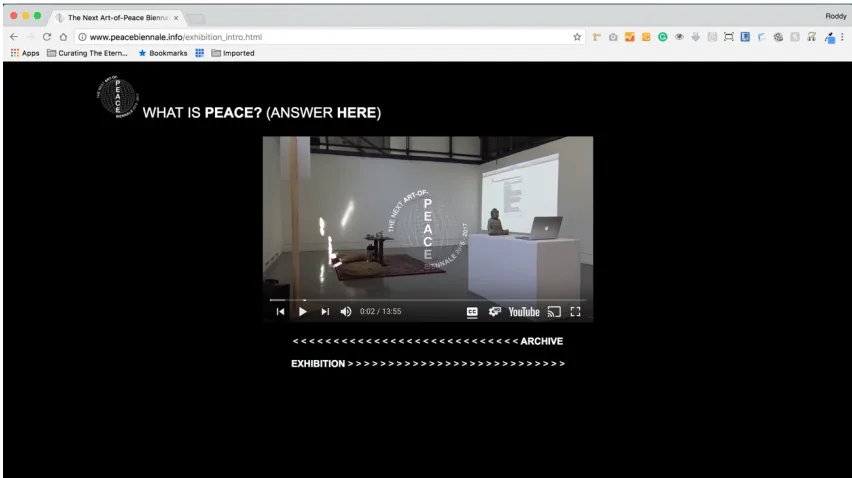
107 FIGURE 38: WHAT IS PEACE (ANSWER HERE) EXHIBITION ONLINE. HOMEPAGE
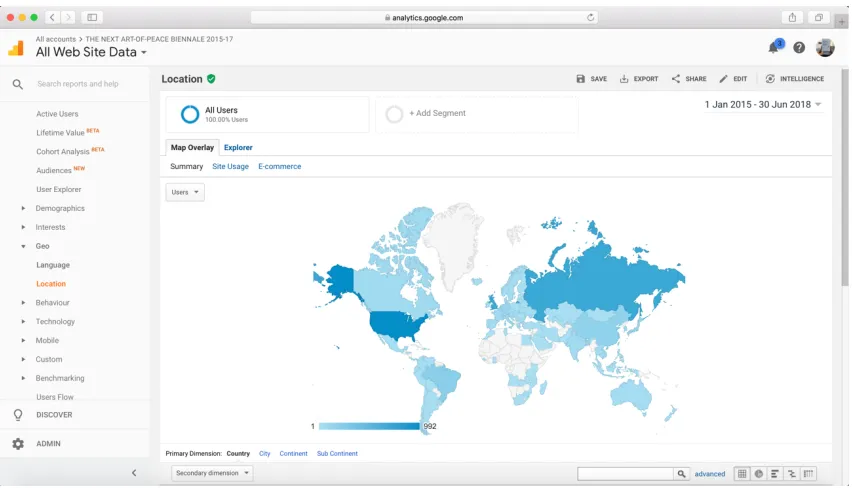
OF THE NEXT ART-OF-PEACE BIENNALE 2015-2017 WEBSITE, JUNE 2018. 107 FIGURE 39: GOOGLE ANALYTICS OF USER LOCATION. THE NEXT
ART-OF-PEACE BIENNALE 2015-2017 WEBSITE, JAN 2015–JUNE 2018.
ANALYTICS.GOOGLE.COM [ACCESSED 30 JUNE 2018]. 108 FIGURE 40: GOOGLE ANALYTICS OF USER BEHAVIOUR. THE NEXT
ART-OF-PEACE BIENNALE 2015-2017 WEBSITE, JAN 2015–JUNE 2018.
ANALYTICS.GOOGLE.COM [ACCESSED 30 JUNE 2018]. 109 FIGURE 41: GOOGLE ANALYTICS SHOWING USERS FROM THE FIVE
COUNTRIES WITH LOWEST BOUNCE RATES. THE NEXT ART-OF-PEACE BIENNALE 2015-2017 WEBSITE, JAN 2015–JUNE 2018.
ANALYTICS.GOOGLE.COM [ACCESSED 30 JUNE 2018]. 109 FIGURE 42: GOOGLE ANALYTICS SHOWING USER DEMOGRAPHICS. THE
NEXT ART-OF-PEACE BIENNALE 2015-2017 WEBSITE, JAN 2015–JUNE 2018. ANALYTICS.GOOGLE.COM [ACCESSED 30 JUNE 2018]. 110 FIGURE 43: THE NEXT ART-OF-PEACE BIENNALE 2015-2017 WEBSITE, 16
JANUARY 2015. WITH EMBEDDED YOUTUBE STREAMING OF AIKIDO DEMONSTRATION AND TWITTER FEED. [SCREENSHOT]. AVAILABLE AT HTTP://ORIGINAL.PEACEBIENNALE.INFO [ACCESSED 20 MAY 2018] 112 FIGURE 44: THE NEXT ART-OF-PEACE BIENNALE 2015-2017 WEBSITE, 16
JANUARY 2015. WITH EMBEDDED YOUTUBE STREAMING OF AIKIDO DEMONSTRATION AND TWITTER FEED. [SCREENSHOT]. AVAILABLE AT HTTP://ORIGINAL.PEACEBIENNALE.INFO. [ACCESSED 20 MAY 2018] 113 FIGURE 45: CLIVE ROBERTSON INTRODUCING ROBERT FILLIOU'S PORTA
FILLIOU (1977) BEFORE SCREENING, RICHARD SALTOUN GALLERY,
LONDON, 16 JANUARY 2015. PHOTO: JUDIT BODOR. 115
FIGURE 46: GRAHAM HENDERSON, ART IS NOT EXPLANATION (2015), ACTION FOR ART'S BIRTHDAY 2015: WHAT IS PEACE?, LONDON, JANUARY 2015.
IMAGE COURTESY GRAHAM ROBERTSON. 116
FIGURE 47: THE LAST ART OF PEACE BIENNALE [EXHIBITION], 13 FEBRUARY– 20 MARCH 2015, RICHARD SALTOUN GALLERY, LONDON. INSTALLATION VIEW OF WORK BY JOSEPH BEUYS AND WOLF VOSTELL. PHOTO
COURTESY RICHARD SALTOUN GALLERY. 118
20 MARCH 2015, RICHARD SALTOUN GALLERY, LONDON. INSTALLATION
VIEW OF ROBERT FILLIOU AND SOL LEWITT. 119
FIGURE 49: THE LAST ART OF PEACE BIENNALE [EXHIBITION], 13 FEBRUARYZ-20 MARCH FEBRUARYZ-2015, RICHARD SALTOUN GALLERY, LONDON. INSTALLATION VIEW OF WORK BY ROBERT FILLIOU, JOSEPH BEUYS AND FRANZ
ERHARD WALTHER: PHOTO COURTESY RICHARD SALTOUN GALLERY. 119 FIGURE 50: THE LAST ART OF PEACE BIENNALE [EXHIBITION], 13 FEBRUARY–
20 MARCH 2015, RICHARD SALTOUN GALLERY, LONDON. INSTALLATION VIEW OF WORK BY FRANZ ERHARD WALTHER AND ARCHIVAL WORK BY BARRY FLANAGAN, TONY MORGAN AND HENNING CHRISTIANSEN. PHOTO
COURTESY RICHARD SALTOUN GALLERY. 120
FIGURE 51: MARK PAWSON: MAIL ARTWORK SENT TO THE CURATOR OF THE LAST ART-OF-PEACE BIENNALE, 23 FEBRUARY 2015. COLLECTION BODOR
HUNTER ARCHIVE. COURTESY MARK PAWSON. 122
FIGURE 52: RODDY HUNTER: FROM ART BIENNALE TO PEACE BIENNALE! POSTAL ART INTERVENTION, JULY 2015. PHOTO: JUDIT BODOR AND
TWITTER SCREENSHOT. 124
FIGURE 53: RODDY HUNTER: FROM ART BIENNALE TO PEACE BIENNALE! POSTAL ART INTERVENTION, JULY 2015. POSTCARD NO.126 WITH
MESSAGE. PHOTO: JUDIT BODOR. 124
FIGURE 54: RODDY HUNTER: FROM ART BIENNALE TO PEACE BIENNALE! POSTAL ART INTERVENTION, JULY 2015. POSTCARDS AT THE POST
OFFICE, VENICE. PHOTO: JUDIT BODOR. 125
FIGURE 55: RODDY HUNTER: FROM ART BIENNALE TO PEACE BIENNALE! POSTAL ART INTERVENTION, JULY 2015. POSTING THE CARDS FROM VENICE TO CLIVE ROBERTSON, CANADA AND ARTPOOL, HUNGARY.
PHOTO: JUDIT BODOR. 126
FIGURE 56: RODDY HUNTER: THE (UNFINISHED) ALL DAY VIDEO BREAKFAST, 17 JANUARY 2016. [SCREENSHOT]. AVAILABLE AT:
HTTP://ARTSBIRTHDAY.PEACEBIENNALE.INFO. [ACCESSED 20 MAY 2018] 127 FIGURE 57: : TWEET FROM ART-OF-PEACE BIENNALE. [SCREENSHOT] RODDY
HUNTER: THE (UNFINISHED) ALL DAY VIDEO BREAKFAST, 16 JANUARY
2016. 130
FIGURE 58: TWEET FROM ART-OF-PEACE BIENNALE. [SCREENSHOT] RODDY HUNTER: THE (UNFINISHED) ALL DAY VIDEO BREAKFAST, 16 JANUARY
2016. 130
FIGURE 59: A PERMANENT CONVERSATION ABOUT PEACE 2017 ONWARDS. [SCREENSHOT]. AVAILABLE AT:
HTTP://ARTSBIRTHDAY2017.PEACEBIENNALE.INFO. [ACCESSED 20 MAY
2018]. 132
FIGURE 60: A PERMANENT CONVERSATION ABOUT PEACE 2017 ONWARDS. [SCREENSHOT]. AVAILABLE AT:
HTTP://ARTSBIRTHDAY2017.PEACEBIENNALE.INFO. [ACCESSED 20 MAY
2018]. 133
FIGURE 61: PHOTOGRAPH OF GEORGIA DEARDEN WEARING ‘I WANT A DYKE FOR A PRESIDENT’ T-SHIRT MADE FOR A PERMANENT CONVERSATION ABOUT PEACE 2017 ONWARDS, AND THE SAME PHOTOGRAPH
PHOTOSHOPPED WITH ROBERT FILLIOU’S HEAD. 136
FIGURE 62: RODDY HUNTER: THE (FULL) ALL DAY VIDEO BREAKFAST, 17 JANUARY 2018. [SCREENSHOT]. AVAILABLE AT:
HTTP://ARTSBIRTHDAY2018.PEACEBIENNALE.INFO. [ACCESSED 20 MAY
FIGURE 63: BAKU, AZERBAIJAN WEBPAGE DETAIL FROM THE (FULL) ALL DAY VIDEO BREAKFAST, 17 JANUARY 2018. [SCREENSHOT]. AVAILABLE AT: HTTP://ARTSBIRTHDAY2018.PEACEBIENNALE.INFO. [ACCESSED 20 MAY
2018]. 138
FIGURE 64: RODDY HUNTER: INVITATION FOR WHAT IS PEACE? (ANSWER HERE). [EXHIBITION] VISUAL RESEARCH CENTRE, DUNDEE
CONTEMPORARY ARTS, DUNDEE, SCOTLAND, 4 MAY - 2 JUNE 2018 139 FIGURE 65: WHAT IS PEACE? (ANSWER HERE). VISUAL RESEARCH CENTRE,
DUNDEE CONTEMPORARY ARTS, DUNDEE, SCOTLAND, 4 MAY –2 JUNE 2018. EXHIBITION DETAIL, ROOM 1-2. PHOTO: JUDIT BODOR. 140 FIGURE 66: WHAT IS PEACE? (ANSWER HERE). VISUAL RESEARCH CENTRE,
DUNDEE CONTEMPORARY ARTS, DUNDEE, SCOTLAND, 4 MAY –2 JUNE 2018. EXHIBITION VIEW, ROOM 1. PHOTO: JUDIT BODOR. 141 FIGURE 67: WHAT IS PEACE? (ANSWER HERE). VISUAL RESEARCH CENTRE,
DUNDEE CONTEMPORARY ARTS, DUNDEE, SCOTLAND, 4 MAY - 2 JUNE 2018. EXHIBITION DETAIL OF A PERMANENT CONVERSATION ABOUT PEACE 2017 CHAT WINDOW PROJECTED ONTO THE WALL. PHOTO: JUDIT
BODOR. 141
FIGURE 68: WHAT IS PEACE? (ANSWER HERE). VISUAL RESEARCH CENTRE, DUNDEE CONTEMPORARY ARTS, DUNDEE, SCOTLAND, 4 MAY –2 JUNE 2018. EXHIBITION DETAIL OF INTERNET BUDDHA (AFTER NAM JUNE PAIK).
PHOTO: JUDIT BODOR. 142
FIGURE 69: WHAT IS PEACE? (ANSWER HERE). VISUAL RESEARCH CENTRE, DUNDEE CONTEMPORARY ARTS, DUNDEE, SCOTLAND, 4 MAY –2 JUNE 2018. EXHIBITION DETAIL OF INTERNET BUDDHA (AFTER NAM JUNE PAIK).
PHOTO: JUDIT BODOR. 143
FIGURE 70: WHAT IS PEACE? (ANSWER HERE). OFFLINE PERFORMANCE. DUNDEE CITY SQUARE, 4 MAY 2018. PHOTO: JUDIT BODOR. 143 FIGURE 71: WHAT IS PEACE? (ANSWER HERE). OFFLINE PERFORMANCE.
DUNDEE CITY SQUARE, 4 MAY 2018. PHOTO: JUDIT BODOR. 144 FIGURE 72: WHAT IS PEACE? (ANSWER HERE). VISUAL RESEARCH CENTRE,
DUNDEE CONTEMPORARY ARTS, DUNDEE, SCOTLAND, 4 MAY–2 JUNE 2018. EXHIBITION DETAIL WITH THE INAUTHENTIC EARTH FLAG. PHOTO:
JUDIT BODOR. 145
FIGURE 73: ZUGEHEND AUF EINE BIENNALE DES FRIEDENS [EXHIBITION POSTER], 1 DECEMBER 1985–12 JANUARY 1986, KUNSETVEREIN AND KUNSTHAUS, HAMBURG, GERMANY. IMAGE COURTESY EDITION BLOCK.
148 FIGURE 74: RODDY HUNTER: D I G I T I S I N G. SCORE FOR A ‘REPORT
PERFORMANCE’ AT CENTERSPACE, VISUAL RESRERCH CENTRE,
DUNDEE, 2 JUNE 2016, AND ONLINE AT WWW.PEACEBIENNALE.INFO. 150 FIGURE 75: SARAH COOK’S TWEET DURING D I G I T I S I N G, A ‘REPORT
PERFORMANCE’ AT CENTERSPACE, VISUAL RESRERCH CENTRE, DUNDEE, 2 JUNE 2016, AND ONLINE AT WWW.PEACEBIENNALE.INFO.
[SCREENSHOT] 151
FIGURE 76. ROBERT FILLIOU'S DIAGRAM, 'TOWARDS A NEW AUTHENTICITY' FROM HIS INVITATION TO PARTICIPATE IN THE ART-OF-PEACE BIENNALE, HAMBURG, 1985. IMAGE COURTESY EDITION BLOCK. ONTO WHICH I HAVE MAPPED MY PRINCIPLE RESEARCH TERMS NAMELY CURATING,
Acknowledgements
I owe many thanks for the support I have had in completing this
research. Firstly, I owe a great deal to my principal supervisor Professor Sarah Cook who saw the potential in the proposal from the beginning and whose generous support and advocacy of my work has enabled me to reposition my practice as an artist, curator and researcher in the field of new media curating. Having begun the research at the University of Sunderland, I also thank
Professor Beryl Graham for her insightful supervision and outstanding research training. Thanks to Dr Anna Notaro, my second supervisor at Dundee, and academics at both institutions for their excellent feedback throughout my research. I have held academic positions at three institutions during the research period and am pleased to acknowledge the support of York St John University, Middlesex University and the University of Cumbria for help with tuition fees and research leave. My colleagues at Cumbria have been
particularly tolerant while I have tried to balance a senior management role with completing a PhD, so thank you. There are too many artists to mention whom I have met throughout The Eternal Network over the past twenty-five years and whose impact on my learning and development has been transformational. You know who you are, and I thank you sincerely. In connection with the research here, I thank Richard Martel, Boris Nieslony, Mike Stubbs, Professor André Stitt, György Galántai & Júlia Klaniczay (Artpool), Michael Morris, Lisa Le Feuvre, Professor Ken Friedman, Dr Helen Pritchard, Tom Sherman, Dr Marialaura Ghidini, Rebecca Weeks & Ian Whitford, Peter Courtemanche, Professor Rebecca Fortnum, Ken Devine, Richard Saltoun, Clive Robertson, René Block, Ruth Catlow & Marc Garrett (Furtherfield), Dr Katalin Cseh-Varga & Dr Adam Czirak, Dr Rasa Smite, Janusz Bałdyga & Waldemar Tatarczuk, Dr Barnaby Dicker, Georgia Dearden, Andrea M.J. Toth, Dr Dominic Johnson and Andy Slater. I owe most to the support and patience of my family. Thanks to Arlene, Eric, Andrew, Emma, Greg, Edit, Zoltán and Balázs for always being there even when I haven’t been. Above all, my warmest and most profound love and
Declaration
I, Roderick Hunter, declare that this thesis has been composed solely by myself and that it has not been submitted, in whole or in part, in any previous application for a degree. Except where stated otherwise by reference or acknowledgment, the work presented is entirely my own.
Abstract
This practice-based research project investigates the production,
distribution and reception of network art practice before and after globalisation. It does so to engage with the Internet as ‘the most material and visible sign of globalisation’ (Manovich 2001) whose emergence as the pre-eminent network technology arrives concurrently with the disappearance of its utopian promise. Taking Robert Filliou’s 1968 conception of The Eternal Network as a starting point, the research seeks to understand the opportunities and limitations of network art practice through identifying and developing a range of curatorial and artistic methods in practice. Methodologically, it presents the researcher as an artist-curator-performer. Doing so enables ‘inhabitation’ (rather than
're-enactment') of the concepts and principles of Filliou’s work. Filliou thus becomes a medium of research for the development of network art practice after the Net and vice versa.Curating only the second edition of The Art-of-Peace Biennale becomes the primary output of the research. Filliou conceived of the Biennale in 1970, proposed it in 1982 and René Block organised the first edition at the Kunstverein, Hamburg, Germany, in 1985. The contemporary edition, The Next Art-of-Peace Biennale 2015-17, occurred mainly but not exclusively through the online platform, www.peacebiennale.info. It did so to respond to the radical shift in modes of online production, distribution and reception since the first edition. The research describes, contextualises and reflects on the emergence of The Next Art-of-Peace Biennale 2015-2017 and describes a final exhibition, What is Peace? (Answer Here), held in 2018. It presents a contribution to knowledge through artistic and curatorial practice exploring online and offline exhibition-making, video, performance,
correspondence art and writing. Through developing an ontology of ‘curatorial behaviour’ exploring the ‘locations’, ‘durations’, ‘materialities’ and ‘interactions’ of network art practice, the research identifies artistic and curatorial principles able to withstand the ‘high-tech gloom’ (Thompson 2011, p. 49) of mendacious globalisation in a late Web 2.0, postmedium condition.
1. INTRODUCTION
1.1. Background
The background to the research lies in almost twenty-five years’ experience and practice in international artists’ networks. I became a
performance artist in 1988 while a student at the University of Glasgow due to an ever-increasing interest in experimental artistic and cultural practices. The discovery of new cultural knowledge was already a networked practice in itself, particularly before the widespread availability of the Internet. Much was gleaned through production and exchange of samizdat and counter-culture publications, recordings and events. The sense of generating cultural knowledge through its dissemination and exchange took on a different dimension entirely with the broader accessibility of the Internet in the early-mid-1990s. I became directly engaged in curatorial and intermedia practices as an active member of Hull Time Based Arts (HTBA), England, between 1994-98, where I first had access to fax, the Internet and email. Throughout this period, I also had first-hand encounters with the development of net.art (early Internet-based art exchanges) through HTBA’s programming and commissioning. I was invited by Heath
Bunting to participate in the Digital Chaos Slacker Cyber Conference in Bath, 1996 and later in the ANTI WITH E – Backspace.Org Lecture Series in London, 1997 alongside such as Richard Barbrook, Geert Lovink, Kathy Rae Huffman and others. In 1998, I completed my Masters research on the subject of ‘mediation’, supervised by Professor John Newling at Nottingham Trent
University. In 2000, I set up the performance_art_network electronic discussion list, which still exists today (Fig. 1). All of this revealed a need to investigate further the immediacy of live performance alongside the capacity of new media technology to support new thinking around art as a form of cultural
communication.
the human network’ (Filliou, 1995, p. 80) shaped my understanding and foregrounds the present research. As a young somewhat earnest artist
convinced of the fundamental and profound properties of performance as art, I identified readily with the inclusive and expansive immanence of Filliou’s
concept. Although I was only marginally active in peer-to-peer mail art networks often assumed to be the synonymous manifestation of The Eternal Network, I had a fundamental sense nonetheless of conceptually situating my art/life practice within ‘a wider network of everyday events, doings, and sufferings ‘going on around [me] all the time in all parts of the world’ (Milman 2013, n.p). The existence of The Eternal Network provided a sense of belonging and connection with artists around the world. I shared the affinity that ‘as artists we will keep in touch by mail; will, when money allows, travel, and each of us no matter what town, city or country we live in will create a modest centre of activity’ (Robertson 1991, p.10).
It made sense that I first learned about The Eternal Network while travelling extensively to participate in performance art festivals during the post-1989 era of international cultural mobility, particularly across ‘former East’ and ‘former West’ (Formerwest.org, 2018) Europe. I also have a history of
participation in network projects explicitly empathetic to Filliou’s practice. One example is the passport-based Les Territoires Nomades (The Nomad
Territories) (Fig. 2-3) originated by Collectif Inter/Le Lieu in Québec (1994-97), which traces the influence of Filliou’s Le Territoire de la République Géniale (The Territory of the Republic of Genius) (1970-75). My affinity with Filliou is of central importance to both understanding and evaluating the current research. The question, ‘what am I ‘doing’ with Filliou’s work?’ becomes important (see 3.2.5, 3.5) regarding authorship, remediation or re-enactment of his practices and concepts.
The research, moreover, is motivated by a desire to re-examine the potential of Filliou’s The Eternal Network as both a space of network
practice to address complex, conceptual, postavantgarde works such as The Eternal Network is a further motivation. Orthodox museum and gallery curating have default modes of engaging materiality that derive knowledge and value principally from physical artefacts and which cannot therefore articulate the performative, temporal relationships that constitute network art practice (Graham and Cook, 2015, pp. 51-83).
In this sense, the research often refers to ‘curatorial behaviour’ to emphasise the temporal qualities of curatorial practice, particularly when
engaging the event-based and performative ontology of network art practice. In Rethinking Curating, Beryl Graham and Sarah Cook ‘describe new media as being characteristically about process rather than object, and […] use verbs of behaviour than nouns of medium to describe artworks.’ (Ibid, p. 5) I’m also interested to observe a tendency for contemporary postmodern, postmedium artists to ‘behave curatorially’, which is to say to ‘borrow’ behaviours from curating (such as collecting, exhibition-making, writing) and embed these into their own generative, creative practice, to determine the curatorial context for their own work. This tradition of the artist-curator is well established from Duchamp to Group Material, including Filliou (2.3.4) among others in between, and seems designed at least in part to thwart or limit future institutional
curatorial intervention. Nam June Paik's reported exclamation: 'Marx: Seize the production-medium. Fluxus: Seize the distribution-medium!' (Saper, 2001, p. 133) also suggests an ideological awareness underpinning the cultural
dimension of network art practice. In other words, the means of dissemination becomes and supersedes the means of production. I also use 'curatorial
behaviour' to acknowledge how, particularly online behaviours of appropriation, dissemination and mediation have become ubiquitous beyond the professional realm of institutional curatorial practices. ‘Curatorial behaviour’ thus emerges as relevant to this research insofar as it contributes toward social and cultural anthropology of how we discover, make and remake the postdigital world around us.
1.2. Research Enquiry
art practices after the Net and after globalisation. It considers how artists have sought to transcend geographical, political, psychological and social frontiers of mind and territory, of mental and physical space since George Brecht and Robert Filliou’s creation of The Eternal Network in March 1968 replaced ‘the [obsolete] notion of the avant-garde’ (Filliou 1973, p. 7). The research considers how concepts and structures of network art practice have enabled new
formations of collaboration, exchange and dialogue across obstacles of borders and boundaries. The study focuses initially on models of networked artistic and creative practice emerging historically from within the techno-cultural complex of the Sputnik era. It then develops through discussion and analysis of artistic and curatorial practice in the context of Web 1.0, Web 2.0 (Lovink 2011, pp. 1-23). It then signals opportunities for new strategies in response to the emergence of ‘Web 3.0’ (Kreps and Kimppa 2015) including blockchain technology (Catlow, Garrett, Jones and Skinner, 2017).
At the outset of the study, I set two central research questions:
• How can The Eternal Network be curated after globalisation?
• What are both the opportunities and limitations of curating network art practice given current dependence on Internet technologies?
The first question here refers to artists George Brecht and Robert FiIliou’s announcement of the creation of La Fête Permanente (or, in non-equivalent English translation, The Eternal Network) in 1968. Brecht and Filliou’s
collaboration emerged from their association within Fluxus: a postavantgarde in art variously described as a collective, movement or network itself. The Eternal Network shares with Fluxus more broadly a late-twentieth-century desire for internationalism and globalism in communication, dialogue and exchange (Higgins 1998). The decentralised or distributed planetary network model enabling The Eternal Network as a utopian experience and expression of 'globalism' also equally allows, however, the integration of economic and social activities necessary to enable the 'societies of control' (Deleuze 1992) of
become in our contemporary world. Use of these technologies has contracted our experience of geographical distance (Virilio 1995) and, arguably as a
consequence, has enabled conditions of hegemonic globalisation. It is pertinent then to re-examine and critique Filliou’s principles of ‘poetical economy’ and the conceptual, postavantgarde nature of The Eternal Network as a basis to
develop curatorial strategies that respond to artistic, economic and social conditions of globalisation.
I designed four research aims identifying what would be required to answer the research questions. These were to:
• ensure a present understanding of network practice from a position of current engagement.
• establish my role as an active practitioner-researcher within a range of curatorial contexts and communities of practice.
• develop a range of artistic, creative, critical and curatorial strategies toward working in and across a range of online, offline and hybrid platforms.
• attempt to ‘remediate’ (Bolter and Grusin, 2000) analogue concepts and principles of Robert Filliou’s practice and work related to The Eternal Network through contemporary, particularly digital and online, contexts of practice.
Further, the achievement of these research aims would depend on the accomplishment of three research objectives:
• To examine how twentieth-century postavantgarde practices—in particular, conceptual art, performance art and net.art—reveal creative strategies that both anticipate and resist the geopolitical, networked context of Twenty-first Century ‘globalisation’.
• To curate a series of projects experimenting with forms of network art practice through which work emerging from these fields can be
disseminated through a range of means and media.
1.3. Methodology
The core of the research is practice-based in my development of an ontology exploring the ‘locations’, ‘durations’, ‘materialities’ and
‘interactions’ of network art practice in a late-Web 2.0, postmedium condition. Positioned within a historically informed and critically contextualised field of practice, I adopted a hybrid position of engagement as an artist-curator-performer which understands artistic practice and curatorial behaviour as interchangeable (which is to say as temporal, event-based, performative and networked). Importantly, this methodological approach is empathetic to Filliou’s perspective as a practitioner and enabled me to inhabit the concepts and principles driving his work. In my earlier practice, I was as wary of online and digital space as I suspect Filliou is too. Through shifting him into this space in the course of the research, I have been able to make the same journey with my practice in finding more ways to be networked and in the network. ‘Research’, Filliou proposed, ‘is not the privilege of people who know—on the contrary it is the domain of people who do not know’ (Filliou, 1995, p. 82). This view reflects how he came to art later in life (his first solo exhibition came at Galerie Köpcke, Copenhagen in 1961 when he was 35 years old) having been a teenage
member of the French Resistance Movement, studied economics at UCLA, and worked for the United Nations Korean Reconstruction Agency (UNKRA). He was influenced greatly by the utopian socialism of Charles Fourier and
motivated as a combination of all these experiences by the desire to make ‘the world a world with peace and harmony’ (Thompson 2011, p.153). He saw creativity and artistic practice as direct means to achieve these aims through co-research and co-invention. His many practice-as-research projects included Research on The Eternal Network, La Galerie Légitime, La Cédille qui Sourit, Permanent Creation, The Genial Republic, Research on the origin, Built-in versus Built Upon, The Principles of Poetical Economy, the Art-of-Peace and many more. His methodology is further revealed in what he calls the Relative Secret of Permanent Creation (‘Whatever you’re thinking; think something else. Whatever you’re doing; do something else’) and the Absolute Secret of
Given the background above, the research project sought to implement and demonstrate as much of Filliou’s methodological approach to practice as possible but within the changed context of contemporary online and offline environments. This juxtaposition would be essential in testing the viability of the concept behind The Eternal Network, in order to determine how one might curate it today. Realising the value of embedding curatorial behaviour in artistic practice meant that I would be able to determine the conditions of production, distribution and reception of the work. In the first instance, I also felt this needed to be an event-based approach so that the ‘now-ness’ of the networked,
telematics exchange would be central to the experience of the work.
Throughout the project I drew upon a range of Filliou’s concepts and practices through exploring works such as Le Filliou Idéal (1964), Video Dinner and Video Breakfasting (1979), Non-école de Villefranche (1965) and
l’Anniversaire de l'art (1963-present), La Galerie légitime (1969), Research at the Stedelijk (1971), and Travelling Light – It’s a Dance Really (1979). Given Filliou’s wariness of ‘high-tech gloom’ (Thompson 2011, p. 49), some of these could be considered ‘remediations’ (Bolter and Grusin, 2000) insofar as I explored ways to resituate Filliou in an online, digital space distinct from his typically analogue, offline habitus. I was unsure whether the concepts and principles of his practice, particularly as concerns The Eternal Network, would withstand the late Web 2.0 environment. This uncertainty drove my enquiry. Instead of devising a historical-curatorial approach, I sought to performatively inhabit concepts associated with The Eternal Network in a range of ways. Ultimately, the research identifies The Art-of-Peace Biennale as a partially unrealised project, which could be explored further as an artistic-curatorial platform enabling a context for this work to happen between 2015-17.
The research also employs a diverse range of methods within the context of this methodological approach. The methods established to conduct the
Galántai (see Appendix I), and Die Schwarze Lade - Black Kit, Köln to
understand more about the networking and archival practice of Boris Nieslony. It was also important to visit the exhibition Robert Filliou: The Institute of
Endless Possibilities, curated by Lisa Le Feuvre at Henry Moore Institute, Leeds as the first institutional solo exhibition devoted to Filliou in the United Kingdom. I also became consultant curator of the group exhibition The Last Art-of-Peace Biennale, Richard Saltoun Gallery, London which became a significant offline curatorial practice outcome of the research (see Appendix II).
To address any imbalance in dealing historically with Filliou and the milieu of The Eternal Network over more contemporary new media theory and practice, I undertook this methodological process of archival, interview and exhibition research to develop my networked practice empathetic to, but distinct from, the histories of practice I was researching. I identified important curatorial platforms that can be experienced directly online, such as furtherfield.org, and, with the use of electronic discussion lists such as CRUMB - Curatorial Resource for Upstart Media Bliss (see Appendix II), online video and audio streams of discussions and conferences, and social media such as Twitter, I mapped projects and links relevant to my research and practice. I have also developed and showed online performative/curatorial work using my domain and hosting at the online platform www.peacebiennale.info and often connected other forms of social media. Peer-to-peer contact, correspondence, collaboration and
participation have become important methods to exploring network art practice.
In developing practice-based research outcomes, I have made a series of experimental online performances that have taken particular works of Filliou such as those mentioned above and have the overall effect of shifting Filliou’s performance online. This method has been successful in both re-examining Filliou’s model of practice within an online environment as well as in
developments in network art practice over the last fifty years. It is at once a historical and contemporary example, an event curated in many different ways each year anew, unlike the problem of curating historical, autonomous artefacts in institutional exhibitions.
The critical, theoretical and practical investigation laid a coherent foundation in devising the principal practice-led outcome of the research. In discovering Filliou’s conception of The Art-of-Peace Biennale (Thompson 2011), I became the self-appointed curator of The Next Art-of-Peace Biennale, 2015-17 some thirty years after René Block organised the first edition in 1985. The web platform www.peacebiennale.info became a central practice output of the research, an online exhibition space, and an archival interface of the research. The written component of the thesis also presents specific criteria of analysis - an ontology - exploring the function of ‘locations’, ‘durations’, ‘materialities’, and ‘interactions’ of network art practice throughout the development of the
research. It also intends to provide a reflective overview of implicit and explicit decision-making in the process of the work’s development. This analytical ontology also became generative, rather than only descriptive, in the formulation and creation of the final exhibition (3.4).
1.4. Scope of the Research
The research emerged from wanting to understand the ontology of network art practice including, but also beyond, its material and technological infrastructures of creative exchange. It is a practice-based exploration through which a new body of artistic-curatorial practice is achieved to demonstrate responses to the research questions.
This research project is not an art historical treatment of the subject of networked art, nor a practical exploration of networked or digital art
media-based network-artworks as is the case of, for example, Josephine Bosma’s current research on preserving Robert Adrian X’s The World in 24 Hours (2.3.6).
The research does, however, provide an alternative model to curating The Eternal Network distinct from recent exhibition-making projects in galleries and museums concerning Filliou's work and milieu mentioned above and discussed throughout this thesis.
1.5. Definitions
The research engages ‘curating’, ‘network’ and ‘globalisation’ as central research terms that intersect, implicate, diffract and entangle one other to explore how to curate analogue concepts and practices of pre-Internet network art practice after digital globalisation. All three terms are considered here as actively becoming and as porous and susceptible to the affordances, dynamics and interactions of the others. ‘Curating’ is understood as a
behavioural practice of negotiating the production, distribution and reception of aesthetic and cultural experience. It is a critical and creative practice engaged in constructing, as well as reflecting, its subject. As discussed above (1.1) the emphasis upon curatorial behaviour overcomes customary specialisation of production, distribution and reception and by extension also that of the artist, curator and audience (2.3.5). ‘Network’, as the thing-to-be-curated, is proposed as both a concept for interpreting the world and an infrastructural object or system delimited by the extent of its links and stations. As such, the sense and experience of ‘network’ operation extend beyond the plane of points and lines toward a space-time of manifestation and interaction of consciousness (2.3.1). ‘Globalisation’ presents the contemporary conditions of curating networks – and indeed networked curating – and the almost wholly digital means of
constructing the contemporary world of appearances and experiences. ‘Globalisation’, moreover, reflects contextually on a metamorphosis by which utopian ‘globalism’ of wholeness and interconnectedness in the 1960s
The title of the research suggests its context to be ‘after globalisation’ discussed in parallel with the notion of ‘after the Net’. The ‘conceptual’ and ‘material’ breaks of digital globalisation notwithstanding (Galloway, 2015, see 2.2.4), ‘the contemporary phase of development, characterised by a network model’ (Cox 2010, p.81) remains ultimately ‘non-teleological, combining
emergent and residual forms’ (Ibid). Geert Lovink writes of Web 2.0, ‘[o]nce the Internet changed the world; now the world is changing the Internet [, its]
mainstreaming is well and truly over, and the forgettable Web 2.0 saga has run its course’ (Lovink, 2001, p.1). As such, 'after globalisation' and 'after the Net' indicate the particular cultural, political, social, and technological context surrounding the current moment of production, distribution and reception of network art practice. As also suggested by the terms ‘postdigital’ and ‘post-Internet’, this moment is one of disillusionment that ‘[d]igitality is a problem, not a panacea’ and that ‘[p]lanetary neoliberalism is a boondoggle not a
deliverance’ (Galloway 2014, p.98). Furthermore, from a philosophical perspective at least, it may well be that the analogue holism of globalism
virtualises immanence, whereas the separation perfected by digital globalisation in effect actualises transcendence (Galloway 2014).
an 'event-score' being a work deliberately designed for repeated, future performance in a manner, not unlike a poetry reading or music recital but
including a much broader range. The event score is a post-Cagean art form and most readily associated with Fluxus (Friedman, Smith and Sawchyn, 2018). 'Remediation' here refers specifically to Bolter and Grusin’s theory that new media (e.g. artificial intelligence, virtual reality) repurpose earlier media
(painting, film and photography) in response to the double logic of remediation that ‘our culture wants both to multiply its media and to erase all traces of mediation' (Bolter and Grusin, 2000, p. 5). The research eventually proposes ‘inhabitation’ of historical practice as the most appropriate term to describe the approach taken to Filliou here. (4.3)
1.6. Structure of the written component
The written submission accompanies the practice which is available online at www.peacebiennale.info. The thesis is in two main parts, each with three sections. Chapter 2—the contextual review—maps a critical, historical and theoretical framework (Fig. 4) through which the research project aims to
develop appropriate practice-based research strategies addressing principles, concepts and practices of Robert Filliou’s The Eternal Network after
globalisation. It comprises three sections which historically charts the
emergence of network art practice from within the techno-cultural complex of the Sputnik era, outlines the ontology of the network-artwork, and then explores the relationship between the analogue and digital (Galloway 2018a, 2018b) as a basis upon which to discuss recent examples of artistic and curatorial network practice.
Chapter 3 describes the development of practice during three
(Answer Here), 2018, Visual Research Centre, Dundee.
The conclusion (Chapter 4) highlights the findings related to both of the central research questions (4.2, 4.3), as well as reflects on my event-based, networked artistic-curatorial methodology (4.4), how the research overall contributes to knowledge in the field (4.5) and then finally makes suggestions for further research (4.6).
Figure 1: Message History, performance_art_network discussion list [screenshot] https://groups.yahoo.com/neo/groups/performance_art_network/info [Accessed 5 December
Figure 2: Collectif Inter/Le Lieu, Québec, Passport of the Les Territoires Nomades / The Nomad Territories, 1994-97.
2. CONTEXTUAL REVIEW
2.1. Introduction and Structure
This chapter maps a critical, historical and theoretical framework through which the research project aims to develop appropriate practice-based research strategies addressing principles, concepts and practices of Robert Filliou’s The Eternal Network after globalisation. The review focuses on the intersections of curating, network and globalisation to, in short, explore whether network art practice after the Internet represents ‘high-tech gloom’ (Thompson 2011, p. 49) or possibly signals a way toward a ‘New Authenticity’? (Zugehend auf eine Biennale des Friedens, 1985) (Fig. 84).
The review comprises three related but distinct sections. The first section (2.2), Beyond ‘East’ and ‘West’ through ‘The Eternal Network’: Networked Artists’ Communities as Counterpublics of Cold War Europe1 critically and
historically charts the emergence of network art practice from within the techno-cultural complex of the Sputnik era. This time-frame is significant for the
research as a moment of utopian promise that also heralded the ideological onset of the East-West Cold War. This irony led to the construction of borders of mind and territory in which artists intervened through rethinking new and
traditional communications media as methods of artistic practice. The section includes a discussion of how artists in the mid-twentieth-century embraced the alternative models of participation and dissemination enabled by
communications networks to overcome or transcend geopolitical distance in time and space. It particularly focuses on models of practice such as the Documenta 6 Satellite Telecast (1977)—featuring Joseph Beuys, Douglas Davis and Nam June Paik—, Robert Filliou’s TELEPATHIC MUSIC no. YOUNG
1This section was initially presented as an edited paper at the conference Performing Arts in
ARTISTS’ CLUB—made with György Galántai (1973)—, Mieko Shiomi’s Spatial Poem (1965-1975), and Jarosław Kozłowski and Andrzej Kostołowski’s NET Manifesto (1971). I argue that these artists constituted a networked
‘counterpublic’ which can be better understood through a discussion of ideas related to ideology, cybernetics, counterculture and public sphere as seen through writings of Neumark and Chandler (2005), Findeisen and Zimmermann (2015), Paulsen (2013), Parks (2005), Hardt and Negri (2000), Habermas
(2014) and Warner (2002). The sense of a network-as-counterpublic builds on a historical notion of the avant-garde as having a network structure circumvents official public spheres of discourse. In the former Eastern Europe, this
phenomenon became recently characterised as the ‘second public sphere’ (See for example http://www.2ndpublic.org/). A question arises here concerning how any notion of ‘public sphere’ has changed after the Net and redefined discourse and practice around privacy, surveillance and what the Situationists would have described in the 1960s as 'recuperation'.
The second section (2.3.) Curating the Network-artwork After
Globalisation2 takes George Brecht and Robert Filliou’s co-creation of The
Eternal Network (1968) as a starting point to explore the idea of whether an artwork could function as a network and vice versa—the grounds on which to determine the success or failure of an artwork-as-network, and the role
curatorial practice might have in these respects. Having established in the first section that postavantgarde artists employed communication media as artistic media to circulate both concepts and images to develop collaborative practice, this section makes it clear that the network is not only an alternative means of circulating artworks but arguably an artwork in itself. My analysis in this section identifies how production, distribution and reception integrate within the
unfolding of the ‘artwork’. I argue that the attractiveness of the network-artwork is at once political and aesthetic given its function as a decentralised, or
distributed, environment bypassing particularly institutional curatorial spaces. Moreover, The notion of a network-artwork, where dissemination becomes and precedes creative production, reveals a space in which artistic and curatorial processes, the roles of curator and artist and so also the relationship between artistic and curatorial research become blurred. The section extends to a discussion of how Robert Filliou employed curatorial strategies within his practice, evidenced in works such as La Galerie Légitime (1961-72) and Hand Show (1962). Considering the challenge of exhibiting such work in a solo retrospective at the Henry Moore Institute, Leeds (2013), contemporary developments in new media art and curatorial practice are discussed as benefiting a historical analysis of Filliou’s network-artwork practice.
The third section (2.4), From the Analogue Globalism to Digital Globalisation observes that the concepts, principles and practices of The Eternal Network emerge from an earlier historical period unlike the experience of our contemporary world. This change is due to a paradigm shift of analogue to digital, offline to online, synthesis to separation, immanence to
transcendence. This section particularly focuses on the Biennale as both condition and critique of globalisation (2.4.1) and relationship between the analogue and digital (Galloway 2018a, 2018b) as a basis upon which to discuss recent examples of artistic and curatorial network practice. These will include examples of contemporary critical art practices involved in constructing
platforms, infrastructure and networks as acts of dissent and resistance against homogenous cultural formations, such as can be seen through the work of Furtherfield, London. If Filliou was correct in his observation that The Eternal Network replaced the concept of the avant-garde on the basis that ‘with incomplete knowledge, who can say who is in front, and who ain't?’ (Filliou 1973, p. 7), what are the implications for artistic-political agency and activism in contemporary art in the non-linear world of knowledge production through Internet technologies?
2.2. Beyond ‘East’ and ‘West’ through The Eternal Network: Networked Artists’ Communities as Counterpublics of Cold War Europe
reconceptualised frontiers of mind and territory named ‘East’ and ‘West’, particularly in Europe. Preceded and overlapped by events such as the Hungarian Revolution (1956), the launch of the first artificial Earth satellite Sputnik 1 (1957), the Televised Moon Landing (1969). As illustrated by Robert Filliou’s 1968 conception of The Eternal Network, the 1960s-70s was an expansive period for the artistic counterculture (Roszak 1995) in both Europe and the United States of America in particular. Many artists resisted the state-driven Cold War propaganda on both sides through intervening in
communication systems—such as postal, radio, telephonic and television transmission—to develop their own horizontally distributive ‘distance art and activism’ (Chandler and Neumark 2006, p. 4). This networked approach of ‘artists turning communication media into their art media’ (Ibid., p. 3) is also where ‘art, activism and media fundamentally reconfigure each other—at a distance’ (Ibid.). This distance, they contend, ‘is always multiple and relative in its configurations […] coloured by geography, technology, temporality, emotion; or it may reference the gap, space, or interval between two points, lines or objects’ (Ibid.), as the postavantgarde aspires to become a countercultural experience of global, peer-to-peer communication. This also internationalised the social, cultural and political scope and function of a ‘second public sphere’ to circumvent totalitarian colonisation of private and public realms of action, behaviour, thought and experience as particularly experienced by artists in East-Central, South-Eastern Europe and the Balkans. Examples discussed will include Robert Filliou’s announcement of The Eternal Network (1968), and collaboration with Hungarian artist György Galántai to present Telepathic Music (Telepatikus Zene, 1979) in Budapest. I will also analyse Mieko Shiomi’s Spatial Poem-series of global events (1965-1975) and Jarosław Kozłowski and Andrzej Kostołowski’s NET Manifesto (1971). The section concludes by indicating how the art practices of these networked communities in this period facilitated horizontal distribution, transmission and reception of concepts, images and ideas reflecting on the emerging reality of late twentieth century Cold War society and became a medium of collaborative production and critical dissemination between East and West.
2.2.1. Sputnik, Cold War Technologies and New Network Architectures
The launch of Sputnik 1 by the Soviet Union (4 October 1957, Baikonur, Kazakhstan) remains an important motif of the ideological context surrounding postwar US-Soviet discourse across former East and West in Europe and signified accelerated political, military, technological, and scientific
development. In her prologue to The Human Condition, in which she also goes onto outline her theory of the public sphere, Hannah Arendt observes, ‘this event, second in importance to no other, not even to the splitting of the atom, would have been greeted with unmitigated joy if it had not been for the
uncomfortable military and political circumstances attending it’ (Arendt 1998, p. 1). This irony lies in humankind’s achievement in conceiving of the wholeness of life on our planet and yet signalling the possibility of ‘escape from men’s
imprisonment’ (Ibid.) from within our failures in this same world. In particular, the Sputnik-era ushered exploration of planetary, satellite communication but
primarily from the perspective and function of the military-industrial-information complex from which it emerged. Kris Paulsen cites Lisa Parks’ Cultures In Orbit (2005) to argue that while satellite technology “enabled instantaneous, real-time audio and visual contact between distant sites, joining them in a simultaneous ‘now’, and it’s use also ‘highlighted how the fantasy of a ‘global present’” was steeped in ‘Western discourses of modernization, global unity, and planetary control’ (Paulsen 2013, p. 6). Parks talks particularly of the first live, global satellite television programme titled Our World broadcast from the BBC in London on 25 June 1967, which emphasised “the difference between life in the various hemispheres, (…) making it clear that the ‘industrialized’ and ‘free’ North and West stood against the ‘hungry’ and ‘developing’ South and East” (Ibid. p. 7). It is also relevant to note Park’s observation that the Soviet Union withdrew from the broadcast in protest at Western political support for Israel in the Middle East which led to the similar withdrawal of Poland, Hungary, East Germany and Czechoslovakia (2005, p. 27). Paulsen concludes that either way:
transmission may have achieved transcontinental instantaneity, but its multi-directionality did not include the audience in any of its vectors.
(Paulsen 2013, p. 10)
Reinhold Martin reflects further that ‘Sputnik and itsAmerican
counterpart, Explorer, were also the very product of the medium of publicness that was the sine qua non for both (or all) sides of the Cold War impasse: the modern state’ (2013, n.p). This, taking the perspective of Michael Hardt and Antonio Negri (2000), meant the ‘categories of ‘public’ and ‘private’, linked historically with state socialism or social democracy on the one hand, and liberal republicanism on the other, simply connote two different means to the same end: the reproduction of capital’ (Martin 2013, n.p). Notwithstanding the differences in the political organisation of societies in the former ‘East’ and ‘West’ of Europe, Sputnik signalled a moment of technological acceleration leading to a countercultural realisation that ‘cold war technocracy itself had granted its opponents the power to see the world in which they lived as a single whole’ (Turner 2008, p. 83). The United States of America in its desire to
establish an ‘imaginary construct’ or ‘Western fantasy’ of ‘global presence’ (Parks 2005, p. 23) had responded directly to the Soviet Union’s successful launch of Sputnik 1 by setting up the Advanced Research Projects Agency (ARPA) whose work led to the Prototype of the Internet, called ‘ARPANET’, being successfully tested in 1969. Prompted also by the Cuban missile crisis of 1962, Paul Baran’s On Distributed Communications Networks was published for the United States Air Force Project RAND in 1964 and proposed a digital data communications system able to withstand a nuclear attack through identifying and reviewing three modes of network architecture, namely ‘centralised’, ‘decentralised’ and ‘distributed’ (see https://www.peacebiennale.info/blog/paul-baran-centralized-decentralized-and-distributed-networks-1964/). Each of these demonstrated how data can travel between interlinked nodes across a network. The centralised model represents a ‘one-to-many’ network where data
can withstand hostile interventions. The distributed network would prove
essential not only for the Cold War superpowers in pursuing military supremacy through technological advancement but also for the planetary counterculture emerging in parallel during the same period who would seek to use any
available communication media and systems such as postal, radio, telephonic and television transmission.
2.2.2. Network consciousness: Documenta 6 Satellite Telecast; Robert Filliou and György Galántai
It would take until twenty years after the launch of Sputnik 1 that artists would explore live satellite broadcast on a planetary scale, when performances by Nam June Paik, Joseph Beuys and Douglas Davis were telecast to twenty-five different countries during Documenta 6 in Kassel, former West Germany. Organised by Davis (Miller and Weinberg 2015, p. 108), the broadcast featured Paik and Charlotte Moorman performing events such as TV Bra, TV Cello, and TV Bed live from Kassel, Joseph Beuys addressing the world on humanity, art, creativity and ‘social sculpture’, and Douglas Davis, not in Kassel but from Venezuela, performing The Last 9 minutes, ‘a participatory piece in which he addresses the time/space distance between himself and the television viewing audience’ (Eai.org 2017). More research is needed to verify the reach of the broadcast and how many of the countries may have been outside the West, but it is not encouraging to notice the small number of artists from the Eastern Bloc, or even outside Europe or the United States, who participated or exhibited works in the whole of Documenta 6. In this sense, it is tempting to see the broadcast, whatever the intentions of Beuys, Paik and Davis, as emblematic of the ‘western fantasy of global presence’ (Parks 2005, p. 23) through which globalisation emerges as a solution to European decolonisation across the world while the Soviet Union maintains occupation of East-Central Europe. Paik’s performances featured television sets as objects whether on Moorman’s body or as part of a sculpture relaying the broadcast itself, or as part of his work, TV Buddha. Beuys, whose ‘essential aims’ are described as ‘the
organisers] granted this request’ (Electronic Arts Intermix 1977). Beuys addressed the camera, introducing and elaborating on the need for ‘social sculpture’ as a ‘new form of art’ and referred to the relationship between art, liberation and freedom (Medienkunstnetz.de 2017). As there was no feedback channel for viewer interaction, both Paik and Beuys’ approaches did little to change the ‘one-to-many’ and centralised model of network communication of the satellite broadcast medium. Douglas Davis, by contrast, broke the
convention of the fourth wall in his performance The Last Nine Minutes. Gesturing at the viewer from the other side of their television screen, he appeared to strike the inside of the screen with his fists. Then he flattened his palms outwards suggesting the viewer should lay their hands on the screen to reciprocate contact. In this way, Davis also physicalised the object of the
television like Paik and addressed the viewer directly like Beuys. The difference, however, is that Davis addressed the individual viewer through the camera (where Beuys saw the mass public by contrast) and looked for a human
connection on a one-to-one that cut across the mass media. At this threshold of new globalised satellite telecommunication, Davis seems aware that new
technologies and new networks will not only shape our understanding of the public sphere but structurally transform that space of discourse production on a global scale. While appearing decentralised, according to Baran’s formulation (1964), satellite telecommunication networks still retain centralised nodes of concentrated power and influence in the production of public discourse. Davis’ exhortation to the individual viewer in front of their television set is to retain the capacity of one-to-one, distributed human exchange to provide another channel of discourse production, and indeed of political and cultural action, instead of inevitably adapting to certain forms of conditioned political or cultural behaviour caused by this proliferation of new media.
tool to help describe something and not what is being described’ (2005, p. 131). Network consciousness was arguably a tool to describe the systems orientation of cybernetics as ‘a vision of a world built not around vertical hierarchies and top-down flows of power, but around looping circuits of energy and information’ (Turner 2006, p. 38). This was also not only a phenomenon of the former West, however, as Slava Gerovitch also describes ‘the cybernetics movement as a vehicle of de-Stalinization in Soviet science [seeking] a new foundation of … a computer-based cybernetic criterion of objectivity as overtly non-ideological, non-philosophical, non-class-oriented, and non-Party-minded’ (2002, p. 8). We also know that Rezső Tarján led the Research Group for Cybernetics within the Academy of Sciences (Kibernetikai Kutatócsoport, KKCS) in Budapest as early as 1957, and so conditions of knowledge of the new discipline were becoming widespread in the East. This notwithstanding Norbert Wiener’s Cybernetics: Or Control and Communication in the Animal and the Machine was not available in the Soviet Union until 10 years after its 1948 publication as ‘the political
theorists of the USSR were unable to reconcile the implications of cybernetic theory with Marxist-Leninist doctrine’ (Ascott 2003, p. 163). Highlighting the weakness of ‘vertical hierarchies’ of the modern state would also be useful to postavantgarde artists seeking to circumvent command and control power structures. From an artistic perspective, the intermingling of systems orientation, network consciousness and new directions in contemporary art was present in the former East as well as West from the 1960s onwards.
Though no scientist, and quite possibly a technophobe given his distrust of ‘high-tech gloom’ (Thompson 2011, p. 49), Robert Filliou co-created The Eternal Network or La Fête Permanente (in its non-equivalent French) with George Brecht in 1968 as a network-artwork that could enable collaboration, exchange and dialogue across space and time in the interest of ‘permanent creation’. In a lecture in 1977 Filliou explained further:
So the way I see the Network, as a member of the Network, is the way it exists artistically through the collective efforts of all these artists in Europe, in North America, in Asia, in Australia, in New Zealand, [also, in Africa] – everywhere […] each one of us artistically functions, in the Network, which has replaced the
Terry Reid put it, where the place is – where we are is where the things are taking place and although we may need to meet at times or gather information at certain places – the network works automatically. But this artistic network itself – it may help to think of it as being part of the wider network where artistic activity just becomes one of the elements of the human network, and I would include in it all our fellow travellers, other animal and plant
species. This world/earth experience is part of this wider network which you can take or leave but certainly has been important to many of us working with these concepts and ideas.
(Filliou 1995, p. 80)
More than solely a means of distribution or medium of production, for Filliou The Eternal Network became a conceptual context for spontaneous and ‘permanent creation’—a horizontally distributive, participatory space-time of uninterrupted creativity, which would overcome the dialectical relationship between ‘art’ and ‘life’, affirm both ‘work’ as ‘play’ and ‘art’ as ‘organised leisure’ to critique both alienated labour and alienated art.The Eternal Network is then a conceptual artwork-network through which the related concept of ‘permanent creation’ can be experienced and understood.
Filliou’s belief in these principles led to an itinerant practice lived through the dissemination of The Eternal Network geographically and conceptually. Born in Suave, France in 1926, he lived for various peri
![Figure 14: Roddy Hunter: Le Hunter Idéal (after Robert Filliou), 2013 [screenshot], Art’s Birthday 2013, various global locations, http://artsbirthday.roddyhunter.info](https://thumb-us.123doks.com/thumbv2/123dok_us/1095134.1610138/92.595.113.539.230.488/figure-filliou-screenshot-birthday-various-locations-artsbirthday-roddyhunter.webp)