Article
A thought experiment on sustainable management of
the Earth system
Jobst Heitzig 1,*, Wolfram Barfuss 1,2, Jonathan F. Donges 1,3
1 Potsdam Institute for Climate Impact Research, PO Box 60 12 03, Potsdam, Germany 2 Humboldt-Universität zu Berlin, Department of Physics, Berlin, Germany
3 Stockholm University, Stockholm Resilience Centre, Stockholm, Sweden
* Correspondence: [email protected]; Tel.: +49-331-288-2692
Abstract: We introduce and analyse a simple formal thought experiment designed to reflect a qualitative decision dilemma humanity might currently face in view of climate change. In it, each generation can choose between just two options, either setting humanity on a pathway to certain high wellbeing after one generation of suffering, or leaving the next generation in the same state as this one with the same options, but facing a continuous risk of permanent collapse. We analyse this abstract setup regarding the question of what the right choice would be both in a rationality-based framework including optimal control, welfare economics and game theory, and by means of other approaches based on the notions of responsibility, safe operating spaces, and sustainability paradigms. Despite the simplicity of the setup, we find a large diversity and disagreement of assessments both between and within these different approaches.
Keywords: decision dilemma, intergenerational welfare, time horizon, risk attitude, inequality aversion, fairness, responsibility, sustainability paradigms
1. Introduction
The growing debate about concepts such as the Anthropocene [1], Planetary Boundaries [2–4], and Safe and Just Operating Spaces for Humanity [5], and the evidence about climate change and approaching tipping elements [6,7] shows that humanity and in particular the current generation has the power to shape the planet in ways that influence the living conditions for many generations to come. Many renowned scholars think that climate change mitigation by a rapid decarbonization of the global social metabolism is the only way to avoid large-scale suffering for many generations, and some suggest a “carbon law” by which global greenhouse gas emissions must basically be halved every decade from now [8]. Others argue that such a profound transformation of our economy would lead to unacceptable suffering at least in some world regions as well, at least temporarily, and suggest that instead of focussing on mitigation, the focus should be on economic development so that continued economic growth will enable future generations to adapt to climate change. Still others advocate trying to avert some negative impacts of climate change by large-scale technological interventions aiming at “climate engineering” [9,10]. Since a later voluntary or involuntary phase-out of many climate engineering measures can have even more disruptive effects than natural tipping elements [11], one should of course also be concerned that a focus on climate engineering and, maybe to a somewhat lower degree, also a focus on adaptation might increase humanity’s dependence on large-scale infrastructure and fragile technology to much higher levels than we learned to deal with, posing a growing risk of not being able to manage these systems forever.
While one might argue that there does not need to be a strict choice between either mitigation or adaptation, the presence of tipping elements in both the natural Earth system and in social
systems [12] and the likelihood of nonlinear feedback loops between them [13] suggests that only significant mitigation efforts will avoid natural tipping, and only significant socio-economic measures will cause the “social” tipping into a decarbonized world economy that is no longer fundamentally based on the combustion of fossil fuels. This means the current generation may face a mainly qualitative rather than a quantitative choice: do or do not initiate a rapid decarbonization? And this choice might take the form of a dilemma where we can either pursue our development and adaptation pathway and put many generations to come at a persistent risk of technological or management failure, or get on a transformation pathway that sacrifices part of the welfare of one or a few generations to enable all later generations to prosper at much lower levels of risk.
While all this might seem exaggerating, we believe that as long as there is a non-negligable possibility that indeed we face such a dilemma, it is worthwhile thinking about its implications, in particular its ethical consequences for the current generation. The contribution we aim at making in this article is hence not a descriptive one such as trying to assess policy options or other aspects of humanity’s agency, as in integrated assessment modeling [14], or their biospherical impacts as in Earth system modeling, or the dynamics of the Anthropocene that arises from feedbacks between biophysical, socio-metabolic, and socio-cultural processes as in the emerging discipline of World-Earth modeling [15]. Instead, we aim at making a normative contribution that studies some ethical aspects of the described possible dilemma, independently of whether this dilemma really currently exists. To get such an ethical debate started and allow it to focus on what we think are the most central aspects of the dilemma, we chose to use the method of thought experiments (TEs) for this work, a well-established technique in philosophy, in particular in moral philosophy, that studies real-world challenges through the analysis of often extremingly simple and radically exaggerated fictitious situations to identify core problems and test ethical principles and theories [16].
In Section 2, we introduce one such TE in two complementary ways, (i) as a formal abstraction of the above-sketched possible dilemma for humanity, and (ii) as a verbal narrative in the style of a parable. We justify the design of the thought experiment further by relating it to (i) a recent classification of the “topology” of sustainable management of dynamical systems with desirable states [17] and (ii) a very low-dimensional conceptual model of long-term climate and economic development designed to illustrate that classification [18]. In Section 3, we start discussing the ethical aspects of the TE by analysing it with the tools of rationality-based frameworks, in particular optimal control theory, welfare economics and game theory. This is complemented in Section 4 by a short discussion of alternative approaches based on the notions of responsibility, safe operating spaces, and different sustainability paradigms. Section 5 concludes.
2. A thought experiment
Before giving a verbal narrative, we describe our TE in more formal terms, using some simple terminology of dynamical systems theory, control theory and welfare ecomics:
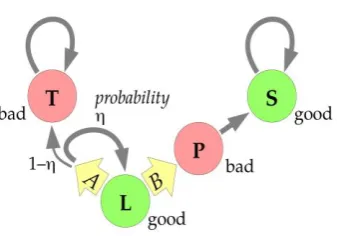
Up until generation 0 and including it, all generations have been in state X(k) = L, where welfare is “high”, denoted W(k) = 1. When in state X(k) = L, generation k has two choices, A (which is considered the “default” choice that all generations before 0 have made) and B.
◦ If generation k chooses option A, the next state is either L or T, depending somewhat on chance. It will be again X(k+1) = L with some (typically large) probability η > 0, which is a time-independent constant, and will be X(k+1) = T with probability π = 1– η > 0.
◦ If they choose option B, the next state will be X(k+1) = P for sure.
In state X(k) = T, welfare is low, denoted W(k) = 0, and the state will never change again, X(k’) = T for all k’ > k.
In state X(k) = P, welfare is also “low”, W(k) = 0, but the next state will be X(k+1) = S for sure.
Finally, in state X(k) = S, welfare is again high, W(k) = 1, and the state will never change again, X(k’) = S for all k’ > k.
We assume all this is known to generation 0 and all later generations.
Note that this TE has one free parameter, the probability η. Figure 1 shows this setup. Obviously, one may be immediately tempted to make the TE more “realistic” by introducing additional aspects, such as overlapping generations, a finer distinction between states, options, or welfare levels, more than one “decision maker”, more possible transitions, or even an explicit time dependency to account for external factors. But we boldly abstain from doing any of that at this point to keep the situation as simple as possible, allowing us to focus only on those aspects present in the TE for our analysis. Rather than justifying what we ignored, we will justify what we put into the TE, but only after having given a verbal, parable-like version of the TE:
On an island very far away from any land lives a small tribe whose main food resource are the fruits of a single ancient big tree despite which only grass grows on the island. Although the tree is so strong that it would never die from natural causes, every year there is a rainy season with strong storms, and someday one such storm might kill and blow away the tree. In fact, until just one generation ago, there was a second such tree that was blown away during a storm. If the same happens to the remaining tree, the tribe would have to live on grass forever, having no other food resource. Every generation so far has passed down the knowledge of a rich but unpopulated land across the large sea that can be safely reached if they build a large and strong boat from the tree’s trunk. Still, the tribe is so small and the journey would be so hard that they would have to send all their people to be sure the journey succeeds. Also, the passage would take so much time that a whole generation would have to live aboard and hope to catch the odd fish for food, causing deep suffering, and would not be able to see the new land with their own eyes, only knowing their descendants would live there happily and safely for all generations to come. No generation has ever set off on this journey.
The main purpose of this narrative is not to add detail to the TE but only to make it more accessible by suggesting a possible alternative interpretation of the states and options in the experiment that is simpler than the actual application to humanity and the Earth system that we motivated it with originally in the introduction. As any such narrative contains details that are not central to the problem one wants to study but which might distract the analysis, the existence of two alternative narratives may also be used to check which aspects of them are actually crucial elements of the TE (namely those occurring in both narratives) and which are not. While the following text may sometimes refer to either narrative, our analysis will only depend on the formal specification.
TSM is a classification of the possible states of a dynamical system which has both a default dynamics (which it will display without the interference of a decision-maker) and a number of alternative, “managed” dynamics (which the decision-maker may bring about by making certain “management” choices). The TSM classification starts with such a system and a set of possible states considered “desirable”, and then classifies each possible system state with regard to questions such as “is this state desirable”, “will the state remain desirable by default/by suitable management”, “can a desirable state be reached with/without leaving the desirable region”, etc. This results in a number of state space regions that differ qualitatively w.r.t. the possibility of sustainable management. One of the most important among these state space regions is what is called a “lake” in TSM. In a “lake”, the decision maker faces the dilemma of either (i) moving the system into an ultimately desirable and secure region called a “shelter”, but having to cross an undesirable region to do so, or (ii) using suitable management to avoid ever entering the undesirable region as long as management is sustained, but knowing that the system will enter the undesirable region when management is stopped, which leaves a permanent risk and makes the lake region insecure. Rather than giving the mathematical details of TSM (see [17] for those), let us exemplify these notions with a simple model of long-term climate and economic development, which was analysed with TSM in [18].
The “AYS” model is a very simple conceptual model of long-term global climate and economic development, describing the deterministic development of just three aggregate continuous variables in continuous time via the equations
dA/dt = E – A/τA, dY/dt = (β – θ A) Y, dS/dt = R – S/τS.
In this, A is the excess atmospheric carbon stock over preindustrial levels, naturally decaying towards zero at rate τA but growing due to emissions E; Y is gross world economic product,
growing at a basic rate β slowed-down by climate-related damages; θ is the sensitivity of this slowing to A; S is the global knowledge stock for producing renewable energy, decaying at rate τS but growing due to learning-by-doing in proportion to produced renewable energy R; energy efficiency stays constant so that total energy use, U, is proportional to Y, U = Y/ϵ; energy is supplied by either fossils, F = G U, or renewables, R = (1–G) U, in proportions depending on relative price G = 1/(1+(S/σ)ρ); σ is the break-even level of S at which fossils and renewables cost the same; ρ is a
learning curve exponent; and finally emissions are proportional to fossil combustion, E = F/ϕ. In [18], several things are shown about this model system: (i) With plausible estimates of the intial state and parameters, it will eventually both violate the climate planetary boundary and stay at welfare levels below current welfare, converging to a fixed point with S = 0. (ii) The system can be forced to neither violate the climate planetary boundary nor to decrease welfare below current levels if humanity has the option to adjust the economic growth rate in real-time within some reasonable levels, but will return to case (i) once this management is stopped. (iii) If one does not wait for too long, it can also be forced to an alternative attractor where S and Y grow indefinitely if humanity can reduce σ by subsidizing renewables or taxing fossils to a reasonable extent, and this management can be phased-out some time after fossils have become uncompetitive, but this decarbonization transition cannot avoid decreasing welfare below current levels for a small number of generations.
the management option is removed. In designing our TE, we omitted the dark downstream and simplified the situation so that the system directly goes to the trench (“T”) when management breaks down in “L”.
3. Analyses using rationality-based frameworks
We will now start to analyse the ethical aspects of the TE by applying a number of well-established frameworks based on a common assumption of rationality, where we take a broad working definition of rationality here that considers a decision-maker’s choice rational if the decision-maker knows of no alternative choice that gives her a strictly more-preferred prospect than the choice taken, in view of her knowledge, beliefs, and capabilities.
Since we want to focus on what is the ethically right response to the dilemma rather than what makes a politically feasible or implementable choice, we will first treat humanity as a whole as formally just one single infinitely-lived decision maker that perfectly knows the system as specified in the formal version of the TE, can make a new choice at every generation, can employ randomization for this if desired, can plan ahead, and has the overall goal of having high welfare in all generations. The natural framework for this kind of problem is the language of optimal control theory. Since it will turn out that optimal choices and plans (called “policies” in that language) will very much depend on the evaluation of trajectories (sequences of states) in terms of desirability, we will use concepts such as time preferences, inequality aversion, and risk aversion from decision theory and welfare economics to derive candidate intergenerational welfare functions to be used for this evaluation, and will discuss their impact on the optimal policy. We will restrict our analysis to a consequentialist point of view that takes into account only the actual and potential consequences of actions and their respective probabilities, and leave the inclusion of nonconsequentialist, e.g. procedural [19], preferences for later work.
After that, we will refine the analysis by considering each generation a new decision maker, so that humanity can no longer plan its own future choices but rather a generation can only recommend and/or anticipate later generations’ choices. The natural framework for this kind of problem is the language of game theory. While most of economic theory applies game theory to selfish players, we will apply it instead to players with social preferences based on welfare measures since in our TE a generation’s welfare is deliberately assumed to be independent of their own choice between A and B.
3.1. Optimal control framework with different intergenerational welfare functions
Terminology. A trajectory, X, is a sequence of states X(0), X(1), … in the set {L, T, P, S}, where X(t) specifies the state generation t will be in. The only possible trajectories in our TE are
“XcLT” = (L, …, L, T, T, …), with c > 0 times L and then T forever (so that c is the time of “collapse”);
“XkLPS” = (L, …, L, P, S, S, …), with k > 0 times L, then once P, then S forever; “all-L” = (L, L, …), which is possible but has probability zero.
A reward sequence (RS, sometimes also called a payoff stream), denoted r, is a sequence r(0), r(1), r(2), … in the set {0, 1}, where r(t) = 0 or 1 means generation t has low or high overall welfare, respectively. Each trajectory determines an RS via r(t) = 1 if X(t) in {L, S} and r(t) = 0 otherwise. The only possible RSs are thus
“rc10” = (1, …, 1, 0, 0, …) with c > 0 ones and then zeros forever;
“rk101” = (1, …, 1, 0, 1, 1, …) with k > 0 ones, then one zero, then ones forever; “all-1” = (1, 1, … ), which is possible but has probability zero.
with which generation t will choose option A (staying in L) if they are in state L, i.e., if X(t) = L. In view of the possible trajectories, we may without loss of generality assume that if p(t) = 0 for some t, all later entries are irrelevant since state L will never occur after generation t. So we consider only policies of the form
infinite sequences (p(0), p(1), … ) with all p(t) > 0,
finite sequences (p(0), p(1), …, p(k–1), 0) with p(t) > 0 for all t < k. The two most extreme (“polar”) policies are
“all-A” = (1, 1, … ), “directly-B” = (0),
and another interesting set of policies is
“Bk” = (1, 1, …, 1, 0) with k+1 ones, where the case k=0 is “directly-B” and k → ∞ is “all-A”, all of which are deterministic. A policy p is time-consistent iff it is a Markov policy, i.e., iff all its entries p(t) are equal, so the only time-consistent policies are “all-A”, “directly-B”, and the policies
“Ax” = (x, x, x, …) with 0 < x < 1, where the case x → 0 is “directly-B” and x → 1 is “all-A”. Given a policy p, the possible trajectories and RSs have these probabilities:
P(XcLT|p) = P(rc10|p) = p(0) η p(1) η … p(c–2) η p(c–1) π P(XkLPS|p) = P(rk101|p) = p(0) η p(1) η … p(k–2) η (1–p(k–1)) P(all-L|p) = P(all-1|p) = 0
Thus each policy p defines a probability distribution over RSs, called a reward sequence lottery (RSL) here, denoted RSL(p).
The only missing part of our control problem specification is now a function that numerically evaluates RSLs, or some other information on what RSLs are preferred over which others, in a way that allows the derivation of optimal policies. Let us assume we have specified a binary social preference relation that decides for each pair of RSLs g, h which of the following four cases holds: (i) g is strictly better than h, denoted g > h, (ii) the other way around, h > g, (iii) they are equally desirable, g ~ h, or (iv) they are incomparable, denoted g|h. We use the abbreviation g ≥ h for g > h or g ~ h, and g ≤ h for g < h or g ~ h. For example, we might put g > h iff V(g) > V(h) and g ~ h iff V(g) = V(h) for some evaluation function V.
Let us assume the social preference relation has the “consistency” property that each non-empty set C of RSLs contains some g such that h > g for no h in C. Then for each non-non-empty set C of policies, we can call any policy p in C optimal under the constraint C (or C-optimal for short) iff RSL(q) > RSL(p) for no q in C. In particular, if the preference relation encodes ethical desirability, C contains all policies deemed ethically acceptable, and p is C-optimal, then generation 0 has a good ethical justification in choosing option A with probability p(0) and option B with probability B.
We will now discuss several such preference relations and the resulting optimal policies. A common way of assessing preferences over lotteries is by basing them on preferences over certain outcomes, hence we first consider whether each of two certain RSs, r and s, is preferable. A minimal plausible preference relation is based only on the Pareto principle that r(t) ≥ s(t) for all t should imply r ≥ s, and r(t) ≥ s(t) for all t but r(t) > s(t) for some t should imply r > s. In our case, the only strict preferences would then between the RSs “all-1”, “rk101”, “rc10”, and “rc’10” for c > c’, where we would have all-1 > rk101 > rc10 > rc’10. But this does not suffice to make policy decisions. E.g., when we just want to compare policies “directly-B” with “all-A”, we need to compare RS “rk101” for k=1 with a lottery over RSs of the form “rc10” for all possible values of c.
options A and B. The satisfaction of basic needs criterion [21] asks from what time on welfare stays above some minimal level; if we use 1 as that level, this criterion prefers RS (1, 0, 1, 1, …) to all other RS that can occur with positive probability in our TE, hence it will recommend policy “directly-B” since it makes sure from generation 2 on welfare stays high. The overtaking and long-run average criteria [21] consider all RSs “rk101” equivalent and strictly more sustainable than all RSs “rc10”, hence they also recommend “directly-B” since that is the only policy avoiding permanently low welfare for sure. Other sustainability criteria are based on the idea of aggregating welfare over time, which we will discuss next.
Aggregation of welfare over time. Let’s now focus on the simple question whether the RS “rB” = (1, 0, 1, 1, …) that results from “directly-B” is preferable to the RS “rc10” = (1, 1, …, 1, 0, 0, …) with c ones, which may result from “all-A”? This may be answered quite differently. The easy way out is to deem them incomparable since for some time points t, rB(t) > rc10(t), while for other t, rc10(t) > rB(t), but this does not help. A strong argument is that rB should be preferred since it has the larger number of generations with high welfare. Still, at least economists would object that real people’s evaluations of future prospects are typically subject to discounting, so that a late occurrence of low welfare would be considered less harmful than an early one. A very common approach in welfare economics is therefore to base the preference over RSs on some quantitative evaluation v(r), called an intergenerational welfare function, which in some way “aggregates” the welfare levels in r and can then also be used as a basis of an evaluation function V(g) of RSLs which further aggregates the evaluations of all possible RSs in view of their probability. But let us postpone the consideration of uncertainty for now and stick with the two deterministic RSs rB and rc10.
The most commonly used form of discounting (since it can lead to time-consistent choices) is exponentialdiscounting, which would make us evaluate any RS r as
v(r) = r(0) + δ r(1) + δ² r(2) + δ³ r(3) + …,
using powers of a discount factor 0 ≤ δ < 1 that encodes humanity’s “time preferences”. For the above rB and rc10, this gives v(rB) = (1–δ+δ²)/(1–δ) and v(rc10) = (1–δc)/(1–δ). So with exponential
discounting, rB > rc10 iff 1–δ+δ² > 1–δc or, equivalently, δc–1+δ > 1, i.e., the policy “directly-B” is
preferable iff δ is large enough or c is small enough. Since 1/δ can be interpreted as a kind of (fuzzy) evaluation time horizon, this means that “directly-B” will be preferable iff the time horizon is large enough to “see” the expected ultimate transition to state T at time c under the alternative extreme policy “all-A”. At what δ exactly the switch occurs depends on how we take into account the uncertainty about the collapse time c, i.e., get from preferences over RSs to preferences over RSLs, which will be discussed later. A variant of the above evaluation v due to Chichilnisky [21] adds to v(r) some multiple of the long-term limit, limt→∞ r(t), which is 1 for rB and 0 for all rc10, thus making
“directly-B” preferable also for smaller δ, depending on the weight given to this limit.
Let us shortly consider the alternative policy “Bk” = (1, …, 1, 0) with k ones, where choosing B is delayed by k periods, and “B1” equals “directly-B”. If k < c, this results in RS r(k+1)101, which is evaluated as (1–δk+1+δk+2)/(1–δ), which grows strictly with growing k. So if the collapse time c was
known, the best policy among the “Bk” would be the one with k = c–1, i.e., initiating the transition at the last possible moment right before the collapse, which is evaluated as (1–δc+δc+1)/(1–δ) > (1–
δc)/(1–δ), hence it would be preferred to “all-A”. However, c is of course not known but a random
variable, so we need to come back to this question when discussing uncertainty below.
An argument against exponential discounting is that even for values of δ close to 1, late generations’ welfare would be considered too unimportant. Under the most common alternative form of discounting, hyperbolicdiscounting, one would instead have the evaluation
v(r) = r(0) + r(1)/(1+κ) + r(2)/(1+2κ) + r(3)/(1+3κ) + …
prior distribution [22]. Under hyperbolic discounting, v(rB) is infinite while v(rc10) is finite independently of k, so the policy “directly-B” would be always preferable to “all-A” no matter how uncertainty about the actual c is accounted for.
A somewhat opposite alternative to hyperbolic discounting is what one could call “rectangular” discounting: simply average the welfare of only a finite number, say H many, of the generations:
v(r) = (r(0) + … + r(H–1)) / H,
where H is the evaluation horizon. With this, v(rB) = (H–1)/H and v(rc10) = min(c,H)/H, so that v(rB) > v(rc10) iff H > c+1. So again, “directly-B” is preferable if the horizon is large enough.
Social preferences over uncertain prospects: expected probability of regret. Let us now consider evaluations of RSLs rather than RSs, which requires us to take into account the probabilities of all possible RSs that an RSL specifies.
If we already have a social preference relation “≥” on RSs, such as one of those discussed above, then a very simple idea is to consider an RSL g’’ strictly preferable to another RSL g’ iff the probability that a realization r’’(g’’) of the random process g’’ is strictly preferable to an independent realization r’(g’) of the random process g’ is strictly larger than ½:
g’’ > g’ iff P(r’’(g’’) > r’(g’)) > ½.
The rationale for this is based in the idea of expected probability of regret. Assume policy p was chosen, resulting in some realization r(RSL(p)), and someone asks whether not policy q should have been taken instead and argues that this should be evaluated by asking how likely the realization r’(RSL(q)) under the alternative policy would have been strictly preferable to the actual realization r(RSL(p)). Then the probability of the latter, averaged over all possible realizations r(RSL(p)) of the policy actually taken, should be not too large. This expected probability of regret is just P(r’’(g’’) > r’(g’)) for g’=RSL(p) and g’’=RSL(q). Since for the special case where g’ = g’’, the value P(r’’(g’’) > r’(g’)) can be everything up to at most ½, the best we can hope for is that P(r’’(RSL(q)) > r’(RSL(p))) ≤ ½ for all q ≠ p if we want to call p optimal.
In our example, the polar policy “directly-B” results in an RSL “gB” which gives 100% probability to RS “rB”, the opposite polar policy “all-A” results in an RSL “gA” which gives a probability of ηc–1π to RS “rc10”, and other policies result in RSLs with more complicated
probability distributions. E.g., with exponential discounting, rB > rc10 iff δc–1+δ > 1, hence gB > gA iff
the sum of ηc–1π over all c with δc–1+δ > 1 is larger than ½. If c(δ) is the largest such c, which can be
any value between 1 (for δ → 0) and infinity (for δ → 1), that sum is 1–ηc(δ), which can be any value
between π (for δ → 0) and 1 (for δ → 1). Similarly, with rectangular discounting, rB > rc10 iff H > c+1, hence gB > gA iff 1–ηH–1 > ½ . In both cases, if η < ½, “directly-B” is preferred to “all-A”, while
for η > ½, it depends on δ or H, respectively. In contrast, under hyperbolic discounting, “directly-B” is always preferred to “all-A”.
What about the alternative policy “Bk” as compared to “all-A”? If c ≤ k, we get the same reward sequence as in “all-A”, evaluated as (1–δc)/(1–δ). If c > k, we get an evaluation of (1–
δk+1+δk+2)/(1–δ), which is larger than (1–δc)/(1–δ) iff δc-k–1+δ > 1. So RSL(Bk) > gA iff the sum of ηc–1π
over all c > k with δc-k–1+δ > 1 is larger than ½. Since the largest such c is c(δ)+k, that sum is ηk(1–
ηc(δ)), so whenever “Bk” is preferred to “all-A”, then so is “directly-B”. Let us also compare “Bk” to
“directly-B”. In all cases, “directly-B” gets (1–δ+δ2)/(1–δ), while “Bk” gets the larger (1–δk+1+δk+2)/(1–
δ) if c > k, but only (1–δc)/(1–δ) if c ≤ k. The latter is < (1–δ+δ2)/(1–δ) iff c ≤ c(δ). So “directly-B” is
strictly preferred to “Bk” iff 1–ηmin(c(δ),k) > ½ , i.e., iff both c(δ) and k are larger than log(½)/log(η),
would thus lead to time-inconsistent choices: in every generation, it would seem optimal to delay the choice B by the same positive number of generations but not forever, so no generation would actually make that choice.
Before considering a less problematic way of accounting for uncertainty, let us shortly discuss a way of deriving preferences over RSs rather than RSLs that is formally similar to the above. In that case the rationale would not be in terms of regret but in terms of Rawls’ veil of ignorance. Given two RSs r’ and r’’, would one rather want to be born into a randomly selected generation in situation r’ or into a randomly selected generation in situation r’’? I.e., let us put
r’’ > r’ iff P(r’’(t’’) > r’(t’)) > ½,
where t’’, t’ are drawn independently from the same distribution, e.g., the uniform one on the first H generations or a geometric one with parameter δ. Then rB(t’’) > rc10(t’) iff rB(t’’) = 1 and rc10(t’) = 0, i.e., iff t’’ ≠ 1 and t’ > c. Under the uniform distribution over H generations, the latter has a probability of (H–1)(H–c)/H² if H ≥ c, which can be any value between 0 (for H = c) and 1 (for very large H), hence whether rB > rc10 depends on H again. Similarly, rB(t’’) < rc10(t’) iff rB(t’’) = 0 and rc10(t’) = 1. This has probability min(c,H)/H², which is 1 for H = 1 and approaches 0 for very large H, hence whether rB < rc10 depends on H as well. However, this version of preferences over RS leaves a large possibility for undecidedness, rB|rc10, where neither rB > rc10 nor rc10 > rB. This is the case when both (H–1)(H–c)/H² and min(c,H)/H² are at most ½ , i.e., when max[(H–1)(H–c), min(c,H)] ≤ H²/2, which is the case when H ≥ 2 and H²–2(c+1)H+2c ≤ 0, i.e., when 2 ≤ H ≤ c+1+(c²+1)½.
A similar result holds for the geometric distribution with parameter δ. So while the probability of regret idea can lead to time-inconsistent choices, the formally similar veil of ignorance idea may not be able to differentiate enough between choices. Another problematic property of our veil of ignorance-based preferences is that they can lead to preference cycles. E.g., assume H = 3 and compare the RSs r = (0,1,2), r’ = (2,0,1), and r’’ = (1,2,0). Then it would occur that r > r’ > r’’ > r, so there would be no optimal choice among the three.
Evaluation of uncertain prospects: prospect theory and expected utility theory. We saw that the above preferences relations based on regret and the veil of ignorance, while intuitively appealing, are however unsatisfactory from a theoretical point of view, since they can lead to time-inconsistent choices and preference cycles, i.e., they may fail to produce clear assessments of optimality. The far more common way of dealing with uncertainty is therefore based on numerical evaluations instead of binary preferences. A general idea, motivated by a similar theory regarding individual rather than social preferences called prospect theory [23], is to evaluate an RSL g by a linear combination of some function of the evaluations of all possible RSs r with coefficients that depend on their probabilities,
V(g) = ∑r w(P(r|g)) f(v(r)).
In the simplest version, corresponding to the special case of expected utility theory, both the probability weighting function r and the evaluation transformation function f are simply the identity, w(p)=p and f(v)=v, so that V(g) = ∑r P(r|g) v(r) = Eg v(r), the expected evaluation of the RSs
resulting from RSL g. If combined with a v(r) based on exponential discounting, this gives the following evaluations of our polar policies: V(RSL(directly-B)) = v(rB) = (1–δ+δ²)/(1–δ) and V(RSL(all-A)) = Eall-A v(rc10) = ∑c>0 ηc–1π(1–δc)/(1–δ) = 1/(1–δη). Hence “directly-B” is preferred to
“all-A” iff (1–δ+δ²)(1–ηδ)–1+δ > 0. Again, this is the case for δ > δcrit(η) with δcrit(0) = 0 and δcrit(1) = 1. The
result for rectangular discounting is similar while for hyperbolic discounting “directly-B” is always preferred to “all-A”, all this as expected from the considerations above.
case) or f(v) = –exp(–av) with a > 0 (constant absolute risk aversion)1. This basically leads to a
preference for small variance in v. One can see numerically that in both cases increasing the degree of risk aversion, a, lowers δcrit(η), not significantly so in the isoelastic case but significantly in the
constant absolute risk aversion case, hence risk aversion favours “directly-B”. In particular, the isoelastic case with a → ∞ is equivalent to a “worst-case” analysis that always favours “directly-B”. Conversely, one can encode risk-seeking by using f(v) = v1+a with a > 0.
Under expected utility theory, the delayed policy “Bk” has (1–δ)V(RSL(Bk)) = ηk(1–δk+1+δk+2) +
∑c=1…k ηc–1π(1–δc), which is either strictly decreasing or strictly increasing in k. Since “directly-B” and
“all-A” corresponds to the limits k → 0 and k → ∞, “Bk” is never optimal but always worse than either “directly-B” or “all-A”. The same holds with risk-averse specifications of f. Under isoelastic risk-seeking with f(v) = v1+a, however, we have (1–δ)V(RSL(Bk)) = ηk(1–δk+1+δk+2)1+a + ∑c=1…k ηc–1π(1–
δc)1+a, which may have a global maximum for a strictly positive and finite value of k, so that
delaying may seem preferable. E.g., with δ = 0.8, η = 0.95, and a = ½ , V(RSL(Bk)) is maximal for k = 6, i.e., one would want to choose six times A before choosing B, again a time-inconsistent recommendation.
As long as the probability weighting function w is simply the identity, there is always a deterministic optimal policy. While other choices for w could potentially lead to non-deterministic optimal policies, they can be used to encode certain forms of risk attitudes that cannot be encoded via f. E.g., one can introduce some degree of optimism or pessimism by over- or underweighing the probability of the unlikely cases where c is large. For example, if we put w(p) = p1–b with 0 ≤ b < 1,
then increasing the degree of optimism b, one can move δcrit(η) arbitrarily close towards 1, which is
not surprising. We will however not discuss this form of probability reweighting further but will use a different way of representing “caution” below. Since that form is motivated by its formal similarity to a certain form of inequality aversion, we will discuss the latter first now before returning to risk attitudes.
Inequality aversion: a Gini-Sen intergenerational welfare function. While discounting treats different generations’ welfare differently, it only does so based on time lags, and all the above evaluations still only depend on some form of (weighted) time-average welfare and are blind to welfare inequality as long as these time-averages are the same. However, one may argue that an RS with less inequality between generations, such as (1, 1, 1, …), should be strictly preferable to one with the same average but more inequality, such as (2, 0, 2, 0, 2, 0, …). Welfare economics has come up with a number of different ways to make welfare functions sensitive to inequality, and although most of them were initially developed to deal with inequality between individuals of a society at a given point in time (which we might call “intragenerational” inequality here), we can use the same ideas to deal with inequality between welfare levels of different generations (“intergenerational” inequality). Since our basic welfare measure is not quantitative but qualitative since it only distinguishes “low” from “high” welfare, inequality metrics based on numerical transformations, such as the Atkinson-Theil-Foster family of indices, are not applicable in our context, but the Gini-Sen welfare function [24], which only requires an ordinal welfare scale, is. The idea is that the value of a specific allocation of welfare to all generations is the expected value of the smaller of the two welfare values of two randomly drawn generations. If the time horizon is finite, H > 0, this leads to the following evaluation of an RS r:
V2(r) = (∑t=0…H–1 ∑t’=0…H–1 min[r(t), r(t’)]) / H².
It is straightforward to generalize the idea from drawing two to drawing any integer number a > 0 of generations, leading to a sequence of welfare measures Va(r) that get more and more inequality
averse as a is increased from 1 (no inequality aversion, “utilitarian” case) to infinity (complete inequality aversion), where the limit for a → ∞ is the egalitarian welfare function:
V1(r) = [r(0) + … + r(H–1)] / H,
Va(r) = (∑t1=0…H–1 … ∑ta=0…H–1 min[r(t1), …, r(ta)]) / Ha,
V∞(r) = min[r(0), …, r(H–1)].
Note that I = 1–V2(r)/V1(r) is the Gini index of inequality and the formula V2(r) = V1(r) (1–I) is often
used as the definition of the Gini-Sen welfare function.
Our RSs “rc10” then gets Va(rc10) = min(c/H, 1)a, while “rk101” gets Va(rk101) = [(H–1)/H]a if k
< H and Va(rk101) = 1 if k ≥ H. Together with expected utility theory for evaluating the risk about c,
this makes Va(all-A) = ηH + ∑c=1…H ηc–1π(c/H)a and Va(directly-B) = [(H–1)/H]a. Numerical evaluation
shows that even for large H, “all-A” may still be preferred due to the possibility that collapse will not happen before H and all generations will have the same welfare, but this is only the case for extremely large values of a. If we use exponential instead of rectangular discounting and compare the policies “directly-B”, “Bk”, and “all-A”, we may again get a time-inconsistent recommendation to choose B after a finite number of generations. E.g., Fig. 2a shows V(Bk) vs. k for the case η = 0.985, δ = 0.9, a = 2, where the optimal delay would appear to be five generations. If we restrict our optimization to the time-consistent policies “Ax”, the optimal x in that case would be ≈ 0.83, i.e., each generation would choose A with about 83% probability and B with about 17% probability, as shown in Fig. 2b. Still, note that the absolute evaluations vary only slightly in this example.
Let us see what effect a formally similar idea has in the context of risk aversion.
Caution: Gini-Sen applied to alternative realizations. What happens if instead of drawing a ≥ 1 many generations t1, …, ta at random, we draw a ≥ 1 many realizations r1, …, ra of an RSL g at
random and use the expected minimum of all the RS-evaluations V(ri) as a “cautious” evaluation of
the RSL g?
Va(g) = ∑r1 … ∑ra g(r1) × … × g(ra) × min[v(r1), …, v(ra)].
For a=1, this is just the expected utility evaluation of g, while for a→∞, it gives a “worst-case” evaluation. For actual numerical evaluation, the following equivalent formula is more useful (assuming that all v(r) ≥ 0):
Va(g) = ∫x≥0 Pg(v(r) ≥ x)a dx,
where Pg(v(r) ≥ x) is the probability that v(r) ≥ x if r is a realization of g. In that form, a can be any
real number ≥ 1 and it turns out that the evaluation is a special case of cumulative prospect theory [23], with the cumulative probability weighting function w(p) = pa. Focussing on “all-A” vs.
“directly-B” again, we get Va(all-A) = (1–ηaH)/(1–ηa)H and Va(directly-B) = (H–1)/H, hence “all-A” is
preferred iff (1–ηaH)/(H–1) > 1–ηa, i.e., iff H and a are small enough and η is small enough. In
particular, regardless of H and η, for a → ∞ we always get a preference for “directly-B” as in the constant absolute risk aversion. This is because with the Gini-Sen-inspired specification of caution, the degree of risk aversion effectively acts as an exponent to the survival probability η, i.e., increasing risk aversion has the same effect as increasing collapse probability, which is an intuitively appealing property.
reward. It is therefore natural to consider applying “inequality aversion” on the RSL level to encode fairness, by putting
Va(g) = (∑t1=0…H–1 … ∑ta=0…H–1 min[V(g, t1), …, V(g, ta)]) / Ha,
where V(g, t) is some evaluation of the uncertain reward of generation t resulting from g, e.g., the expected reward or some form of risk-averse evaluation. The interpretation is that Va(g) is the
expected minimum of how two randomly drawn generations within the time horizon evaluate their uncertain rewards under g. Using exponential discounting instead, the formula becomes
Va(g) = (1–δ)a ∑t1=0…H–1 … ∑ta=0…H–1 δt1+...+ta min[V(g, t1), …, V(g, ta)].
If we use expected reward for V(g, t) and evaluate the time-consistent policies “Ax” with this Va(g),
the result looks similar to Fig. 2b, i.e., the optimal time-consistent policy is again non-deterministic. A full optimization of Va(g) over the space of all possible probabilistic policies shows that the
overall optimal policy regarding Va(g) is not much different from the time-consistent one, it
prescribes choosing A with probabilities between 79 and 100% in different generations for the setting of Fig. 2.
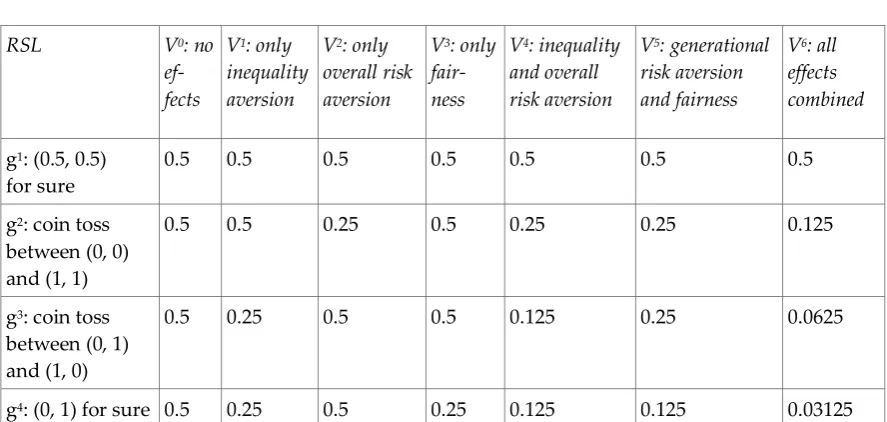
Combining inequality and risk aversion with fairness. How could one consistently combine all the discussed aspects into one welfare function? Since a Gini-Sen-like technique of using minima can be used for each of them, it seems natural to base a combined welfare function on that technique as well. Let us assume we want to evaluate the four simple RSLs g1, …, g4 listed in Table
1 in a way that makes V(g1) > V(g2) because the latter is more risky, V(g2) > V(g3) because the latter
has more inequality, and V(g3) > V(g4) because the latter is less fair. Then we can achieve this by
applying the Gini-Sen technique several times to define welfare functions V0 … V6 that represent
more and more of our aspects as follows:
Simple averaging: V0(g) = Er Et r(t)
where Er f(r) is the expectation of f(r) w.r.t. the lottery g and Et f(t) is the expectation of f(t)
w.r.t. some chosen discounting weights
Gini-Sen welfare of degree a=3: V1(g) = Er Et1 Et2 Et3 min{r(t1), r(t2), r(t3)}
Overall risk-averse welfare: V2(g) = Er1 Er2 min{Et r1(t), Et r2(t)}
Fairness-seeking welfare of degree a=3: V3(g) = Et1 Et2 Et3 min{Er r(t1), Er r(t2), Er r(t3)}
Inequality- & overall risk-averse welfare: V4(g) = Er1 Er2 min{v4(r1), v4(r2)}
with v4(r) = Et1 Et2 Et3 min{r(t1), r(t2), r(t3)}
Inequality & overall risk index: I4(g) = 1 – V4(g)/V0(g)
Generational risk averse & fair welfare: V5(g) = Et1 Et2 Et3 min{V5(g, t1), V5(g, t2), V5(g, t3)}
with V5(g, t) = Er1 Er2 min{r1(t), r2(t)}
Generational risk & fairness index: I5(g) = 1 – V5(g)/V0(g)
The resulting evaluations for g1 … g4 can be seen in Table 1. We chose a higher degree of
inequality-aversion (a = 3) than the degree of risk-inequality-aversion (a = 2) so that V6(g2) > V6(g3) as desired. Applied to
our thought experiment, V6 can result in properly probabilistic and time-inconsistent policy
recommendations, as shown in Figure 3 for two example choices of η and discounting schemes. An alternative way of combining inequality and risk aversion into one welfare function would be to use the concept of recursive utility [25], which is however beyond the scope of this article.
Summarizing the results of our analysis in the optimal control framework that treats humanity as a single infinitely-lived decision maker, we see that there is no clear recommendation to either choose A or B at time 0 since depending on the degrees and forms of time preferences/time horizon and risk/inequality/fairness attitudes, either one of the policies “all-A” or “directly-B” may appear optimal, or it may even appear optimal to deterministically delay the choice for B by a fixed number of generations or choose A by a time-varying probability, leading to time-inconsistent recommendations. At least we were able to formally confirm quite robustly the overall intuition that risk aversion and long time horizons are arguments in favour of B while risk seeking and short time horizons are arguments in favour of A. Only the effect of inequality aversion might be surprising, since it can lead to either recommending a time-inconsistent policy of delay (if we restrict ourselves to deterministic policies) or a probabilistic policy of choosing A or B with some probabilities (if we restrict ourselves to time-consistent policies). In the next subsection, we will see what difference it makes that no generation can be sure about the choices of future generations.
3.2. Game-theoretical framework
Let’s abbreviate generation t’ by Gt’ and the set of generations t > t’ by G>t’ and focus on
generation t’ = 0 at first. Let’s assume that V = V4, V5, or V6 with exponential discounting encodes
their social preferences over RSLs. Given G0’s beliefs about G>0’s behaviour, q(0, t) for all t > 0, we
then need to find that x in [0, 1] which maximizes V(RSL(px,q)), where px,q is the resulting policy px,q
= (x, q(0, 1), q(0, 2), …). If G0 believes G1 will choose B for sure (i.e., q = (0, …) = “directly-B”) and
chooses strategy x, the resulting RSL(px,q) produces the reward sequence r1 = (1, 0, 0, …) with
probability xπ, r2 = (1, 0, 1, 1, …) with prob. 1–x, and r3 = (1, 1, 0, 1, 1, …) with probability xη. Hence
V4(RSL(px,q)) = x² [(1–(1–δ)δ²)³ η² – (1–δ)³η² + 2(1–δ)³η – 2(1–(1–δ)δ)³η – (1–δ)³ + (1–(1–δ)δ)³] + 2x (–(1–
δ)³η + (1–(1–δ)δ)³η + (1–δ)³ – (1–(1–δ)δ)³] + (1–(1–δ)δ)³. Since the coefficient in front of x² is positive, V4 is maximal for either x = 0, where it is (1–δ+δ²)³, or for x = 1, where it is (δ³–δ²+1)³η² + (δ–1)³(η²–1),
which is always smaller, so w.r.t. V4, x = 0 (choosing B for sure) is optimal under the above beliefs.
For V5, we have V5(RSL(px,q), t) = 1 for t = 0, (xη)² for t = 1, (1–x)² for t = 2, and (1–xπ)² for t > 2. If x <
1/(1+η), we have (xη)² < (1–x)² < (1–xπ)² < 1, while for x > 1/(1+η), we have (1–x)² < (xη)² < (1–xπ)² < 1. For x ≤ 1/(1+η), V5(RSL(px,q)) is again quadratic in x with positive x² coefficient with value 1 + (1–δ)³
– (1–δ²)³ at x = 0 and again a smaller value at x = 1/(1+η). Also for x ≥ 1/(1+η), V5(RSL(px,q)) is
quadratic in x with positive x² coefficient and a value of 1 – δ(3 – 3δ + δ² – η²[1–δ+δ²][3–δ(1–δ+δ²)(3– δ+δ²–δ³)]) for x = 1, which is larger than the value for x = 0 if η is large enough and/or δ small enough. A similar thing holds for the combined welfare measure V6, as shown in Fig. 4, blue line,
for the case η = 0.95 and δ = 0.805, where G0 will choose A if they believe G1 will choose B, resulting
in an evaluation V6 ≈ 0.43. The orange line in the same plot shows V6(RSL(px,q)) for the case in which
G0 believes that G1 will choose A and G2 will choose B if they’re still in L, which corresponds to the
beliefs q = (1, 0, …). Interestingly, in that case, it is optimal for G0 to choose A, resulting in an
evaluation V6 ≈ 0.42. Since the dynamics and rewards do not explicitly depend on time, the same
logic applies to all later generations, i.e., for that setting of η and δ and any t ≥ 0, it is optimal for Gt
to choose A when they believe Gt+1 will choose B and optimal to choose B when they believe Gt+1
will choose A and Gt+2 will choose B.
Now assume that all generations have preferences encoded by welfare function V6 and believe
that all generations Gt with even t will choose A and all generations Gt with odd t will choose B.
Then it is optimal for all generations to do just that. In other words, these assumed common beliefs form a strategic equilibrium (more precisely, a subgame-perfect Nash equilibrium) for that setting of η and δ. However, under the very same set of parameters and preferences, the alternative common belief that all even generations will choose B and all odd ones A also forms such an equilibrium. Another equilibrium consists of believing that all generations choose A with probability ≈ 83.7% which all generations evaluate as only V6 ≈ 0.40, which is less than in the other two equilibria. The
existence of more than one strategic equilibrium is usually taken as an indication that the actual behaviour is very hard to predict even when assuming complete rationality. In our case, this means G0 cannot plausibly defend any particular belief about G>0’s policy on the grounds of G>0’s
rationality since G>0 might follow at least either of the three identified equilibria (or still others). In
other words, for many values of η and δ a game-theoretic analysis based on subgame-perfect Nash equilibrium might not help G0 in deciding between A and B. A common way around this is to
consider “stronger” forms of equilibrium to reduce the number of plausible beliefs, but this complex approach is beyond the scope of this article. An alternative and actually older approach [26] is to use a different basic equilibrium concept than Nash equilibrium, not assuming players have beliefs about other players policies encoded as subjective probabilities, but rather assuming players apply a worst-case analysis. In that analysis, each player would maximize the minimum evaluation that could result from any policy of the others. For choosing B, this evaluation is simply v(1, 0, 1, 1, …), while for choosing A, the evaluation can become quite complex. Instead of following this line here, we will use a similar idea when discussing the concept of responsibility in the next section, where we will discuss other criteria than rationality and social preferences.
4.1. Responsibility
Rather than asking what combinations of uncertain welfare levels we should prefer for future generations one can also ask what responsibility we have regarding future welfare. We will sketch here a certain simple theory of responsibility designed to be applicable to problems involving multiple agents, uncertainty, and potential ethically undesired outcomes (EUOs), as in our TE. We distinguish two major types of responsibility, forward- and backward-looking responsibility, the latter having two subtypes, factual and counterfactual responsibility. While forward-looking responsibility is about still existing possibilities an agent or group of agents has to reduce the probability of future EUOs (“responsibility to”), backward-looking responsibility (“responsibility for”) is about past possibilities that would have reduced the probability of an EUO that actually occurred (factual responsibility, e.g. Nagel’s unlucky drunken driver [27]) or could have occurred (counterfactual responsibility, e.g. Nagel’s lucky drunken driver [27]). In all three types, the degree of responsibility is measured in terms of differences of probabilities of EUOs. Rather than giving a formal definition, it will suffice to discuss the details of this theory at the hand of several choices for what constitutes an EUO in our TE.
Let us start by considering that an EUO is simply a low welfare in generation 1. Then the degree of forward-looking resp. of G0 is the absolute difference between the probability of low
welfare in generation 1 when choosing A rather than B, which equals η. In other words, G0 would
have a degree of η responsibility to choose A in order to avoid the EUO that G1 gets low welfare. If
they choose B instead, they will have a degree of factual backward-looking responsibility for G1’s
low welfare equalling again η since this is the amount by which they could have reduced the probability of the EUO. If they behave “responsibly” by choosing A, G1’s welfare might also be low
(with probability π), but G0 would still not have backward-looking responsibility since they could
not have reduced that probability.
If the EUO was simply a low welfare in G2 rather than G1, the assessment of G0’s responsibility
must consider the possible actions of G1 in addition to those of G0. If G0 chooses B, the probability of
the EUO is zero, while if they choose A, it depends on G1’s choice. If G1 would choose B, the EUO
has probability 1 so that G0’s choice would make a difference of 1, while if G1 would choose A, the
EUO has probability 1–η² < 1 and G0’s choice would make a difference of only 1–η² < 1. In both
cases, however, they have considerable forward-looking responsibility to choose B since by that they can reduce the probability of the EUO significantly. If choosing B, no backward-looking resp. accrues. If G0 and G1 both choose A and the collapse occurs at time 2, G1 has no factual
responsibility since they could not have reduced that probability, but G1 has factual responsibility of degree 1–η². If G0 chooses A and G1 B, G1’s factual responsibility is η as seen above, but G0’s is
even larger, since in view of G1’s actual choise, G0 could have reduced the probability from one to
zero by choosing B instead. So G0 has factual responsibility of 1. It might seem counterintuitive at
first that the sum of the factual responsibilities of the two agents regarding that single outcome would be larger than 100%, but our theory was actually explicitly designed to produce this result in order to show that responsibility cannot simply be divided. Otherwise, each individual in a large group of bystanders at a fight in public could claim to have almost no responsibility to intervene (diffusion of responsibility). Finally, if both G0 and G1 choose B and no collaps happens, G0 still has
counterfactual responsibility since the collaps could have happened and G0 could have reduced that
probability by 1–η². This distinction between factual and counterfactual responsibility would also allow a discussion of Nagel’s concept of moral luck in consequences [27] and responses to it such as [28] but we won’t go there here.
If the EUO is low welfare in G3, it becomes more complicated. By choosing B, G0 can avoid the
EUO for sure, but when choosing A they might hope G1 will choose B and the EUO will be avoided
for sure as well, in which case they might claim to have a rather low responsibility to choose B which amounts only to π, the probability that G1 will have no chance of choosing B due to
two bystanders neither one would be ethically obliged to intervene since both could hope the other does. Here we even take the opposite view and argue that G0’s degree of forward-looking
responsibility should equal the largest possible amount by which they might be able to reduce the probability of the EUO, maximized over all possible behaviours of the other agents. This means that rather than being optimistic about G1’s action they need to be pessimistic about both G1’s and G2’s
behaviour. The worst that can happen regarding the welfare of G3 when G0 chooses A is that G1
would choose A and G2 B. In that case, the EUO has probability 1, so G0 would still be fully
responsible (degree 1) to choose B in order to avoid the EUO.
Now what definition of EUO we should actually adopt in our TE? Two candidates seem natural, either a low welfare in any generation should already constitute an EUO (in which case it cannot be avoided by either A or B), or only an infinite number of low welfare generations, i.e., an eventual collapse into state T, should constitute an EUO. In the latter case, each generation in L has 100% forward-looking responsibility to choose B, and if they choose A instead, they will end up having 100% factual responsibility for the eventual collapse, regardless of the choices of later generations. Summarizing, we argue that a theory of responsibility that avoids the diffusion of responsibility and wishful thinking will deem B the responsible action in our TE since it avoids the worst for sure, even though this makes G0 responsible for G1’s suffering.
4.2. Safe operating space for humanity
In the following we continue our analyses of the ethical aspects of the TE from the perspective of the safe operating space (SOS) for humanity [29]. The SOS is located within planetary boundaries “with respect to the Earth system” which “are associated with the planet’s biophysical subsystems and or processes” [29]. The SOS is a fairly new concept for environmental governance, encapsulating several established concepts such as the limits to growth [30,31], safe minimum standards [32–34], the precautionary principle [35] and the tolerable windows concept [36,37]. We let our analysis guide by the three “main” articles around the planetary boundaries and the SOS concepts [3,4,29], which have at the time of this writing together well over ten thousand citations, so that a comprehensive review of the SOS debate is beyond the possibilities of this article. We will therefore incorporate other papers only selectively.
One main difference to the approaches covered in the previous sections is the level of mathematical formalization. While we do acknowledge that some attempts of mathematical formalization of a SOS decision paradigm have been made [38], the original and most of the subsequent works do not provide a mathematical operationalization.
First of all we assess whether our TE is a suitable model within which the SOS concept can be applied at all. Ref. [3] acknowledges that “anthropogenic pressures on the Earth System have reached a scale where abrupt global environmental change can no longer be excluded”, which “can lead to the unexpected crossing of thresholds that drive the Earth System, or significant sub-systems, abruptly into states deleterious or even catastrophic to human well-being”. Therefore the authors “propose a new approach to global sustainability in which we define planetary boundaries within which we expect that humanity can operate safely.” These lines resemble very well the situation in our TE where the decision maker faces either a transition from L to T or from L to S.
However, the authors of the three papers in question do not mention any unfavorable P-like states on the way from L to S. Ref. [29] states that “the evidence so far suggests that, as long as the thresholds are not crossed, humanity has the freedom to pursue long-term social and economic development.“ Emphasizing the long-term aspect, the last quote at least does not exclude the possibility of unfavorable iterim states P on the way to safe, long-term “shelter” states S.
to be interpreted as “destabilizing” [4]. However, this view disregards that our TE does not tell anything about the holocene-likeness of the states L, T, P and S. One may very well interprete states L, P and S as holocene-like. Further, as stated above, the ultimate justification for the planetary boundaries is to avoid Earth system states “catastrophic to human well-being” [3]. It is the only precautionary principle used by the PB approach that suggests to stay within holocene-like state.
Another opposition to the view that the SOS can be applied to the decision problem in our TE may result from the fact that “the planetary boundaries approach as of yet focuses on boundary definitions only and not as a design tool of compatible action strategies” [3]. The “PB framework as currently construed provides no guidance as to how […] the maintenance of a Holocene-like state […] may be achieved […] and it cannot readily be used to make choices between pathways for piecemeal maneuvering within the SOS or more radical shifts of global governance” [4]. We make two observations from these quotes: First, the PB framework may not be used to guide how holocene-like states shall be maintained, but it can surely be used as a guiding principle that holocene-like states shall be maintained. Second, these quotes suggest that the authors assume that we are still currently in a holocene-like SOS, since they do not explicitly account for re-entering it. However, one of the key messages of all three papers is that humanity has already crossed several of the nine planetary boundaries. One could conclude that humanity has therefore left the SOS.
The ultimate question regarding our TE is which states of our TE correspond to the SOS. Interpreting the T state as the catastrophic state that is to be avoided, four options seem plausible to constitute the SOS: (i) S, (ii) P and S, (iii) L and S, (iv) L, P and S. State S is clearly part of the SOS. As mentioned above, the three papers avoid to discuss P-like states. Therefore both possibilities must be considered: either P-like states belong to the SOS or they do not. Regarding whether state L belongs to the SOS, [29] states: “Determining a safe distance [from the thresholds] involves normative judgements of how societies choose to deal with risk and uncertainty”. This clearly reflects the circumstance that real-world environmental governance always has to account for risks and uncertainties. But also in our TE we can associate the “risk” with the probability π of transitioning to state T under action A. Thus, if our decision maker judges the risk π to be acceptable, L belongs to the SOS.
What are the consequences of classifying either of assuming the SOS is composed of either of the sets (i)–(iv)? (i) If only S belongs to the SOS, one should choose action B, take the suffering of the next generation into account and finally end up in the SOS. There “humanity [can] pursue long-term social and economic development“ [29]. (ii) If P but not L belongs to the SOS, the decision is still to take action B since that moves them even faster into the SOS. (iii) If L but not P belong to the SOS and we interpret the transition L → P → S as a “radical shift […] of global governance” [4], the SOS concept “cannot […] be used to make choices between pathways” [4], i.e., would be of no help here. Denoting that transition as “radical” can be justified since it temporarily leaves the SOS. Finally, (iv) assuming all of L, P and S to belong to the holocene-like SOS, the SOS concept still “cannot readily be used to make choices between pathways for piecemeal maneuvering within the safe operating space” [4].
Overall, we conclude that whether or not the initial state L belongs to the SOS is essential for whether the SOS concept can be used to guide decisions in our TE. If L does not belong to the SOS, the decision problem is solved by taking action B. Otherwise the concept explicitly states that it cannot give guidance facing the trade-off highlighted in our TE.
4.3. Sustainability paradigms à la Schellnhuber