health care: The state of the literature
Bart N. Green,
DC, MSEd*Claire D. Johnson,
DC, MSEd**Anthony J. Lisi,
DC†John Tucker,
PhD‡Objective: To summarize scholarly literature that describes practice, utilization, and/or policy of chiropractic services within international active duty and/or veteran health care environments.
Data Sources: PubMed, the Cumulative Index to Nursing and Allied Health Literature, and the Index to Chiropractic Literature were searched from their starting dates through June 2009.
Review Methods: All authors independently reviewed each of the articles to verify that each met the inclusion criteria. Citations of included papers and other pertinent findings were logged in a summary table.
Results: Thirteen articles were included in this study. Integration of chiropractic care into military or veteran health care systems has been described in 3 systems: the United States Department of Defense, the United States Department of Veterans Affairs, and the Canadian Forces.
Conclusion: Chiropractic services seem to be included successfully within military and veteran health care facilities. However, there is a great need for additional written evaluation of the processes, policies, practices, and effectiveness of chiropractic services in these environments.
(JCCA 2009; 53(3):194–204)
* Chiropractic Division, Department of Physical and Occupational Therapy, Naval Medical Center San Diego, MCAS Miramar Branch Medical Clinic, PO Box 452002, San Diego, CA 92145-2002. Email:[email protected]
** National University of Health Sciences, 200 E. Roosevelt Rd., Lombard, IL 60148. † VA Connecticut Healthcare System, 950 Campbell Avenue, West Haven, CT 06516.
‡ Director, Government and Interprofessional Relations, Canadian Chiropractic Association, 600-30 St. Patrick Street, Toronto, ON M5T 3A3. The views expressed in this article are those of the authors and do not reflect the official policy or position of the Department of the Navy, Department of Defense, or the United States Government. The views expressed in this article are those of the authors and do not reflect the official policy or position of the Canadian Chiropractic Association.
© JCCA 2009.
Objectifs : Résumer la littérature scientifique décrivant la pratique, l’utilisation, et/ou les politiques des services chiropratiques, en pratique active et/ou dans l’environnement des soins de santé des vétérans à l’échelle internationale.
Sources de données : Les outils de recherche suivants ont été recherché depuis leur création jusqu’au mois de juin 2009 : PubMed, ‘Cumulative Index to Nursing and Allied Health Literature’ (CINAHL), et ‘Index to Chiropractic Literature’
Méthodologie : Chaque auteur a révisé chacun des articles afin de déterminer ceux qui rencontraient les critères d’inclusion. Les citations et autres résultats pertinents sont résumés dans un tableau.
Résultats : Treize articles ont été retenus. Trois systèmes décrivent l’intégration des services
chiropratiques dans le système de santé des militaires ou des vétérans : le Département de la Défense des États-Unis, le Département des Affaires des Vétérans des États-Unis et les Forces Armés Canadiennes.
Conclusion : Les soins chiropratiques semblent être bien intégrés au sein du corps militaire ainsi que celui des vétérans. Cependant, l’évaluation du processus, des politiques, de la pratique et de l’efficacité des services chiropratiques dans ces environnants demeure
nécessaire.
k e y w o r d s: Chiropractic; Military Medicine; Hospitals, Veterans; Military Personnel
Introduction
The use of various forms of complementary and alterna-tive medicine (CAM) continues to grow internationally.1
Eisenberg and colleagues2 defined CAM as:
“Interven-tions not taught widely at US medical schools or general-ly available at US hospitals.” Popular CAM practices include: herbal remedies, yoga, acupuncture, and chiro-practic.1 Chiropractic care has been used reportedly by
7.4%1 to 11%3 of the general American adult population,
representing approximately 190 million office visits per year and about 30% of all CAM practitioner visits.4
Smith and colleagues recently reported that as much as one third of United States (US) Navy and Marine Corps personnel utilize some form of CAM.5
Recently, there has been increased interest in how doc-tors of chiropractic may be integrated within military and veteran healthcare facilities.6 More than a decade has
passed since Lott’s7 postulation in the journal Military
Medicine regarding how, or if, chiropractic services would be integrated into the military health care system. Starting in 1995, a 3-year demonstration program showed successful inclusion of the service in 10 different US De-partment of Defense (DoD) sites.8 The service is
current-ly available at 49 military treatment facilities across the United States,9 and continues to expand.10 More recently,
in 2004, chiropractic care was introduced into the US De-partment of Veterans Affairs (VA)11 and is now available
at 36 VA facilities. In Canada, chiropractic care is cur-rently offered at 1 military hospital.12
Despite the availability of numerous published articles regarding chiropractic care and the chiropractic profes-sion in general, the number of writings about chiropractic care specifically included within the military/veteran set-ting is unknown. Since chiropractic care is the primary CAM practice now included within military and veteran hospitals, a survey of existing literature may assist practi-tioners in the art of evidence-based practice, guide ad-ministrators in the practice of evidence-based health care, focus future research efforts, and ultimately benefit mili-tary and veteran patients. Knowing how chiropractic care is utilized within these environments may aid with
quali-ty improvement and assist decision makers to determine if further inclusion of chiropractic services is warranted. The purpose of this study was to identify and summarize scholarly literature that describes chiropractic practice, utilization, and/or policy included within international active duty and/or veteran health care systems, and to provide suggestions for how to increase research produc-tivity from these unique environments.
Methods
Search Strategy
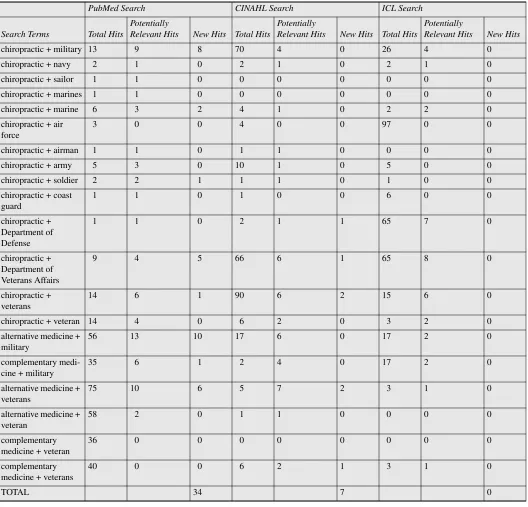
PubMed and the Cumulative Index to Nursing and Allied Health Literature (CINAHL) were searched using EB-SCOhost Web. The Index to Chiropractic Literature (ICL) was reviewed directly at its site (www.chiroindex.org). Searches for all databases were from the starting dates of each through June 2009. In PubMed we combined the term “chiropractic” with a variety of terms relevant to the topic (Table 1). “Complementary medicine” and “ alterna-tive medicine” were also combined with other terms (Table 1) in an effort to broaden the search and capture all relevant publications. The same strategy was used with CINAHL. Pertinent hits were verified against the previ-ously recorded relevant citations (ie, those that met in-clusion criteria) from the PubMed search; these were noted as “new hits” in Table 1. This procedure was used for the ICL search, verifying results from the ICL against both PubMed and CINAHL. We searched for additional articles by reading the references found in the articles retrieved, searching our personal libraries, and by contact-ing authors who have published in this area.
Inclusion/Exclusion Criteria
All languages and research designs from any country, and only articles from peer-reviewed scholarly journals, were included in the search. Commentaries from non-peer reviewed sources (eg, trade magazines) and other non-scholarly sources were excluded, as were writings not specific to the reported use of chiropractic or of chiropractic in military or veteran facilities. Abstracts of
conference proceedings were not included due to the high rate of conference presentations that never reach full pub-lication.13,14 Articles were considered for final inclusion
if they described practice, utilization, and/or policy of chiropractic within active duty and/or veteran health care environments.
Table 1 Search terms and results.
PubMed Search CINAHL Search ICL Search
Search Terms Total Hits
Potentially
Relevant Hits New Hits Total Hits
Potentially
Relevant Hits New Hits Total Hits
Potentially
Relevant Hits New Hits
chiropractic + military 13 9 8 70 4 0 26 4 0
chiropractic + navy 2 1 0 2 1 0 2 1 0
chiropractic + sailor 1 1 0 0 0 0 0 0 0
chiropractic + marines 1 1 0 0 0 0 0 0 0
chiropractic + marine 6 3 2 4 1 0 2 2 0
chiropractic + air force
3 0 0 4 0 0 97 0 0
chiropractic + airman 1 1 0 1 1 0 0 0 0
chiropractic + army 5 3 0 10 1 0 5 0 0
chiropractic + soldier 2 2 1 1 1 0 1 0 0
chiropractic + coast guard
1 1 0 1 0 0 6 0 0
chiropractic + Department of Defense
1 1 0 2 1 1 65 7 0
chiropractic + Department of Veterans Affairs
9 4 5 66 6 1 65 8 0
chiropractic + veterans
14 6 1 90 6 2 15 6 0
chiropractic + veteran 14 4 0 6 2 0 3 2 0
alternative medicine + military
56 13 10 17 6 0 17 2 0
complementary medi-cine + military
35 6 1 2 4 0 17 2 0
alternative medicine + veterans
75 10 6 5 7 2 3 1 0
alternative medicine + veteran
58 2 0 1 1 0 0 0 0
complementary medicine + veteran
36 0 0 0 0 0 0 0 0
complementary medicine + veterans
40 0 0 6 2 1 3 1 0
Methods of Review
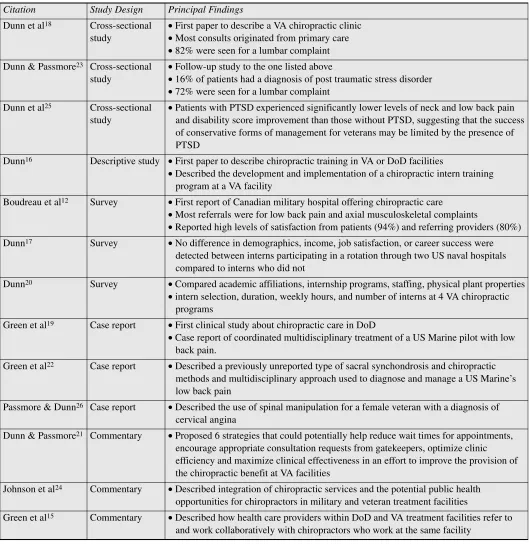
The search process was conducted by the primary author; co-authors were asked to contribute citations with which they were familiar but which might be missing from the list created by the primary author. Abstracts of the cita-tions that obviously or possibly met the review criteria were saved. The full papers of each abstract were then re-trieved. Each article was independently reviewed to veri-fy that it met the inclusion criteria. Papers that did not meet the criteria were discarded and a note was made as to why they were excluded. Once a paper was included, the citation, study design, principal findings, and other pertinent notes were logged in a summary table (Table 2). Quality scoring was not performed as the articles re-viewed were descriptive and not homogenous.
Results
Forty-three potential articles were identified (41 from lit-erature searches and 2 from colleagues published in this topic area) and 13 were acceptable for review,12,15–26 thus
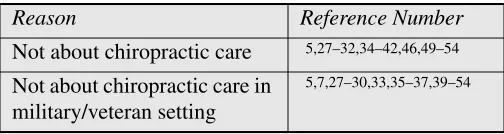
30 papers5,7,27–54 had been excluded. Reasons for
exclu-sion are presented in Table 2. The most common reason papers were excluded was because they described the use of CAM amongst military or veteran beneficiaries, but included no breakdown of the utilization of chiropractic care from the larger set of CAM practices. Also, it was not made clear whether the chiropractic care included in the CAM practices discussed was provided at a designat-ed military or veteran health care facility or if chiroprac-tic care was obtained from outside sources. Two papers with apparent US military/veteran and chiropractic rele-vance that were excluded were those by Lott7 and
Coulter33 and this deserves further explanation. Lott’s
pa-per predated the inclusion of chiropractic services in the DoD or VA environments and was a commentary fore-casting how the service might be included; it was exclud-ed because it did not discuss actual working settings. Coulter’s paper was a critique of a VA study that investi-gated the use of VA care vs. fee-for-service spinal manip-ulation performed by chiropractors for veterans with low back pain. This paper was excluded because it did not in-volve the use of chiropractic care within the VA setting.
Integration of chiropractic care into military or veteran health care systems has been described in 3 systems: the DoD, the VA, and the Canadian Forces. The predomi-nance of papers is from the US. A summary of the
in-cluded articles is presented in Table 3. Three cross-sectional studies, 1 descriptive educational study, 3 sur-veys, 3 case reports, and 3 commentaries comprise the literature on the topic of chiropractic care in military or veteran health care.
Dunn and colleagues18 authored the first paper to
de-scribe a VA chiropractic clinic along with some demo-graphics of its patients, most of whom had received medical or physical therapy management prior to chiro-practic care. This is predictable, as many VA patients have chronic disorders. The overwhelming majority of patients (82%) were referred for chiropractic care be-cause of low back complaints, were male (88%), an aver-age aver-age of 55 years, and most of the consults originated from primary care. Previous treatments included: medical management (n = 67); physical therapy (n = 49); chiro-practic (n = 19); acupuncture (n = 4); surgeries (n = 3); massage therapy (n = 2). Fifty percent of the patients had service-connected disability.
Dunn and Passmore23 followed up on this study in
2008 and rendered essentially the same findings, but also included data on veterans with a diagnosis of post trau-matic stress disorder (PTSD), revealing that 16% of the patients in the sample had this diagnosis. The number of lumbar cases referred to chiropractic care dropped by 16% compared to the first study.
More recently, Dunn and colleagues25 followed up on
the PTSD/musculoskeletal pain connection and analyzed baseline and discharge pain and disability scores for vet-erans with both neck and low back regions and for those patients with and without PTSD. They found that patients with PTSD experienced significantly lower levels of score improvement than those without PTSD, suggesting that the success of conservative forms of management for veterans may be limited by the presence of PTSD.
Due to the large number of consults referred to their VA clinic, Dunn and Passmore21 offered suggestions for
managing the influx of new consults and commented on Table 2 Reasons for excluding papers from this review.
Reason Reference Number
Not about chiropractic care 5,27–32,34–42,46,49–54
Not about chiropractic care in military/veteran setting
Table 3 Summary of studies reviewed.
Citation Study Design Principal Findings
Dunn et al18 Cross-sectional study
• First paper to describe a VA chiropractic clinic
• Most consults originated from primary care
• 82% were seen for a lumbar complaint Dunn & Passmore23 Cross-sectional
study
• Follow-up study to the one listed above
• 16% of patients had a diagnosis of post traumatic stress disorder
• 72% were seen for a lumbar complaint Dunn et al25 Cross-sectional
study
• Patients with PTSD experienced significantly lower levels of neck and low back pain and disability score improvement than those without PTSD, suggesting that the success of conservative forms of management for veterans may be limited by the presence of PTSD
Dunn16 Descriptive study • First paper to describe chiropractic training in VA or DoD facilities
• Described the development and implementation of a chiropractic intern training program at a VA facility
Boudreau et al12 Survey • First report of Canadian military hospital offering chiropractic care
• Most referrals were for low back pain and axial musculoskeletal complaints
• Reported high levels of satisfaction from patients (94%) and referring providers (80%) Dunn17 Survey • No difference in demographics, income, job satisfaction, or career success were
detected between interns participating in a rotation through two US naval hospitals compared to interns who did not
Dunn20 Survey • Compared academic affiliations, internship programs, staffing, physical plant properties
• intern selection, duration, weekly hours, and number of interns at 4 VA chiropractic programs
Green et al19 Case report • First clinical study about chiropractic care in DoD
• Case report of coordinated multidisciplinary treatment of a US Marine pilot with low back pain.
Green et al22 Case report • Described a previously unreported type of sacral synchondrosis and chiropractic methods and multidisciplinary approach used to diagnose and manage a US Marine’s low back pain
Passmore & Dunn26 Case report • Described the use of spinal manipulation for a female veteran with a diagnosis of cervical angina
Dunn & Passmore21 Commentary • Proposed 6 strategies that could potentially help reduce wait times for appointments, encourage appropriate consultation requests from gatekeepers, optimize clinic efficiency and maximize clinical effectiveness in an effort to improve the provision of the chiropractic benefit at VA facilities
Johnson et al24 Commentary • Described integration of chiropractic services and the potential public health opportunities for chiropractors in military and veteran treatment facilities
efficiencies that may be used in the VA system to maxi-mize the use of chiropractic care.
Dunn16 was the first to report on training opportunities
for chiropractic students in VA or DoD medical treat-ment facilities. He provides a description of the develop-ment of a chiropractic intern training program at the Western New York VA and how it was implemented. Additional training opportunities developed at 2 naval hospitals at the time were also discussed. No program evaluation was reported, however. Further information regarding the growing VA training opportunities was provided by Dunn in 2007.20 This paper described the
process that is used to establish an affiliation agreement between VA and academic institutions and provided a comparison of such affiliations, programs, facilities, and other parameters for those VA hospitals with chiropractic training programs.20
There is 1 paper published pertaining to DoD chiro-practic training programs.17 In this survey study, interns
who had participated in a rotation through a US naval hospital were compared to interns who did not have this opportunity. A variety of variables were considered, but the focus was on whether there was a significant differ-ence in career quality of life indicators, such as job satis-faction and income once these interns were in active professional practice. No such difference was present.
Two case reports pertaining to the use of chiropractic care and active duty US military members have been re-ported by Green and colleagues.19,22 Both of these cases
report the interdisciplinary clinical management of cases of low back pain, one for a jet fighter pilot19 and the other
for an enlisted US Marine with a rare sacral anomaly.22
There is 1 case report about a veteran receiving chiro-practic care, wherein a female veteran who presented with chest pain was managed in an interdisciplinary man-ner and eventually had resolution of her symptoms with cervico-thoracic spinal manipulation.26
Despite chiropractic care being included in the DoD, VA, and Canadian Forces for a number of years, what chiropractors do, how they function within military or veteran health care centers, and suggestions for how oth-er health care providoth-ers might work with chiropractors was only published in 2009.15 Finally, some interest in
how chiropractors who work in military and veteran hos-pitals might become involved in public health efforts has been reported by Johnson et al.24
We found only 1 paper from outside the US that dis-cussed the use of chiropractic care in military or veteran facilities in Canada. Boudreau et al12 surveyed military
patients and physicians regarding their satisfaction with chiropractic services at the 1 location in Canada where chiropractic care is included at a military or veteran treat-ment facility. The response rate was 67.6% (69 of 102) for patients, and 83.3% (10 of 12) for physicians. In each group, the majority of respondents (94.2% of military personnel and 80.0% of referring physicians) reported satisfaction with chiropractic services. The authors also reported that most patients were referred for chiropractic care for low back pain and that referring physicians pre-ferred to make chiropractic referrals for axial, muscu-loskeletal complaints.12
Discussion
Main Findings
Our primary finding that little published research exists on chiropractic care within veteran or military integrated health care delivery systems is surprising, since chiro-practic services have been part of the military medical system for over 14 years in the US and 9 years in Canada. The 13 papers identified and reviewed represent initial reports of chiropractic integration with veteran and mili-tary medicine in the areas of education, clinical care, clinical processes, and public health.
The literature on this topic is entirely descriptive in na-ture, which we feel is appropriate given that this is a nas-cent area of investigation by the profession. If one were to use the Oxford Centre for Evidence-Based Medicine levels of evidence55 to categorize the included studies,
then the level of evidence generated from these integrat-ed environments would be levels 4 and 5 on a scale from 1 to 5 with 5 being the lowest score. Clearly, while the ef-forts achieved thus far are noteworthy, there is much more work to establish an evidence base pertaining to ef-fectiveness, best practices, or policy specific to the active duty and veteran population cared for in integrated health care systems where chiropractors are working.
Practice, Utilization, and Policy
experienced prior chiropractic care and typically access chiropractic services through primary care providers. Chiropractic care is provided at the same facilities where other healthcare services are provided. Patients tend to have musculoskeletal complaints but may have other complicating factors (eg, post traumatic stress syn-drome). There are high levels of patient satisfaction with chiropractic care in the practices described. Chiropractic care of patients tends to be integrated and multidiscipli-nary in nature. An exception to this may be Canada, where many patients are referred to chiropractors typical-ly at the patient’s request; military personnel may access care only by referral, often when other treatments have been unsuccessful. No data are available concerning utili-zation or referral protocols. There are educational pro-grams that provide experiences for interns in the VA and DoD environments and there are many opportunities for doctors of chiropractic to participate in public health ini-tiatives in the DoD and VA.
Musculoskeletal problems are common in the military, both at home and in combat theater56–58 and affect service
members across many occupational specialties.59 Given
that providers in military and veteran settings refer pa-tients to chiropractic services for musculoskeletal prob-lems, chiropractors have the potential to contribute in a very positive manner to relieve this huge health care bur-den. However, at this time it is unclear how often chiro-practic services are utilized within a given facility. It is unreported if patients who receive multidisciplinary care have better outcomes than those only receiving one type of care. No clear reports of policy or cost effectiveness were found in this review. Without specific data to state otherwise, it is assumed that access to care varies widely across jurisdictions, especially where there are competing models for the care of musculoskeletal disorders. Studies that explore collaborative models would be particularly useful, especially if those studies examined a number of sites in different countries. This short series of articles demonstrates that inclusion of chiropractic within the military healthcare system is possible and may be benefi-cial for certain disorders; however, more details are need-ed to produce reproducible and robust summaries.
Increasing Research Capacity
More information about the implementation of chiroprac-tic services as a health care benefit in the DoD, VA,
Canadian Forces, and other countries is needed. Analysis will require systematic assessment; health care adminis-trators and policy makers will need to know whether or not chiropractic care is effective in these environments, for what conditions it might be effective, if it represents a good expenditure of funds, and posit other relevant que-ries. Unfortunately, as of this writing, no published evi-dence in the peer reviewed literature was found that sheds light on these questions. If the prevailing state of chiro-practic services is to be evaluated, further data need to be explored and results published. Important areas for future inquiry will include assessment of structures of care (e.g., models of clinical implementation and provider training and characteristics), processes of care (e.g., clinical practices and procedures; provider workload and produc-tivity; process of integration), and outcomes of care (e.g., clinical outcomes and cost effectiveness).
Specific research questions to consider might include the following. Are components of chiropractic care effec-tive in improving the management of spinal conditions in military and veteran populations? Is there a clinical pre-diction rule that would best determine when chiropractic consultation would likely be of most benefit to a patient with a particular problem who presents to a primary care manager? In what measurable ways does adding a chiro-practic clinic contribute to system performance, quality, or military readiness? If chiropractic care is provided on-station, does it reduce utilization of other services and thus improve access to these services? For what conditions is chiropractic care most effective and cost effective in the military and veteran populations? Is chiropractic utiliza-tion, frequency of treatment, and use of adjunctive thera-pies reasonably uniform within each health care system? These and other metrics can be used to guide the decision-making process of our health care system. In order to meet these research needs, we suggest that the issues of train-ing, time, fundtrain-ing, and collaboration be addressed.
assessing future chiropractors as provider candidates. Further, training in grant writing will be necessary to se-cure adequate funding to conduct the advanced studies, and/or seasoned researchers will have to be secured to aid in this process.
Time: Sufficient time needs to be set aside for research activities. For example, chiropractors in the DoD are hired or contracted for patient care and 100% of the prac-titioner’s professional workload is dedicated to duties re-lating to clinical concerns. A similar situation exists at the Archie McCallum hospital in Nova Scotia. As a re-sult, even if a practitioner is trained in research methods and scientific writing, no time is allowed to engage in this activity. Some precedent for allowing research activ-ities to occupy a percentage of a given chiropractor’s duty requirements is provided in the VA system. Publica-tion and scholarly activity are elements of the VA Chiro-practic Qualification Standards utilized for rank and promotion; this offers incentive for providers to engage in constructive writing on the subject of chiropractic practices. For research productivity to exist, time must be allocated.
Funding: Funding is an essential component associated with the successful completion of research studies. In ad-dition to intramural funding already available at some fa-cilities, grants will need to be secured from outside the system and through collaborative efforts with outside in-vestigators. Attracting the interest of seasoned, non-chi-ropractic researchers may largely be influenced by the availability of funding. The VA Office of Research and Development has issued a request for applications on chi-ropractic care research; at the time of this writing, one project has been funded and another is in review. Exter-nal funding from sources such as the NatioExter-nal Center for Complementary and Alternative Medicine, Canadian In-stitutes of Health Research, and Canadian Chiropractic Association may also be available. Additionally, private foundations, such as the Samueli Center for Research on Integrative Medicine in the Military, may be sources of additional support. At the time of this writing, the Samu-eli Institute has funded one VA project and two DoD projects, with subsequent studies under consideration. Additional funding sources need to be identified and se-cured to complete research projects.
Collaboration: Larger data-driven studies require the time, money, and resources to which most individual practitioners do not have access. Military and veteran hospitals have some personnel and resources (depart-ments of research and investigation, institutional review boards, medical writers, etc.) available to assist in the re-search effort. Chiropractic practitioners in these hospitals can form a working relationship with these resources. In addition, working with universities or external research departments can provide the means necessary to imple-ment and complete complex endeavors, such as clinical trials and case control studies. In many instances research agendas develop from successful clinical collaborations where providers come to know one another and learn about one another’s health care. When collaboration is missing the impetus to deepen research question is also missing, so such research may be difficult to launch.
Limitations
comprised of cross-sectional studies, surveys, case re-ports, and commentaries; thus, the generalizability of the data may be limited.
Conclusion
Our review of the literature revealed 13 studies that might guide future chiropractic practice or policy in the military or veteran health care environment. This paper provides a summary of early reports of how some chiropractic ser-vices have functioned successfully in military and veteran health care facilities. Chiropractors work within a multi-disciplinary healthcare environment, manage neuromusc-ulokeletal and other complaints, work with primary care providers, and have high levels of patient satisfaction. This study points to the need for additional high quality docu-mentation. In order to develop a process for evaluating chiropractic services in military and veteran integrated health care delivery systems, more published research is needed. We suggest that in order to develop a greater literature base, additional training, time, funding, and col-laboration are needed.
References
1 Tindle H, Davis R, Phillips R, Eisenberg D. Trends in use of complementary and alternative medicine by US adults: 1997–2002. Altern Ther Health Med 2005; 11(1):42–49. 2 Eisenberg D, Kessler R, Foster C, Norlock F, Calkins D,
Delbanco T. Unconventional medicine in the United States: prevalence, costs, and patterns of use. N Engl J Med 1993; 328:246–252.
3 Eisenberg D, Davis R, Ettner S, Appel S, Wilkey S, vanRompay M, et al. Trends in alternative medicine use in the United States, 1990–1997: results of a follow-up national survey. JAMA 1998; 280:1569–1575.
4 Meeker W, Haldeman S. Chiropractic: A profession at the crossroads of mainstream and alternative medicine. Ann Intern Med 2002; 136:216–227.
5 Smith TC, Ryan MA, Smith B, Reed RJ, Riddle JR, Gumbs GR, et al. Complementary and alternative medicine use among US Navy and Marine Corps personnel. BMC Complement Altern Med 2007; 7:16.
6 Gillert D. Military health: Is a chiropractor in your future? American Forces Press Service, 1998:Available from: http:/ /www.defenselink.mil/news/newsarticle.aspx?id= 41594. 7 Lott C. Integration of chiropractic in the Armed
Forces health care system. Military Medicine 1996; 161(12):755–759.
8 Birch & Davis Associates I. Final report: Chiropractic Health Care Demonstration Program. Falls Church [VA], 2000.
9 TRICAREManagementActivity. Designated locations for the chiropractic health care program. Falls Church [VA]: Military Health System, 2007.
10 National Defense Authorization Act for Fiscal Year 2004, Pub. L. No. 108–136, § 711, 117 Stat. 1392, 1530, 2003. 11 DepartmentofVeteransAffairs. Department of Veterans
Affairs Health Care Programs Enhancement Act of 2001, Pub. L. 107–135, 2002 Jan 23.
12 Boudreau LA, Busse JW, McBride G. Chiropractic services in the Canadian Armed Forces: a pilot project. Mil Med 2006; 171(6):572–576.
13 Scherer R, Langenberg P, vonElm E. Full publication of results initially presented in abstracts. Cochrane Database Syst Rev 2007(2):MR000005.
14 Dumville J, Petherick E, Cullum N. When will I see you again? The fate of research findings from international wound care conferences. Int Wound J 2008; 5:26–33. 15 Green BN, Johnson CD, Lisi AJ. Chiropractic in U.S.
military and veterans’ health care. Mil Med 2009; 174(6):vi–vii.
16 Dunn AS. A chiropractic internship program in the Department of Veterans Affairs Health Care System. J Chiropr Educ 2005; 19(2):92–96.
17 Dunn AS. Department of Defense chiropractic internships: A survey of internship participants and nonparticipants. J Chiropr Educ 2006; 20(2):115–122.
18 Dunn AS, Towle JJ, McBrearty P, Fleeson SM.
Chiropractic consultation requests in the Veterans Affairs Health Care System: demographic characteristics of the initial 100 patients at the Western New York medical center. J Manipulative Physiol Ther 2006; 29(6):448–454. 19 Green BN, Sims J, Allen R. Use of conventional and
alternative treatment strategies for a case of low back pain in a F/A-18 aviator. Chiropr Osteopat 2006; 14:11. 20 Dunn AS. A survey of chiropractic academic affiliations
within the department of veterans affairs health care system. J Chiropr Educ 2007; 21(2):138–143.
21 Dunn AS, Passmore, S.R. When demand exceeds supply: Allocating chiropractic services at VA medical facilities. J Chiropr Humanit 2007; 14:22–27.
22 Green BN, Schultz G, Stanley M. Persistent synchondrosis of a primary sacral ossification center in an adult with low back pain. Spine J 2008; 8:1037–1041.
23 Dunn AS, Passmore SR. Consultation request patterns, patient characteristics, and utilization of services within a Veterans Affairs medical center chiropractic clinic. Mil Med 2008; 173(6):599–603.
25 Dunn AS, Passmore SR, Burke J, Chicoine D. A cross-sectional analysis of clinical outcomes following chiropractic care in veterans with and without post-traumatic stress disorder. Mil Med 2009; 174(6):578–583. 26 Passmore SR, Dunn AS. Positive patient outcome after
spinal manipulation in a case of cervical angina. Man Ther 2009:Epub ahead of print.
27 Baldwin CM, Kroesen K, Trochim WM, Bell IR. Complementary and conventional medicine: a concept map. BMC Complement Altern Med 2004; 4:2. 28 Baldwin CM, Long K, Kroesen K, Brooks AJ, Bell IR.
A profile of military veterans in the southwestern United States who use complementary and alternative medicine: implications for integrated care. Arch Intern Med 2002; 162(15):1697–1704.
29 Campbell DG, Turner AP, Williams RM, Hatzakis M, Jr., Bowen JD, Rodriquez A, et al. Complementary and alternative medicine use in veterans with multiple sclerosis: Prevalence and demographic associations. J Rehabil Res Dev 2006; 43(1):99–110.
30 Ceylan S, Hamzaoglu O, Komurcu S, Beyan C, Yalcin A. Survey of the use of complementary and alternative medicine among Turkish cancer patients. Complement Ther Med 2002; 10(2):94–99.
31 Cherniack EP, Pan CX. Alternative and complementary medicine for elderly veterans: Why and how they use it. Altern Complement Ther 2002; 8(5):291–294.
32 Cherniack EP, Senzel RS, Pan CX. Correlates of use of alternative medicine by the elderly in an urban population. J Altern Complement Med 2001; 7(3):277–280.
33 Coulter ID. United States Department of Veterans Affairs Chiropractic Services Pilot Program evaluation study SDR #86–09: a critique. J Manipulative Physiol Ther 1993; 16(6):375–383.
34 Cretin S, Farley DO, Dolter KJ, Nicholas W. Evaluating an integrated approach to clinical quality improvement: clinical guidelines, quality measurement, and supportive system design. Med Care 2001; 39(8 Suppl 2):II70–84. 35 Davis GE, Bryson CL, Yueh B, McDonell MB, Micek
MA, Fihn SD. Treatment delay associated with alternative medicine use among veterans with head and neck cancer. Head Neck 2006; 28(10):926–931.
36 Drivdahl CE, Miser WF. The use of alternative health care by a family practice population. J Am Board Fam Pract 1998; 11(3):193–199.
37 Druss BG, Rohrbaugh R, Kosten T, Hoff R, Rosenheck RA. Use of alternative medicine in major depression. Psychiatr Serv 1998; 49(11):1397.
38 Garback LM, Lancaster KJ, Piñero DJ, Bloom ED, Weinshel EH. Use of herbal complementary alternative medicine in a veteran outpatient population. Top Clin Nutr 2003; 18(3):170–176.
39 Harris BS. Use of alternative therapies by active duty Air Force personnel (Masters thesis). Uniformed Services University of the Health Sciences, 1996.
40 Isikhan V, Komurcu S, Ozet A, Arpaci F, Ozturk B, Balbay O, et al. The status of alternative treatment in cancer patients in Turkey. Cancer Nurs 2005; 28(5):355–362. 41 Kroesen K, Baldwin CM, Brooks AJ, Bell IR. US military
veterans’ perceptions of the conventional medical care system and their use of complementary and alternative medicine. Fam Pract 2002; 19(1):57–64.
42 Makela JP. Arnold-Chiari malformation type I in military conscripts: symptoms and effects on service fitness. Mil Med 2006; 171(2):174–176.
43 McEachrane-Gross FP, Liebschutz JM, Berlowitz D. Use of selected complementary and alternative medicine (CAM) treatments in veterans with cancer or chronic pain: a cross-sectional survey. BMC Complement Altern Med 2006; 6:34.
44 McPherson F, Schwenka MA. Use of complementary and alternative therapies among active duty soldiers, military retirees, and family members at a military hospital. Mil Med 2004; 169(5):354–357.
45 Micek MA, Bradley KA, Braddock CH, 3rd, Maynard C, McDonell M, Fihn SD. Complementary and alternative medicine use among Veterans Affairs outpatients. J Altern Complement Med 2007; 13(2):190–193.
46 Oakes MJ, Sherwood DL. An isolated long thoracic nerve injury in a Navy Airman. Mil Med 2004; 169(9):713–715. 47 Rix GD, Rothman EH, Robinson AW. Idiopathic neuralgic
amyotrophy: an illustrative case report. J Manipulative Physiol Ther 2006; 29(1):52–59.
48 Roberts DM. Alternative medicine: the attitude of the Army Medical Services. J R Army Med Corps 1985; 131(3):159–163.
49 Strader DB, Bacon BR, Lindsay KL, La Brecque DR, Morgan T, Wright EC, et al. Use of complementary and alternative medicine in patients with liver disease. Am J Gastroenterol 2002; 97(9):2391–2397.
50 Suarez T, Reese FL. Coping, psychological adjustment, and complementary and alternative medicine use in persons living with HIV and AIDS. Psychol Health 2000; 15(5):635–649.
51 Tan G, Alvarez JA, Jensen MP. Complementary and alternative medicine approaches to pain management. J Clin Psychol 2006; 62(11):1419–1431.
52 Smith TC, Smith B, Ryan MA. Prospective investigation of complementary and alternative medicine use and
subsequent hospitalizations. BMC Complement Altern Med 2008; 8:19.
54 Kramer BJ, Jouldjian S, Washington DL, Harker JO, Saliba D, Yano EM. Health care for american Indian and alaska native women. Womens Health Issues 2009; 19(2):135–143.
55 Phillips B, Ball C, Sackett D, Badenoch D, Straus S, Haynes B, et al. Oxford Centre for Evidence-based Medicine levels of evidence. Oxford: Centre for Evidence-based Medicine, 2001.
56 Clark ME, Bair MJ, Buckenmaier CC, 3rd, Gironda RJ, Walker RL. Pain and combat injuries in soldiers returning from Operations Enduring Freedom and Iraqi Freedom: implications for research and practice. J Rehabil Res Dev 2007; 44(2):179–194.
57 Gironda RJ, Clark ME, Massengale JP, Walker RL. Pain among veterans of Operations Enduring Freedom and Iraqi Freedom. Pain Medicine 2006; 7:339–343.
58 McKee KT, Jr., Kortepeter MG, Ljaamo SK. Disease and nonbattle injury among United States soldiers deployed in Bosnia-Herzegovina during 1997: summary primary care statistics for Operation Joint Guard. Mil Med 1998; 163(11):733–742.
59 Feuerstein M, Berkowitz SM, Peck CA, Jr.