Title: Negative Mood and Obsessive-Compulsive Related Clinical
2Constructs: an Examination of Underlying Factors
34
Running title: The relationship between clinical constructs 5
6
Gary I. Britton1* and Graham C. L. Davey2 7
1 School of Human and Social Sciences,University of West London, Brentford, Middlesex, UK. 8
2 School of Psychology, University of Sussex, Brighton, UK.
9 10
Correspondence: 11
Gary Britton 12
14
Number of words: 5192. 15
Number of figures: 0. 16
Number of tables: 2. 17
2
Abstract
29
Emerging evidence suggests that many of the clinical constructs used to help understand and 30
explain obsessive-compulsive (OC) symptoms, and negative mood, may be causally interrelated. 31
One approach to understanding this interrelatedness is a motivational systems approach. This 32
approach suggests that rather than considering clinical constructs and negative affect as separable 33
entities, they are all features of an integrated threat management system, and as such are highly 34
coordinated and interdependent. The aim of the present study was to examine if clinical 35
constructs related to OC symptoms and negative mood are best treated as separable or, 36
alternatively, if these clinical constructs and negative mood are best seen as indicators of an 37
underlying superordinate variable, as would be predicted by a motivational systems approach. A 38
sample of 370 student participants completed measures of mood and the clinical constructs of 39
inflated responsibility, intolerance of uncertainty (IU), not just right experiences (NJREs) and 40
checking stop rules. An exploratory factor analysis suggested two plausible factor structures, one 41
where all construct items and negative mood items loaded onto one underlying superordinate 42
variable, and a second structure comprising of 5 factors, where each item loaded onto a factor 43
representative of what the item was originally intended to measure. A confirmatory factor 44
analysis showed that the five factor model was preferential to the one factor model, suggesting 45
the four constructs and negative mood are best conceptualised as separate variables. Given the 46
predictions of a motivational systems approach were not supported in the current study, other 47
possible explanations for the causal interrelatedness between clinical constructs and negative 48
mood are discussed. 49
50
Key words: Obsessive-Compulsive Disorder; Inflated Responsibility; Intolerance of Uncertainty; 51
Not Just Right Experiences; Checking Stop Rules; Negative Mood. 52
3
1: Introduction
65
A number of clinical constructs have been identified and causally linked to obsessive-66
compulsive (OC) symptoms (Davey, 2003). These constructs aim to capture the beliefs, attitudes 67
and thought patterns associated with OC symptoms, and examples of such constructs include 68
intolerance of uncertainty (IU; Beech & Liddell, 1974) and inflated responsibility (Salkovskis, 69
1985). In addition to the aforementioned clinical constructs, negative mood has also been 70
casually linked to OC symptoms. For example, Salkovskis and Freeston (2001) proposed that 71
negative mood may increase the occurrence of intrusive thoughts, increase the accessibility of 72
negative assumptions, increase the likelihood of inadequate appraisals and decrease the efficacy 73
of dismissal, suppression, and other neutralising strategies. Whilst on occasion two or more of 74
these clinical constructs maybe connected together in a causal model (see e.g., Lind & Boschen 75
2009) more often these constructs are treated as separable and as having separable causal effects 76
on OC symptoms. The aim of the present study is to examine if clinical constructs related to OC 77
symptoms and negative mood are best treated as separable or, alternatively, if these clinical 78
constructs and negative mood are best seen as indicators of an underlying superordinate variable 79
or variables. 80
81
Consistent with the idea that constructs are separable, constructs are usually measured 82
using separate inventories or sub-scales (see e.g., Obsessive Compulsive Cognitions Working 83
Group [OCCWG], 1997) and constructs have been manipulated independently of one another to 84
examine their effect on OC symptoms (e.g., Ladouceur et al. 1995). Most theories are silent on 85
any potential relationship between constructs or explicitly state they believe constructs to be 86
separable (e.g. Summerfeldt 2004, 2007) and, when constructs are examined together within a 87
single study, they are usually placed head to head against one another to see which construct 88
“best” predicts OC symptoms (e.g., Steketee et al., 1998) - an approach which emphasizes the 89
supposed separable nature of the constructs and the differences, as opposed to the similarities, 90
between them. This approach is often taken in studies even when the relevant constructs have 91
been shown to be at least moderately correlated with one another within the same study (e.g., 92
Steketee et al., 1998). 93
94
However, emerging research suggests that constructs may interact to increase OC 95
symptoms and that constructs themselves may be causally interrelated. For example, using a 96
mediation model, Lind and Boschen (2009) found that the relationship between inflated 97
responsibility and checking was fully mediated by IU. In a series of three experiments that 98
explored the causal relationships between inflated responsibility, IU and negative mood, Britton 99
and Davey (2014) found that all three constructs were causally interrelated. Similarly, Dash and 100
Davey (2012) found that manipulating negative mood casually affected the deployment of as-101
many-as-can (AMAC) stop rules, whilst Britton (2011) found that manipulating inflated 102
responsibility increases the intensity of “not just right experiences” (NJRE). 103
4 Britton and Davey (2014) interpreted their results within a motivational systems
105
approach. In this approach emotions such as anxiety are seen as features of a ‘precautionary 106
system’ that simultaneously alerts the individual to challenges and threats to goals, and 107
coordinates cognitive and behavioural reactions in order that the individual can respond more 108
effectively to these challenges and threats. Individual threat management systems such as this 109
will be characterised by a functional coherence in which perceptual, affective, cognitive and 110
behavioral processes work together to reduce the fitness costs of potential threats (e.g., Frijda 111
1986; Keltner et al., 2006). As perceptual, affective, cognitive and behavioral elements are all 112
part of an integrated evolved functional system, we would expect these elements to be highly 113
coordinated and interdependent, with the affective experience being an emerging property of the 114
activation of the various functional elements in the system (Neuberg et al., 2011; Kendrick & 115
Shiota, 2008). Britton and Davey (2014) argued that if disorders such as OC disorder (OCD) are 116
fundamentally derived from anxiety as an adaptive emotion then one implication of the 117
motivational systems view is that emotional, cognitive and behavioral elements characteristic of 118
anxiety should be coordinated and interdependent within the threat management system relevant 119
to anxiety, and the integrated nature of the relationships between negative mood and constructs 120
such as inflated responsibility and IU are supportive of such a view. Rather than one set of 121
factors (e.g., constructs) being causes of a different set of factors (e.g., affect), they are all 122
integrated components of an anxiety precautionary system that promotes a ‘cascade’ of relevant 123
perceptions, cognitions, behaviors and affective experience conducive to solving the adaptive 124
problem (Kenrick et al., 2010). 125
126
The primary purpose of this paper is to further examine the underlying relationship 127
between 4 constructs related to OC disorder and negative mood. Specifically, the primary aim of 128
the current study was to examine if these clinical constructs and negative mood are separable or 129
if they are indicators of a single superordinate variable, as would be suggested by a motivational 130
system approach, or, alternatively, if they are indicative of a different number ofunderlying 131
variables. Due to the large number of clinical constructs linked to OCD within the literature, the 132
authors’ chose to include only those constructs which have been shown to be casually related to 133
each other and/or with negative mood within the literature. 134
135
In addition to negative mood, the clinical constructs IU and inflated responsibility were 136
measured in the current study as evidence suggests they have bidirectional relationships with 137
both negative mood and with each other (Britton & Davey, 2014). IU is defined as a 138
“dispositional characteristic that arises from a set of negative beliefs about uncertainty and its 139
connotations and consequences” (Birrell et al., 2011, p.1200) and is underpinned by appraisals 140
such as ‘uncertainty is dangerous’, ‘uncertainty is intolerable’ and ‘I can’t deal with uncertainty’ 141
(Koerner & Dugas, 2006). Inflated responsibility is defined as the belief that one has the power 142
to bring about or prevent subjectively crucial negative outcomes (Salkovskis, 1985; Rachman, 143
1998). 144
5 Two further constructs were also measured in the current study as evidence suggests that 146
they are causally facilitated by negative mood, IU or inflated responsibility (Dash & Davey, 147
2012; Britton, 2011) and therefore these constructs may potentially be coordinated and 148
interdependent within any relevant threat management system. NJREs can be defined as, “the 149
subjective sense that something isn’t just as it should be”, an unsettled feeling due to something 150
in the individual or in the world around them not being right (Coles et al., 2003). The final 151
construct focused on in this paper is “as many as can” (AMAC) goal-directed stop rules for 152
checking. Stop rules can be best explained by linking them to task motivation. Broadly, two 153
specific types of task motivation have been proposed, performance focused motivation and task 154
focused motivation (Vaughn et al., 2006). A performance motivated individual who engages in a 155
task will be focused on meeting a certain standard or criteria whilst engaged in that task. The 156
person motivated in this way is likely to continue with the task until they have met their given 157
standard or criteria for that task (e.g. Hirt et al., 1996). In contrast, a task motivated individual 158
who engages in a task will do so without concern about evaluation or without any particular 159
performance standards for the task. A person using AMAC stop rules whilst engaged in a task 160
(such as checking or worrying) is analogous to someone using performance focused motivation, 161
the individual’s AMAC stop rule for that task will encourage them to continue with the task until 162
they are sure they have met whatever their specific criteria or standard was for that task. 163
164
It is of note that all four constructs measured in the current study have been shown to 165
have a causal effect on OC symptoms (Ladouceur et al., 1995; Toffolo et al., 2013; Coles et al., 166
2005; MacDonald & Davey, 2005) and each have also been linked to anxiety related symptoms 167
(Startup & Davey, 2003; Ladouceur et al., 2000; Coles et al., 2003) making an exploration of the 168
relatedness of these constructs also of relevance to anxiety disorders. In summary, the primary 169
aim of the current study is to explore the underlying relationships between negative mood and 4 170
OC symptom related constructs which recent evidence suggest are causally interrelated. A threat 171
management system approach would suggest that each construct and negative mood would be 172
best depicted as an indicator of a single superordinate variable whilst, if constructs and negative 173
mood are separable, we would predict that a 5 factor model would be the best depiction of these 174
relationships, with each of the 4 constructs and negative mood, respectively, represented by a 175
single factor. Plausible arguments could be made for other factor solutions. For example, 176
Summerfeldt’s (2004, 2007) model of OCD proposes two core, continuous, orthogonal 177
dimensions to explain the motivational processes important to the development and maintenance 178
of OCD: harm avoidance (as characterised by inflated responsibility) and incompleteness (as 179
characterised by NJRE). This model would suggest that NJRE and inflated responsibility should 180
be represented by two separate factors. However, it would be difficult to predict based on this 181
model if negative mood, for example, should load onto either of these two factors or a separate 182
factor. 183
184
In order to explore the factor structure underlying the four constructs and negative mood 185
an exploratory factor analysis was first carried out in order to ascertain possible factor structures 186
underlying the relationships between the 4 measured constructs and negative mood. Any 187
emerging plausible models based on the findings of this exploratory factor analysis were then 188
6 190
2: Method
191
2.1: Participants 192
A questionnaire booklet was completed by a student sample of 370 participants (male: 193
74; female: 296). Ages ranged from 17 to 74 years (M = 27.38, SD = 11.96). 48.3% of the 194
sample in the current study consisted of psychology undergraduates at the University of Sussex 195
who received partial fulfilment of a course requirement by taking part in the study. The reminder 196
of the sample represent other students, university staff and university visitors who volunteered to 197
fill in the questionnaire after being initially approached by the researcher. This latter groups of 198
participants received the gratitude of the researcher for participation but were not financially 199
rewarded. 200
201
2.2: Procedure 202
Participants were provided with questionnaire-batteries, with every second questionnaire 203
package reverse ordered. Participants were asked to supply some very basic demographic 204
information and to provide informed consent before completing the questionnaire. 205
206
This study was carried out in accordance with the recommendations of British 207
Psychological Society with written informed consent from all subjects. All subjects gave written 208
informed consent in accordance with the Declaration of Helsinki. The protocol was approved by 209
the ethics committee at the University of Sussex. 210
211
2.3: Measures 212
IU was measured using the Intolerance of Uncertainty Scale (IUS, Freeston et al., 1994), 213
which was designed to measure an individual’s IU, particularly the ideas that uncertainty is 214
unacceptable, reflects badly on a person, leads to frustration and stress, and leads to the inability 215
to take action. The IUS has demonstrated excellent internal consistency (α = .94), good test– 216
retest reliability (r = .78) and convergent and divergent validity (Buhr & Dugas, 2002). The IUS 217
had excellent internal consistency in the current study (α = .95). 218
219
NJREs were measured using the The Not Just Right Experiences-Questionnaire Revised 220
(NJRE-QR, Coles et al., 2003) which is composed of 19 items. The first ten items measure how 221
often NJRE occur. The next two items (items 11 and 12) ask respondents to indicate which 222
NJRE occurred most recently and when it last occurred (past few hours to past month). The last 7 223
items in the questionnaire measure the intensity of NJRE. The NJRE-QR produces two total 224
scores, NJRE occurrence (composite score of NJRE-QR items 1-10) and NJRE intensity 225
7 (α =.79) for the 10 NJRE occurrence items, and all 19 items showed good convergent and
227
discriminant validity, evident in stronger correlations with OCD symptoms than with depressive 228
symptoms, trait anxiety, social anxiety or worry. In the current sample the NJRE occurrence sub-229
scale showed acceptable internal consistency (α = .74) whilst the NJRE intensity scale showed 230
excellent internal consistency (α = .94). 231
232
Negative mood was measured using the Positive and Negative Affect Schedule (PANAS, 233
Watson et al., 1988) which consists of two 10-item mood scales. The first is a measure of 234
positive affect and lists 10 “positive” emotions and the second is a measure of negative affect 235
and lists 10 “negative” emotions. Watson et al., (1988) report that both scales have good internal 236
consistency (reliability of the positive affect scale ranged from α = .86 to α =.90, the negative 237
affect scale from α = .84 to α = .87). The construct validity of the scale has been supported (see 238
Crawford & Henry, 2004). In the current sample both the positive affect scale (α = .87) and the 239
negative affect scale (α = .88) showed good internal consistency. 240
241
Inflated responsibility was measured using the Responsibility Attitude Scale (RAS; 242
Salkovskis et al., 2000), a 26-item questionnaire that measures general beliefs related to inflated 243
responsibility. The internal consistency of the scale is excellent and test–retest reliability is also 244
excellent (r = .94, Salkovskis et al., 2000). Several studies attest to the measures convergent 245
validity (Salkovskis et al., 2000; Yorulmaz et al., 2002). The RAS had excellent internal 246
consistency in the current study (α = .92). 247
248
AMAC checking stop rules were measured using the Checking Stop Rule Questionnaire 249
(CSRQ, Britton 2011), a 20-item questionnairewhere 10 items measure endorsement of AMAC 250
stop rules and where 10 measure endorsement of “feel like continuing” (FLC) stop rules. Britton 251
(2011) reported that two factors underlie the CSRQ, the first measuring AMAC stop rules and 252
the second FLC stop rules and that both of these factors are reliable (reliability for AMAC 253
subscale was α = .91, reliability for the FLC subscale was α = .88). The same study found that 254
the CSRQ’s two subscales correlate in expected directions with other relevant constructs 255
providing evidence of the CSRQ’s validity (Britton, 2011). In the present study the AMAC 256
subscale had excellent internal consistency (α = .91) whilst the FLC subscale had very good 257
internal consistency (α = .89). 258
259
3: Results
260
3.1: Missing data 261
There was very little missing data in the sample; overall 99.12% of the total number of 262
questions were answered across the sample. Therefore, any missing data was imputed by adding 263
the mean of the relevant question. 264
8 3.2: Preliminary analysis
266
A preliminary analysis was conducted to examine the Pearson’s correlation between the 267
total scores (or relevant sub-scale scores) on the questionnaire measures of the four constructs 268
and negative mood. IU, inflated responsibility, negative mood, AMAC stop rule use and NJRE 269
occurrence and intensity were all significantly correlated, with correlations ranging from medium 270
to large in terms of size (correlations ranging from .36 to .69, see table 1). From this preliminary 271
analysis it is realistic to assume that IU, inflated responsibility, negative mood, AMAC stop rule 272
use, NJRE occurrence and NJRE intensity all overlap and possibly reflect some underlying 273
superordinate variable. 274
275
Table 1: Pearson correlation coefficients between the total scores on the 4 clinical constructs and 276
negative mood. 277
IU Inflated Responsibility
Negative mood
NJRE Occurrence
NJRE Intensity
AMAC
IU † .59* .56* .48* .44* .48*
Inflated Responsibility
† .42* .36* .36* .48*
Negative mood † .37* .37* .40*
NJRE Occurrence † .69* .43*
NJRE Intensity † .44*
AMAC †
*p < .001, Two-tailed significance reported. 278
279
3.3: Analytic strategy and treatment of categorical data 280
In order to explore to explore if the constructs and negative mood are separable or if they 281
are best seen as indicators of one (or more) superordinate variables, a two-stage approach was 282
taken. Firstly, an exploratory factor analysis was conducted to provide an indication of how 283
many factors may underlie the data set. Secondly, plausible factor structures (as suggest by the 284
exploratory factor analysis) were compared directly using confirmatory factor analysis. 285
286
Items entered into a factor analysis should generally be continuous as opposed to 287
categorical (Kline, 2005). Within the current study, 10 items were measured on scales with less 288
than 5 levels. These 10 items are the first ten items of the NJRE-QR. Each of these items ask the 289
participant to state if they have experienced a specific NJRE within the past month (e.g. I have 290
had the sensation after getting dressed that parts of my clothes tags, collars, pant legs, etc, didn’t 291
feel just right) and participants are simply asked to offer a yes or no response. Kline (2005) 292
suggests one way to overcome the problem of categorical items in factor analysis is to parcel 293
items together, that is to create one or more total scores (linear composites) across a set of two or 294
more items. These parcels can then be treated as continuous indicators. It was decided to 295
therefore make two composite variables (both of which would have a range of possible scores 296
9 score, NJRE occurrence 1. In support of the combination of all of these items into one score, all 298
of the individual items were significantlypositively correlated with each other (all correlations 299
significant at p <.001). The responses to NJRE items 6, 7, 8, 9, and 10 were combined to make a 300
second composite score, NJRE occurrence 2. In support of the combination of all of these items 301
into one score, all of the individual items were significantly positively correlated with each other 302
(all correlations significant at p <.01). With these 10 variables transformed into two composite 303
scores, all variables in the data set were now measured on a scale with at least 5 levels. 304
305
3.4: Exploratory factor analysis 306
An exploratory factor analysis was performed on the four constructs and negative mood 307
to explore the factor structure underlying these variables. All of the 26 items measuring inflated 308
responsibility (the RAS), the 27 items measuring IU (the IUS), the 10 items measuring AMAC 309
stop rule use (from the CSRQ) and the 10 items measuring negative mood (from the PANAS) 310
were examined in the analysis. In addition, the two composite NJRE occurrence variables 311
described in the previous section and the items in the NJRE-QR measured on separate 7-point 312
Likert scales (items 13-19) were also examined in the analysis (giving a total of 82 items). 313
314
Communalities ranged from .50 to .84. Fifteen components had eigenvalues over 1: 315
23.29, 5.02, 4.59, 3.37, 3.15, 1.97, 1.70, 1.54, 1.36, 1.25, 1.20, 1.13, 1.12, 1.07, 1.01. The scree 316
plot was used to determine the optimum number of factors (as recommended by e.g., Catell, 317
1966; Field, 2009). The scree plot strongly indicated a one or five factor solution over alternative 318
factor solutions (e.g., a two factor solution or three factor solution) and so these two possible 319
factor structures were further explored. 320
321
Firstly, a factor analysis was run extracting one factor. This solution explained 23.29% of 322
the variance. The internal consistency for this scale was excellent (α = .96). Examination of the 323
factor loadings showed that while most of the items had moderate loadings (.40 or above, Field, 324
2009) on the one emergent factor, 9 items did not. Of the items which did not load moderately 325
onto the emergent factor, 7 were from the RAS, one from the CSRQ and one from the PANAS. 326
327
Secondly, a factor analysis was run extracting five factors with varimax rotation (a 328
varimax rotation was used to aid with interpretation of the emergent factors, however, it is of 329
note that an oblique rotation was also run which produced a nearly identical factor solution to the 330
varimax rotation. The results of the oblique rotation are therefore not reported). After rotation the 331
five emergent factors had eigenvalues of: 12.28, 8.55, 6.65, 6.23 and 5.61. This solution 332
explained 47.94% of the variance. Looking at the rotated component matrix the resulting scale 333
produced 5 reliable subscales each separately measuring each of the original 5 constructs; IU, 334
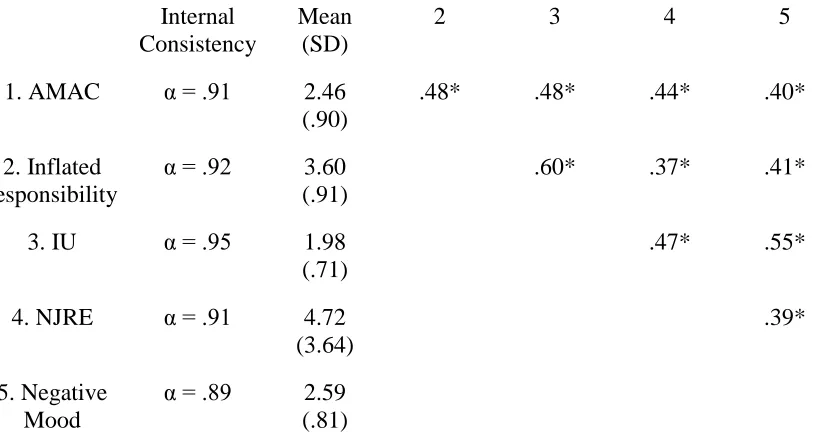
inflated responsibility, negative mood, NJRE, AMAC stop rules (see table 2 for internal 335
consistency, means and standard deviations on the five scales and correlations between factors). 336
Of note is the fact that all of the items thought to measure a particular construct loaded most 337
strongly onto the factor thought to represent that construct. 338
10 Table 2. Descriptive statistics for the 5 constructs and correlations between factors (n = 370). 340
Internal Consistency
Mean (SD)
2 3 4 5
1. AMAC α = .91 2.46 (.90)
.48* .48* .44* .40*
2. Inflated responsibility
α = .92 3.60 (.91)
.60* .37* .41*
3. IU α = .95 1.98 (.71)
.47* .55*
4. NJRE α = .91 4.72 (3.64)
.39*
5. Negative Mood
α = .89 2.59 (.81)
Note: * p <.001. Two-tailed significance reported. 341
342
3.5: Confirmatory factor analysis 343
A confirmatory factor analysis was performed to directly compare the five factor model 344
and the one factor model. 345
346
The one factor model was specified so that all items loaded directly onto one factor. In 347
the five factor model items were specified to load onto only one of five factors according to the 348
pattern indicated by the five factor solution (i.e. all IU items loading only onto factor 1, or the IU 349
factor, all RAS items loading only onto factor 2, or the inflated responsibility factor, all negative 350
mood PANAS items load only onto factor 3, or the negative mood factor, all NJRE-QR factors 351
loading only onto factor 4, or the NJRE factor, all AMAC CSRQ items loading only onto factor 352
5, or the AMAC factor). In the model all five factors were specified to correlate with one another 353
(as is suggested in table 2). 354
355
This analysis showed the five factor model is a significantly better fit than the one factor 356
model, Δχ² (10) = 4840, p <. 001.The five factor solution is therefore preferred over the one 357
factor solution. 358
359
It should be noted that neither the one factor nor the five factor model were an especially 360
good fit to the data using many conventional fit indices, although observation of these indices 361
support the findings of the chi-square test, suggesting that the five factor model is a better fit to 362
11 because a large number of significant pathways were not specified in the models as doing so 364
would have compromised the point of the analysis: to test the relative fit of a one factor vs five 365
factor model. A list of the significant pathways not added to the models by type are: correlations 366
between error terms, correlations between items, correlations between error terms and items (five 367
factor model only), correlations between error terms and latent variables (five factor model only) 368
and correlations between items and latent variables (five factor model only). Values for selected 369
fit indices for the one factor model are: CFI = .51, RMR = .22, RMSEA = .08 with 90% 370
confidence interval .08-.09. Values for selected fit indices for the five factor model are: CFI = 371
.79, RMR = .12, RMSEA = .06 with 90% confidence interval .05-.06. 372
373
4: Discussion
374
The analyses reported in this paper demonstrate that inflated responsibility, IU, NJRE, 375
AMAC stop rules and negative mood are best seen as five separate variables rather than as 376
indicators of an underlying superordinate variable or variables. The exploratory factor analysis 377
suggested two plausible factor structures, one where all construct items and negative mood items 378
loaded onto one underlying superordinate variable, and a second structure comprising of 5 379
factors, where each item loaded onto a factor representative of what the item was originally 380
intended to measure (i.e. all IU items loading only onto factor 1, or the IU factor, all RAS items 381
loading only onto factor 2, or the inflated responsibility factor etc). A confirmatory factor 382
analysis showed that the five factor model was preferential to the one factor model, suggesting 383
the four constructs and negative mood are best conceptualised as separate variables. 384
385
The results of the present study are therefore not supportive of a motivational systems 386
approach in relation to explaining the relationships between constructs related to OC symptoms 387
and negative mood (Britton & Davey, 2014). Such an approach would suggest that, as the 388
constructs measured and negative mood are highly coordinated and interdependent within the 389
relevant threat management system, they should all load onto one superordinate variable 390
representative of that threat management system. Rather, the results of the present study suggest 391
the four constructs and negative mood are separable and therefore support the fact that each of 392
the clinical constructs are generallydiscussed, measured and manipulated separately from each 393
other within the OCD literature. The results are also supportive of those theories which suggest 394
that the constructs are separable, for example, Summerfeldt’s (2004, 2007) model of OCD which 395
proposes two dimensions to explain the motivational processes important to the development and 396
maintenance of OCD: harm avoidance (as characterised by inflated responsibility) and 397
incompleteness (as characterised by NJRE). In addition, the results of the present study are 398
supportive of those theories which suggest that clinical constructs and negative mood are 399
separable, for example, Salkovskis et al’s (2000) model which suggests that inflated 400
responsibility and negative mood are separate but causally interrelated variables which both 401
increase the occurrence of intrusive thoughts. Cognitive treatments for OCD and anxiety 402
disorders are often based on addressing the types of clinical constructs measured in the current 403
paper (e.g., inflated responsibility, Kohlenberg & Vandenberghe, 2007; IU, Dugas & Ladouceur, 404
2000). The results of the present study support the idea that it possible to separately address the 405
clinical constructs measured in the current study in the treatment of OCD and anxiety disorders. 406
12 The finding that the constructs measured and negative mood seem to be separable rather 408
than indicators of a core underlying variable raises a question: how do we explain bidirectional 409
causal relationships between negative mood with constructs related to OC symptoms, and the 410
bidirectional relationship between constructs themselves (e.g., Britton & Davey, 2014), if they 411
are not indictors of one superordinate variable? 412
413
One possibility is that although constructs related to OC symptoms and negative mood 414
are unique and separable entities they are entities which to some extent overlap with one another, 415
as indicated by the fact that all four constructs measured in the current study and negative mood 416
appear to correlate moderately with one another. As such, the manipulation of one construct or 417
negative mood will have a causal influence on other constructs measured (or negative mood), 418
due to the overlapping relationship between the relevant constructs and negative mood. 419
420
Another possibility is that that while constructs related to OC symptoms and negative 421
mood represent unique and separable entities, they are all connected to a third variable which 422
mediates the relationship between them. One potential candidate for mediating the relationship 423
between inflated responsibility, IU and negative mood (Britton & Davey, 2014) is that all three 424
constructs affect information processing style, and in particular trigger systematic processing of 425
information. Systematic processing is a bottom-up, data-driven and comprehensively analytic 426
style in which perceivers access and scrutinize all informational input for its relevance and 427
importance to their judgement, and integrate all information in forming their judgement (Chaiken 428
et al., 1989). Negative mood has been shown experimentally to facilitate systematic processing 429
(Ambady & Gray, 2002; Batra & Stayman, 1990; Tiedens & Linton, 2001) as have a range of 430
situational and dispositional factors including responsibility, accountability, desire for control, 431
personal relevance and task importance (Chaiken et al., 1989; Maheswaran & Chaiken, 1991; 432
Lee et al., 1999; Ambady & Gray, 2002; Batra & Stayman, 1990; Tiedens & Linton, 2001; 433
Sorrentino et al., 1988) and many of these factors are likely to be enhanced by feelings of 434
inflated responsibility and IU. For example, feelings of IU have been linked to increases in desire 435
for control (Krohne, 1993) whilst increases in inflated responsibility are likely to lead to an 436
increased sense of task importance (Salkovskis, 1985). Negative mood in particular provides 437
information that characterises a situation as problematic and fosters the spontaneous adoption of 438
a systematic, detail-oriented, bottom-up processing style (Schwarz, 1990). Increasing feelings of 439
responsibility will also signal a situation as problematic and foster systematic processing 440
(Chaiken et al., 1989) – but only if the outcomes for which the individual feels responsible are 441
appraised as having potentially harmful or threatening outcomes, a characteristic typical of the 442
OC explanatory construct of inflated responsibility (Salkovskis, 1985). An increase in IU will 443
increase the desire for control (Krohne, 1993) and this in turn will also foster systematic 444
processing (Maheswaran & Chaiken, 1991). Thus, inflated responsibility, IU and negative mood 445
are all factors that potentially have an integrated relationship with a specific information 446
processing style which may explain the bidirectional causal relationships between them. 447
Activation of that common processing style through increases in inflated responsibility, IU or 448
negative mood, respectively, is likely to lead to an increase in scores on the other two constructs, 449
as all three constructs are associated with increases in systematic processing. It is also of note 450
13 processing style, even under conditions that non-OCD participants use a speed-oriented
452
information processing style (Soref et al., 2008; Kalanthroff et al., 2014). 453
454
Whilst the four constructs measured in the current study and negative mood appear to be 455
separate variables, the fact that one factor explained a good deal of shared variance between the 456
four constructs and negative mood in the exploratory factor analysis is of note. Whilst this factor 457
may have simply been artifact of shared method variance, it is possible it maybe representative 458
of a core genetic/biological deficit underlying OC symptoms (e.g., Maia et al., 2008) or anxiety 459
related problems more generally (e.g., Norrholm & Ressler, 2009). 460
461
Finally, the present study has a number of limitations. First, given a primarily student 462
sample was used in the present study, it is not clear how generalisable the conclusions of this 463
study are to a clinical population. It should be noted that taxometric studies have suggested that 464
OC related symptoms are generally best considered as dimensional rather than categorical (e.g., 465
Haslam et al., 2005) and many cognitive models of OC symptoms follow a dimensional model 466
(e.g., Frost & Steketee, 2002) supporting the appropriateness of studying OC related phenomena 467
in student samples. However, the validity of the results presented in this paper would be 468
strengthened if they were replicated within a clinical sample. Second, the present study measured 469
only 4 constructs, and negative mood, and as such did not measure a number of other constructs 470
that have been linked to OC symptoms (e.g., thought-action fusion, Rachman, 1993). Whilst this 471
was done as we wished to include only those constructs which have been connected causally 472
through experimental manipulation, it should be noted that the inclusion of other constructs may 473
have led to a different factor structure emerging in the current study. A related limitation of the 474
present study is that OC symptoms and anxiety symptoms which have been linked to the 475
constructs measured in the current study (e.g., worry) were also not measured. Again, the 476
inclusion of OC symptoms and symptoms related to other disorders may have led to a different 477
factor structure emerging in the current study. Finally, only self-report measures were used in the 478
current study. Whilst noting the limitations associated with self-report measures, the authors’ 479
would comment that the constructs measured in the current study are almost exclusively 480
measured by self-report in the wider OC literature, and so measurement of these constructs in 481
this study is consistent with other research in this field. 482
483
Conflict of Interest Statement 484
The authors declare that the research was conducted in the absence of any commercial or 485
financial relationships that could be construed as a potential conflict of interest. 486
487
References 488
Ambady, N., & Gray, H. M. (2002). On being sad and mistaken: Mood effects on the accuracy of 489 thin-slice judgments. Journal of Personality & Social Psychology, 83(4), 947-961.
14 Batra, R., & Stayman, D.M. (1990), The Role of Moods in Advertising Effectiveness, Journal of 491
Consumer Research, 17, 203-214. 492
Beech, H. R., & Liddell, A. (1974). Decision-making, mood states and ritualistic behaviour 493 among obsessional patients. In H. R. Beech (ed.), Obsessional States (pp. 143-160). London: 494
Methuen. 495
Birrell, J., Meares, M., Wilkinson, A., & Freeston, M. (2011). Toward a definition of intolerance 496 of uncertainty: a review of factor analytical studies of the Intolerance of Uncertainty Scale. 497
Clinical Psychology Review, 31, 1198-1208. 498
Britton, G. I., & Davey, G. C. L. (2014). Interrelationships between negative mood and clinical 499 constructs: a motivational systems approach. Frontiers in Psychology, 5, 393.
500
501 Buhr, K., & Dugas, M. J. (2002). The Intolerance of Uncertainty Scale: psychometric properties of the English version. Behaviour Research and Therapy, 40, 931–945.
502
Catell, R. B. (1966). The scree test for number of factors. Multivariate Behavioural Research, 1, 503 245–276.
504
Chaiken, S., Liberman, A., & Eagly, A. H. (1989). Heuristic and systematic information 505 processing within and beyond the persuasion context. In J. S. Uleman & J. A. Bargh. (Eds.), 506
Unintended thought. New York: Guilford. 507
Coles, M. E., Frost, R. O., Heimberg, R. G., & Rheaume, J. (2003). “Not just right experiences”: 508 perfectionism, obsessive–compulsive features and general psychopathology. Behaviour Research 509
and Therapy, 41, 681–700. 510
Coles, M.E., Heimberg, R. G., Frost, R. O., & Steketee, G. (2005). Not just right experiences and 511 obsessive–compulsive features: experimental and self-monitoring perspectives. Behaviour 512
Research and Therapy, 43, 153–167. 513
Crawford, J. R., & Henry, J. D. (2004). The Positive and Negative Affect Schedule (PANAS): 514 Construct validity, measurement properties and normative data in a large non-clinical sample. 515
British Journal of Clinical Psychology, 43, 245-265. 516
Dash, S. R., & Davey, G. C. L. (2012). An experimental investigation of the role of negative 517 mood in worry: The role of appraisals that facilitate systematic information processing. Journal 518
of Behavior Therapy and Experimental Psychiatry, 43, 823-831. 519
Davey, G. C. L. (2003). What is interesting isn’t always useful. Psychologist, 16, 412–416. 520 Dugas, M. J., & Ladouceur, R. (2000). Treatment of GAD. Targeting intolerance of uncertainty 521
in two types of worry. Behaviour Modification, 24, 635-657. 522
Field, A. P. (2009). Discovering Statistics using SPSS. (3rd ed.). London: Sage. 523
Freeston, M. H., Rheaume, J., Letarte, H., Dugas, M. J., & Ladouceur, R. (1994). Why do people 524 worry? Personality and Individual Differences, 17, 791–802.
15 Frijda, N. H. (1986). The emotions. London: Cambridge University Press. 526
Frost, R. O., & Steketee, G. (Eds.). (2002). Cognitive approaches to obsessions and 527 compulsions: Theory, assessment, and treatment. Amsterdam: Pergamon.
528
Haslam, N., Williams, B. J., Kyrios, M., McKay, D., & Taylor, S. (2005). Subtyping obsessive-529 compulsive disorder: A taxometric analysis. Behavior Therapy, 36, 381-391.
530
Hirt, E., Melton, R., McDonald, H., & Harackiewicz, J. (1996) Processing goals, task interest, 531 and the mood–performance relationship: A mediational analysis. Journal of Personality and 532
Social Psychology, 71, 245–261. 533
Kalanthroff, E., Anholt, G. E., & Henik, A. (2014). Always on guard: test of high vs. low control 534 conditions in obsessive-compulsive disorder patients. Psychiatry Research, 219, 322-328.
535
Keltner, D., Haidt, J., & Shiota, M. N. (2006). Social functionalism and the evolution of 536 emotions. In M. Schaller, J. A. Simpson, & D. T. Kenrick (Eds.), Evolution and social 537
psychology (pp. 115-142). New York: Psychology Press. 538
Kenrick, D. T., Griskevicius, V., Neuberg, S. L., & Schaller, M. (2010). Renovating the pyramid 539 of needs: Contemporary extensions built upon ancient foundations. Perspectives on
540
Psychological Science, 5, 292-314. 541
Kenrick, D. T., & Shiota, M. N. (2008). Approach and Avoidance Motivation(s): An 542
Evolutionary Perspective. Handbook of Approach and Avoidance Motivation. Psychology Press. 543
Kline, R. B. (2005). Principles and Practice of Structural Equation Modeling (2nd ed.). New 544 York: Guilford.
545
Koerner, N., & Dugas, M. J. (2006). “A cognitive model of generalized anxiety disorder: the role 546 of intolerance of uncertainty,” in Worry and Its Psychological Disorders: Theory, Assessment 547
and Treatment, eds G. C. L. Davey and A. Wells (Chichester: John Wiley and Sons, Ltd), 201– 548
216. 549
Kohlenberg, R. J., & Vandenberghe, L. (2007). Treatment-resistant OCD, inflated responsibility, 550 and the therapeutic relationship: two case examples. Psychology and Psychotherapy: Theory, 551
Research and Practice, 80, 455-465. 552
Krohne, H. W. (1993). Vigilance and cognitive avoidance as concepts in coping research. In: H. 553 W. Krohne (Ed.), Attention and avoidance: strategies in coping with aversiveness (pp. 19–50). 554
Seattle: Hogrefe & Huber. 555
Ladouceur, R., Gosselin, P., & Dugas, M. J. (2000). Experimental manipulation of intolerance of 556 uncertainty: A study of a theoretical model of worry. Behaviour Research and Therapy, 38, 933-557
941. 558
Ladouceur, R., Rheaume, J., Freeston, M.H., Aublet, F., Jena, K., Lachance, S., et al. (1995). 559 Experimental manipulations of responsibility: An analogue test for models of obsessive-560
16 Lee, H., Herr, P.M., Kardes, F.R., & Kim, C. (1999). Motivated search: effects of choice 562
accountability, issue involvement, and prior knowledge on information acquisition and use. 563
Journal of Business Research, 45, 75-88. 564
Lind, C., & Boschen, M. J. (2009). Intolerance of uncertainty mediates the relationship between 565 responsibility beliefs and compulsive checking. Journal of Anxiety Disorders, 23, 1047–1052. 566
MacDonald, C. B., & Davey, G. C. L. (2005). A mood-as-input account of perseverative 567 checking: The relationship between stop rules, mood and confidence in having checked 568
successfully. Behaviour Research and Therapy, 43, 69-91. 569
Maheswaran, D. & Chaiken, S. (1991). Promoting Systematic Processing in Low-Motivation 570 Settings: Effect of Incongruent Information on Processing and Judgment. Journal of Personality 571
and Social Psychology, 61, 13-25. 572
Maia, T. V., Cooney, R. E., & Peterson, B. S. (2008). The neural bases of obsessive-compulsive 573 disorder in children and adults. Developmental and Psychopathology, 20, 1251–1283.
574
Neuberg, S. L., Kenrick, D. T., & Schaller, M. (2011). Human threat management systems: Self-575 protection and disease-avoidance. Neuroscience & Biobehavioral Reviews, 35, 1042-1051. 576
Norrholm, S. D., & Ressler K. J. (2009). Genetics of anxiety and trauma-related disorders. 577 Neuroscience, 164, 272–287.
578
Obsessive Compulsive Cognitions Working Group (1997). Cognitive assessment of obsessive-579 compulsive disorder. Behaviour Research and Therapy, 35, 667–681.
580
Rachman, S. (1993). Obsessions, responsibility and guilt. Behaviour Research and Therapy, 31, 581 149-154.
582
Rachman, S. (1998). A cognitive theory of obsessions: elaborations. Behaviour Research and 583 Therapy, 36, 385-401.
584
Salkovskis, P. M. (1985). Obsessional-compulsive problems: a cognitive-behavioural analysis. 585 Behaviour Research and Therapy, 16, 233–248.
586
Salkovskis, P. & Freeston, M. H. (2001). 'Obsessions, compulsions, motivation, and 587
responsibility for harm', Australian Journal of Psychology, 53, 1-6. 588
Salkovskis, P.M., Wroe, A.L., Gledhill, A., Morrison, N., Forrester, E., Richards, C., et al. 589 (2000). Responsibility attitudes and interpretations are characteristic of obsessive compulsive 590
disorder. Behaviour Research and Therapy, 38, 347–372. 591
Schwarz, N. (1990). Feelings as information: Informational and motivational functions of 592 affective states. In E.T. Higgins & R. Sorrentino (Eds.), Handbook of motivation and cognition: 593
Foundations of social behavior (Vol. 2, pp. 527-561). New York: Guilford Press. 594
Soref, A., Dar, R., Argov, G., & Meiran, N. (2008). Obsessive-compulsive tendencies are 595
associated with a focused information processing strategy. Behaviour Research and Therapy, 46, 596
17 Sorrentino, R. M., Bobocel, C. R., Gitta, M. Z., Olson, J. M., & Hewitt, E. C. (1988). 598
Uncertainty orientation and persuasion: Individual differences in the effects of personal 599
relevance on social judgments. Journal of Personality and Social Psychology, 55, 357-371. 600
Startup H.M. & Davey G.C.L. (2003). Inflated responsibility and the use of stop rules for 601 catastrophic worrying. Behaviour Research and Therapy, 41, 495–503.
602
Steketee, G., Frost, R. O., & Cohen, I. (1998). Beliefs in obsessive-compulsive disorder. Journal 603 of Anxiety Disorders, 12, 525-537.
604
Summerfeldt, L. J. (2004). Understanding and treating incompleteness in obsessive-compulsive 605 disorder. Journal of Clinical Psychology, 60, 1155-1168.
606
Summerfeldt, L. J. (2007). Treatment in completeness, ordering, and arranging concerns. In: M. 607 M. Antony, C. Purdon, & L. J. Summerfeldt (Eds.), Psychological treatment of obsessive– 608
compulsive disorder: fundamentals and beyond (pp. 187–207). Washington, DC: American 609
Psychological Association. 610
Tiedens, L. Z., & Linton, S. (2001). Judgment under emotional certainty and uncertainty: The 611 effects of specific emotions and their associated certainty appraisals on cognitive processing. 612
Journal of Personality and Social Psychology, 81, 973-988. 613
Toffolo, M. B. J., van den Hout, M. A., Hooge, I. T. C., Engelhard, I. M., & Cath, D. C. (2013). 614 Mild uncertainty promotes checking behaviour in subclinical obsessive–compulsive disorder. 615
Clinical Psychological Science, 1, 103–109. 616
Vaughn, L.A., Malik, J., Schwartz, S., Petkova, Z., & Trudeau, L. (2006). Regulatory fit as input 617 for stop rules. Journal of Personality and Social Psychology, 91, 601-611.
618
Watson, D., Clark, L. A., & Tellegen, A. (1988). Development and validation of brief measures 619 of positive and negative affect: The PANAS Scales. Journal of Personality and Social
620
Psychology, 47, 1063–1070. 621
622 Yorulmaz, O., Karanci, A. N., & Tekok-Kılıc¸, A. (2002). Inflated responsibility in obsessive-compulsive symptomatology. Presentation in the XII. National Psychology Congress.