Rehabilitation and treatment of a recreational
golfer with hip osteoarthritis: a case report
Emily R. Howell, BPHE(Hons), DC, FCCPOR(C)*
Objective: This case study reviews the conservative
chiropractic treatment of hip osteoarthritis (OA) and the prescription of a rehabilitation program for a recreational golfer.
Clinical features: A 49-year-old registered nurse/ college instructor presented with a five year history of left hip OA and pain, recent right hip pain and occasional low back stiffness. Once her symptoms improved, a golf-specific functional rehabilitation program was prescribed in preparation for the upcoming golf season.
Intervention and Outcome: The initial treatment included ultrasound, soft tissue and myofascial therapy, mobilizations, acupuncture and home advice. Rehabilitative exercises included core and scapular stability exercises, general conditioning, golf specific stretches, functional swinging, proprioceptive and strengthening exercises, and referral to a swing coach. The positive outcomes included increased ranges of motion, decreased pain, as well as improvements in golf driving distance and endurance.
Summary: Conservative management and golf-specific
* Ashbridge’s Health Centre, 1522 Queen St. East, Toronto, ON M4L 1E3. E-mail: [email protected].
© JCCA 2012
Objectif : La présente étude de cas porte sur le
traitement chiropratique conservateur de l’arthrose de la hanche et la prescription d’un programme de réadaptation pour une golfeuse récréative.
Caractéristiques cliniques : Une infirmière et enseignante au collège de 49 ans présente depuis cinq ans de l’arthrose et de la douleur à la hanche gauche, et, depuis récemment, de la douleur à la hanche droite et des raideurs lombaires occasionnelles. Une fois ses symptômes atténués, un programme de réadaptation adapté aux golfeurs lui a été prescrit en prévision de la saison de golf qui approchait.
Intervention et résultat : Le traitement initial
comprenait des ultrasons, de la thérapie myofasciale et pour tissus mous, des mobilisations, de l’acupuncture et des conseils sur le domicile. Les exercices de réadaptation suivants ont été, entre autres, prescrits : exercices de stabilisation du tronc et du scapulaire, conditionnement général, étirements adaptés au golf, élans de golf fonctionnels, exercices de proprioception et de renforcement, et orientation vers un entraîneur d’élan de golf. Parmi les résultats favorables se trouvent l’amélioration de l’amplitude des mouvements, une atténuation de la douleur ainsi que l’amélioration de l’endurance et de la distance parcourue par la balle de golf au coup de départ.
rehabilitation prescription appears to be beneficial for hip OA and recreational golf performance in this case.
(JCCA 2012; 56(3):201-208)
k e y w o r d s : low back pain, hip osteoarthritis, golf,
rehabilitation, chiropractic, exercise
de la hanche et le rendement au golf dans un contexte récréatif.
(JCCA 2012; 56(3):201-208)
m o t s c l é s : lombalgie, arthrose de la hanche, golf,
réadaptation, chiropratique, exercice
Introduction
The sport of golf has been increasing in popularity in re-cent years and has been shown to increase in frequency of play with age.1 Since golf offers a lower intensity sport
and lacks the risk of physical contact, it is an ideal physical activity for older adults.2 It has been shown that walking
18 holes of golf has been shown to help golfers achieve the recommended 10,000 steps per day, which can lead to associated health benefits.3 Also, golf is a versatile sport
that participants can return to after total hip arthroplasty with less pain and high satisfaction, but postoperative re-habilitation is a major contributor to positive postsurgical golf performance.4,5
Common areas of injury in golfers are in the low back (27-30%), the wrist (18%) and the elbow (25%) and are often due to overuse.2,6,7 It has been demonstrated in
pre-vious studies that the lumbar spine sustains compressive loads of up to eight times one’s body weight during a golf swing.8,9 Inactivity prior to playing, poor posture,
com-bined with poor physical conditioning and poor swing mechanics (such as over-rotating to surpassing their neu-tral pain-free backswing axial rotation position; increased trunk flexion at ball strike and excessive side flexion dur-ing backswdur-ing) have all been shown to predispose golf-ers to getting low back pain.2,5,8 Golfers who have low
back pain demonstrate earlier activation (before back-swing commences) and less activity of the erector spinae muscles, as well as well as a delay to the onset time in the external obliques with the start of the back swing and a delay and decreased endurance capacity in transverses abdominus activation.2,5,6,8,10 A large difference in lateral
endurance testing of golfers (more than a 12.5 second difference between sides), a BMI lower that 25.7 kg/m2,
and shortened hip flexors have also been shown to lead to low back injury in professional golfers in a longitudinal
study.8 Types of low back pain reported in golfers include
mechanical lower back pain, sacroiliac joint dysfunction, disc herniation, spondylolysis and vertebral compression fractures.2,5,9 Hip osteoarthritis or dysfunction has been
theorized to play a contributing role in mechanical low back, since it can lead to decreased internal lead hip rota-tion during the swing phase, leading more forces to over-stress the lumbar spine.2,8 Restriction of the lead side hip
internal rotation and lumbar extension (which may lead to increased force being transmitted to the lumbar spine) have been shown in golfers with a history of low back pain.5
Chiropractors reported in 2010 that 25.6% of their pa-tients present with the low back/pelvis as their chief com-plaint and 9.4% with the lower extremity as their chief complaint.11 Therefore, this case report deals with
condi-tions that are relevant to most chiropractic practices. The purpose of this case report is to describe the successful management of a patient with hip osteoarthritis and to present a rehabilitative program for golfers.
Case report
pain started deep in the groin region and referred laterally into the gluteal region and was worse at night, with some short term stiffness in the morning. She rated the pain as a 4-7/10 (10 being the worst pain she had ever experi-enced), depending on the activities she was performing. She described it as constantly stiff and “throbbing” in cer-tain positions. Aggravating factors included getting out of a car, sitting with her knees up, stepping off a curb, stair climbing and after long walks (which resolved after 2-3 days). She reported that rest and ibuprofen relieved the hip pain. She explained that the pain “came and went” depending on her activities. She documented that she took Advair and Ventolin for her asthma, Venlafaxine for her menopause related night sweats and hot flashes, as well as calcium, vitamin D, Omega 3 fatty acid, and a high fiber supplement (PGX) for weight loss. She stated that she was normally active by using an elliptical machine at the gym, as well as playing golf frequently. She reported that her diet was “average”, that she was a non-smoker and that she drank alcohol occasionally in moderation. She stated she slept “well” with 6 to 8 hours per night, but that it was interrupted because of her left hip pain. Previous accidents included a bike accident which led to a cervical spine injury and contusions, as well as a motor vehicle collision as a pedestrian which led to knee contusions. Previous surgery included the removal of her left ovary. She had been previously diagnosed with asthma and her relevant family history included breast cancer, thyroid conditions, hypertension and osteoporosis. Her systems review revealed that she wore reading glasses and that she had a history of migraine headaches. The review of red flags was unremarkable. The review of her psychosocial history revealed that she was married and had no children. Other complaints included bilateral foot pain (on the ball of the foot and first metatarsal), occasional low back stiff-ness and that she was attempting to lose weight.
The physical examination revealed a mild limp and favoring of the right leg. The lumbar ranges of motion were full and pain free. Hip ranges of motion revealed de-creased internal rotation bilaterally (more on the left) and decreased external rotation on the left. Active hip exten-sion testing revealed weak deep abdominals bilaterally. Active hip abduction testing revealed weak bilateral glu-teal muscles (as well as tight iliotibial bands and tensor fascia lattae). Ranges of motion and joint play in the first metatarsals were reduced bilaterally and the patient
re-ported tenderness at the base and lateral aspect of the first and the base of the second metatarsals bilaterally. Soft tis-sue palpation revealed tight and tender bilateral gluteal, tensor fascia latta, iliopsoas, piriformis (more left than right sided), hamstrings, gastrocnemius, first metatarsal plantar flexors, lumbar erector spinae and quadratus lum-borum muscles. Compression of the left hip aggravated the patient’s symptoms and traction relieved it. Positive orthopedic tests include: bilateral Thomas (supine, knee to chest which reproduced the hip pain), Obers (side lying, top leg is abducted and then released to adduct passively with gravity, tight bilateral iliotibial bands cause the thigh not to adduct) and bilateral Hibbs (prone, internally ro-tate hip; this was reduced bilaterally and reproduced hip pain).12,13 The neurological examination lower limbs was
unremarkable.
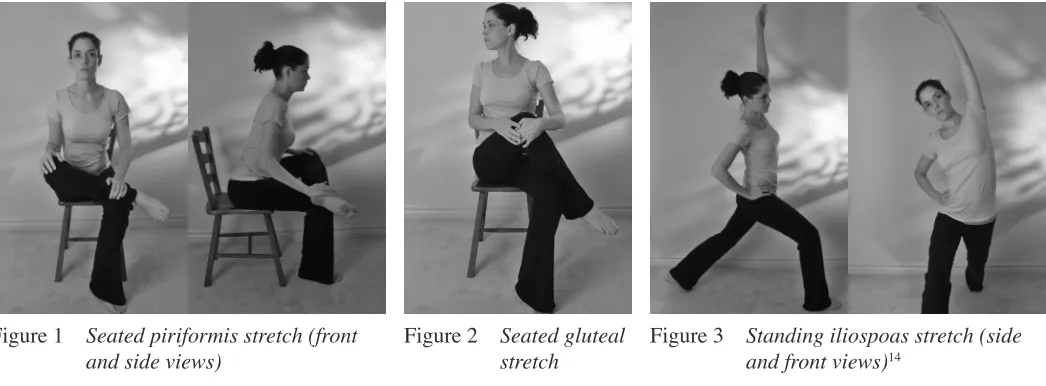
The differential diagnoses included left hip osteoarth-ritis; right hip bursitis or osteoarthosteoarth-ritis; bilateral myofa-scial strain; bilateral metatarsalgia (secondary to myo-fascial strain) and myomyo-fascial strain of the musculature of the lower back (secondary to muscular imbalance and weakness). The prognosis was rated as moderate, since osteoarthritis is degenerative in nature. The plan of man-agement included ultrasound, soft tissue and myofascial release therapy, mobilizations (of the lumbar spine, and the first and second metatarsals) and hip traction mobil-izations (using a Mulligan belt), and acupuncture. Home care recommendations included stretching (see figures 1-3 & table 1), deep abdominal bracing, home heat and icing, topical anti-inflammatory cream (Muscle Care cream®),
ibuprofen (recommended by her MD), good supportive shoes (avoiding high heeled shoes and wearing newer running shoes to increase shock absorption), getting up regularly from sitting and increasing her cardiovascular exercise gradually (low weight bearing, such as cycling or swimming). Treatment was rendered on the first visit according to the plan of management.
Table 1 Rehabilitative exercises prescribed
Visit # Prescribed Exercises
1 Stretches: priformis, gluteals and iliopsoas muscles (see figures 1-3)14
Deep abdominal bracing 14
General cardiovascular exercises/conditioning: 3-4 days per week, working up to 30 minutes.
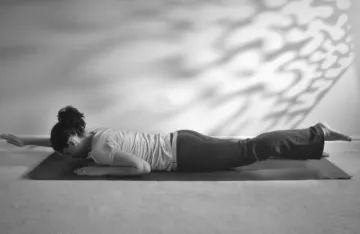
8 Modified curl up, side bridge and modified bird dogs: to be performed daily with a neutral spine, deep abdominal activation and 8-10 second endurance-aimed holds (with adding more repetitions within her tolerance; see figures 4-6).14
10 Proprioceptive exercises: progressing from eyes open to eyes closed, two legged to one legged and two-directional rocker to multitwo-directional wobble board.
12 Scapular stability exercises: external rotation/rotator cuff, push up plus (on the wall since kneeling aggravated her knees) and scapular retractions (standing with a theraband) , twice per week, with 10-12 repetitions working up to 2-3 sets (see figures 7-9).15
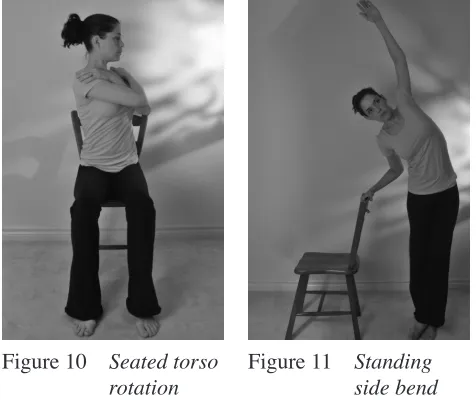
Golf specific stretches: seated torso rotation (to later add a club behind her head) and standing side bends (see figures 10 & 11).16
13 Functional swinging and strengthening exercises: bicep curls, wall squats, resisted backswings, downswings and through swings (increasing resistance band tension slowly) with 10-15 repetitions, working up to 3 sets and 2 seconds in each direction.6,16
Figure 1 Seated piriformis stretch (front
and side views) Figure 2 Seated gluteal stretch Figure 3 Standing iliospoas stretch (side and front views)14
Table 2 Core exercise testing results
Exercise tested Initial testing (visit 8) Subsequent testing (visit 15)
Modified curl up 1 minute 37 seconds 2 minutes 47 seconds
Right side bridge 1 minute 2 seconds 1 minute 5 seconds
Left side bridge 51 seconds 1 minute 35 seconds
was only aggravated with long distance walking and pro-longed sitting and for one night at a time, and that is was quickly relieved with ibuprofen. The left hip pain eventu-ally dissipated and she was left with occasional right hip pain which she described as “achy”. By the sixth visit she reported the left hip was “great” and that she only had very mild morning stiffness in the right hip (related to sleeping on her right side all night). The next visit she re-ported both hips were “great” and mild lower back tight-ness. She stated that the recommendation of abdominal bracing really helped her lower back discomfort. At this point she requested a rehabilitation program to strengthen her core for the upcoming golf season. On the eighth visit, she reported that her hips were “good”, except for one day after a 9 hour car trip. After demonstration and instruc-tion, initial baseline measurements were taken on this visit for “back safe” core stability exercises (see tables 1 & 2).14 The bird dog was modified to a prone position
be-cause the patient had difficultly kneeling due to previous knee injuries. The patient was then instructed to do these exercises at home.14
The treatments were extended to once every 1.5-2.0 weeks. The patient reported that core exercises were help-ing her lower back and that her hips continued to main-tain the improvement. She reported that she had increased the number of exercise repetitions and that she felt she was getting “stronger”. On her tenth visit, she was able to walk longer distances without pain. Proprioceptive rocker board exercises were added. She reported enjoying the balance and “core” exercises since she felt they seemed to decrease her lower back stiffness. On the twelfth visit, she reported her left hip was pain free and the right hip had only lateral muscle pain. She reported progressing to one-legged balance exercises and a multidirectional balance board from a two-directional rocker board. She continued the core exercises daily. At this point, scapular stability exercises and golf specific stretches were also added (see figures 7-11 and table 1).15,16
Visits were staggered to once every two weeks and the patient reported only occasional pain that was relieved by ibuprofen. The patient reported performing the one-legged balance exercises more frequently. Functional swinging and strengthening exercises were added on this visit (see table 1).6,16 On the fourteenth visit, she reported that both
hips were virtually pain free and that she had also lost five pounds in two weeks after joining Weight Watchers®
pro-Figure 4 Modified curl up
Figure 5A Side bridge (beginner on knees)
Figure 5B Side bridge (advanced on feet)
gram online. She reported using the balance board daily on one leg, as well as preforming the upper body and core exercises on alternate days. She stated that the wall squats aggravated her knee pain, but that she had started “car-dio boxing” at home 20 minutes daily which she felt was strengthening her upper body. She also reported that she had taken a lesson with a golfing professional. The golf-ing professional also noted how “balanced” she was and gave her a few corrections for her swing performance (i.e. not shortening at the end range) and a golf “drill” to work on.
Her next visit, 2 ½ weeks later, she reported no hip pain on the left side and only very low grade “ache” on the right side. She also stated that her low back felt “good”. On this visit, the core exercises tests were repeated (see table 2). Due to the outcome, she was given directions to increase her focus on the right sided side bridge and right arm/left leg bird dogs. Overall she reported doing her exercises regularly. She stated that she would be trav-elling for a golf trip for the following month for 10 days and was then advised to do a 5-10 minute warm up before each game and to stretch afterwards.
On follow-up 6 months later, the patient reported golf-ing for a week, durgolf-ing which her left hip was pain free and she had improvements in her endurance and driv-ing distance. She later golfed 15 times in the first half of the summer season and reported improvements of 10-14 yards driving distance overall. A referral to her family doctor was suggested to investigate the symptoms in her right hip, since her left hip was now pain free. The patient chose to return for monthly care to maintain her current positive results and get assistance with her exercise pro-gressions.
Discussion
Research has demonstrated that highly proficient golf-ers have greater hip and torso strength (which provide a solid base of support), increased shoulder, hip and torso flexibility (to help improve driving distance) and balance (allowing the body to adapt to different terrains and main-tain good position over the body’s base of support) than golfers who do not perform as well on the golf course.17,18
Static and dynamic balance (including one leg stance, one leg perturbed stance and lunging) has been shown to be better in older golfers when compared with nongolfing healthy adults, which researchers have associated with Figure 7 Shoulder external rotation/rotator cuff
exercise
Figure 8 Wall push-up plus
Figure 9 Scapular retraction
Figure 10 Seated torso
walking on uneven golfing surfaces and the transfer from two to one-legged stances that is often required in golf.19
It has also been documented that better golfers have higher club head velocity, higher ball launch angle, lower standard deviation of ball velocity and faster body-twist angular velocity.16 Golf specific training programs have
been given to athletes and have been shown to improve performance and prevent injuries.17
It has been shown that strength increases up to one’s early 20’s, plateaus until their 50’s and then starts to de-cline by 10% per decade (mostly due to a decrease in muscle mass).5 Golf performance also has a similar
pat-tern, since recreational golfers tend to peak in their 30’s and start to decrease in their performance in their 40’s.5
This is why a conditioning program is so important for older participants to follow, since previous studies have demonstrated gains in strength and club head speed with relatively short training periods.5
Golf-specific functional rehabilitation and proper swing mechanics instruction have been recommended as part of a treatment and prevention plan for golfers with low back pain.2,6,16 These recommendations include spinal
stabiliza-tion exercises to activate the transversus abdominus and multifidus muscles, transitioning to a more classic swing (by shortening their backswing to decrease low back strain without affecting performance or moving to a two-plane swing to minimize hip and trunk separation), aerobic en-durance training to reduce fatigue, balance training, resist-ance exercises, as well as a good warm-up of at least 10 minutes, and flexibility/stretching of affected muscula-ture (which has been shown to decrease injury by up to 60%).2,6,7,8,16,20 Slight activation of the erector spinae, biceps
femoris and gluteus maximus muscles has been shown to assist the transfer of load from spine to legs, which in turn prevents spinal shear.21 McGill has researched many
lumbar spine sparing stabilization exercises using correct techniques and optimal progression.14 When combined
with abdominal bracing the modified curl-up, side bridge and bird dog help to create a “muscular corset” to protect the spine against daily challenges.14 Functional training
has been shown to improve club head speed, ball velocity and driving distance (by increasing upper torso axial rota-tion velocity), as well as improving funcrota-tional fitness in the older golfing population.7,16 Referral to a professional
golf instructor has also been recommended to aid with swing pattern correction.5,8,18
There are many golf-specific training programs that recommend various exercises, such as transversus ab-dominus conditioning, seated thoracic and lumbar rota-tion exercises, hip flexor and lumbar extensor stretching, oblique and core stability.6 Other programs include a
warm up followed by static stretches, spinal stabilization such as: pelvic tilts, floor bridging, floor quadriped, prone abdominals, dynamic abdominal crunches and scapular stability exercises; balance exercises, and strengthening exercises.7 One study recommended bird dog, side planks,
crunches/curl-ups, front planks and later hang twist, lunge twist, prone twist, Roman twist, Russian twist, latissimus dorsi pull downs, Kettle bell squats and standing and seated horizontal throws, as well as pylometrics much later on.8 Other authors have also recommended
focus-ing on groups of conditionfocus-ing exercises, such as stretch-ing, strengthening with elastic tubing (hip abductions and adductions, scapular retractions, resisted backswings and downswings, resisted through-swings) abdominal crunches and balancing.16 A three phase resistance
train-ing program discusses preventtrain-ing “musculoskeletal injur-ies, improve strength and power of the golf swing and increase general fitness”.15 It included trunk stability
exercises, shoulder exercises, strength and power train-ing, resistance training and flexibility training.14,15
Switch-ing from a “modern”golf swSwitch-ing (large shoulder turn with a restricted hip turn, leading to increased lateral bending and exaggerated hyperextension) to a “classic” golf swing (front heel raised during backswing to increase hip turn, shorten the backswing or a combination of both, decreas-ing the lumbar spine torque), along with increasdecreas-ing trunk flexibility has also been shown to assist golfers with low back pain.9
Summary
conservative care and rehabilitation management of hip osteoarthritis and low back pain may help golfers im-prove their performance and prevent further injuries.
Acknowledgements
I would like to thank Dr. Karen Hudes for proof reading and editing this paper and Dr. Erica Mockler for her as-sistance in obtaining some of the references.
References
1. Lindsay DM, Horton JF, Vanderhoort AA. A review of injury characteristics, aging factors and prevention programmes for the older golfer. Sports Med. 2000 Aug; 30(2): 89–103.
2. Reed JJ, Wadsworth LT. Lower back pain in golf: a review. Curr Sports Med Rep. 2010; 9(1): 57–59.
3. Kobriger SL, Smith J, Hollman JH, Smith AM. The contribution of golf to daily physical activity recommendations: How many steps does it take to complete a round of golf? Mayo ClinProc. 2006 Aug; 81(8): 1041–1043.
4. Liem D, Van Fabeck K, Poetzl W, Winkelmann W, Gosheger G. Golf after total hip arthoplasty: a
retrospective review of 46 patients. J Sports Rehabi. 2006; 15: 206–215.
5. Cann AP, Vendervoort AA, Lindsay DM. Optimizing the benefits versus risks of golf participation by older people. J Geriatr PhysTher. 28; 39(5): 85–91.
6. Grimshaw P, Giles A, Tong R, Grimmer K. Lower back and elbow injuries in golf. Sports Med. 2002; 32(10): 655–666.
7. Thompson CJ, Cobb KM, Blackwell J. Functional training improves club head speed and functional fitness in older golfers. J Strength Cond Res. 2007; 21(1): 131–137. 8. Brunitt J, Dale RB. Functional rehabilitation exercise
prescription for golfers. Athl Ther Today. 2008 March; 13(2): 37–41.
9. Gluck G S, Bendo J A,Spivak JM. The lumbar spine and low back pain in golf: a literature review of swing biomechanics and injury prevention. Spine J. 2008; 8: 778–788.
10. Evans C, Oldreive W. A study to investigate whether golfers with a history of low back pain show a reduced endurance of transverses abdominus. J Man ManipTher. 2000; 8(4): 162–174.
11. National Board of Chiropractic Examiners. Practice analysis of chiropractic 2010. Chapter 8: Patient conditions: 95–120.
12. Hoppenfeld S. Physical examination of the spine & extremities. Appleton & Lange, Norwalk, CT, U.S.A., 1976, ISBN 0-8385-7853-5.
13. Vizniak NA. Quick reference: Clinical chiropractic handbook. DC Publishing International, Canada, 2002-2003, ISBN 0-9732742-0–4.
14. McGill SM. Low back disorders: Evidence based
prevention and rehabilitation, Human Kinetics Publishers, Champaign, IL, U.S.A., 2002. ISBN 0-7360-4241-5, Second Edition, 2007.
15. Lehman GJ. Resistance training for performance and injury prevention in golf. J Can Chiro Assoc. 2006; 50(1): 27–42.
16. Lephart SM, Smoliga JM, Myers JB, Sell TC, Tsai Y-S. An eight-week golf-specific exercise program improves physical characteristics, swing mechanics, and golf performance in recreational golfers. J Strength Cond Res. 2007; 21(3): 860–869.
17. Sell TC, Tsai Y-S, Smoliga JM, Myers JB, Lephart SM. Strength, flexibility, and balance characteristics of highly proficient golfers. J Strength Cond Res. 2007; 21(4): 1166–1171.
18. Booth L. A physiotherapy perspective on improving swing technique in a professional golfer: a case study. Phys Ther Sport. 2005; 6: 97–102.
19. Tsang WWN, Hui-Chan CWY. Static and dynamic balance control in older golfers. J Aging Phys Act. 2010; 18: 1–13. 20. Pink M, Perry J, Jobe FW. Electromyographic analysis of
the trunk in golfers. Am J Sports Med. 1993; 21(3): 385– 388.