1
TITLE
1
DNA processing in the context of non-coding transcription
23
AUTHOR NAMES
4
Uthra Gowthaman1,*, Desiré García-Pichardo1,*, Yu Jin1, Isabel Schwarz1, Sebastian
5
Marquardt1, 2
6
* These authors contributed equally 7
AFFILIATION
81 Copenhagen Plant Science Centre
9
Department of Plant and Environmental Sciences 10
University of Copenhagen 11
Bülowsvej 21, 1870 Frederiksberg C 12
Denmark 13
CORRESPONDING AUTHOR
142 [email protected] (Sebastian Marquardt)
15
16
KEYWORDS
17Long non-coding RNA (lncRNA); RNA Polymerase II (RNAPII) transcription; gene regulation; 18
tandem transcriptional interference (tTI); antisense transcription; DNA processing 19
2
ABSTRACT
20
RNA polymerase II (RNAPII) frequently transcribes non-protein coding DNA sequences in 21
eukaryotic genomes into long non-coding RNA (lncRNA). Here, we focus on the impact of 22
the act of lncRNA transcription on nearby functional DNA units. Distinct molecular 23
mechanisms linked to the position of lncRNA relative to the coding gene illustrate how non-24
coding transcription controls gene expression. We review the biological significance of the 25
act of lncRNA transcription on DNA processing, highlighting common themes, such as 26
mediating cellular responses to environmental changes. This review presents the 27
background in chromatin signaling to appreciate examples in different organisms where we 28
can interpret functions of non-coding DNA through the act of RNAPII transcription. 29
30
31
32
33
34
35
36
37
38
39
3
MAIN TEXT
41
The act of non-coding transcription as a source of regulation
42
of nearby DNA elements
43
RNA polymerase II (RNAPII) transcription of non-coding DNA converts large parts of 44
eukaryotic genomes into non-coding RNAs (ncRNAs) [1,2]. Many annotated genes are 45
therefore in close proximity to non-coding transcription, raising the question of how this 46
affects gene expression [3,4]. RNAPII transcribed long non-coding RNAs (lncRNAs) are 47
distinguished from shorter ncRNAs based on their size (> 200 nt) [5]. lncRNA may regulate 48
other transcripts either in cis (near the site of production) or in trans (at a distant genomic 49
location) [6]. Thus far, we distinguish gene regulation through cis-acting lncRNA by two main 50
mechanisms: (i) the function of the resulting lncRNA molecule or (ii) the act of non-coding 51
transcription [7]. In general, lncRNAs are less abundant and less conserved at the sequence 52
level than messenger RNAs (mRNAs) [8]. Gene regulation by the act of lncRNA transcription 53
could reconcile where non-conserved lncRNA in equivalent positions near genes may have 54
similar effects on gene expression in distant species [7]. This review focuses on different 55
molecular mechanisms by which the act of ncRNA transcription affects DNA processing 56
(see Glossary) in cis. We divided ncRNAs according to their genomic location and 57
orientation concerning the target protein-coding genes to encapsulate common mechanistic 58
characteristics. Our review complements other excellent reviews on the functions exerted 59
by lncRNA molecules [9–11] and metazoan enhancers [12] by focusing on how the act of 60
4
Chromatin signaling during RNAPII transcription
62
In eukaryotes, histone proteins package DNA into chromatin with profound effects on 63
transcription. N-terminal tails of histone proteins are dynamically modified with post-64
translational modifications (PTMs) during transcription [13,14]. Histone PTMs contribute to 65
the definition of RNAPII transcription stages, where different pre-RNA processing events 66
execute RNA synthesis [15]. Importantly, chromatin-modifying enzymes are recruited by 67
dynamic phosphorylation of RNAPII and contribute to transcription stage specification 68
[16,17]. 69
Amongst histone PTMs, acetylation (ac) and methylation (me) marks are most thoroughly 70
characterized. Histone acetyltransferases catalyze the acetylation of histones including 71
histone 3 (H3) and histone 4 (H4) [18]. In Saccharomyces cerevisiae, RNAPII carboxy-72
terminal domain-dependent signaling triggers the methylation at H3 lysine (K) 4 and 36 by 73
histone methyltransferases Set1 and Set2 [19–21]. Expressed genes display a 74
characteristic modification profile with H3/H4ac around the transcription start sites (TSSs), 75
H3K4 trimethylation (H3K4me3) around the first nucleosome, and H3K36me3 towards the 76
3’-end [22,23]. Additional histone PTMs reinforce characteristic distribution profiles across 77
genes [24]. The pattern of histone PTMs along genes shares many similarities between 78
species, for example human [25], Drosophila [26], yeasts [23,27] and Arabidopsis [17]. 79
H3K36me3 characterizes RNAPII elongation in multiple organisms [28,29]. One important 80
function of H3K36me3 in budding yeast is the suppression of intragenic transcription 81
initiation [30–32]. Repression of intragenic initiation mediated by H3K36me3 is linked to the 82
Rpd3S histone deacetylase complex (HDAC) and local chromatin remodeling [14,32]. 83
5
Spt6 promote RNAPII elongation through displacement and re-assembly of nucleosomes 85
[33]. During active transcription, FACT and Spt6 function selectively on H2A/H2B and H3 to 86
maintain the dynamic chromatin state [33]. Histone chaperones suppress transcription 87
initiation within transcription units in several organisms, including yeast [34], humans [35] 88
and plants [36]. Generally, lncRNA transcription shares much of the chromatin-based 89
signaling with mRNA transcription [37]. Chromatin signaling associated with RNAPII 90
transcription provides a valuable model for effects of the act of non-coding transcription on 91
DNA biology. Scenarios where lncRNA transcription overlaps functional DNA elements 92
serve as paradigms to illustrate the effects by this model. 93
Tandem Transcriptional Interference
94
Transcriptional interference (TI) defines the direct suppressive effect of RNAPII transcription 95
in cis from one transcription unit overlaying a second transcription unit [38]. Transcription 96
from a non-coding transcript can trigger TI to regulate a protein-coding gene located 97
downstream in tandem [39]. In this section, we review common molecular mechanisms of 98
TI into downstream genes by defined non-coding transcription events upstream in tandem 99
(referred to as tTI). While we note tantalizing connections to the inhibition of downstream 100
TSSs by gene isoforms initiating further upstream, these interactions between transcripts 101
with coding potential fall outside the scope of this review [40–43]. 102
Interplay between chromatin-modifying complexes and transcription factors in tTI
103
The local chromatin environment influences RNAPII transcription. Chromatin-based 104
signaling mechanisms during gene transcription appear central for tTI across eukaryotes 105
[17]. A prevalent tTI mechanism in yeast involves the deposition of transcription-coupled 106
6
instance, tTI by two lncRNAs, IRT1 and IRT2, controls cell-type based regulation of IME1
108
expression determining sexual differentiation in budding yeast [47]. IRT1 tTI triggers Set2-109
dependent H3K36me3 and Set3-dependent HDAC activity to repress IME1 initiation in 110
haploids. IRT2, a second lncRNA upstream of IRT1, in turn represses IRT1 by tTI to promote 111
IME1 expression [45]. Likewise, a toggle-switch mechanism between two lncRNA transcripts 112
(ICR1 and PWR1) influenced by competitive binding of transcription factors, regulates the 113
budding yeast FLO11 gene affecting cell adhesion and flocculation [48,49]. The act of ICR1
114
transcription represses FLO11 by tTI and the expression of antagonistic lncRNA PWR1
115
alleviates the repression. In fission yeast, lncRNA transcription upstream of the tgp1+ and
116
pho1+ metabolite transporter genes deposits H3K36me3 that recruits HDAC to repress
117
RNAPII initiation [44]. FACT participates in tTI by mediating reduced transcription factor 118
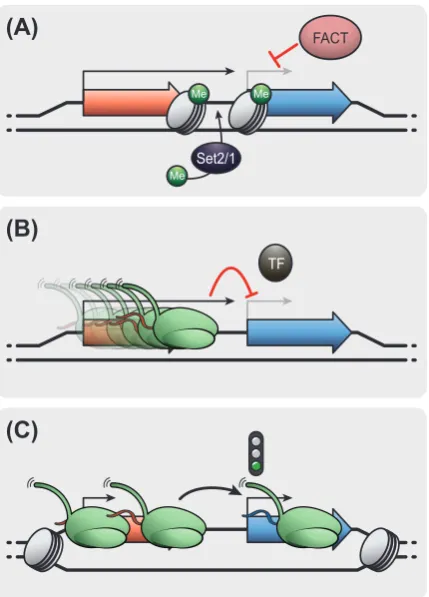
binding at the downstream gene promoter (Figure 1A). Together, these examples of tTI by 119
upstream lncRNA illustrate how an interplay of RNAPII elongation-linked chromatin 120
signaling represses initiation of downstream gene expression in various biological contexts. 121
Physical displacement and changes in chromatin structure
122
In addition to the recruitment of histone-modifying proteins to repress the downstream gene, 123
the act of RNAPII transcription may physically prevent access to DNA elements (Figure 1B). 124
Experiments such as in vivo footprinting [50,51] and nucleosome-scanning [52] suggest 125
transcription increases nucleosome density over nucleosome depleted regions (NDRs) that 126
otherwise characterize eukaryotic promoter regions. The displacement of transcription 127
factors by chromatin-compaction of NDRs may represent an alternative mechanism for tTI. 128
In S. cerevisiae, tTI from the upstream lncRNA SRG1 regulates the SER3 gene involved in 129
serine biosynthesis [53]. In serine-rich media, FACT mediates repression by promoting 130
nucleosome assembly at the SER3 promoter and facilitates elongation of SRG1
7
independently of the Set2-mediated H3K36me3 [39]. The increased nucleosome density 132
compacts chromatin and repels transcription factor binding to regulatory sequences in the 133
SER3 promoter [39]. More generally, the act of transcription from an upstream non-coding 134
unit may trigger the displacement of transcription factors from binding to the downstream 135
gene promoter. The zinc-responsive transcription of the ZRR1 lncRNA displaces the 136
transcriptional activator of ADH1 to repress gene expression [50]. ZRR1-based tTI of ADH1
137
links the expression of ADH1 to the availability of zinc in the environment. In fission yeast, 138
tTI mediates environmentally adjusted phosphate homeostasis. tTI displaces the 139
transcription factor Pho7 by upstream lncRNA transcription events at the pho1+, pho84+and
140
tgp1+ loci [51]. Moreover, compound transcripts resulting from invading upstream
141
transcription may contain the mRNA open reading frame (ORF). In such cases, failure to 142
produce functional proteins may include elements of translational repression by upstream 143
ORFs [54]. To summarize, we find support for two prominent mechanisms of tTI causing 144
gene repression. A mechanism relying on (i) chromatin-based signaling and (ii) the repelling 145
effects mediated by chromatin compaction. The mechanisms are not mutually exclusive and 146
may act together in some contexts. Possibly, the function of FACT interlinks the two 147
mechanisms by preventing transcription factor binding and promotion of nucleosome 148
assembly [55]. However, this review distinguishes them to acknowledge the strong evidence 149
for both mechanisms. These mechanisms underpin environment-induced gene regulation, 150
arguing for roles of tTI in linking environmental sensing to gene expression. 151
Permissive effects of tandem lncRNA transcription on gene expression
152
While tTI mediates repression, the act of lncRNA transcription near gene promoters may 153
also activate gene expression. In fission yeast, lncRNA transcription upstream of the fbp1+
154
gene promotes expression by mediating an open configuration around the fbp1+ TSS [56]
8
(Figure 1C). In addition, efficient transcriptional termination of upstream lncRNA prevents 156
tTI (see Box 1) and stimulates gene expression. The budding yeast lncRNA CUT60 strikingly 157
illustrates the biological significance of this phenomenon. CUT60 termination promotes 158
expression of the ATP16 gene, encoding a subunit of the mitochondrial ATP synthase 159
complex. Inefficient termination of CUT60 represses ATP16 expression, resulting in 160
mitochondrial genome loss [57]. CUT60 termination may also contribute to NDR 161
maintenance to facilitate initiation. In summary, even though the act of RNAPII transcription 162
is often associated with gene repression, several examples support roles in activation. 163
Future characterization of examples illustrating roles in gene activation may help to 164
discriminate molecular features connected to gene activation and repression. 165
Gene regulation by the act of antisense transcription
166
Transcription of lncRNAs from the antisense strand of protein-coding genes characterizes 167
antisense lncRNA transcription [58,59]. A correlation between genes changing expression 168
in response to new environmental conditions and the presence of non-coding antisense 169
transcription suggests roles of antisense lncRNA in gene regulation [60,61]. Many case 170
studies support a mutual inhibitory effect of the sense and antisense transcript pairs [60]. In 171
addition to antisense lncRNA transcription, a range of synonymous terminologies exist, for 172
example, natural antisense transcripts (NATs) [62], antisense lncRNAs (aslncRNAs) [63] or 173
antisense RNAs (asRNAs) [64]. In this section, we review how the act of antisense non-174
coding transcription affects the expression of the corresponding sense gene. 175
Transcriptional read-through to regulate gene expression
176
Antisense lncRNA transcription can result from distinct promoters, read-through RNAPII 177
9
associated with eukaryotic gene promoters [59,65]. Antisense lncRNA transcription is 179
abundant in gene-dense genomes like S. cerevisiae and associated with genes of varying 180
expression levels [60]. For example, the SUR7 gene is regulated by the SUT719 antisense 181
lncRNA transcript [60]. High expression levels of SUR7 signals feedback repression by 182
triggering increased SUT719 expression, which in turn represses SUR7. Likewise, read-183
through transcription of the antisense lncRNA RME2 into the 5’ untranslated region (UTR)
184
of the IME4 gene achieves cell-specific regulation of budding yeast meiosis [66]. RME2
185
transcription opposes RNAPII elongation of IME4 in haploid cells, thus repressing full-length 186
IME4 mRNA production. Nonsense-mediated RNA decay (NMD) targets antisense lncRNAs 187
for degradation in the cytoplasm [67]. In budding yeast, stabilization of antisense lncRNAs 188
in an NMD pathway mutant correlates with lower expression of genes, arguing for repressive 189
effects of antisense lncRNA [64]. In differentiated mouse embryonic stem cells, genomic 190
imprinting of the Igf2r gene is mediated by transcription of the antisense lncRNA Airn [68]. 191
Repression of the paternal Igf2r allele by DNA methylation is alleviated by abolishing Airn
192
transcription through the removal of the Airn promoter sequence, supporting a connection 193
between antisense lncRNA expression and epigenetic regulation. Collectively, these 194
examples point to mutual inhibition of the antisense lncRNA generated from read-through 195
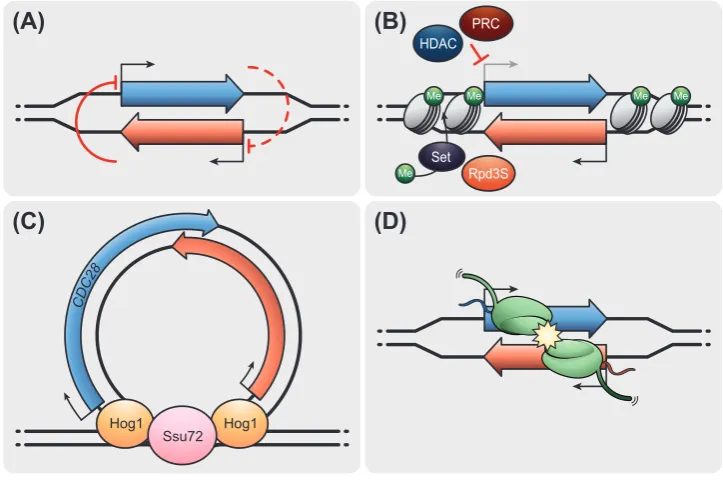
transcription and mRNA transcription (Figure 2A). 196
Chromatin-based repression by antisense lncRNA
197
Regulation of expression of sense gene expression by the corresponding antisense lncRNA 198
transcription often relies on chromatin-based mechanisms (Figure 2B). The budding yeast 199
GAL10 locus represents a well-characterized example of this paradigm. Glucose-rich 200
environments induce the transcription of the GAL10 lncRNA. The act of GAL10 lncRNA 201
10
expression of mRNA in the GAL1-10 locus [69,70]. Reduced antisense lncRNA transcription 203
increases H3K9ac at the GAL1 gene, coinciding with increased GAL1 expression [71]. 204
Similarly, transcription of an antisense lncRNA at the phosphate-repressed PHO84 gene 205
induces Set1-dependent histone methylation that recruits HDACs to mediate repression of 206
PHO84 [72]. Chromatin-based repression of PHO84 by antisense lncRNA may limit the 207
threshold for gene activation to phosphate environments providing a sufficiently strong 208
stimulus [72]. In Drosophila melanogaster, the nascent antisense lncRNA ANRIL recruits 209
Polycomb repressive complex (PRC) to silence the nearby Ink4b gene by H3K27me3 [73]. 210
Likewise, the mammalian ATX7 locus harbors the antisense lncRNA SCAANT1 whose 211
transcription mediates increased deposition of H3K27me3, a PRC-linked repressive 212
chromatin modification, to silence ATX7 [74]. In Arabidopsis, cold-induced antisense 213
lncRNA COOLAIR transcription at the FLOWERING LOCUS C (FLC) gene triggers FLC
214
repression involving PRC and H3K27me3 [75,76]. Alternative COOLAIR co-transcriptional 215
pre-RNA processing through varying poly-adenylation [77] and splicing [78] alters the 216
efficiency of antisense mediated FLC repression. Single-cell analyses at the FLC locus 217
suggest mutually exclusive cellular expression states of sense and antisense lncRNA 218
transcription, arguing for mutual inhibition [79]. In yeast and human, genes with high natural 219
antisense lncRNA transcription are associated with low levels of H3K36me3 and H3K79me3 220
around the mRNA TSS [71]. These data indicate that transcription on both DNA strands of 221
a gene coincides with impaired establishment of co-transcriptional chromatin signals. 222
However, when antisense lncRNA transcription is induced, antisense transcription elevates 223
levels of H3K36me3 in +1/-1 nucleosomes and triggers chromatin compaction to repress 224
11
characteristics with tTI. In summary, the act of antisense lncRNA transcription affects 226
chromatin signaling by diverse mechanisms to affect gene expression. 227
Emerging mechanisms of gene regulation by the act of antisense transcription
228
Antisense lncRNA transcription in budding yeast at the CDC28 locus represents an example 229
of regulation by gene looping that correlates positively with gene expression [81]. Antisense 230
lncRNA transcription recruits the Hog1 protein kinase that facilitates binding of the gene 231
looping factor Ssu72. Gene looping mediates the transfer of Hog1 alongside transcription 232
factors to the 5’-UTR of the CDC28 gene, promoting its expression (Figure 2C). The 233
presence of antisense lncRNA transcription and mRNA poses a conundrum since 234
biophysical considerations suggest that two RNAPII complexes transcribing towards each 235
other should not be able to pass [82]. In Arabidopsis, the collision of RNAPII complexes 236
corresponding to sense and antisense transcription of the same DNA locus represents a 237
mechanism to regulate cold-tolerance [83]. Cold-induced read-through transcription of the 238
antisense lncRNA SVALKA protrudes into the CBF1 gene, which triggers the collision of 239
RNAPII complexes. At CBF1, RNAPII collision results in premature termination of CBF1
240
mRNA production in response to cold to uncouple fitness penalties associated with high-241
level CBF1 expression (Figure 2D). In mice, antisense lncRNA transcription at the Zeb2
242
gene (Zeb2-NAT) inhibits promoter-proximal splicing of Zeb2 pre-mRNA. Interestingly, the 243
partially spliced transcript promotes Zeb2 protein expression through the inclusion of an 244
internal ribosomal entry site required for the translation of mRNA in young mice [62]. Older 245
mice display increased Zeb2-NAT and Zeb2 protein expression compared to younger 246
animals, arguing for antisense lncRNA-mediated effects on ageing [84]. RNAPII also 247
navigates non-coding antisense transcription by RNA polymerase III (RNAPIII). In 248
12
complex subunit, contains an interspersed repeat region. Simultaneous transcription of this 250
region by RNAPIII and transcription of sense Polr3e gene by RNAPII leads to a roadblock 251
and reduction in expression of Polr3e [85]. Future studies will clarify the scope of gene 252
expression regulation by mechanisms such as gene looping, polymerase collision and 253
splicing inhibition by the act of antisense lncRNA transcription. In summary, the mechanistic 254
diversity of gene regulation by antisense lncRNA transcription suggests context-dependent 255
interpretation of effects and calls for nuanced approaches to resolve common principles. 256
Emerging functions of non-coding transcription
257
Transcriptional control by intragenic ncRNAs
258
Although intergenic elements such as gene promoters are key for gene expression 259
regulation, intragenic ncRNA transcription may superimpose transcriptional control. For 260
instance, nitrogen deprivation causes rapid induction of the ASP3 gene in S. cerevisiae, 261
aided by an intragenic ncRNA transcribed in the same orientation as the mRNA [86]. Even 262
when ASP3 mRNA is repressed, the ncRNA transcription persists and mediates high 263
residual levels of H3K4me3 at the ASP3 promoter to facilitate rapid transcriptional 264
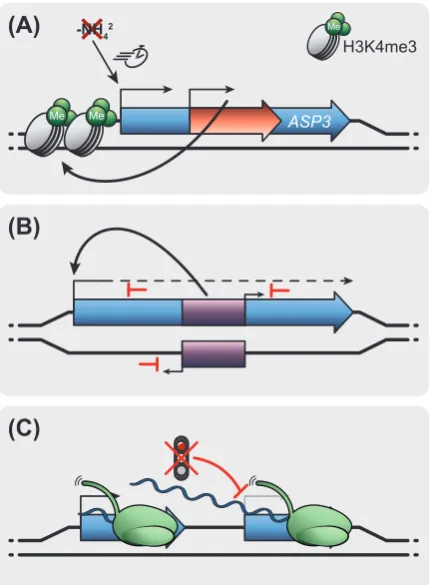
adaptation to changing nitrogen availability (Figure 3A). In mammals, transcription of 265
intragenic enhancer RNA may affect host gene expression [87,88]. We refer readers to 266
excellent recent reviews on enhancer function [12,89]. In brief, enhancer RNA transcription 267
can attenuate host gene expression by promoting premature termination of mRNA 268
transcription [87] (Figure 3B). Moreover, transcription of an intragenic antisense enhancer 269
can facilitate the expression of a shorter isoform of the host gene [88]. In summary, the act 270
of transcription of intragenic ncRNAs influences host gene expression. In this regard, 271
functions of mammalian intragenic enhancers can be interpreted through regulatory 272
13
Defective termination as a gene expression regulator
274
An alternative transcriptional termination pathway in human cells, specific to most lncRNAs 275
that contain microRNAs (miRNAs), prevents read-through into downstream genes [90]. The 276
microprocessor complex responsible for recognizing and generating pre-miRNA is key in 277
this termination mechanism. Generally, non-coding transcription of RNAPII beyond the poly-278
adenylation site is part of the canonical RNAPII transcription termination mechanism and 279
thus represents an integral part of gene expression [91]. Diverse environmental cellular 280
stresses in mammals and plants, besides virus infections (e.g. herpes simplex (HSV-1) or 281
influenza), interfere with RNAPII termination, leading to defective termination and 282
widespread generation of read-through non-coding transcription into downstream protein-283
coding genes [92–96] (Figure 3C). The molecular mechanisms underlying read-through 284
transcription in HSV-1 infection point to a blockage of mammalian RNAPII termination by 285
preventing the mRNA 3’-cleavage [95]. Malignant reprogramming of cancer cells associates 286
with widespread read-through transcription [97], further supporting the correlation between 287
excessive non-coding read-through transcription and cellular stresses. Moreover, 288
acceleration of RNAPII transcription in Arabidopsis revealed extensive transcriptional read-289
through linked to an autoimmune phenotype [98]. In conclusion, these data support links 290
between non-coding read-through transcription and cellular fitness. It remains to be 291
investigated whether widespread non-coding transcription events reflect cellular adaptations 292
to new environments, or whether they indicate a breakdown of cellular functions. 293
Non-coding transcription and DNA processing
294
The act of lncRNA transcription also impacts DNA replication and genome maintenance. 295
14
stable association of the origin recognition complex (ORC) and the pre-replication complex 297
at ARSs promote RNAPII pausing by a roadblock mechanism and mediate transcriptional 298
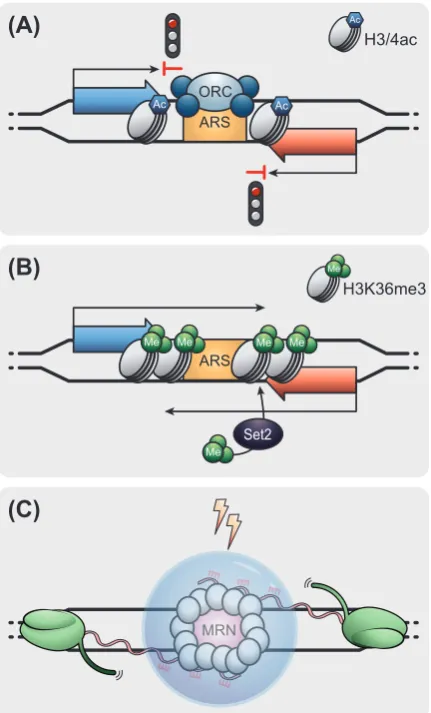
termination at the edges of replication origins [99,100] (Figure 4A). ARS invasion by lncRNA 299
transcription correlates with low DNA replication efficiency and late origin firing, affecting the 300
temporal program of replication [99,100]. Mechanistically, RNAPII transcription through 301
ARSs affects replication in part by chromatin-mediated effects. Akin to tTI, RNAPII 302
elongation mediates a Set2-dependent increase of H3K36me3, a decrease of histone 303
acetylation and an increase in nucleosome occupancy around the ARSs [100]. This 304
chromatin landscape correlates with lower efficiency of ORC binding and inefficient ARS 305
firing [100] (Figure 4B). Future studies should investigate if tTI-like effects on DNA 306
replication, as detected in S. cerevisiae, represent a phenomenon preserved through 307
evolution. In summary, the act of lncRNA transcription over ARSs inhibits DNA replication 308
and thus cell cycle progression. 309
In human cells, the act of lncRNA transcription is essential for the repair of double-strand 310
breaks (DSBs), a harmful type of DNA lesion [101]. Transcription occurs in the first steps of 311
the DNA damage response (DDR). DDR couples a series of mechanisms responsible for 312
the recognition, signaling and repair of DNA damage. Detection of the lesion by the MRE11– 313
RAD50–NBS1 (MRN) complex allows the formation of functional promoters, where RNAPII 314
bidirectionally synthesizes damage-induced lncRNAs (dilncRNAs) [101,102]. dilncRNAs are 315
processed into small ncRNAs that base-pair with nascent dilncRNA to trigger the formation 316
of DDR foci, necessary for DSB repair [101]. Application of inhibitors of RNAPII transcription 317
revealed the requirement of dilncRNA transcription for the formation of DDR foci, and that 318
15
foci [101,102] (Figure 4C). These examples support functional roles for the act of lncRNA 320
transcription in DNA biology beyond the regulation of gene expression. 321
Concluding remarks
322
Research focus is shifting from the discovery of lncRNAs to clarifying their functional roles 323
and molecular mechanisms of action. A general purpose of non-coding transcription remains 324
elusive and most insight stems from case studies. Given the extent of spurious RNAPII 325
transcription in genomes, it is attractive to reflect on functional implications of the act of 326
lncRNA transcription regardless of the DNA sequence. While most evidence connects the 327
act of lncRNA transcription to the regulation of gene expression, recent advances link this 328
mechanism to DNA processing more broadly. An increasing repertoire of molecular 329
techniques (see Box 2) promises to facilitate functional dissection of lncRNAs at their site of 330
production to resolve the scope of these mechanisms. While superficially similar, the 331
regulation of neighboring gene expression by the act of lncRNA transcription in cis may 332
involve a range of mechanisms distinct in molecular detail. An important aspect of future 333
studies will be the identification of molecular characteristics common to regulatory roles by 334
the act of lncRNA transcription. Such information would inform predictions on which and 335
how many non-coding DNA elements may function through the act of transcription (see 336
Outstanding Questions), perhaps bypassing the need for detailed experimental dissection 337
of lncRNA transcription events. 338
ACKNOWLEDGEMENTS
339
We thank the Marquardt lab members for their feedback and suggestions on the manuscript. 340
16
Copenhagen Plant Science Centre Young Investigator Starting grant. The Marquardt Lab 342
acknowledges support from the European Research Council (ERC) under the European 343
Union’s Horizon 2020 Research and Innovation Programme StG2017-757411 (S.M.). 344
REFERENCES
345
1 Djebali, S. et al. (2012) Landscape of transcription in human cells. Nature 489, 101–
346
108 347
2 Jensen, T. H. et al. (2013) Dealing with pervasive transcription. Mol. Cell 52, 473–484
348
3 Quinn, J. J. and Chang, H. Y. (2016) Unique features of long non-coding RNA 349
biogenesis and function. Nat. Rev. Genet. 17, 47–62
350
4 Gil, N. and Ulitsky, I. (2020) Regulation of gene expression by cis-acting long non-351
coding RNAs. Nat. Rev. Genet. 21, 102–117
352
5 Rinn, J. L. and Chang, H. Y. (2020) Long Noncoding RNAs: Molecular Modalities to 353
Organismal Functions. Annu. Rev. Biochem. 89, 283-308 354
6 Kornienko, A. E. et al. (2013) Gene regulation by the act of long non-coding RNA 355
transcription. BMC Biology 11, 59 356
7 Ard, R. et al. (2017) Emerging properties and functional consequences of noncoding 357
transcription. Genetics 207, 357–367
358
8 Pang, K. C. et al. (2006) Rapid evolution of noncoding RNAs: Lack of conservation 359
does not mean lack of function. Trends Genet. 22, 1–5
360
9 Geisler, S. and Coller, J. (2013) RNA in unexpected places: Long non-coding RNA 361
functions in diverse cellular contexts. Nat. Rev. Mol. Cell Biol. 14, 699–712
362
17
nuclear structure and gene expression. Nat. Rev. Mol. Cell Biol. 17, 756–770
364
11 Kopp, F. and Mendell, J. T. (2018) Functional Classification and Experimental 365
Dissection of Long Noncoding RNAs. Cell 172, 393–407
366
12 Field, A. and Adelman, K. (2020) Evaluating Enhancer Function and Transcription. 367
Annu. Rev. Biochem. 89, 213-234 368
13 Bannister, A. J. and Kouzarides, T. (2011) Regulation of chromatin by histone 369
modifications. Cell Research 21, 381–395
370
14 Smolle, M. and Workman, J. L. (2013) Transcription-associated histone modifications 371
and cryptic transcription. Biochim. Biophys.Acta 1829, 84–97
372
15 Buratowski, S. (2009) Progression through the RNA polymerase II CTD cycle. Mol.
373
Cell 36, 541–546
374
16 Li, B. et al. (2007) The Role of Chromatin during Transcription. Cell 128, 707–719
375
17 Leng, X. et al. (2020) A G(enomic)P(ositioning)S(ystem) for Plant RNAPII 376
Transcription. Trends Plant Sci. 25, 744-764 377
18 Carrozza, M. J. et al. (2003) The diverse functions of histone acetyltransferase 378
complexes. Trends Genet. 19, 321–329
379
19 Ng, H. H. et al. (2003) Targeted recruitment of Set1 histone methylase by elongating 380
Pol II provides a localized mark and memory of recent transcriptional activity. Mol. Cell
381
11, 709–719 382
20 Krogan, N. J. et al. (2003) Methylation of Histone H3 by Set2 in Saccharomyces 383
cerevisiae Is Linked to Transcriptional Elongation by RNA Polymerase II. Mol. Cell
18
Biol. 23, 4207–4218
385
21 Li, B. et al. (2003) The Set2 histone methyltransferase functions through the 386
phosphorylated carboxyl-terminal domain of RNA polymerase II. J. Biol. Chem. 278, 387
8897–8903 388
22 Bannister, A. J. et al. (2005) Spatial distribution of di- and tri-methyl lysine 36 of histone 389
H3 at active genes. J. Biol. Chem. 280, 17732–17736
390
23 Pokholok, D. K. et al. (2005) Genome-wide map of nucleosome acetylation and 391
methylation in yeast. Cell 122, 517–527
392
24 Weiner, A. et al. (2015) High-resolution chromatin dynamics during a yeast stress 393
response. Mol. Cell 58, 371–386
394
25 Barski, A. et al. (2007) High-Resolution Profiling of Histone Methylations in the Human 395
Genome. Cell 129, 823–837
396
26 Kharchenko, P. V. et al. (2011) Comprehensive analysis of the chromatin landscape 397
in Drosophila melanogaster. Nature 471, 480–486
398
27 Sinha, I. et al. (2006) Genome-wide patterns of histone modifications in fission yeast. 399
Chromosom. Res. 14, 95–105
400
28 Bell, O. et al. (2007) Localized H3K36 methylation states define histone H4K16 401
acetylation during transcriptional elongation in Drosophila. EMBO J. 26, 4974–4984
402
29 Guenther, M. G. et al. (2007) A Chromatin Landmark and Transcription Initiation at 403
Most Promoters in Human Cells. Cell 130, 77–88
404
19
coding regions by Rpd3S to suppress spurious intragenic transcription. Cell 123, 581–
406
592 407
31 Keogh, M. C. et al. (2005) Cotranscriptional set2 methylation of histone H3 lysine 36 408
recruits a repressive Rpd3 complex. Cell 123, 593–605
409
32 Venkatesh, S. et al. (2012) Set2 methylation of histone H3 lysine 36 suppresses 410
histone exchange on transcribed genes. Nature 489, 452–455
411
33 Reinberg, D. and Sims, R. J. (2006) De FACTo nucleosome dynamics. J. Biol. Chem.
412
281, 23297–23301 413
34 Kaplan, C. D. et al. (2003) Transcription elongation factors repress transcription 414
initiation from cryptic sites. Science 301, 1096–1099
415
35 Carvalho, S. et al. (2013) Histone methyltransferase SETD2 coordinates FACT 416
recruitment with nucleosome dynamics during transcription. Nucleic Acids Res. 41, 417
2881–2893 418
36 Nielsen, M. et al. (2019) Transcription-driven chromatin repression of Intragenic 419
transcription start sites. PLoS Genet. 15, e1007969 420
37 Schlackow, M. et al. (2017) Distinctive Patterns of Transcription and RNA Processing 421
for Human lincRNAs. Mol. Cell 65, 25–38 422
38 Shearwin, K. E. et al. (2005) Transcriptional interference - A crash course. Trends
423
Genet. 21, 339–345
424
39 Hainer, S. J. et al. (2011) Intergenic transcription causes repression by directing 425
nucleosome assembly. Genes Dev. 25, 29–40
20
40 Lin, D. et al. (2018) Intragenic transcriptional interference regulates the human 427
immune ligand MICA. EMBO J. 37, e97138 428
41 Chia, M. et al. (2017) Transcription of a 5’ extended mRNA isoform directs dynamic
429
chromatin changes and interference of a downstream promoter. Elife 6, e27420 430
42 Hollerer, I. et al. (2019) Evidence for an integrated gene repression mechanism based 431
on mRNA isoform toggling in human cells. G3 9, 1045–1053
432
43 Jorgensen, V. et al. (2020) Tunable Transcriptional Interference at the Endogenous 433
Alcohol Dehydrogenase Gene Locus in Drosophila melanogaster. G3 10, 1575–1583
434
44 Ard, R. and Allshire, R. C. (2016) Transcription-coupled changes to chromatin 435
underpin gene silencing by transcriptional interference. Nucleic Acids Res. 44, 10619–
436
10630 437
45 Moretto, F. et al. (2018) A regulatory circuit of two lncRNAs and a master regulator 438
directs cell fate in yeast. Nat. Commun. 9, 780 439
46 Kim, J. et al. (2016) Modulation of mRNA and lncRNA expression dynamics by the 440
Set2–Rpd3S pathway. Nat. Commun. 7, 13534 441
47 Van Werven, F. J. et al. (2012) Transcription of two long noncoding RNAs mediates 442
mating-type control of gametogenesis in budding yeast. Cell 150, 1170–1181
443
48 Bumgarner, S. L. et al. (2009) Toggle involving cis-interfering noncoding RNAs 444
controls variegated gene expression in yeast. Proc. Natl. Acad. Sci. U. S. A. 106, 445
18321–18326 446
49 Bumgarner, S. L. et al. (2012) Single-Cell Analysis Reveals that Noncoding RNAs 447
21
Mol. Cell 45, 470–482
449
50 Bird, A. J. et al. (2006) Repression of ADH1 and ADH3 during zinc deficiency by Zap1-450
induced intergenic RNA transcripts. EMBO J. 25, 5726–5734
451
51 Garg, A. et al. (2018) A long noncoding (lnc)RNA governs expression of the phosphate 452
transporter Pho84 in fission yeast and has cascading effects on the flanking prt 453
lncRNA and pho1 genes. J. Biol. Chem. 293, 4456–4467
454
52 Hainer, S. J. et al. (2012) Identification of mutant versions of the Spt16 histone 455
chaperone that are defective for transcription-coupled nucleosome occupancy in 456
saccharomyces cerevisiae. G3 2, 555–567
457
53 Martens, J. A. et al. (2005) Regulation of an intergenic transcript controls adjacent 458
gene transcription in Saccharomyces cerevisiae. Genes Dev. 19, 2695–2704
459
54 Johnstone, T. G. et al. (2016) Upstream ORF s are prevalent translational repressors 460
in vertebrates. EMBO J. 35, 706–723
461
55 Feng, J. et al. (2016) Noncoding Transcription Is a Driving Force for Nucleosome 462
Instability in spt16 Mutant Cells. Mol. Cell Biol. 36, 1856–1867
463
56 Hirota, K. et al. (2008) Stepwise chromatin remodelling by a cascade of transcription 464
initiation of non-coding RNAs. Nature 456, 130–134
465
57 Du Mee, D. J. M. et al. (2018) Efficient termination of nuclear lncrna transcription 466
promotes mitochondrial genome maintenance. Elife 7, e31989 467
58 Pelechano, V. and Steinmetz, L. M. (2013) Gene regulation by antisense transcription. 468
Nat. Rev. Genet. 14, 880–893
22
59 Mellor, J. et al. (2016) The Interleaved Genome. Trends Genet. 32, 57–71
470
60 Xu, Z. et al. (2011) Antisense expression increases gene expression variability and 471
locus interdependency. Mol. Syst. Biol. 7, 468 472
61 Murray, S. C. et al. (2012) A pre-initiation complex at the 3′-end of genes drives
473
antisense transcription independent of divergent sense transcription. Nucleic Acids
474
Res. 40, 2432–2444
475
62 Beltran, M. et al. (2008) A natural antisense transcript regulates Zeb2/Sip1 gene 476
expression during Snail1-induced epithelial-mesenchymal transition. Genes Dev. 22, 477
756–769 478
63 Wery, M. et al. (2018) Bases of antisense lncRNA-associated regulation of gene 479
expression in fission yeast. PLoS Genet. 14, e1007465 480
64 Nevers, A. et al. (2018) Antisense transcriptional interference mediates condition-481
specific gene repression in budding yeast. Nucleic Acids Res. 46, 6009–6025
482
65 Marquardt, S. et al. (2014) A chromatin-based mechanism for limiting divergent 483
noncoding transcription. Cell 157, 1712–1723
484
66 Gelfand, B. et al. (2011) Regulated Antisense Transcription Controls Expression of 485
Cell-Type-Specific Genes in Yeast. Mol. Cell Biol. 31, 1701–1709
486
67 Wery, M. et al. (2016) Nonsense-Mediated Decay Restricts LncRNA Levels in Yeast 487
Unless Blocked by Double-Stranded RNA Structure. Mol. Cell 61, 379–392
488
68 Latos, P. A. et al. (2012) Airn transcriptional overlap, but not its lncRNA products, 489
induces imprinted Igf2r silencing. Science 338, 1469–1472
23
69 Houseley, J. et al. (2008) A ncRNA Modulates Histone Modification and mRNA 491
Induction in the Yeast GAL Gene Cluster. Mol. Cell 32, 685–695
492
70 Pinskaya, M. et al. (2009) H3 lysine 4 di- and tri-methylation deposited by cryptic 493
transcription attenuates promoter activation. EMBO J. 28, 1697–1707
494
71 Brown, T. et al. (2018) Antisense transcription-dependent chromatin signature 495
modulates sense transcript dynamics. Mol. Syst. Biol. 14, e8007 496
72 Castelnuovo, M. et al. (2013) Bimodal expression of PHO84 is modulated by early 497
termination of antisense transcription. Nat. Struct. Mol. Biol. 20, 851–858
498
73 Yap, K. L. et al. (2010) Molecular Interplay of the Noncoding RNA ANRIL and 499
Methylated Histone H3 Lysine 27 by Polycomb CBX7 in Transcriptional Silencing of 500
INK4a. Mol. Cell 38, 662–674
501
74 Sopher, B. L. et al. (2011) CTCF Regulates Ataxin-7 Expression through Promotion 502
of a Convergently Transcribed, Antisense Noncoding RNA. Neuron 70, 1071–1084
503
75 Swiezewski, S. et al. (2009) Cold-induced silencing by long antisense transcripts of 504
an Arabidopsis Polycomb target. Nature 462, 799–802
505
76 Csorba, T. et al. (2014) Antisense COOLAIR mediates the coordinated switching of 506
chromatin states at FLC during vernalization. Proc. Natl. Acad. Sci. U. S. A. 111, 507
16160–16165 508
77 Liu, F. et al. (2010) Targeted 3′ processing of antisense transcripts triggers
509
arabidopsis FLC chromatin silencing. Science 327, 94–97
510
78 Marquardt, S. et al. (2014) Functional Consequences of Splicing of the Antisense 511
Transcript COOLAIR on FLC Transcription. Mol. Cell 54, 156–165
24
79 Rosa, S. et al. (2016) Mutually exclusive sense-antisense transcription at FLC 513
facilitates environmentally induced gene repression. Nat. Commun. 7, 13031 514
80 Gill, J. K. et al. (2020) Fine Chromatin-Driven Mechanism of Transcription Interference 515
by Antisense Noncoding Transcription. Cell Rep. 31, 107612 516
81 Nadal-Ribelles, M. et al. (2014) Control of Cdc28 CDK1 by a Stress-Induced lncRNA. 517
Mol. Cell 53, 549–561
518
82 Hobson, D. J. et al. (2012) RNA Polymerase II Collision Interrupts Convergent 519
Transcription. Mol. Cell 48, 365–374
520
83 Kindgren, P. et al. (2018) Transcriptional read-through of the long non-coding RNA 521
SVALKA governs plant cold acclimation. Nat. Commun. 9, 4561 522
84 De Jesus, B. B. et al. (2018) Silencing of the lncRNA Zeb2-NAT facilitates 523
reprogramming of aged fibroblasts and safeguards stem cell pluripotency. Nat.
524
Commun. 9, 94 525
85 Yeganeh, M. et al. (2017) Transcriptional interference by RNA polymerase III affects 526
expression of the Polr3e gene. Genes Dev. 31, 413-421 527
86 Huang, Y. C. et al. (2010) Intragenic transcription of a noncoding RNA modulates 528
expression of ASP3 in budding yeast. RNA 16, 2085–2093
529
87 Cinghu, S. et al. (2017) Intragenic Enhancers Attenuate Host Gene Expression. Mol.
530
Cell 68, 104-117 531
88 Onodera, C. S. et al. (2012) Gene isoform specificity through enhancer-associated 532
25
89 Andersson, R. and Sandelin, A. (2020) Determinants of enhancer and promoter 534
activities of regulatory elements. Nat. Rev. Genet. 21, 71–87
535
90 Dhir, A. et al. (2015) Microprocessor mediates transcriptional termination of long 536
noncoding RNA transcripts hosting microRNAs. Nat. Struct. Mol. Biol. 22, 319–327
537
91 Proudfoot, N. J. (2016) Transcriptional termination in mammals: Stopping the RNA 538
polymerase II juggernaut. Science 352, aad9926 539
92 Vilborg, A. et al. (2015) Widespread Inducible Transcription Downstream of Human 540
Genes. Mol. Cell 59, 449–461
541
93 Fukudome, A. et al. (2017) Salt stress and CTD PHOSPHATASE-LIKE4 mediate the 542
switch between production of small nuclear RNAs and mRNAs. Plant Cell 29, 3214–
543
3233 544
94 Bauer, D. L. V. et al. (2018) Influenza Virus Mounts a Two-Pronged Attack on Host 545
RNA Polymerase II Transcription. Cell Rep. 23, 2119-2129.e3 546
95 Wang, X. et al. (2020) Herpes simplex virus blocks host transcription termination via 547
the bimodal activities of ICP27. Nat. Commun. 11, 293 548
96 Hennig, T. et al. (2018) HSV-1-induced disruption of transcription termination 549
resembles a cellular stress response but selectively increases chromatin accessibility 550
downstream of genes. PLOS Pathog. 14, e1006954 551
97 Grosso, A. R. et al. (2015) Pervasive transcription read-through promotes aberrant 552
expression of oncogenes and RNA chimeras in renal carcinoma. Elife 4, e09214 553
98 Leng, X. et al. (2020) Organismal benefits of transcription speed control at gene 554
26
99 Candelli, T. et al. (2018) Pervasive transcription fine-tunes replication origin activity. 556
Elife 7, e40802 557
100 Soudet, J. et al. (2018) Noncoding transcription influences the replication initiation 558
program through chromatin regulation. Genome Res. 28, 1867–1881
559
101 Michelini, F. et al. (2017) Damage-induced lncRNAs control the DNA damage 560
response through interaction with DDRNAs at individual double-strand breaks. Nat.
561
Cell Biol. 19, 1400–1411
562
102 Pessina, F. et al. (2019) Functional transcription promoters at DNA double-strand 563
breaks mediate RNA-driven phase separation of damage-response factors. Nat. Cell
564
Biol. 21, 1286–1299
565
103 Mischo, H. E. and Proudfoot, N. J. (2013) Disengaging polymerase: Terminating RNA 566
polymerase II transcription in budding yeast. Biochim. Biophys. Acta 1829, 174–185
567
104 LaCava, J. et al. (2005) RNA degradation by the exosome is promoted by a nuclear 568
polyadenylation complex. Cell 121, 713–724
569
105 Wyers, F. et al. (2005) Cryptic Pol II transcripts are degraded by a nuclear quality 570
control pathway involving a new poly(A) polymerase. Cell 121, 725–737
571
106 Wery, M. et al. (2009) The nuclear poly(A) polymerase and Exosome cofactor Trf5 is 572
recruited cotranscriptionally to nucleolar surveillance. RNA 15, 406–419
573
107 Ogami, K. et al. (2018) RNA surveillance by the nuclear RNA exosome: Mechanisms 574
and significance. Noncoding RNA 4, 8 575
108 Steinmetz, E. J. et al. (2001) RNA-binding protein Nrd1 directs poly(A)-independent 576
3′-end formation of RNA polymerase II transcripts. Nature 413, 327–331
27
109 Vasiljeva, L. and Buratowski, S. (2006) Nrd1 interacts with the nuclear exosome for 578
3′ processing of RNA polymerase II transcripts. Mol. Cell 21, 239–248
579
110 Porrua, O. and Libri, D. (2015) Transcription termination and the control of the 580
transcriptome: Why, where and how to stop. Nat. Rev. Mol. Cell Biol. 16, 190–202
581
111 Thiebaut, M. et al. (2006) Transcription Termination and Nuclear Degradation of 582
Cryptic Unstable Transcripts: A Role for the Nrd1-Nab3 Pathway in Genome 583
Surveillance. Mol. Cell 23, 853–864
584
112 Tudek, A. et al. (2014) Molecular basis for coordinating transcription termination with 585
noncoding RNA degradation. Mol. Cell 55, 467–481
586
113 Fasken, M. B. et al. (2015) Nab3 Facilitates the Function of the TRAMP Complex in 587
RNA Processing via Recruitment of Rrp6 Independent of Nrd1. PLoS Genet. 11, 588
e1005044 589
114 Tatomer, D. C. et al. (2019) The Integrator complex cleaves nascent mRNAs to 590
attenuate transcription. Genes Dev. 33, 1525–1538
591
115 Thomas, Q. A. et al. (2020) Transcript isoform sequencing reveals widespread 592
promoter-proximal transcriptional termination in Arabidopsis. Nat. Commun. 11, 2589 593
116 Paralkar, V. R. et al. (2016) Unlinking an lncRNA from Its Associated cis Element. Mol.
594
Cell 62, 104–110
595
117 Qi, L. S. et al. (2013) Repurposing CRISPR as an RNA-Guided Platform for 596
Sequence-Specific Control of Gene Expression. Cell 152, 1173–1183
597
118 Howe, F. S. et al. (2017) CRISPRi is not strand-specific at all loci and redefines the 598
28
119 Gilbert, L.A. et al. (2014) Genome-Scale CRISPR-Mediated Control of Gene 600
Repression and Activation. Cell 159, 647–661
601
120 Takahashi, H. et al. (2012) 5′ end-centered expression profiling using cap-analysis
602
gene expression and next-generation sequencing. Nat. Protoc. 7, 542–561
603
121 Ntini, E. et al. (2013) Polyadenylation site-induced decay of upstream transcripts 604
enforces promoter directionality. Nat. Struct. Mol. Biol. 20, 923–928
605
122 Pelechano, V. et al. (2014) Genome-wide identification of transcript start and end sites 606
by transcript isoform sequencing. Nat. Protoc. 9, 1740–1759
607
123 Churchman, L. S. and Weissman, J. S. (2011) Nascent transcript sequencing 608
visualizes transcription at nucleotide resolution. Nature 469, 368–373
609
124 Nojima, T. et al. (2015) Mammalian NET-seq reveals genome-wide nascent 610
transcription coupled to RNA processing. Cell 161, 526–540
611
125 Kindgren, P. et al. (2020) Native elongation transcript sequencing reveals temperature 612
dependent dynamics of nascent RNAPII transcription in Arabidopsis. Nucleic Acids
613
Res. 48, 2332–2347
614
126 Core, L. J. et al. (2008) Nascent RNA sequencing reveals widespread pausing and 615
divergent initiation at human promoters. Science 322, 1845–1848
616
127 Kwak, H. et al. (2013) Precise maps of RNA polymerase reveal how promoters direct 617
initiation and pausing. Science 339, 950–953
618
128 Zhu, J. et al. (2018) RNA polymerase II activity revealed by GRO-seq and pNET-seq 619
in Arabidopsis. Nat. Plants 4, 1112–1123
29
129 Tome, J. M. et al. (2018) Single-molecule nascent RNA sequencing identifies 621
regulatory domain architecture at promoters and enhancers. Nat. Genet. 50, 1533–
622
1541 623
130 Schwalb, B. et al. (2016) TT-seq maps the human transient transcriptome. Science
624
352, 1225–1228 625
131 Herzog, V. A. et al. (2017) Thiol-linked alkylation of RNA to assess expression 626
dynamics. Nat. Methods 14, 1198–1204
627
132 Schofield, J. A. et al. (2018) TimeLapse-seq: Adding a temporal dimension to RNA 628
sequencing through nucleoside recoding. Nat. Methods 15, 221–225
629
133 Szabo, E. X. et al. (2020) Metabolic Labeling of RNAs Uncovers Hidden Features and 630
Dynamics of the Arabidopsis Transcriptome. Plant Cell 32, 871-887 631
134 Drexler, H. L. et al. (2020) Splicing Kinetics and Coordination Revealed by Direct 632
Nascent RNA Sequencing through Nanopores. Mol. Cell 77, 985-998.e8 633
Glossary
634
Attenuation: The regulatory mechanism operating by premature termination of transcription 635
to cause a reduction in gene expression. 636
Chromatin conformation: Spatial organization of chromatin in a nucleus. 637
Compound transcript: A fused transcript resulting from intervening transcription from an 638
30
Cryptic transcript: The uncharacterized RNA transcripts of RNAPII subjected to rapid 640
nuclear degradation. 641
DNA processing: All the molecular and biochemical events that act on DNA. 642
Enhancer: Short genomic regions that facilitate the binding of regulatory proteins to 643
increase the transcription of an associated gene. Enhancers can be located far away 644
upstream or downstream (intergenic) or on the same associated gene (intragenic). 645
Genomic imprinting: A biochemical process that marks the parental origin of epigenetic 646
information. 647
Histone chaperone: A protein complex that interacts with histone proteins and regulates 648
nucleosome assembly. 649
Intragenic transcription: Independent transcription occurring within the annotated region 650
of a gene producing intragenic RNAs. 651
In vivo footprinting: A technique to analyze the DNA-protein interactions in a cell at a given 652
time point. 653
Nascent transcript: The RNA transcript attached to RNA polymerase during the act of 654
transcription. 655
Splicing: A molecular process involving the spliceosome complex in the removal of 656
intragenic and non-coding sequences (introns) from primary RNA transcripts. 657
Transcription factor: Proteins involved in activating or repressing the transcription 658
31
BOX 1: RNAPII transcription termination and tTI
660
In eukaryotes, poly-(A) site (PAS) dependent transcription termination and 3’-end 661
processing of transcripts are tightly coupled [103]. Eukaryotic PAS-dependent RNAPII 662
termination is mechanistically linked to extensive non-coding transcription beyond the 3’-663
cleavage site [91]. RNAPII reading beyond the 3’-cleavage site generates unstable RNA 664
targeted for co-transcriptional degradation linked to the termination process [103]. 665
Nevertheless, the effects of termination-linked read-through RNAPII transcription in gene 666
regulation await clarification. In yeast and humans, the co-transcriptionally recruited multi-667
protein Trf4p/Air2p/Mtr4p polyadenylation complex (TRAMP), mediates efficient turnover 668
and processing of a wide range of RNA transcripts. TRAMP interacts with and 669
polyadenylates the RNA substrate to mark it for degradation by the exosome complex [104– 670
107]. The interaction of TRAMP and nuclear exosome functions as an RNA surveillance 671
mechanism of the cell by eliminating the cryptic transcripts arising from pervasive 672
transcription [2,104]. 673
In S. cerevisiae, RNAPII termination of small nuclear RNA and lncRNA depends on Nrd1, 674
Nab3, and Sen1 (NNS) proteins [108–110] that terminate specific short sequences in the 675
nascent RNA. It interacts with the cap-binding complex and recruits nuclear exosome for 676
rapid degradation of ncRNA [109–113]. Sequence level conservation of key players in the 677
NNS-dependent termination is limited. However, the Integrator complex appears to fulfil the 678
role of these termination pathways in mammals and plants [114,115]. 679
Elucidation of the mechanisms specifying transcription termination pathways informs 680
experimental approaches to terminate lncRNA transcription. Targeted termination of the 681
upstream transcript is expected to alleviate the downstream gene from repression by tTI 682
32
may trigger lncRNA transcription termination [68,116]. In plants, insertion of a T-DNA 684
cassette between non-coding and coding DNA also terminates interfering transcription [83]. 685
However, these approaches disrupt the underlying DNA sequence elements. Using targeted 686
roadblocks for transcription may offer an alternative strategy to trigger RNAPII termination 687
without extensive DNA sequence modification. Catalytically dead Cas9 (dCas9) proteins 688
targeted to a specific locus of interest may facilitate RNAPII termination of upstream 689
transcription by acting as a roadblock [117]. However, CRISPR-dCas9-based approaches 690
applied to selectively terminate transcription may have to be evaluated cautiously. dCas9 691
recruitment may result in the generation of new transcripts [118], and may act most efficiently 692
near TSSs prior to the elongation phase [119]. Application of experimental approaches 693
aiming to terminate RNAPII transcription promise targeted tests of gene repression by tTI. 694
BOX 2: Novel methods for RNA detection
695
We may still underestimate lncRNA transcription since the detection of unstable RNA 696
molecules represents a formidable challenge. Transcriptome analyses in mutants of RNA 697
degradation factors offer one strategy to address this issue. Genome-wide sequencing 698
strategies capturing the 5’-end of RNA enable mapping of TSSs (i.e., TSS-seq, CAGE). 699
Total RNA extract from cells deficient in nuclear exosome RNA degradation activity reveals 700
TSSs of unstable (i.e. cryptic) transcripts [83,120,121]. To distinguish full-length transcripts 701
and different isoforms, Transcript IsoForm sequencing (TIF-seq) circularizes cDNA of the 702
whole RNA molecule and identifies the 5’ and 3’ ends [115,122]. 703
The specific purification of nascent RNA attached to RNAPII from cells reveals the act of 704
nascent transcription in genomes (NET-seq, mNET-seq, plaNET-seq) [123–125]. Since 705
33
helps to reveal RNAPII transcription at genomic locations without prior transcript 707
annotations, likely representing uncharacterized lncRNA. 708
Run-on sequencing methods reveal transcripts by allowing incorporation of labeled 709
nucleotides following purification of stalled transcription complexes (GRO-Seq, PRO-seq) 710
[126–128]. An advantage of continuing transcription in vitro is the ability to capture short 711
transcripts that are otherwise challenging to map. However, co-transcriptional RNA 712
degradation pathways may be co-purified. Additional refinements permit the selection of 713
capped transcripts, nucleotide resolution, paired-end sequencing, and reactivation of 714
paused polymerases (CoPRO) [129]. 715
Metabolic pulse-labelling of cells by nucleotide base conversion approaches, such as TT-716
seq, TimeLapse-seq and SLAM-seq, allow us to compare recently generated (i.e. labeled) 717
RNA to total RNA, the latter two even avoiding experimental RNA enrichment [130–132]. 718
Base conversion rates provide information on RNA half-lives, and short labelling times 719
inform on newly synthesized RNA. In whole Arabidopsis plants, NEU-seq captures 720
transcriptome dynamics of nuclear and organellar RNA [133]. 721
The combined information of several methods interrogates the presence of lncRNA 722
transcription comprehensively. nano-COP combines 4sU-labelled chromatin-associated 723
RNA for direct RNA nanopore long-read sequencing to analyze co-transcriptional 724
processing [134]. Long-read sequencing methods are continuously improved and offer 725
reduced bias by avoiding reverse transcription and PCR amplification that can limit short-726
read sequencing. However, short-read sequencing methods will remain influential in the 727
34
FIGURE LEGEND
729
Figure 1. Tandem transcriptional interference (tTI) affects gene expression. Illustration of 730
the non-coding and coding gene is in red and blue respectively. (A) Productive elongation 731
from upstream non-coding transcription represses the transcription of the downstream 732
coding gene. In budding yeast, downstream gene repression often includes deposition of 733
elongation-specific chromatin marks by the histone methyltransferases Set1 and Set2. 734
Recruitment of elongation-promoting factors such as FACT maintains repression of RNAPII 735
initiation at the gene promoter by promoting productive elongation. (B) Physical 736
displacement of protein complexes by tTI from upstream non-coding transcription. 737
Elongating RNAPII from upstream non-coding transcription triggers the displacement of 738
transcription factors (TFs) from the downstream gene promoter. This mechanism causes 739
repression of the downstream coding gene by allowing productive elongation of the non-740
coding transcript. (C) The act of transcription from the upstream non-coding unit maintains 741
an open chromatin state. This allows the translocation of RNAPII through the TSS of the 742
downstream coding gene and enables the binding of transcription machinery to activate the 743
downstream gene expression. 744
Figure 2. Antisense lncRNA transcription in the regulation of gene expression. Illustration of 745
the non-coding and coding gene is in red and blue respectively. (A) The on and off-model of 746
sense and antisense transcription. Transcription of antisense lncRNA extends into the 747
promoter of the coding gene and prevents its expression. However, with changes in the 748
environmental conditions, the induction of the coding gene suppresses the expression of 749
the antisense transcript. (B) Antisense lncRNA transcription mediates recruitment of histone 750
35
local chromatin state recruits repressive complexes like HDAC (at GAL1 locus, S.
752
cerevisiae), Rpd3S (at PHO84 locus, S. cerevisiae), and PRC (in higher eukaryotes) to 753
inhibit the expression of the coding gene. (C) Promotion of sense gene transcription by 754
induction of looping at CDC28 locus. Transcription of antisense lncRNA recruits the 755
transcription factor Hog1 and the gene looping factor Ssu72. A gene loop transfers the 756
transcription factor to the promoter and activates sense gene transcription. (D) Collision of 757
RNAPII complexes transcribing the same DNA region in opposing directions. Collision may 758
result in premature termination of the sense transcript or act as a roadblock and reduce gene 759
expression. 760
Figure 3. Various mechanisms of gene regulation by lncRNA transcription. Illustration of the 761
coding gene is in blue. (A) The act of transcription of the intragenic lncRNA (red) maintains 762
high levels of H3K4me3 in the ASP3 host gene promoter. The open chromatin 763
conformation through continuous low-level lncRNA transcription promotes rapid induction 764
of gene expression in nitrogen starvation. (B) The transcription of an intragenic enhancer 765
(purple) can activate or attenuate host gene expression. Transcription of intragenic 766
enhancers may result in prematurely terminated transcripts through a mechanism that bears 767
similarity to transcriptional interference. The balance between RNAPII initiation and 768
attenuation of gene expression mediated by enhancer transcription defines the level of fine-769
tuning. (C) Cellular stress and increased transcription speed trigger defective mRNA 770
termination, resulting in 3’-extended transcripts. These transcripts may extend into 771
neighbouring genes, potentially causing a widespread tTI. 772
Figure 4. The act of lncRNA transcription impacts DNA replication and repair. Illustration of 773
the non-coding and coding gene is in red and blue respectively. (A) The binding of the origin 774
36
terminates transcription of adjacent coding or non-coding sequences. (B) Pervasive lncRNA 776
transcription through ARSs causes changes in chromatin, such as an increase of 777
H3K36me3 by Set2, increased nucleosome density and reduced levels of histone 778
acetylation around ARSs. These chromatin-mediated effects reduce ORC binding and the 779
efficiency of ARS firing. (C) After a DNA double-strand break (DSB) event, the MRE11– 780
RAD50–NBS1 (MRN) complex recognizes the lesion and recruits RNAPII. RNAPII 781
synthesizes divergent damage-induced long non-coding RNAs (dilncRNAs) from the DSBs. 782
Small ncRNAs base-pair with dilncRNAs to trigger the formation of DNA damage response 783
foci (blue bubble), stimulating the recruitment of factors through liquid-liquid phase 784
(B)
TF
(C)
(A) FACT
Me Me
(D)
Hog1 Hog1
Ssu72 (C)
(A)
Me Me Me Me
Me Set Rpd3S PRC HDAC (B)
(C) (B) (A)
Me Me
-NH42 Me
H3K4me3
(A)
ARS
Ac ORC Ac
Ac H3/4ac
(C)
MRN
(B)
ARS
Me
Me Me Me
Set2
Me
Me