For Peer Review
Encouraging practitioners in infection prevention and control to publish: A cross-sectional survey
Journal: Journal of Infection Prevention Manuscript ID JIP-SR-16-0037.R1
Manuscript Type: Original Article
Keyword: Barriers and facilitators, Competencies, Writing for publication
Abstract:
Aim: The aim of this cross-sectional survey was to determine the views of infection prevention and control practitioners (IPCPs) on publishing research.
Methods: A convenience sample was obtained by approaching delegates at the 2015 Infection Prevention Society conference and data was captured via a hand-held electronic device.
Findings: Of the 79 respondents most (83%) read Journal of Infection Prevention (JIP) and found it useful for informing their practice
(72%). However, most (91%) had never published in JIP, and less than half (40%) published elsewhere. The main barrier to publication was not having work suitable for publication (38%). Support (37%), training in writing for publication (10%) and time (9%) were considered to be important facilitators in encouraging respondents to publish.
Discussion: Strategies that support IPCPs in developing their writing skills may encourage more IPCPs to disseminate evidence to support best practice by publishing their work in peer reviewed journals.
For Peer Review
AbstractAim: The aim of this cross-sectional survey was to determine the views of infection
prevention and control practitioners (IPCPs) on publishing research.
Methods: A convenience sample was obtained by approaching delegates at the 2015
Infection Prevention Society conference and data was captured via a hand-held
electronic device.
Findings: Of the 79 respondents most (83%) read Journal of Infection Prevention(JIP) and found it useful for informing their practice (72%). However, most (91%) had never
published in JIP, and less than half (40%) published elsewhere. The main barrier to
publication was not having work suitable for publication (38%). Support (37%), training
in writing for publication (10%) and time (9%) were considered to be important
facilitators in encouraging respondents to publish.
Discussion: Strategies that support IPCPs in developing their writing skills may
encourage more IPCPs to disseminate evidence to support best practice by publishing
their work in peer reviewed journals.
Keywords:
Barriers and facilitators; writing for publication 8
For Peer Review
IntroductionDissemination of the findings from research is essential in order to support
evidence-based practice. Publication in peer-reviewed journals such as the Journal of Infection
Prevention (JIP) is acknowledged as the key strategy for dissemination, in addition to
being an important indicator of both institutional and individual achievement in research
(Kapp et al 2011 and Rickard et al 2009). Publishing findings not only provides
tangible outcomes but is important for academic recognition and continuing
professional development (Kapp et al 2011). Despite these benefits, many researchers
never publish their work and a study by Hicks (1993) highlights the extent of this
problem. Only one percent from a sample size of 550 midwives published their work,
even though almost two thirds had conducted self-initiated research (Hicks 1993).
More current research has also indicated that there are still barriers for nurses writing
for publication (Albarran and Scholes 2005). Some common barriers to writing for
publication reported in the literature appear to be: lack of time; lack of confidence;
difficulty in identifying how to start and what to write; inexperience and lack of
knowledge of the process (Dowling et al 2013, Keen et al 2007, McGrail et al 2006,
Staudt et al 2003). Some less frequently mentioned obstacles are: fear of their work
being rejected; lack of skills in academic writing; lack of support and resources;
personal responsibilities (Kapp et al 2007, Keen et al 2007, Staudt et al 2003).
This cross-sectional survey study was conducted at the Infection Prevention Society
(IPS) 2015 Conference in Liverpool to establish participants’ views on publishing their 8
For Peer Review
research, particularly in JIP. The aim of the survey was to increase participants’
awareness of the potential for publishing in JIP and to understand the factors that
would encourage IPCPs to publish in this journal.
Methods
A questionnaire was developed in SurveyMonkey© and face validity was checked by
members of the JIP Editorial Management Group and the IPS Consultative Committee.
A convenience sample was obtained by approaching delegates and asking them to
complete the survey via a hand-held electronic device. Consent was implied by
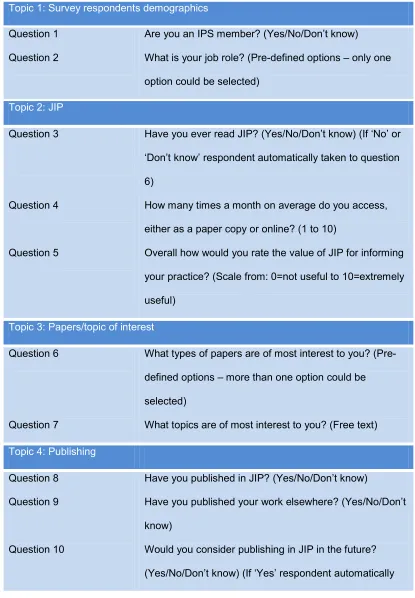
willingness to participate in the survey. The questionnaire consisted of twelve
questions (Table I). All questions had pre-defined options (except question seven
which allowed free text), to ensure quick completion and good response rates. Not all
questions were required to be answered by all respondents. Some questions only
allowed one option to be chosen whilst other questions permitted more than one option
to be selected. One question used a Likert scale. Descriptive analysis using
frequencies and percentages was used to analyse the responses. Content analysis
(Silverman 2010) identified themes from free text and was used to report on the most
frequent responses. 8
For Peer Review
ResultsThe total number of participants who completed the survey was 79; of these 58 (73%)
were IPS members and 65 (83%) indicated that they read JIP. Forty-five (58%) of the
survey respondents worked in an infection prevention and control job role.
Respondents preferred to read the hard copy of JIP (n=56, 89%) rather than online
(n=24, 38%), with most reading it once or twice a month (n=45, 90%). Most
respondents read JIP soon after receiving it and 47 (72%) rated it as useful for
informing their practice (score of between 7 and 10).
Overall 72 (91%) of respondents have never published in JIP, although 29 (40%) have
published elsewhere. Although, 16 (20%) participants would not consider publishing in
JIP in the future, the main reason given for this was ‘I don’t have anything suitable for
publication’ (n=6, 38%). Some of the other reasons given for not publishing in JIP
were: never having written for publication (n=4, 25%); lack of time (n=3, 19%); lack of
confidence (n=1, 6%) and not having the necessary skills (n=1, 6%). The most
common factor mentioned that would encourage respondents to publish was the
provision of some type of support (n=29, 37%), followed by training in writing for
publication (n =8; 10%) and time (n=7; 9%) (Figure I). 8
For Peer Review
DiscussionAlthough many previous studies have investigated specific approaches to support
writing for publication, this survey has gathered opinions about barriers and facilitators
to publishing directly from healthcare professionals attending an infection prevention
and control conference. The key barriers to writing for publication identified in this
survey were not having suitable work to publish, lack of writing experience, confidence
or skills and insufficient time. These mirror those reported in earlier literature (Dowling
et al 2013, Keen et al 2007, McGrail et al 2006, Staudt et al 2003). A systematic
review of the interventions to increase publication rates concluded that writing courses,
writing mentorship and support groups are all facilitators in helping support and
motivate authors to publish their work (McGrail et al 2006). This is borne out by this
survey which indicated that support from others and training in writing for publication
were the most important factors that would encourage respondents to publish.
Writing is a skill which can be taught and learned (Rickard et al 2009). Training can be
delivered in various formats such as writing courses, workshops or via writing
seminars. Two studies explored how writing courses can help and support writing for
publication (Richardson and Carrick-Sen 2011, Murray and Newton 2008). Murray and
Newton’s (2008) qualitative study involved interviewing allied health professionals who
had previously attended a six month writing for publication course and discovered that
those who attended had improved writing confidence, enhanced writing skills and 8
For Peer Review
increased publication productivity. Another study outlined the effect of a five session
writing seminar series on encouraging publishing behaviours amongst nurses and
found this approach to be more effective in increasing publication rates than a one day
workshop (Lawrence and Folcik 1996).
Time to write was also cited as a factor which would aid publishing, although this can
be challenging for those working in clinical settings where other aspects of the role may
be perceived to take precedence. Murray and Newton (2008) highlighted the
importance of providing ongoing support to writers after course attendance to ensure
time and space to write is provided within the workplace. There are different types of
support and support groups and mentor support were mentioned as key approaches by
our respondents to help facilitate them to publish. The practical and psychological
benefits of these support methods have also been regularly documented in other
studies and include: information sharing; discussion; constructive feedback; motivation;
confidence; encouragement; peer support (Frantz et al 2011, Richardson and
Carrick-Sen 2011, Keen 2007, Rickard et al 2009, Steinert et al 2008). Facilitating both time
and support systems for writing for publication should be recognised as essential since
the UK competences for practitioners in infection prevention and control require that
they both participate in and disseminate knowledge from research and other related
activities (Burnett 2011). Sharing evidence from research or the implementation of
novel practice is also fundamental to assuring high quality infection prevention and
control services (Wilson 2015). 8
For Peer Review
An easier publication and submission process and the provision of written guidance
were also reported as factors which would encourage respondents to publish and these
findings are supported in a study by Staudt et al (2003) which suggested that courses
and curriculums should provide information on the publication process. Collaborative
writing involves a team of writers working together to produce a publication and is a
useful process for inexperienced writers because they can be supported by more
experienced writers, thereby enhancing quality and productivity (Price 2014 and Keen
2007).
In conclusion, this survey has highlighted that whilst many IPC practitioners value JIP
in informing their own practice, most are reluctant to publish themselves. Provision of
training in writing for publication and support through mentorship are strategies that
may encourage more practitioners to disseminate their work through publication.
For Peer Review
ReferencesAlbarran JW and Scholes J. (2005) How to get published: seven easy steps. Nursing in
Critical Care 10(2): 72-77.
Burnett E. (2011) Outcome Competences for Practitioners in Infection Prevention and
Control. Journal of Infection Prevention. 12: 57-90.
Dowling DA, Savrin C and Graham GC. (2013) Writing for publication: perspectives of
graduate nursing students and doctorally prepared faculty. Journal of Nursing
Education 52(7): 371-375.
Frantz J, Phillips J and Rhoda A. (2011) Coaching for publication in higher education:
views of the coach. TheInternet Journal of Allied Health Sciences & Practice 9(2): 1-7.
Hicks C. (1993) A survey of midwives’ attitudes to, and involvement in, research: the
first stage in identifying needs for a staff development programme. Midwifery 9: 51-62.
Kapp CA, Albertyn RM and Frick BL. (2011) Writing for publication: an intervention to
overcome barriers to scholarly writing. South African Journal of Higher Education 25(4):
741-759.
Keen A. (2007) Writing for publication: pressures, barriers and support strategies.
Nursing Education Today 27: 382-388. 8
For Peer Review
Lawrence MM and Folcik MA. (1996) Writing for publication. Journal of Nursing Staff
Development 12(6): 289-293.
McGrail MR, Rickard CM and Jones R. (2006) Publish or perish: a systematic review of
interventions to increase academic publication rates. Higher Education Research &
Development 25(1): 19-35.
Murray R and Newton M. (2008) Facilitating writing for publication. Physiotherapy
94(1): 29-34.
Ness V, Duffy K, McCallum J and Price L(2014)Getting published: Reflections of a
collaborative writing group. Nurse Education Today 34 (1): 1-5.
Richardson A and Carrick-Sen D. (2011) Writing for publication made easy for nurses:
an evaluation. British Journal of Nursing 20(12): 756-759.
Rickard CM, McGrail MR, Jones R, O'Meara P, Robinson A, Burley M and Ray-Barruel
G. (2009) Supporting academic publication: evaluation of a writing course combined
with writers' support group. Nurse education today 29(5): 516-521.
Silverman D. (2010) Doing Qualitative Research Third Edition: SAGE Publications Ltd:
California
Staudt MM, Dulmus C and Bennett GA. (2003) Facilitating writing by practitioners:
survey of practitioners who have published. Social work 48(1): 75-83. 8
For Peer Review
Steinert Y, McLeod PJ, Liben S and Snell L. (2008) Writing for publication in medical
education: The benefits of a faculty development workshop and peer writing group.
Medical Teacher 30: e280-e285.
Wilson J. (2015) The art of scientific publication. Journal of Infection Prevention. 16:
245-6. 8
For Peer Review
Conflict of interest statementThe authors declare that there is no conflict of interest 8
For Peer Review
Question 1
Question 2
Are you an IPS member? (Yes/No/Don’t know)
What is your job role? (Pre-defined options – only one
option could be selected)
Topic 2: JIP
Question 3
Question 4
Question 5
Have you ever read JIP? (Yes/No/Don’t know) (If ‘No’ or
‘Don’t know’ respondent automatically taken to question
6)
How many times a month on average do you access,
either as a paper copy or online? (1 to 10)
Overall how would you rate the value of JIP for informing
your practice? (Scale from: 0=not useful to 10=extremely
useful)
Topic 3: Papers/topic of interest
Question 6
Question 7
What types of papers are of most interest to you?
(Pre-defined options – more than one option could be
selected)
What topics are of most interest to you? (Free text)
Topic 4: Publishing
Question 8
Question 9
Have you published in JIP? (Yes/No/Don’t know)
Have you published your work elsewhere? (Yes/No/Don’t
know)
For Peer Review
Question 12
only one option could be selected)
What would encourage you to publish your work?
(Predefined options - more than one option could be
selected)
For Peer Review
37.2% (29) 10.3% (8)
15.4% (12) 9.0% (7)
7.7% (6) 6.4% (5) 5.1% (4) 3.8% (3) 1.3% (1) 1.3% (1) 1.3% (1) 1.3% (1)
3.8% (3)
0.0% 10.0% 20.0% 30.0% 40.0%
Support* Training in writing for publication Nothing Time Easier publication/submission process Having suitable material If journal had an impact factor Written guidance eg. template If journal had additional type of publication eg.
Poster
Personal invitation General invitation Team publishing N/A answer
* Includes: publication support group (6%); mentor support (6%); editorial support (5); unspecified support (5%); workplace support (5%); branch support (4%); online support (4%); support from academics (1%)