Enhancing Electronic Intelligent Tutoring
Systems by Responding to Affective States
A thesis presented in partial fulfillment
of the requirements for the degree of
Doctor of Philosophy
in Computer Science
Faculty of Computing, Engineering and the Built Environment
at Birmingham City University, UK
Xiaomei Tao
Abstract
The overall aim of this research is the exploration mechanisms which allow an
understanding of the emotional state of students and the selection of an appropriate
cognitive and affective feedback for students on the basis of students' emotional state
and cognitive state in an affective learning environment. The learning environment in
which this research is based is one in which students learn by watching an
instructional video. The main contributions in the thesis include:
A video study was carried out to gather data in order to construct the emotional
models in this research. This video study adopted a methodology in qualitative
research called “Quick and Dirty Ethnography”(Hughes et al., 1995). In the video
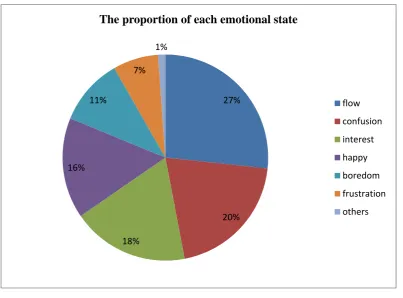
study, the emotional states, including boredom, frustration, confusion, flow,
happiness, interest, were identified as being the most important to a learner in
learning. The results of the video study indicates that blink frequencies can reflect
the learner's emotional states and it is necessary to intervene when students are in
self-learning through watching an instructional video in order to ensure that
attention levels do not decrease.
A novel emotional analysis model for modeling student’s cognitive and emotional
state in an affective learning system was constructed. It is an appraisal model
which is on the basis of an instructional theory called Gagne’s theory (Gagne,
1965).
A novel emotion feedback model for producing appropriate feedback tactics in
approach. On the basis of the tutor-remediation hypothesis and the
self-remediation hypothesis (Hausmann et al., 2013), two feedback tactic
selection algorithms were designed and implemented.
The evaluation results show: the emotion analysis model can be used to classify
negative emotion and hence deduce the learner’s cognitive state; the degree of
satisfaction with the feedback based on the tutor-remediation hypothesis is higher
than the feedback based on self-remediation hypothesis; the results indicated a higher
degree of satisfaction with the combined cognitive and emotional feedback than
Acknowledgements
Primarily, I would like to thank my main supervisor, Mike Jackson, who has been an
unceasing source of advice, feedback, guidance, support and encouragement during
the whole Phd research stage. I am also very grateful to Dr Martyn Ratcliffe, my
study director, and Prof Qinzhou Niu, my local supervisor, who both supplied lots of
advice, guidance, support, idea and disscussions to me. And I also express my thanks
to Dr. Bin Hu for his help when he was in the supervisor team.
I would like to thank the teachers and students who participated in the video study and
the evaluation in the research work, especially my colleges: Jili Chen, Hengzhou Ye,
Xinxiao Li, Xiaohui Chen, Yu Wang, Mingliang Zou, Qiu Lu, Qiang Guo, Hanying
Liu, Yunsheng Ge. And I also want to express my thanks to the developers of the
evaluation system, Jian Huang, Hai Lu.
I would like to express my appreciation to Prof. Paul Bowker, Prof. Peter J. Larkham,
Prof. John Sparrow, for their advice to my research.
Finally, in particular, I would like to thank to all of my family, and especially my
parents, my husband David and my son, my husband's parents, for their consistent
Publications
Journal articles
1. TAO, X. & NIU, Q. 2013. Using Ethnography Method to Collect Emotional Data
in Affective Learning Research. International Journal of Information and
Electronics Engineering, 3, 216-220.
2. XIAO-MEI, T. & QIN-ZHOU, N. 2013. An emotion classification algorithm
based on the blink frequency detection and Bayesian network in affective
learning. Computer Science, 40, 287-291.
3. XIAOMEI, T. & QINZHOU, N. 2015. Study of an algorithm about producing
instructional feedback strategy based on an affective learning ontology. Computer
Engineering & Science, 37, 320-328.
4. XIAOMEI, T. & QINZHOU, N. 2015. Study of an algorithm about producing
utility optimal instructional feedback tactics based on Ontology and Influence
Diagram model in Affective Computing. Application Research of Computers 32,
427-433.
International conferences
1. XIAOMEI, T., QINZHOU, N., JACKSON, M. & HU, B. A theoretical
framework of pedagogical agents based on psychological incentive mechanism
and Artificial Psychology theory. IT in Medicine and Education, 2008. ITME
Table of contents
1 Introduction ... 1
1.1 Statement of the problem ... 1
1.2 Research goals ... 4
1.3 Research contributions ... 5
1.4 Structure of the thesis... 8
2 Literature review of basic concepts in general affective learning system ... 10
2.1 Study of emotion ... 10
2.1.1 Emotion in learning ... 10
2.1.2 Representation of emotion ... 13
2.1.3 Emotion and cognition in learning ... 15
2.2 Affective learning ... 17
2.2.1 Concept of affective learning ... 17
2.2.2 Affective learning systems ... 18
2.3 “Teacher immediacy” and “student immediacy” ... 27
2.4 How an affective learning system responds to a learner ... 29
2.4.1 Event-driven feedback and emotion-driven feedback ... 29
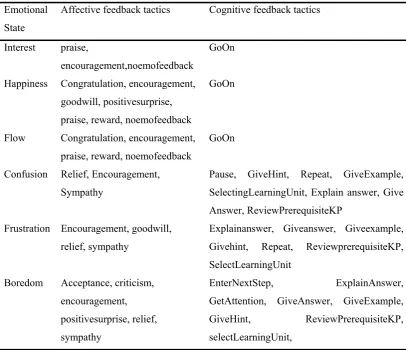
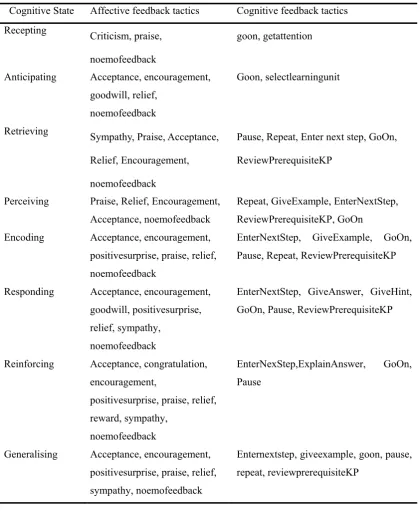
2.4.2 Affective and Cognitive feedback tactics ... 31
2.5 Summary ... 35
3 Background study ... 36
3.1.1 Methods ... 36
3.1.2 Non-interactive environments ... 37
3.1.3 Interactive environment ... 40
3.2 Data processing ... 42
3.2.1 Processing the data in the students’ video ... 43
3.2.2 Processing the data in the instructional video ... 45
3.2.3 Processing the data in the stimulated recall ... 47
3.3 Results ... 48
3.3.1 Result 1 ... 48
3.3.2 Result 2 ... 49
3.3.3 Result 3 ... 51
3.3.4 Result 4 ... 53
3.4 Discussion ... 59
3.4.1 Discussion about the necessity of interference for self-learning by watching video ... 59
3.4.2 Discussion about how to use blink frequency in affective learning ... 60
3.5 Summary ... 62
4 Emotion analysis model and feedback model ... 64
4.1 Introduction ... 64
4.2 Related research work of emotion models ... 68
4.3 Emotional models in the affective learning system ... 69
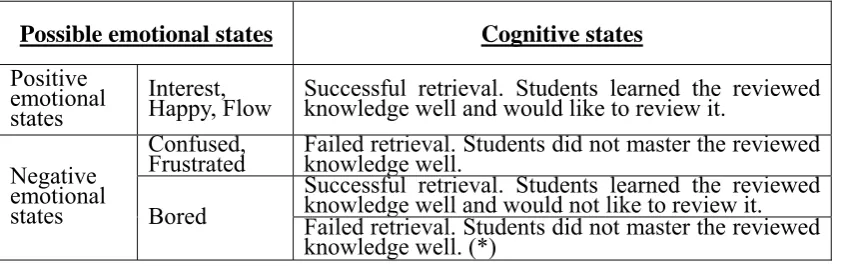
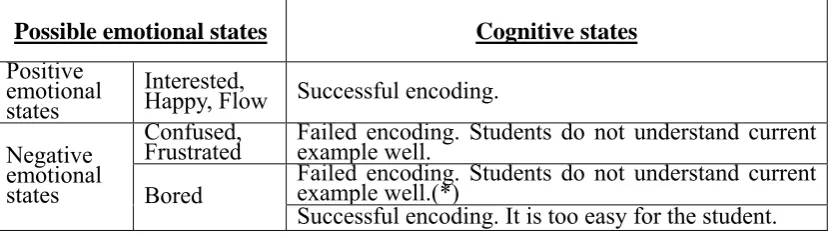
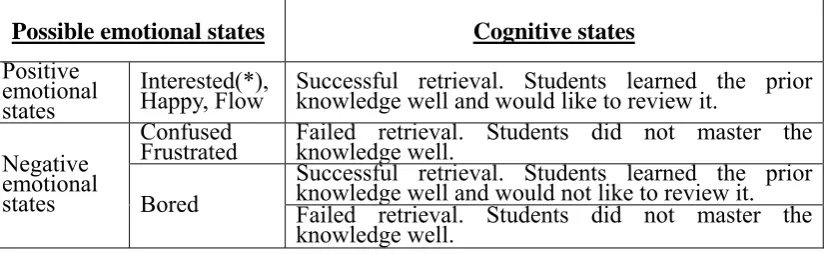
4.4 The Emotion analysis model ... 71
4.4.2 Introduction of Bayesian networks ... 73
4.4.3 Emotion representation model ... 75
4.4.4 Emotional state and corresponding cognitive state ... 76
4.4.5 Using a Bayesian belief network to model the learner’s emotion ... 81
4.5 Emotion feedback model ... 86
4.5.1 Review of modeling techniques in the emotion feedback model ... 87
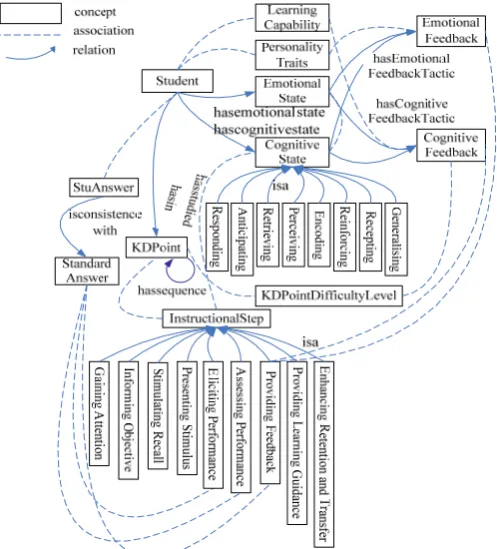
4.5.2 Affective learning Ontology ... 93
4.5.3 Feedback tactic selection Influence Diagram Model ... 105
4.5.4 An algorithm which produces utility optimal instructional feedback tactics based on the self-remediation hypothesis ... 110
4.5.5 An algorithm to produce utility optimal instructional feedback tactics based on tutor-remediation hypothesis ... 116
4.6 Summary ... 118
5 Evaluation ... 120
5.1 Stage 1 ... 121
5.1.1 Experimental hypothesis ... 122
5.1.2 Data ... 122
5.1.3 Method ... 122
5.1.4 Results ... 123
5.2 Stage 2 ... 126
5.2.1 Experimental hypothesis ... 127
5.2.3 Evaluation Data ... 128
5.2.4 Participants ... 131
5.2.5 Experimental process ... 131
5.2.6 Results and analysis ... 132
5.3 Stage 3 ... 135
5.3.1 Experimental hypothesis ... 136
5.3.2 Method ... 136
5.3.3 Evaluation Data ... 136
5.3.4 Participants ... 137
5.3.5 Experimental process ... 137
5.3.6 Results and analysis ... 138
5.4 Summary ... 141
6 Discussion ... 142
6.1 The video study ... 142
6.1.1 Learning content ... 142
6.1.2 Subjects in the video study ... 144
6.1.3 Settings ... 144
6.1.4 Is there enough data? ... 145
6.1.5 Improvements to the coding scheme ... 145
6.2 Emotion analysis model and emotion feedback model ... 147
6.2.1 The feasibility of using eye blink to determine emotional state ... 147
6.2.3 Improvements to the affective learning ontology ... 148
6.2.4 Improvements to the influence diagram model ... 149
6.3 The Evaluation results... 151
6.3.1 Discussion to the evaluation results in stage 1 ... 151
6.3.2 Discussion of the evaluation results in stage 2 ... 155
6.3.3 Discussion to the evaluation results in stage 3 ... 155
6.3.4 Summary ... 156
7 Conclusion ... 157
7.1 Answers to the research questions ... 157
7.2 Research Contributions ... 159
7.3 Future Work ... 163
7.4 Summary ... 165
References ... 167
Appendix A The affective learning Ontology ... 179
Appendix B Cases in the evaluation ... 219
Chapter 1
1
Introduction
1.1
Statement of the problem
Imagine you are studying a course by watching a video lecture using a computer,
while you are engaged and understand the lecture well, the video goes smoothly.
When you are confused about a knowledge point in the lecture, the system will stop
and suggest that you watch the clip again and start playing from the correct place with
your permission. Or the system suggests that you review related clips and relocates
the start point at where the prerequisite knowledge point is located. If you feel bored
about a trivial knowledge point, the system will suggest that you jump over this clip
and begin the next knowledge point. As well as recommending which video clip you
should view, the system supports you with emotional feedback. The system responds
to you with encouraging, relaxed words when you feel frustrated. The system attracts
your attention when your mind begins to wander. The system leaves you alone when
you are deeply engaged in learning, and responds to you intelligently in order to
maintain you in a positive state and relieve you from negative emotions.
Computer-based lecture videos have become an increasingly popular method for the
delivery of distance learning in both higher education and commercial companies.
Standard video players interact with users via the control play facilities, such as
forward/reverse control, fast and slow motion, and play point relocate etc, but cannot
satisfactory solution for learning by instructional video involves enhancing the
computer system so that it can offer feedback intelligently as a human tutor does in
the classroom. An intelligent tutoring system (ITS) can provide direct customized
instruction or feedback to students (Psotka, 1988). Human tutors understand learners’
cognitive states and emotional states on the basis of their observation and experience.
Previous research on traditional ITS, however, is mostly based on a learner’s
pedagogical state, for example Summary Street (Franzke et al., 2005), Autotutor
(Graesser et al., 2005), REALP (Heffernan et al., 2006), eTeacher (Schiaffino et al.,
2008), ZOSMAT (Keleş et al., 2009), Help Tutor (Roll et al., 2011). The
communication of emotion between the students and the tutors is rarely taken into
account.
With the development of Affective Computing (Picard, 1997), it has become possible
to enhance an ITS system or e-learning system with emotional intelligence. Affective
Computing is defined by Picard (1997) as “computing that relates to, arises from or
deliberately influences emotions”. Research in Affective Computing encompasses
recognizing, interpreting, processing, and simulating human affects. Affective
Computing research in the educational field has considered the contribution of
emotional factors to e-learning systems. This has led to the development of affective
learning systems. Affective learning systems are e-learning systems enhanced with
affective abilities in order to recognize the learner’s emotional states and respond
intelligently. Research into affect recognition has made great progress in recent years
This work has demonstrated that it is possible to detect emotional states. The main
thrust of the research described in this thesis is not to duplicate previous work but
rather to show the way in which knowledge of the emotional state of a student can
inform the delivery of material in an e-learning environment.
The overall research hypothesis is: it is beneficial to provide cognitive and emotional
feedback when students are in self-learning through watching an instructional video,
and to feedback from both cognitive and emotional aspects is better than only using
single cognitive feedback.
The research problem set out below considers how to respond to affective states in an
affective learning system:
1) Most work in affective computing has focused on the six basic emotions: fear,
anger, happiness, sadness, disgust, and surprise (Ekman and Friesen, 1978a). In a
learning environment, however, learners rarely experience sadness, fear, or
disgust (D'Mello et al., 2007). Even the most widely adopted affective model, the
OCC model of emotion (Ortony et al., 1990), does not include many of the
affective phenomena observed in natural learning situations, such as interest,
boredom, or surprise. So the first problem is to understand which emotions are
most important to a learner in learning, including how to represent these
emotional states.
2) Most studies that have been done so far have focused on emotion recognition by
the interpretation of facial expression, gesture, bio-feedback signals etc. The term
but only a pattern of measurable external changes associated with feelings (Picard
et al., 2004). Hence the second problem is to explore what causes such emotional
states in a learning environment and how to implement the analysis process by
use of a computational model.
3) When the affective analysis is complete, the system needs to produce a response
to the learner. There is some indication that positive affect increases intrinsic
motivation (Estrada et al., 1994). Minsky (2007) also states, “when we change
what we call our ‘emotional states’, we’re switching between different ways to
think”. It is, therefore, a vital task in an affective learning system to generate an
appropriate response to the learner. The third problem is how to generate the
feedback to the learners in an affective learning system.
In summary, there are three research questions in this thesis:
Question 1: Which emotions are most important to a learner in learning and how
to represent these emotional states?
Question 2: What causes such emotional states in a learning environment and
how to implement the analysis process by use of a computing model?
Question 3: How to use a computing model to generate the feedback to the
learners in terms of their cognitive and affective states?
1.2
Research goals
understand the emotional state of students and how to select an appropriate feedback
tactic for the students in affective learning environment. Feedback tactic means a
description about how to respond the student, which contains both aspects of
cognitive and emotional feedback. A feedback tactic could be a tutorial action such as
reviewing the prerequisite knowledge point, or an emotional intervention such as
saying encouraging words. In this study, we consider learning by video because it is a
universal and low cost way for learning, and it is close to classroom teaching.
This overall aim can be broken down into the following four main sub-goals:
1) To gather data about how students behave when they study by watching an
instructional video and how human tutors and students interact with each other in
classroom tutoring scenario. This goal is addressed in chapter 3.
2) To develop a method for understanding a learner’s emotional state. This goal is
addressed in chapter 4.
3) To develop a method for selecting appropriate feedback tactics in accordance
with a learner’s emotional and cognitive state in an affective learning
environment. This goal is addressed in chapter 4.
4) To develop an evaluation system by applying the outcomes of goals 2-3. This
goal is addressed in chapter 5.
1.3
Research contributions
contributions that this thesis makes:
1) A video study was carried out to gather data, including the student’s emotional
states, what causes these emotional states, and how the tutor responds the learners,
etc. The video study and its findings will be addressed in detail in chapter 3.
This video study adopted a methodology in qualitative research called
“Quick and Dirty Ethnography”. This approach is capable of providing much
valuable knowledge in an affective learnng environment setting in a
relatively short space of time.
The emotional states, including boredom, frustration, confusion, flow,
happiness, interest, were identified as being the most important to a learner in
learning.
The results of the video study indicates that the blink frequencies can reflect
the learner's emotional states and it is necessary to intervene when students
are in self-learning through watching instructional video in order to ensure
that attention levels do not continue to decrease.
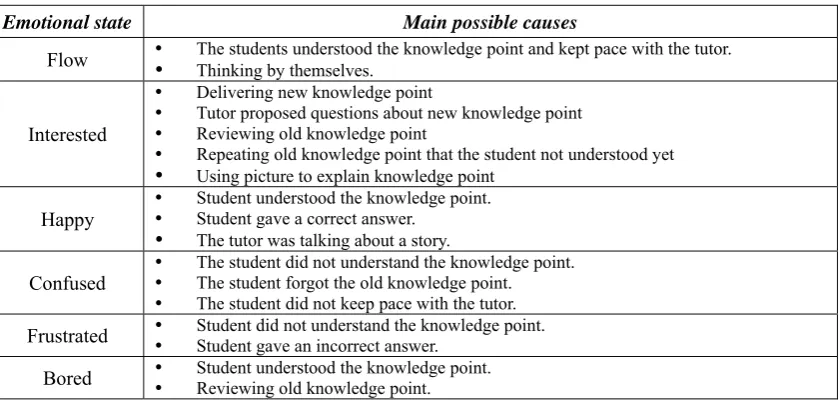
The main causes for each emotional state of students in learning and teachers’
interpretations about the causes of their activities during teaching are
collected. These data collected are used to construct the emotion
understanding and feedback models.
2) A novel emotional analysis model for modeling student’s cognitive and emotional
state in an affective learning system was constructed. The construction and
In the emotion analysis model, a novel method was proposed to classify the
emotion into positive or negative state using the eye blink frequency.
The emotion analysis model is developed via a Bayesian Belief Network
(BBN) reasoning approach and it is used to determine the student’s cognitive
and emotional state while watching an instructional video.
This Bayesian network is an appraisal model which could deduce the
cognitive and emotional state. The construction of this network is on the
basis of an instructional theory called Gagne’s theory, which divides a
learning process into nine instructional steps, and the relationship between
each instructional step and its corresponding cognitive state.
The model was validated using 10-fold cross-validation and the evaluation
restult proved that this model can classify negative emotion and deduce the
learner’s cognitive state.
3) A novel method for producing appropriate feedback tactics in affective learning
system was developed by Ontology and Influence Diagram (ID) approach. The
ID model is used to select appropriate cognitive and emotional feedback tactics in
term of the student’s current cognitive and emotional state using utility analysis.
The construction and the evaluation of the feedback decision ID model will be
addressed in chapter 4 and chapter 5.
Considering the affective feedback has impact on the affective and cognitive
states in next time slot, the ID model splits affective feedback and cognitive
before cognitive feedback.
On the basis of the tutor-remediation hypothesis and the self-remediation
hypothesis, two feedback tactic selection algorithms were designed and
implemented respectively.
The evaluation results show that the degree of satisfaction with the feedback
based on the tutor-remediation hypothesis is higher than the feedback based
on self-remediation hypothesis. And the results indicated a higher degree of
satisfaction with the combined cognitive and emotional feedback than
cognitive feedback on its own.
1.4
S
tructure of the thesis
The structure of the thesis is as follows:
Chapter 2:
We introduce the concept of emotion and the representation model of emotion, and
discuss the interaction between cognition and emotion in learning. Then, we review
the research progress in the field of affective computing and affective learning. In
particular, we review the ways of how affective learning systems respond a learner,
and discuss modeling techniques.
Chapter 3:
This chapter presents the methodology, experimental design and results of the video
study that involves non-interactive and interactive learning environments in a
in the stimulated recall after the interactive learning exercise is used to construct the
emotion understanding and feedback models.
Chapter 4:
In this chapter, we introduce the methods for modelling students’ cognitive and
emotional states, and the methods for selecting appropriate cognitive and emotional
feedback in an affective learning system. We use the Bayesian Belief Network and
Influence Diagram as the modeling tools, and the data gathered in the video study to
construct the emotion understanding model and feedback model.
Chapter 5:
We present the methodology and result of the evaluation study of the video based
affective learning system. Given a learning scenario and student’s profile, experienced
teachers evaluate the feedback tactics generated by the affective learning system.
Chapter 6:
In this chapter, we discuss and analyse the methodology and results in this study.
Chapter 7:
The conclusions are presented and potential future research which extends the work
Chapter 2
2
Literature review of basic concepts in
general affective learning system
In this section, we overview research related to the study of emotion and cognition,
affective computing and affective learning, and how affective learning systems
respond to the learner.
2.1
Study of emotion
2.1.1
Emotion in learning
Today, the study of emotion involves diverse fields, such as psychology, cognitive
science, computer science, education, neuroscience, engineering, etc., however, there
is not an agreed definition of emotion. Kleinginna & Kleinginna (1981) analyzed
nearly one hundred definitions related to emotion and reported that emotion is a
complex set of interactions among subjective and objective factors, mediated by
neural/hormonal systems. In this thesis, the definition from Parkinson & Colman
(1995) is adopted, in which they define emotion as “a relatively short-term, evaluative
state focused on a particular intentional object (a person, an event, or a state of
affairs)”. Other terms which have the same meaning are “affective state” or
“emotional state”, so this thesis uses the terms interchangeably.
process and this must be addressed in the theory and practice of teaching/learning
(O'Regan, 2003).With an increase of understanding about how emotional states affect
learning, over the last few years, attention has increasingly been drawn to
incorporating learners’ emotional states into Intelligent Tutoring Systems (ITS).
Ekman’s six basic emotions (Ekman and Friesen, 1978b), namely fear, anger,
happiness, sadness, disgust, and surprise, have been adopted in many affective
computing research publications, such as (Black and Yacoob, 1995, Lien, 1998,
Hamdi et al., 2012, Das and Bandyopadhyay, 2010). Learning is a process of
acquiring new knowledge or skill and the emotions encountered in the learning
process have their own characteristics and special meanings. In the learning
environment, what emotions are associated with studying?
Pekrun et al.(2002) studied the ‘occurrence and phenomenological structures of
academic emotions’. The most frequently reported learners’ emotional states are
anxiety, enjoyment of learning, hope, pride, and relief, as well as anger, boredom and
shame. O'Regan (2003) explored the lived experience of students learning online. The
emotions specifically identified experienced by students during learning experiences
are frustration, fear/anxiety, shame/embarrassment, enthusiasm/excitement and pride.
These have a variable effect on the learning process depending on the strength and
nature of the emotion, as well as the learning context. Kort et al.(2001) proposed the
emotion sets possibly relevant to the SMET (Science, Mathematics, Engineering, and
Technology) learning process, which includes pairs of anxiety-confidence,
terror-enchantment and each pair embracing 6 emotional states from negative to
positive states (for example, the pair of anxiety-confidence includes Anxiety, Worry,
Discomfort, Comfort, Hopeful, Confident). Craig et al (2004) observed the occurrence
of six affective states during learning with an intelligent tutoring system using a
manual affect coding system. They analysed frustration, boredom, flow, confusion,
eureka and neutral and found significant relationships between learning and the
affective states of boredom, flow and confusion. Afzal & Robinson (2006) have
derived an emotion set that represents five affective states in learning scenarios: afraid,
angry, bored, interested and unsure. D'Mello et al. (2007) confirmed the hypothesis
that the basic emotions (anger, disgust) do not play significant roles in learning, the
most common states were neutral, confusion, and boredom, and the frequency of
occurrence of delight, frustration, and surprise — was significantly lower.
From the literature study above, it can be seen that there is no unified and standard
theory or framework to describe the relationship of emotion to learning. For example,
there is no consistency in the conclusions reported in the literature, as to whether the
emotional state of “anger” appears in learning or not.
On the basis of the statistics analysing to the words describing emotion as they appear
in the literature mentioned above, a total of 59 different words describing emotions
were counted. After merging of the similar semantic terms, there were 27 different
words left. On the basis of the statistical frequency of the occurrence of the 27 words,
the words and the frequency of the occurrence ranking in the top 6 respectively are:
absorption with the activity at hand and the situation (Csikszentmihalyi, 1990),
synonymous semantic terms are "calm", "indifference", "insight". The synonymous
terms of "happiness" are "delight", "enjoyment", "satisfied", "eureka". The
synonymous terms of "interest" are "intrigue" and "curiosity". The synonymous terms
of "frustration" are "dispirited" and " disappointed". The synonymous term of
"Boredom" is "ennui". The top six emotional states were selected as the emotions to
be studied in our research, and those emotional states will be examined by a
qualitative methodology which described in Chapter 3.
2.1.2
Representation of emotion
There are two common emotion representation models: categorized emotion
representation and dimensional emotion representation(Schröder, 2004).
Categorized emotion representation means using emotion-denoting words, or category
labels in human languages to describe emotions. For example, Ekman’s six basic
emotions (Ekman and Friesen, 1978b), namely fear, anger, happiness, sadness, disgust,
and surprise, were mentioned in section 2.1.1.
In the dimensional emotion representation method, the emotions are represented by
multidimensional scales. The most common dimensions are pleasure, arousal and
dominance (Mehrabian and Russell, 1974), which respectively range from happy to
sad, from calm to excited, and from in control to out of control. An emotional state is
represented by a PAD (Pleasure, Arousal, Dominance) model with numerical values,
classify affective states is simply to distinguish between the positive and the negative
values (the valence) and react both to absolute values of valence and to changes of
valence.
Both representations have been adopted in the affective learning systems. A complete
dimensional representation covers all the feeling of emotional experience and
eliminates the need for classifying the emotional states into certain categories. The
categorical model expresses specific meaning for each state, but the boundary
between every two different emotional states has to been drawn by defining the
threshold for the observed parameters which measure affective response. Cowi et al.
(1999) states that emotion categories can be located in an emotion dimension space
via rating tests. Schröder (2004) argued that the inverse is not possible, as emotion
dimensions only capture the most essential aspects of an emotion concept, they
provide an underspecified description of an emotional state. Although we cannot
match every emotion representation in the emotion space with a specific category
precisely, we can adopt AI techniques to accomplish this classification to a certain
extent. For example, Muñozet et al. (2011) uses the Control-Value theory of
achievement emotions and employs motivational and cognitive variables to determine
an emotion by using Dynamic Bayesian Networks (DBNs). A Dynamic Bayesian
Network (DBN) is a Bayesian Network which relates variables to each other over
adjacent time steps (Dagum et al., 1995). A Bayesian Network (BN) is a probabilistic
graphical model (a type of statistical model) that represents a set of random variables
Bayesian belief network (BBN) (Russell et al., 1995). Chapter 4 will demonstrate how
to use a Bayesian Network and learning context information to determine the
emotional state and the cause of the emotional state, and also how to use a Dynamic
Bayesian Network to model the emotion feedback tactic selection process.
2.1.3
Emotion and cognition in learning
Cognition is mental processes including attention, memory, producing and
understanding language, solving problems, and making decisions. Human emotion
and cognition are completely intertwined with each other in guiding rational behavior
and decision-making (Goleman, 1995, Norman, 1980). Clore & Palmer (2009) state
that positive affect tends to promote cognitive, relational processes, whereas negative
affect tends to inhibit relational processing, resulting in more perceptual,
stimulus-specific processing.
During the learning process, on the basis of Gagne's instructional theory (Gagne,
1965), there is a nine-step process called the events of instruction, and each step
correlates to a certain cognitive process. In (Chaffar and Frasson, 2005), the authors
proposed some emotional conditions of learning that should exist corresponding to
each cognitive process in order to improve learning, such as in the cognitive process
of attention, emotional conditions are: avoiding negative emotions, avoiding emotions
like joy or sadness that are not related to the learning activity, and inducing the
emotion of curiosity by highlighting an element in the interface suddenly.
evaluations (appraisals) of events and situations. And Ortony et al. (1988) proposed
an appraisal based model of emotions called the Ortony, Clore and Collins’s (OCC)
model, which describes the cognitive structure of emotions and have been employed
to generate emotions for embodied characters. In the definition in IGI Gloal (2016),
“OCC model is a widely used model of emotion that states that the strength of a given
emotion primarily depends on the events, agents, or objects in the environment of he
agent exhibiting theemotion. A large number of researchers have employed the OCC
model to generate emotions for their embodied characters. The model specifies about
22 emotion categories and consists of five processes that define the complete system
that characters follow from the initial categorization of an event to the resulting
behaviour of the character. These processes are namely a) classifying the event, action
or object encountered, b) quantifying the intensity of affected emotions, c) interaction
of the newly generated emotion with existing emotions, d) mapping the emotional
state to an emotional expression and e) expressing the emotional state.”
OCC model provides a clear and convincing structure of the eliciting conditions of
emotions and the variables that affect their intensities. In this model, emotions arise
from valenced (positive or negative) reactions to situations consisting of events, actors
and objects. In a learning process, normally the learners’ goal is assumed to be
understanding their work, mastering new skills, developing abilities, improving their
level of competence, and learning new things. If those goals are achieved, the learner
will achieve positive emotional states; otherwise they will adopt negative emotional
Phelps (2006) suggested that the classic division between the study of emotion and
cognition may be unrealistic and that an understanding of human cognition requires a
consideration of emotion. In order to better understand the emotional states and
cognitive states, and to select appropriate feedback, it is necessary to consider
emotion and cognition in learning together.
2.2
Affective learning
2.2.1
Concept of affective learning
Research in neuroscience and psychology has indicated that emotion plays an
essential role in perception, learning and decision making, as it influences cognitive
processes (Goleman, 1995). As a consequence, a new sub discipline of Artificial
Intelligence, Affective Computing, has been developed. It is defined by Picard (1997)
as “computing that relates to, arises from or deliberately influences emotions”.
Research in Affective Computing encompasses recognizing, interpreting, processing,
and simulating human affects. Affective Computing research in the educational field
has considered the contribution of emotional factors to e-learning systems (D'Mello et
al., 2007, Woolf et al., 2009). This has led to the development of Affective Learning
Systems, which are e-learning systems enhanced with affective abilities in order to
2.2
Wit the emo affe Cry Prim (AB and and (Ru sele affe num year Figu tuto The2.2
Affect
th an increa
last few yea
otional state
ective learn
ystal Island,
me Climb:
BM) for inte
affective s
Five-facto
ussell et al.,
ect the tuto
ective behav
mber factori
rs.
ure 2-1 Hig
or model (Ru
e students w
tive learn
ase of unde
ars, attentio
e into the In
ning system
Mentor, Af
Hernández
elligent tuto
state, and th
or models (
, 2009) with
orial action
vior model
ization and
gh level repr
ussell et al.
were arbitra
ning syste
erstanding a
on has increa
ntelligent T
ms will be i
ffective Aut
and Sucar
oring system
he affective
(Costa and
h a utility m
ns according
l has been
was evalua
resentation o
, 2009)
rily divided
ems
about how e
asingly bee
Tutoring Sys
introduced,
toTutor, Ga
r (2007) dev
ms. The ABM
state is bas
McCrea,
measure on
g to the p
integrated
ated with 22
of the dynam
d into two g
emotional s
en drawn to
stem. In thi
they respe
aze Tutor.
veloped an
M considers
sed on the O
1992). A d
n both, lear
pedagogical
d into an e
2 students w
mic decisio
groups of 1
states affect
incorporati
s section of
ectively are
affective b
s the studen
OCC (Orton
dynamic de
rning and af
and affec
ducational
whose avera
on network f
11 students,
t learning,
ing the learn
f the thesis
e Prime Cl
behavior m
nt’s pedagog
ony et al., 1
ecision netw
affect is use
ctive state.
game to l
age age wa
for the affec
played with Prime Climb without the affective behavior model (control group) and the
second group played with Prime Climb with the affective behavior model
(experimental group). Firstly, each student was given a pre-test to evaluate the prior
knowledge of the students on factorization, and then the students played with Prime
Climb approximately during 20 minutes. After playing, each student was given a
post-test to determine if there was an increase in learning. In the control group the
agent instruction was only based on the student pedagogical model. The hints were
selected according to the student knowledge about factorization and presented in a
speech bubble. With the experimental group, the instruction was based on both the
pedagogical model and on the affective behavior model. The hints were still presented
through speech bubbles, but they were also accompanied by animations selected
according to the affective states of the student. In the control group, the difference
between pre-test and post-test was not statistically significant (two-tailed t-test, p =
0.88), confirming that students did not learn from the interaction. In the experimental
group, the difference between pre-test and post-test was not statistically significant
(two-tailed t-test, p = 0.67) confirming that, as in the control group, students learned
little from the interaction. Although the pre-test to post-test gain for the experimental
group was slightly higher than the gain for the control group, the difference is not
statistically significant. A possible reason why the difference was not statistically
significant was that the students did not play long enough for the ABM to make a
difference. In addition, the ABM model has been integrated to an intelligent learning
since they show a high agreement between the affective state established by the
affective student model and the affective state reported by the students(Hernández et
al., 2010). But in this evaluation, there was no evaluation about the learning gains
using the ABM model.
Crystal Island: Sabourin, J., et al. (2011) present work that investigates the benefits of
using theoretical models of learner emotions to guide the development of Bayesian
Networks for the prediction of student affect. Predictive models were empirically
learned from data acquired from 260 students interacting with the game-based
learning environment, Crystal Island. Results indicated the benefits of using
theoretical models of learner emotions to inform predictive models. Evaluation of the
model showed that the Bayesian Network could predict the emotion label with 25.5%
accuracy and could predict the valence of the emotional state with 66.8% accuracy.
The Dynamic Bayesian Network could predict emotional state with 32.6% accuracy
and valence with 72.6% accuracy.
Mentor: Leontidis et al. (2009) presented a Web-Based Adaptive Educational System
to support personalized distance learning, which is named Mentor. The main purpose
of Mentor was to support learners’ actions during the learning process in an affective
way. To achieve this Mentor incorporated an affective module which enhanced the
traditional learning practices with an affective dimension. The affective module made
use of an ontological approach in combination with a Bayesian Network model in
order to provide learners with the correct affective guidance. In total fifty-four
evaluation. The students were given an evaluation questionnaire to fill in where they
wrote down their impressions of Mentor. The questionnaire examined the impact of
the system in the students' learning process and the satisfaction from students'
interaction with the system using three levels, high, medium and low. The results
showed that the satisfaction level with Mentor’s interaction at high level is 88% and
the satisfaction level with the impact of the system at high level in their learning
process is 82%.
Affective AutoTutor: (D'mello et al., 2008, D'Mello and Graesser, 2009, D'mello and
Graesser, 2013) There are two versions of AutoTutor that detect and respond to
students’ affective and cognitive states (D’Mello et al., 2008, D'Mello and Graesser,
2009). These affect-sensitive versions of AutoTutor, called the Supportive and
Shakeup tutors, are collectively referred to as Affective AutoTutor. They used a set of
production rules that were designed to map dynamic assessments of the student’s
cognitive and affective states with tutor actions to address the presence of boredom,
confusion, and frustration. The system used a decision-level fusion algorithm where
each channel (conversational cues, face, and posture) independently provides its own
diagnosis of the student’s affective state. The major difference between the Shakeup
AutoTutor and the Supportive AutoTutor is in the source of emotion attribution.
While the Supportive AutoTutor attributed the students’ negative emotions to the
material or itself, the Shakeup AutoTutor directly attributed the emotions to the
students. Classification accuracies obtained from gross body language were 70%,
neutral baseline (baserate = 50%) (D’Mello, Picard, & Graesser, 2007). Taken
together, classification accuracies were 73% when each affective state was aligned
with the optimal sensory channel (D’Mello et al., 2008). Machine-learning
experiments yielded affect detection accuracies of 73%, 72%, 70%, 83%, and 74%,
respectively (chance = 50%) in detecting boredom, confusion, delight, flow, and
frustration, from neutral. Accuracies involving discriminations between two, three,
four, and five affective states (excluding neutral) were 71%, 55%, 46%, and 40% with
chance rates being 50%, 33%, 25%, and 20%, respectively (D'Mello and Graesser,
2009).
D'mello and Graesser (2013) tested the effectiveness of the Affective AutoTutor in
promoting deep learning gains in computer literacy sessions with 36 undergraduate
students and achieved some positive results. Firstly, the Supportive Tutor consistently
outperformed the Shakeup Tutor. Secondly, the Supportive AutoTutor was more
effective than the Regular tutor for students with a low level of prior knowledge (low
and high median split on pretest scores) in the second session, but not the first session.
Participating in the second session on a related subject matter might cause
interference with acquired knowledge in the first session. So, the tutor should be
supportive to these students when there has been enough context to show there are
problems. Thirdly, low prior-knowledge students learned significantly more from the
Supportive AutoTutor than the Regular tutor, while the students with more knowledge
did not benefit from the Supportive AutoTutor. These students with more knowledge
content.
Gaze Tutor: D'Mello et al.(2012) developed an intelligent tutoring system (ITS) that
aims to promote engagement and learning by dynamically detecting and responding to
students’ boredom and disengagement. The tutor used a commercial eye tracker to
monitor a student’s gaze patterns and identify when the student was bored, or
disengaged. The tutor then attempted to reengage the student with dialog moves that
directed the student to reorient his or her attentional patterns towards the animated
pedagogical agent embodying the tutor. The efficacy of the gaze-reactive tutor in
promoting learning, motivation, and engagement were evaluated in a controlled
experiment where 48 students were tutored on four biology topics with both
gaze-reactive and non-gaze-reactive (control condition) versions of the tutor. The
results indicated that: (a) gaze-sensitive dialogs were successful in dynamically
reorienting students’ attentional patterns to the important areas of the interface, (b)
gaze-reactivity was effective in promoting learning gains for questions that required
deep reasoning, (c) gaze- reactivity had minimal impact on students’ state motivation
and on self-reported engagement, and (d) individual differences in scholastic aptitude
moderated the impact of gaze-reactivity on overall learning gains.
Besides the affective learning systems presented above, more research work about
incorporating the learner's emotional states into the Intelligent Tutoring System is
presented briefly. Kort et al. (2001) proposed a comprehensive four-quadrant model
that explicitly linked learning and affective states. They used this model in their
learner’s affective state by monitoring facial features, posture patterns, and onscreen
keyboard and mouse behaviours. Conati (2002) proposed a probabilistic system which
tracked a learner’s emotions during interactions with an educational game. Her system
relied on dynamic decision networks to assess the affective states of joy, distress,
admiration, and reproach. Lahart, Kelly & Tangney (2007) described a system called
P.A.C.T., which provides personalised coaching for parents in their role as home
tutors. P.A.C.T. endeavoured to coach parents in a set of tutoring strategies that
provided a mechanism to positively influence the emotional state of the child
therefore enhancing the learning process. Yusoff & Boulay (2010) described an
affective tutoring system that added an emotion-focused strategy to a standard
problem focused strategy in order to help students better regulate their emotional
states. Lin et al. (2014) developed a novel ATS which included four modules:
affective recognition (combines facial emotion recognition and semantic emotion
recognition), tutor agent, content, and instruction strategies for examining the
influence of ATS in Accounting remedial instruction on learning effectiveness and
usability.
Emotion recognition is a key technology underpinning the systems mentioned in the
previous paragraphs. The learners’ affective states are recognized by various sensors,
which can capture postural, facial, skin-surface, and gesture changes (Picard et al,
2004). Emotion recognition is only the first step in an affective learning system. The
job of the computer in recognition, however, is to assess a constellation of such
The term ‘emotion recognition’ does not, therefore, refer to a system which identifies
what a subject is feeling, but only a pattern of measurable external changes associated
with feelings (Picard et al., 2004). Most research omits further emotion interpretation
but responds to the emotion directly. The causes of the emotion are complicated, for
example, given the one emotion of “boredom”, there may exist two completely
different causes, a too difficult challenge or a too easy challenge. Chapter 4 will
discuss how to interpret emotion in the learning environment using an emotion
analysis model.
Table 2-1 Overview of existing systems
System Summaries of the existing system
Prime Climb
Prime Climb is an instructional game to learn number factorization
which could be integrated with an affective behavior model (ABM). The ABM is a dynamic decision network which could select the tutorial actions according to the pedagogical and affective state. It was evaluated with 22 students whose average age was 12 years. The pre-test to post-test gain for the experimental group was slightly higher than the gain for the control group, the difference is not statistically significant.
Crystal Island
Crystal Island is a game-based learning environment, in which student’s emotional state could be predicted by Bayesian Networks. the Bayesian Network could predict the emotion label with 25.5% accuracy and could predict the valence of the emotional state with 66.8% accuracy. The Dynamic Bayesian Network could predict emotional state with 32.6% accuracy and valence with 72.6% accuracy. The data used in this research were collected from 260 students.
Mentor
Mentor is a web-based adaptive educational system to support personalized distance learning. The affective module made use of an ontological approach in combination with a Bayesian Network model and provided the cognitive and emotional feedback to the students. In total 54 students in the field of computer science aging from 18 to 25 participated in the evaluation. The results showed that the satisfaction level with Mentor’s interaction at high level is 88% and the satisfaction level with the impact of the system at high level in their learning process is 82%.
Affective AutoTutor
Affective AutoTutor takes the individualized instruction and human-like interactivity to a new level by automatically detecting and responding to students’ emotional states in addition to their cognitive states. Machine learning techniques were used to classify students’ affective states. A set of production rules were used to map the input parameters with appropriate tutor actions. Affective AutoTutor was tested with 36 undergraduate students in promoting deep learning gains in computer literacy sessions and achieved some positive results.
Gaze Tutor
2.3
“
Teacher immediacy” and “student immediacy”
The term ‘immediacy’ was first described by social psychologist Albert Mehrabian
(Mehrabian, 1969) as ‘those communication behaviours that enhance closeness to,
and nonverbal interaction, with another. Andersen (1979) later described immediacy
as a nonverbal manifestation of high affect, demonstrated through such strategies as
maintaining eye contact, leaning closer, and smiling. Teacher immediacy behaviours
were further developed by Gorham (1988) to include verbal behaviours such as
responding promptly, praises students' work, actions or comments, uses humor in
class, addressing students by name, and using personal examples. Today, the term
‘instructional immediacy’, rather than ‘teacher immediacy’ is used in connection with
the online environment (Walkem, 2014). It includes those behaviours that an
instructor takes to increase students’ sense of human interaction, instructor presence,
caring and connectedness (Kim and Bonk, 2010).
Plax et al. (1983) states that students' perceptions of teachers' selective use of
Behavior Alteration Techniques (BATs) and teachers' nonverbal immediacy were
shown to be associated with students' affective domain of learning. And a linear
combination of teacher nonverbal immediacy and BAT use was shown to be
positively related to student’s affective domain of learning. The affective domain of
learning refers to students' attitudes, beliefs, and values toward the subject matter and
learning experience (Bloom, 1956) .
Although teacher immediacy has received considerable attention, there is a large gap
McCroskey, 2000). In (Rosoff and Morganstern, 1980), feedback was categorized as
being either negative (students providing no behavior enhancement) or positive
(students providing enhanced behaviors or nonverbal agreement). Feedback was
described as specific nonverbal immediacy behaviors, including positive head nods,
eye contact, attentive postures, and repeated interactions or questions during and after
class. These student behaviors were hypothesized to express agreement, approval, and
interest in the teacher and the material being presented.
The online teaching environment requires different immediacy behaviours from those
witnessed in conventional classrooms (Kim and Bonk, 2010). A number of studies
have been undertaken to identify key immediacy behaviours in the online
environment (Walkem, 2014). These include the use of humour (Gorham, 1988),
addressing students by name in correspondence (Gorham, 1988), the sharing of
personal experiences (Gorham, 1988), responding promptly to students (Gorham,
1988, Kim and Bonk, 2010), and posting introductions that include pictures and
appropriate personal and professional information (Kim and Bonk, 2010).
The detection of student immediacy and the delivery of teacher immediacy can be
accomplished in an affective learning environment by current techniques. This
research focuses on how to understand student immediacy and deliver teacher
2.4
How an affective learning system responds to a learner
2.4.1
Event-driven feedback and emotion-driven feedback
On the basis of the literature review, affective learning systems have different types of
feedback mechanisms. Some systems respond to learners when the learner has an
interaction event with the system, this type of feedback is called event-driven
feedback. For example, if a learner gives an answer in a question-answer activity, the
system responds to the learner in terms of the answer state. The system responds to
the learner with congratulation when the learner gives a correct answer, or encourages
the learner to try again when the learner fails. Underpinning this type of feedback, the
system predicts the learners’ emotional state using an appraisal model, such as OCC
(Ortony et al., 1990). Systems adopting this feedback driven mechanism include
(Hernández et al., 2006, Lester et al., 2011, Heylen et al., 2004, Jaques et al., 2004,
Leontidis et al., 2009). This type of system normally instructs students using a series
of activities, and questions and answers. In contrast, some systems respond to the
learner when they detect the learner’s emotional state, this is called emotion-driven
feedback. This type of feedback could appear at any time during the learning process
not just when there is an event. For example, when the system detects that a learner
shows confusion when trying a task, it responds to the learner with a hint. As to this
type of feedback, the learning activities could be various, such as reading, thinking,
watching video, etc. The emotion recognition techniques normally are on the basis of
emotional state could be detected in real time. The systems adopting emotion driven
feedback include (Li and Ji, 2005, D'mello et al., 2008, D'Mello et al., 2012,
Sarrafzadeh et al., 2008, Liao et al., 2006).
Event-driven feedback essentially uses an event to predict emotion and its intrinsic
limitation is that the system is triggered only when there is an event. In fact, learners
need support not only when they interact with the system, but also during their
learning process. The response to a learner when he feels very confused, such as a
hint, is helpful to prevent the learner descending into more negative emotion caused
by failure. The advantages of event-driven feedback are obvious and listed below:
The reason why an emotional state appears can be inferred by the appraisal
model, and this is very helpful for providing appropriate feedback;
The learner will not feel offended during the learning process, especially whilst
deep thinking.
Emotion-driven feedback could provide feedback at any time during the learning
process. The learner could receive support before they believe they have failed, and
this type of anticipatory feedback is very important for preventing a negative state to
appear and supporting a learner’s confidence. Nevertheless, it is inadvisable to
provide feedback every time when an emotional state changes, so the opportunity for
feedback still needs to be selected carefully. In addition, emotion-driven feedback has
the limitations below:
The emotion recognition needs extra facilities and software to support it, such as
these are intrusive;
The cause of an emotional state cannot be identified in the emotion recognition
process, further analysis incorporating the learning context is necessary.
These two feedback driven methods have their own advantages and disadvantages,
but could be inter-complementary. They could be integrated in a system, which is
able to respond to learners when there is an event with event driven feedback, and
respond to learners when their emotional state changes using emotion driven
feedback.
2.4.2
Affective and Cognitive feedback tactics
Feedback tactics are a description of how to respond to a learner in a tactical view
rather than an operational view. For example, “review the prerequisite knowledge
point” is a description in tactical view, and “review the definition of Matrix” is a
description in operational view. Cognitive feedback is common in e-learning systems,
which respond to learners by providing cognitive instructional material, such as hints,
examples, etc. Affective feedback tactics mean a description of how to respond to a
learner by emotion elicited material, such as via a humorous video, encouragement,
etc. The goal of both tactics is supporting the learners during the learning process. The
effects on learners’ cognition and emotion from those feedback tactics are intertwined
due to the interrelationship between cognition and emotion. Cognitive feedback could
provide the cognitive support to the learner, and this will indirectly influence a
and this will cause a positive emotional state in the learner. On the other hand,
emotion feedback could provide the emotional support to a learner, and a positive
emotional state could facilitate the development of cognition. On the basis of the
interrelationship between cognition and emotion, a model of learners’ cognition and
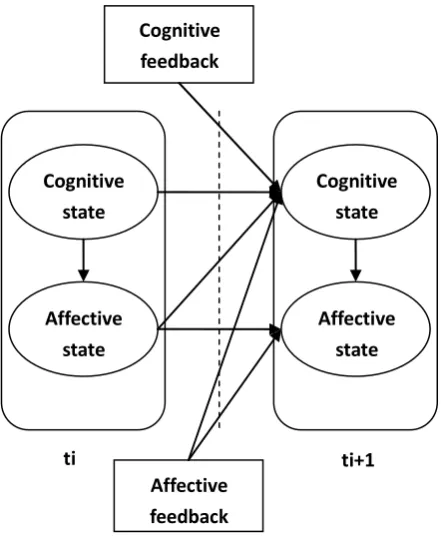
emotion was proposed in Figure 2-2. The main difference between the model in
Figure 2-1 and the model in Figure 2-2 are: the model in Figure 2-2 describes the
causal relationship between cognitive state and affective state; affective feedback is
included in the model independently.
Cognitive
state
Affective
state
Cognitive
state
Affective
state
ti ti+1
Cognitive
feedback
Affective
feedback
Figure 2-2 A learner’s cognition and emotion model
There is no consistency in the literature on the terms used for affective and cognitive
feedback, in (Robison et al., 2009b), they are called task-based and affect-based
feedback, and in (Yusoff and Boulay, 2010), they are called emotion-focused strategy
The common feedback tactics used in affective learning systems (Boulay, 2011,
D'mello et al., 2008, Hernández et al., 2006, D'Mello et al., 2012, Lahart et al., 2007,
Arroyo et al., 2007, Liao et al., 2006, Murray and VanLehn, 2000, Murray et al., 2004,
Lester et al., 2011, Robison et al., 2009b, Woolf et al., 2009, Sarrafzadeh et al., 2008,
Heylen et al., 2004, Jaques et al., 2004, Leontidis et al., 2009) are classified as follows.
The affective feedback tactics are:
Positive affective feedback tactics: empathetic statement, encouraging statement,
game, praising students’ effort, acknowledging students’ emotion, adding interest and
excitement, meta-cognitive response about students’ progress and about good learning
habits.
Concerning “meta-cognitive response about students’ progress and about good
learning habits”, for example, “Congratulations! You are getting more questions right
than before.(Woolf et al., 2009)”
Negative affective feedback tactics: warning statement.
Neutral affective feedback tactics are: getting attention, requesting emotional
information from the student, links performance to student effort and attributes failure
to external issue and success to internal issues.
Concerning, “links performance to student effort and attributes failure to external
issue and success to internal issues”, for example, we will use external responses
(“That problem was really hard”) when students of low self-concept (self-concept
means assessment of current performance in a discipline, which is related to academic
(“Congratulations, you did an amazing job with that!”) when they succeed, hopefully
reversing their negative beliefs (Woolf et al., 2007) .
The cognitive feedback tactics are: make the task easier, make the work more
challenging, give a lesson about a basic concept, give a lesson about a sub-topic, give
a lesson about a new topic, repetition, review, ask a question, discussing problems or
solutions, give hints, answer questions, show-new-skills.
Most of the systems cited here do not have a clear boundary between affective
feedback and cognitive feedback, which are normally combined as pedagogical tactics.
Or use different dimension to describe feedback tactic, for example, Auto Tutor
(D'mello et al., 2008) incorporates this 5 dimensional assessment of the student and
responds with: (a) feedback for the current answer, (b) an empathetic and motivational
statement, (c) the next dialogue move, (d) an emotional display on the face of the
AutoTutor embodied pedagogical agent, and (e) emotionally modulating the voice
produced by AutoTutor’s text to speech engine. Only the research work in (Yusoff
and Du Boulay, 2009, Yusoff and Boulay, 2010) classify affective feedback and
cognitive feedback (called emotion-focused strategy and problem focused strategy in
their study)and evaluated the system with and without affective tactics. The affective
feedback undertaken in (Yusoff and Du Boulay, 2009, Yusoff and Boulay, 2010) was
a shorter version of Benson’s relaxation techniques (Benson et al., 1999) which
concentrated on the upper limbs only.
In the literature, some principles of feedback have significance on the rule design, for
student effort and attributing failure to external issues and success to internal issues,
immediate feedback for students with low achievement levels in the context of either
simple (lower-level) or complex (higher-level) tasks is superior to delayed feedback,
delayed feedback is suggested for students with high achievement levels, especially
for complex tasks (Woolf et al., 2007, Woolf et al., 2009).
2.5
Summary
The literature review in this chapter introduced the inter-relationship between emotion
and cognition in learning, the existing Affective Learning Systems, and focused on
how the system responds to learners from practical and technical aspects. The
emotion set {boredom, frustration, confusion, flow, happiness, interest} is selected for
further research work on the basis of the analysis of the literatures. The ‘emotion
recognition’ models in most existing systems only identify a pattern of measurable
external changes associated with emotions. The existing systems do not interpret
learners’ emotional states with an independent model but respond to the emotion
directly, so this interpretation work is weak. Without a step to understand the cause of
a learner’s emotional state, the effect of the feedback model will be limited. It is
necessary to deduce what emotional states appear during learning process, and model
the emotion interpretation process and feedback process. How to understand a
learner’s emotion and how to respond to learners on the basis of the cause are the
Chapter 3
3
Background study
How do students behave when learning via an instructional video? What emotional
states do students experience and why? How do teachers respond to students in
classroom teaching? In order to answer these questions, two video studies were
designed to investigate the characteristics of two types of interactions in learning:
non-interactive environments and interactive environments. In the former the students
learn by themselves via watching an instructional video, and in the latter the students
were taught by a human tutor.
This chapter presents the methodology, experimental design and results of the video
study that involves non-interactive and interactive learning environments in a
university. Students’ behaviours in different contexts are compared. The data collected
in the stimulated recall after the interactive learning exercise is used to construct the
emotion understanding and feedback models.
3.1
Experimental design
3.1.1
Methods
The methodology adopted was “Quick and Dirty Ethnography” (Hughes et al., 1995).
This ‘quick and dirty’ approach is capable of providing much valuable knowledge of
of time. There is a trade-off between the efficiency and the completeness in this
methodology. Fieldworkers adopting this approach undertake short focused studies to
quickly gain a general picture of the setting. In this research, instead of a large scale
study, a total of 15 students, 2 tutors, 4 sessions were used to explore how emotion
works in learning generally. There are two teaching/learning environments in the
observation study, non-interactive environments and interactive environments. The
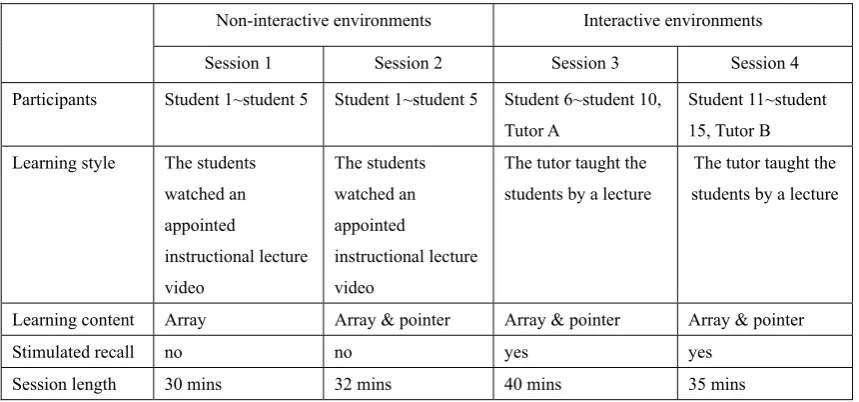
conditions of the observation experiment are summarized in Table 3-1.
Table 3-1 The experimental conditions
Non-interactive environments Interactive environments Session 1 Session 2 Session 3 Session 4 Participants Student 1~student 5 Student 1~student 5 Student 6~student 10,
Tutor A
Student 11~student 15, Tutor B Learning style The students
watched an appointed
instructional lecture video
The students watched an appointed
instructional lecture video
The tutor taught the students by a lecture
The tutor taught the students by a lecture
Learning content Array Array & pointer Array & pointer Array & pointer
Stimulated recall no no yes yes
Session length 30 mins 32 mins 40 mins 35 mins
3.1.2
Non-interactive environments
3.1.2.1
Aims of the experiment
The observational experiment in the non-interactive environment is designed to
determine how the students behave when they learn through watching an instructional
3.1.2.2
Subjects
There were five participants in the non-interactive environment, 1 female and 4 males.
All the subjects were junior students at Guilin University of Technology, China. Their
major was Physics, their ages ranging from 20 to 22. The students were selected
randomly from volunteers. Demographics including age, gender and major were
collected from the students when they applied to participate in the experiment.
3.1.2.3
Experimental settings
The students watched the instructional video as a group, but independently. They each
had a PC that was used to display the video they watched and to record their
responses (via a web camera) at the same time. The web cameras used in the
experiments were mounted on stands, operating at the frame rate of 15 fps., with a
resolution of 320×240 px. They were set on the desk next to the monitor, aimed at the
student, so as to that they could capture any upper body movement. The participants
wore earphones to hear the tutor’s voice. They were required to make a hand gesture
at the start point (for synchronization purposes) and were not able to control the
operation of the video during the session. This constraint was necessary to
synchronize all the students’ videos and the instructional video. Students were
3.1.2.4
Instructional content
The content for session 1 was material on computer main memory storage using an
array. This was relatively basic and included topics such as arra