Leading Sheep Final Report 2011-2015
Project ON-00039
This publication has been compiled by Nicole Sallur and Alex Stirton of Agri-Science Queensland, Department of Agriculture and Fisheries.
© State of Queensland, 2015.
The Queensland Government supports and encourages the dissemination and exchange of its information. The copyright in this publication is licensed under a Creative Commons Attribution 3.0 Australia (CC BY) licence. Under this licence you are free, without having to seek our permission, to use this publication in accordance with the licence terms.
You must keep intact the copyright notice and attribute the State of Queensland as the source of the publication. For more information on this licence, visit http://creativecommons.org/licenses/by/3.0/au/deed.en
Contents
Contents ... 3
Summary ... 4
Introduction from Project Advisory Panel Chair ... 5
Project background ... 6
Vision and objectives ... 7
Methods ... 8
Operational ... 8
Evaluation – measuring success ... 9
Future direction ... 10
Results ... 11
Membership ... 11
Event evaluation ... 11
Webinars ... 13
Women and youth ... 14
Collaboration ... 15
Queensland Innovative Sheep Network... 15
Financial support for Queensland producers to attend national events ... 16
Communication and promotion ... 16
Media – print and radio ... 16
Case studies ... 17
Website ... 17
Emails to subscribers ... 18
Evaluation and reporting database ... 18
Future direction ... 18
Discussion ... 19
Recommendations ... 21
Bibliography ... 22
Appendices ... 23
Appendix 1: Project Advisory Panel and Regional Coordinating Committees ... 23
Appendix 2: List of all LS3 activities ... 24
Summary
Leading Sheep has been successfully meeting the sheep industry’s need for timely information since 2005. The approach is tailored to both how and what information is delivered based on long-term and emergent industry priorities. The third phase of Leading Sheep 2011-2015 (LS3) has focused on predation, nutrition, health, business optimisation and marketing and selling wool and sheep meat as longer-term issues, and responded to immediate information needs for flood and drought assistance, fires and vegetation
management. LS3 supports decision-making to increase the profitability and productivity of Queensland’s sheep and wool businesses through the adoption of technologies and practices. It is an important
partnership between Australian Wool Innovation (AWI) and the Department of Agriculture and Fisheries (DAF) and is supported by AgForce. LS3 supports a regionally specific model with a dedicated extension officer, regional coordinator and committee to identify and prioritise issues and conduct activities based on these.
LS3 has 1505 people on its database and reaches nearly half of Queensland’s sheep producers, managing 1.5 million sheep (52% sheep in Queensland, ABS 2012/13) and 28,500 bales of wool. The success of the Leading Sheep approach and value provided to industry is exemplified by:
• an increase in membership of 605 people
• the diverse audience, with 35% of members being female and 17% under the age of 35.
• participants rating events highly for satisfaction (average score of 8.6/10) and value to their business (8.1/10)
• 96% of participants would recommended Leading Sheep events to others
• 99% of participants learning something new, and 74% intending to make a change on their property • a follow-up survey showing that 40% of participants have already implemented change.
A number of new and successful initiatives commenced in LS3:
• Queensland Innovative Sheep Network (QISN) – a network of young people working together to create opportunities and change, ensuring the ongoing prosperity of the Queensland sheep industries
• financial support for Queensland producers to attend national conferences • Flock talk – regular sheep feature in the Queensland Country Life
• Around the Camp – monthly e-newsletter highlighting current topics and events
• promotion of technical information and producer case studies via Flock talk, LS3 website and emails to the database
• development of an evaluation and reporting spreadsheet to automate and simplify data collection and reporting.
LS3 delivered 97 events to 2853 participants, 62 of these events were face-to-face (1997 participants) and 35 webinars (856 participants). There is still scope for improvement, with 500 members receiving email updates but not yet attending an event, and the majority of people yet to attend multiple events. Intention to make a change is lower for webinar participants compared with face-to-face events (56% versus 84%). Pre-recorded webinars are available on the LS3 website, and are receiving a high number of hits, but people are watching only 9% of the content.
The following key recommendations are suggested as a result of LS3.
• Improve planning and delivery of events to increase the percentage of producers intending to make a change and actually making a change.
• Plan and deliver webinars in discrete content blocks of approximately 10-15 minutes. • Continue to support QISN.
• Identify future events to support Queensland producers to attend.
• Continue and improve the following communication initiatives: Flock talk, Around the Camp, case studies and technical updates.
Introduction from Project Advisory Panel Chair
This report encapsulates the third round of Leading Sheep, a project targeting Queensland wool producers with the aim of increasing their profitability and viability. The project draws on innovation and technology to encourage producer adoption of relevant extension. Leading Sheep is a partnership between AWI, DAF and AgForce and is well supported and recognised by Queensland wool producers.
Round three of Leading Sheep has benefitted from the previous project ground work, allowing it to forge ahead with information delivery to a producer audience well acquainted and comfortable with the
technologies utilised. I was closely involved with the introduction of our first webinars and feel quite proud at the adoption rate of and enthusiasm for this particular form of delivery by our wool producers. It is a positive reflection on their openness to new ideas and bodes well for the adoption of new management innovation in other areas of their wool businesses.
The challenges of our industry are constantly changing and this is reflected in the focus of the various Leading Sheep projects. Round two focused on Breech Strike Management with wild dogs at the forefront during this current round. The Project Advisory Panel (PAP) must identify where our new challenges may lie and plan for them into round four. The structure of Leading Sheep, with producer committees working with a Regional Coordinator, allows for new and emerging innovation to be accessed proactively as well as being reactive to any acute challenges as they emerge. I believe this to be one of the many strengths of the project and feel it is of upmost importance that the producers are the main drivers of the regional agendas. I would like to acknowledge the time and energy given of our producers into these committees as well as our Regional Coordinators who help make things happen at the paddock level.
After nine years, Leading Sheep has the enviable position of being the ‘go-to’ place for sheep and wool information and innovation delivery in Queensland. Our network is well established throughout the state and our ability to reach producers effectively and efficiently allows us to meet the challenges of agriculture in Queensland. In one year alone, we presented webinars on drought feeding, flood recovery and then bushfire control; we not only connected producers with the agencies to help them at these critical times but we also connected them with each other, I feel this should not be underestimated.
As important as this may be, the project must continue to evolve in order to be of maximum benefit to our producers and remain relevant into the future. As PAP Chair, I have been fortunate to be part of the exciting last year of round three; the emergence of the Queensland Innovative Sheep Network, targeting our 18-35 year old producers has been a highlight and will hopefully foster and encourage young Queensland sheep and wool producers industry wide. I would like to thank the previous Chair Mrs. Jenny Keogh for her leadership, energy and drive, the PAP for their foresight and dedication and the supporting staff and agencies for their unfailing enthusiasm; it has been a remarkable team.
I wish the fourth round of Leading Sheep every success and envisage it will continue to support and encourage a relevant, forward thinking and powerful Queensland wool industry.
Kylie Rutledge
Project background
Leading Sheep (LS) is a network designed to assist Queensland’s sheep and wool producers to increase their long-term productivity and profitability. It is a framework for supporting decision-making about technologies and practices. It is an important partnership between AWI and DAF and is supported by AgForce. This is the third round of funding, LS1 2005-2007, LS2 2008-2011 and LS3 (current project) 2011-2015.
LS supports a regionally specific model and each region has a dedicated extension officer, regional coordinator and regional committee (mainly sheep and wool producers) to develop local priorities. At a strategic level LS is overseen by a PAP which is made up of industry leaders, producers and representatives from the stakeholders (AWI, DAF and AgForce).
In all three phases of LS, consultation occurred (face-to-face, phone and online surveys) with a wide range of sheep and wool industry stakeholders, including producers, to determine priorities for each phase of the project. In LS1 these priorities were: reduced predation, higher reproduction rates, more valuable wool and meat, more effective parasite control and improved resource management. In LS2 the priorities were: meeting customer needs, enhanced management practices, value adding production and management of predators. While in the current phase (LS3) the priorities are: predation, nutrition, animal health, business optimisation and marketing and selling wool and sheep meat.
LS1 delivered a total of 75 activities to 1291 participants. Almost two-thirds of the LS1 activities were face-to-face while the rest were either tele-workshops or other e-technology methods (webinars and eBooks). Greater than 90% of participants reported gaining new knowledge from LS1 activities and 87% intend on making a change. Over 50% reported some sort of practice change over the longer term as a result of LS1 activities.
LS2 delivered a total of 87 activities to 2071 participants. Around 60% of LS2 activities were face-to-face and 40% were webinars. Almost 83% gained new knowledge and 69% intend on making a change as a result of LS2 activities. In the longer term 42% of LS2 participants indicated that they had changed practices on their property.
LS has also developed an extensive network and database of producers and industry representatives; this has provided a quick and easy method of communication and information dissemination. In addition, an ongoing publicity campaign over the last nine years has led to LS being readily recognised by producers and a clear point of contact for the Queensland industry.
Effective delivery of information to producers and industry has been an underpinning factor throughout the life of LS. The successful adoption and use of online webinars as an information delivery method has been the envy of other extension projects, both within the industry as well across industries. The next step has been to record these webinars and make these recordings available for public viewing on YouTube and the Leading Sheep website.
A rigorous program of monitoring and evaluation spanning the usefulness of individual activities to on-farm practice change has been invested in throughout the life of LS.
Vision and objectives
LS is a framework for supporting decision-making about technologies and practices to increase the
profitability and productivity of Queensland sheep businesses. It aims to achieve a high level of engagement with sheep businesses in Queensland to support their ongoing decision-making processes about productivity and profitability by working on the following priorities:
Predation
Local: facilitating the coming together of key stakeholders to plan and implement coordinated action at a local level which leads to lower predation.
State: utilising the LS model to share knowledge and information amongst stakeholders with state wide responsibility to improve efficiency of the effort to lower the impact of predation.
Animal nutrition
To improve the nutritional knowledge and skills of sheep producers to enable them to increase their lambing percentage, weaner performance and sheep survival during drought.
Animal health
To improve awareness of developments in animal health including genetic tools, alternatives to mulesing and new uses for old technology.
Business optimisation
To support landholders to develop their skills and knowledge to improve business performance.
To innovate the spread and use of communication and information management technologies that improve the effectiveness and efficiency of the industry.
Marketing and selling wool and sheep meat
Methods
Operational
Operationally LS3 has four main components:
• three regional committees (mainly producers) tasked with identifying and prioritising local needs and building ownership and capacity
• an extensive database (network) of producers and other sheep and wool industry members
• a communication strategy to raise awareness and provide a clear point of contact for the Queensland sheep and wool industry
• a management and stakeholder PAP to provide strategic assessment and direction.
For operational delivery of the project, Queensland is divided into three regions (north/central west, south west and south). Each region has a committee of producers and industry representatives who work with a regional coordinator and DAF extension officer to identify and prioritise local issues. Each regional
committee met face-to-face at least once, while holding a number of webinars/teleconferences (2-3/year) throughout the project. The committees raised the ideas for activities and provided local input into presenter, location and dates. The regional coordinator and extension officer then organised, promoted, delivered and evaluated the activities.
All regional coordinators, extension officers and project manager participated in monthly webinars to review activities, discuss future plans and share ideas between regions.
LS3 utilised a number of communication channels (website, media releases, emails, monthly e-newsletter, radio interviews and Queensland Country Life sheep supplement) to help promote project activities and build the public profile of the project. Extension officers manage the emails that are sent to the LS network. Emails can be sent to a specific region, postcode or to the entire database. These are generally used to promote LS activities as well as relevant information and fact sheets. A monthly e-newsletter (‘Around the Camp’) was developed to keep the network regularly updated about sheep information, but it also opened an avenue to include other organisations event details and articles. DAF communication staff developed media releases for LS, mainly promoting upcoming events within the regions. Due to staff shortages, later in the project an external communications company was contracted to write media releases, case studies and news articles. A strong focus in LS3 was to utilise the updated website more effectively, especially the events calendar, online event registration and using the website as a storage point for many of the extension resources developed by LS, particularly recorded webinars. A regular sheep feature (three times per year) in the Queensland Country Life has been initiated based on the success of the DAF beef features. ‘Flock talk’ aims to increase awareness of LS and is used as an alternate method of getting information out to producers. Maintaining a database and network of Queensland sheep and wool producers and other industry members is a critical component of LS. This extensive database has made it possible to easily and readily make contact with the industry, promote relevant information and obtain feedback.
PAP members met two to three times a year (with at least one face-to-face) throughout the project to discuss strategic direction and review and approve milestones and operational plans developed by the LS3 team. This group also had considerable input into the direction and scope of a new project proposal, LS4 (2015-2018).
LS3 also met with the other AWI funded network projects across Australia once a year to share tools,
Evaluation – measuring success
A rigorous program of monitoring and evaluation spanning the usefulness of individual activities to on-farm practice change has been developed over the life of LS. Monitoring and evaluation for LS3 was based on the information and resources developed in both LS1 and LS2. The main aims of the LS 3 evaluation were to: • demonstrate that the project objectives were being met
• provide information to help improve future activities
• to provide success stories to publicise the benefits of the project • to inform the development of future projects
• to confirm the information delivered is meeting producer needs.
The overarching LS3 evaluation methodology was to:
• develop the LS3 log frame based on project objectives linked to the elements of Bennett’s hierarchy. • redesign evaluation tools that match Bennett’s Hierarchy elements and incorporate knowledge gained in
LS1 and LS2.
• design each activity and its expected effects, both long and short-term using the evaluation tools. • evaluate the immediate effects of the activity using a custom e-survey or hardcopy format depending on
the situation.
• regional committees to use the immediate effects data to inform their future action. • evaluate the longer term effects of LS activities, mainly practice change.
• report evaluation data to advisory panel and partners.
The key steps in the planning, evaluation and reporting process for LS3 were: • activity checklist
• activity design • attendance records • short-term evaluation • update database • event report • narratives • case studies
• long-term evaluation.
The activity checklist and activity design were to assist with planning and to ensure the event would deliver on LS3 objectives and achieve practice change.
Attendance records were important so that we had an accurate record of participation to report, along with gender and age group. They also allowed us to update contact details on our database.
The short-term evaluation was completed by participants after each event (target 80%) and was designed to capture their thoughts on the event, whether they intend to make a change on their property as a result of this event and future topics of interest.
The event report was to capture our learnings from the event and to have a summary for reporting purposes. It was important to update the database with contact details, new members, event attendance records and mailing lists.
Narratives were short stories captured by the project team that demonstrated how producers who have attended Leading Sheep events are being influenced to change (target two per region per year).
The long-term evaluation was designed to demonstrate on-farm practice change as a result of the project, collected via a phone survey of about 20% of sheep businesses on the LS3 database.
For more detail on this methodology, refer to Leading Sheep 3 Final Evaluation Plan, May 2012.
Towards the start of LS3 an excel spreadsheet was developed by DAF management specifically for the LS project, to help manage evaluation information collected from each activity. The spreadsheet was designed to collate the specific data needed when reporting to AWI and DAF, which has led to a more prompt and efficient reporting process. The raw evaluation data is entered into the spreadsheet by the extension officers after each event.
In November 2012, a desktop review of the LS3 evaluation system was conducted by Peter Hanrahan (Peter Hanrahan Consulting Pty Ltd) to ensure processes were in place, so that LS could effectively and efficiently improve their project and report against its objectives. The reviewer concluded that LS3 had a good and realistic evaluation plan and that the on-ground data from activities was collected and collated thoroughly. As a result of this review a number of recommendations were made including:
• entering attendance details directly onto computer spreadsheet, rather than on paper • asking a more targeted question on the event evaluation form to gather future event ideas • developing a process to review activities when producer assessment is low
• communicating feedback from activities to other team members
• utilising the electronic keypads to collect evaluation information at face-to-face events
• continuing to explore new evaluation systems and processes to improve efficiency and reduce double entry of data
• assessing the number of industry support people involved in LS and look for ways to enhance these relationships.
For more detail on this desktop assessment, refer to Desktop assessment of the evaluation processes for Leading Sheep 2011-2014 prepared by Peter Hanrahan, Peter Hanrahan Consulting Pty Ltd, November 2012.
Future direction
A number of methods were used to capture feedback from LS participants to help inform a new LS4 project proposal. These methods included a phone survey (106 responses), an electronic survey (97 responses) and gaining feedback from the regional coordinators, extension officers, regional coordinating committees and Queensland Innovative Sheep Network. The main questions asked were:
• What is the major strength of the LS project?
• What is the most important weakness of the LS project?
• What is the most important and relevant thing that LS can do to make a real difference to your business, both now and into the future?
• If dogs are under control and meat/wool prices continue to fluctuate - what will be the big issue for sheep producers in the next 5-10 years?
Results
Membership
LS3 has 1505 people on its database. Seventy percent of these are producers representing 681 farm businesses (45% of Queensland sheep businesses ABS 2012/13). For those where there is recorded information this represents almost 1.5 million sheep (compared to ABS 2012/13 figure of 2.9 million sheep in Queensland) and 28,500 bales of wool. Of the total people on the database, 35% (521) are females and 17% (263) are under the age of 35 years. Six hundred and five new members have been added to the database since the start of 2011. However, almost 500 people on the database have not attended a single event, even though they have received the LS newsletters and event notifications.
Event evaluation
LS3 has delivered 97 events to 2853 participants. Sixty-two of these events were face-to-face and 35 webinars to 1997 and 856 participants respectively, see Table 1.
The evaluation showed 1547 different people have attended at least one LS3 event. Seventy-one percent (1097) of participants have only attended one event.
Measured industry responses to LS3 activities are detailed in Table 1, showing feedback including satisfaction, value, new knowledge, intention to change and actual change.
Table 1: Level of achievement for LS3
Report item Level of achievement
No. of events 97 (62 face to face and 35 webinars)
No. of participants 2853 (1997 face to face and 856 webinars)
Satisfaction with event 8.6/10
Value of event (rating) 8.1/10
Value of event ($) (data from 9 events only) $2496
Recommend event to others 96%
New knowledge 93%
Intention to change 74%
Very likely to make the change 38%
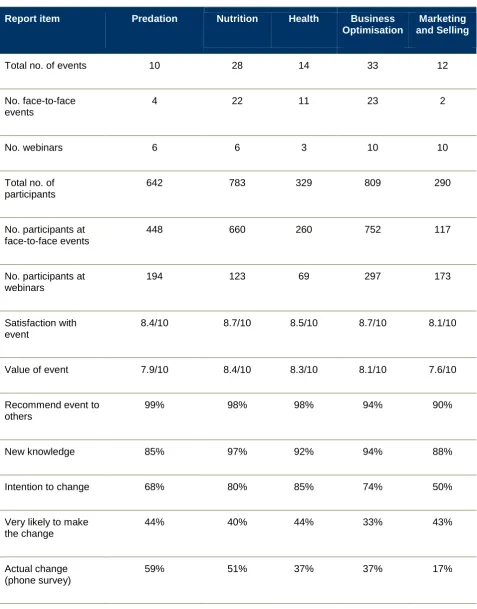
This information broken down by each project objective is detailed in Table 2.
Table 2: Level of achievement for each objective of LS3
Report item Predation Nutrition Health Business
Optimisation
Marketing and Selling
Total no. of events 10 28 14 33 12
No. face-to-face events
4 22 11 23 2
No. webinars 6 6 3 10 10
Total no. of participants
642 783 329 809 290
No. participants at face-to-face events
448 660 260 752 117
No. participants at webinars
194 123 69 297 173
Satisfaction with event
8.4/10 8.7/10 8.5/10 8.7/10 8.1/10
Value of event 7.9/10 8.4/10 8.3/10 8.1/10 7.6/10
Recommend event to others
99% 98% 98% 94% 90%
New knowledge 85% 97% 92% 94% 88%
Intention to change 68% 80% 85% 74% 50%
Very likely to make the change
44% 40% 44% 33% 43%
Actual change (phone survey)
Some specific quotes from producers outlining their feedback on LS3 events are highlighted below: • “thank you for such an informative afternoon and entertaining and empowering evening”
• “more field trips like this - excellent seeing things first hand”
• “very well organised and locally relevant, very well coordinated with speakers”
• “this was a good event, got a lot from the properties we visited but also good to talk to other participants”
• “connecting famers to great industry knowledge like the presenter”
• “it was good to hear from local graziers dealing with local problems and sharing ideas”
• “one of the best field days I've attended, very informative, very knowledgeable group of presenters and attendees, thank you”
• “hearing from producers about their experiences is the best learning tool”
• “we are slowly improving the quality and number of lambs/ewes and directly supplying a local butcher and we credit our progress to these workshops – thank you”.
Detailed narratives and case studies show specific examples of the effect of the project. Eighteen narratives and nine case studies were collected, across the range of LS3 objectives, for more detail on these please refer to Leading Sheep Evaluation Report 2011-2015. The producers who participated in case studies rated LS3 as a very important (8.4/10) and very reliable (9/10) source of sheep management information.
Webinars
LS have pioneered the use of webinars as an efficient and effective information delivery tool. Below are some specific comments from producers about the webinars they have attended in LS3:
• “it was good, I would like to log in again or for any other information sessions, great way of communicating up to date information”
• “this is a great way to get information to wool growers”
• “this was great, it was presented really clearly, simply and logically. Good basic scientific information linked to what is relevant for producers. The presenter also highlighted how producers could get involved and I feel there was enough information there to initiate further investigation by those interested, i.e. present the background, high light relevance and give direction of where/how to go from here”
• “thank you very much for this information, and for making the recording of the recent webinar available to those of us who were unable to attend. Our kids do their school via distance education, and their phone lessons seem to always clash with webinar times which means that we cannot attend even though we are very interested in the information presented. Thank you for all that you do for our industry”.
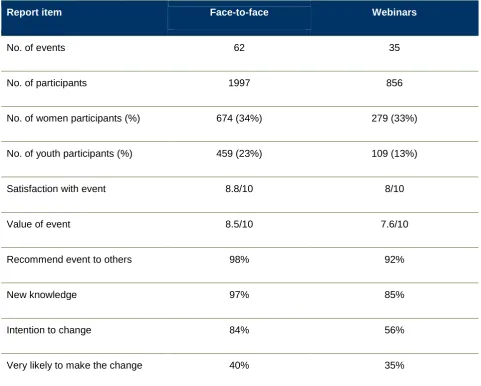
Table 3: Face-to-face events compared to webinars
Report item Face-to-face Webinars
No. of events 62 35
No. of participants 1997 856
No. of women participants (%) 674 (34%) 279 (33%)
No. of youth participants (%) 459 (23%) 109 (13%)
Satisfaction with event 8.8/10 8/10
Value of event 8.5/10 7.6/10
Recommend event to others 98% 92%
New knowledge 97% 85%
Intention to change 84% 56%
Very likely to make the change 40% 35%
The webinars that have been delivered have also been recorded and placed on the LS website. This equates to 21 webinars with 607 live attendances compared to 5833 views of the recording. However the viewing time of the recorded webinar is extremely low with average view duration of 4 minutes and 8 seconds (7% of the total video length of about 60 minutes). This increases slightly to 8 minutes 45 seconds for Australian only views, but this is still low at only 15% of total video length. However viewing time varies depending on the webinar topic. For example viewing time is over 14 minutes for the electric fencing webinar but only 2 minutes for the 1080 baiting webinar.
Women and youth
Collaboration
During the last four years LS3 has collaborated with 12 different organisations to run activities including: • Making More from Sheep (30 events)
• Sheep Cooperative Research Centre (8 events) • South West Natural Resource Management (6 events) • BMO Accountants (5 events)
• Suncare (4 events) • Traprock (3 events)
• Australian Wool Innovation (2 events) • Mercardo (2 events)
• Bestprac (1 event) • Landmark (1 event) • Dorper Society (1 event) • Anglicare (1 event).
Collaboration with these organisations has contributed to the success of these events, as evidenced by this comment: “another fabulous Leading Sheep event - well done to all. Thanks for involving Suncare and we hope to work with you again soon!” It also allowed LS3 to obtain wider exposure with a different audience and run more events than would have been possible on our own.
As well as collaboration LS3 has also supported other organisations events both financially and with promotion. Most of these events were drought related. LS3 decided to support these events, rather than holding our own, so as not to compete with producers’ limited time which was exasperated because of the drought. These events included:
• DAF (7 events) – drought assistance information
• South West Natural Resource Management (6 events) – caravan of collaboration • Royal Flying Doctor Service (2 events) – drought days
• Country Women’s Association (1 event) – break the drought afternoon • AgForce (1 event) – predator control workshop
• Suncorp (1 event) – chatting about change.
Queensland Innovative Sheep Network
In late 2013 LS, AgForce and Queensland Merino Stud Sheepbreeder’s Association (QMSSA) identified a need to engage with and run some activities for the ‘youth’ (18-35) of the Queensland sheep and wool industry. Terms of reference for a group to lead this initiative were drafted so that the young people could decide for themselves what they needed. As a result the Queensland Innovative Sheep Network (QISN) was formed and a committee elected in July 2014.
As decided by the elected committee QISN is a network of young participants working together to create opportunities and change, ensuring ongoing prosperity of the Queensland sheep industries. Focusing on Queensland sheep industries and young people, the mission of QISN is to:
• encourage participation and cultivate passion
• inspire collaboration across generations to ensure ongoing success and prosperity • create opportunities for education and change through innovation and communication.
“Creating a voice for the industries’ young people by young people.”
QISN are currently organising their first industry event in conjunction with the Queensland State Sheep Show in Goondiwindi in May 2015. QMSSA provided funding for this event and asked QISN to organise and facilitate the event. The event is Q&A with panel of industry leaders including Roger Fletcher, Fletchers International, Kat Giles, Sheepmeat Council and Bruce McLeish, Elders. The committee is focused on making this event a success as it will help build the QISN profile and increase exposure for the QISN network.
Financial support for Queensland producers to attend
national events
LS3 provided financial support for two Queensland sheep producers to attend both the Sheep CRC conference and LambEx in Adelaide during July 2014. Interested people submitted their resume as well as responded to selection criteria. A panel, consisting of LS staff and producers, determined the most suitable applicants. The successful applicants were Tamara White ("Riverview", Surat) and Pru Barkla ("Rosscoe Downs", Cunnamulla). After their attendance at these events, the applicants produced a detailed report outlining the key messages from the conference presentations and potential future webinar presenters, which was distributed via the LS mailing list. They both commented that the trip was very worthwhile and would encourage anyone and everyone to make sure that they get 'exposed' to what else is happening in the industry.
Communication and promotion
LS3 has delivered on its communication strategy to encourage more producers to join the network, attend activities and adopt best management practices. This strategy was initially developed by DAF’s
communication team, however due to budget cuts and staff losses half way through the project their support was limited. Cox Inall Communications was then contracted to provide communication support for LS3 via articles, media releases, case studies and finalising a breech strike management ebook.
Media – print and radio
Over the life of LS3 there were at least 43 media releases produced (see Appendix 3) and these were published in the Queensland Country Life, Warrego Watchman, Longreach Leader, Daily News Warwick, Bush Telegraph Warwick, Barcoo Independent, Southern Downs Weekly, MacIntyre Gazette, North West Star and the Rural Weekly section of regional papers (with a combined circulation of 192,315) as well as on ABC radio. There were a number of other media articles also written by reporters attending LS3 events.
In 2014 a regular two page sheep feature in the Queensland Country Life was initiated – ‘Flock talk’. Flock talk is published three times per year and its aim is to provide Queensland producers with a regular and alternative source of information as well as to increase the profile of LS3. So far three editions of Flock talk have been published: September 2014, November 2014 and March 2015 with two more planned later this year. Stories have focused on maximising lambs weaned, guard donkeys, wild dogs, nutrition and sheep reproduction with an emphasis on producer case studies. Queensland Country Life has a distribution of 35,000 plus an online version with the potential to reach 43,000 per edition with links to the LS3 website.
Case studies
Throughout LS3 a demand for more information on predator control and exclusion fences was identified. In particular producers were looking for pictures of fences and information about the type/specifications, construction and results from these fences.
Two exclusion fencing case studies were developed and published in early 2013, focusing on producers that had finished building their fences:
• Wild Dog and Kangaroo Exclusion Fencing – a case study at “Banff Downs”, Morven • Wild Dog and Kangaroo Exclusion Fencing – a case study at “Moorooka”, Morven.
Once published these case studies were made available on the LS website and have been distributed at a number of Predator Control field days and workshops. They have also been very popular at local agents (Landmark and Elders) branches.
In 2014 Bestprac and LS collaborated to fund the development of more predator control case studies: • Electric fencing – ‘Gordonvale’, Isisford
• Exclusion fencing – ‘Banff Downs’, Morven – a follow up to the original fencing case study • Whole shire approach to coordinated control – Winton Shire
• Meeting the wild dog challenge at Longreach – producer group
When completed these case studies will be made available on the LS website, distributed through the LS network and included in Flock talk as well as being made available at any future predator control
workshops.
LS3 evaluation requires nine case studies be developed to highlight practice changes producers have made as a result of attending a LS event. Previously these have only been used for reporting purposes. During LS3 it was decided to use these not only for reporting but also make them available on the LS website, distributed throughout the network, include them in Flock talk as well as distribute at workshops. These case studies highlight a variety of practice changes made within sheep enterprises and by
promoting these to other producers it is hoped that they will encourage others to adopt similar changes within their businesses.
These case studies are as follows:
• Australian Sheep Breeding Values boosting profitability for Stanthorpe grower • Electric fencing zaps pasture pressure at ‘Accord’ Longreach
• Business optimisation using ASBVs
• Early weaning and feedlotting Merino lambs boosts ewe survival at Bollon • Worm control improving the bottom line
• Nutrition management at Muttaburra • Worm control lessons at Quilpie • Increasing lambing success at Blackall
• Drought feeding to minimize ewe and lamb losses
Website
In October 2012, a new and improved LS website was launched. The new website allowed staff to maintain and update the site more frequently, rather than relying on an external provider. It also
Emails to subscribers
In early 2013, a monthly LS3 e-newsletter, titled ‘Around the Camp’, was developed, to promote current issues and information and other organisations events. Twenty-four issues of Around the Camp have been published and distributed to the members on the LS3 database.
Forty-eight factsheets, case studies and updates on current issues were also sent around the LS3 database as a way of keeping producers up to date with the latest information and highlighting what other sheep producers were doing. These were on a variety of topics spanning the LS3 objectives as well funding opportunities for producers, QISN, drought assistance, value of webinars and sheep and lamb projections.
Evaluation and reporting database
During late 2012, an evaluation and reporting spreadsheet was developed to automate and simplify data collection and reporting. Over time, this spreadsheet has been modified and improved. It collects and collates all attendee details as well as summarizing and graphing event evaluation results and membership statistics.
Future direction
The main strength of LS3 is that it provides a variety of locally relevant information in a range of formats. Both producers and technical experts are used as presenters and producers have the opportunity to come together to talk and learn from each other.
A large proportion of survey respondents could not identify any weaknesses of LS3. Those that were cited related to the content of the activity and the fact that they were not locally relevant, use of interstate presenters and too theoretical. Others were around logistical issues such as location, not enough one-on-one time and lack of promotion.
A variety of responses were given as to what LS can do to make a real difference. Suggestions for activity topics were the main area identified including predation, kangaroos, wool marketing, lamb survival, genetics, financial management and animal welfare. Other responses mainly related to keep on doing what we have been doing in terms of running activities, providing a networking opportunity and keeping people informed.
The next big issues for sheep and wool producers were identified as: lamb survival, keeping and
Discussion
The participation rate for LS3 was 2853, significantly exceeding the target of 2000. There was a good mix of face-to-face events and webinars, with two-thirds and one-third respectively. LS3 has grown its
membership by 605 members since the start of 2011. Evaluation results from the LS3 activities
demonstrate excellent feedback, with high scores for satisfaction, value, recommend to others and new knowledge. The main improvement would be to convert more of those who intend to make a change to those actually making a change. Options to achieve this include, planning events that provide more detailed information outlining how to implement the practice/recommendation, and providing real life producer case studies that have done just that.
Across all five LS3 objectives, there has been a good mix of events and participation numbers. Only a small number of predation focused face to face events have been held, due to the large number of other organisations focused on this area. However, the ones that LS3 have held have been highly successful and well attended – two field days with an average attendance of 183 and two fencing bus trips with an average attendance of 41. While for the marketing and selling objective the majority of events have been webinars. The evaluation results across all objectives are extremely positive, with high scores for: satisfaction, value, recommending an event to others, and new knowledge. There is some variation in those who intend to make a change ranging from 85% for health to 50% for marketing and selling, as well as for those who have actually made a change (59% for predation and 17% for marketing and selling). As mentioned above, improving these measures needs to be a new focus, particularly for specific objectives where they are lower.
Disappointingly, 71% of participants have only been to one LS3 event, which is similar for LS2 with 73%. The events that these one-off participants attended were mainly face-to-face and in the areas of business optimisation, predation and nutrition. These topics are applicable to all producers (not just sheep
producers) and hence some of these one-off attendees might have been solely cattle producers which may be why they have not attended any more events. A concerted effort is needed to update the LS3 database to determine if there is a trend amongst those who are just attending one LS event. There are almost 500 active subscribers on the LS3 database who have not participated in a single event, even a webinar. The majority of these non-participants are Queensland producers, even though they are receiving LS emails. Further analysis also needs to be completed with these people to determine why they are not attending.
When comparing the evaluation results of face-to-face events and webinars, both show positive results in terms of satisfaction, value and new knowledge. However, webinars could be improved with the
percentage of people intending to make a change (56% webinars vs 84% face-to-face). This comes down to better planning and preparation of webinars so they are focused on key information as well as
implementation steps.
Interestingly, only 13% of webinar participants are younger than 35 years (compared to 23% for face-to-face events), while 17% on the LS3 database are in this age bracket. A report by Barr (2014) shows that producers under the age of 35 years make up approximately 10% of all sheep producers in Australia. This indicates that the majority of young producers in the sheep industry are attending our events and are on our database. However, there are a number of ‘other’ young people in the industry besides producers, including agents, catchment staff and company representatives. Attracting this target audience should be a continued focus of LS. Potential ways to achieve this might be to have targeted webinar topics based on feedback from QISN and delivering webinars at different times of the day/night. As well as identifying who these people are and sending them a personal invitation to a relevant and local LS event, or organising an event in collaboration with this company or organisation.
Even though there are a large number of recorded webinar views, people are only watching, on average, 7% of the total webinar, which equates to about 9 minutes for Australian viewers. This is a strong
Collaboration with other organisations has enhanced the success of LS3 and contributed to greater participation and database numbers as well as achieving efficiencies.
Two positive initiatives of LS3 that warrant continuing support are QISN and financial assistance for Queensland producers to attend national events. QISN has taken awhile to get off the ground and is just organising its first event in May 2015, with hopefully more in the future to attract and retain young people to the industry. Due to the small size of the industry in Queensland, very few large sheep and wool focused events are held in Queensland. To keep Queensland abreast of industry news and initiatives it is imperative for Queensland producers to attend these larger national events and one way LS can support this is by offering financial assistance to help cover travel costs.
Communication and promotion of LS3 is a vital tool to help increase database numbers, attendance at events and encourage the uptake of resources produced. A variety of methods need to be utilised including print and radio, website, emails, e-newsletters, technical updates and case studies. Successful new initiatives undertaken in LS3 included Flock talk, radio snippets, Around the Camp, and publication of case studies.
Recommendations
1. Surveys of Queensland sheep producers have determined the main focus areas for LS4 as
predation, lamb survival, encouraging people to stay and enter the industry particularly young people and time and labour saving ideas. LS4 will need to deliver responsive services that target topical issues, as they emerge. Regular contact with regional committees will provide feedback to adapt services to meet real and current needs of producers will be critical.
2. Improved planning and delivery of activities are needed to increase the percentage of producers intending to make a change and those who actually make a change. Suggested ways include ‘how to’ guides and case studies.
3. Plan and deliver webinars in discrete content blocks of approximately 10 to 15 minutes so that, for example, a one hour webinar would actually be four or five 10 to 15 minute YouTube videos. The aim of this would be to increase the percentage of the total webinar time people are watching from 7% (or about 9 minutes) to the majority of the recorded webinar.
4. Attract other young people (not just producers) to LS. Suggested ways include: collaborate with QISN, personal invite, and run events with those organisations to be ‘targeted’ for young people. 5. Continue to collaborate with other organisations to enhance the success of LS activities and improve
efficiency and effectiveness.
6. Continue to support QISN by promoting the QISN network and events.
7. Identify future national or interstate events to provide financial assistance for Queensland producers to attend and bring ideas back to share with the whole industry.
8. Continue and improve the communication initiatives commenced in LS3 – Flock talk, radio snippets/stories, Around the Camp, case studies, technical updates and the LS website. The partnership with Cox Inall Communications has proven very successful and it is recommended that this be continued in the future.
9. Further data collection and analysis of ‘one-off’ attendees and those who are on database but have not attended anything to determine if and how these figures can be improved.
Bibliography
ABS (2012/13) 7121.0 Agricultural Commodities, Australia, 2012-2013. Released 30 May 2014. http://www.abs.gov.au/AUSSTATS/[email protected]/DetailsPage/7121.02012-2013?OpenDocument
Anon (2011) Leading Sheep Project Advisory Panel 2011-2014 Responsibilities and Obligations. Anon (2014) Leading Sheep 3 Project Key Roles and Responsibilities.
Barr N (2012) New entrants to Australian agricultural industries. Where are the young farmers? RIRDC Publication No. 14/003.
Hamilton A (2011) Milestone Report Leading Sheep WP465 Milestone TMS01 31 December 2011, Department of Employment, Economic Development and Innovation.
Hamilton A (2012) Milestone Report Leading Sheep WP465 Milestone TMS02 1 June 2012, Department of Agriculture, Fisheries and Forestry.
Hamilton A (2012) Milestone Report Leading Sheep WP465 TMS03 31 December 2012, Department of Agriculture, Fisheries and Forestry.
Hamilton A (2013) Leading Sheep Project ON-00039 – Milestone Report TMS04 1 June 2013, Department of Agriculture, Fisheries and Forestry.
Hamilton A, Roberts G, Sallur N and McAllister P (2011) Leading Sheep 2008-2011 WP 261 Final Report May 2011, Department of Employment, Economic Development and Innovation.
Hanrahan P (2012) Desktop assessment of the evaluation processes for Leading Sheep 2011-2014 November 2012, Peter Hanrahan Consuluting Pty Ltd.
Knights GI (2007) Leading Sheep EA 051 Final Report December 2007, Department of Primary Industries and Fisheries.
McDonald L (2011) Leading Sheep Communication Strategy, Department of Employment, Economic Development and Innovation.
Roberts Evaluation Pty Ltd (2014) Leading Sheep Producer Survey Department of Agriculture, Fisheries and Forestry Final Report September 2014.
Sallur N (2012) Leading Sheep 3 Final Evaluation Plan May 2012, Department of Agriculture, Fisheries and Forestry.
Sallur N (2015) Leading Sheep Final Evaluation Report 2011-2015 Milestone 4000213-0070 Due 31 March 2015 Department of Agriculture and Fisheries.
Sallur N and Stirton A (2013) Leading Sheep Project ON-00039 – Milestone Report 4000213-0090 15 December 2013, Department of Agriculture, Fisheries and Forestry.
Sallur N and Stirton A (2014) Leading Sheep Project ON-00039 – Milestone Report 4000213-0110 1 June 2014, Department of Agriculture, Fisheries and Forestry.
Appendices
Appendix 1: Project Advisory Panel and Regional
Coordinating Committees
Advisory Panel South Region South West Region North/Central
West Region
Kylie Rutledge “Moble” Quilpie 07 4656 4731 [email protected]
Noel O’Dempsey “Linallie” Texas 07 4653 1441 [email protected]
Amy Brown “Heather” Bollon 07 4625 6129
Joy Hardie
“Verastan” Muttaburra 07 4658 7285
Nicole Sallur DAF Charleville 07 4654 4220
Neil Cameron
“Kurrajong” Millmerran 07 4668 0248
Phil Bell
“Miltonise” Bollon 07 4625 7486
Jodi Axford “Goolma” Winton 07 4657 3875 [email protected]
Don Perkins
“Nelyambo” Dirranbandi 07 4625 8686
Leith McColl
“Coorawong” Goondiwindi 07 4675 1285
Anthony Glasson “Picarilli” Thargomindah 07 4655 3106
Michael Campbell
“Barcaldine Downs” Barcaldine 07 4651 1529
David Jamieson
“Bunglebree” Dirranbandi 07 4625 6281
Bruce Toms
“Beltana” Stanthorpe 07 4681 3721 [email protected]
Bruce Lines Rodwells Roma 07 4622 7799
David Counsell
“Dunblane” Barcaldine 07 4651 2498
Karen Huskisson
“Wattle Downs” The Gums 07 4665 9129
Peter Campbell “Wyambeh” Roma 07 4626 5454
Tim Williams
“Banff Downs” Morven 07 4654 8204
David Fysh
“Acacia Downs” Longreach 07 4658 5616
Emily King AWI Sydney 02 8295 3176 [email protected]
Don Perkins
“Nelyambo” Dirranbandi 07 4625 8686
Nicole Sallur DAF Charleville 07 4654 4220
Greg Hunt
Australian Wool Network Longreach
07 4658 2842
Krista Cavallaro DAF Brisbane 07 3255 4324
Gai White “Riverview” Surat 07 4626 5416
Alison Krieg “Benalla” Blackall 07 4657 5069 [email protected]
Michael Allpass AgForce Brisbane 07 3236 3100
Allie Jones
“Dunkerry” Nindigully 0488 768 388 [email protected]
Buckles Peacey “Laidlaw” Longreach 07 4658 5341 [email protected]
Alex Stirton DAF Charleville 07 4654 4212
Alex Stirton DAF Charleville 07 4654 4212
Appendix 2: List of all LS3 activities
Name of Activity Location Date Numbers Attended
QRAA Flood Grants Webinar 04 March 2011 10
Marketing Options for Qld Lambs
Webinar 15 March 2011 15
Fire – Master or Servant – Your Call
Webinar 25 March 2011 32
Best Practice Baiting Techniques
Webinar 15 April 2011 25
Worm Management Strategies
Nindigully 17 June 2011 44
Comparing Enterprise Options
Mitchell, Morven, Augathella, Charleville, Cunnamulla
20 June 2011 44
Flystrike Prevention Muttaburra 26 August 2011 25
Turning Reproduction Potential into Reality
Goondiwindi 9 September 2011 30
Westech Wool Market Outlook
Webinar 13 September 2011 7
Westech Field Day Barcaldine 13-14 September 2011 25
Westech The New Ewe Webinar 14 September 2011 2
Flystrike Prevention Bollon 19 September 2011 33
Worm Egg Counting Thallon 26 September 2011 17
Making Worm Management Easy
Webinar 28 October 2011 28
ASBV’s put simply Webinar 14 November 2011 16
Guardian Animal – Donkey
Webinar 14 December 2011 44
Guardian Animal – Alpaca
Webinar 16 December 2011 26
Thinking your Sheep Are Worm Free?
Webinar 20 March 2012 22
Worms & OJD Miles 3 April 2012 29
Bred Well Fed Well Cunnamulla 16 April 2012 15
Bred Well Fed Well Dirranbandi 17 April 2012 25
Bred Well Fed Well Goondiwindi 18 April 2012 28
Making Your Rural Fire Service Work for You!
Webinar 23 May 2012 9
Sheep Pregnancy Scanning – keeping more lambs alive
Webinar 28 May 2012 24
Bred Well Fed Well Winton 18 June 2012 17
Bred Well Fed Well Muttaburra 19 June 2012 27
Bred Well Fed Well Blackall 20 June 2012 18
Wool Clip Blackall 3 July 2012 41
Wool Clip Stanthorpe 4 July 2012 43
Market Class – a
Woolbuyer’s Perspective
Gore 12 July 2012 47
Bred Well Fed Well follow up
Webinar 26 July 2012 34
Put the Fire into your Pasture Management
Webinar 10 August 2012 38
West Season Spelling Cunnamulla 4 September 2012 11
Condition Scoring and Pasture Assessment
RamSelect Mitchell 2 October 2012 25
RamSelect Bollon 3 October 2012 13
Making More from Pasture
Augathella 16 October 2012 18
Making More from Pasture
Morven 17 October 2012 20
Outlook for Sheepmeat and Lamb
Webinar 25 October 2012 36
Getting Back to Business Winton 20 October 2012 8
Getting Back to Business Illfracombe 31 October 2012 10
Getting Back to Business Yaraka 1 November 2012 11
Getting Back to Business Longreach 2 November 2012 12
Condition Scoring and Pasture Assessment
Stonehenge 13 November 2012 12
Condition Scoring and Pasture Assessment
Blackall 14 November 2012 13
Building your Business Quilpie 20 November 2012 5
Building your Business Thargomindah 21 November 2012 6
RamSelect Stanthorpe 29 November 2012 20
Lamb Marketing Options – a Feedlotters’
Perspective
Webinar 8 February 2013 11
Farmer Want’s a Life Dirranbandi 19 February 2013 29
Farmer Want’s a Life Moonie 20 February 2013 34
Outlook for Wool Prices Webinar 21 February 2013 15
Farmer Want’s a Life Cecil Plains 27 February 2013 19
Farmer Want’s a Life Dalby 28 February 2013 54
Confidently Pricing your Wool – using
Woolcheque
Webinar 21 March 2013 13
Good Food Guide for Sheep
Webinar 25 March 2013 25
Sheep Flocks & Beef Herds Business Forum and Dinner
Longreach 19 April 2013 78
Practical Sheep and Beef Nutrition for the Traprock
Inglewood 2 March 2013 42
Nutritional Management of Spring Lambing Merinos to Rear More Lambs
Webinar 9 May 2013 28
Predator Control Field Day
Longreach 19 July 2013 197
Are your Rams Ready for Joining?
Webinar 6 August 2013 19
Nutritional Management of Merinos for Optimum Reproduction
Longreach 12 August 2013 28
Nutritional Management of Merinos for Optimum Reproduction
Cunnamulla 14 August 2013 17
Nutritional Management of Merinos for Optimum Reproduction
Bollon 15 August 2013 17
Nutritional Management of Merinos for Optimum Reproduction
St George 16 August 2013 18
Succession planning for your farm business
Dirranbandi 3 September 2013 9
Succession planning for your farm business
Charleville 5 September 2013 12
RamSelect Blackall 17 September 2013 12
Follow up Webinar to John Milton Workshops
Webinar 25 September 2013 10
RamSelect Thallon 11 October 2013 20
Pig Control Webinar 30 October 2013 25
Auctions Plus Wool Webinar 14 November 2013 13
Current Outlook for Wool Prices
Webinar 5 December 2013 42
CEAK – Attracting and Retaining Staff
Charleville 19 February 2014 7
Vegetation Management Webinar
Webinar 26 March 2014 30
Bestprac Forum – What’s on the Menu for your Livestock
Longreach 4 April 2014 74
Electric Fencing – the Ins and Outs Webinar
Webinar 29 May 2014 43
Predator Control Field Day
Mitchell 20 June 2014 169
Making the most from the prime lambs
Nindigully 14 July 2014 66
Going Bush Feral Fencing Bus Trip
Blackall/Barcaldine 5 August 2014 39
Will Sheepmeat Demand Stay Strong? Ewe Bet.
Webinar 5 August 2014 14
Sheep and Wool Bus Tour
Dubbo 26-29 August 2014 19
Wool Market - Continue to Disappoint or a Spring Rally
Webinar 22 September 2014 7
Carbon Farming in the Grazing Lands
Webinar 25 September 2014 57
Storing and Measuring Soil Carbon
Webinar 1 October 2014 28
Increasing Profits and Reducing Carbon Emissions
South West Exclusion Fencing Bus Trip
Morven/Mungallala 24 November 2014 43
AWI – Where your Levy is Invested
Webinar 11 December 2014 38
Getting Back to Business Winton 25 February 2015 10
Getting Back to Business Longreach 26 February 2015 13
Getting Back to Business Isisford 27 February 2015 4
Central West Sheep Forum and Dinner
Longreach 20 March 2015 70
Profitable Lamb Production
Appendix 3: Summary of media releases
2015
Finding that extra five kilograms - Profitable Lamb Production workshop (March 2015) Field day: One stop predator control shop (March 2015)
Free disease and biosecurity workshops for the south west (March 2015) Central west sheep forum draws inspiration (March 2015)
Leading Sheep and ‘How Green is my Cactus’ together in Longreach (February 2015)
2014
Sheep producers hit the road to view exclusion fencing success stories (November 2014) Queensland sheep producers back from National Merino Show (September 2014) Free workshops to boost business profitability (August 2014)
Leading Queensland sheep producers at LambEx and Sheep CRC conferences (July 2014) National Merino Sheep Show (July 2014)
Lamb Finishing Day – Nindigully (July 2014)
Mitchell producers tackle wild dog challenge with Leading Sheep experts (June 2014) Producers find out what’s on the menu for their livestock (April 2014)
What on your Livestock’s menu - Qld Bestprac forum (March 2014)
2013
Quilpie wool producer to lead Leading Sheep program in Queensland (December 2013) Learning how to buy better rams at RamSelect (August 2013)
National sheep nutrition expert shares nutrition knowledge with Qld producers (August 2013) Bollon producer takes on Leading Sheep coordinator role (June 2013)
Longreach predator control on display at field day (May 2015)
2012
Workshops reveal secrets of business success (October 2012) Workshops put focus on stud values (October 2012)
Managing pastures a key to growth for sheep producers (September 2012)
Wet season spelling field day – Cunnamulla (August 2012)
Stanthorpe AWI Wool Clip – Stanthorpe (community announcement) (June 2012) Lamb scan for a bigger flock (May 2012)
Converting Sheep Breeding into Business Profits (May 2012)
Bred Well Fed Well is coming to Southern Queensland (March 2012) Stop parasites and diseases worming their way into your flock (March 2012) Breed more lambs, producers told at forum (February 2012)
Barber’s pole workshop (January 2012)
2011
Producers flock to livestock nutrition forum (December2011)
Protecting your livestock investment – guardian animal webinars (December 2011) Sheep webinar gaining from genetics (November2011)
Ewe-trition tips for more lambs (November 2011) Worm webinar to talk tactics (October2011)
DEEDI staff continue Westech tradition (September 2011)
Bollon flystrike workshop to prepare sheep for wet season ahead (August 2011) Flystrike workshops to prepare sheep for Qld wet (August 2011)