For Peer Review
The OneTogether collaborative approach to reduce the risk of surgical site infection: identifying the challenges to
assuring best practice
Journal: Journal of Infection Prevention Manuscript ID: JIP-OA-14-0045.R1
Manuscript Type: Original Article
Keyword: Surgical Site Infection, Competencies, Education, Clinical Governance, Behaviour, Audit, Evidence-based Practice
Abstract:
Background: Surgical site infections (SSI) account for 16% of healthcare associated infection, are associated with considerable morbidity, mortality and increased costs of care. Ensuring that evidence-based practice to prevent SSI is incorporated across the patient’s surgical journey is complex. OneTogether is a quality improvement collaborative formed to promote and support the spread and adoption of best practice to prevent SSI. This paper describes the findings of an expert workshop on infection prevention in the operating department.
Methods: A total of 84 delegates from 75 hospitals attended the workshop, comprising 46 (55%) theatre nurses/operating department practitioners; 16 (19%) infection control practitioners and 22 (26%) other healthcare practitioners. Discussion focused on evidence, policy implementation and barriers to best practice. Responses were synthesised into a narrative review.
Results: Delegates reported significant problems in translating evidence-based guidance into everyday practice, lack of local polices and poor compliance. Major barriers were lack of leadership, poorly defined responsibilities, and lack of knowledge/training.
Conclusions: This workshop has provided important insights into major challenges in assuring compliance with best practice in relation to the prevention of SSI. The OneTogether partnership aims to support healthcare practitioners to improve the outcomes of patients undergoing surgery by reducing the risk of SSI.
For Peer Review
The OneTogether collaborative approach to reduce the risk of surgical site infection: identifying the challenges to assuring best practice.
Abstract
Background: Surgical site infections (SSI) account for 16% of healthcare associated infection, are associated with considerable morbidity, mortality and increased costs of care. Ensuring evidence-based practice to prevent SSI is incorporated across the patient’s surgical journey is complex. OneTogether is a quality improvement collaborative of infection prevention and operating
department specialists, formed to support the spread and adoption of best practice to prevent SSI. This paper describes the findings of an expert workshop on infection prevention in operating departments.
Methods: A total of 84 delegates from 75 hospitals attended the workshop, comprising 46 (55%) theatre nurses/operating department practitioners; 16 (19%) infection control practitioners and 22 (26%) other healthcare practitioners. Discussion focused on evidence, policy implementation and barriers to best practice. Responses were synthesised into a narrative review.
Results: Delegates reported significant problems in translating evidence-based guidance into everyday practice, lack of local polices and poor compliance. Major barriers were lack of leadership, poorly defined responsibilities, and lack of knowledge/training.
Conclusions: This workshop has provided important insights into major challenges in assuring compliance with best practice in relation to the prevention of SSI. The OneTogether partnership aims to support healthcare practitioners to improve the outcomes of patients undergoing surgery by reducing the risk of SSI.
Introduction
Quality and safety in healthcare is a key priority for patients and those that deliver clinical care. In 2013 three key reports linked to patient safety provided important insights into less than optimal care in healthcare organisations. The public enquiry into care provided at the Mid Staffordshire NHS Foundation Trust (Francis 2013) and a report into fourteen failing trusts (Keogh 2013) demonstrated 2
For Peer Review
less than optimal care in healthcare organisations. The National Advisory Group on the Safety of Patients in England (2013) report made recommendations to learn and improve safety by the National Advisory Group on the Safety of Patients in England (2013) and stated ‘Patient safety should be the ever-present concern of every person working in or affecting NHS-funded care. The quality of
patient care should come before all other considerations in the leadership and conduct of the NHS,
and patient safety is the keystone dimension of quality.’
Healthcare associated infections (HCAIs) present a major risk to patients and mitigating this must be an integral part of the quality agenda for all healthcare providers’. Ensuring that infection
prevention practice is embedded in the delivery of care to all patients in all settings is therefore an important priority. National prevalence surveys of HCAI indicate that surgical site infections (SSI) are one of the most common infections, accounting for between 15% and 20% of all HCAI (Smyth et al, 2006; Health Protection Agency 2012; Zarb 2012). However such surveys generally underestimate the true risk of SSI because many infections do not become apparent until after the patient has been discharged from hospital. Surgical site infections are associated with considerable morbidity and mortality, they are estimated to double the length of postoperative stay, and in the most severe infections significantly increase the risk of death (Astagneau et al 2001; Coello et al 2005; Broex et al 2009). In addition, when repeat admissions to hospital, repeat operations and other treatments are taken into account, severe SSI can quadruple the costs of care and decrease the quality of life of affected patients (Whitehouse et al 2002; Hollenbeak et al 2000).
The risk of a patient developing SSI depends on a combination of factors including: the number of micro-organisms introduced into the operative site, the number that remain when the wound is closed, the ability of micro-organisms to multiply and invade tissues, and the efficacy of the patients’s immune defences against them (National Collaborating Centre for Women’s and Children’s Health (NCCWCH) 2008). Evidence-based guidance on practices shown to prevent or reduce the risk of SSI is available (NICE 2008; NCCWCH 2008; Bratzler et al 2013; Mangram et al 1999; Hoffman et al 2002). However, in the multidisciplinary environment of the operating theatre ensuring that evidence is incorporated into best practice in a timely manner across the patient’s surgical journey is complex (Leaper et al 2014). This is compounded by the patient pathway crossing physical and cultural boundaries e.g. ward, anaesthetic room, operating theatre and recovery. Infection prevention teams are not always involved in local policy development or risk assessment within the operating theatre setting, it may be difficult to implement infection prevention guidance 2
For Peer Review
consistently and the impact of poor practice may not be obvious to theatre staff who may not be aware of whether a patient subsequently develops SSI.
Multi-organisational partnerships or quality improvement collaboratives (QICs) have been identified as an efficient approach to improving provider practices and patient outcomes through the
dissemination of evidence-based practices (Nadeem et al 2013). OneTogether is partnership between leading professional organisations with an interest in the prevention of SSI, and has been initiated as a quality improvement collaborative with the aim of promoting and supporting the spread and adoption of best practice to prevent SSI across the surgical patient pathway. The partners in OneTogether are: The Association for Perioperative Practice (AfPP), The Infection Prevention Society (IPS), College of Operating Department Practitioners (CODP) and the Royal College of Nursing (RCN). The objectives of the partnership are to:
1. explore how guidance on infection prevention in relation to surgery is applied in practice 2. identify challenges and barriers that affect compliance with guidance;
3. support the implementation of best practice through the development of a readily accessible and practical set of resources that can be used to inform and educate staff working across the entire surgical pathway.
This paper describes the findings from an expert workshop that explored compliance with infection control guidance on prevention of SSI and the barriers that currently affect how guidance is implemented. The workshop focused on bridging the gap between infection prevention specialists and the surgical team in the following key areas of practice:
• Skin preparation
• Instrument management
• Management of patient temperature
• Surgical environment • Prophylactic antibiotics • Wound management • Surveillance of SSI
The information gathered will be used to inform the development of infection prevention resources to support implementation of best practice in these areas.
Methods
For Peer Review
OneTogether held a SSI prevention expert conference in November 2013, which brought together operating theatre staff and infection prevention specialists to discuss current practice and the barriers to good infection prevention (see figure 1). The 84 delegates comprised 46 (55%) theatre nurses and operating department practitioners (ODP), 16 (19%) infection control practitioners (ICP), and 22 (26%) healthcare professionals with other roles related to operating departments (e.g. educator, manager, infection control link practitioner, surveillance nurse). Participants represented more than 75 different hospitals in England, including both NHS and private sector healthcare facilities.
The overall aim of the workshop was to identify ‘small and large actions’ that could overcome barriers to implementation of infection prevention guidance across the surgical pathway. Working in groups and looking at each of the domains of infection prevention practice indicated above, the participants reviewed:
• The availability of evidence and policy
• Ownership of practice
• Barriers to implementation of best practice
• Small and large actions that would support excellent, consistent care.
The responses gathered from each of the workshops were then synthesised and are reflected in this narrative review.
Results
Implementation of operating department policy and practice
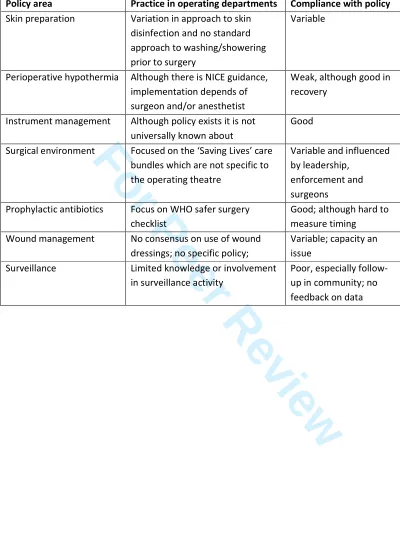
In some aspects of practice there was awareness of National guidelines or local polices, in particular in relation to perioperative warming and instrument management, but in other aspects of practice either clear guidelines were not considered to be available or there was wide variation in practice e.g. skin preparation (see Table 1). Compliance with recommended practice was considered to be variable, but greatest in respect of instrument management and weakest in relation to fluid warming, surveillance of SSI and management of the surgical environment.
Barriers to implementing best practice in the prevention of perioperative hypothermia
The NICE guideline on perioperative warming recommends that all patients should be assessed for risk of intraoperative hypothermia, their temperature documented before induction of anaesthesia 2
For Peer Review
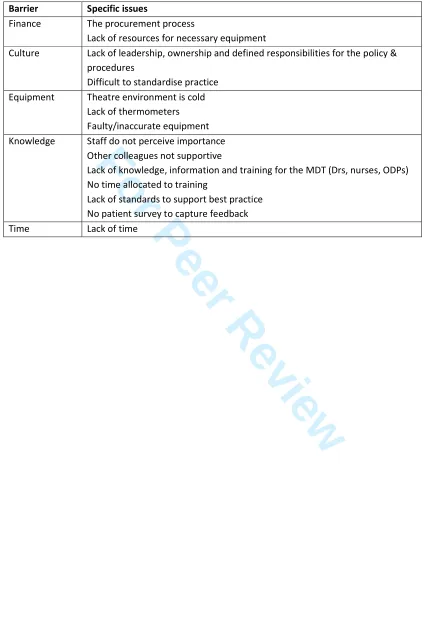
and then every 30 minutes until the end of surgery. For high-risk patients, active warming should be used to maintain normal body temperature prior to transfer (NICE 2008). The data captured from this group of theatre personnel suggests that compliance with the guideline is weak in operating theatres, although better in recovery areas, and in many theatres there is a lack of clear policy or ownership of practice related to patient warming. Key barriers identified are summarised in Table 2. These include the lack of equipment such as thermometers, which are essential for consistent monitoring to detect if the patients temperature drops below 36oC, and difficulties in ordering the equipment necessary to support whole body warming because of procurement procedures, e.g. not standard items, or the equipment is not given priority in the allocation of resources. Lack of
knowledge and training across the multidisciplinary team on the significance of body temperature in preventing SSI and absence of defined standards for best practice it difficult to establish effective audit systems.
Barriers to compliance with best practice in skin preparation
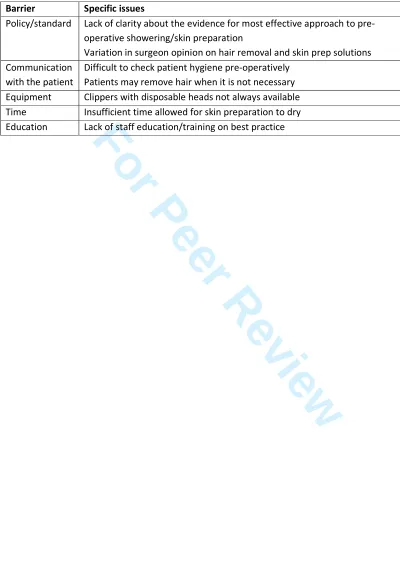
In relation to skin preparation, guidelines on the prevention of surgical site infections advise that patients should have a shower or bath prior to surgery, and recommend hair should not be removed routinely and where necessary electric clippers should be used rather than razors in order to minimise skin damage (NCCWCH 2008; Mangram et al 1999; Woodhead et al 2002). An antiseptic solution containing povidone-iodine or chlorhexidine should be used to disinfect the skin at the surgical site immediately before the incision is made (NCCWCH 2008; Mangram et al 1999; Woodhead et al 2002). Key barriers to assuring best practice in relation to skin preparation are summarized in Table 3.
Barriers to best practice in relation to instrument management
Any item in contact with sterile tissues should be sterile to protect the wound from contamination and subsequent infection. Systems must therefore be in place to ensure that used surgical
instruments are correctly handled and washed after surgery to facilitate the removal of protein and assure the efficacy of sterilisation procedures in removing micro-organisms including prions
(NCCWCH 2008; National Institute for Health and Care Excellence 2013). These systems should also ensure that sterile instruments remain sterile prior to use and that any equipment in contact with the sterile surgical field is either sterile, or covered with a sterile barrier (Department of Health 2013). Instruments should be laid up in a clean area, as close to the procedure time as possible, and protected from contamination prior to use as airborne particles shed from fabric or skin may transfer microorganisms onto the instruments (Barrie et al 1994). The key barriers to good practice 2
For Peer Review
could be summarised as lack of resources, issues related to equipment flow and communication with CSSD, standardisation of practice, and training.
Surgical environment
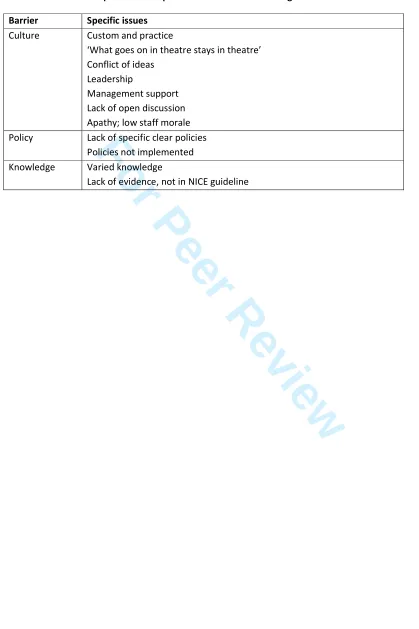
Micro-organisms carried on airborne particles can also enter the surgical wound either directly or by first settling onto the surgical field or instruments (Hoffman et al 2002; Barrie et al 1994). Airborne microbial particles are commonly derived from the skin or clothing fabric of the people present in the operating room, and the greater the movement the more particles are likely to be shed (Mangram et al 1999; Mackintosh et al 1978; Whyte et al 1979). In order to minimize the risk of contaminated particles settling into the incision an effective ventilation system that changes and filter the air should be in place, the number of personnel present in theatre should be kept to a minimum, the doors to the operating theatre kept closed and traffic in and out of theatre should be restricted (Mangram et al 1999; Hoffman et al 2002; Woodhead et al 2002). The participants identified knowledge of staff and aspects of theatre management and culture as key barriers to compliance with this best practice (see Table 4).
Surveillance
Evidence suggests that systematically capturing data on SSI and reporting rates to the surgical team is highly effective in reducing the risk of infection (Mangram et al 1999, Haley et al 1985). A
standardised surveillance methodology should be used to provide robust data on rates of SSI and inform the surgical team about the quality of infection prevention in the operating theatre (Wilson 2013). Monitoring of infection rates is also essential to provide patients with accurate information about the risk of SSI associated with the operation. In England, surveillance of SSI following orthopaedic surgery is mandatory for all NHS trusts; many private hospitals also participate in the PHE SSI Surveillance Service. Despite this many theatre personnel were not engaged or involved in the surveillance, did not get any feedback on the results, or see any action taken in response to them. Practical difficulties with performing surveillance were also identified, in particular: requires time and resources, is hampered by the lack of integrated IT systems, and it is difficult to follow-up patients after discharge to identify those who develop SSI.
Wound management
The NICE guideline recommends that surgical incisions should be covered with an appropriate interactive dressing at the end of the operation (NCCWCH 2008). The main barrier to best practice in relation to wound management was identified as education with a lack of training to support 2
For Peer Review
expertise in dressing selection. There was also considered to be a lack consensus on policy, varied opinions on the evidence supporting dressing choice and lack of clarity about who owns the decision about dressing choice.
Potential solutions
Discussion about solutions to the problems identified included making guidance and policy more visible, user-friendly and widely available. A number of key ‘small actions’ that could be relatively easily implemented included making clear policies available in pocket format or lanyard style for easy reference and supporting it with ‘decision trees’; involving the ICN in theatre audit and establishing an infection control forum. Longer-term strategies included establishing operating theatre link nurse roles; breaking down barriers between clinical teams and between theatre and ward staff; improving surveillance with feedback of rates to theatre staff; and developing defined standards of care that can be used for monitoring practice and supporting staff training to ensure policies are clearly understood.
Discussion
The information captured by this workshop with experts in operating theatre and infection control has provided an important insight into the difficulties of translating evidence-based guidance into everyday practice in the operating department. The experience of many of these staff was that local polices did not exist for many aspects of practice and that compliance with best practice is poor, especially for perioperative warming, skin preparation and management of the surgical
environment. Others have identified poor compliance with evidence-based practice as a problem in the prevention of SSI (Leaper et al 2014). Evidence for poor compliance with infection prevention policy in operating theatres has been provided by Campbell et al 2008. They surveyed operating theatre staff about the use of evidence based processes of care such as pre-operative skin preparation, administration of prophylactic antibiotics and checking of intra-operative blood glucose, and found that these practices were in place in only 42% of the 32 hospitals surveyed. In addition, experts in surgical quality and SSI (given no information about whether the hospital was a
low or high outlier) were able to correctly identify each as a high or low outlier on the basis of what
they observed during a site visit. In fact, they were generally able to make this determination within
the first few hours of the visits. In addition, they found evidence for an association between
hospitals with the lowest risk of SSI and policies aimed at minimising operating room foot traffic and systems that increased the operative team efficiency (Campbell et al 2008).
For Peer Review
The main barriers to implementation of best practice identified by the group of practitioners in our study were: a lack of leadership to drive implementation of guidance; lack of ownership of policies such that responsibilities to ensure compliance are not clearly defined; and a lack of knowledge, information and training for the multi-disciplinary team. Practical problems with the purchase, supply and storage of equipment is needed to support best practice e.g. disposable hair clippers, was also identified as an important barrier. The lack of engagement of theatre personnel in surveillance activity demonstrates a missed opportunity to involve staff in the best position to prevent SSI in monitoring rates of infection and using the information to drive quality improvement.
Although a self-selected group, the delegates were drawn from a broad range of NHS and
independent sector providers across the UK. Their analysis suggests a widespread picture of poor compliance with best practice in relation to infection prevention practice in the surgical environment driven by lack of knowledge, leadership and ownership of good practice across the multidisciplinary team. It demonstrates the need for closer working between infection control practitioners and operating department staff to develop local policy based on evidence based guidance and effective translation of policy into systems of work that define clear responsibilities for the multi-disciplinary team.
Initiatives such as the World Health Organisation (WHO) Safer Surgery Checklist are focused on improving patient safety in operating department practice but have not broadly encompassed infection prevention, except with regard to the administration of prophylactic antimicrobial therapy (WHO 2008). However, evidence is emerging that this collaborative approach to improving patient safety in the theatre environment may have a demonstrable positive effect on patient outcomes (Norton et al 2014; Haugen et al 2013, Berg et al 2014). The Surgical Care Improvement Project (SCIP) in the USA has developed a set of 10 evidence-based quality improvement performance measures aimed specifically at the prevention of SSI (Rosenberger et al 2011). Combining SCIP and WHO safer surgery checklist has been shown to have a positive impact on compliance with best practice in relation to the prevention of SSI (Tillman et al 2013). In addition, there is emerging evidence for a reduction in rates of SSI associated with improved compliance with infection prevention indicators (Berenguer et al 2009; Schwann et al 2011).
Conclusion and future plans for OneTogether
This workshop has provided important insights into some of the major challenges in assuring compliance with best practice in relation to the prevention of SSI. Lack of guidance is not the main 2
For Peer Review
problem. Key to quality improvement is education and training on what is required to prevent SSI, communication of clear standards of practice to all members of the multidisciplinary team, and systems that support monitoring and feedback of data on both compliance with standards and rates of SSI. The OneTogether partnership is developing a programme of work over the next three years that is aimed at supporting these requirements. Activity will focus on:
• developing an infection prevention self-assessment tool for operating theatres
• creating a set of resources for each element of infection prevention practice that provides micro-training on the evidence-base and recommended practice, model policy and standards of practice and audit tools.
• a second expert conference to shape the way forward.
Work has commenced with the production of a wall chart illustrating the key practice required to prevent SSI and highlighted in this workshop (OneTogether 2014). This represents the beginning of a journey to support healthcare practitioners in improving the outcomes of patients undergoing surgery by reducing the risk of SSI.
Conflicts of interest: None declared
References
Astagneau, P., Rioux, C., Golliot, F., Brücker, G. and for the INCISO Network Study Group. (2001)
Morbidity and mortality associated with surgical site infections: results from the 1997–1999
INCISO surveillance. Journal of Hospital Infection. 48: 267-274.
Barrie, D., Hoffman, P.N., Wilson, J.A. and Kramer, J.M. (1994) Contamination of Hospital Linen by
Bacillus cereus. Epidemiology and infection. 113(2): 297-306.
Berenguer CM, Ochsner MG, Lord SA, Senkowski CK. (2010) Improving surgical site infections: using National Surgical Quality Improvement Program data to institute Surgical Care Improvement Project protocols in improving surgical outcomes. Journal American College of Surgeons. 210: 737-41. Bergs J, Hellings J, Cleemput I, Zurel Ö, De Troyer V, Van Hiel M, Demeere JL, Claeys D, Vandijck D.
(2014) Systematic review and meta-analysis of the effect of the World Health Organization surgical
safety checklist on postoperative complications. British Journal of Surgery. 101: 150-8. 2
For Peer Review
Bratzler, D.W., Slain, D., Steinberg, J.P., Weinstein, R.A., Dellinger, E.P., Olsen, K.M., et al. (2013) Clinical practice guidelines for antimicrobial prophylaxis in surgery. American Journal of Health-System Pharmacy. 70: 195-283.
Broex, E.C.J., Van Asselt, A.D.I., Bruggeman, C.A. and Van Tiel, F.H. (2009) Surgical site
infections: how high are the costs? Journal of Hospital Infection. 72:193-201.
Campbell, J., Darrell A., Hutter, M.M., Schwartz, J., Ko, C., Itani, K., et al. (2008) Surgical site
infection prevention: the importance of operative duration and blood transfusion-results of the first
American College of Surgeons-National Surgical Quality Improvement Program Best Practices
Initiative. Journal of the American College of Surgeons. 207: 810-820.
Coello, R., Charlett, A., Wilson, J., Ward, V., Pearson, A. and Borriello, P. (2005) Adverse impact of
surgical site infections in English hospitals. Journal of Hospital Infection. 60: 93-103.
Department of Health. (2013) Management and decontamination of surgical instruments: Part A – The formulation of local policies and choices. CFPP 01-01. HMSO: London.
Frances R. (2013) Report of the Mid-Staffordshire NHS Foundation trust Public Enquiry. The Stationery Office; London.
Haley, R.W., Culver, D.H., White, J.W., Morgan, M.W., Emori, G.T., Munn, V.P. and Hooton, T.M.
(1985). The efficacy of infection surveillance and control programs in preventing nosocomial
infections in US hospitals. American Journal of Epidemiology. 121: 182-205.
Haugen AS, Søfteland E, Almeland SK, Sevdalis N, Vonen B, Eide GE, et al. (2014) Effect of the World Health Organization Checklist on Patient Outcomes: A Stepped Wedge Cluster Randomized Controlled Trial. Annals of Surgery. [Epub ahead of print].
Health Protection Agency. (2012) English National Point Prevalence Survey on
Healthcare-associated Infections and Antimicrobial Use, 2011. London: Health Protection Agency.
Hoffman, P.N., Williams, J., Stacey, A., Bennett, A.M., Ridgway, G.L., Dobson, C., et al. (2002) Microbiological commissioning and monitoring of operating theatre suites. Journal of Hospital infection. 52:1-28.
For Peer Review
Hollenbeak, C.S., Murphy, D.M., Koenig, S., Woodward, R.S., Dunagan, W.C. and Fraser, V.J.
(2000) The clinical and economic impact of deep chest surgical site infections following coronary
artery bypass graft surgery. Chest. 118:397-402.
Keogh, B. (2013) Review into the quality of care and treatment provided by 14 hospital trusts in England: overview report. NHS England.
Leaper DJ, Tanner J, Kiernan M, Assadian O, Edmiston CE. (2014) Surgical site infection: poor compliance with guidelines and care bundles. International Wound Journal. [Epub ahead of print]
Mackintosh, C.A., Lidwell, O.M., Towers, A.G. and Marples, R.R. (1978) The dimensions of skin fragments dispersed into the air during activity. Epidemiology and infection. 81: 471-480.
Mangram, A.J., Horan, T.C., Pearson, M.L., Silver, L.C., Jarvis, W.R. and The Hospital Infection
Control Practices Advisory Committee. (1999) Guideline for prevention of surgical site infection.
Infection Control and Hospital Epidemiology, 20: 247-278.
Nadeem, E.; Olin, S.S.; Campbell Hill, L.; Hoagwood, E.A.; Horowitz, M.S. (2013) Understanding the Components of Quality Improvement Collaboratives: A Systematic Literature Review. Milbank Quarterly. 91: 354–394.
National Advisory Group on the Safety of Patients in England. (2013) A promise to learn – a commitment to act. Improving the Safety of Patients in England. Available:
https://www.gov.uk/government/uploads/system/uploads/attachment_data/file/226703/Berwick_
Report.pdf.
National Collaborating Centre For Women’s And Children’s Health. (2008) Surgical Site Infection:
prevention and treatment of surgical site infection. NICE Clinical Guideline. London: Royal College
of Obstetricians and Gynaecologists.
National Institute for Health and Care Excellence. (2008) Inadvertent perioperative hypothermia: The management of inadvertent perioperative hypothermia in adults.
National Institute for Health and Care Excellence. (2013) Patient safety and reduction of risk of transmission of Creutzfeldt-Jakob disease (CJD) via interventional procedures. NICE: London.
Norton E, Singer SJ, Sparks W, Ozonoff A, Baxter J, Rangel S. (2014) Operating room clinicians' 2
For Peer Review
attitudes and perceptions of a pediatric surgical safety checklist at one institution. Journal of Patient Safety. [Epub ahead of print].
Rosenberger, L.H.; Politano, A.D.; Sawyer, R.G. (2011) The Surgical Care Improvement Project and prevention of post-operative infection including surgical site infection. Surgical Infection. 12: 163-68. Schwann NM, Bretz KA, Eid S, Burger T, Fry D, Ackler F, et al. (2011) Point-of-care electronic
prompts: an effective means of increasing compliance, demonstrating quality, and improving outcome. Anesthesia & Analgesia. 113: 869-76.
Smyth, E.T.M., McIlvenny, G., Enstone, J.E., Emmerson, A.M., Humphreys, H., Fitzpatrick, F. et al.
(2008) Four Country Healthcare Associated Infection Prevalence Survey 2006: overview of the
results. Journal of Hospital Infection. 69: 230-248.
Tillman M, Wehbe-Janek H, Hodges B, Smythe WR, Papaconstantinou HT. (2013) Surgical care improvement project and surgical site infections: can integration in the surgical safety checklist improve quality performance and clinical outcomes? Journal of Surgical Research. 184:150-6.
Whitehouse, J.D., Friedman, N.D., Kirkland, K.B., Richardson, W.J. and Sexton, D.J. (2002) The
Impact of Surgical-Site Infections Following Orthopedic Surgery at a Community Hospital and a
University Hospital: Adverse Quality of Life, Excess Length of Stay, and Extra Cost. Infection
Control and Hospital Epidemiology. 23: 183-189.
Whyte W, Bailey, P.V.; Hamblen, D.L.; Fisher, W.D.; Kelly, I.G. (1983) A bacteriologically occlusive clothing system for use in the operating room. Journal Bone Joint Surgery. 65B: 502-506.
Wilson, J.A., 2013. Surgical site infection: the principles and practice of surveillance: Part 2:
analysing and interpreting data. Journal of Infection Prevention. 14: 198-202.
Woodhead, K., Taylor, E.W., Bannister, G., Chesworth, T., Hoffman, P. and Humphreys, H., 2002. Behaviours and rituals in the operating theatre. A report from the Hospital Infection Society Working Party on Infection Control in Operating Theatres. Journal of Hospital Infection. 51: 241-255.
World Health Organisation. Safer Surgery Checklist. (2008). Available: http://www.who.int/patientsafety/safesurgery/ss_checklist/en/ 2
For Peer Review
Zarb, P., Catry, B., Monnet, D., Goossens, H., Suetens, C., Coignard, B., et al and Hospital Contact Points For The ECDC Pilot Point Prevalence Survey. (2012). The European Centre for Disease Prevention and Control (ECDC) pilot point prevalence survey of healthcare-associated infections and antimicrobial use. Euro surveillance. 17(46).
For Peer Review
Table 1: Availability of policy and compliance with best practice
Policy area Practice in operating departments Compliance with policy
Skin preparation Variation in approach to skin disinfection and no standard approach to washing/showering prior to surgery
Variable
Perioperative hypothermia Although there is NICE guidance, implementation depends of surgeon and/or anesthetist
Weak, although good in recovery
Instrument management Although policy exists it is not universally known about
Good
Surgical environment Focused on the ‘Saving Lives’ care bundles which are not specific to the operating theatre
Variable and influenced by leadership,
enforcement and surgeons
Prophylactic antibiotics Focus on WHO safer surgery checklist
Good; although hard to measure timing Wound management No consensus on use of wound
dressings; no specific policy;
Variable; capacity an issue
Surveillance Limited knowledge or involvement in surveillance activity
Poor, especially follow-up in community; no feedback on data 2
For Peer Review
Table 2: Barriers to implementing NICE guideline on preventing perioperative hypothermIa Barrier Specific issues
Finance The procurement process
Lack of resources for necessary equipment
Culture Lack of leadership, ownership and defined responsibilities for the policy & procedures
Difficult to standardise practice Equipment Theatre environment is cold
Lack of thermometers Faulty/inaccurate equipment Knowledge Staff do not perceive importance
Other colleagues not supportive
Lack of knowledge, information and training for the MDT (Drs, nurses, ODPs) No time allocated to training
Lack of standards to support best practice No patient survey to capture feedback
Time Lack of time
For Peer Review
Table 3: Barriers to implementing best practice in relation to skin preparation Barrier Specific issues
Policy/standard Lack of clarity about the evidence for most effective approach to pre-operative showering/skin preparation
Variation in surgeon opinion on hair removal and skin prep solutions Communication
with the patient
Difficult to check patient hygiene pre-operatively Patients may remove hair when it is not necessary Equipment Clippers with disposable heads not always available Time Insufficient time allowed for skin preparation to dry Education Lack of staff education/training on best practice 2
For Peer Review
Table 4: Barriers to implement best practice in relation to the surgical environment Barrier Specific issues
Culture Custom and practice
‘What goes on in theatre stays in theatre’ Conflict of ideas
Leadership
Management support Lack of open discussion Apathy; low staff morale Policy Lack of specific clear policies
Policies not implemented Knowledge Varied knowledge
Lack of evidence, not in NICE guideline 2
For Peer Review
Figure 1: Guiding principles of OneTogether 2
For Peer Review
203x162mm (96 x 96 DPI)