1
T
HEI
NTERNET OFT
HINGS INM
ANUFACTURINGI
NNOVATIONP
ROCESSES:
D
EVELOPMENT ANDA
PPLICATION OF AC
ONCEPTUALF
RAMEWORKAbstract
Purpose: This study aims to contribute and enrich the scientific debate about the phenomenon called the Internet of Things (IoT) from a managerial perspective. Through the lenses of management and innovation literature, we investigate the main facts that characterize the IoT and developed a conceptual framework to interpret its evolution. The framework has then been applied to the case of a three-dimensional (3D) printing technology used for additive manufacturing.
Design/methodology/approach: A theoretical analysis of the phenomenon of the IoT and its main elements has been performed to construct a conceptual framework in a managerial fashion able to describe the evolutionary impacts of the phenomenon on the manufacturing industry.
Findings: Through consequential steps, namely radical, modular, architectural and incremental innovation, and by adopting and integrating the Henderson and Clark model, we explain the cornerstones of the evolutionary impact of the IoT on the manufacturing industry. Finally, we apply our framework to the case of additive manufacturing and 3D printing.
Practical implications: Our framework’s practical value is related to its employability in interpreting and possibly forecasting the evolution of manufacturing industries thanks to the advent of the IoT, allowing managers to capture value arising from technological changes.
Originality/value: This study offers a clear and simple model to interpret the impacts of the IoT. Such a goal has been obtained by systematizing the disconnected research on the topic and arranging such contributions into solid paradigms of the managerial literature.
2
1. Introduction
In recent decades, challenges in the competitive arena have grown exponentially. Companies are nowadays experiencing extreme competition, mainly due to increasing pressures from technological changes and global challenges. These “emerging” pressures result in the globalization of manufacturing, characterized by faster transfers of materials, complex payment systems and the compression of products’ life cycles, which drive the need for the superior integration of technologies with increasingly sophisticated customers’ needs (e.g. Shepherd and Ahmed, 2000). Successful companies do not only respond to their current customers’ or organizational needs, rather they anticipate future trends by developing ideas, products or services to rapidly and effectively meet future demands. Such an ability is an essential requirement to develop and sustain a competitive advantage (Porter, 1985; Peteraf, 1993). Thus, through innovation in products and processes, companies increase their capacity to enter or create new markets and this ultimately represents an key for success (Li et al., 2013; Teece, 2010).
3 Thus, the aim of this paper is to investigate the main facts that characterize the IoT and through this, theorize a conceptual framework coming from the innovation literature in order to analyze and interpret the past, present and future dimensions of the influence of the IoT on manufacturing. Since the IoT is still a developing concept, our model also contributes by clearly positioning and framing the phenomenon into traditional models of the managerial literature.
The paper is structured as follows. In the first part, we present a wider view of innovation in manufacturing. By using the definition and evolution of Intelligent Products, we retrace the evolution of the IoT phenomenon in the manufacturing industry, presenting four main facts that have characterized it over recent years. Consequently, we reframe these facts into four evolutionary stages in the light of the most accepted innovation theories in order to build a conceptual framework, while also highlighting the implications for product and process innovations from manufacturing firms. Finally, we apply our conceptual framework to the emerging phenomenon of 3D printing in the larger sector of additive manufacturing to demonstrate the validity of our model.
2. Manufacturing and the challenges of Internet-based technology
4 This fact is even truer with the advent of the Internet and the third industrial revolution, called the digital revolution (Devaraj, Krajewski and Wei, 2007). Advanced manufacturing technologies strongly rely on various ICT technologies to achieve higher productivity, higher quality and lower production costs. Such an effect is especially focused on processes of manufacturing automation, and of information systems (Anaya, Dulaimi, and Abdallah, 2015; Tian, Yin and Taylor, 2002). Indeed, the advent of Internet-based technologies has led to the emergence of new manufacturing philosophies and new forms of organization, such as virtual organizations, remote manufacturing, computer-integrated manufacturing systems, and Internet-based manufacturing, i.e. wireless milling machines, coordinated measuring machines, networked sensor arrays and surveillance systems (Bi et al., 2008; Dewan, Bing and Seidman, 2000; Pratt, Sriram and Wozny, 1997). For example, “design anywhere, manufacture anywhere” is a new approach to production which shares design and manufacturing data across multiple platforms and infrastructures (Kellmereit and Obodovski, 2013; Manenti, 2011). Recent studies have confirmed such trends, indicating that the future of manufacturing firms will be mostly information-oriented and knowledge-driven, leading to a much more flexible and an abudance of automated operations systems (Davenport and Short, 2003; Li et al., 2010). Any manufacturing technology thus will need to be integrated in a network system and to work in “distributed environments”, i.e. environments populated by interconnected physical items and virtual systems able to perform integrated tasks, regardless of the physical location of specific machineries, devices or processes, dealing with different databases or information acquired externally (DaCosta, 2013; Kehoe and Boughton, 2001). The benefits of Internet-based solutions within manufacturing environments are recognized, especially in terms of scalability with the demand and of flexibility in deploying and customizing solutions (Dewan et al., 2000).
5 In detail, “Cloud-Based Manufacturing (CBM) refers to a networked manufacturing model that exploits on-demand access to a shared collection of diversified and distributed manufacturing
resources to form temporary, reconfigurable production lines which enhance efficiency, reduce
product lifecycle costs, and allow for optimal resource allocation in response to variable-demand
customer generated tasking” (Wu et al., 2015; p. 2). Thus, this technology may permit the improvement of operational efficiency by boosting the interaction in business-to-business (B2B) relationships, such as manufacturer-to-wholesaler or wholesaler-to-retailer. Such solutions may reveal promptly a lack of stock regarding a particular item hastening the process of re-ordering. Consequently, this environment provides a structured way to orderly and efficiently store, integrate, manage and control both data and process from manufacturing to distribution (Yusuf et al., 2004). Therefore, Internet-based technology by supporting B2B integration, in turn affects the operating performance in terms of cost-cutting, quality, flexibility, and delivery performance (Devaraj and Kohli, 2003).
2.1 Internet of Things
As previously noted, production and distribution processes have to face a completely different environment from that of the past. Items or “things” are embedded into the environment, meaning they are continually connected and interacting with each other, exchanging information flows. This phenomenon has emerged quite recently in the academic and practitioner literature and been given the name of Internet of Things (IoT), although some pioneer works on similar topics can be traced back to the beginning of the new millennium (e.g. Kruth, Leu and Nakagawa, 1998; Tian et al., 2002; McFarlane et al., 2003; Yam, Takhistov and Miltz, 2005).
6 such a purpose, elaborating on the scattered and disconnected existing literature to draw a more complete and systemic model.
We begin our discussion by referring to one of the most complete definitions of the IoT, which refers to a networked interconnection of everyday objects and items, which are often equipped with ubiquitous intelligence (Xia et al., 2012). Therefore, the IoT occurs when the object-system is integrated into the Internet space, allowing such an object to be constantly connected. Yet another advantage of this phenomenon is that despite a better virtual reachability, such objects remain uniquely identified in a network, even in the vast world of the Internet. The IoT environment connects and shares data from inanimate objects, but this can also include sensors connected to living “entities”, such as people, animals and plants (Ashton, 2009). For example, this is the case with monitoring biomedical devices, which while monitoring life parameters can autonomously and in real time deliver such information to the healthcare institutions that can then perform a faster diagnosis and intervene in the case of abnormal values (Rengier et al., 2010).
The IoT is the basic approach employed by many technologies such as RFID (Radio Frequency Identification), NFC (Near Field Communications), IPv6 (Internet Protocol version 6) and/or even the simple wireless connection that allows both mobile and fixed devices to remain constantly connected to the web (Chao et al., 2007; Gubbi et al., 2013; Ilic et al., 2010).
7 Kärkkäinen (2003) analyzed the role of IPs in the supply chain, with a focus on the traceability of products. IPs are constantly monitored and connected along their life cycles and this may provide a consistent flow of information for a supplier to improve production efficiency. The necessity for such innovation comes from the increasing number of product variants, leading to an increased complexity and reduced performance in supply chain management. Such a condition is generated by the large amount of data to be handled, variance of items and increased transaction volumes. Thus, capacity planning and forecasting the demand becomes limited without a clear system of identification for each product, component or variant, both during production and distribution (Holmström, 1997). Processing real-time information “anytime and anywhere” suggests a process that belongs to the IoT paradigm, and this calls for an open, scalable, secure and standardized infrastructure capable of recognizing items with unique identification codes. Thus, IPs’ embedding identification codes (Haller, 2010) provide strong data support to the Enterprise Resource Planning (ERP). This process influences all functions, such as purchasing, inventory, sales, marketing, finance, and human resources. The ERP is crucial to match suppliers’ and customers’ needs efficiently in the workflow from production to distribution. This evolution has dramatically changed the production system and generated a new environment that enables items’ functions, which were not possible in the past. Therefore, we argue the following:
Fact 1: The IoT is populated by unique identified items.
8 extend shelf life, enhance safety, improve quality, provide information, and warn about possible
problems” (Yam et al., 2005; p. 2). These functions are responsible for sensing the environment and processing information, they allow the packaging to respond to stimuli from the environment and to become autonomously active in case of trigger events.
Smart packaging can play an important role in facilitating the flow both of materials and information in the supply chain cycle. In the food industry, a smart package can be equipped with a label that offers visual indications of temperature history during distribution and storage. This is critical information for example in the distribution chain of frozen food products (Caleb et al., 2013). Yet, smart packaging can also incorporate biosensors that detect, record and transmit information pertaining to biochemical reactions in order to ensure the safety conditions of food (López-Gómez et al., 2009). Thus, such intelligent system tracking products, and monitoring their conditions, facilitates real-time data access permitting a rapid response and timely decision-making process (Yam et al., 2005). Due to the availability of such real-time data and interconnections of the items, IPs may be enriched by new functions simply by adding new modules, avoiding a change of paradigm in their structures. Therefore, we argue:
Fact 2: The IoT is populated by active items.
As mentioned above, IPs can also be useful in decision-making processes; however, such a situation occurs only if the items considered are able to produce flows of data. From this perspective, IPs are considered to be a connection between physical products and information-based technology (such as a database) to provide data to a decision maker (McFarlane et al., 2003).
9 to “things”, or part of the connected system that can generate information by itself and automatically provide a new architecture that, for the first time, enables us to measure the world in a cheaper and simpler way (smart objects).
According to what has been premised, IPs have a unique identification, a permanent connection to the decision-maker environment and now we are adding the ability to be “smart”. This opens up new frontiers for management whose decisions can now draw upon a large set of high-quality and low-cost information (LaValle et al., 2013; McAfee and Brynjolfsson, 2012). Rental car, car-sharing and logistics companies may be the perfect context in which to see the benefits of the previously described conditions. Vehicles equipped with smart technologies can synchronously be fed with information, i.e. location and status, the decision-making dashboard allowing managers to make prompt decisions based on the actual needs (e.g. Caputo, 2012).
Many business applications in production and the supply chain management can use smart items such as a tagged truck, forklift, pallet, carton, and work-in-progress bin. Thus, interconnected objects produce value by producing data flows eligible to be used in business processes. Compared to the past, this information was not accessible in such a direct manner due to the technological limitations of infrastructures and systems (Vitzthum and Konsynski, 2008). Accordingly, we sustain:
Fact 3: The IoT is an environment populated by items that produce flows of data.
10 and life signals. Those sensors allow a smart thing to constantly sense its condition and environment for relevant movements, and initiate actions based on preprogrammed rules (Fleisch, 2010).
The growth of the IoT in industrial environments also makes manufacturing “smart”, not only the objects populating this environment, but with the possibility of a new range of automation and control equipment. In particular, the IoT generates benefits in manufacturing companies by collecting data from sensors and communicating them to plant workers, plant managers, software systems and the supply chain. “Linked together, items can provide humans with a measurement tool that opens the door to many new findings and applications.” (Fleisch, 2010: p. 5). This possibility represents an opportunity to be implemented whereby computers can measure an “environment”, making available large amounts of detailed information at a reasonable cost.
Consequently, this phenomenon contains a low degree of innovation, but radically changes the way in which firms use the data. This is possible, due to the incremental evolution of the data environment that permits the exchange and use of data between product and process. The main benefit refers to simply reframing the existing module; the product then allows the production of a flow of data that can be used by decision makers (management) to control and be aware of the product and process. Therefore we argue the following:
Fact 4: The IoT is an environment populated by items that constantly exchange data with each other.
11 Thus, as previously stated, the development of a conceptual framework to systematize the evolution of the IoT concept may be valuable. To do so, first we integrate the above-mentioned four facts with the innovation literature, in particular Henderson and Clark’s model (1990). Then, we interpret the model in a dynamic fashion that explains the different facts in relation to evolutionary stages. Finally, we focus our attention on how this innovation impacts on the product and process innovation outcome, especially in the manufacturing industry.
3. The IoT in Manufacturing: A Conceptual Framework
3.1 Classification of innovations
This section aims to build a “bridge” between the general literature on innovation management and the technical knowledge about the IoT phenomenon. Thus, briefly we will present the conceptual blocks to create and build a coherent, interpretative model.
As we said in the introduction, the innovation process is crucial for firms’ survival (Damanpour, 1991; Smith and Tushman, 2005). The Internet, and in particular the IoT, creates a dramatic change in manufacturing procedures. This innovation is not easy to understand with the classical paradigms coming from the past. In fact, one of the most cited definitions states that innovation is the “adoption of an internally generated or purchased device, system, policy, program, process, product, or service that is new to the adopting organization” (Damanpour, 1991; p. 556). Another famous definition of innovation applied to the manufacturing industry is the dichotomy product versus process innovation (Adner and Levinthal, 2001; Crossan and Apaydin, 2010; Utterback and Abernathy, 1975).
However, this classical dichotomist classification does not completely allow us to grasp the complexity of the IoT era.
12 on the outputs of production. In this regard, the IoT enables firms to make available on the market items such as wearable devices that, by virtue of a proper environment, are able to connect, gain, and transmit data from sensors through the Internet (Swan, 2012).
On the other hand, Process innovation refers to new elements introduced into a firm’s operations and production processes, such as new materials, machinery or information workflows. Thus, it consists of changes of production processes of the product/service, and may not necessarily have explicit impact on the final output, while increasing the productivity and/or reducing producing costs (Damanpour, 1991; Utterback and Abernathy, 1975). The IoT embeds microelectromechanical systems including accelerometers, gyroscopes and magnetometers, which are a good example of process innovations. The IoT makes it possible to create a new range of products totally independently, especially in manufacturing, where production will become more networked until everything is interlinked with everything else.
According to this definition, product and process innovations are useful to comprehend the outcome of the IoT but seem not to be sufficient to understand within a wider approach to the phenomenon. Thus, this dichotomy can be enlarged by using the model of Henderson and Clark (1990) based on four dimensions; two more traditional for the innovation literature known as radical and incremental (e.g. Dewar and Dutton, 1986), the others i.e. architectural and modular that consider the innovation as a system and as such, addresses problems of the whole and its parts. Yet, this wider approach understands the discontinuity of an innovation by reason of its environment too, and this seems perfectly fitting to explain the IoT phenomenon.
13 about huge sweeping changes. Firms that innovate incrementally tend to do so just a little bit at a time, exploiting existing technology and focusing on cost or feature improvements in existing products, services, processes, organizations, and/or methods whose performances have been enhanced or upgraded (Norman and Verganti, 2014). This innovation can take place in two forms: (1) a simple product can be improved by employing higher performance components or materials, or (2) a complex product comprising a number of integrated technical subsystems may be improved by partial changes to one of the subsystems.
Modular innovation may result in the complete redesign of core components, while leaving linkages between the components unchanged. Modular innovations will require new knowledge for one or more components, but the architecture remains unchanged. However, modular innovation does involve new, or at least significantly different, components. The use of new or different components is the key feature of modular innovation, especially if the new components embrace a new technology. New technology can transform the way in which one or more components within the overall system operate, but the system and its configuration/architecture remain unchanged. On the other hand, Architectural innovation changes the nature of interactions between core components, while reinforcing the core design concepts. Components need to be interconnected tighter with a proper architecture that generally evolves after a major component upgrade. This type of innovation will have a great impact upon the linkage of components, but the single components will remain the same(Henderson and Clark, 1990; Magnusson, Lindström and Berggren, 2003).
3.2 Presentation of a dual axis model: Component vs. Architecture
14 architecture (associated with the Axis X) is a system of inter-linking elements or subsystems and its outcomes comprise the overall task or purpose for which the system is designed. The system can be interchangeably a product, a process or an organization, as we premise. The component, on the other hand (associated with Axis Y), represents a specific part, element or subsystem of a broader environment that is devoted to a specific function. Surely then, the impact of the innovation on both elements, i.e. architecture and component, can be high or moderate. Thus, crossing such dimensions, and focusing on the innovation and intensity of such an impact, we can obtain the model that we are going to use to explain and interpret the IoT phenomenon.
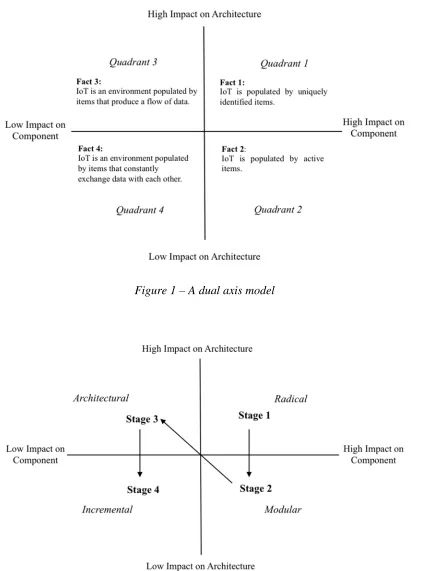
A high innovation impact on both architecture and components (quadrant 1) is completely redesigned and the whole system ends up with a possible completely new system; in managerial terms this results in new markets and opportunities (Radical Innovation). However, the impact of innovation can be very high on only a component, part or subsystem, but the overall system structure may remain substantially unchanged (quadrant 2). In this case, the system is integrated and upgraded by new functions (Modular Innovation). Conversely, an innovation may leave unchanged the single parts of a system but deeply reshape the interconnections between them (quadrant 3). In this case, the effect is a possible innovative purpose and employability of the re-assembled system (Architectural Innovation). Finally, an innovation may have a low impact both in terms of architecture and components, and in this case the overall effect is limited (quadrant 4). This is the case of an improved performance of existing functions (Incremental Innovation).
Having stated the general model, we position the aforementioned facts about the IoT to build a specific model for this context (Figure 1). Fact 1 is characterized by both a high impact on components and a high impact on architecture; Fact 2 is characterized by a high impact on components and a low impact on architecture; Fact 3 is characterized by a low impact on components and a high impact on architecture; finally, Fact 4 is characterized by both a low impact on components and a low impact on architecture.
16 Despite the definition of innovation for the IoT used by Gubbi and colleagues, they stated an articulated definition that covers our model. They stated that the IoT is “a radical evolution of the current Internet into a network of interconnected objects that not only harvests information from
the environment (sensing) and interacts with the physical world (actuation/command/control), but
also uses existing Internet standards to provide services for information transfer, analytics,
applications, and communications.” (Gubbi et al., 2013, p. 1646).
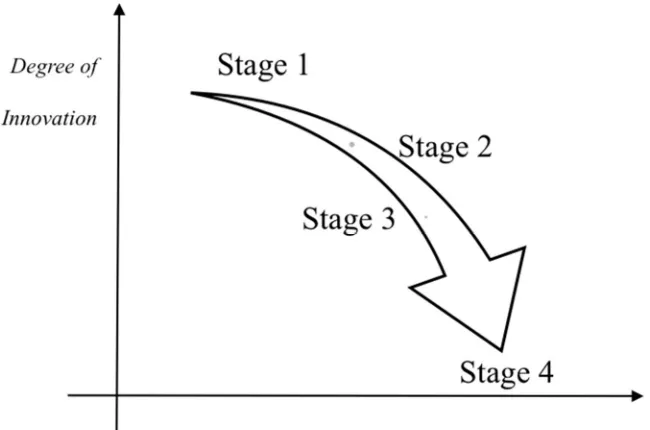
This definition considers that the IoT phenomenon has occurred in a single moment and this would justify the use of the only concept of radical innovation; however, our model by taking into account all of these features proposes a better fit of the impact of the IoT in the manufacturing industry, also considering an evolutionary perspective (Figure 2).
- - - Please insert Figure 2 about here - - -
17 - - - Please insert Figure 3 about here - - -
- - - Please insert Table 1 about here - - -
3.3 Product and process implications of the IoT
At this point in our discussion it is useful to close the circle of our argument and relate our model to the product and process implications of the IoT in manufacturing. We have so far classified the different types of innovations in manufacturing to develop a dual axis model by integrating the Henderson and Clark model with the four facts characterizing the IoT. Now, our logical process brings us back, within this section, to relate our model to the original classification of product and process innovation (Figure 4).
- - - Please insert Figure 4 about here - - -
The first thee facts generally influence product innovation. Indeed, Stage 1 makes it possible to produce revolutionary and breakthrough items, a new product is developed and introduced. Stage 2 involves, generally, the product function due to new equipment enabling items to sense the environment, new modules being introduced to the existing product and thus making it “smarter”. Stage 3 is in regard to the process of data production, when the architecture is developed to gather and utilize data.
18 key factors that influence the dynamic of product and process innovations, are underlined (Damanpour and Schneider, 2006; Reichstein and Salter, 2006).
Finally, Stage 4 implies how these data are used in strategic decision-making to promote process optimization. This final step involves only processes inside firms by redesigning the decision-making processes, thanks to the availability of data.
4. Applied Conceptual Framework: The Case of Additive Manufacturing
To represent our conceptual framework in a wider perspective, we apply the developed dual axis model to a revolution that is happening in various industries: additive manufacturing. Additive manufacturing represents a technological innovation that in recent years has attracted growing interest and is proving to be a viable trajectory for technological innovation in different sectors. It is certainly a current topic; however, at the academic level, the problems related to this innovation have been addressed almost exclusively from a technical point of view within optical engineering or architecture and design. The novelty of our paper is therefore to address this innovation from a management perspective through the application of the conceptual framework developed in this paper.
4.1 Additive Manufacturing
19 Additive manufacturing can be regarded as process innovation (Kruth et al., 1998). In particular, the additive manufacturing production method uses different technologies that allow the creation of items by generating and adding successive layers of material. This contrasts with what happens in many of the traditional production techniques, such as turning and milling, in which we proceed by subtraction from solid material (subtractive manufacturing). This innovation comes from new machinery, such as 3D printers, which can be used in prototyping or directly in the production of either semi-finished or finished products. There are three basic 3D printing methods that can be differentiated based on the input material: powder, liquid or solid (Lipson and Kurman, 2013). First, the Selective Laser Sintering (SLS) method uses a laser to sinter (fuse) thermoplastic powders, metal or silicates The machine creates layer after layer, fusing powders on a table that lowers gradually. The main advantage of this technology lies in the fact that various types of raw material may be employed with a high return in mechanical and thermal yields (Kruth et al., 2003). Second, Stereolithography (SLA) is based on the polymerization of liquid resin, with a laser focused on the work surface through optical systems that build items layer upon layer. Once the item is completed, it will be extracted and put in an ultraviolet oven to harden the material and make it usable for further steps. SLA allows for the production of parts with complex geometries and surfaces in a better way than other additive processes, but it is still only used only for small lots (e.g. custom jewelry) due to the amount of time required to produce each piece (Dimitrov, Schreve and De Beer, 2006).
20 The first applications of additive manufacturing came from prototype making. In recent years, this technology has evolved and it has now also been used in the production phase. Currently the production of finished products through 3D printers is widely considered the true "frontier" for the future development of this technology (Boccardi et al., 2014).
4.2 Additive Manufacturing and the IoT
It is easy to understand the connection between data flow and the IoT, as being any item connected to a network producing data that can be collected and analyzed. Yet, the connection between 3D printing and the IoT is not immediately clear and requires further consideration. For this reason, we suggest that the application of the developed conceptual framework can be a useful tool to contribute to the understanding of this relationship and stimulate future research on the topic. First, regarding Stage 1 of our conceptual framework, products from 3D printing and additive manufacturing need a unique identifier code embedded within the object, such as RFID tags that are useful in the IoT product identification (Bak, 2003; Ilic et al., 2010). Using 3D printing, it is possible to build unique 3D codes inside the material of the object itself (Lakafosis et al., 2010). The ability to embed readable codes directly into the items would mean that any object created in this way could immediately be a part of the IoT. In addition, the constant cost reductions for RFID technologies has pushed firms worldwide towards integrating this type of technology into product and process innovation, making its adoption extremely widespread.
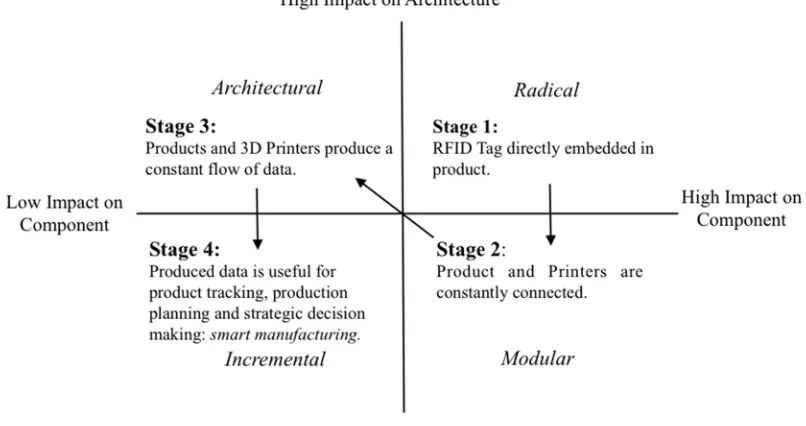
21 Consequently, Stage 3 is a natural evolution from Stages 1 and 2. Items and 3D printers can be “unique” on the Internet; they are equipped with sensing instruments and constantly connected. This means that they produce a constant flow of data in two ways. The first, as explained above, refers to product, and the second refers directly to the 3D printers, which thanks to being connected to the Internet, can be remotely controlled and monitored (e.g. Ilic et al., 2010). This is an important shift through the concept of smart manufacturing (Davis et al., 2012), where the control of a networked manufacturing system across information management plays a crucial role in developing the “smart factory” (Lucke et al., 2008).
Therefore, additive manufacturing is eligible to be called “smart manufacturing” in relation to this new technological shift that converges in Stage 4. Production can be modified in the light of data provided by items. Fact 4 underlines the importance of connection between items and data to forecast and adjust production to demand (Xu, 2012). This evolutionary process then results in “smart manufacturing” which is the natural order begun by the IoT and additive manufacturing. Our interpretation of this new emerging phenomenon is summarized in Figure 5 using the aforementioned framework to demonstrate the wide application of this model.
5. Conclusions
22 scientific research. Therefore, we agreed to investigate a case study within the spectrum of manufacturing: that of additive manufacturing or 3D printing.
We started our theoretical argument by systematizing the main elements, that we called facts, that characterize the phenomenon of the IoT, and we reached the following conclusions: 1) the IoT is an environment populated by uniquely identified items (Ashton, 2009); 2) these items are “active”, in other words, they may autonomously respond to internal and external stimuli (Yan and Huang, 2008); 3) they produce a massive flow of data (McAfee and Brynjolfsson, 2012), and 4) can constantly exchange data with each other (Lee et al., 2013). Such facts however, also represent the evolutionary steps of the impacts that the IoT has had on manufacturing. Reconstructing these facts, it is easy to follow that the introduction of the IoT in production environments has been a radical innovation for the whole market. The ability of the items populating the environment to react and self-activate in response to events has been possible only with the development of new components integrated into those items. On the one hand, such evolution did not change the whole structure of the products, rather just a few additional components representing a modular innovation. On the other hand, their ability to produce real-time information through the same components required a substantial restructuration of the whole system of interconnections among them. Since this innovation targets a different combination and relation among already developed components, it is an architectural innovation. Finally, once the item-system has been able to produce the data, only with an innovation of a minor entity, i.e. incremental, could items communicate and exchange information with each other.
23 the shift from one stage to another in different industries to additive manufacturing. We speculate that general variables can account for those forces coming from the economic environment that influence the adoption and spread of new innovations; while, specific variables might differ from industry to industry, and we predict that those will mainly relate to the technical capabilities necessary for the evolution to happen. Our model offers a base from which future research can investigate which those variables are and how they interplay. We explicitly call for future research on this topic, similarly to what has been done in agile manufacturing (e.g. Jin-Hai, Anderson and Harrison, 2003), as the current knowledge on the topic does not yet allow for a systematic investigation of those variables.
The model has several practical implications, since it can predict and describe the evolutionary path of any sector within the manufacturing industry due to the advent of the IoT. Managers can benefit from the application of the model to their industry allowing them to predict how the industry will evolve and which technologies will represent the bottlenecks (e.g. Bakar and Ahmad, 2010; Kogut and Zander, 1992; Rigby and Zook, 2002; Teece, 2010), allowing their firms to capture value and effectively navigate technological shifts and competition.
We acknowledge the study also has some limitations, which are mainly related to the use of a deductive method to systematize the existing literature on the topic. We try to cope with such limitations by presenting a real case study on the 3D printing technology to assess the validity of our model.
- - - Please insert Figure 5 about here - - -
24 possible to interpret the possible outcomes using the literature and reframing the past events (Facts 1, 2, 3 and 4) by using the model in order to have an idea of the challenges in the future.
References
Adner, R., & Levinthal, D. (2001). “Demand heterogeneity and technology evolution: implications for product and process innovation”. Management Science, 47(5), 611-628.
Anaya, L., Dulaimi, M., & Abdallah, S. (2015). “An investigation into the role of enterprise information systems in enabling business innovation.” Business Process Management Journal, 21(4).
Ashton, K. (2009). “That ‘internet of things’ thing”. RFiD Journal, 22(7), 97-114.
Bak, D. (2003). “Rapid prototyping or rapid production? 3D printing processes move industry towards the latter”, Assembly Automation, 23(4), 340-345.
Bakar, L. J. A., & Ahmad, H. (2010). “Assessing the relationship between firm resources and product innovation performance: A resource-based view.” Business Process Management Journal, 16(3), 420-435.
Becheikh N., Landry R., & Amara N. (2006), “Lessons from innovation empirical studies in the manufacturing sector: A systematic review of the literature from 1993-2003”, Technovation, 26(5), 644-664.
Bi, Z. M., Lang, S. Y., Shen, W., & Wang, L. (2008). “Reconfigurable manufacturing systems: the state of the art.” International Journal of Production Research, 46(4), 967-992.
Boccardi, A., Marzi, G., Zollo, L., Ciappei, C., & Pellegrini, M. (2014). “Gli effetti della Stampa 3D sulla competitività aziendale. Il caso delle imprese orafe del distretto di Arezzo.” Atti del XXVI Convegno annuale di Sinergie.
Caleb, O. J., Mahajan, P. V., Al-Said, F. A. J., & Opara, U. L. (2013). “Modified atmosphere packaging technology of fresh and fresh-cut produce and the microbial consequences—a review.” Food and Bioprocess Technology, 6(2), 303-329.
Caputo, A. (2012). “Insights on Italian car sharing: the case of Genoa.” International Journal of Business and Globalisation, 9(2), 207-220.
Chao, C. C., Yang, J. M., & Jen, W. Y. (2007). “Determining technology trends and forecasts of RFID by a historical review and bibliometric analysis from 1991 to 2005. Technovation, 27(5), 268-279.
Crossan, M. M., & Apaydin, M. (2010). “A multi-dimensional framework of organizational innovation: A systematic review of the literature”. Journal of Management Studies, 47(6), 1154-1191.
DaCosta, F. (2013). Rethinking the Internet of Things: a scalable approach to connecting everything. Apress Open.
Damanpour F. (1991), “Organizational Innovation: A Meta-Analysis of Effects of Determinants and Moderators”, The Academy of Management Journal, 34(3), 555-590.
25 Damanpour, F., & Schneider, M. (2006). “Phases of the adoption of innovation in organizations: Effects of environment, organization and top Managers”. British Journal of Management, 17(3), 215-236.
Davenport, T. H., & Short, J. (2003). “Information technology and business process redesign”. Operations Management: Critical Perspectives on Business and Management, 1, 97.
Davis, J., Edgar, T., Porter, J., Bernaden, J., & Sarli, M. (2012). “Smart manufacturing, manufacturing intelligence and demand-dynamic performance.” Computers & Chemical Engineering, 47, 145-156.
Devaraj, S., & Kohli, R. (2003). “Performance impacts of information technology: Is actual usage the missing link?” Management Science, 49(3), 273-289.
Devaraj, S., Krajewski, L., & Wei, J. C. (2007). “Impact of eBusiness technologies on operational performance: the role of production information integration in the supply chain.” Journal of Operations Management, 25(6), 1199-1216.
Dewan, R. Bing, J., & Seidman, A. (2000). “Adoption of Internet-based product customization and pricing strategies”. Journal of Management Information Systems, 17(2), 9-28.
Dewar, R. D., Dutton, J. E. (1986). “The adoption of radical and incremental innovations: an empirical analysis”. Management Science, 32(11): 1422-1433.
Dimitrov, D., Schreve, K., & De Beer, N. (2006). “Advances in three dimensional printing-state of the art and future perspectives”, Journal for New Generation Sciences, 4(1), p. 21-49
Ettlie et al. 1984
Fleisch, E. (2010). “What is the internet of things? An economic perspective.” Economics, Management, and Financial Markets, 2, 125-157.
Gubbi, J., Buyya, R., Marusic, S., & Palaniswami, M. (2013). “Internet of Things (IoT): A vision, architectural elements, and future directions”. Future Generation Computer Systems, 29(7), 1645-1660.
Guinard, D., Trifa, V., Karnouskos, S., Spiess, P., & Savio, D. (2010). “Interacting with the soa-based internet of things: Discovery, query, selection, and on-demand provisioning of web services.” Services Computing, IEEE Transactions on, 3(3), 223-235.
Haller, S. (2010). “The things in the internet of things.” Poster at the (IoT 2010). Tokyo, Japan, November, 5, 26.
Henderson, R. M., & Clark, K. B. (1990). “Architectural innovation: The reconfiguration of existing product technologies and the failure of established firms.” Administrative Science Quarterly, 35(1), 9-30.
Holmström, J. (1997). “Product range management: a case study of supply chain operations in the European grocery industry”, Supply Chain Management: An International Journal, 2(3), 107-115.
Ilic, A., Grössbauer, A., Michahelles, F., & Fleisch, E. (2010). “Understanding data volume problems of RFID-enabled supply chains.” Business Process Management Journal, 16(6), 904-916.
Jin-Hai, L., Anderson, A. R., & Harrison, R. T. (2003). “The evolution of agile manufacturing.” Business Process Management Journal, 9(2), 170-189.
26 Kehoe, D., & Boughton, N. (2001). “Internet based supply chain management: A classification of approaches to manufacturing planning and control.” International Journal of Operations & Production Management, 21(4), 516-525.
Kellmereit, D. & Obodovski, D. (2013). The Silent Intelligence: The Internet of Things. DnD Ventures 1st edition, California.
Kiritsis, D. (2011). “Closed-loop PLM for intelligent products in the era of the Internet of things”. Computer-Aided Design, 43(5), 479-501.
Kogut, B., & Zander, U. (1992). “Knowledge of the firm, combinative capabilities, and the replication of technology.” Organization science, 3(3), 383-397.
Kruth, J. P., Leu, M. C., & Nakagawa, T. (1998). “Progress in additive manufacturing and rapid prototyping”, CIRP Annals-Manufacturing Technology, 47(2), 525-540.
Kruth, J. P., Wang, X., Laoui, T., & Froyen, L. (2003). “Lasers and materials in selective laser sintering”, Assembly Automation, 23(4), 357-371.
Lakafosis, V., Rida, A., Vyas, R., Yang, L., Nikolaou, S., & Tentzeris, M. M. (2010). “Progress towards the first wireless sensor networks consisting of inkjet-printed, paper-based RFID-enabled sensor tags”. Proceedings of the IEEE, 98(9), 1601-1609.
LaValle, S., Lesser, E., Shockley, R., Hopkins, M. S., & Kruschwitz, N. (2013). “Big data, analytics and the path from insights to value.” MIT Sloan Management Review, 21.
Lee, C., Leem, C. S., & Hwang, I. (2011). “PDM and ERP integration methodology using digital manufacturing to support global manufacturing”, The International Journal of Advanced Manufacturing Technology, 53(1-4), 399-409.
Lee, J., Lapira, E., Bagheri, B., & Kao, H. A. (2013). “Recent advances and trends in predictive manufacturing systems in big data environment”, Manufacturing Letters, 1(1), 38-41.
Li, B. H., Zhang, L., Wang, S. L., Tao, F., Cao, J. W., Jiang, X. D., & Chai, X. D. (2010). “Cloud manufacturing: a new service-oriented networked manufacturing model”. Computer Integrated Manufacturing Systems, 16(1), 1-7.
Li, Q., Maggitti P.G., Smith K.G., Tesluk P.E., & Katila R. (2013), “Top Management Attention to Innovation: The Role of Search Selection and Intensity in new Products Introduction”, The Academy of Management Journal, 56(3), 893-916.
Lipson, H., & Kurman, M. (2013). “Fabricated: The new world of 3D printing.” John Wiley & Sons. Lööf, H., & Heshmati, A. (2006). “On the relationship between innovation and performance: A
sensitivity analysis.” Economics of Innovation and New Technology, 15(4-5), 317-344.
López-Gómez, A., Fernández, P. S., Palop, A., Periago, P. M., Martinez-López, A., Marin-Iniesta, F., & Barbosa-Cánovas, G. V. (2009). “Food safety engineering: an emergent perspective.” Food Engineering Reviews, 1(1), 84-104.
Lucke, D., Constantinescu, C., & Westkämper, E. (2008). “Smart factory-a step towards the next generation of manufacturing”, Manufacturing Systems and Technologies for the New Frontier (pp. 115-118). Springer London.
Manenti, P. (2011). “Building the global cars of the future.” Managing Automation, 26(1), 8-14. Magnusson, T., Lindström, G., & Berggren, C. (2003). “Architectural or modular innovation?
Managing discontinuous product development in response to challenging environmental performance targets.” International Journal of Innovation Management, 7(01), 1-26.
27 McAfee, A., & Brynjolfsson, E. (2012). “Big data: the management revolution.” Harvard Business
Review, 90, 60-6.
McFarlane, D., Sarma, S., Chirn, J. L., Wong, C., & Ashton, K. (2003). “Auto ID systems and intelligent manufacturing control.” Engineering Applications of Artificial Intelligence, 16(4), 365-376.
McFarlane, D. C., Giannikas, V., Wong, A., & Harrison, M. G. (2012). “Intelligent products in the supply chain-10 years on.” Information Control Problems in Manufacturing14(1), 655-660. Norman, D. A., & Verganti, R. (2014). “Incremental and radical innovation: Design research vs.
technology and meaning change.” Design Issues, 30(1), 78-96.
Pandey, S., Gupta, B., & Nahata, A. (2013). “Terahertz plasmonic waveguides created via 3D printing”. Optics Express, 21(21), 24422-24430.
Peteraf, M. A. (1993). “The cornerstones of competitive advantage: a resource‐based view.” Strategic Management Journal, 14(3), 179-191.
Porter, M. E. (1985). Competitive Advantage. Free Press, New York.
Prajogo, D. I. (2006). “The relationship between innovation and business performance—a comparative study between manufacturing and service firms.” Knowledge and Process Management, 13(3), 218-225.
Pratt, M.T., Sriram, R.D. & Wozny, M.J., (1997) Product Modeling For Computer Integrated Design And Manufacture, Chapman & Hall.
Reichstein T., & Salter A. (2006), “Investigating the sources of process innovation among UK manufacturing firms”, Industrial and Corporate Change,15(4), 653-682.
Rengier F., Mehndiratta, A., von Tengg-Kobligk, H., Zechmann, C.M., Unterhinninghofen, R., Kauczor, H.-U. & Giesel, F.L. (2010). “3D Printing based on imaging data: review of medical applications”. International Journal of Computer Assisted Radiology and Surgery, 5(4), 335-348.
Rigby, D., & Zook, C. (2002). “Open-market innovation.” Harvard business review, 80(10), 80-93. Schroeder, R. G., Scudder, G. D., & Elm, D. R. (1989). “Innovation in manufacturing.” Journal of
Operations Management, 8(1), 1-15.
Shepherd, C., & Ahmed, P. K. (2000). “From product innovation to solutions innovation: a new paradigm for competitive advantage.” European Journal of Innovation Management, 3(2), 100-106.
Smith W.K., & Tushman M.L. (2005), “Managing strategic contradictions: A top management model for man-aging innovation streams”, Organization Science, 16(5), 522-536.
Sood, A., & Tellis, G. J. (2005). “Technological evolution and radical innovation.” Journal of Marketing, 69(3), 152-168.
Swan, M. (2012). “Sensor mania! the internet of things, wearable computing, objective metrics, and the quantified self-2.0”. Journal of Sensor and Actuator Networks, 1(3), 217-253.
Teece, D. J. (2010). “Business models, business strategy and innovation.” Long Range Planning, 43(2), 172-194.
Tian, G. Y., Yin, G., & Taylor, D. (2002). “Internet-based manufacturing: A review and a new infrastructure for distributed intelligent manufacturing.” Journal of Intelligent Manufacturing, 13(5), 323-338.
28 Ventä, O. (2007). “Intelligent products and systems.” Technology Theme-Final Report. VTT,
Espoo: VTT Publications, 304.
Vitzthum, S., & Konsynski, B. (2008). “CHEP: the net of things.” Communications of the Association for Information Systems, 22(1), 26.
Xia, F., Yang, L. T., Wang, L., & Vinel, A. (2012). “Internet of things”. International Journal of Communication Systems, 25(9), 1101.
Xu, X. (2012). “From cloud computing to cloud manufacturing.” Robotics and computer-integrated manufacturing, 28(1), 75-86.
Yam, K. L., Takhistov, P. T., & Miltz, J. (2005). “Intelligent packaging: concepts and applications.” Journal of Food Science, 70(1), 1-10.
Yan, B., & Huang, G. (2008, December). “Application of RFID and Internet of Things in Monitoring and Anti-counterfeiting for Products.” Business and Information Management. 1, 392-395. IEEE.
Yusuf, Y. Y., Gunasekaran, A., Adeleye, E. O., & Sivayoganathan, K. (2004). “Agile supply chain capabilities: Determinants of competitive objectives.” European Journal of Operational Research, 159(2), 379-392.
Wu, D., Rosen, D. W., Wang, L., & Schaefer, D. (2015). “Cloud-based design and manufacturing: A new paradigm in digital manufacturing and design innovation.” Computer-Aided Design, 59, 1-14.
Zein, I., Hutmacher, D. W., Tan, K. C., & Teoh, S. H. (2002). “Fused deposition modeling of novel scaffold architectures for tissue engineering applications”, Biomaterials,23(4), 1169-1185. Zuehlke, D. (2010). “SmartFactory - Towards a factory-of-things”, Annual Reviews in
29 Figures
Figure 1 – A dual axis model
30 Figure 3 – Degree of innovation and evolutionary phases of innovations
31 Figure 5 - Application of the dual axis model to the additive manufacturing
Tables
Table 1 – Summary of the model
INNOVATION COMPONENTS LINKAGE BEETWEEN
COMPONENTS
FACTS STAGES
RADICAL New Reconfigured Fact 1 STAGE 1
MODULAR New Minor Change Fact 2 STAGE 2