Presented at the 11th World Congress of Semiotics, Nanjing, China, October 2012 Published De Gruyter Mouton in Chinese Semiotic Studies Vol.10 No.2 pp229-245 Online: 19 July 2014. Print: August 2014
DOI: https://doi.org/10.1515/css-2014-0021
Title
Bridging Civilisations: The Application of Systemic-Functional Semiotics in the Comparison of Drawings from China and Europe
Authors
Professor Howard Riley PhD MA(Royal College of Art)
Head of School of Research & Postgraduate Studies
Faculty of Art & Design
Swansea Metropolitan University
De La Beche Street
Swansea SA1 3EU
Wales, UK
Email: [email protected]
Amanda Roberts MA BA PGCE
Doctoral Candidate
Faculty of Art & Design
Swansea Metropolitan University
Email: [email protected]
Abstract
This paper discusses the application of systemic-functional semiotics in the analysis of visual materials, and, specifically, presents an original systemic-functional model that is intended to facilitate both the analysis and synthesis of drawings in a cross-cultural context. The model is explained as developing from Michael O’Toole’s systemic-functional
HALLIDAY, 1985) The article is illustrated with examples of work from China, Europe, and the authors’ drawing practice..
Introduction
In his article Pushing Out the Boundaries: Designing a Systemic-Functional Model for
Non-European Visual Arts, Michael O’Toole ((O’Toole, 2005) demonstrates how
systemic-functional semiotics can reveal how ideological values are embodied within the
conventions of drawing by analysing a scroll painting of 1689 by Chinese artist Gong
Xian.
This paper takes O’Toole’s premise as its starting point: that systemic-functional
semiotics can reveal a variety of ideological positions through analysis of visual work
produced in a variety of cultural contexts. Specifically, the paper compares the
representation of both landscape and figure within European and Chinese art.
O’Toole’s systemic-functional model, elaborated in his 2011 The Language of Displayed
Art, is an adaptation of the English socio-linguist Michael Halliday’s (1973; 1978; 1985)
model for language which is adumbrated below in terms suitable for a discussion of
drawing as a code of visual communication.
Before visual comparisons are made, a brief explanation of their theoretical basis is
offered:
The Social Semiotics of Drawing
positions within their sets of social relations. Such an ideological positioning involves a definite way of using signs, and a structured sensibility (an aesthetic) both grounded in a particular system of social relations. How the artist selects and combines the compositional elements of the drawing, and how the viewer relates to that drawing are both functions of the social contexts in which the work is
(re)produced.
But to simply say that drawings reflect social structure, (or in the case of the Western tradition of life drawing, the social relations between artist, model and viewer) is too passive: drawing not only expresses the social context but is also part of a more complex dialectic in which drawings actively symbolise the social system, thus producing as well as being produced by it.
Variation in ways of drawing is the symbolic expression of variation in social relationships. Drawing systems are produced within society, and help to produce social form in their turn. This dialectical relationship is what Michael Halliday (1978:183) discusses in the phrase social semiotic. Halliday developed his theory during a long career which began with the study of Chinese language structures. He studied in China in the 1950s under Luo Changpei at Beijing, and Wang Li at Lingnan, before returning to England to take a doctorate in Chinese linguistics at Cambridge University. Such cross-cultural studies of languages provided him with insights into the variety of languages. Here, we adapt Halliday’s insight to another code of
communication common to all cultures, that of drawing.
Varieties of drawing
Of the two kinds of variation in language identified by Halliday (et al.1964), dialect
expresses the diversity of social structure, and register expresses the diversity of social process. Whilst the meaning of dialect may be commonly understood, register
may require further discussion. It refers to the fact that language usage varies according to the situation in which it is used.
From this social semiotic perspective, any social context may be understood as a temporary construct, mapped in terms of three variables which Halliday (1978:33) calls Field, Tenor, and Mode.
Field of social process – what is going on at the time of production of the drawing.
Tenor of social relationships – the type of drawing we produce varies according to the
level of formality, of technicality, of need for clarity of communication, etc. It is
the role relationships – the drawer, the subject matter, the viewer and their
interrelationships – that affect the variations.
Mode of symbolic interaction – in the sense that how we draw, and with which
particular medium, varies with our attitude; from the clinically objective through
the poetically gestural to an absent-minded doodling,
The Functions and Systems of Drawing
Any code of communication (language, dress, drawing …) has three main functions: to represent some aspect of our experiences of the world; to both express our attitude, mood regarding our experience, and to position the receiver in terms of mood and attitude towards that which is being represented; and thirdly to structure these two into a coherent, perceptible form. These functions may be termed the
representational, the interpersonal, and the compositional.
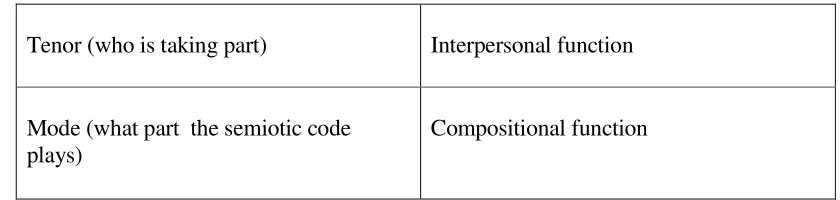
The parameters of social context, field, tenor, and mode are systematically related to the functions of the semiotic model. In fact, those meanings that constitute our understanding of any particular social situation are made visible through the selection and combination of elements within the semiotic model.
Parameter of social context Function of drawing through which a social situation is realised
Tenor (who is taking part) Interpersonal function
Mode (what part the semiotic code plays)
Compositional function
Figure 1 The Parameters of Social Context
Such a model which theorises how the functions of drawing operate within a social context relates specific choices to specific social contexts. We are thus able to imbue the relationship between code and social structure with dialectic resonances.
The chart shown here, Figure 2, is an attempt to map these functional relationships for the whole domain of drawing, and is an adaptation of O'Toole's (2011) format for analysing paintings. It should be noted that each term within each box of the model – for example, Theme in the first box - represents the whole range of
available selections embraced by the term itself: every theme available to the artist (or indeed for the viewer’s interpretation.) Each range of available choices implied by all those terms is what Halliday meant by System: a Hallidayian system represents a range of available choices. Hence the term Systemic-Functional semiotics!
. Function
Level of Engagement
REPRESENTATIONAL (what is depicted)
INTERPERSONAL (how the viewer is positioned in terms of mood and attitude)
The Work as Displayed Theme Narrative Genre Representational/abstract Interplay of episodes/passages Attitude, Modality Rhythm/Focal points Intimate/monumental Public/private Dynamic/static
Overall format and size Gestalt relations: horizontals, verticals, diagonals
Frame/Mount/Light Range of colour/B&W Systems of geometry: perspective,
orthographic, axonometric, etc.
Episodes of the Work Actions, events central to narrative supporting narrative
Orientation of viewer Perspective/non perspective Gaze/eyework Modality: happy/gloomy, calm/excited etc.
Relative position in drawing
Interplay of figures/passages Contrast of tone/texture
Combinations of marks (sub-assemblies) Direction Transparency/opacity Atmosphere
Time of day Surfaces/edges Distance Force Heavy/lightweight Flatness/illusions of depth
Relative positions of marks
Relative sizes of marks Division of picture-plane: ratios, angles Overlap of shapes/tones
Individual Marks Effects of light on
surfaces and media (air, water) in the environment
Hard/soft Stylisation Matt/gloss
Wet/dry
Indices of maker’s movements
Position within picture plane
Texture of surface Medium
Size relative to picture-plane
Figure 2 The Functions and Systems of Drawing
Each System in the systemic functional semiotic chart represents specific choices made by
the artist, who makes compositional selections that serve to position the viewer, who is then
work. A Postmodern understanding positions meanings generated as socially and
culturally dependent . Social semiotic analysis is intrinsically suitable for generating
multiple interpretations and may be applied across a multiplicity of viewing experiences.
The analysis of works demonstrated in this paper will necessarily reflect understandings
related to twentyfirst century Western European perspectives.
The Systemic-Functional Model in Action 1: Landscape
As O’Toole (2005:96) observes:
Particular systems may dominate in the realisation of each of the functions in
any one visual culture, and each system may be realized in particular culturally
characteristic forms and patterns…
These choices of representation are rarely arbitrary decisions on the part of the artist, but
can represent and realise - make visible – the different ideologies to which the artists are
affiliated.
For example, a comparative analysis of Claude Lorrain’s Landscape with CountryDance
(Figure 3) with its near-contemporary, Kuncan’s Landscape after Night Rain Shower,
(Figure 4) can demonstrate how certain of these Systems reveal ideological differences
viewer in terms of their mood and attitude towards the subject-matter depicted.
Figure 4 Kuncan, 1660 Landscape after Night Rain Shower. The Palace Museum Beijing.
A widely-held understanding of the differences between Chinese and European
conventions for the depiction of three-dimensional space upon a two-dimensional surface is
based on the systems of projective geometry favoured by each culture. For some time it has
been understood that the cultural belief systems prevalent in Renaissance Italy gave rise to
the development of Artificial Perspective, which places the viewer at the apex of the
Euclidean cone of vision, as in the Lorrain drawing. For a similar length of time it has been
understood in the West that such an egocentric ideology has not prevailed in Chinese visual
culture, hence the more prevalent use of non-perspectival projective geometries such as
Vertical Oblique projection (Dubery and Willats, 1983) in the Kuncan drawing. It is also
worth noting here that within the Interpersonal Function the ‘landscape’ format of
Lorrain’s drawing is conducive to a reading of space as a wide vista, whereas Kuncan’s
choice of ‘portrait’ format is conducive to a reading of space as vertically structured.
However, the wide range of geometric projections is but one System for positioning the
viewer spatially – part of the function labelled the Interpersonal in Figure 2: other Systems
at work on the viewer may be discerned in both Western and Chinese image-making, such
as Focus, Gaze and Modality all at work in the three Functions simultaneously.
Differences between the artists’ cultural values fully emerge when the following aspects of
the interpersonal function are considered: orientation and focus of the viewer, the direction
of the gaze and paths of eye movement, and the representation of distance through illusions
of depth.
Lorrain grounds the viewer directly in front of the centre of the represented landscape and
slightly elevated, as though positioned on a slight slope facing the scenery. The landscape
is revealed as a stage set, trees and foliage to the sides and details in the foreground serve to
frame the central narrative, the dancers themselves. These compositional choices allow the
viewer to connect with the scene, we are invited to join the festive activities. The viewer’s
from the cows in the foreground through the dancing figures, up the tree into the bright
tonal block of the sky and drawn along the horizon line, taking in the picturesque idyll,
down the facing trees and onto the goats, unattended and falling off the cliff. The narrative
of the story reveals itself as the viewer’s gaze is directed through the picture, and the
landscape, characteristically for its cultural genre, recedes into the background.
Kuncan positions the viewer at some point in space, not grounded as in the Lorrain
drawing, but gazing over an inaccessible and misty depth of landscape in which the point of
focus varies as the eyework of the viewer roams from the bold diagonals of the rocky
outcrop at lower right towards the high tonal contrast of the foliage in the centrally
positioned foreground tree. The diagonal of the tree branches leads the eye to the finely
detailed crane, the simply-constructed hut and, eventually, a human figure, lower left,
hardly differentiated from his surroundings and who faces out of the pictorial plane. The
line of the hut’s roof draws the viewer’s eye back into the landscape and the delicate
upward sweep of the brushstrokes, suggesting undulating bamboo, lead us to the bridge
affording access to the series of rather more sophisticated buildings that climb the gradient
of the landscape, centre right. The continued upward sweep of these buildings form a curve
across the picture connecting to the facing cliffs, upper left, upon which sits the highest,
isolated building facing directly into the calligraphy which completes the composition. In
Kuncan’s work the potential narrative play between the crane, the seated figure and the
buildings is made incidental to the expanse and grandeur of the landscape they exist within.
His compositional choices serve to distance the viewer from the scene; we are awed by the
mystery (mistery?) and monumentality of this landscape and we are reminded of our
Having identified such diametrically-opposed cultural beliefs regarding the relationship
between mankind and landscape expressed through the Systems at work in the
Interpersonal function, let us see what our systemic-functional model can reveal about the
two cultures by addressing the Representational Function. There are discernible
similarities within these two drawings: at the level of engagement The Work as Displayed,
both images figuratively represent rural landscapes. But despite their initial similarities, a
further consideration of the works in relation to their representational function reveals clues
to their different cultural influences and references, as we shall see: The Episodes of both
drawings suggest a rural idyll, figures and buildings are harmoniously incorporated into the
landscapes, and at the Combinations of Marks level of engagement, both drawings are
executed in pen and sepia ink, with line worked on top of an underlying ink wash. There is
a shared delicacy and a sensitivity in the mark making that creates a similar atmospheric
quality in both works and which suggests that elements of the landscape have been
carefully observed, even though selections from the Systems of projective geometry, gaze
and focus position the viewer differently, as discussed above. However, IndividualMarks
that describe the textural quality of the foreground foliage and log in the Lorrain landscape
and the complex arrangement of the rock bedding plane in Kuncan’s image are combined
with more generic and culturally specific forms of mark making. For example, both images
define larger tonal blocks with wash, but the Lorrain landscape further defines areas of tone
with fine line hatching. This is most evident in the foreground rocks, but also discernible in
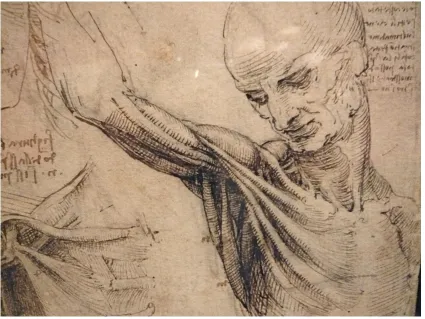
the foliage on the tree and in the clouds. Hatching, which uses closely spaced parallel lines
European tradition, evolving from woodblock engraving. Highly developed in the
drawings of Leonardo da Vinci, (Figure 5)
Figure 5 Leonardo da Vinci c1510-11 The Muscles of the Shoulder (detail) Royal
Collection Trust © Her Majesty Queen Elizabeth II 2012.
the technique became closely associated with Renaissance drawing which, through its
subsequent association with the Academy, came to epitomise the formal traditions of
European art. Hatching is not used in Kuncan’s work. Instead the stylisation of the marks
forming the tree in the compositional foreground have a calligraphic quality to them. The
the need for additional layering, indicating the importance of the direct calligraphic
tradition of Chinese painting.
Within the drawings as displayed, the initial static atmosphere of the works is countered by
Kuncan’s fluid and dynamic brushwork, and by Lorrain’s narrative played out by the
dancing figures and their unattended goats. Mark making and narrative respectively create
tensions between stillness and movement thus engaging the viewer through this apparent
contradiction.
To sum up: for Lorrain, the landscape appears as a backdrop to the represented narrative,
in Kuncan’s drawing the narrative is inconsequential and insignificant in relation to its
landscape setting. Such contrast might be understood as indicating a European
preoccupation with the Picturesque, whereas the East ponders upon the Sublime.
The Systemic-Functional Model in Action 2: The Figure
Along with landscape, the human figure is one of the most common genres in art. This
section analyses the representation of the figure within two cultures; contemporary China,
and the contemporary practice of one of the authors, Roberts.
Engaging with Zhang Dali’s installation Chinese Offspring at the level of The Work in
Context (this work was displayed in the Saatchi Gallery, London in 2009), Figure 6
indicates the high degree of perceptual intrigue engendered through the contrast of exterior
Figure 7 Zhang Dali2003-5 Chinese Offspring installation view, Saatchi Gallery.
Figure 7a Zhang Dali 2003-5Chinese Offspring (details)
Within the installation room, the life-size resin-moulded figures are displayed hanging
from the ceiling, out of reach of the visitor, but close enough for the viewer to observe
individual differences in the poses of these otherwise anonymised figures – no
distinctions of dress or other codes of personal identity. A further opposition to that
figures, positioning the viewer in a most uncomfortable attitude: the dignity of the figures’
elevation contradicted by their undignified suspension by the feet, connoting a complete
lack of control over their situation. Such oppositional compositional choices might be
associated metaphorically with the wider cultural oppositions apparent in contemporary
China: the shift from a rural way of life to an urban one, entailing the turning of lives
upside down, in the common phrase; the necessity for many of the rural-based population
to work in the construction of the rapidly-growing cities, abandoning their rural
individuality to urban anonymity.
Figure 8 Zhang Dali 2003-5 Chinese Offspring (detail)
At the level of engagement Individual Marks, the viewer notices that each suspended
figure is indeed marked with its individual number, but also with the common label
Chinese Offspring and the signature of the artist (Figure 8). Could the conventions of the
construed as an ironic comment upon the controlling activities of the state, both in the
spheres of workers control and population control policies?
In any case, Dali’s representation of the human figure breaks with the traditional
conventions of Chinese art, a trait we shall also discern in the seemingly traditional
charcoal representations of the life model in Roberts’ practice, discussed next:
Figure 9 Amanda Roberts2012 Emma Extended Drawing. charcoal on paper
A useful entry point to the semiotic analysis of Roberts’ Extended Drawings series is the
mapping of the specific parameters of the particular set of social relations existing at their
execution onto the three functions identified in Figures 1 and 2:
Field: A private studio drawing session.
Tenor: Female model and female artist interact at close quarters, with the artist directing
the model’s pose, and shifting viewing/drawing positions at regular intervals.
Mode: The interaction is realised visually through a series of charcoal drawings taped
The image underpinned with this basic background information already generates a series
of assumptions and associations. The close proximity between the model and the artist
during the drawing process within a private drawing studio suggests a level of intimacy and
familiarity.
The initial impact of the Functional Compositional structure of The Work as
Displayed is the scale of the drawings. The represented figures are large, and viewed
within the context of the studio, dominate the viewing space. The scale of the works is
accentuated by the figures’ lack of containment within either a frame or a single sheet
of paper. Each figure expands and fills the compositional plane, although the figure,
and the multiple viewpoints represented within it, is enclosed within a figurative
compositional whole. The absence of any background, other than areas of blocked
tonal differentiations that operate as a ground against which the form of the body is
defined, combined with the unframed edges of the work counteracts the concept of the
drawing as an autonomous space. Instead, the figure inhabits the space within which it
is exhibited. Since the drawings represent a single figure, narrative interplay exists,
not between figures depicted within a pictorial composition, but between the
represented figure and the viewer within this shared space. The small studio restricts
remote viewing positions and encourages the viewer to move along or around the
works. This mirrors the working practice with both the artist and viewers’ positions
variable and active, the represented figure static. This corresponds to conventional
associations of the female nude with the ‘viewer active/model passive’ but the scale
of the works, experienced within a restricted area, allows the represented figures to
physically dominate the viewing space. The compositional decision not to frame,
from the range of choices (what Halliday termed a system) labeled in Figure 2 as the
system of Framing/MountingLighting , carries significant semiotic potential; the
resultant edges and the physical mass of the represented figures imbue the drawings
with a dynamism at odds with the passivity of the represented pose, and challenges
engagement The Work as Displayed, the compositional choices of close-up viewing
positions and a variety of viewpoints, together with the choice of medium –
organically-expressive charcoal – afford the viewer opportunities to compare the
perception of pictures with the perception of our four-dimensional world: we view the
world from a moving path of observation. This reality of the perceptual process is
implicit in these drawings, rather than obscured in the conventions of a single-point
perspective projection system of geometry, and affords the viewer opportunities to
experience pictorial perception as a movement through space.
The Extended Drawings each compositionally represent a single figure,the viewer engaging
with a narrative representation of a specific person. In Emma ; Extended Drawing, (Figure
9) the focus of detail on the woman’s (Emma’s) face and tattooed arms recognizably
represent individual identity. This emphasis on singularity is contrasted with the stylised
and simplified drawing used to represent her body and the genre of life drawing,
traditionally associated with generalized representations of the female body. Despite the
geometric contortions resulting from the multiple perspective system that represents
divergent viewpoints within a contained form, Emma appears comfortable, and her direct
gaze suggests a confidence participation in her relationship with the viewer. Unlike Zhang
Dali’s figures, and despite her reclining pose Emma is neither static or passive and projects
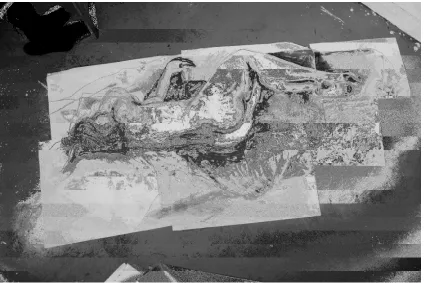
Figure 10 Amanda Roberts 2010 Tonya: Elevated Perspective, charcoal on paper.
Modality within the Interpersonal Function of the The Work as Displayed is inextricably
linked to the viewer’s own preconceptions and expectations. Figure 10,Tonya: Elevated
Perspective is a representation of a woman lying naked on the floor. The drawing is also
displayed on the floor, resulting in an elevation of the viewer’s position. The power
relationship between the depicted form and the viewer is explicit, the viewer looks down
onto the represented body. How the viewer interprets this positioning is liable to differ
from individual to individual. While producing the drawing Tonya was peaceful and self
contained, but this might not be interpreted in the image produced. The figure could be
open to sexual objectification, the model’s eyes are averted from the viewer, the position
she lies in could be interpreted as sexually responsive, but the figure is also vulnerable
particularised response to being placed in this relational position to the represented figure.
The permutations of potential meanings to do with gender/power relations, both
between artist and model and between the drawing and its viewers, may well
stimulate those viewers to reconsider their individual preconceptions about, and
stances towards, the possible permutations of those relations.
Ambiguities and contradictions identified in the Extended Drawings can be
seen as reflecting the concerns and the interests of the artist. Feminist theorists
have established that historically representations of the female nude are
produced by men for a presumably male audience . (Clark 1960, Pollock 1988,
Broude and Garrard 1982)As such , figurative representations of the female
body are susceptible to an objectifying and voyeuristic male gaze. The position
of a female artist, working in the life drawing room, producing figurative
representations of another woman, remains unfixed and undefined. Semiotic
analysis reveals and articulates the fact that ambiguities and tensions of the
artist’s position are embodied in works produced.
Conclusion
We have demonstrated that particular choices made from the available range of choices
(Halliday’s Systems), when realised in culturally characteristic forms, reveal – confirm in
many cases – the ideologies of those cultures. What has been construed in those cultures
as ‘natural’ is revealed through systemic-functional analysis to be culturally-constructed.
References
BROUDE, N.and GARRARD, M.1994 The Power of Feminist Art. New York: Harry N. Abrams.
DUBERY, F. & WILLATS, J. 1983. Perspective and Other Drawing Systems, London, The Herbert Press.
CLARK, K. 1960 The Nude. London: Penguin.
HALLIDAY, M. A. K. 1973 Explorations in the Functions of Language, London, Edward Arnold.
HALLIDAY, M. A. K. 1978. Language as Social Semiotic: the Social Interpretation of Language and Meaning, London, Edward Arnold.
HALLIDAY, M. A. K. 1985. An Introduction to Functional Grammar, London, Edward Arnold.
KREITLER, H. & KREITLER, S. 1972. Psychology of the Arts, Durham, NC, Duke University Press.
O'TOOLE, M. 2011. The Language of Displayed Art (2nd ed.), London, Routledge. POLLOCK, G. 1988 Vision and Difference:. London: Routledge.