R E S E A R C H
Open Access
A survey on biometric cryptosystems and
cancelable biometrics
Christian Rathgeb
*and Andreas Uhl
Abstract
Form a privacy perspective most concerns against the common use of biometrics arise from the storage and misuse of biometric data. Biometric cryptosystems and cancelable biometrics represent emerging technologies of biometric template protection addressing these concerns and improving public confidence and acceptance of biometrics. In addition, biometric cryptosystems provide mechanisms for biometric-dependent key-release. In the last years a significant amount of approaches to both technologies have been published. A comprehensive survey of biometric cryptosystems and cancelable biometrics is presented. State-of-the-art approaches are reviewed based on which an in-depth discussion and an outlook to future prospects are given.
Keywords:biometrics, cryptography, biometric cryptosystems, cancelable biometrics, biometric template protection
1. Introduction
The term biometrics is defined as“automated recogni-tion of individuals based on their behavioral and
biologi-cal characteristics“ (ISO/IEC JTC1 SC37). Physiological
as well as behavioral biometric characteristics are acquired applying adequate sensors and distinctive fea-tures are extracted to form a biometric template in an enrollment process. At the time of verification or identi-fication (identiidenti-fication can be handled as a sequence of verifications and screenings) the system processes another biometric input which is compared against the stored template, yielding acceptance or rejection [1]. It is generally conceded that a substitute to biometrics for positive identification in integrated security applications is non-existent. While the industry has long claimed that one of the primary benefits of biometric templates is that original biometric signals acquired to enroll a data subject cannot be reconstructed from stored tem-plates, several approaches [2,3] have proven this claim wrong. Since biometric characteristics are largely immu-table, a compromise of biometric templates results in permanent loss of a subject’s biometrics. Standard encryption algorithms do not support a comparison of biometric templates in encrypted domain and, thus, leave biometric templates exposed during every
authentication attempt [4] (homomorphic and asym-metric encryption, e.g., in [5-7], which enable a bio-metric comparison in encrypted domain represent exceptions). Conventional cryptosystems provide numer-ous algorithms to secure any kind of crucial informa-tion. While user authentication is based on possession of secret keys, key management is performed introdu-cing a second layer of authentication (e.g., passwords) [8]. As a consequence, encrypted data inherit the secur-ity of according passwords applied to release correct decrypting keys. Biometric template protection schemes which are commonly categorized as biometric cryptosys-tems (also referred to as helper data-based schemes) and cancelable biometrics (also referred to as feature trans-formation) are designed to meet two major require-ments of biometric information protection (ISO/IEC FCD 24745):
•Irreversibility: It should be computationally hard to
reconstruct the original biometric template from the stored reference data, i.e., the protected template, while it should be easy to generate the protected biometric template.
•Unlinkability: Different versions of protected
bio-metric templates can be generated based on the same biometric data (renewability), while protected
templates should not allow cross-matching
(diversity). * Correspondence: [email protected]
Multimedia Signal Processing and Security Lab (Wavelab), Department of Computer Sciences, University of Salzburg, A-5020 Salzburg, Austria
“Biometric cryptosystems (BCSs) are designed to securely bind a digital key to a biometric or generate a
digital key from a biometric“ [9] offering solutions to
biometric-dependent key-release and biometric template protection [10,11]. Replacing password-based key-release, BCSs brings about substantial security benefits. It is significantly more difficult to forge, copy, share, and distribute biometrics compared to passwords [1]. Most biometric characteristics provide an equal level of secur-ity across a user-group (physiological biometric charac-teristics are not user selected). Due to biometric variance (see Figure 1), conventional biometric systems perform “fuzzy comparisons” by applying decision thresholds which are set up based on score distributions between genuine and non-genuine subjects. In contrast, BCSs are designed to output stable keys which are required to match a 100% at authentication. Original biometric templates are replaced through biometric-dependent public information which assists the key-release process.
“Cancelable biometrics (CB) consist of intentional,
repeatable distortions of biometric signals based on transforms which provide a comparison of biometric
tem-plates in the transformed domain“[12]. The inversion of
such transformed biometric templates must not be feasi-ble for potential imposters. In contrast to templates pro-tected by standard encryption algorithms, transformed templates are never decrypted since the comparison of biometric templates is performed in transformed space which is the very essence of CB. The application of transforms provides irreversibility and unlinkability of biometric templates [9]. Obviously, CB are closely related to BCSs.
As both technologies have emerged rather recently and corresponding literature is dispersed across different publication media, a systematic classification and in-depth discussion of approaches to BCS and CB is given. As opposed to existing literature [4,8], which intends to
review BCSs and CB at coarse level, this article provides the reader with detailed descriptions of all existing key concepts and follow-up developments. Emphasis is not only placed on biometric template protection but on cryptographic aspects. Covering the vast majority of published approaches up to and including the year 2010 this survey comprises a valuable collection of references based on which a detailed discussion (including perfor-mance rates, applied data sets, etc.) of the state-of-the-art technologies is presented and a critical analysis of open issues and challenges is given.
This survey is organized as follows: BCSs (Section 2) and CB (Section 3) are categorized and concerning lit-erature is reviewed in detail. A comprehensive discus-sion including the current state-of-the-art approaches to both technologies, security risks, privacy aspects, and open issues and challenges is presented and concluding remarks are given (Section 4).
2. Biometric Cryptosystems
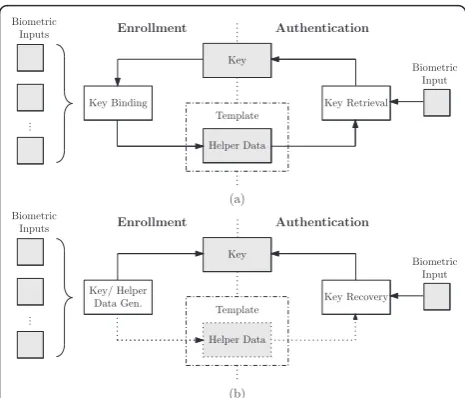
The majority of BCSs require the storage of biometric-dependent public information, applied to retrieve or generate keys, which is referred to as helper data [4]. Due to biometric variance it is not feasible for most bio-metric characteristics to extract keys directly. Helper data, which must not reveal significant information about original biometric templates, assists in recon-structing keys. Biometric comparisons are performed indirectly by verifying key validities, where the output of an authentication process is either a key or a failure message. Since the verification of keys represents a bio-metric comparison in encrypted domain [11], BCSs are applied as a means of biometric template protection [4], in addition to providing biometric-dependent key-release. Based on how helper data are derived, BCSs are classified as key-binding or key-generation systems (see Figure 2):
(1)Key-binding schemes: Helper data are obtained by
binding a chosen key to a biometric template. As a result of the binding process a fusion of the secret key and the biometric template is stored as helper data. Applying an appropriate key retrieval algo-rithm, keys are obtained from the helper data at authentication [8]. Since cryptographic keys are independent of biometric features these are revoc-able while an update of the key usually requires re-enrollment in order to generate new helper data.
(2)Key-generation schemes: Helper data are derived
only from the biometric template. Keys are directly generated from the helper data and a given biometric sample [4]. While the storage of helper data are not obligatory the majority of proposed key-generation schemes does store helper data (if key-generation Figure 1Biometric variance (images taken from FVC’04 and
schemes extract keys without the use of any helper data these are not updatable in case of compromise). Helper data-based key-generation schemes are also referred to as “fuzzy extractors” or“secure sketches”, for both primitives formalisms (and further exten-sions) are defined in [13,14]. A fuzzy extractor reliably extracts a uniformly random string from a biometric input while stored helper data assist the reconstruc-tion. In contrast, in a secure sketch, helper data are applied to recover the original biometric template.
Several concepts of BCSs can be applied as both, key-generation and key-binding scheme [15,16]. Hybrid approaches which make use of more basic concepts [17] have been proposed, too. Furthermore, schemes which declare different goals such as enhancing the security of an existing secret [18,19] have been introduced. In con-trast to BCSs based on key-binding or key-generation, key-release schemes represent a loose coupling of biometric authentication and key-release [8]. In case of successful biometric authentication a key-release mechanism is initiated, i.e., a cryptographic key is released. The loose coupling of biometric and crypto-graphic systems allows to exchange both components easily. However, a great drawback emerges, since the separate plain storage of biometric templates and keys offers more vulnerabilities to conduct attacks. Key-release schemes do not meet requirements of biometric template protection and, thus, are hardly appropriate for high security applications and not usually considered a BCS. Another way to classify BCSs is to focus on how these systems deal with biometric variance. While some schemes apply error correction codes [15,16], others
introduce adjustable filter functions and correlation [20] or quantization [21,22].
Even though definitions for “biometric keys” have been proposed (e.g., in [23,24]), these terms have estab-lished as synonyms for any kind of key dependent upon biometrics, i.e., biometric features take influence on the constitution of keys (as opposed to key-binding schemes). Like conventional cryptographic keys, bio-metric keys have to fulfill several requirements, such as key-randomness, stability, or uniqueness [25,26].
A. Performance measurement
When measuring the performance of biometric systems widely used factors include False Rejection Rate (FRR), False Acceptance Rate (FAR), and Equal Error Rate (EER) [1,27] (defined in ISO/IEC FDIS 19795-1). As score distributions overlap, FRR and FAR intersect at a certain point, defining the EER of the system (in general, decreasing the FRR increases the FAR and vice versa).
These performance metrics are directly transferred to key-release schemes. In the context of BCSs the mean-ing of these metrics change since threshold-based“fuzzy comparison” is eliminated. Within BCSs acceptance requires the generation or retrieval of hundred percent correct keys, while conventional biometric systems response with “Yes” or “No”. The fundamental differ-ence between performance measurement in biometric systems and BCSs is illustrated in Figure 3. The FRR of a BCS defines the rate of incorrect keys untruly gener-ated by the system, that is, the percentage of incorrect keys returned to genuine users (correct keys are user-specific and associated with according helper data). By analogy, the FAR defines the rate of correct keys untruly generated by the system, that is, the percentage of cor-rect keys returned to non-genuine users. A false accept corresponds to the an untrue generation or retrieval of keys associated with distinct helper data at enrollment.
Compared to biometric systems, BCSs generally reveal a noticeable decrease in recognition performance [8]. This is because within BCS in most cases the enrolled
... Biometric
Inputs
Template
Key Binding Key Retrieval
Biometric Input
Enrollment Authentication
Key Recovery (a)
(b) ...
Biometric Inputs
Template
Biometric Input
Enrollment Authentication
Key/ Helper Data Gen.
Key Key
Helper Data
Helper Data
Figure 2The basic concept of biometric (a) key-binding and (b) key-generation.
Intra-Class Distribution
Intra-Class Distribution
Inter-Class Distribution
Biometric System Biometric Cryptosystem
0 100 0 100
(a) (b)
Relativ
e
Matc
h
Coun
t
Relativ
e
Matc
h
Coun
t
100 100
Inter-Class Distribution
Dissimilarity Scores between Biometric Templates
Dissimilarity Scores between extracted / retrieved Cryptographic Keys
template is not seen and, therefore, cannot be aligned properly at comparison. In addition, the majority of BCSs introduce a higher degree of quantization at fea-ture extraction, compared to conventional biometric sys-tems, which are capable of setting more precise thresholds to adjust recognition rates.
B. Approaches to biometric key-binding 1) Mytec1 and Mytec2 (Biometric Encryption™)
The first sophisticated approach to biometric key-bind-ing based on fkey-bind-ingerprints was proposed by Soutar et al. [28-30]. The presented system was called Mytec2, a suc-cessor of Mytec1 [20], which was the first BCS but turned out to be impractical in terms of accuracy and security. Mytec1 and Mytec2 were originally called Bio-metric Encryption™, the trademark was abandoned in 2005. The basis of the Mytec2 (and Mytec1) algorithm is the mechanism of correlation.
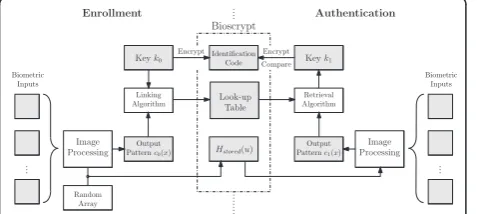
Operation mode(see Figure 4): at enrollment a filter
function, H(u), is derived from f0(x), which is a
two-dimensional image array (0 indicates the first measure-ment). Subsequently, a correlation functionc(x) between
f0(x) and any other biometric inputf1(x) obtained during
verification is defined by c(x) =FT−1{F
1(u)F∗0(u)},
which is the inverse Fourier transform of the product of the Fourier transform of a biometric input, denoted by
F1(u), and F0∗(u), where F0∗(u) is represented by H(u).
The output c(x) is an array of scalar values describing the degree of similarity. To provide distortion tolerance, the filter function is calculated using a set ofTtraining images {f1
0(x),f02(x),. . .,f0T(x)}. The output pattern of
f0t(x) is denoted by ct0(x) with its Fourier transform Ft0(u)H(u). The complex conjugate of the phase com-ponent of H(u), eij(H(u)), is multiplied with a random phase-only array of the same size to create a secure fil-ter, Hstored(u), which is stored as part of the template while the magnitude of H(u) is discarded. The output patternc0(x) is then linked with anN-bit cryptographic
keyk0 using a linking algorithm: if then-th bit ofk0is 0
thenLlocations of the selected part ofc0(x) which are 0
are chosen and the indices of the locations are written into the n-th column of a look-up table which is stored as part of the template, termed BioScrypt. During link-ing, redundancy is added by applying a repetitive code. Standard hashing algorithms are used to compute a hash of k0, termed id0 which is stored as part of the
template, too. During authentication a set of biometric images is combined withHstored(u) to produce an output pattern c1(x). With the use of the look-up table an
appropriate retrieval algorithm calculates an N-bit key
k1extracting the constituent bits of the binarized output
pattern. Finally, a hash id1 is calculated and tested
againstid0 to check the validity ofk1.
The algorithm was summarized in a patent [31], which includes explanations of how to apply the algo-rithm to other biometric characteristics such as iris. In all the publications, performance measurements are omitted.
2) Fuzzy commitment scheme
In 1999 Juels and Wattenberg [15] combined techniques from the area of error correcting codes and cryptogra-phy to achieve a type of cryptographic primitive referred to as fuzzy commitment scheme.
Operation mode (see Figure 5): A fuzzy commitment
scheme consists of a functionF, used to commit a code-wordcÎ Cand a witnessxÎ{0, 1}n. The setCis a set of error correcting codewordscof lengthnand x repre-sents a bitstream of length n, termed witness (biometric data). The difference vector ofcandx,δÎ{0, 1}n, where
x=c +δ, and a hash value h(c) are stored as the com-mitment termed F(c, x) (helper data). Eachx’, which is sufficiently “close” to x, according to an appropriate metric, should be able to reconstructc using the differ-ence vectorδto translatex’in the direction ofx. A hash of the result is tested against h(c). With respect to bio-metric key-binding the system acquires a witness x at enrollment, selects a codeword c Î C, calculates and stores the commitment F(c, x) (δandh(c)). At the time of authentication, a witness x’is acquired and the system checks whetherx’yields a successful decommitment.
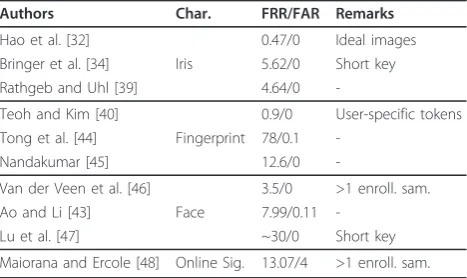
Proposed schemes (see Table 1): The fuzzy
commit-ment scheme was applied to iris-codes by Hao et al. [32]. In their scheme, 2048-bit iris-codes are applied to
Commitment
Biometric Input Error Correcting
Code
Witnessx
Difference Vectorδ Codewordc Hashh(c)
Biometric Input Codewordc
Retrieval
Binding Witnessx
Enrollment Authentication
Figure 5Fuzzy commitment scheme: basic operation mode.
... Biometric
Inputs
Bioscrypt
Look-up Table
Output Patternc0(x)
Linking Algorithm
Keyk0 IdentificationCode
Hstored(u)
Keyk1
Retrieval Algorithm
Output Patternc1(x)
Random Array
... Biometric
Inputs
Encrypt Encrypt
Compare
Enrollment Authentication
Image Processing
Image Processing
bind and retrieve 140-bit cryptographic keys prepared with Hadamard and Reed-Solomon error correction codes. Hadamard codes are applied to eliminate bit errors originating from the natural biometric variance and Reed-Solomon codes are applied to correct burst errors resulting from distortions. The system was tested with 700 iris images of 70 probands obtaining rather impressive results which were not achieved until then. In order to provide an error correction decoding in an iris-based fuzzy commitment scheme, which gets close to a theoretical bound, two-dimensional iterative min-sum decoding is introduced by Bringer et al. [33,34]. Within this approach a matrix is created where lines as well as columns are formed by two different binary Reed-Muller codes. Thereby a more efficient decoding is available. The proposed scheme was adapted to the standard iris recognition algorithm of Daugman to bind and retrieve 40-bit keys. Due to the fact that this scheme was tested on non-ideal iris images a more sig-nificant performance evaluation is provided. Rathgeb and Uhl [35] provide a systematic approach to the con-struction of iris-based fuzzy commitment schemes. After analyzing error distributions between iris-codes of differ-ent iris recognition algorithms, Reed-Solomon and Hardamard codes are applied (similar to [32]). In other further work [36] the authors apply context-based reli-able component selection in order to extract keys from iris-codes which are then bound to Hadamard code-words. Different techniques to improve the performance of iris-based fuzzy commitment schemes have been pro-posed [37-39]. Binary iris-codes are suitable to be applied in a fuzzy commitment scheme, in addition, template alignment is still feasible since it only involves a one-dimensional circular shift of a given iris-code. Besides iris, the fuzzy commitment scheme has been applied to other biometrics as well, which always requires a binarization of extracted feature vectors.
Teoh and Kim [40] applied a randomized dynamic quantization transformation to binarize fingerprint
features extracted from a multichannel Gabor filter. Feature vectors of 375 bits are extracted and Reed-Solomon codes are applied to construct the fuzzy commitment scheme. The transformation comprises a non-invertible projection based on a random matrix derived from a user-specific token. It is required that this token is stored on a secure device. Similar schemes based on the feature extraction of BioHashing [41] (discussed later) have been presented in [42,43]. Tong et al. [44] proposed a fuzzy extractor scheme based on a stable and order invariant representation of biometric data called Fingercode reporting inapplicable perfor-mance rates. Nandakumar [45] applies a binary fixed-length minutiae representation obtained by quantizing the Fourier phase spectrum of a minutia set in a fuzzy commitment scheme, where alignment is achieved through focal point of high curvature regions. In [46] a fuzzy commitment scheme based on face biometrics is presented in which real-valued face features are binar-ized by simple thresholding followed by a reliable bit selection to detect most discriminative features. Lu et al. [47] binarized principal component analysis (PCA) based face features which they apply in a fuzzy commitment scheme.
A method based on user adaptive error correction codes was proposed by Maiorana et al. [48] where the error correction information is adaptively selected based on the intra-variability of a user’s biometric data. Apply-ing online signatures this seems to be the first approach of using behavioral biometrics in a fuzzy commitment scheme. In [49] another fuzzy commitment scheme based on online signatures is presented.
While in classic fuzzy commitment schemes [15,32] biometric variance is eliminated applying error correc-tion codes, Zheng et al. [50] employ error tolerant lat-tice functions. In experiments a FRR of ~3.3% and a FAR of ~0.6% are reported. Besides the formalism of fuzzy extractors and secure sketches, Dodis et al. [13] introduce the so-called syndrome construction. Here an error correction code syndrome is stored as part of the template and applied during authentication in order to reconstruct the original biometric input.
3) Shielding functions
Tuyls et al. [51] introduced a concept which is referred to as shielding functions.
Operation mode (see Figure 6): It is assumed that at
enrollment a noise-free real-valued biometric feature vector Xof fixed length is available. This feature vector is used together with a secret S(the key) to generate the helper dataW applying an inverse δ-contracting func-tionG-1, such that G(W,X) = S. Like in the fuzzy com-mitment scheme [15], additionally, a hash F(S) =V of the secret S is stored. The core of the scheme is the
δ-contracting functionGwhich calculates a residual for Table 1 Experimental results of proposed fuzzy
commitment schemes.
Authors Char. FRR/FAR Remarks
Hao et al. [32] 0.47/0 Ideal images Bringer et al. [34] Iris 5.62/0 Short key Rathgeb and Uhl [39] 4.64/0
-Teoh and Kim [40] 0.9/0 User-specific tokens Tong et al. [44] Fingerprint 78/0.1
-Nandakumar [45] 12.6/0
-Van der Veen et al. [46] 3.5/0 >1 enroll. sam. Ao and Li [43] Face 7.99/0.11
-Lu et al. [47] ~30/0 Short key
each feature, which is the distance to the center of the nearest even-odd or odd-even interval, depending on whether the corresponding bit of Sis 0 or 1.Wcan be seen as correction vector which comprises all residuals. At authentication another biometric feature vectorYis obtained andG(W, Y) is calculated. In case ||X - Y|| ≤
δ, G(W,Y) =S’ =S =G(W, X). In other words, noisy features are added to the stored residuals and the result-ing vector is decoded. An additional application of error correction is optional. Finally, the hash valueF(S’) of the reconstructed secret S’ is tested against the previously stored one (V) yielding successful authentication or rejection. In further work [52] the authors extract reli-able components from fingerprints reporting a FRR of 0.054% and a FAR of 0.032%.
Buhan et al. [53] extend the ideas of the shielding functions approach by introducing a feature mapping based on hexagonal zones instead of square zones. No results in terms of FRR and FAR are given. Li et al. [54] suggest to apply fingerprint in a key-binding scheme based on shielding functions.
4) Fuzzy vault
One of the most popular BCSs called fuzzy vault was introduced by Juels and Sudan [16] in 2002.
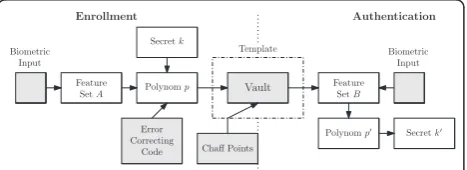
Operation mode (see Figure 7): The key idea of the
fuzzy vault scheme is to use an unordered setAto lock a secret key k, yielding a vault, denoted by VA. If another setBoverlaps largely withA, kis reconstructed, i.e., the vaultVAis unlocked. The vault is created apply-ing polynomial encodapply-ing and error correction. Durapply-ing the enrollment phase a polynom pis selected which encodes the key kin some way (e.g., the coefficients of
pare formed byk), denoted byp¬k. Subsequently, the
elements ofA are projected onto the polynomp, i.e.,p
(A) is calculated. Additionally, chaff points are added in order to obscure genuine points of the polynom. The set of all points,R, forms the template. To achieve suc-cessful authentication another set B needs to overlap withAto a certain extent in order to locate a sufficient amount of points inRthat lie on p. Applying error cor-rection codes,pcan be reconstructed and, thus,k. The security of the whole scheme lies within the infeasibility of the polynomial reconstruction and the number of applied chaff points. The main advantage of this concept is the feature of order invariance, i.e., fuzzy vaults are able to cope with unordered feature set which is the case for several biometric characteristics (e.g., finger-prints [27]).
Proposed schemes(see Table 2): Clancy et al. [55]
pro-posed the first practical and most apparent implementa-tion of the fuzzy vault scheme by locking minutiae points in a “fingerprint vault”. A set of minutiae points,
A, are mapped onto a polynom pand chaff points are randomly added to construct the vault. During authenti-cation, Reed-Solomon codes are applied to reconstruct the polynom pout of which a 128-bit key is recreated. An pre-alignment of fingerprints is assumed which is rarely the case in practice (feature alignment represents a fundamental step in conventional fingerprint recogni-tion systems). To overcome the assumprecogni-tion of pre-align-ment, Nandakumar et al. [56] suggest to utilize high curvature points derived from the orientation field of a fingerprint as helper data to assist the process of align-ment. In their fingerprint fuzzy vault, 128-bit keys are bound and retrieved. Uludag et al. [8,57,58] propose a line-based minutiae representation which the authors evaluate on a test set of 450 fingerprint pairs. Several other approaches have been proposed to improve the alignment within fingerprint-based fuzzy vaults [59-61]. Rotation and translation invariant minutiae representa-tions have been suggested in [62].
Numerous enhancements to the original concept of the fuzzy vault have been introduced. Moon et al. [63] suggest to use an adaptive degree of the polynomial. Nagar and Chaudhury [64] arrange encoded keys and biometric data of fingerprints in the same order into separate grids, which form the vault. Chaff values are inserted into these grids in appropriate range to hide information.
In other work, Nagar et al. [17,65] introduce the idea of enhancing the security and accuracy of a fingerprint-based fuzzy vault by exploiting orientation information of minutiae points. Dodis et al. [13] suggest to use a high-degree polynomial instead of chaff points in order to create an improved fuzzy vault. Additionally, the authors propose another syndrome-based key-generating scheme which they refer to as PinSketch. This scheme is
Biometric Input
Biometric Input
Enrollment Authentication
Template
Feature Vector (X)
Feature Vector(Y) SecretS
(Key)
S
(Key) Hash
(F(S) =V)
Residuals (W) Inverse
δ-contracting Function
(G−1)
δ-contracting Function (G)
Figure 6Shielding functions: basic operation mode.
Biometric Input
Error Correcting
Code
Biometric Input
Enrollment Authentication
Feature SetA
Feature SetB
Polynomp Vault
Template Secretk
Polynomp Secretk
Chaff Points
based on polynomial interpolation like the fuzzy vault but requires less storage space. Arakala [66] provides an implementation of the PinSketch scheme based on fingerprints.
Apart from fingerprints, other biometric characteris-tics have been applied in fuzzy vault schemes. Lee et al. [67] proposed a fuzzy vault for iris biometrics. Since iris features are usually aligned, an unordered set of features is obtained through independent compo-nent analysis. Wu et al. [68,69] proposed a fuzzy vault based on iris as well. After image acquisition and pre-processing, iris texture is divided into 64 blocks where for each block the mean gray scale value is calculated resulting in 256 features which are normalized to inte-gers to reduce noise. At the same time, a Reed-Solo-mon code is generated and, subsequently, the feature vector is translated to a cipher key using a hash func-tion. In further work, Wu et al. [70] propose a system based on palmprints in which 362 bit cryptographic keys are bound and retrieved. A similar approach based on face biometrics is presented in [71]. PCA fea-tures are quantized to obtain a 128-bit feature vector from which 64 distinguishable bits are indexed in a look-up table while variance is overcome by Reed-Solomon codes. Reddy and Babu [72] enhance the security of a classic fuzzy vault scheme based on iris by adding a password with which the vault as well as the secret key is hardened. In case passwords are com-promised the systems security decreases to that of a standard one, thus, according results were achieved under unrealistic preconditions. Kumar and Kumar [73,74] present a fuzzy vault based on palmprints by employing real-valued DCT coefficients of palmprint images binding and retrieving 307 bit keys. Kholmatov and Yanikoglu [75] propose a fuzzy vault for online signatures.
C. Approaches to biometric key-generation
The prior idea of generating keys directly out of bio-metric templates was presented in a patent by Bodo [76]. An implementation of this scheme does not exist and it is expected that most biometric characteristics do not provide enough information to reliably extract a suf-ficiently long and updatable key without the use of any helper data.
1) Private template scheme
The private template scheme, based on iris, was pro-posed by Davida et al. [77,78] in which the biometric template itself (or a hash value of it) serves as a secret key. The storage of helper data which are error correc-tion check bits are required to correct faulty bits of given iris-codes.
Operation mode(see Figure 8): In the enrollment
pro-cessM, 2048-bit iris-codes are generated which are put through a majority decoder to reduce the Hamming dis-tance between them. The majority decoder computes the vectorV ec(V) = (V1,V2, ...,Vn) for an-bit code vec-tor, denoted byV ec(vi) = (vi,1,vi,2, ...,vi,n), where Vj=
majority(v1,j,v2,j, ...,vM,j) is the majority of 0’s and 1’s at each bit position j of M vectors. A majority decoded iris-code T, denoted by V ec(T), is concatenated with check digitsV ec(C), to generate V ec(T)||V ec(C). The check digits V ec(C) are part of an error correction code. Subsequently, a hash value Hash (Name, Attr, V ec(T)||V ec(C)) is generated, where Name is the user’s name, Attr are public attributes of the user and Hash(·) is a hash function. Finally, an authorization officer signs this hash resulting in Sig(Hash(Name, Attr,V ec(T)||V ec(C))). During authentication, several iris-codes are cap-tured and majority decoded resulting inV ec(T’). With the according helper data, V ec(C), the corrected tem-plate V ec(T“) is reconstructed. Hash(Name, Attr,V ec
(T“)||V ec(C)) is calculated and compared against Sig
(Hash(Name, Attr, V ec(T“)||V ec(C))). Experimental results are omitted and it is commonly expected that the proposed system reveals poor performance due to the fact that the authors restrict to the assumption that only 10% of bits of an iris-code change among different Table 2 Experimental results of proposed fuzzy vault
schemes.
Authors Char. FRR/FAR Remarks
Clancy et al. [55] 20-30/0 Pre-alignment Nandakumar et al. [56] 4/0.04
-Uludag et al. [57] Fingerprint 27/0
-Li et al. [61] ~7/0 Alignment-free
Nagar et al. [17] 5/0.01 Hybrid BCS
Lee et al. [67] 0.775/0
-Wu et al. [68] Iris 5.55/0
-Reddy and Babu et al. [72] 9.8/0 Hardend vault
Wu et al. [70] 0.93/0
-Palmprint
Kumar and Kumar [73] ~1/0.3
-Wu et al. [71] Face 8.5/0
-Kholmatov and Yanikoglu [75] Online Sig. 8.33/2.5 10 subjects
... Biometric
Inputs
Feature Vector V ec(T)
V ec(C)
Error Correcting
Code User
Attributes Hash
Private Template
Majority Decoder
User Attributes
Enrollment Authentication
Biometric Input Feature
Vector
V ec(T)
Feature Vector
V ec(T)
iris images of a single subject. In general, average intra-class distances of iris-codes lie within 20-30%. Imple-mentations of the proposed majority decoding technique (e.g., in [79]) were not found to decrease intra-class dis-tances to that extent.
2) Quantization schemes
Within this group of schemes, helper data are con-structed in a way that is assists in a quantization of bio-metric features in order to obtain stable keys.
Operation mode(see Figure 9): In general quantization
schemes, which have been applied to physiological as well as behavioral biometric characteristics, process fea-ture vectors out of several enrollment samples and derive appropriate intervals for each feature element (real-valued feature vectors are required). These inter-vals are encoded and stored as helper data. At the time of authentication, again, biometric characteristics of a subject are measured and mapped into the previously defined intervals, generating a hash or key. In order to provide updateable keys or hashes, most schemes pro-vide a parameterized encoding of intervals. Quantization schemes are highly related to shielding functions [51] since both techniques perform quantization of biometric features by constructing appropriate feature intervals. In contrast to the shielding functions, generic quantization schemes define intervals for each single biometric fea-ture based on its variance. This yields an improved adjustment of the stored helper data to the nature of the applied biometrics.
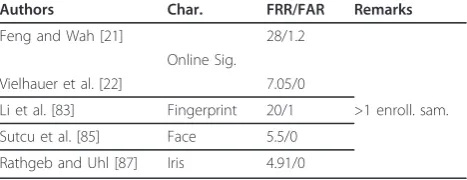
Proposed schemes (see Table 3): Feng and Wah [21]
proposed a quantization scheme applied to online signa-tures in order to generate 40-bit hashes. To match sig-natures, dynamic time warping is applied to xand y -coordinates and shapes ofx,y waveforms of a test sam-ple are aligned with the enrollment samsam-ple to extract correlation coefficients where low ones indicate a rejec-tion. Subsequently, feature boundaries are defined and encoded with integers. If a biometric sample passed the shape-matching stage, extracted features are fitted into boundaries and a hash is returned out of which a public and a private key are generated. Vielhauer et al. [22,24] process online signatures to generate signature hashes, too. In their approach an interval matrix is generated
for each subject such that hashes are generated by map-ping every single feature against the interval matrix. In [80] the authors adopt the proposed feature extraction to an online signature hash generation based on a secure sketch. Authors report a decrease of the FRR but not of the EER. An evaluation of quantization-based key-generation schemes is given in [81]. Sutcu et al. [82] proposed a quantization scheme in which hash values are created out of face biometrics. Li et al. [83] study how to build secure sketches for asymmetric representa-tions based on fingerprint biometrics. Furthermore, the authors propose a theoretical approach to a secure sketch applying two-level quantization to overcome potential pre-image attacks [84]. In [85] the proposed technique is applied to face biometrics. Rathgeb and Uhl [86] extended the scheme of [82] to iris biometrics gen-erating 128-bit keys. In [87] the authors apply a con-text-based reliable component selection and construct intervals for the most reliable features of each subject.
D. Further investigations on BCSs
Besides the so far described key concepts of BCSs, other approaches have been proposed. While some represent combinations of basic concepts, others serve different purposes. In addition, multi-BCSs have been suggested. 1) Password hardening
Monrose et al. [19] proposed a technique to improve the security of password-based applications by incorporating biometric information into the password (an existing password is“salted”with biometric data).
Operation mode (see Figure 10): The keystroke
dynamics of a user a are combined with a password
pwda resulting in a hardened password hpwdawhich can be tested for login purposes or used as crypto-graphic key.j(a,l) denotes a single biometric featurej acquired during the l-th login attempt of user a. To initialize an account, hpwda is chosen at random and 2mshares of hpwda, denoted by {S0t,S1t}, 1≤t≤m, are
created by applying Shamir’s secret-sharing scheme. For each b∈ {0, 1}ma the shares {Stb(t)}, 1 ≤ t ≤ m, can be
used to reconstructhpwda, where b(i) is thei-th bit of
b. These shares are arranged in an instruction table of
... Biometric
Inputs
Enrollment Authentication
Biometric Input
Biometric Template
Intervals Feature
Extraction Interval Definition
Interval Encoding
Interval Mapping
Feature Extraction Hash or
Key
Figure 9Quantization scheme: basic operation mode.
Table 3 Experimental results of proposed quantization schemes.
Authors Char. FRR/FAR Remarks
Feng and Wah [21] 28/1.2
Online Sig.
Vielhauer et al. [22] 7.05/0
Li et al. [83] Fingerprint 20/1 >1 enroll. sam.
Sutcu et al. [85] Face 5.5/0
dimension 2× mwhere each element is encrypted with
pwda. During thel-th login,pwd’a, a given password to access accounta, is used to decrypt these elements (the correctness ofpwd’ais necessary but not sufficient). For each feature ji, comparing the value of ji(a, l) to a threshold ti Î ℝ indicates which of the two values should be chosen to reconstructhpwda. Central to this scheme is the notion of distinguishable features: letμai be the mean deviation andsaibe the standard deviation of the measurementji(a,j1) . . .ji(a,jh) where j1, ...,jh are the lasth successful logins of usera. Then, ji is a distinguishable feature if|μai- ti| > ksaiwherekÎ ℝ+. Furthermore, the feature descriptorbais defined asba(i) = 0 if ti> μai +ksai, and 1 if ti <μai - ksai. For other features,bais undefined. As distinguishing features ji develop over time, the login program perturbs the value in the second column of rowiifμai< ti, and vice versa. The reconstruction of hpwda succeeds only if distin-guishable features remain consistent. Additionally, if a subject’s typing patterns change slightly over time, the system will adapt by conducting a constant-size history file, encrypted with hpwda, as part of the biometric tem-plate. In contrast to most BCSs the initial feature descriptor is created without the use of any helper data.
Proposed schemes: In several publications, Monrose et
al. [18,23,88] apply their password-hardening scheme to voice biometrics where the representation of the utter-ance of a data subject is utilized to identify suitable fea-tures. A FRR of approximately 6% and a FAR below 20% was reported. In further work [25,26] the authors analyze and mathematically formalize major require-ments of biometric key generators, and a method to generate randomized biometric templates is proposed [89]. Stable features are located during a single registra-tion procedure in which several biometric inputs are measured. Chen and Chandran [90] proposed a key-gen-eration scheme for face biometrics (for 128-bit keys), which operates like a password-hardening scheme [19], using Radon transform and an interactive chaotic bis-pectral one-way transform. Here, Reed-Solomon codes
are used instead of shares. A FRR of 28% and a FAR of 1.22% are reported.
2) BioHashing
A technique applied to face biometrics called“ BioHash-ing” was introduced by Teoh et al. [41,91-93]. Basically, the BioHashing approach operates as key-binding scheme, however, to generate biometric hashes secret user-specific tokens (unlike public helper data) have to be presented at authentication. Prior to the key-binding step, secret tokens are blended with biometric data to derive a distorted biometric template, thus, BioHashing can be seen as an instance of “Biometric Salting” (see Section 3).
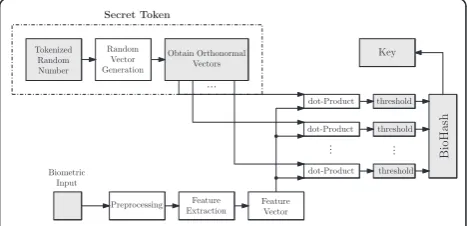
Operation mode(see Figure 11): The original concept
of BioHashing is summarized in two stages while the first stage is subdivided in two substages: first the raw image is transformed to an image representation in log-polar frequency domain ΓÎ ℜM, whereM specifies the log-polar spatial frequency dimension by applying a wavelet transform, which makes the output immune to changing facial expressions and small occlusions. Subse-quently, a Fourier-Mellin transform is applied to achieve translation, rotation and scale invariance. The generated face feature Γ Î ℜM is reduced to a set of single bits b∈ {0, 1}lb of lengthlbvia a set of uniform distributed
secret random numbersriÎ {-1, 1} which are uniquely associated with a token. These tokenized random num-bers, which are created out of a subject’s seed, take on a central role in the BioHashing algorithm. First the user’s seed is used for generating a set of random vectors {riÎ
ℜM
|i = 1, ...,lb}. Then, the Gram-Schmidt process is applied to the set of random vectors resulting in a set of orthonormal vectors {r⊥i ∈ M|i= 1, . . . ,lb}. The dot
product of the feature vector and all orthonormal
vec-tors {|r⊥i ∈ M|i= 1, . . . ,lb} is calculated. Finally a
lb-bit FaceHash b∈ {0, 1}lb is calculated, wherebi, thei -th bit of b is 0 if |r⊥i ≤τ and 1 otherwise, where τ is a predefined threshold. In the second stage of Bio-Hashing a key kc is generated out of the BioHash b. This is done by applying Shamir’s secret-sharing scheme.
Biometric Template
Instruction Table History File
Distinguishing Features
Password
pwd
Feature Thresholding Biometric
Input
Update Hardened
Password
hpwd
Biometric Input Encrypt
Encrypt Decrypt
Decrypt
Enrollment Authentication
Pasword
pwd Hardened Password
hpwd
Figure 10Password hardening: basic operation mode.
Random Vector Generation
Obtain Orthonormal Vectors
Biometric Input
Preprocessing Feature Extraction
Feature Vector
dot-Product dot-Product dot-Product
BioHash
... ...
... threshold
threshold
threshold Tokenized
Random Number
Key
Secret Token
Proposed schemes: Generating FaceHashes, a FRR of 0.93% and a zero FAR are reported. In other approaches the same group adopts BioHashing to several biometric characteristics including fingerprints [94,95], iris bio-metrics [96,97] as well as palmprints [98] and show how to apply generated hashes in generic key-binding schemes [99,100]. The authors reported zero EERs for several schemes.
Kong et al. [101] presented an implementation of FaceHashing and gave an explanation for the zero EER, reported in the first works on BioHashing. Zero EER were achieved due to the tokenized random numbers, which were assumed to be unique across subjects. In a more recent publication, Teoh et al. [102] address the so-called “stolen-token” issue evaluating a variant of BioHashing, known as multistage random projection (MRP). By applying a multi-state discretization the fea-ture element space is divided into 2N segments by adjusting the user-dependent standard deviation. By using this method, elements of the extracted feature vector can render multiple bits instead of 1 bit in the original BioHash. As a result, the extracted bitstreams exhibit higher entropy and recognition performance is increased even if impostors are in possession of valid tokens. However, zero EERs were not achieved under the stolen-token scenario. Different improvements to the BioHashing algorithm have been suggested [103,104].
3) Multi-BCSs and hybrid-BCSs
While multi-biometric systems [105] have been firmly established (e.g., combining iris and face in a single sen-sor scenario) a limited amount of approaches to BCSs utilize several different biometric traits to generate cryp-tographic keys. Nandakumar and Jain [106] proposed the best performing multibiometric cryptosystem in a fuzzy vault based on fingerprint and iris. The authors demonstrate that a combination of biometric modalities leads to increased accuracy and, thus, higher security. A FRR of 1.8% at a FAR of~0.01% is obtained, while the corresponding FRR values of the iris and fingerprint fuzzy vaults are 12 and 21.2%, respectively. Several other ideas of using a set of multiple biometric characteristics within BCSs have been proposed [107-114].
Nagar et al. [17,65] proposed a hybrid fingerprint-based BCS. Local minutiae descriptors, which comprise ridge orientations and frequency information, are bound to ordinate values of a fuzzy vault applying a fuzzy com-mitment scheme. In experiments FRR of 5% and a FAR of 0.01% is obtained, without minutiae descriptors the FAR increased to 0.7%. A similar scheme has been sug-gested in [115].
4) Other approaches
Chen et al. [116] extract keys from fingerprints and bind these to coefficients ofn-variant linear equations. Anyn
(n < m) elements of am-dimensional feature vector can
retrieve a hidden key where the template consists of true data, the solution space of the equation, and chaff data (false solutions of the equation). A FRR of 7.2% and zero FAR are reported. Bui et al. [117] propose a key-binding scheme based on face applying quantization index modulation which is originally targeted for water-marking applications. In [118,119], approaches of com-bining biometric templates with syndrome codes based on the Slepian-Wolf theorem are introduced. Boyen et al. [120] presented a technique for authenticated key exchange with the use of biometric data. In order to extract consistent bits from fingerprints a locality pre-serving hash is suggested in [121]. Thereby minutiae are mapped to a vector space of real coefficients which are decorrelated using PCA. Kholmatov et al. [122] pro-posed a method for biometric-based secret sharing. A secret is shared upon several users and released if a suf-ficiently large number of the user’s biometric traits is presented at authentication. Similar approaches have been proposed in [123,124].
E. Security of biometric cryptosystems
Most BCSs aim at binding or generating keys, long enough to be applied in a generic cryptographic system (e.g., 128-bit keys for AES). To prevent biometric keys from being guessed, these need to exhibit sufficient size and entropy. System performance of BCSs is mostly reported in terms of FRR and FAR, since both metrics and key entropy depend on the tolerance levels allowed at comparison, these three quantities are highly inter-related.
Buhan et al. [53,125] have shown that there is a direct relation between the maximum length k of crypto-graphic keys and the error rates of the biometric system. The authors define this relation as k ≤ - log2(FAR),
may generate arbitrary long keys while inter-class dis-tances (= Hamming distance between keys) remain low. Ballard et al. [25,26] propose a new measure to analyze the security of a BCS, termed guessing distance. The guessing distance defines the number of guesses a potential imposter has to perform in order to retrieve either the biometric data or the cryptographic key. Thus, the guessing distance directly relates to intra-class distances of biometric systems and, therefore, provides a more realistic measure of the entropy of biometric keys. Kelkboom et al. [128] analytically obtained a relationship between the maximum key size and a target system per-formance. A increase of maximum key size is achieved in various scenarios, e.g., when applying several bio-metric templates at enrollment and authentication or when increasing the desired false rejection rates. In the-ory-oriented work, Tuyls et al. [129,130] estimate the capacity and entropy loss for fuzzy commitment schemes and shielding functions, respectively. Similar investigations have been done by Li et al. [131,132] who provide a systematic approach of how to examine the relative entropy loss of any given scheme, which bounds the number of additional bits that could be extracted if optimal parameters were used. A method for arranging secret points and chaff points in fuzzy vaults such that entropy loss is minimized is presented in [133].
Obviously, key lengths have to be maximized in order to minimize the probability that secret keys are guessed [128]. A second factor which affects the security of bio-metric cryptosystems is privacy leakage, i.e., the infor-mation that the helper data contain (leak) about biometric data [134]. Ideally, privacy leakage should be minimized (for a given key length), to avoid identity fraud. The requirements on key size and privacy leakage define a fundamental trade-off within approaches to BCSs, which is rarely estimated. In [135] this trade-off is studied from in an information-theoretical prospective and achievable key length versus privacy leakage regions are determined. Additionally, stored helper data have to provide unlinkability.
3. Cancelable biometrics
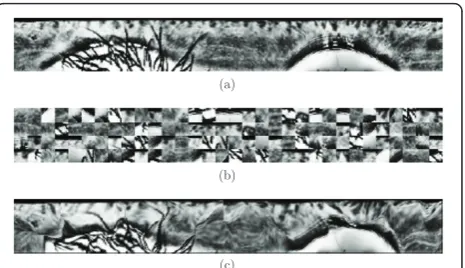
Cancelable biometric transforms are designed in a way that it should be computationally hard to recover the original biometric data (see Figure 12). The intrinsic strength (individuality) of biometric characteristics should not be reduced applying transforms (constraint on FAR) while on the other hand transforms should be tolerant to intra-class variation (constraint on FRR) [12]. In addition, correlation of several transformed templates must not reveal any information about the original bio-metrics (unlinkability). In case transformed biometric data are compromised, transform parameters are chan-ged, i.e., the biometric template is updated. To prevent
impostors from tracking subjects by cross-matching databases it is suggested to apply different transforms for different applications. Two main categories of CB are distinguished [4]:
(1)Non-invertible transforms: In these approaches,
biometric data are transformed applying a noninver-tible function (e.g., Figure 12b,c). In order to provide updatable templates, parameters of the applied trans-forms are modified. The advantage of applying non-invertible transforms is that potential impostors are not able to reconstruct the entire biometric data even if transforms are compromised. However, applying non-invertible transforms mostly implies a loss of accuracy. Performance decrease is caused by the fact that transformed biometric templates are difficult to align (like in BCSs) in order to perform a proper comparison and, in addition, information is reduced. For several approaches these effects have been observed [12,136].
(2) Biometric salting: Biometric salting usually
denotes transforms of biometric templates which are selected to be invertible. Any invertible transform of biometric feature vector elements represents an approach to biometric salting even if biometric tem-plates have been extracted in a way that it is not fea-sible to reconstruct the original biometric signal [137]. As a consequence, the parameters of the transform have to be kept secret. In case user-speci-fic transforms are applied, the parameters of the transform (which can be seen as a secret seed [102] have to be presented at each authentication. Impos-tors may be able to recover the original biometric template in case transform parameters are compro-mised, causing a potential performance decrease of the system in case underlying biometric algorithms do not provide high accuracy without secret trans-forms. While approaches to biometric salting may maintain the recognition performance of biometric
(a)
(b)
(c)
systems non-invertible transforms provide higher security [4].
Approaches to CB can be classified further with respect parts of biometric systems in which transforms are applied. In the signal domain, transformations are either applied to raw biometric measurements (e.g., face image [12]) or to preprocessed biometric signals (e.g., iris tex-ture [138]). In case transforms are applied in signal domain comparators do not need to be adapted. In ture domain extracted biometric features (e.g., face fea-tures in [102]) are transformed, thus, a compromise of transforms requires further effort in reconstructing the original biometric from the template. Experimental results of key concepts of CB are summarized in Table 4.
A. The issue of performance evaluation
While in the majority of proposed approaches to CB template alignment is non-trivial and applied transforms are selected to be non-invertible, still some schemes (e. g., in [72,102]), especially to biometric salting, report an increase in performance. In case user-specific transforms are applied at enrollment and authentication, by defini-tion, two-factor authentication is yielded which may increase the security but does not effect the accuracy of biometric authentication.
A significant increase of recognition rates can be caused by unpractical assumptions during performance evaluations. If user-specific transforms are applied to achieve CB these transforms have to be considered com-promised during inter-class comparisons. Otherwise, bio-metrics becomes meaningless as the system could rely on secret tokens parameters without any risk [101]. Secret tokens, be it transform parameters, random numbers or any kind of passwords are easily compromised and must not be considered secure [1]. Thus, performance evalua-tions of approaches to CB have to be performed under the so-called“stolen-token scenario”where each impostor is in possession of valid secret tokens (the same applies to BCSs in case secret tokens are applied). Figure 13 illustrates how inter-class distances may change with or without considering the stolen-token scenario. If different tokens are applied for each subject a clear separation of intra-class and inter-class distributions is achieved by adopting a new threshold. In contrast, if secret tokens are considered compromised accuracy decreases. Perfor-mance is untruly gained if this scenario is ignored during experiments causing even more vulnerable systems in case of compromise [139].
B. Approaches to non-invertible transforms 1) IBM approaches
Ratha et al. [12] were the first to introduce the concept of CB applying noninvertible transforms.
Operation mode (see Figure 14): Generally, at
enroll-ment, non-invertible transforms are applied to biometric inputs choosing application-dependent parameters. During authentication, biometric inputs are transfor-med and a comparison of transfortransfor-med templates is performed.
Several types of transforms for constructing multiple CB from pre-aligned fingerprints and face biometrics Table 4 Experimental results of proposed approaches to
CB.
Authors Char. FRR/FAR Remarks
Non-invertible transforms
Ratha et al. [140] 15/10- 4 -Fingerprint
Boult et al. [147] ~0.08 EER -Hammerle-Uhl et al. [138] 1.3 EER
-Iris
Zuo et al. [136] 0.005/0 perf. increase Maiorana et al. [146] Online Sig. 10.81 EER
-Biometric salting
Savvides et al. [137] 4.64/0 Non-stolen token Teoh et al. [91] Face 2·10-3EER Non-stolen token Wang et al. [157] 6.68 EER
-Zuo et al. [136] 0.005/<10-3 perf. increase Iris
Ouda et al. [159] 1.3 EER
-Teoh et al. [151] Fingerprint 5.31 EER
-Other CB
Jeong et al. [161] Face 14 EER -Tulyakov et al. [162] 25.9/0
-Fingerprint
Ang et al. [164] 4 EER
-0 100
100
Genuine Users
Imposters without stolen Tokens
Imposters with stolen Tokens Original
Threshold
Clear Separation (Zero EER)
Relativ
eM
a
tc
h
C
o
u
n
t
Dissimilarity Scores between Biometric Templates
Cancelable Biometric System
have been introduced in [12,140,141] including cartesian transform and functional transform. In further work [136], different techniques to create cancelable iris bio-metrics have been proposed. The authors suggest four different transforms applied in image and feature domain where only small performance drops are reported. Ham-merle-Uhl et al. [138] applied classic transformations sug-gested in [12] to iris biometrics. Furthermore, in [142] it is shown that applying both transforms to rectangular iris images, prior to preprocessing, does not work. Similar to [136] Rathgeb and Uhl [143] suggest to apply row per-mutations to iris-codes. Maiorana et al. [144-146] apply non-invertible transforms to obtain cancelable templates from online signatures. In their approach, biometric tem-plates, which represent a set of temporal sequences, are split into non-overlapping sequences of signature features according to a random vector which provides revocability. Subsequently, the transformed template is generated through linear convolution of sequences. The complexity of reconstructing the original data from the transformed template is computationally as hard as random guessing. 2) Revocable biotokens
Boult et al. [147,148] proposed cryptographically secure biotokens which they applied to face and fingerprints. In order to enhance security in biometric systems, bioto-kens, which they refer to as Biotope™, are adopted to existing recognition schemes (e.g., PCA for face).
Operation mode(see Figure 15): Each measured
bio-metric feature vis transformed via scaling and transla-tion resulting inv’= (v - t) ·s. The key idea is to splitv’
into a stable partg termed integer and an unstable part
r. For face biometrics the authors suggest to simply split real feature values into an integer part and a fractional part (e.g., 15.4 is splitted into 15 and 0.4). Since g is considered stable, and a“perfect matching”is claimed to be feasible at authentication, comparisons can be per-formed in the encrypted domain. A one-way transform of g, denoted by w is stored as first part of the secure biometric template. As second part of the template the
unencodedrwhich has been obscured via the transform, as well assandtare stored. At authentication, features are transformed applyings andtonto a residual region defined byr. Then, the unencryptedr is used to com-pute the local distance within a “window”, which is referred to as robust distance measure, to provide a per-fect match of w. However, since a perfect match is required only for a number of features defined by the system threshold, biotokens are not matched exactly. Additionally, user-specific passcodes can be incorpo-rated to create verification-only systems. Although the authors ideas seem promising, several questions with respect to the presented approaches are left open, for instance, the design of the helper function which sepa-rates biometric features into stable and unstable parts and the adoption of this scheme to other biometric characteristics (which is claimed to be feasible). In further work, bipartite biotokens [149,150] are intro-duced and applied to fingerprints in order to provide secure communication via an untrusted channel, where cryptographic keys are released based on successful comparisons of biotokens.
C. Approaches to biometric salting
Savvides et al. [137] generate cancelable face biometrics by applying so-called minimum average correlation filters which provide non-invertibility. User-specific secret per-sonal identification numbers (PINs) serve as seed for a random basis for the filters similar to [31]. As previously mentioned, BioHashing [41] without key-binding provides cancelable biometric templates, too. Early proposals of the BioHashing algorithm did not consider the stolen-token scenario. In more recent work [151] it is demon-strated that the EER for the extraction of cancelable 180-bit fingercodes increases from 0% to 5.31% in the stolen-token scenario. The authors address this issue by proposing a new method which they refer to as MRP [152,153]. It is claimed that MRP (which is applied to face and speech) retains recognition performance in the stolen-token scenario. Furthermore, the authors proposed a method to generate cancelable keys out of dynamic hand signatures [154,155] based on the random mixing step of BioPhasor and user-specific 2Ndiscretization. To
Application 1 Biometric
Inputs
Non-invertible Transform 1
Transformed Biometric 1
Transform Database 1
Non-invertible Transform 2
Non-invertible Transformn
Transformed Biometric 2
Transformed Biometricn
Application 2
Applicationn
Transform Database 2
Transform Databasen
... ... ... ...
Comparison
Comparison
Comparison
Figure 14The basic concept of CB based on non-invertible transforms.
Biometric Input
Biometric Input
Enrollment Authentication
Feature Vector (vs)
Feature Vector (vs) Transform
(sandt)
Residuals (rs) Transformed Features (vs) Stable Parts
(gs)
Encrypted Stable Parts
(ws)
Stable Parts (gs)
Transformed Features (vs) Template
provide CB, extracted features are randomly mixed with a token T using a BioPhasor mixing method. Kim et al. [156] apply user-specific random projections to PCA-based face features followed by an error minimizing tem-plate transform. However, the authors do not consider a stolen-token scenario. Another approach to biometric salting was presented by Wang et al. [157] in which face features are transformed based on a secret key. Non-invertibility is achieved by means of quantization. Ouda et al. [158,159] propose a technique to obtain cancelable iris-codes. Out of several enrollment templates a vector of consistent bits (BioCode) and their positions are extracted. Revocability is provided by encoding the Bio-Code according to a selected random seed. Pillai et al. [160] achieve cancelable iris templates by applying sector random projection to iris images. Recognition perfor-mance is only maintained if user-specific random matrices are applied.
D. Further investigations on cancelable biometrics Jeong et al. [161] combine two different feature extrac-tion methods to achieve cancelable face biometrics. PCA and ICA (independent component analysis) coefficients are extracted and both feature vectors are randomly scrambled and added in order to create a transformed template. Tulyakov et al. [162,163] propose a method for generating cancelable fingerprint hashes. Instead of aligning fingerprint minutiae, the authors apply order invariant hash functions, i.e., symmetric complex hash functions. Ang et al. [164] suggest to apply a key-depen-dent geometric transform to fingerprints. In the first step a core point is selected in the fingerprint image and a line is drawn through it where the secret key defines the angle of the line (0≤key≤ π). Secondly, all minutiae below the line are reflected above the line to achieve a transformed template. Yang et al. [165] apply random projections to minutiae quadruples to obtain cancelable fingerprint templates. In further work [166] the authors address the stolen-token scenario by select-ing random projection matrices based on biometric fea-tures. Lee et al. [167] presented a method for generating alignment-free cancelable fingerprint templates. Similar to [59,162,163], orientation information is used for each minutiae point. Cancelability is provided by a user’s PIN and the user-specific random vector is used to extract translation and rotation invariant values of minutiae points. Hirata and Takahashi [168] propose CB for fin-ger-vain patterns where images are transformed applying a Fourier-like transform. The result is then multiplied with a random filter where the client stores the inverse filter on some token. At authentication the inverse filter is applied to regenerate the transformed enrollment data and correlation-based comparison is performed. A simi-lar scheme is applied to fingerprints in [169]. Bringer et
al. [170] presented an idea of generating time-dependent CB to achieve untraceability among different identities across time.
E. Security of cancelable biometrics
While in the vast majority of approaches, security is put on a level with obtained recognition accuracy according to a reference system, analysis with respect to irreversi-bility and unlinkairreversi-bility is rarely done. According to irre-versibility, i.e., the possibility of inverting applied transforms to obtain the original biometric template, applied feature transformations have to be analyzed in detail. For instance, if (invertible) block permutation of biometric data (e.g., fingerprints in [140] or iris in [138]) is utilized to generate cancelable templates the computa-tional effort of reconstructing (parts of) the original bio-metric data has to be estimated. While for some approaches, analysis of irreversibility appear straight for-ward for others more sophisticated studies are required (e.g., in [145] irreversibility relies on the difficulty in sol-ving a blind deconvolution problem).
In order to provide renewability of protected bio-metric templates, applied feature transformations are performed based on distinct parameters, i.e., employed parameters define a finite key space (which is rarely reported). In general, protected templates differ more as more distant the respective transformation parameters are [146]. To satisfy the property of unlinkability, differ-ent transformed templates, generated from a single bio-metric template applying different parameters, have to appear random to themselves (like templates of different subjects), i.e., the amount of applicable parameters (key space) is limited by the requirement of unlinkability.
stage in which biometric salting performed prior to the key-generation process [171,172]. In [173] it is suggested to combine a secure sketch with cancelable fingerprint templates. While CB protect the representation of the biometric data, the biometric template is reconstructed from the stored helper data. Several other approaches to generating cancelable biometric keys have been pro-posed in [174-177].
4. Discussion and outlook
Based on the presented key concepts of BCSs and CB a concluding discussion is done, including advantages and applications, potential attacks to both technologies, the current state-of-the-art, commercial vendors, and open issues and challenges.
A. Advantages and applications
BCSs and CB offer several advantages over generic bio-metric systems. Most important advantages are summar-ized in Table 5. In order to underline the potential of both technologies, two essential use cases are discussed. 1) Encryption/decryption with biometric keys
The most apparent application of BCSs is biometric-dependent key-release within conventional cryptosystems, replacing insecure password- or PIN-based key-release [8]. Eliminating this weak link within cryptosystems, bio-metric-dependent key-release results in substantial secur-ity benefits making cryptographic systems more suitable for high security applications.
Operation mode (see Figure 16): Any subject
regis-tered with the BCS is able to release cryptographic keys upon presenting biometric characteristics. Biometric-dependent keys are then transferred to the applied cryp-tographic algorithm to encrypt plain data. While several approaches to BCSs fulfill the requirement of generating sufficiently long cryptographic keys to be used in sym-metric cryptosystems, most schemes fail in extracting an adequate amount of information to construct public key infrastructures (with few exceptions, e.g., [178]). Subse-quently, encrypted data are transmitted via any untrusted channel. To decrypt the cipher text again, bio-metrics are presented to release decrypting keys. It is important to point out that by using biometric keys in
generic cryptosystems the generated cipher text is not harder to decipher (in fact it will be even easier to deci-pher since biometric keys often suffer from low entropy).
2) Pseudonymous biometric databases
BCSs and CB meet the requirements of launching pseudonymous biometric databases [9] since both tech-nologies provide biometric comparisons in encrypted domain while stored helper data or transformed templates do not reveal significant information about original biometric templates.
Operation mode (see Figure 17): At enrollment,
bio-metric characteristics of a subject are employed as input for a BCS or CB (as suggested in [12] diverse obscured templates are generated for different databases). Depending on the type of application further encrypted records are linked to the template where decryption could be applied based on biometric-dependent keys. Since biometric templates are not exposed during com-parisons [4], the authentication process is fully pseudon-ymous and, furthermore, the activities of any subject are untraceable.
Several other applications for the use of BCSs and CB have been suggested. In [10], biometric ticketing, consu-mer biometric payment systems and biometric boarding cards are suggested. VoIP packages are encrypted apply-ing biometric keys in [179]. A remote biometric authen-tication scheme on mobile devices based on biometric keys is proposed in [180] and a framework for an alter-native PIN service based on CB is presented in [181]. In [182], helper data-free key-generation is utilized for biometric database hashing. Privacy preserving video surveillance has been proposed in [183].
Table 5 Major advantages of BCS and CB.
Advantage Description
Template protection Within BCSs and CB the original biometric template is obscured such that a reconstruction is hardly feasible.
Secure key release BCSs provide key release mechanisms based on biometrics.
Pseudonymous Auth. Authentication is performed in the encrypted domain and, thus, is pseudonymous.
Revocability of templates Several instances of secured templates can be generated.
Increased security BCSs and CB prevent from several traditional attacks against biometric systems.
More social acceptance BCSs and CB are expected to increase the social acceptance of biometric applications.
Cryptographic Key
Plain Data
Cryptographic System
Cryptographic Key Plain Data
Cryptographic System
Data Encryption Data Decryption
Encrypted Data Untrusted
Channel Biometric
Input
Biometric
Crypto-sytem
Biometric Input
Biometric
Crypto-sytem